
Submitted By :
HEMANT AGGARWAL
MPT (Musculoskeletal disorders)
Submitted To: Dr. Shabnam Joshi
Enrollment no: 180171720002
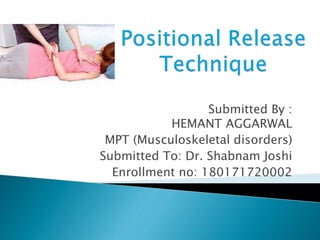
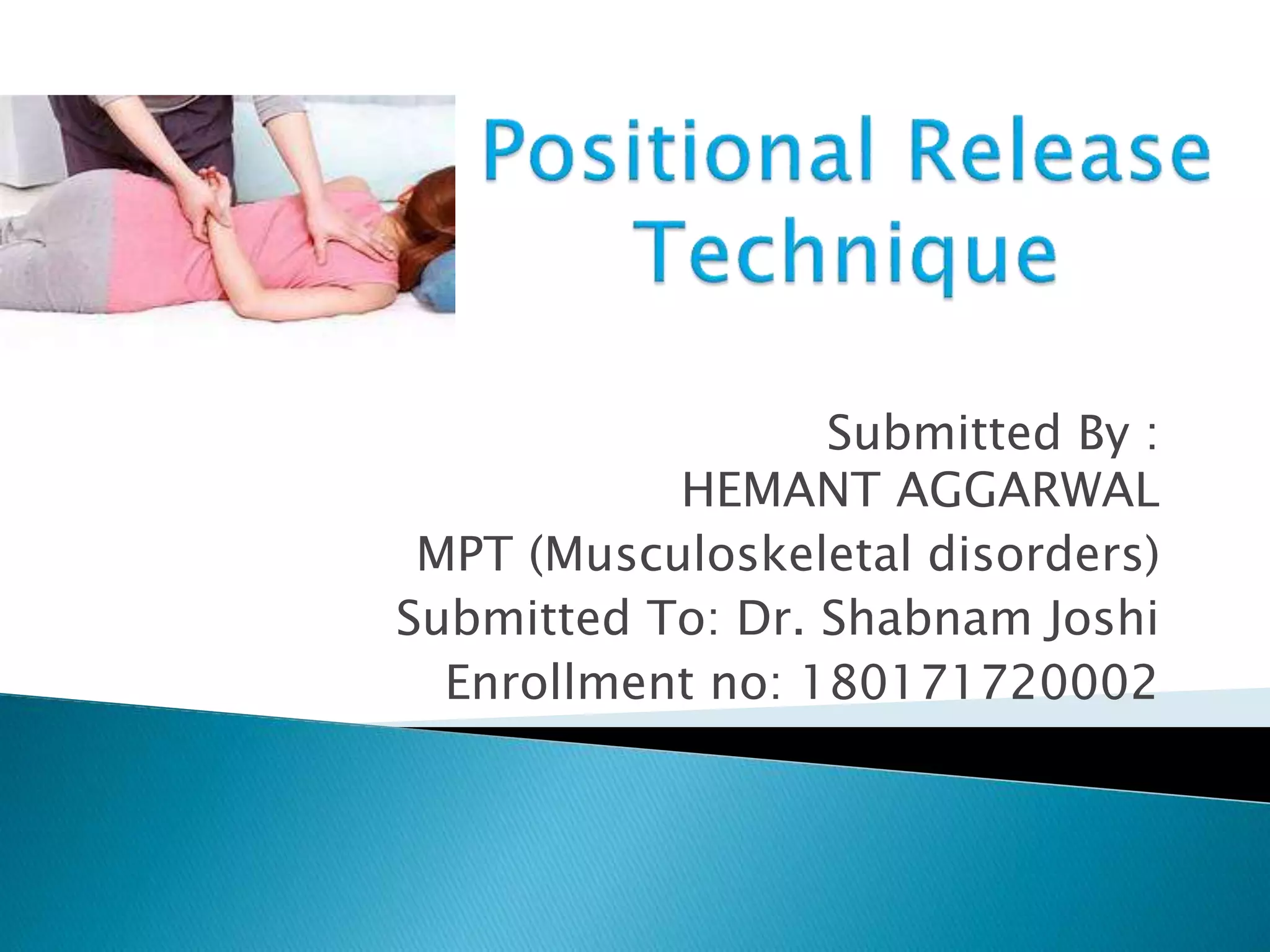
 Positional release therapy, also known by its
parent term strain counterstrain, is a
therapeutic technique that uses a position of
comfort of the body, its appendages, and its
tissues to resolve somatic dysfunction.
 Somatic dysfunction is defined as a
disturbance in the sensory or proprioceptive
system that results in spinal segmental tissue
facilitation and inhibition (Korr 1975).
 Positional release therapy is a method of total
body evaluation and treatment using tender
points (TPs) and a position of comfort (POC) to
resolve the associated dysfunction.
 PRT is an indirect (the body part moves away
from the resistance barrier, I.C., the direction
of greatest ease) and passive (the therapist
performs all the movements without help from
the patient) method of treatment.
 All three planes of movement are used co
attain the position of greatest comfort. Once
the most severe tender poims are found, they
are palpated as a guide to help find the POC.
The POC produces optimal relaxation of the
involved tissues
 Jones (1973) proposed that as a result of
somatic dysfunction, tissues often become
kinked or knotted resulting in pain, spasm,
and a loss of range of motion.
 Simply, PRT unkinks tissues much as one
would a knotted necklace, by gently twisting
and pushing the tissues together to take
tension off the knot.
 When one link in the chain is unkinked,
others nearby untangle, producing profound
pain relief (Speicher and Draper 2006a).
 tender points (TPs) were the result of a
counterstrain mechanism:
 If a tissue is abruptly strained, the opposing
tissue (antagonist) is counterstrained in its
attempt to stabilize against the straining
force,
 resulting in the production of antagonist TPs
that prevent the agonist strained tissue from
fully healing (Jones 1995)
 in PRT the painful and restricted position IS
avoioed, and the goal is to find a position of
ease. The optimal poSition of ease is the
comfort zone (CZ).
 Achieving the optimal POC IS rhe ultimate goal
of treatment.
 the one that requires the greatest degree of
clinical finesse. ThiS will determine the ultimate
success of the therapeutic intervention.
 The comfort zone is specific and is uifferent
for each of the treatment positions
1. Normalization of muscle hypertonicity:
 phase of the PRT treatment lasts
approximately 90 seconds for general
orthopedic patients' and 3 minutes for
neurologic patients
 affect inappropriate proprioceptive activity
during thiS phase, thus helping to normalIZe
tone and set the normal length,rension
relationship in the muscle. This results in (he
elongation of the involved muscle fibers.
2. Normalization of fascial tension:
 begins after 90 seconds for general
orthopedic patients and after 3 minutes for
neurologic patients.
 during this phase, PRT apparently begins to
engage the fascial tension patterns
associated with trauma, inflammation, and
adhesive pathology.
 this is process may Involve an "unwinding"
action in the myofascial tissue.
3. Reduction of joint hypomobility:
 When the muscles crossing joints become
hypertonic or tight, the result is joint
hypomobility (i.e., joint stiffness).
 By using PRT, the affected muscles and fascial
tissues relax
4. Increased circulation and reduced swelling.
 using PRT, pressure appears to be relieved on
imcrvenmg structures such as blood and
lymph vessels.
 The result may be increased circulation,
which m tum aids m the healing of damaged
tissue.
 The Improved lymphatic drainage assists in
the reabsorption of tissue fluids. thus
reducing the swelling associated with
inflammation
5. Decreased pain
 The patient has pain, which may be
associated with muscle guarding. fascial
tension, and restriction of joint move .. ment.
Positional release therapy appears to alleviate
muscle spasm anu restore proper pain free
movement and tissue fleXibility.
6. Increased strength.
 PRT may optimize the blomechanical
efficiency of muscle and Improve the
responsiveness to prescribed conditioning
exercises.
 Acute, subacute, and chronic pain
 Neuropathic pain
 Somatic referred pain
 Muscle spasm
 Tissue hypertonicity
 Range of motion deficit
 Joint hypomobility
 Fibromyalgia
 Central sensitization syndrome
 Peripheral sensitization
 Headache
 Myofascial pain syndrome
 Open wounds
 Sutures
 Healing fractures
 Hematoma
 Hypersensitivity of the skin
 Systemic or localized infection
 During the palpation portion of the
assessment, the practitioner may feel a
fasciculatory response with light palpation,
 but if not, the tender tissue will elicit a rise in
amplitude and intensity of the fasciculation
when the optimal treatment position is
attained.
 Once this response is determined, the
position is held until the fasciculation abates
 The patient should feel no pain or discomfort
during treatment.
 Use the FRM to guide treatment positioning
and duration.
 Treat the most tender trigger or tender point
first.
 If there is a concentration of equally tender
points, apply treatment at the center point of
the concentration.
 If there is a row of TPs, treat the one in the
row that is most tender.
 If all are equally tender, apply treatment to the
center of the row, which often releases the
entire row.
 Generally, anterior tissues are typically treated
with flexion; posterior, with extension; and
lateral, with side bending or rotation
 If significant pain relief is not achieved
(approximately 75 to 100%) after treatment,
then repeat the procedure, return the tissue
more slowly, and consider another cause of the
pain
 Inform patients that they may experience deep
soreness up to 48 hours after the application
of PRT, that they should not engage in vigorous
physical activity for at least 24 hours to prevent
reengaging the tissue restriction.
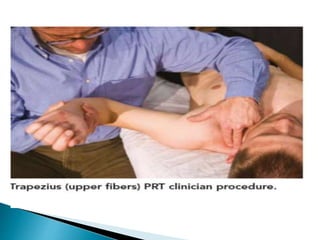
 The patient is supine, and you are either seated
or standing.
 Move the head into lateral flexion toward the
lesion; then apply capital lateral flexion and
rotation toward the lesion.
 With your far hand, place the patient’s elbow
into the proximal sternum or abdomen.
 Then, with your far hand, grasp the anterior
aspect of the flexed elbow, which at this time is
typically at 90° of flexion.
 Move the patient’s involved arm with your far
hand into flexion. The position of comfort is
typically found at approximately 90 to 120°.
 Once the flexion position is found by either
eliciting the fasciculatory response or
determining optimal tissue relaxation, move
the arm through horizontal adduction and
abduction with the far hand. Then apply
humeral rotation with the far hand . Then
apply humeral rotation with the far hand,
typically marked external rotation.
 With your far hand at the patient’s elbow,
apply distraction and compression to facilitate
optimal joint and tissue relaxation.
 With the thenar aspect of your near hand,
apply a light inferior glide to the humerus.
 Timothy E. Speicher, PhD, ATC, LAT, CSCS.
Clinical Guide to Positional Release
Therapy,2016
 positional release therapy, Assessment &
trealment of MusculoskeletaD'Ambrogio,
Kerry J. l Dysfunction,1997.
Positional release technique

Positional release technique

  • 1.
    Submitted By : HEMANTAGGARWAL MPT (Musculoskeletal disorders) Submitted To: Dr. Shabnam Joshi Enrollment no: 180171720002
  • 2.
     Positional releasetherapy, also known by its parent term strain counterstrain, is a therapeutic technique that uses a position of comfort of the body, its appendages, and its tissues to resolve somatic dysfunction.  Somatic dysfunction is defined as a disturbance in the sensory or proprioceptive system that results in spinal segmental tissue facilitation and inhibition (Korr 1975).
  • 3.
     Positional releasetherapy is a method of total body evaluation and treatment using tender points (TPs) and a position of comfort (POC) to resolve the associated dysfunction.  PRT is an indirect (the body part moves away from the resistance barrier, I.C., the direction of greatest ease) and passive (the therapist performs all the movements without help from the patient) method of treatment.  All three planes of movement are used co attain the position of greatest comfort. Once the most severe tender poims are found, they are palpated as a guide to help find the POC. The POC produces optimal relaxation of the involved tissues
  • 4.
     Jones (1973)proposed that as a result of somatic dysfunction, tissues often become kinked or knotted resulting in pain, spasm, and a loss of range of motion.  Simply, PRT unkinks tissues much as one would a knotted necklace, by gently twisting and pushing the tissues together to take tension off the knot.  When one link in the chain is unkinked, others nearby untangle, producing profound pain relief (Speicher and Draper 2006a).
  • 5.
     tender points(TPs) were the result of a counterstrain mechanism:  If a tissue is abruptly strained, the opposing tissue (antagonist) is counterstrained in its attempt to stabilize against the straining force,  resulting in the production of antagonist TPs that prevent the agonist strained tissue from fully healing (Jones 1995)
  • 7.
     in PRTthe painful and restricted position IS avoioed, and the goal is to find a position of ease. The optimal poSition of ease is the comfort zone (CZ).  Achieving the optimal POC IS rhe ultimate goal of treatment.  the one that requires the greatest degree of clinical finesse. ThiS will determine the ultimate success of the therapeutic intervention.  The comfort zone is specific and is uifferent for each of the treatment positions
  • 8.
    1. Normalization ofmuscle hypertonicity:  phase of the PRT treatment lasts approximately 90 seconds for general orthopedic patients' and 3 minutes for neurologic patients  affect inappropriate proprioceptive activity during thiS phase, thus helping to normalIZe tone and set the normal length,rension relationship in the muscle. This results in (he elongation of the involved muscle fibers.
  • 9.
    2. Normalization offascial tension:  begins after 90 seconds for general orthopedic patients and after 3 minutes for neurologic patients.  during this phase, PRT apparently begins to engage the fascial tension patterns associated with trauma, inflammation, and adhesive pathology.  this is process may Involve an "unwinding" action in the myofascial tissue.
  • 10.
    3. Reduction ofjoint hypomobility:  When the muscles crossing joints become hypertonic or tight, the result is joint hypomobility (i.e., joint stiffness).  By using PRT, the affected muscles and fascial tissues relax
  • 11.
    4. Increased circulationand reduced swelling.  using PRT, pressure appears to be relieved on imcrvenmg structures such as blood and lymph vessels.  The result may be increased circulation, which m tum aids m the healing of damaged tissue.  The Improved lymphatic drainage assists in the reabsorption of tissue fluids. thus reducing the swelling associated with inflammation
  • 12.
    5. Decreased pain The patient has pain, which may be associated with muscle guarding. fascial tension, and restriction of joint move .. ment. Positional release therapy appears to alleviate muscle spasm anu restore proper pain free movement and tissue fleXibility. 6. Increased strength.  PRT may optimize the blomechanical efficiency of muscle and Improve the responsiveness to prescribed conditioning exercises.
  • 13.
     Acute, subacute,and chronic pain  Neuropathic pain  Somatic referred pain  Muscle spasm  Tissue hypertonicity  Range of motion deficit  Joint hypomobility  Fibromyalgia  Central sensitization syndrome  Peripheral sensitization  Headache  Myofascial pain syndrome
  • 14.
     Open wounds Sutures  Healing fractures  Hematoma  Hypersensitivity of the skin  Systemic or localized infection
  • 15.
     During thepalpation portion of the assessment, the practitioner may feel a fasciculatory response with light palpation,  but if not, the tender tissue will elicit a rise in amplitude and intensity of the fasciculation when the optimal treatment position is attained.  Once this response is determined, the position is held until the fasciculation abates
  • 16.
     The patientshould feel no pain or discomfort during treatment.  Use the FRM to guide treatment positioning and duration.  Treat the most tender trigger or tender point first.  If there is a concentration of equally tender points, apply treatment at the center point of the concentration.  If there is a row of TPs, treat the one in the row that is most tender.  If all are equally tender, apply treatment to the center of the row, which often releases the entire row.
  • 17.
     Generally, anteriortissues are typically treated with flexion; posterior, with extension; and lateral, with side bending or rotation  If significant pain relief is not achieved (approximately 75 to 100%) after treatment, then repeat the procedure, return the tissue more slowly, and consider another cause of the pain  Inform patients that they may experience deep soreness up to 48 hours after the application of PRT, that they should not engage in vigorous physical activity for at least 24 hours to prevent reengaging the tissue restriction.
  • 18.
     The patientis supine, and you are either seated or standing.  Move the head into lateral flexion toward the lesion; then apply capital lateral flexion and rotation toward the lesion.  With your far hand, place the patient’s elbow into the proximal sternum or abdomen.  Then, with your far hand, grasp the anterior aspect of the flexed elbow, which at this time is typically at 90° of flexion.  Move the patient’s involved arm with your far hand into flexion. The position of comfort is typically found at approximately 90 to 120°.
  • 19.
     Once theflexion position is found by either eliciting the fasciculatory response or determining optimal tissue relaxation, move the arm through horizontal adduction and abduction with the far hand. Then apply humeral rotation with the far hand . Then apply humeral rotation with the far hand, typically marked external rotation.  With your far hand at the patient’s elbow, apply distraction and compression to facilitate optimal joint and tissue relaxation.  With the thenar aspect of your near hand, apply a light inferior glide to the humerus.
  • 21.
     Timothy E.Speicher, PhD, ATC, LAT, CSCS. Clinical Guide to Positional Release Therapy,2016  positional release therapy, Assessment & trealment of MusculoskeletaD'Ambrogio, Kerry J. l Dysfunction,1997.