VOJTA THERAPY
By
Dr Mohd Shoeb (PT)
 Vojta-Therapy is a dynamic neuromuscular
treatment method based on the developmental
kinesiology and principles of reflex locomotion.
 This method is supposed to treat patients with
disorders of central nervous system and
musculoskeletal system.
 It was developed by child neurologist Prof. Vaclav
Vojta in the 20th century and now used
predominantly in Europe.
WHAT IS A REFLEX
LOCOMOTION
 Reflex is an involuntary movement as a
response to external stimuli.
 Locomotion is defined as an ability to
perform a movement from one place to
another.
 In reflex locomotion, there is a
coordinated, rhythmic activation of the total
skeletal musculature and a CNS response at
various circuit levels.
INDICATION
 According to Vojta, this therapy can be applied
to the patients of any age group.
 It can be used as standard therapy in
physiotherapy for almost every movement
disturbance and for numerous illnesses.
 Infantile postural asymmetry,
 Congenital muscular torticollis (“wry neck”),
 Stroke,
 Cerebral palsy,
Indications
 Lumbosciatica,
 Hip dysplasia,
 Respiratory distress syndrome (RDS),
 Migraine,
 Peripheral paralysis of the extremities (e.g.
plexus paresis, spina bifida, paraplegia,
etc.),
 Various myopathies,
 Problems in the breathing, swallowing and
chewing functions.
STIMULATING ZONES
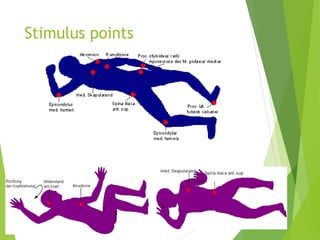
 Vojta describes 10 different zones that are
available to stimulate the motor patterns of
reflex locomotion.
 A light pressure on certain stimulus zone
(muscles or bones) and resistance to the
current movement is applied to cause
patient's involuntary motor response and
performance of certain movement patterns.
Stimulus points
Coordination complexes
The Vojta method can be divided into 2 main
phases:
 Reflex creeping
(lying flat with the chest down and back up)
 Reflex rolling
(lying flat with the chest up and back
down)
One principle – many
variations
 Reflex locomotion is activated from the three main
positions:
 prone,
 supine,
 side lying.
 These have more than thirty variations
Reflex Creeping
 Reflex creeping is a movement sequence that includes
the most fundamental components of locomotion:
1. Specific postural control
2. Uprighting or extension against gravity and
3. Goal-directed stepping movements of the arms and legs.
 Thus, reflex creeping encompasses the basic patterns of
the human locomotion.
 The main position is prone lying with the head resting
on the bed rotated to one side.
Reflex Creeping
IMPLEMENTATION
The application of 4 Vojta therapies
Reflex Creeping
 The goals of reflex creeping are notably:
 Activation of the muscular support and uprighting
mechanisms necessary for
 supporting and grasping,
 rising and walking,
 as well as stepping movements of the arms and legs.
 Activation of the respiratory, abdominal, and pelvic floor
musculature, as well as the sphincters of the bladder and
bowel
 Swallowing (important for mastication)
 Eye movements
Reflex Rolling
 Reflex rolling transitions from supine to side lying and
leads to crawling.
 Therapeutically, reflex rolling is used in different phases
of supine and side lying.
Reflex Rolling: Phase 1
 Supine Lying
 The first phase starts with supine lying, arms and legs extended.
 Stimulation at intercostal space (7 & 8)
 Rotation is achieved (Keeping head rotation resisted).
Reflex Rolling: Phase 2
 Side Lying
 It encompasses movement sequences that are also present
in spontaneous rolling, crawling and lateral movement.
 he underlying upper arm and the underlying leg support
the body.
 They move it upwards and forwards against gravity.
 While doing this, muscular activation in the underlying
arm proceeds from the shoulder to the elbow and finally
to the hand, where it finds support.
 The movement ends when the rolling sequence is
completed in crawling.
Reflex Rolling
Effects of Vojta Therapy
 The effect of Vojta Therapy on the patient can cover
the following areas in particular.
 Skeletal Muscles:
 More functional spine
 Head moves freely
 Helps in postural correction
 Face and Mouth:
 It facilitates sucking, swallowing and chewing
 Independent and goal directed free eye movement
 Voice clearing; louder and stronger.
 Helps in speech acquisition.
Effects of Vojta Therapy
 Respiratory Function:
 The rib cage widens.
 The breathing becomes deeper and more even.
 The Autonomic Nervous System:
 Better blood circulation to the skin.
 The sleep-wake rhythm improves.
 The regulating functions of the bowel and the urinary bladder are activated.
 The Mind:
 The patient seems more balanced, happier and is more emotionally resilient.
Effects of Vojta Therapy
 Perception:
 Equilibrium reactions are improved.
 Orientation in space becomes better.
 The sensations – cold, warm, sharp or dull – become stronger
or more accurate.
 Own proprioception becomes more distinct.
 The recognition of forms and structures exclusively through
touch (stereognosis) becomes better.
 The ability to concentrate becomes more persistent and more
flexible.
INTERVENTION MECHANISM
 The reflex locomotion elicited by Vojta therapy is
associated with specific changes in cortical and
subcortical brain.
 Tactile stimulations on pre-defined zone of body
activates central nervous system.
 If stimulation is given correctly and repeatedly,
motor pattern generated are learned by brain and
could be executed voluntarily by an individual.
 Moreover, it can activate vegetative and autonomic
reactions such as eye coordination, jaw and tongue
movements, bowel and bladder coordination,
sucking, swallowing and breathing.
Reference:
 www.vojta.com
 https://www.physio-pedia.com/Vojta_Therapy
“
”
THANK YOU FOR LISTENING

......................VOJTA THERAPY.pptx

  • 1.
  • 2.
     Vojta-Therapy isa dynamic neuromuscular treatment method based on the developmental kinesiology and principles of reflex locomotion.  This method is supposed to treat patients with disorders of central nervous system and musculoskeletal system.  It was developed by child neurologist Prof. Vaclav Vojta in the 20th century and now used predominantly in Europe.
  • 3.
    WHAT IS AREFLEX LOCOMOTION  Reflex is an involuntary movement as a response to external stimuli.  Locomotion is defined as an ability to perform a movement from one place to another.  In reflex locomotion, there is a coordinated, rhythmic activation of the total skeletal musculature and a CNS response at various circuit levels.
  • 4.
    INDICATION  According toVojta, this therapy can be applied to the patients of any age group.  It can be used as standard therapy in physiotherapy for almost every movement disturbance and for numerous illnesses.  Infantile postural asymmetry,  Congenital muscular torticollis (“wry neck”),  Stroke,  Cerebral palsy,
  • 5.
    Indications  Lumbosciatica,  Hipdysplasia,  Respiratory distress syndrome (RDS),  Migraine,  Peripheral paralysis of the extremities (e.g. plexus paresis, spina bifida, paraplegia, etc.),  Various myopathies,  Problems in the breathing, swallowing and chewing functions.
  • 6.
    STIMULATING ZONES  Vojtadescribes 10 different zones that are available to stimulate the motor patterns of reflex locomotion.  A light pressure on certain stimulus zone (muscles or bones) and resistance to the current movement is applied to cause patient's involuntary motor response and performance of certain movement patterns.
  • 7.
  • 8.
    Coordination complexes The Vojtamethod can be divided into 2 main phases:  Reflex creeping (lying flat with the chest down and back up)  Reflex rolling (lying flat with the chest up and back down)
  • 9.
    One principle –many variations  Reflex locomotion is activated from the three main positions:  prone,  supine,  side lying.  These have more than thirty variations
  • 10.
    Reflex Creeping  Reflexcreeping is a movement sequence that includes the most fundamental components of locomotion: 1. Specific postural control 2. Uprighting or extension against gravity and 3. Goal-directed stepping movements of the arms and legs.  Thus, reflex creeping encompasses the basic patterns of the human locomotion.  The main position is prone lying with the head resting on the bed rotated to one side.
  • 11.
  • 12.
  • 13.
    Reflex Creeping  Thegoals of reflex creeping are notably:  Activation of the muscular support and uprighting mechanisms necessary for  supporting and grasping,  rising and walking,  as well as stepping movements of the arms and legs.  Activation of the respiratory, abdominal, and pelvic floor musculature, as well as the sphincters of the bladder and bowel  Swallowing (important for mastication)  Eye movements
  • 14.
    Reflex Rolling  Reflexrolling transitions from supine to side lying and leads to crawling.  Therapeutically, reflex rolling is used in different phases of supine and side lying.
  • 15.
    Reflex Rolling: Phase1  Supine Lying  The first phase starts with supine lying, arms and legs extended.  Stimulation at intercostal space (7 & 8)  Rotation is achieved (Keeping head rotation resisted).
  • 16.
    Reflex Rolling: Phase2  Side Lying  It encompasses movement sequences that are also present in spontaneous rolling, crawling and lateral movement.  he underlying upper arm and the underlying leg support the body.  They move it upwards and forwards against gravity.  While doing this, muscular activation in the underlying arm proceeds from the shoulder to the elbow and finally to the hand, where it finds support.  The movement ends when the rolling sequence is completed in crawling.
  • 17.
  • 18.
    Effects of VojtaTherapy  The effect of Vojta Therapy on the patient can cover the following areas in particular.  Skeletal Muscles:  More functional spine  Head moves freely  Helps in postural correction  Face and Mouth:  It facilitates sucking, swallowing and chewing  Independent and goal directed free eye movement  Voice clearing; louder and stronger.  Helps in speech acquisition.
  • 19.
    Effects of VojtaTherapy  Respiratory Function:  The rib cage widens.  The breathing becomes deeper and more even.  The Autonomic Nervous System:  Better blood circulation to the skin.  The sleep-wake rhythm improves.  The regulating functions of the bowel and the urinary bladder are activated.  The Mind:  The patient seems more balanced, happier and is more emotionally resilient.
  • 20.
    Effects of VojtaTherapy  Perception:  Equilibrium reactions are improved.  Orientation in space becomes better.  The sensations – cold, warm, sharp or dull – become stronger or more accurate.  Own proprioception becomes more distinct.  The recognition of forms and structures exclusively through touch (stereognosis) becomes better.  The ability to concentrate becomes more persistent and more flexible.
  • 21.
    INTERVENTION MECHANISM  Thereflex locomotion elicited by Vojta therapy is associated with specific changes in cortical and subcortical brain.  Tactile stimulations on pre-defined zone of body activates central nervous system.  If stimulation is given correctly and repeatedly, motor pattern generated are learned by brain and could be executed voluntarily by an individual.  Moreover, it can activate vegetative and autonomic reactions such as eye coordination, jaw and tongue movements, bowel and bladder coordination, sucking, swallowing and breathing.
  • 22.
  • 23.