Practical issues of EPAs restricted to low frequency currents Thangamani Ramalingam
Section 1-  BASICS Section 2-  CLINICAL DECISION MAKING Section 3-  THE PRACTICAL ISSUES
Electrical  Stimulation The In’s & Out’s of Getting Zapped
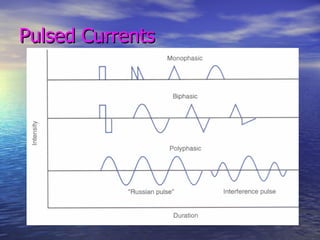
Electrical Currents Continuous Currents: Direct Current  (DC) – polarity remains constant Iontophoresis Car battery Alternating Current  (AC) – polarity at each end is constantly reversed Household current Pulsatile Currents: Monophasic  – similar to DC (either +/-) but is not constant Biphasic  – similar to AC (+/- phases) but due to interpulse intervals it can’t be AC Polyphasic
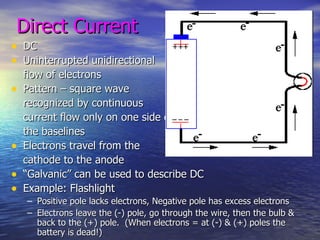
Direct Current DC Uninterrupted unidirectional  flow of electrons Pattern – square wave  recognized by continuous  current flow only on one side of the baselines Electrons travel from the  cathode to the anode “ Galvanic” can be used to describe DC Example: Flashlight Positive pole lacks electrons, Negative pole has excess electrons Electrons leave the (-) pole, go through the wire, then the bulb & back to the (+) pole.  (When electrons = at (-) & (+) poles the battery is dead!)
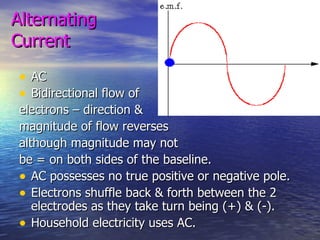
Alternating  Current AC Bidirectional flow of  electrons – direction &  magnitude of flow reverses  although magnitude may not  be = on both sides of the baseline. AC possesses no true positive or negative pole. Electrons shuffle back & forth between the 2 electrodes as they take turn being (+) & (-). Household electricity uses AC.
Pulsed Currents
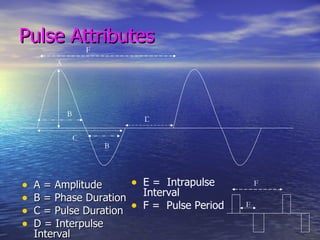
Pulse Attributes A = Amplitude B = Phase Duration C = Pulse Duration D = Interpulse Interval A B C D E F E =  Intrapulse Interval F =  Pulse Period B F
Pulse Attributes Pulse charge:   # of electrons contained within a pulse Expressed in  micro coulombs   Pulse frequency:  # of events per second Measured pulses per second (pps) or the cycle frequency of AC is cycles per second (cps) or Hz Low-frequency currents:  less than 1,000 cycles or pulses per second (electrical stimulation units used for biological effects) Medium-frequency currents:  1,000-100,000 pps/cps High-frequency currents:  greater than 100,000 pps/cps (used for heating effects- diathermy)
Pulse Attributes Pulse Rise Time:   amount of time needed for the pulse to reach its peak value ( nanoseconds ) Rapidly rising pulses cause nerve depolarization Pulse Decay Time:   amount of time required for the pulse to go from its peak back to zero  Pulse Train:   individual patterns of waveforms, durations &/or frequencies that are linked together (repeat @ regular intervals) Amplitude Ramp:  gradual rise &/or fall in amplitude of a pulse train (causes a gradual    in the force of m. contractions by progressive recruitment of motor units)
Measures of Electrical Current Flow Resistance:  ( R ) – opposition to electron flow in a conducting material Type, length, & cross-sectional area of the material & temperature of the circuit determine the amount of resistance offered to the flow of electrons Conductors:  materials allowing current to pass with relative ease Resistors/Insulators:  materials that tend to oppose current flow Impedance:  ( Z )  Alternating Current Inductance:  degree that a varying current can induce voltage (H – henry) (negligible in biological systems) Capacitance:  frequency-dependent ability to store a charge (C); many cell membranes are capacitors
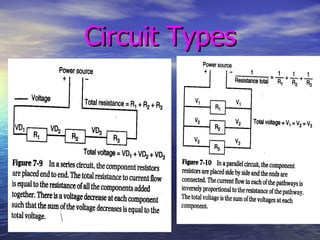
Circuit Types
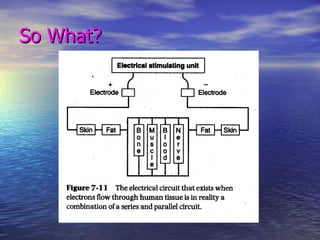
So What?
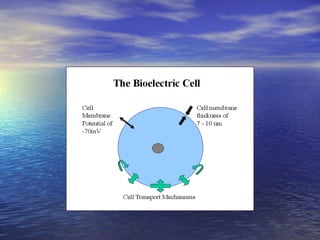
What happens in the Body? Current enters the body through a  SERIES  circuit. Once the current enters the tissues, it takes many different  PARALLEL  paths. Electrical stim is applied  trans- cutaneously  except for some bone growth stimulators that may be implanted into the muscle or bone. Resting potential  – potential difference between the inside & outside of the membrane Cathode  – depolarization of the nerve occurs Anode  – hyperpolarization of the nerve occurs
What happens in the Body? Cathode  – pH becomes basic (greater than 7) Anode  – pH becomes acidic (less than 7) Na +  move towards cathode, picks up an electron, & through reaction with H 2 O, liquefies proteins, causing a general softening of the tissues in the area & a decrease in nerve irritability Tissues under anode harden because chemical mediators for a coagulation of protein Effects not as pronounced when monophasic, biphasic or AC are used Na+ moves from inside the cell to the outside the cell allowing K+ to move into the cell (Sodium-potassium pump)
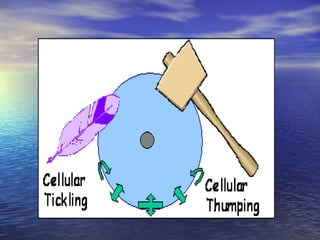
Physiological effects of electrical stimulation Cellular level  Tissue level Segmental level Systemic level
Therapeutic Uses for Electrical Stimulation Control acute & chronic pain Reduce edema Reduce & or inhibit muscle spasm Reduce joint contractures Minimize atrophy Facilitate tissue healing Facilitate muscle reeducation Facilitate fracture healing Strengthen muscle
Clinical application of Electricity: minimizing the resistance Reduce the skin-electrode resistance Minimize air-electrode interface Keep electrode clean of oils, etc. Clean the skill on oils, etc. Use the shortest pathway for energy flow Use the largest electrode that will selectively stimulate the target tissues If resistance increases, more voltage will be needed to get the same current flow
Clinical Application of Electricity: Material of Circuit Not all of the body’s tissues conduct electrical current the same Excitable Tissues Nerves Muscle fibers blood cells cell membranes Non-excitable tissues Bone Cartilage Tendons Ligaments Current prefers to travel along excitable tissues
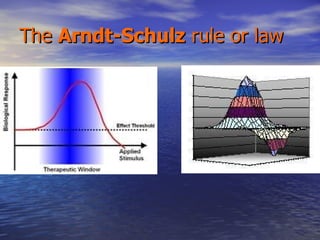
Stimulation Parameter : Amplitude: the intensity of the current, the magnitude of the charge. The amplitude is associated with the depth of penetration. The deeper the penetration the more muscle fiber recruitment possible  remember the all or none response and the Arndt-Schultz Principle
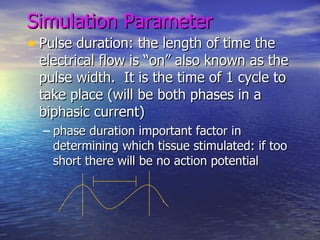
Simulation Parameter Pulse duration: the length of time the electrical flow is “on” also known as the pulse width.  It is the time of 1 cycle to take place (will be both phases in a biphasic current) phase duration important factor in determining which tissue stimulated: if too short there will be no action potential
Stimulation Parameter: Pulse rise time: the time to peak intensity of the pulse (ramp) rapid rising pulses cause nerve depolarization Slow rise: the nerve accommodates to stimulus and a action potential is not elicited Good for muscle re-education with assisted contraction - ramping (shock of current is reduced)
Stimulation Parameters Pulse Frequency: (PPS=Hertz) How many pulses occur in a unit of time Do not assume the lower the frequency the longer the pulse duration Low Frequency: 1K Hz and below (MENS .1-1K Hz), muscle stim units) Medium frequency: 1K to 100K Hz (Interferential, Russian stim ,LVGS) High Frequency: above 100K Hz (diathermies)
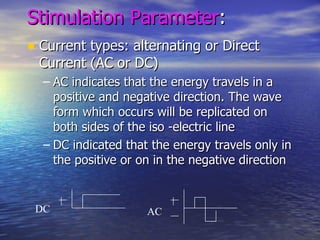
Stimulation Parameter : Current types: alternating or Direct Current (AC or DC) AC indicates that the energy travels in a positive and negative direction. The wave form which occurs will be replicated on both sides of the iso -electric line DC indicated that the energy travels only in the positive or on in the negative direction DC AC
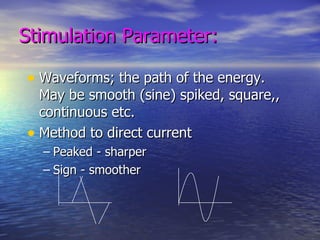
Stimulation Parameter: Waveforms; the path of the energy. May be smooth (sine) spiked, square,, continuous etc. Method to direct current Peaked - sharper Sign - smoother
Stimulation Parameter: Duty cycles: on-off time. May also be called inter-pulse interval which is the time between pulses. The more rest of “off” time, the less muscle fatigue will occur 1:1 Raito fatigues muscle rapidly 1:5 ratio less fatigue 1:7 no fatigue (passive muscle exercise)
Stimulation Parameter: Average current (also called Root Mean Square) the “average” intensity Factors effective the average current: pulse amplitude pulse duration waveform (DC has more net charge over time thus causing a thermal effect. AC has a zero net charge (ZNC). The DC may have long term adverse physiological effects)
Stimulation Parameter: Current Density The amount of charge per unit area.  This is usually relative to the size of the electrode.  Density will be greater with a small electrode, but also the small electrode offers more resistance.
Capacitance:   The ability of tissue (or other material) to store electricity.  For a given current intensity and pulse duration The higher the capacitance the longer before a response.  Body tissues have different capacitance. From least to most: Nerve (will fire first, if healthy) Muscle fiber Muscle tissue
Capacitance: Increase intensity (with decrease pulse duration) is needed to stimulate tissues with a higher capacitance. Muscle membrane has 10x the capacitance of nerve
Factors effecting the clinical application of electricity Factors effecting the clinical application of electricity Rise Time: the time to peak intensity The onset of stimulation must be rapid enough that tissue accommodation is prevented The lower the capacitance the less the charge can be stored If a stimulus is applied too slowly, it is dispersed
SECTION-2
HISTORY OF ES 420B.C-hippocrates-in torpaedo fish 46A.D-scribonius largus-gout/headache 1700-luigi galvani & alessantro volta 1745-leyden jar for ES 1831-michael faraday 1850s-duchene-motor points(father of ES) 1909-rheo/chron-louis 1916-SD curve-Adrian FES-1961-liberson 1962-HVPC-robert becker
Recent  perceptions in practice Clinical decision making   Research based Client centered (patient preferences) Context relevant (professional knowledge)
No recipes    only insight
 
 
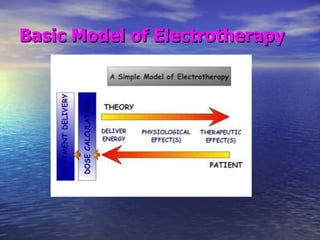
Basic Model of Electrotherapy
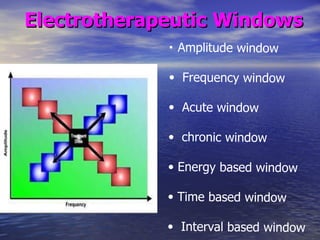
Electrotherapeutic Windows    Amplitude window Frequency window Acute window chronic window Energy based window Time based window Interval based window
The  Arndt-Schulz  rule or law
FAM Frequency Analysis Method The external currents with different  frequencies are considered to cause different effects in tissues. Thus we assume that tissue reactions on different frequencies in different states of the body will also differ from each other.  Measuring the sensory, motor and pain thresholds by stimulating the tissue with the interference current may offer a diagnostic tool in physiotherapy and rehabilitation
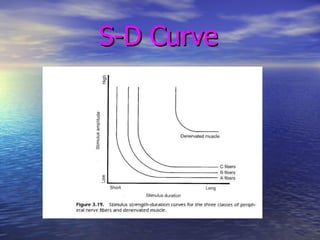
S-D Curve
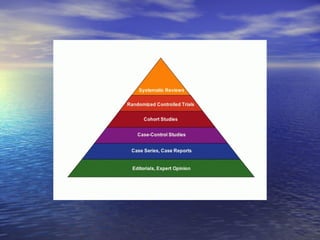
Evidence   based practice   Lack of Evidence  Vs Evidence of lack
  Van Tulder  et al . [ 1 ] specify that "strong evidence" is provided by multiple high quality randomised trials with consistent findings,  "moderate evidence" is provided by consistent findings in multiple low quality trials, and "limited or conflicting evidence" is provided by only one randomised trial or by inconsistent findings “ No evidence”one low quality RCT/CCT
 
Recommendations Effects of therapy Experiences Prognosis Diagnostic tests PEDro Cochrane library CINAHL Pubmed Pubmed pubmed
Critically appraised paper (peer reviewed) is more reliable
Clinical  guidelines always superior than systematic reviews
Clinical guidelines as a resource for EBP www.show.scot.nhs.uk/sign/ www.nice.org.uk www.nhmrc.gov.au/publications www.nzgg.org.nz www.guideline.gov.usa www.g-i-n.net/index.cfm(guidelines   international network)
SECTION-3
The  practical issues Electricity is an element of PT modalities most frightening and least understood. Understanding the basis principles will later aid you in establishing treatment protocols.
TENS Cathode is placed proximally in TENS except in AL-TENS Transcutaneous Electrical Nerve Stimulation ( TENS ) uses similar-sized electrodes  Over superficial vascular structures because transmission of currents may go through neural tissue as well as ionic fluids Can cause muscle contractions, but that is not why it is used Moderate caffeine levels (200 mg, approx 2-3 c. coffee) may decrease effectiveness of TENS
IFT 4KHZ-pain relief 2KHZ-muscle stimulation Pre modulated/4EL Able to penetrate tissues with little resistance No accomadation/gildemeister effect
Wound Healing:  E- stim for Tissue Repair (ESTR) Robert Becker – 1962 Theory - “Current of Injury” normal bioelectric system, nonexcitable tissues have a charge skin ----- deeper tissues +++++ neuraxis ++++++ periphery ------- Wounds - system is disturbed & creates a “current of injury” that initiates tissue healing . . . inflammatory process, migration of cells, etc.. Use of E-stim magnifies the “current of injury” to initiate, maintain, or speed the process.
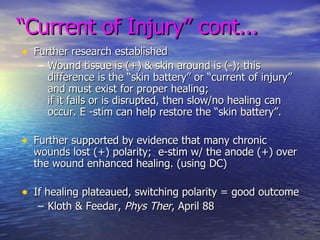
“ Current of Injury” cont... Further research established Wound tissue is (+) & skin around is (-); this difference is the “skin battery” or “current of injury” and must exist for proper healing;  if it fails or is disrupted, then slow/no healing can occur. E -stim can help restore the “skin battery”. Further supported by evidence that many chronic wounds lost (+) polarity;  e-stim w/ the anode (+) over the wound enhanced healing. (using DC) If healing plateaued, switching polarity = good outcome Kloth & Feedar,  Phys Ther , April 88
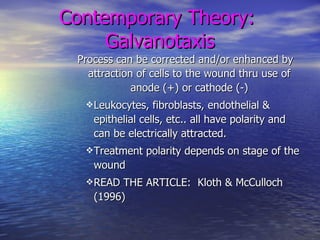
Contemporary Theory:  Galvanotaxis Process can be corrected and/or enhanced by attraction of cells to the wound thru use of anode (+) or cathode (-) Leukocytes, fibroblasts, endothelial & epithelial cells, etc.. all have polarity and can be electrically attracted. Treatment polarity depends on stage of the wound READ THE ARTICLE:  Kloth & McCulloch (1996)
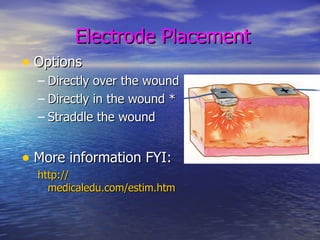
Electrode Placement Options Directly over the wound Directly in the wound * Straddle the wound More information FYI: http:// medicaledu.com/estim.htm
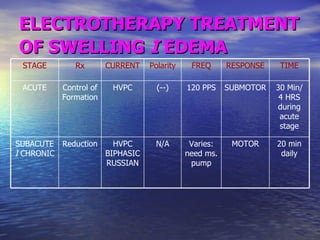
ELECTROTHERAPY TREATMENT OF SWELLING  I  EDEMA   20 min daily MOTOR Varies: need ms. pump N/A HVPC BIPHASIC RUSSIAN Reduction SUBACUTE  I  CHRONIC 30 Min/ 4 HRS during acute stage SUBMOTOR 120 PPS (--) HVPC Control of Formation ACUTE TIME RESPONSE FREQ Polarity CURRENT Rx STAGE
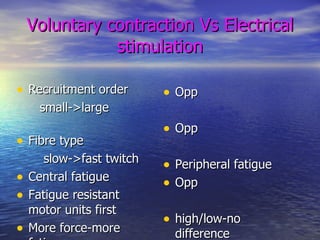
Voluntary contraction Vs Electrical stimulation Recruitment order small->large  Fibre type  slow->fast twitch Central fatigue  Fatigue resistant motor units first More force-more fatigue  Opp Opp Peripheral fatigue Opp high/low-no difference
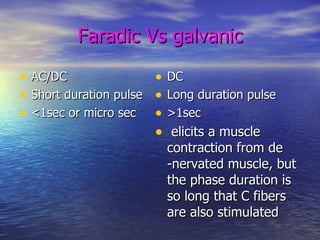
Faradic Vs galvanic AC/DC Short duration pulse <1sec or micro sec DC Long duration pulse >1sec elicits a muscle contraction from de -nervated muscle, but the phase duration is so long that C fibers are also stimulated
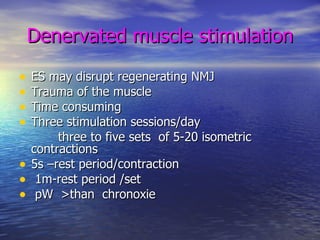
Denervated   muscle stimulation ES may disrupt regenerating NMJ Trauma of the muscle Time consuming Three stimulation sessions/day three to five sets  of 5-20 isometric contractions 5s –rest period/contraction 1m-rest period /set pW  >than  chronoxie
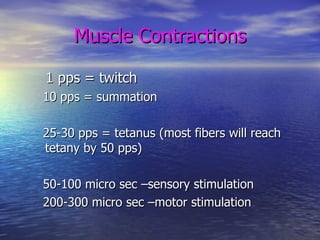
Muscle Contractions 1 pps = twitch  10 pps = summation 25-30 pps = tetanus (most fibers will reach tetany by 50 pps) 50-100 micro sec –sensory stimulation 200-300 micro sec –motor stimulation
Frequency selection: 100Hz - pain relief 50-60 Hz = muscle contraction 1-50 Hz = increased circulation The higher the frequency (Hz) the more quickly the muscle will fatigue 1-4 Hz-beta endorphin 40-100Hz-enkepalin,serotonin
Electrocution and dangers Electric and earth shock ELCB  BF/CF areas Guidelines by Robertson et al(2001) AC is more dangerous than DC(P=V*I) The strongest stimulation is where the current exits the body
Unexpected effects  of ES Over and above the normal physiological and psychological limits Skin Eyes General symptoms Cardio-resp Neurological Attitude musculoskeletal
Risk Management Risk grading-0,(1,2),3 Safety& maintenance( quality assurance) Infection Aversion Children (guidelines)
ES for neurological conditions UMN lesion-  FES LMN lesion-  enhance re innervations maintain muscle property UMN&LMN-  no use (Eg: ALS)
The history of FES before 19th century 
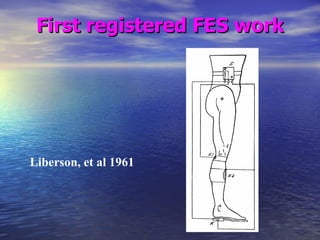
First registered FES work Liberson, et al 1961
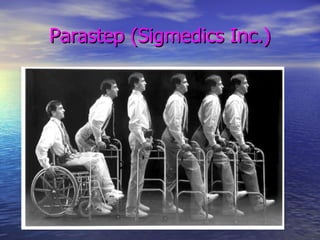
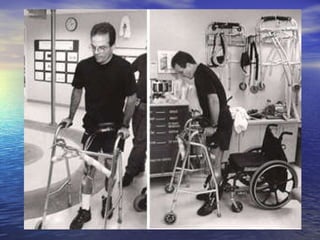
Parastep (Sigmedics Inc.)
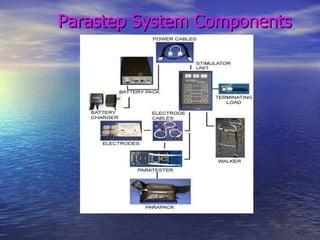
Parastep System Components


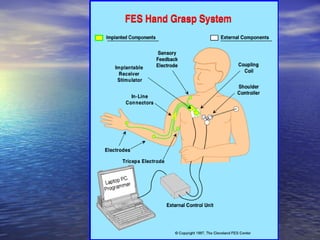
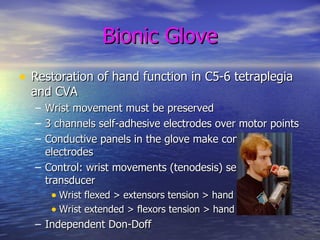
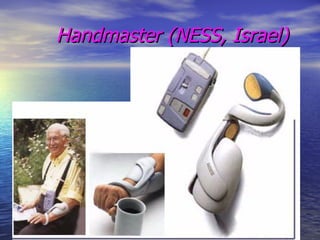
Restoration of hand function in C5-6 tetraplegia and CVA Wrist movement must be preserved 3 channels self-adhesive electrodes over motor points Conductive panels in the glove make contact electrodes Control: wrist movements (tenodesis) sensed by a transducer Wrist flexed > extensors tension > hand opens Wrist extended > flexors tension > hand closes Independent Don-Doff Bionic Glove
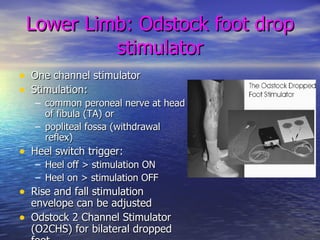
Lower Limb: Odstock foot drop stimulator One channel stimulator Stimulation:  common peroneal nerve at head of fibula (TA) or popliteal fossa (withdrawal reflex) Heel switch trigger:  Heel off > stimulation ON Heel on > stimulation OFF Rise and fall stimulation envelope can be adjusted Odstock 2 Channel Stimulator (O2CHS) for bilateral dropped foot
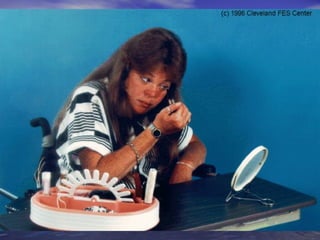
Handmaster (NESS, Israel)
References Electrotherapy in rehab-meryl roth gersh Orthopaedic PT secrets-placzek & boyce Electrotherapy explained-low and reed Practical EBP- herbert electrotherapyEBP-Tim watson
QUERIES

Presentation 21 4-11electrotherapy

  • 1.
    Practical issues ofEPAs restricted to low frequency currents Thangamani Ramalingam
  • 2.
    Section 1- BASICS Section 2- CLINICAL DECISION MAKING Section 3- THE PRACTICAL ISSUES
  • 3.
    Electrical StimulationThe In’s & Out’s of Getting Zapped
  • 4.
    Electrical Currents ContinuousCurrents: Direct Current (DC) – polarity remains constant Iontophoresis Car battery Alternating Current (AC) – polarity at each end is constantly reversed Household current Pulsatile Currents: Monophasic – similar to DC (either +/-) but is not constant Biphasic – similar to AC (+/- phases) but due to interpulse intervals it can’t be AC Polyphasic
  • 5.
    Direct Current DCUninterrupted unidirectional flow of electrons Pattern – square wave recognized by continuous current flow only on one side of the baselines Electrons travel from the cathode to the anode “ Galvanic” can be used to describe DC Example: Flashlight Positive pole lacks electrons, Negative pole has excess electrons Electrons leave the (-) pole, go through the wire, then the bulb & back to the (+) pole. (When electrons = at (-) & (+) poles the battery is dead!)
  • 6.
    Alternating CurrentAC Bidirectional flow of electrons – direction & magnitude of flow reverses although magnitude may not be = on both sides of the baseline. AC possesses no true positive or negative pole. Electrons shuffle back & forth between the 2 electrodes as they take turn being (+) & (-). Household electricity uses AC.
  • 7.
  • 8.
    Pulse Attributes A= Amplitude B = Phase Duration C = Pulse Duration D = Interpulse Interval A B C D E F E = Intrapulse Interval F = Pulse Period B F
  • 9.
    Pulse Attributes Pulsecharge: # of electrons contained within a pulse Expressed in micro coulombs Pulse frequency: # of events per second Measured pulses per second (pps) or the cycle frequency of AC is cycles per second (cps) or Hz Low-frequency currents: less than 1,000 cycles or pulses per second (electrical stimulation units used for biological effects) Medium-frequency currents: 1,000-100,000 pps/cps High-frequency currents: greater than 100,000 pps/cps (used for heating effects- diathermy)
  • 10.
    Pulse Attributes PulseRise Time: amount of time needed for the pulse to reach its peak value ( nanoseconds ) Rapidly rising pulses cause nerve depolarization Pulse Decay Time: amount of time required for the pulse to go from its peak back to zero Pulse Train: individual patterns of waveforms, durations &/or frequencies that are linked together (repeat @ regular intervals) Amplitude Ramp: gradual rise &/or fall in amplitude of a pulse train (causes a gradual  in the force of m. contractions by progressive recruitment of motor units)
  • 11.
    Measures of ElectricalCurrent Flow Resistance: ( R ) – opposition to electron flow in a conducting material Type, length, & cross-sectional area of the material & temperature of the circuit determine the amount of resistance offered to the flow of electrons Conductors: materials allowing current to pass with relative ease Resistors/Insulators: materials that tend to oppose current flow Impedance: ( Z ) Alternating Current Inductance: degree that a varying current can induce voltage (H – henry) (negligible in biological systems) Capacitance: frequency-dependent ability to store a charge (C); many cell membranes are capacitors
  • 12.
  • 13.
  • 14.
    What happens inthe Body? Current enters the body through a SERIES circuit. Once the current enters the tissues, it takes many different PARALLEL paths. Electrical stim is applied trans- cutaneously except for some bone growth stimulators that may be implanted into the muscle or bone. Resting potential – potential difference between the inside & outside of the membrane Cathode – depolarization of the nerve occurs Anode – hyperpolarization of the nerve occurs
  • 15.
    What happens inthe Body? Cathode – pH becomes basic (greater than 7) Anode – pH becomes acidic (less than 7) Na + move towards cathode, picks up an electron, & through reaction with H 2 O, liquefies proteins, causing a general softening of the tissues in the area & a decrease in nerve irritability Tissues under anode harden because chemical mediators for a coagulation of protein Effects not as pronounced when monophasic, biphasic or AC are used Na+ moves from inside the cell to the outside the cell allowing K+ to move into the cell (Sodium-potassium pump)
  • 16.
    Physiological effects ofelectrical stimulation Cellular level Tissue level Segmental level Systemic level
  • 17.
    Therapeutic Uses forElectrical Stimulation Control acute & chronic pain Reduce edema Reduce & or inhibit muscle spasm Reduce joint contractures Minimize atrophy Facilitate tissue healing Facilitate muscle reeducation Facilitate fracture healing Strengthen muscle
  • 18.
    Clinical application ofElectricity: minimizing the resistance Reduce the skin-electrode resistance Minimize air-electrode interface Keep electrode clean of oils, etc. Clean the skill on oils, etc. Use the shortest pathway for energy flow Use the largest electrode that will selectively stimulate the target tissues If resistance increases, more voltage will be needed to get the same current flow
  • 19.
    Clinical Application ofElectricity: Material of Circuit Not all of the body’s tissues conduct electrical current the same Excitable Tissues Nerves Muscle fibers blood cells cell membranes Non-excitable tissues Bone Cartilage Tendons Ligaments Current prefers to travel along excitable tissues
  • 20.
    Stimulation Parameter :Amplitude: the intensity of the current, the magnitude of the charge. The amplitude is associated with the depth of penetration. The deeper the penetration the more muscle fiber recruitment possible remember the all or none response and the Arndt-Schultz Principle
  • 21.
    Simulation Parameter Pulseduration: the length of time the electrical flow is “on” also known as the pulse width. It is the time of 1 cycle to take place (will be both phases in a biphasic current) phase duration important factor in determining which tissue stimulated: if too short there will be no action potential
  • 22.
    Stimulation Parameter: Pulserise time: the time to peak intensity of the pulse (ramp) rapid rising pulses cause nerve depolarization Slow rise: the nerve accommodates to stimulus and a action potential is not elicited Good for muscle re-education with assisted contraction - ramping (shock of current is reduced)
  • 23.
    Stimulation Parameters PulseFrequency: (PPS=Hertz) How many pulses occur in a unit of time Do not assume the lower the frequency the longer the pulse duration Low Frequency: 1K Hz and below (MENS .1-1K Hz), muscle stim units) Medium frequency: 1K to 100K Hz (Interferential, Russian stim ,LVGS) High Frequency: above 100K Hz (diathermies)
  • 24.
    Stimulation Parameter :Current types: alternating or Direct Current (AC or DC) AC indicates that the energy travels in a positive and negative direction. The wave form which occurs will be replicated on both sides of the iso -electric line DC indicated that the energy travels only in the positive or on in the negative direction DC AC
  • 25.
    Stimulation Parameter: Waveforms;the path of the energy. May be smooth (sine) spiked, square,, continuous etc. Method to direct current Peaked - sharper Sign - smoother
  • 26.
    Stimulation Parameter: Dutycycles: on-off time. May also be called inter-pulse interval which is the time between pulses. The more rest of “off” time, the less muscle fatigue will occur 1:1 Raito fatigues muscle rapidly 1:5 ratio less fatigue 1:7 no fatigue (passive muscle exercise)
  • 27.
    Stimulation Parameter: Averagecurrent (also called Root Mean Square) the “average” intensity Factors effective the average current: pulse amplitude pulse duration waveform (DC has more net charge over time thus causing a thermal effect. AC has a zero net charge (ZNC). The DC may have long term adverse physiological effects)
  • 28.
    Stimulation Parameter: CurrentDensity The amount of charge per unit area. This is usually relative to the size of the electrode. Density will be greater with a small electrode, but also the small electrode offers more resistance.
  • 29.
    Capacitance: The ability of tissue (or other material) to store electricity. For a given current intensity and pulse duration The higher the capacitance the longer before a response. Body tissues have different capacitance. From least to most: Nerve (will fire first, if healthy) Muscle fiber Muscle tissue
  • 30.
    Capacitance: Increase intensity(with decrease pulse duration) is needed to stimulate tissues with a higher capacitance. Muscle membrane has 10x the capacitance of nerve
  • 31.
    Factors effecting theclinical application of electricity Factors effecting the clinical application of electricity Rise Time: the time to peak intensity The onset of stimulation must be rapid enough that tissue accommodation is prevented The lower the capacitance the less the charge can be stored If a stimulus is applied too slowly, it is dispersed
  • 32.
  • 33.
    HISTORY OF ES420B.C-hippocrates-in torpaedo fish 46A.D-scribonius largus-gout/headache 1700-luigi galvani & alessantro volta 1745-leyden jar for ES 1831-michael faraday 1850s-duchene-motor points(father of ES) 1909-rheo/chron-louis 1916-SD curve-Adrian FES-1961-liberson 1962-HVPC-robert becker
  • 34.
    Recent perceptionsin practice Clinical decision making Research based Client centered (patient preferences) Context relevant (professional knowledge)
  • 35.
    No recipes only insight
  • 36.
  • 37.
  • 38.
    Basic Model ofElectrotherapy
  • 39.
    Electrotherapeutic Windows   Amplitude window Frequency window Acute window chronic window Energy based window Time based window Interval based window
  • 40.
    The Arndt-Schulz rule or law
  • 41.
    FAM Frequency AnalysisMethod The external currents with different frequencies are considered to cause different effects in tissues. Thus we assume that tissue reactions on different frequencies in different states of the body will also differ from each other. Measuring the sensory, motor and pain thresholds by stimulating the tissue with the interference current may offer a diagnostic tool in physiotherapy and rehabilitation
  • 42.
  • 43.
    Evidence based practice Lack of Evidence Vs Evidence of lack
  • 44.
      Van Tulder et al . [ 1 ] specify that &quot;strong evidence&quot; is provided by multiple high quality randomised trials with consistent findings, &quot;moderate evidence&quot; is provided by consistent findings in multiple low quality trials, and &quot;limited or conflicting evidence&quot; is provided by only one randomised trial or by inconsistent findings “ No evidence”one low quality RCT/CCT
  • 45.
  • 46.
    Recommendations Effects oftherapy Experiences Prognosis Diagnostic tests PEDro Cochrane library CINAHL Pubmed Pubmed pubmed
  • 47.
    Critically appraised paper(peer reviewed) is more reliable
  • 48.
    Clinical guidelinesalways superior than systematic reviews
  • 49.
    Clinical guidelines asa resource for EBP www.show.scot.nhs.uk/sign/ www.nice.org.uk www.nhmrc.gov.au/publications www.nzgg.org.nz www.guideline.gov.usa www.g-i-n.net/index.cfm(guidelines international network)
  • 50.
  • 51.
    The practicalissues Electricity is an element of PT modalities most frightening and least understood. Understanding the basis principles will later aid you in establishing treatment protocols.
  • 52.
    TENS Cathode isplaced proximally in TENS except in AL-TENS Transcutaneous Electrical Nerve Stimulation ( TENS ) uses similar-sized electrodes Over superficial vascular structures because transmission of currents may go through neural tissue as well as ionic fluids Can cause muscle contractions, but that is not why it is used Moderate caffeine levels (200 mg, approx 2-3 c. coffee) may decrease effectiveness of TENS
  • 53.
    IFT 4KHZ-pain relief2KHZ-muscle stimulation Pre modulated/4EL Able to penetrate tissues with little resistance No accomadation/gildemeister effect
  • 54.
    Wound Healing: E- stim for Tissue Repair (ESTR) Robert Becker – 1962 Theory - “Current of Injury” normal bioelectric system, nonexcitable tissues have a charge skin ----- deeper tissues +++++ neuraxis ++++++ periphery ------- Wounds - system is disturbed & creates a “current of injury” that initiates tissue healing . . . inflammatory process, migration of cells, etc.. Use of E-stim magnifies the “current of injury” to initiate, maintain, or speed the process.
  • 55.
    “ Current ofInjury” cont... Further research established Wound tissue is (+) & skin around is (-); this difference is the “skin battery” or “current of injury” and must exist for proper healing; if it fails or is disrupted, then slow/no healing can occur. E -stim can help restore the “skin battery”. Further supported by evidence that many chronic wounds lost (+) polarity; e-stim w/ the anode (+) over the wound enhanced healing. (using DC) If healing plateaued, switching polarity = good outcome Kloth & Feedar, Phys Ther , April 88
  • 56.
    Contemporary Theory: Galvanotaxis Process can be corrected and/or enhanced by attraction of cells to the wound thru use of anode (+) or cathode (-) Leukocytes, fibroblasts, endothelial & epithelial cells, etc.. all have polarity and can be electrically attracted. Treatment polarity depends on stage of the wound READ THE ARTICLE: Kloth & McCulloch (1996)
  • 57.
    Electrode Placement OptionsDirectly over the wound Directly in the wound * Straddle the wound More information FYI: http:// medicaledu.com/estim.htm
  • 58.
    ELECTROTHERAPY TREATMENT OFSWELLING I EDEMA 20 min daily MOTOR Varies: need ms. pump N/A HVPC BIPHASIC RUSSIAN Reduction SUBACUTE I CHRONIC 30 Min/ 4 HRS during acute stage SUBMOTOR 120 PPS (--) HVPC Control of Formation ACUTE TIME RESPONSE FREQ Polarity CURRENT Rx STAGE
  • 59.
    Voluntary contraction VsElectrical stimulation Recruitment order small->large Fibre type slow->fast twitch Central fatigue Fatigue resistant motor units first More force-more fatigue Opp Opp Peripheral fatigue Opp high/low-no difference
  • 60.
    Faradic Vs galvanicAC/DC Short duration pulse <1sec or micro sec DC Long duration pulse >1sec elicits a muscle contraction from de -nervated muscle, but the phase duration is so long that C fibers are also stimulated
  • 61.
    Denervated muscle stimulation ES may disrupt regenerating NMJ Trauma of the muscle Time consuming Three stimulation sessions/day three to five sets of 5-20 isometric contractions 5s –rest period/contraction 1m-rest period /set pW >than chronoxie
  • 62.
    Muscle Contractions 1pps = twitch 10 pps = summation 25-30 pps = tetanus (most fibers will reach tetany by 50 pps) 50-100 micro sec –sensory stimulation 200-300 micro sec –motor stimulation
  • 63.
    Frequency selection: 100Hz- pain relief 50-60 Hz = muscle contraction 1-50 Hz = increased circulation The higher the frequency (Hz) the more quickly the muscle will fatigue 1-4 Hz-beta endorphin 40-100Hz-enkepalin,serotonin
  • 64.
    Electrocution and dangersElectric and earth shock ELCB BF/CF areas Guidelines by Robertson et al(2001) AC is more dangerous than DC(P=V*I) The strongest stimulation is where the current exits the body
  • 65.
    Unexpected effects of ES Over and above the normal physiological and psychological limits Skin Eyes General symptoms Cardio-resp Neurological Attitude musculoskeletal
  • 66.
    Risk Management Riskgrading-0,(1,2),3 Safety& maintenance( quality assurance) Infection Aversion Children (guidelines)
  • 67.
    ES for neurologicalconditions UMN lesion- FES LMN lesion- enhance re innervations maintain muscle property UMN&LMN- no use (Eg: ALS)
  • 68.
    The history ofFES before 19th century 
  • 69.
    First registered FESwork Liberson, et al 1961
  • 70.
  • 71.
  • 72.
  • 73.
  • 74.
  • 75.
    Restoration of handfunction in C5-6 tetraplegia and CVA Wrist movement must be preserved 3 channels self-adhesive electrodes over motor points Conductive panels in the glove make contact electrodes Control: wrist movements (tenodesis) sensed by a transducer Wrist flexed > extensors tension > hand opens Wrist extended > flexors tension > hand closes Independent Don-Doff Bionic Glove
  • 76.
    Lower Limb: Odstockfoot drop stimulator One channel stimulator Stimulation: common peroneal nerve at head of fibula (TA) or popliteal fossa (withdrawal reflex) Heel switch trigger: Heel off > stimulation ON Heel on > stimulation OFF Rise and fall stimulation envelope can be adjusted Odstock 2 Channel Stimulator (O2CHS) for bilateral dropped foot
  • 77.
  • 78.
    References Electrotherapy inrehab-meryl roth gersh Orthopaedic PT secrets-placzek & boyce Electrotherapy explained-low and reed Practical EBP- herbert electrotherapyEBP-Tim watson
  • 79.