TOPIC OUTLINE
• Electrotherapy
• Ultrasound
• Diathermy
• Laser
DEFINITION OF TERMS
1. CHARGE
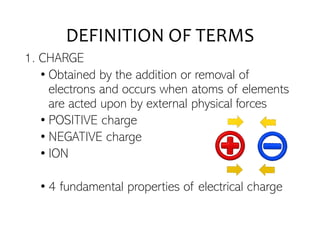
• Obtained by the addition or removal of
electrons and occurs when atoms of elements
are acted upon by external physical forces
• POSITIVE charge
• NEGATIVE charge
• ION
• 4 fundamental properties of electrical charge
DEFINITION OF TERMS
2. Polarity
• Net charge of an object→ being either negative and positive
• Electrode with net negativity and positivity
3. Electrical Field
• Force created by the separation of charge may be one of
attraction or repulsion and represents the electrical field
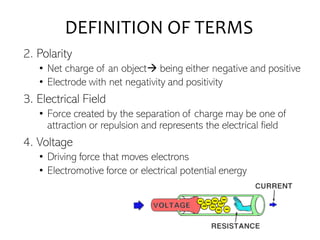
4. Voltage
• Driving force that moves electrons
• Electromotive force or electrical potential energy
5. Conductors and Insulators
• Materials in which ions move freely are conductors
• Materials in which ions do not move freely are insulators
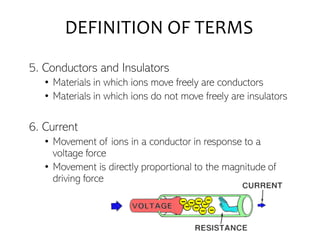
6. Current
• Movement of ions in a conductor in response to a
voltage force
• Movement is directly proportional to the magnitude of
driving force
DEFINITION OF TERMS
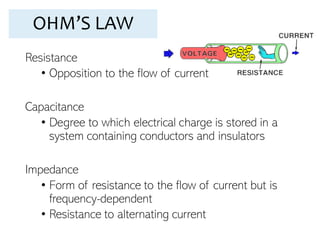
OHM’S LAW
Resistance
• Opposition to the flow of current
Capacitance
• Degree to which electrical charge is stored in a
system containing conductors and insulators
Impedance
• Form of resistance to the flow of current but is
frequency-dependent
• Resistance to alternating current
DEFINITION OF TERMS
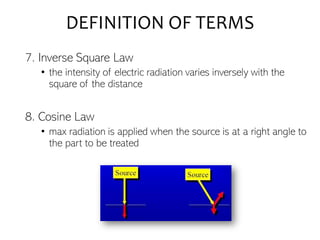
7. Inverse Square Law
• the intensity of electric radiation varies inversely with the
square of the distance
8. Cosine Law
• max radiation is applied when the source is at a right angle to
the part to be treated
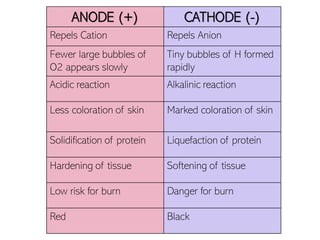
ANODE (+) CATHODE (-)
Repels Cation Repels Anion
Fewer large bubbles of
O2 appears slowly
Tiny bubbles of H formed
rapidly
Acidic reaction Alkalinic reaction
Less coloration of skin Marked coloration of skin
Solidification of protein Liquefaction of protein
Hardening of tissue Softening of tissue
Low risk for burn Danger for burn
Red Black
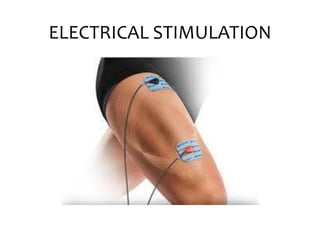
ELECTRICAL STIMULATION
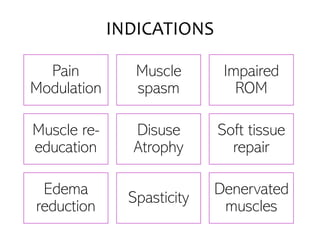
INDICATIONS
Pain
Modulation
Muscle
spasm
Impaired
ROM
Muscle re-
education
Disuse
Atrophy
Soft tissue
repair
Edema
reduction
Spasticity
Denervated
muscles
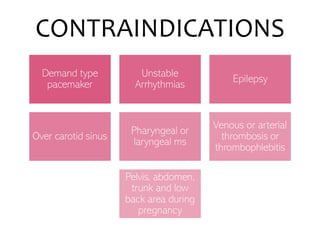
CONTRAINDICATIONS
Demand type
pacemaker
Unstable
Arrhythmias
Epilepsy
Over carotid sinus
Pharyngeal or
laryngeal ms
Venous or arterial
thrombosis or
thrombophlebitis
Pelvis, abdomen,
trunk and low
back area during
pregnancy
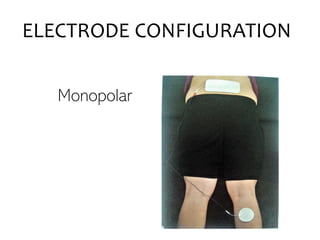
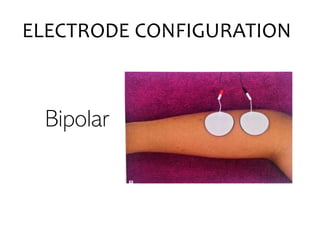
ELECTRODE CONFIGURATION
Monopolar
Bipolar
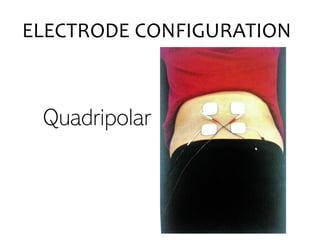
ELECTRODE CONFIGURATION
Quadripolar
ELECTRODE CONFIGURATION
SAFETY
• All electrical outlets should have the three prong GFCI
outlets
• Ensure all line-powered equipment has a testing seal
• Never use an extension cord
• Unplug all line powered equipment at the end of each
day
• A sticker should be placed on equipment indicating the
last inspection/ maintenance every 6-12 months
• Keep an updated log for all equipment in the PT dept
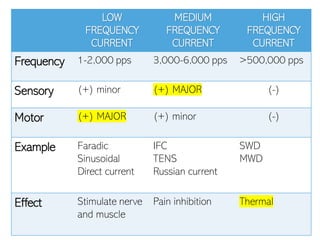
LOW
FREQUENCY
CURRENT
MEDIUM
FREQUENCY
CURRENT
HIGH
FREQUENCY
CURRENT
Frequency 1-2,000 pps 3,000-6,000 pps >500,000 pps
Sensory (+) minor (+) MAJOR (-)
Motor (+) MAJOR (+) minor (-)
Example Faradic
Sinusoidal
Direct current
IFC
TENS
Russian current
SWD
MWD
Effect Stimulate nerve
and muscle
Pain inhibition Thermal
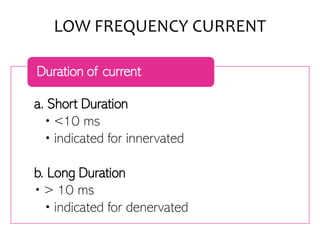
LOW FREQUENCY CURRENT
a. Short Duration
• <10 ms
• indicated for innervated
b. Long Duration
• > 10 ms
• indicated for denervated
Duration of current
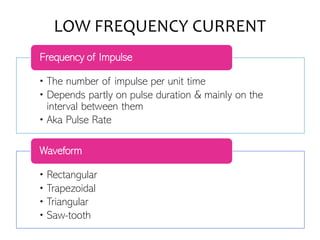
• The number of impulse per unit time
• Depends partly on pulse duration & mainly on the
interval between them
• Aka Pulse Rate
Frequency of Impulse
• Rectangular
• Trapezoidal
• Triangular
• Saw-tooth
Waveform
LOW FREQUENCY CURRENT
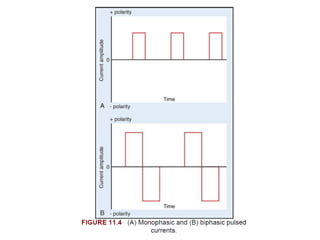
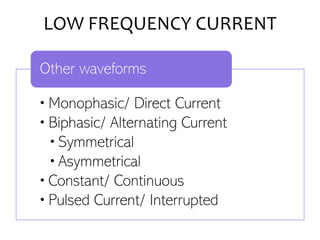
•Monophasic/ Direct Current
•Biphasic/ Alternating Current
•Symmetrical
•Asymmetrical
•Constant/ Continuous
•Pulsed Current/ Interrupted
Other waveforms
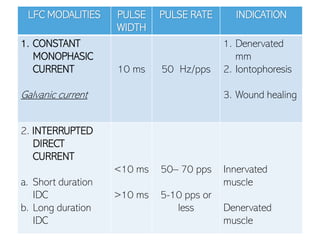
LFC MODALITIES PULSE
WIDTH
PULSE RATE INDICATION
1. CONSTANT
MONOPHASIC
CURRENT
Galvanic current
10 ms 50 Hz/pps
1. Denervated
mm
2. Iontophoresis
3. Wound healing
2. INTERRUPTED
DIRECT
CURRENT
a. Short duration
IDC
b. Long duration
IDC
<10 ms
>10 ms
50– 70 pps
5-10 pps or
less
Innervated
muscle
Denervated
muscle
LFC MODALITIES PULSE
WIDTH
PULSE
RATE
INDICATION
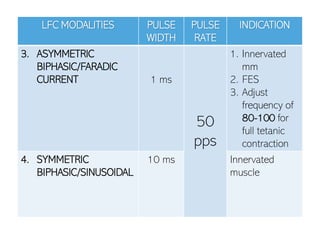
3. ASYMMETRIC
BIPHASIC/FARADIC
CURRENT 1 ms
50
pps
1. Innervated
mm
2. FES
3. Adjust
frequency of
80-100 for
full tetanic
contraction
4. SYMMETRIC
BIPHASIC/SINUSOIDAL
10 ms Innervated
muscle
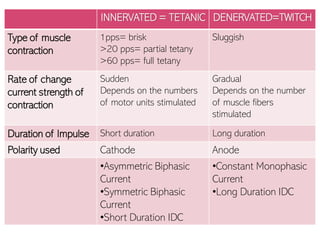
INNERVATED = TETANIC DENERVATED=TWITCH
Type of muscle
contraction
1pps= brisk
>20 pps= partial tetany
>60 pps= full tetany
Sluggish
Rate of change
current strength of
contraction
Sudden
Depends on the numbers
of motor units stimulated
Gradual
Depends on the number
of muscle fibers
stimulated
Duration of Impulse Short duration Long duration
Polarity used Cathode Anode
•Asymmetric Biphasic
Current
•Symmetric Biphasic
Current
•Short Duration IDC
•Constant Monophasic
Current
•Long Duration IDC
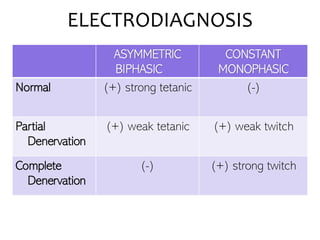
ELECTRODIAGNOSIS
ASYMMETRIC
BIPHASIC
CONSTANT
MONOPHASIC
Normal (+) strong tetanic (-)
Partial
Denervation
(+) weak tetanic (+) weak twitch
Complete
Denervation
(-) (+) strong twitch
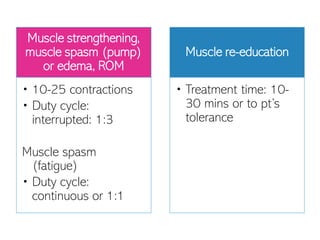
Muscle strengthening,
muscle spasm (pump)
or edema, ROM
• 10-25 contractions
• Duty cycle:
interrupted: 1:3
Muscle spasm
(fatigue)
• Duty cycle:
continuous or 1:1
Muscle re-education
• Treatment time: 10-
30 mins or to pt’s
tolerance
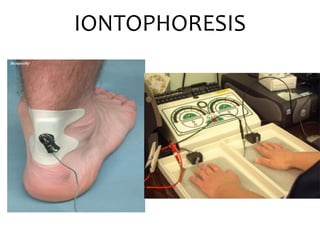
IONTOPHORESIS
IONTOPHORESIS
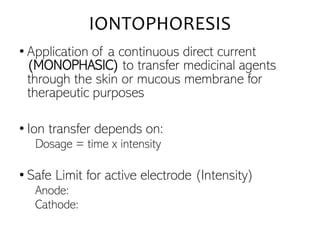
• Application of a continuous direct current
(MONOPHASIC) to transfer medicinal agents
through the skin or mucous membrane for
therapeutic purposes
• Ion transfer depends on:
Dosage = time x intensity
• Safe Limit for active electrode (Intensity)
Anode:
Cathode:
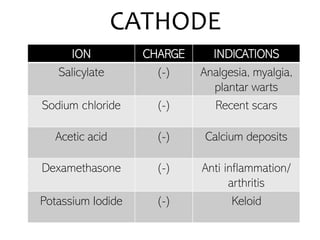
CATHODE
ION CHARGE INDICATIONS
Salicylate (-) Analgesia, myalgia,
plantar warts
Sodium chloride (-) Recent scars
Acetic acid (-) Calcium deposits
Dexamethasone (-) Anti inflammation/
arthritis
Potassium Iodide (-) Keloid
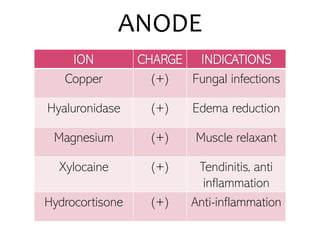
ANODE
ION CHARGE INDICATIONS
Copper (+) Fungal infections
Hyaluronidase (+) Edema reduction
Magnesium (+) Muscle relaxant
Xylocaine (+) Tendinitis, anti
inflammation
Hydrocortisone (+) Anti-inflammation
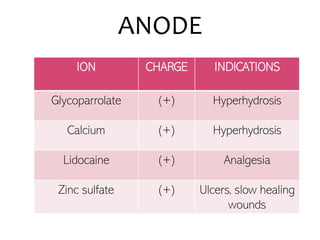
ANODE
ION CHARGE INDICATIONS
Glycoparrolate (+) Hyperhydrosis
Calcium (+) Hyperhydrosis
Lidocaine (+) Analgesia
Zinc sulfate (+) Ulcers, slow healing
wounds
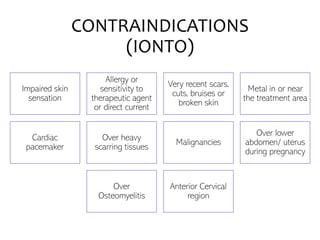
CONTRAINDICATIONS
(IONTO)
Impaired skin
sensation
Allergy or
sensitivity to
therapeutic agent
or direct current
Very recent scars,
cuts, bruises or
broken skin
Metal in or near
the treatment area
Cardiac
pacemaker
Over heavy
scarring tissues
Malignancies
Over lower
abdomen/ uterus
during pregnancy
Over
Osteomyelitis
Anterior Cervical
region
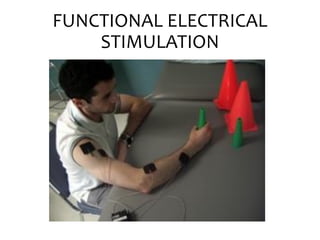
FUNCTIONAL ELECTRICAL
STIMULATION
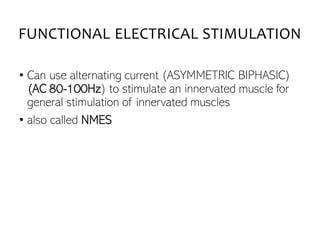
FUNCTIONAL ELECTRICAL STIMULATION
• Can use alternating current (ASYMMETRIC BIPHASIC)
(AC 80-100Hz) to stimulate an innervated muscle for
general stimulation of innervated muscles
• also called NMES
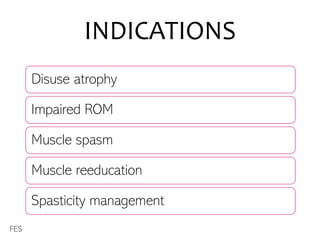
INDICATIONS
Disuse atrophy
Impaired ROM
Muscle spasm
Muscle reeducation
Spasticity management
FES
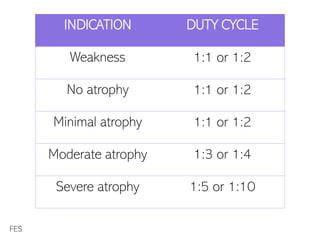
INDICATION DUTY CYCLE
Weakness 1:1 or 1:2
No atrophy 1:1 or 1:2
Minimal atrophy 1:1 or 1:2
Moderate atrophy 1:3 or 1:4
Severe atrophy 1:5 or 1:10
FES
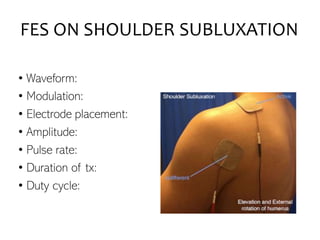
FES ON SHOULDER SUBLUXATION
• Waveform:
• Modulation:
• Electrode placement:
• Amplitude:
• Pulse rate:
• Duration of tx:
• Duty cycle:
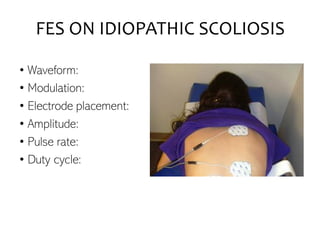
FES ON IDIOPATHIC SCOLIOSIS
• Waveform:
• Modulation:
• Electrode placement:
• Amplitude:
• Pulse rate:
• Duty cycle:
FES AS DF ASSIST
• Waveform:
• Modulation:
• Electrode placement:
• Amplitude:
• Pulse rate:
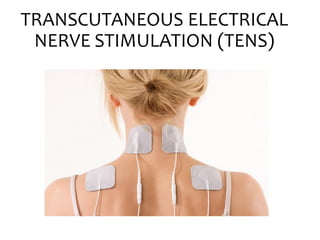
TRANSCUTANEOUS ELECTRICAL
NERVE STIMULATION (TENS)
TRANSCUTANEOUS ELECTRICAL
NERVE STIMULATION
• Most common & important form of electro analgesia
THEORIES OF PAIN RELIEF
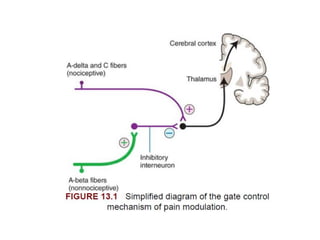
1. Gate Control Theory
2. Release of natural endogenous opiates
3. Counter Irritation
4. Induced Vasodilation
INDICATIONS (TENS)
Post op pain
During labor and delivery
Bone Fx
Chronic pain
Trigeminal neuralgia
Phantom pain
Antiemetic effects
Improved blood flow
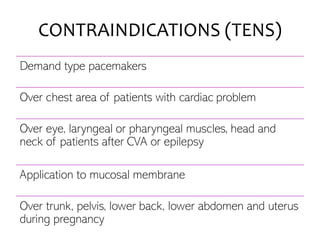
CONTRAINDICATIONS (TENS)
Demand type pacemakers
Over chest area of patients with cardiac problem
Over eye, laryngeal or pharyngeal muscles, head and
neck of patients after CVA or epilepsy
Application to mucosal membrane
Over trunk, pelvis, lower back, lower abdomen and uterus
during pregnancy
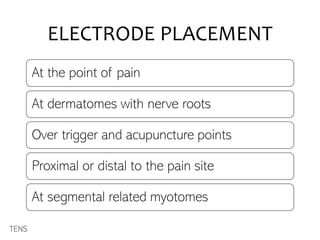
ELECTRODE PLACEMENT
At the point of pain
At dermatomes with nerve roots
Over trigger and acupuncture points
Proximal or distal to the pain site
At segmental related myotomes
TENS
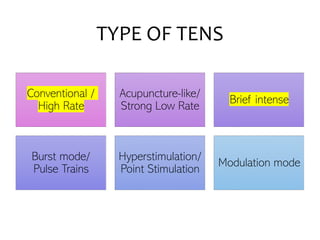
TYPE OF TENS
Conventional /
High Rate
Acupuncture-like/
Strong Low Rate
Brief intense
Burst mode/
Pulse Trains
Hyperstimulation/
Point Stimulation
Modulation mode
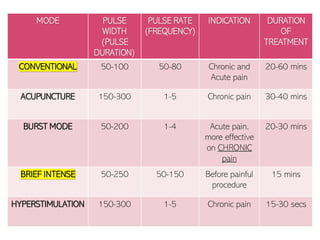
MODE PULSE
WIDTH
(PULSE
DURATION)
PULSE RATE
(FREQUENCY)
INDICATION DURATION
OF
TREATMENT
CONVENTIONAL 50-100 50-80 Chronic and
Acute pain
20-60 mins
ACUPUNCTURE 150-300 1-5 Chronic pain 30-40 mins
BURST MODE 50-200 1-4 Acute pain,
more effective
on CHRONIC
pain
20-30 mins
BRIEF INTENSE 50-250 50-150 Before painful
procedure
15 mins
HYPERSTIMULATION 150-300 1-5 Chronic pain 15-30 secs
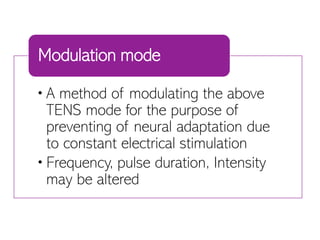
•A method of modulating the above
TENS mode for the purpose of
preventing of neural adaptation due
to constant electrical stimulation
•Frequency, pulse duration, Intensity
may be altered
Modulation mode
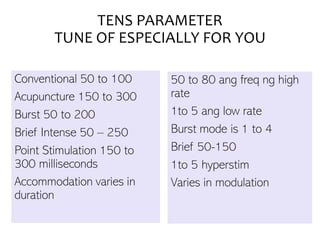
TENS PARAMETER
TUNE OF ESPECIALLY FOR YOU
Conventional 50 to 100
Acupuncture 150 to 300
Burst 50 to 200
Brief Intense 50 – 250
Point Stimulation 150 to
300 milliseconds
Accommodation varies in
duration
50 to 80 ang freq ng high
rate
1to 5 ang low rate
Burst mode is 1 to 4
Brief 50-150
1to 5 hyperstim
Varies in modulation
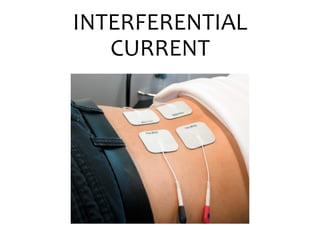
INTERFERENTIAL
CURRENT
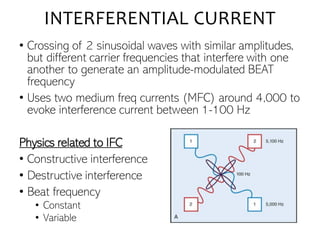
INTERFERENTIAL CURRENT
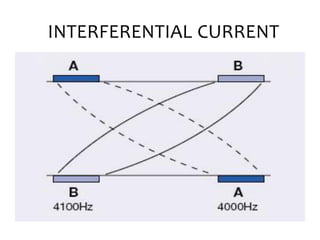
• Crossing of 2 sinusoidal waves with similar amplitudes,
but different carrier frequencies that interfere with one
another to generate an amplitude-modulated BEAT
frequency
• Uses two medium freq currents (MFC) around 4,000 to
evoke interference current between 1-100 Hz
Physics related to IFC
• Constructive interference
• Destructive interference
• Beat frequency
• Constant
• Variable
• Pain
• Swelling/ Edema
• Urinary Incontinence
• Osteoarthritic pain
INDICATION
• Malignancies
• All types of electronic implants
• During first trimester of pregnancy
• Over lower abdomen/ uterus during pregnancy
• Over transcervical area
CONTRAINDICATIONS
IFC
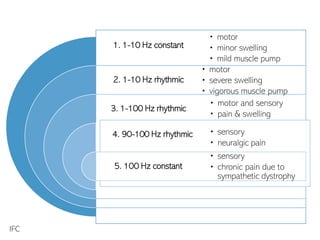
1. 1-10 Hz constant
2. 1-10 Hz rhythmic
3. 1-100 Hz rhythmic
4. 90-100 Hz rhythmic
5. 100 Hz constant
• motor
• minor swelling
• mild muscle pump
• motor
• severe swelling
• vigorous muscle pump
• motor and sensory
• pain & swelling
• sensory
• neuralgic pain
• sensory
• chronic pain due to
sympathetic dystrophy
IFC
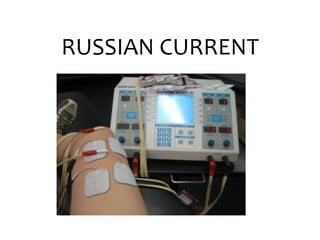
RUSSIAN CURRENT
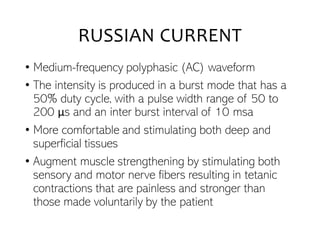
RUSSIAN CURRENT
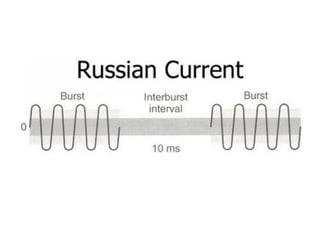
• Medium-frequency polyphasic (AC) waveform
• The intensity is produced in a burst mode that has a
50% duty cycle, with a pulse width range of 50 to
200 μs and an inter burst interval of 10 msa
• More comfortable and stimulating both deep and
superficial tissues
• Augment muscle strengthening by stimulating both
sensory and motor nerve fibers resulting in tetanic
contractions that are painless and stronger than
those made voluntarily by the patient
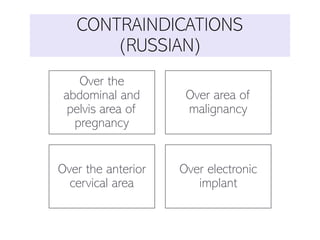
CONTRAINDICATIONS
(RUSSIAN)
Over the
abdominal and
pelvis area of
pregnancy
Over area of
malignancy
Over the anterior
cervical area
Over electronic
implant
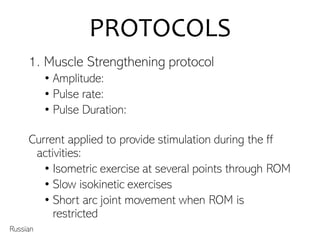
PROTOCOLS
1. Muscle Strengthening protocol
• Amplitude:
• Pulse rate:
• Pulse Duration:
Current applied to provide stimulation during the ff
activities:
• Isometric exercise at several points through ROM
• Slow isokinetic exercises
• Short arc joint movement when ROM is
restricted
Russian
PROTOCOLS
2. Muscle spasm protocol
• Amplitude:
• Pulse rate:
• Pulse duration:
• ES applied to provide isometric contraction
Russian
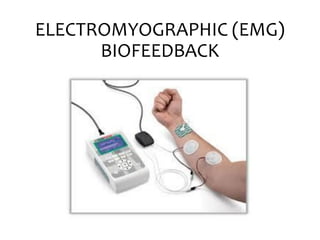
ELECTROMYOGRAPHIC (EMG)
BIOFEEDBACK
EMG BIOFEEDBACK
• Electronic instrument used to measure motor unit
action potential (MUAP) that are generated by active
muscles
• The signals are detected, amplified & converted into
audio visual signals that are used to reinforce
voluntary control
• Used to either increase or decrease muscle activity to
achieve a functional goal
• Measures electrical activity of muscle and not the
muscle contraction directly
• Any condition where mm contraction is
detrimental
• Skin irritation at electrode site
CONTRAINDICATIONS
• Good vision, hearing and communication
abilities
• Good comprehension of simple commands,
concentration
• Good motor planning skills
• No profound sensory or proprioceptive loss
Patient selection for Biofeedback training
EMG
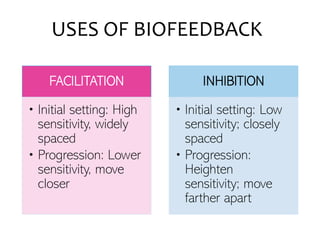
USES OF BIOFEEDBACK
FACILITATION
• Initial setting: High
sensitivity, widely
spaced
• Progression: Lower
sensitivity, move
closer
INHIBITION
• Initial setting: Low
sensitivity; closely
spaced
• Progression:
Heighten
sensitivity; move
farther apart
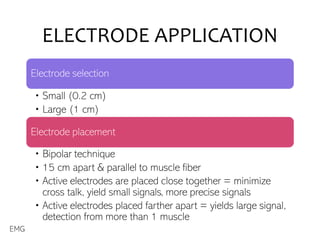
ELECTRODE APPLICATION
Electrode selection
• Small (0.2 cm)
• Large (1 cm)
Electrode placement
• Bipolar technique
• 15 cm apart & parallel to muscle fiber
• Active electrodes are placed close together = minimize
cross talk, yield small signals, more precise signals
• Active electrodes placed farther apart = yields large signal,
detection from more than 1 muscle
EMG
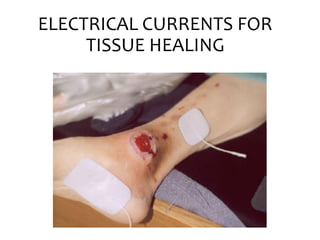
ELECTRICAL CURRENTS FOR
TISSUE HEALING
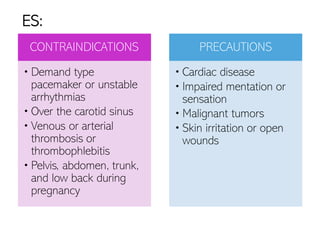
CONTRAINDICATIONS
• Demand type
pacemaker or unstable
arrhythmias
• Over the carotid sinus
• Venous or arterial
thrombosis or
thrombophlebitis
• Pelvis, abdomen, trunk,
and low back during
pregnancy
PRECAUTIONS
• Cardiac disease
• Impaired mentation or
sensation
• Malignant tumors
• Skin irritation or open
wounds
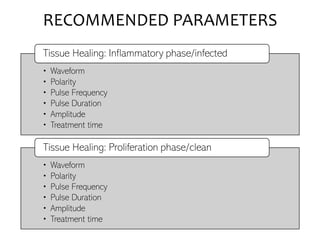
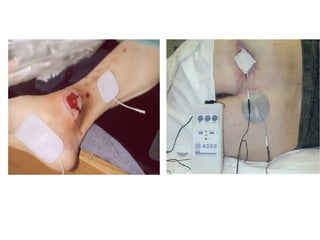
ES:
RECOMMENDED PARAMETERS
• Waveform
• Polarity
• Pulse Frequency
• Pulse Duration
• Amplitude
• Treatment time
Tissue Healing: Inflammatory phase/infected
• Waveform
• Polarity
• Pulse Frequency
• Pulse Duration
• Amplitude
• Treatment time
Tissue Healing: Proliferation phase/clean
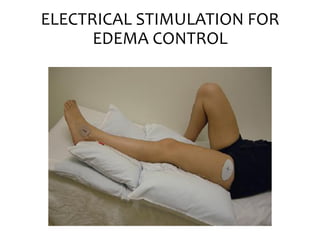
ELECTRICAL STIMULATION FOR
EDEMA CONTROL
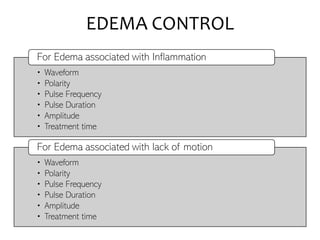
EDEMA CONTROL
• Waveform
• Polarity
• Pulse Frequency
• Pulse Duration
• Amplitude
• Treatment time
For Edema associated with Inflammation
• Waveform
• Polarity
• Pulse Frequency
• Pulse Duration
• Amplitude
• Treatment time
For Edema associated with lack of motion
ULTRASOUND
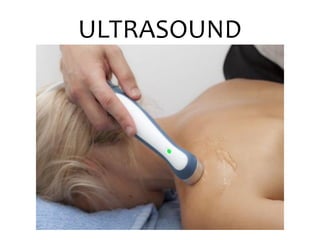
ULTRASOUND
• Mechanical energy produced by sound waves at
frequencies between 85 Hz and 3 Mhz and delivered
at intensities between 1 and 3 w/cm2 is absorbed by
body tissues and changed to thermal energy
• Heats tissues with a high collagen content
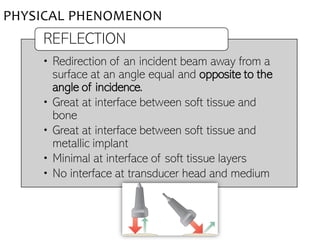
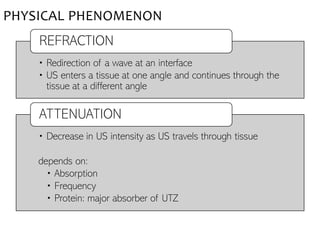
PHYSICAL PHENOMENON
• Redirection of an incident beam away from a
surface at an angle equal and opposite to the
angle of incidence.
• Great at interface between soft tissue and
bone
• Great at interface between soft tissue and
metallic implant
• Minimal at interface of soft tissue layers
• No interface at transducer head and medium
REFLECTION
• Redirection of a wave at an interface
• US enters a tissue at one angle and continues through the
tissue at a different angle
REFRACTION
• Decrease in US intensity as US travels through tissue
depends on:
• Absorption
• Frequency
• Protein: major absorber of UTZ
ATTENUATION
PHYSICAL PHENOMENON
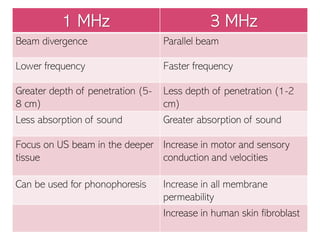
1 MHz 3 MHz
Beam divergence Parallel beam
Lower frequency Faster frequency
Greater depth of penetration (5-
8 cm)
Less depth of penetration (1-2
cm)
Less absorption of sound Greater absorption of sound
Focus on US beam in the deeper
tissue
Increase in motor and sensory
conduction and velocities
Can be used for phonophoresis Increase in all membrane
permeability
Increase in human skin fibroblast
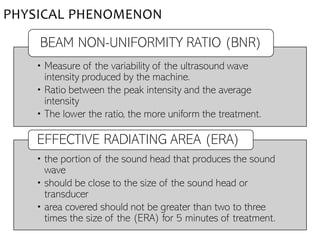
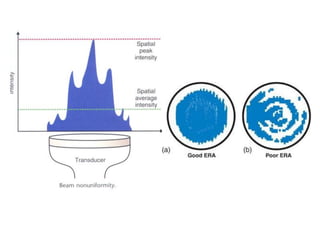
• Measure of the variability of the ultrasound wave
intensity produced by the machine.
• Ratio between the peak intensity and the average
intensity
• The lower the ratio, the more uniform the treatment.
BEAM NON-UNIFORMITY RATIO (BNR)
• the portion of the sound head that produces the sound
wave
• should be close to the size of the sound head or
transducer
• area covered should not be greater than two to three
times the size of the (ERA) for 5 minutes of treatment.
EFFECTIVE RADIATING AREA (ERA)
PHYSICAL PHENOMENON
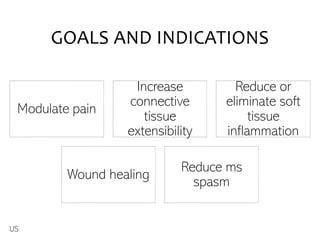
GOALS AND INDICATIONS
Modulate pain
Increase
connective
tissue
extensibility
Reduce or
eliminate soft
tissue
inflammation
Wound healing
Reduce ms
spasm
US
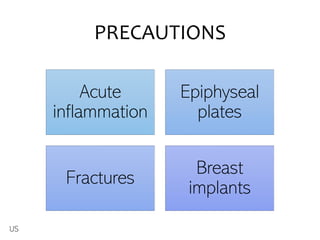
PRECAUTIONS
Acute
inflammation
Epiphyseal
plates
Fractures
Breast
implants
US
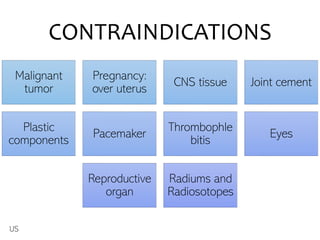
CONTRAINDICATIONS
Malignant
tumor
Pregnancy:
over uterus
CNS tissue Joint cement
Plastic
components
Pacemaker
Thrombophle
bitis
Eyes
Reproductive
organ
Radiums and
Radiosotopes
US
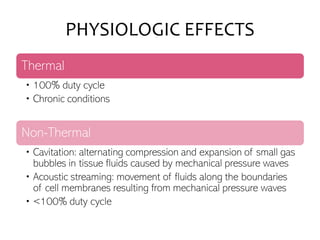
PHYSIOLOGIC EFFECTS
Thermal
• 100% duty cycle
• Chronic conditions
Non-Thermal
• Cavitation: alternating compression and expansion of small gas
bubbles in tissue fluids caused by mechanical pressure waves
• Acoustic streaming: movement of fluids along the boundaries
of cell membranes resulting from mechanical pressure waves
• <100% duty cycle
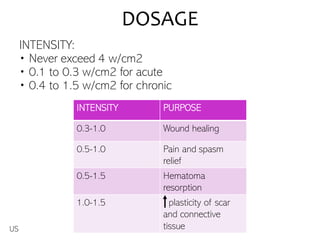
DOSAGE
INTENSITY:
• Never exceed 4 w/cm2
• 0.1 to 0.3 w/cm2 for acute
• 0.4 to 1.5 w/cm2 for chronic
INTENSITY PURPOSE
0.3-1.0 Wound healing
0.5-1.0 Pain and spasm
relief
0.5-1.5 Hematoma
resorption
1.0-1.5 plasticity of scar
and connective
tissue
US
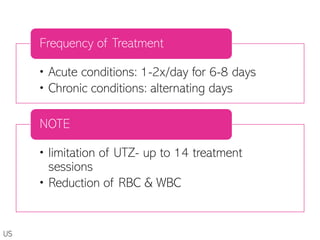
• Acute conditions: 1-2x/day for 6-8 days
• Chronic conditions: alternating days
Frequency of Treatment
• limitation of UTZ- up to 14 treatment
sessions
• Reduction of RBC & WBC
NOTE
US
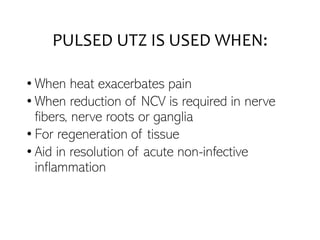
PULSED UTZ IS USED WHEN:
• When heat exacerbates pain
• When reduction of NCV is required in nerve
fibers, nerve roots or ganglia
• For regeneration of tissue
• Aid in resolution of acute non-infective
inflammation
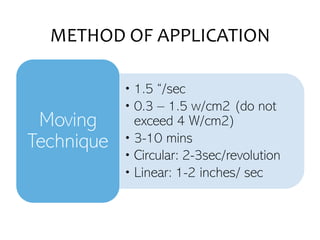
METHOD OF APPLICATION
• 1.5 “/sec
• 0.3 – 1.5 w/cm2 (do not
exceed 4 W/cm2)
• 3-10 mins
• Circular: 2-3sec/revolution
• Linear: 1-2 inches/ sec
Moving
Technique
METHOD OF APPLICATION
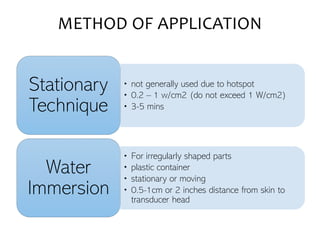
• not generally used due to hotspot
• 0.2 – 1 w/cm2 (do not exceed 1 W/cm2)
• 3-5 mins
Stationary
Technique
• For irregularly shaped parts
• plastic container
• stationary or moving
• 0.5-1cm or 2 inches distance from skin to
transducer head
Water
Immersion
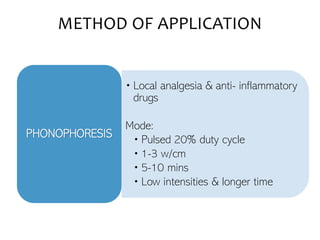
• Local analgesia & anti- inflammatory
drugs
Mode:
• Pulsed 20% duty cycle
• 1-3 w/cm
• 5-10 mins
• Low intensities & longer time
PHONOPHORESIS
METHOD OF APPLICATION
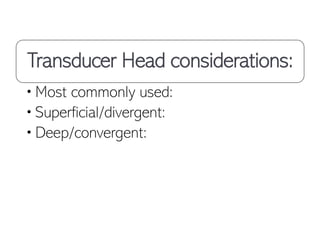
Transducer Head considerations:
•Most commonly used:
•Superficial/divergent:
•Deep/convergent:
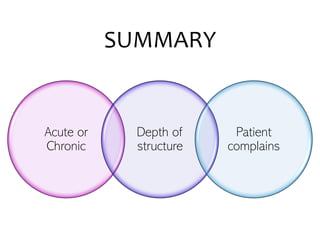
SUMMARY
Acute or
Chronic
Depth of
structure
Patient
complains
DIATHERMY
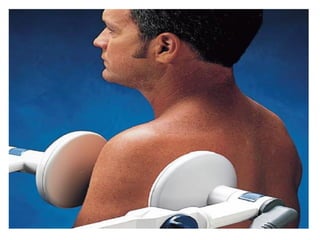
DIATHERMY
• “through heating”
• application of shortwave or microwave
electromagnetic energy to produce heat and
other physiological changes within tissues
• heats deeper than hot packs and heats a
larger area than ultrasound
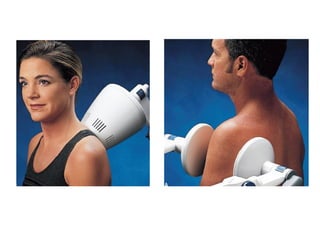
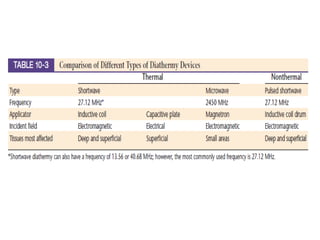
TYPES OF DIATHERMY APPLICATORS
• Inductive Coils
• heating by the magnetic field method
• Can heat both deep and superficial tissues, but they
produce the most heat in tissues closest to the
applicator and in tissues with the highest electrical
conductivity
• Capacitive Plates
• heating by the electrical field method
• produce the most heat in skin and less heat in deeper
structures
• Magnetron
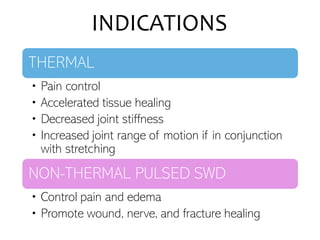
INDICATIONS
THERMAL
• Pain control
• Accelerated tissue healing
• Decreased joint stiffness
• Increased joint range of motion if in conjunction
with stretching
NON-THERMAL PULSED SWD
• Control pain and edema
• Promote wound, nerve, and fracture healing
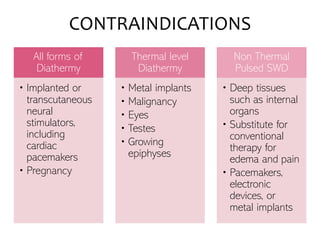
CONTRAINDICATIONS
All forms of
Diathermy
• Implanted or
transcutaneous
neural
stimulators,
including
cardiac
pacemakers
• Pregnancy
Thermal level
Diathermy
• Metal implants
• Malignancy
• Eyes
• Testes
• Growing
epiphyses
Non Thermal
Pulsed SWD
• Deep tissues
such as internal
organs
• Substitute for
conventional
therapy for
edema and pain
• Pacemakers,
electronic
devices, or
metal implants
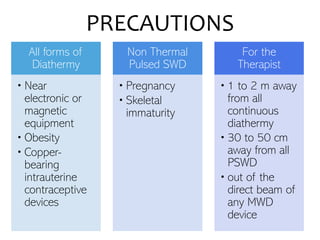
PRECAUTIONS
All forms of
Diathermy
• Near
electronic or
magnetic
equipment
• Obesity
• Copper-
bearing
intrauterine
contraceptive
devices
Non Thermal
Pulsed SWD
• Pregnancy
• Skeletal
immaturity
For the
Therapist
• 1 to 2 m away
from all
continuous
diathermy
• 30 to 50 cm
away from all
PSWD
• out of the
direct beam of
any MWD
device
APPLICATION
• Treatment time
• Patient positioning
LASER
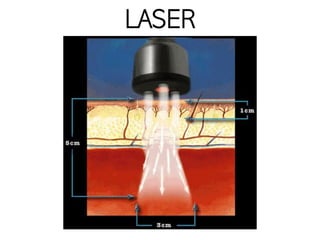
LASER
• Light Amplification by Stimulated Emission of
Radiation
Properties of LASER:
1. Coherence
2. Monochromaticity
3. Collimation
LASER
INDICATIONS
Tissue
healing
Arthritis
Pain
Management
Laser
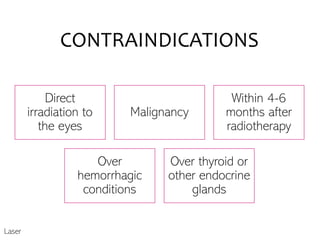
CONTRAINDICATIONS
Direct
irradiation to
the eyes
Malignancy
Within 4-6
months after
radiotherapy
Over
hemorrhagic
conditions
Over thyroid or
other endocrine
glands
Laser
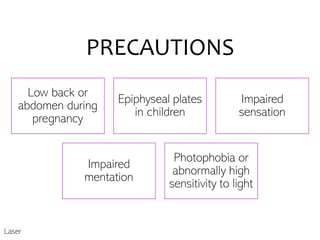
PRECAUTIONS
Low back or
abdomen during
pregnancy
Epiphyseal plates
in children
Impaired
sensation
Impaired
mentation
Photophobia or
abnormally high
sensitivity to light
Laser
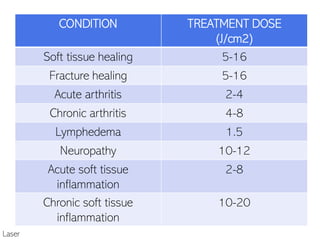
CONDITION TREATMENT DOSE
(J/cm2)
Soft tissue healing 5-16
Fracture healing 5-16
Acute arthritis 2-4
Chronic arthritis 4-8
Lymphedema 1.5
Neuropathy 10-12
Acute soft tissue
inflammation
2-8
Chronic soft tissue
inflammation
10-20
Laser
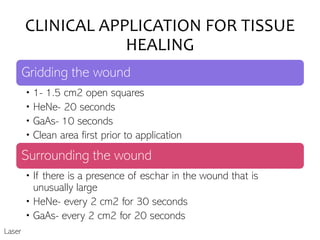
CLINICAL APPLICATION FOR TISSUE
HEALING
Gridding the wound
• 1- 1.5 cm2 open squares
• HeNe- 20 seconds
• GaAs- 10 seconds
• Clean area first prior to application
Surrounding the wound
• If there is a presence of eschar in the wound that is
unusually large
• HeNe- every 2 cm2 for 30 seconds
• GaAs- every 2 cm2 for 20 seconds
Laser
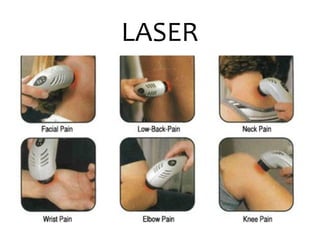
CLINICAL APPLICATION FOR PAIN
MANAGEMENT
• HeNe- 30 seconds
• GaAs- 20 seconds
• Direct stimulation over the site of dysfunction or stimulation
of associated acupuncture, trigger or motor points
• If pain reduction has occurred after 4 or 5 sessions, the use
of laser is discontinued
• No more than 8-12 treatments
Electrotherapy class lecture for students

Electrotherapy class lecture for students

  • 2.
    TOPIC OUTLINE • Electrotherapy •Ultrasound • Diathermy • Laser
  • 3.
    DEFINITION OF TERMS 1.CHARGE • Obtained by the addition or removal of electrons and occurs when atoms of elements are acted upon by external physical forces • POSITIVE charge • NEGATIVE charge • ION • 4 fundamental properties of electrical charge
  • 4.
    DEFINITION OF TERMS 2.Polarity • Net charge of an object→ being either negative and positive • Electrode with net negativity and positivity 3. Electrical Field • Force created by the separation of charge may be one of attraction or repulsion and represents the electrical field 4. Voltage • Driving force that moves electrons • Electromotive force or electrical potential energy
  • 5.
    5. Conductors andInsulators • Materials in which ions move freely are conductors • Materials in which ions do not move freely are insulators 6. Current • Movement of ions in a conductor in response to a voltage force • Movement is directly proportional to the magnitude of driving force DEFINITION OF TERMS
  • 6.
    OHM’S LAW Resistance • Oppositionto the flow of current Capacitance • Degree to which electrical charge is stored in a system containing conductors and insulators Impedance • Form of resistance to the flow of current but is frequency-dependent • Resistance to alternating current
  • 7.
    DEFINITION OF TERMS 7.Inverse Square Law • the intensity of electric radiation varies inversely with the square of the distance 8. Cosine Law • max radiation is applied when the source is at a right angle to the part to be treated
  • 8.
    ANODE (+) CATHODE(-) Repels Cation Repels Anion Fewer large bubbles of O2 appears slowly Tiny bubbles of H formed rapidly Acidic reaction Alkalinic reaction Less coloration of skin Marked coloration of skin Solidification of protein Liquefaction of protein Hardening of tissue Softening of tissue Low risk for burn Danger for burn Red Black
  • 9.
  • 10.
  • 11.
    CONTRAINDICATIONS Demand type pacemaker Unstable Arrhythmias Epilepsy Over carotidsinus Pharyngeal or laryngeal ms Venous or arterial thrombosis or thrombophlebitis Pelvis, abdomen, trunk and low back area during pregnancy
  • 12.
  • 13.
  • 14.
  • 15.
    SAFETY • All electricaloutlets should have the three prong GFCI outlets • Ensure all line-powered equipment has a testing seal • Never use an extension cord • Unplug all line powered equipment at the end of each day • A sticker should be placed on equipment indicating the last inspection/ maintenance every 6-12 months • Keep an updated log for all equipment in the PT dept
  • 16.
    LOW FREQUENCY CURRENT MEDIUM FREQUENCY CURRENT HIGH FREQUENCY CURRENT Frequency 1-2,000 pps3,000-6,000 pps >500,000 pps Sensory (+) minor (+) MAJOR (-) Motor (+) MAJOR (+) minor (-) Example Faradic Sinusoidal Direct current IFC TENS Russian current SWD MWD Effect Stimulate nerve and muscle Pain inhibition Thermal
  • 17.
    LOW FREQUENCY CURRENT a.Short Duration • <10 ms • indicated for innervated b. Long Duration • > 10 ms • indicated for denervated Duration of current
  • 18.
    • The numberof impulse per unit time • Depends partly on pulse duration & mainly on the interval between them • Aka Pulse Rate Frequency of Impulse • Rectangular • Trapezoidal • Triangular • Saw-tooth Waveform LOW FREQUENCY CURRENT
  • 20.
    LOW FREQUENCY CURRENT •Monophasic/Direct Current •Biphasic/ Alternating Current •Symmetrical •Asymmetrical •Constant/ Continuous •Pulsed Current/ Interrupted Other waveforms
  • 21.
    LFC MODALITIES PULSE WIDTH PULSERATE INDICATION 1. CONSTANT MONOPHASIC CURRENT Galvanic current 10 ms 50 Hz/pps 1. Denervated mm 2. Iontophoresis 3. Wound healing 2. INTERRUPTED DIRECT CURRENT a. Short duration IDC b. Long duration IDC <10 ms >10 ms 50– 70 pps 5-10 pps or less Innervated muscle Denervated muscle
  • 22.
    LFC MODALITIES PULSE WIDTH PULSE RATE INDICATION 3.ASYMMETRIC BIPHASIC/FARADIC CURRENT 1 ms 50 pps 1. Innervated mm 2. FES 3. Adjust frequency of 80-100 for full tetanic contraction 4. SYMMETRIC BIPHASIC/SINUSOIDAL 10 ms Innervated muscle
  • 23.
    INNERVATED = TETANICDENERVATED=TWITCH Type of muscle contraction 1pps= brisk >20 pps= partial tetany >60 pps= full tetany Sluggish Rate of change current strength of contraction Sudden Depends on the numbers of motor units stimulated Gradual Depends on the number of muscle fibers stimulated Duration of Impulse Short duration Long duration Polarity used Cathode Anode •Asymmetric Biphasic Current •Symmetric Biphasic Current •Short Duration IDC •Constant Monophasic Current •Long Duration IDC
  • 24.
    ELECTRODIAGNOSIS ASYMMETRIC BIPHASIC CONSTANT MONOPHASIC Normal (+) strongtetanic (-) Partial Denervation (+) weak tetanic (+) weak twitch Complete Denervation (-) (+) strong twitch
  • 25.
    Muscle strengthening, muscle spasm(pump) or edema, ROM • 10-25 contractions • Duty cycle: interrupted: 1:3 Muscle spasm (fatigue) • Duty cycle: continuous or 1:1 Muscle re-education • Treatment time: 10- 30 mins or to pt’s tolerance
  • 26.
  • 27.
    IONTOPHORESIS • Application ofa continuous direct current (MONOPHASIC) to transfer medicinal agents through the skin or mucous membrane for therapeutic purposes • Ion transfer depends on: Dosage = time x intensity • Safe Limit for active electrode (Intensity) Anode: Cathode:
  • 28.
    CATHODE ION CHARGE INDICATIONS Salicylate(-) Analgesia, myalgia, plantar warts Sodium chloride (-) Recent scars Acetic acid (-) Calcium deposits Dexamethasone (-) Anti inflammation/ arthritis Potassium Iodide (-) Keloid
  • 29.
    ANODE ION CHARGE INDICATIONS Copper(+) Fungal infections Hyaluronidase (+) Edema reduction Magnesium (+) Muscle relaxant Xylocaine (+) Tendinitis, anti inflammation Hydrocortisone (+) Anti-inflammation
  • 30.
    ANODE ION CHARGE INDICATIONS Glycoparrolate(+) Hyperhydrosis Calcium (+) Hyperhydrosis Lidocaine (+) Analgesia Zinc sulfate (+) Ulcers, slow healing wounds
  • 31.
    CONTRAINDICATIONS (IONTO) Impaired skin sensation Allergy or sensitivityto therapeutic agent or direct current Very recent scars, cuts, bruises or broken skin Metal in or near the treatment area Cardiac pacemaker Over heavy scarring tissues Malignancies Over lower abdomen/ uterus during pregnancy Over Osteomyelitis Anterior Cervical region
  • 32.
  • 33.
    FUNCTIONAL ELECTRICAL STIMULATION •Can use alternating current (ASYMMETRIC BIPHASIC) (AC 80-100Hz) to stimulate an innervated muscle for general stimulation of innervated muscles • also called NMES
  • 34.
    INDICATIONS Disuse atrophy Impaired ROM Musclespasm Muscle reeducation Spasticity management FES
  • 35.
    INDICATION DUTY CYCLE Weakness1:1 or 1:2 No atrophy 1:1 or 1:2 Minimal atrophy 1:1 or 1:2 Moderate atrophy 1:3 or 1:4 Severe atrophy 1:5 or 1:10 FES
  • 36.
    FES ON SHOULDERSUBLUXATION • Waveform: • Modulation: • Electrode placement: • Amplitude: • Pulse rate: • Duration of tx: • Duty cycle:
  • 37.
    FES ON IDIOPATHICSCOLIOSIS • Waveform: • Modulation: • Electrode placement: • Amplitude: • Pulse rate: • Duty cycle:
  • 38.
    FES AS DFASSIST • Waveform: • Modulation: • Electrode placement: • Amplitude: • Pulse rate:
  • 39.
  • 40.
    TRANSCUTANEOUS ELECTRICAL NERVE STIMULATION •Most common & important form of electro analgesia THEORIES OF PAIN RELIEF 1. Gate Control Theory 2. Release of natural endogenous opiates 3. Counter Irritation 4. Induced Vasodilation
  • 42.
    INDICATIONS (TENS) Post oppain During labor and delivery Bone Fx Chronic pain Trigeminal neuralgia Phantom pain Antiemetic effects Improved blood flow
  • 43.
    CONTRAINDICATIONS (TENS) Demand typepacemakers Over chest area of patients with cardiac problem Over eye, laryngeal or pharyngeal muscles, head and neck of patients after CVA or epilepsy Application to mucosal membrane Over trunk, pelvis, lower back, lower abdomen and uterus during pregnancy
  • 44.
    ELECTRODE PLACEMENT At thepoint of pain At dermatomes with nerve roots Over trigger and acupuncture points Proximal or distal to the pain site At segmental related myotomes TENS
  • 45.
    TYPE OF TENS Conventional/ High Rate Acupuncture-like/ Strong Low Rate Brief intense Burst mode/ Pulse Trains Hyperstimulation/ Point Stimulation Modulation mode
  • 46.
    MODE PULSE WIDTH (PULSE DURATION) PULSE RATE (FREQUENCY) INDICATIONDURATION OF TREATMENT CONVENTIONAL 50-100 50-80 Chronic and Acute pain 20-60 mins ACUPUNCTURE 150-300 1-5 Chronic pain 30-40 mins BURST MODE 50-200 1-4 Acute pain, more effective on CHRONIC pain 20-30 mins BRIEF INTENSE 50-250 50-150 Before painful procedure 15 mins HYPERSTIMULATION 150-300 1-5 Chronic pain 15-30 secs
  • 47.
    •A method ofmodulating the above TENS mode for the purpose of preventing of neural adaptation due to constant electrical stimulation •Frequency, pulse duration, Intensity may be altered Modulation mode
  • 48.
    TENS PARAMETER TUNE OFESPECIALLY FOR YOU Conventional 50 to 100 Acupuncture 150 to 300 Burst 50 to 200 Brief Intense 50 – 250 Point Stimulation 150 to 300 milliseconds Accommodation varies in duration 50 to 80 ang freq ng high rate 1to 5 ang low rate Burst mode is 1 to 4 Brief 50-150 1to 5 hyperstim Varies in modulation
  • 49.
  • 50.
  • 51.
    INTERFERENTIAL CURRENT • Crossingof 2 sinusoidal waves with similar amplitudes, but different carrier frequencies that interfere with one another to generate an amplitude-modulated BEAT frequency • Uses two medium freq currents (MFC) around 4,000 to evoke interference current between 1-100 Hz Physics related to IFC • Constructive interference • Destructive interference • Beat frequency • Constant • Variable
  • 52.
    • Pain • Swelling/Edema • Urinary Incontinence • Osteoarthritic pain INDICATION • Malignancies • All types of electronic implants • During first trimester of pregnancy • Over lower abdomen/ uterus during pregnancy • Over transcervical area CONTRAINDICATIONS IFC
  • 53.
    1. 1-10 Hzconstant 2. 1-10 Hz rhythmic 3. 1-100 Hz rhythmic 4. 90-100 Hz rhythmic 5. 100 Hz constant • motor • minor swelling • mild muscle pump • motor • severe swelling • vigorous muscle pump • motor and sensory • pain & swelling • sensory • neuralgic pain • sensory • chronic pain due to sympathetic dystrophy IFC
  • 54.
  • 55.
    RUSSIAN CURRENT • Medium-frequencypolyphasic (AC) waveform • The intensity is produced in a burst mode that has a 50% duty cycle, with a pulse width range of 50 to 200 μs and an inter burst interval of 10 msa • More comfortable and stimulating both deep and superficial tissues • Augment muscle strengthening by stimulating both sensory and motor nerve fibers resulting in tetanic contractions that are painless and stronger than those made voluntarily by the patient
  • 57.
    CONTRAINDICATIONS (RUSSIAN) Over the abdominal and pelvisarea of pregnancy Over area of malignancy Over the anterior cervical area Over electronic implant
  • 58.
    PROTOCOLS 1. Muscle Strengtheningprotocol • Amplitude: • Pulse rate: • Pulse Duration: Current applied to provide stimulation during the ff activities: • Isometric exercise at several points through ROM • Slow isokinetic exercises • Short arc joint movement when ROM is restricted Russian
  • 59.
    PROTOCOLS 2. Muscle spasmprotocol • Amplitude: • Pulse rate: • Pulse duration: • ES applied to provide isometric contraction Russian
  • 60.
  • 61.
    EMG BIOFEEDBACK • Electronicinstrument used to measure motor unit action potential (MUAP) that are generated by active muscles • The signals are detected, amplified & converted into audio visual signals that are used to reinforce voluntary control • Used to either increase or decrease muscle activity to achieve a functional goal • Measures electrical activity of muscle and not the muscle contraction directly
  • 62.
    • Any conditionwhere mm contraction is detrimental • Skin irritation at electrode site CONTRAINDICATIONS • Good vision, hearing and communication abilities • Good comprehension of simple commands, concentration • Good motor planning skills • No profound sensory or proprioceptive loss Patient selection for Biofeedback training EMG
  • 63.
    USES OF BIOFEEDBACK FACILITATION •Initial setting: High sensitivity, widely spaced • Progression: Lower sensitivity, move closer INHIBITION • Initial setting: Low sensitivity; closely spaced • Progression: Heighten sensitivity; move farther apart
  • 64.
    ELECTRODE APPLICATION Electrode selection •Small (0.2 cm) • Large (1 cm) Electrode placement • Bipolar technique • 15 cm apart & parallel to muscle fiber • Active electrodes are placed close together = minimize cross talk, yield small signals, more precise signals • Active electrodes placed farther apart = yields large signal, detection from more than 1 muscle EMG
  • 65.
  • 66.
    CONTRAINDICATIONS • Demand type pacemakeror unstable arrhythmias • Over the carotid sinus • Venous or arterial thrombosis or thrombophlebitis • Pelvis, abdomen, trunk, and low back during pregnancy PRECAUTIONS • Cardiac disease • Impaired mentation or sensation • Malignant tumors • Skin irritation or open wounds ES:
  • 67.
    RECOMMENDED PARAMETERS • Waveform •Polarity • Pulse Frequency • Pulse Duration • Amplitude • Treatment time Tissue Healing: Inflammatory phase/infected • Waveform • Polarity • Pulse Frequency • Pulse Duration • Amplitude • Treatment time Tissue Healing: Proliferation phase/clean
  • 69.
  • 70.
    EDEMA CONTROL • Waveform •Polarity • Pulse Frequency • Pulse Duration • Amplitude • Treatment time For Edema associated with Inflammation • Waveform • Polarity • Pulse Frequency • Pulse Duration • Amplitude • Treatment time For Edema associated with lack of motion
  • 72.
  • 73.
    ULTRASOUND • Mechanical energyproduced by sound waves at frequencies between 85 Hz and 3 Mhz and delivered at intensities between 1 and 3 w/cm2 is absorbed by body tissues and changed to thermal energy • Heats tissues with a high collagen content
  • 74.
    PHYSICAL PHENOMENON • Redirectionof an incident beam away from a surface at an angle equal and opposite to the angle of incidence. • Great at interface between soft tissue and bone • Great at interface between soft tissue and metallic implant • Minimal at interface of soft tissue layers • No interface at transducer head and medium REFLECTION
  • 75.
    • Redirection ofa wave at an interface • US enters a tissue at one angle and continues through the tissue at a different angle REFRACTION • Decrease in US intensity as US travels through tissue depends on: • Absorption • Frequency • Protein: major absorber of UTZ ATTENUATION PHYSICAL PHENOMENON
  • 76.
    1 MHz 3MHz Beam divergence Parallel beam Lower frequency Faster frequency Greater depth of penetration (5- 8 cm) Less depth of penetration (1-2 cm) Less absorption of sound Greater absorption of sound Focus on US beam in the deeper tissue Increase in motor and sensory conduction and velocities Can be used for phonophoresis Increase in all membrane permeability Increase in human skin fibroblast
  • 77.
    • Measure ofthe variability of the ultrasound wave intensity produced by the machine. • Ratio between the peak intensity and the average intensity • The lower the ratio, the more uniform the treatment. BEAM NON-UNIFORMITY RATIO (BNR) • the portion of the sound head that produces the sound wave • should be close to the size of the sound head or transducer • area covered should not be greater than two to three times the size of the (ERA) for 5 minutes of treatment. EFFECTIVE RADIATING AREA (ERA) PHYSICAL PHENOMENON
  • 79.
    GOALS AND INDICATIONS Modulatepain Increase connective tissue extensibility Reduce or eliminate soft tissue inflammation Wound healing Reduce ms spasm US
  • 80.
  • 81.
    CONTRAINDICATIONS Malignant tumor Pregnancy: over uterus CNS tissueJoint cement Plastic components Pacemaker Thrombophle bitis Eyes Reproductive organ Radiums and Radiosotopes US
  • 82.
    PHYSIOLOGIC EFFECTS Thermal • 100%duty cycle • Chronic conditions Non-Thermal • Cavitation: alternating compression and expansion of small gas bubbles in tissue fluids caused by mechanical pressure waves • Acoustic streaming: movement of fluids along the boundaries of cell membranes resulting from mechanical pressure waves • <100% duty cycle
  • 83.
    DOSAGE INTENSITY: • Never exceed4 w/cm2 • 0.1 to 0.3 w/cm2 for acute • 0.4 to 1.5 w/cm2 for chronic INTENSITY PURPOSE 0.3-1.0 Wound healing 0.5-1.0 Pain and spasm relief 0.5-1.5 Hematoma resorption 1.0-1.5 plasticity of scar and connective tissue US
  • 84.
    • Acute conditions:1-2x/day for 6-8 days • Chronic conditions: alternating days Frequency of Treatment • limitation of UTZ- up to 14 treatment sessions • Reduction of RBC & WBC NOTE US
  • 85.
    PULSED UTZ ISUSED WHEN: • When heat exacerbates pain • When reduction of NCV is required in nerve fibers, nerve roots or ganglia • For regeneration of tissue • Aid in resolution of acute non-infective inflammation
  • 86.
    METHOD OF APPLICATION •1.5 “/sec • 0.3 – 1.5 w/cm2 (do not exceed 4 W/cm2) • 3-10 mins • Circular: 2-3sec/revolution • Linear: 1-2 inches/ sec Moving Technique
  • 87.
    METHOD OF APPLICATION •not generally used due to hotspot • 0.2 – 1 w/cm2 (do not exceed 1 W/cm2) • 3-5 mins Stationary Technique • For irregularly shaped parts • plastic container • stationary or moving • 0.5-1cm or 2 inches distance from skin to transducer head Water Immersion
  • 88.
    • Local analgesia& anti- inflammatory drugs Mode: • Pulsed 20% duty cycle • 1-3 w/cm • 5-10 mins • Low intensities & longer time PHONOPHORESIS METHOD OF APPLICATION
  • 89.
    Transducer Head considerations: •Mostcommonly used: •Superficial/divergent: •Deep/convergent:
  • 90.
  • 91.
  • 92.
    DIATHERMY • “through heating” •application of shortwave or microwave electromagnetic energy to produce heat and other physiological changes within tissues • heats deeper than hot packs and heats a larger area than ultrasound
  • 93.
    TYPES OF DIATHERMYAPPLICATORS • Inductive Coils • heating by the magnetic field method • Can heat both deep and superficial tissues, but they produce the most heat in tissues closest to the applicator and in tissues with the highest electrical conductivity • Capacitive Plates • heating by the electrical field method • produce the most heat in skin and less heat in deeper structures • Magnetron
  • 95.
    INDICATIONS THERMAL • Pain control •Accelerated tissue healing • Decreased joint stiffness • Increased joint range of motion if in conjunction with stretching NON-THERMAL PULSED SWD • Control pain and edema • Promote wound, nerve, and fracture healing
  • 96.
    CONTRAINDICATIONS All forms of Diathermy •Implanted or transcutaneous neural stimulators, including cardiac pacemakers • Pregnancy Thermal level Diathermy • Metal implants • Malignancy • Eyes • Testes • Growing epiphyses Non Thermal Pulsed SWD • Deep tissues such as internal organs • Substitute for conventional therapy for edema and pain • Pacemakers, electronic devices, or metal implants
  • 97.
    PRECAUTIONS All forms of Diathermy •Near electronic or magnetic equipment • Obesity • Copper- bearing intrauterine contraceptive devices Non Thermal Pulsed SWD • Pregnancy • Skeletal immaturity For the Therapist • 1 to 2 m away from all continuous diathermy • 30 to 50 cm away from all PSWD • out of the direct beam of any MWD device
  • 98.
  • 100.
  • 101.
    LASER • Light Amplificationby Stimulated Emission of Radiation Properties of LASER: 1. Coherence 2. Monochromaticity 3. Collimation
  • 102.
  • 103.
  • 104.
    CONTRAINDICATIONS Direct irradiation to the eyes Malignancy Within4-6 months after radiotherapy Over hemorrhagic conditions Over thyroid or other endocrine glands Laser
  • 105.
    PRECAUTIONS Low back or abdomenduring pregnancy Epiphyseal plates in children Impaired sensation Impaired mentation Photophobia or abnormally high sensitivity to light Laser
  • 106.
    CONDITION TREATMENT DOSE (J/cm2) Softtissue healing 5-16 Fracture healing 5-16 Acute arthritis 2-4 Chronic arthritis 4-8 Lymphedema 1.5 Neuropathy 10-12 Acute soft tissue inflammation 2-8 Chronic soft tissue inflammation 10-20 Laser
  • 107.
    CLINICAL APPLICATION FORTISSUE HEALING Gridding the wound • 1- 1.5 cm2 open squares • HeNe- 20 seconds • GaAs- 10 seconds • Clean area first prior to application Surrounding the wound • If there is a presence of eschar in the wound that is unusually large • HeNe- every 2 cm2 for 30 seconds • GaAs- every 2 cm2 for 20 seconds Laser
  • 108.
    CLINICAL APPLICATION FORPAIN MANAGEMENT • HeNe- 30 seconds • GaAs- 20 seconds • Direct stimulation over the site of dysfunction or stimulation of associated acupuncture, trigger or motor points • If pain reduction has occurred after 4 or 5 sessions, the use of laser is discontinued • No more than 8-12 treatments