FARADIC
CURRENT
Contents of Lecture
Effects of Current on body
Faradic Current
Production
Modified Faradic Current
Indication & Uses
Methods of Application
Contra-Indications
Electric current and body
 Tissue of body ___ capable of transmitting
current because Tissue fluid contain ions.

 Conductivity of different tissues varies depend on
amount of fluid that they contain
 Muscles___ Good blood supply
 Fat_____ poor conductor
 Epidermis ____ high resistance (1000 ohm or
more) ___little fluid
 In applying electric treatment appropriate
measures are used to reduce its resistance
True Faradic Current
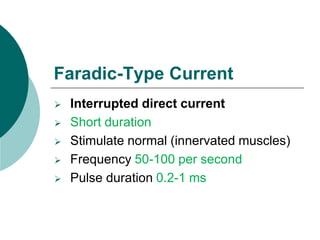
It is an unevenly direct current, with one
phase of high amplitude and short duration
and the other phase of low amplitude and
longer duration
Pulse duration__ 1ms
Frequency __ 50 Hz
Faradic-Type Current
 Interrupted direct current
 Short duration
 Stimulate normal (innervated muscles)
 Frequency 50-100 per second
 Pulse duration 0.2-1 ms
Modified Direct current
Faradic current can be modified by
interruption and surging.
In surging, surged duration, frequency,
wave form and surged interval are used.
Tetanic contraction
Near Normal tetanic like contraction and
relaxation of muscle
To produce a tetanic contraction by
faradic type of current stimuli must be
applied at a rate of at least 30 stimuli per
second
The strength of muscle contraction depend
on the number of motor units bring about
into action
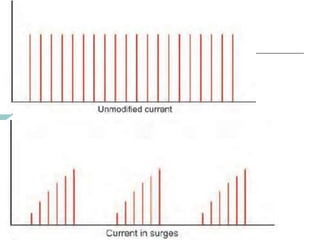
Surged Current
 Intensity of successive impulses
increases gradually, each impulse
reaching a peak value greater than the
preceding one, then falls either
suddenly or gradually in surges
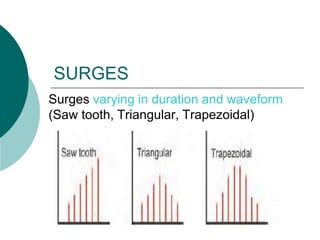
SURGES
Surges varying in duration and waveform
(Saw tooth, Triangular, Trapezoidal)
Advantages:
oIt avoids fatigue
oIt does not give surprise to patient as
current is increases slowly
oContraction of muscle is like
physiological/voluntary contraction
Production
Same principle as interrupted direct current
Values of resistance is low to get short
duration and high frequency
4 functional parts
Power supply
 Oscillator circuit
modulating circuit
Amplifying circuit
Functional parts
oPower supply: battery or AC
oOscillator circuit: Short duration pulses
of 0.1 to 1ms with a frequency of 50 to 100
Hz)
oModulating circuit: Give surged output
varies frequency)
oAmplifying circuit : (increase the output
voltage appropriately)
Originally/True Faradic
Current
Induction coil (Induction Coil, a device for
converting low-voltage direct current (DC)
into high-voltage alternating current (AC).
Two unequal phases
1.Low intensity and long duration
2.High intensity and short duration
Electronic Stimulators
Same physiological effect as original
faradic current
Different waveform
Physiological
Effects
Stimulation of sensory nerves..
 prickling like sensation due to
stimulation of sensory nerves
 cause reflex vasodilation of superficial
blood vessels
 leading to erythema.
Stimulation of motor nerves
If sufficient intensity---cause muscle
contraction, 50 times per second----muscle
fatigue,
surging-----fatigue is due to without intervals
of relaxation)
Effects of muscle
contraction
o Increased metabolism ad pumping action of
muscles
o Electrical stimulation---Muscle contraction—
increased metabolism----increase in demand for
oxygen and food---- increase in waste products
and metabolites-----dilates the capillaries and
arterioles, increase in blood supply to muscle
o Muscle contract and relax---pumping action on
venous and lymphatic return---direct fluid toward
heart.
Stimulation of denervated
muscle
impulse lasting for 1ms and intensity of
current required for producing contraction in
denervated muscle with a faradic current is
too great to be tolerated .
So, its not satisfactory for stimulation of
denervated muscles
On the partially denervated muscles ( to
stimulate partially denervated muscle; higher
intensity than normal muscle is required)
Indications/Therapeutic Uses
• Facilitation of muscle contraction
• Re-education of muscle-action
• Training a new muscle action
• Neuropraxia of a motor nerve
• Diagnostic tool
• Improved venous and lymphatic drainage
Facilitation of muscle
contraction
Muscle contraction---facilitated by faradic current---used
when pt is unable to produce muscle contraction.
Muscle contraction is inhibited by
 Trauma
 Inflammation
 pain
 surgery
Faradic assists in voluntary contraction.
Example: stimulation of quads after meniscectomy
Re-education of muscle-
action
oVoluntary action lost---Prolonged disuse
oIncorrect use (Abductor Hallucis in Hallux
Valgus)
Training a new muscle
action
oAfter surgery ------ new movement pattern
must be established
oDuring stimulation pt should attempt to
perform voluntary contraction.
Neuropraxia of a motor
nerve
o Impulses from the brain are
unable to pass the site of the
lesion
o Voluntary power is lost
Diagnostic Tool
 Innervated muscles will contract in
response to faradic and faradic type
of current at minimal intensity
 Partially innervated muscle will
require more intensity of current
then normal
 Completely denervated muscle
will not respond even at higher
intensity
Methods of application
 Motor point stimulation
 Labile Method
 Nerve Conduction Method
 Bath Method
 Faradism Under Pressure
Motor Point Stimulation
 Involves stimulation of individuals
muscles
 Indifferent electrode is placed at
the origin of muscle
 Active electrode (handle/pen
electrode) is placed at the motor
point
Advantages:
o Each muscle can be
stimulated
o Effect of passive
exercise can be given
to each muscle
o Contraction of individual
muscle can be obtained
o Every muscle can be
stimulated and isolated
muscle contraction
Disadvantages:
 Tedious
 Time consuming
 Difficult to stimulate
the deeply situated
muscle
Labile Method
o It is for stimulation of large muscles
with multiple nerve supply
for example trunk muscles
o Indifferent electrode is placed at
origin of muscle or muscles
o Active electrode in form of either
disc or small plate electrode is
moved over area to be treated
Nerve Conduction Method
 An indifferent electrode is placed at
convenient place
 Active electrode to a point at which
the nerve trunk is superficial
 Stimulate motor nerve trunk
 Contraction of all the muscles that it
supplies
Bath Method
Application of faradic current to the body parts in a
tub, tray or tank containing water
Application of faradic current to foot; faradic footbath
Advantages:
 Skin resistance is lowered
 Perfect contact with tissues
Disadvantages:
 It can not be localized
 Superficial muscles contract to a greater extent
than deeper ones
 Chances of Electric Shocks
Faradism Under Pressure
 Treatment of edema to increase the
venous and lymphatic drainage
 Faradic current is applied along with an
elastic bandage such as elasto cerepe
bandage
 Body part which is to be treated is kept
elevated during the treatment
 15-20 minutes
Uses
o Edema
o After knee surgeries
o Rheumatoid arthritis
o Tendon transplantation
Contra-Indications
o Cardiac Pacemakers
o Impaired sensation
o Impaired mentation (CP)
o Arterial disorders
o Danger of hemorrhage
o Area of defective supply
o Venous disorders (DVT)
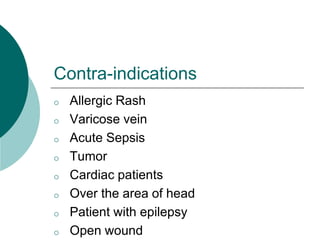
Contra-indications
o Allergic Rash
o Varicose vein
o Acute Sepsis
o Tumor
o Cardiac patients
o Over the area of head
o Patient with epilepsy
o Open wound
faradic current and its effects and stimulations

faradic current and its effects and stimulations

  • 1.
  • 2.
    Contents of Lecture Effectsof Current on body Faradic Current Production Modified Faradic Current Indication & Uses Methods of Application Contra-Indications
  • 3.
    Electric current andbody  Tissue of body ___ capable of transmitting current because Tissue fluid contain ions.  Conductivity of different tissues varies depend on amount of fluid that they contain  Muscles___ Good blood supply  Fat_____ poor conductor  Epidermis ____ high resistance (1000 ohm or more) ___little fluid  In applying electric treatment appropriate measures are used to reduce its resistance
  • 4.
    True Faradic Current Itis an unevenly direct current, with one phase of high amplitude and short duration and the other phase of low amplitude and longer duration Pulse duration__ 1ms Frequency __ 50 Hz
  • 5.
    Faradic-Type Current  Interrupteddirect current  Short duration  Stimulate normal (innervated muscles)  Frequency 50-100 per second  Pulse duration 0.2-1 ms
  • 6.
    Modified Direct current Faradiccurrent can be modified by interruption and surging. In surging, surged duration, frequency, wave form and surged interval are used.
  • 8.
    Tetanic contraction Near Normaltetanic like contraction and relaxation of muscle To produce a tetanic contraction by faradic type of current stimuli must be applied at a rate of at least 30 stimuli per second The strength of muscle contraction depend on the number of motor units bring about into action
  • 9.
    Surged Current  Intensityof successive impulses increases gradually, each impulse reaching a peak value greater than the preceding one, then falls either suddenly or gradually in surges
  • 10.
    SURGES Surges varying induration and waveform (Saw tooth, Triangular, Trapezoidal)
  • 11.
    Advantages: oIt avoids fatigue oItdoes not give surprise to patient as current is increases slowly oContraction of muscle is like physiological/voluntary contraction
  • 12.
    Production Same principle asinterrupted direct current Values of resistance is low to get short duration and high frequency 4 functional parts Power supply  Oscillator circuit modulating circuit Amplifying circuit
  • 13.
    Functional parts oPower supply:battery or AC oOscillator circuit: Short duration pulses of 0.1 to 1ms with a frequency of 50 to 100 Hz) oModulating circuit: Give surged output varies frequency) oAmplifying circuit : (increase the output voltage appropriately)
  • 14.
    Originally/True Faradic Current Induction coil(Induction Coil, a device for converting low-voltage direct current (DC) into high-voltage alternating current (AC). Two unequal phases 1.Low intensity and long duration 2.High intensity and short duration
  • 15.
    Electronic Stimulators Same physiologicaleffect as original faradic current Different waveform
  • 16.
  • 17.
    Stimulation of sensorynerves..  prickling like sensation due to stimulation of sensory nerves  cause reflex vasodilation of superficial blood vessels  leading to erythema.
  • 18.
    Stimulation of motornerves If sufficient intensity---cause muscle contraction, 50 times per second----muscle fatigue, surging-----fatigue is due to without intervals of relaxation)
  • 19.
    Effects of muscle contraction oIncreased metabolism ad pumping action of muscles o Electrical stimulation---Muscle contraction— increased metabolism----increase in demand for oxygen and food---- increase in waste products and metabolites-----dilates the capillaries and arterioles, increase in blood supply to muscle o Muscle contract and relax---pumping action on venous and lymphatic return---direct fluid toward heart.
  • 20.
    Stimulation of denervated muscle impulselasting for 1ms and intensity of current required for producing contraction in denervated muscle with a faradic current is too great to be tolerated . So, its not satisfactory for stimulation of denervated muscles On the partially denervated muscles ( to stimulate partially denervated muscle; higher intensity than normal muscle is required)
  • 21.
    Indications/Therapeutic Uses • Facilitationof muscle contraction • Re-education of muscle-action • Training a new muscle action • Neuropraxia of a motor nerve • Diagnostic tool • Improved venous and lymphatic drainage
  • 22.
    Facilitation of muscle contraction Musclecontraction---facilitated by faradic current---used when pt is unable to produce muscle contraction. Muscle contraction is inhibited by  Trauma  Inflammation  pain  surgery Faradic assists in voluntary contraction. Example: stimulation of quads after meniscectomy
  • 23.
    Re-education of muscle- action oVoluntaryaction lost---Prolonged disuse oIncorrect use (Abductor Hallucis in Hallux Valgus)
  • 24.
    Training a newmuscle action oAfter surgery ------ new movement pattern must be established oDuring stimulation pt should attempt to perform voluntary contraction.
  • 25.
    Neuropraxia of amotor nerve o Impulses from the brain are unable to pass the site of the lesion o Voluntary power is lost
  • 26.
    Diagnostic Tool  Innervatedmuscles will contract in response to faradic and faradic type of current at minimal intensity  Partially innervated muscle will require more intensity of current then normal  Completely denervated muscle will not respond even at higher intensity
  • 27.
    Methods of application Motor point stimulation  Labile Method  Nerve Conduction Method  Bath Method  Faradism Under Pressure
  • 28.
    Motor Point Stimulation Involves stimulation of individuals muscles  Indifferent electrode is placed at the origin of muscle  Active electrode (handle/pen electrode) is placed at the motor point
  • 29.
    Advantages: o Each musclecan be stimulated o Effect of passive exercise can be given to each muscle o Contraction of individual muscle can be obtained o Every muscle can be stimulated and isolated muscle contraction Disadvantages:  Tedious  Time consuming  Difficult to stimulate the deeply situated muscle
  • 30.
    Labile Method o Itis for stimulation of large muscles with multiple nerve supply for example trunk muscles o Indifferent electrode is placed at origin of muscle or muscles o Active electrode in form of either disc or small plate electrode is moved over area to be treated
  • 31.
    Nerve Conduction Method An indifferent electrode is placed at convenient place  Active electrode to a point at which the nerve trunk is superficial  Stimulate motor nerve trunk  Contraction of all the muscles that it supplies
  • 32.
    Bath Method Application offaradic current to the body parts in a tub, tray or tank containing water Application of faradic current to foot; faradic footbath Advantages:  Skin resistance is lowered  Perfect contact with tissues Disadvantages:  It can not be localized  Superficial muscles contract to a greater extent than deeper ones  Chances of Electric Shocks
  • 33.
    Faradism Under Pressure Treatment of edema to increase the venous and lymphatic drainage  Faradic current is applied along with an elastic bandage such as elasto cerepe bandage  Body part which is to be treated is kept elevated during the treatment  15-20 minutes
  • 34.
    Uses o Edema o Afterknee surgeries o Rheumatoid arthritis o Tendon transplantation
  • 35.
    Contra-Indications o Cardiac Pacemakers oImpaired sensation o Impaired mentation (CP) o Arterial disorders o Danger of hemorrhage o Area of defective supply o Venous disorders (DVT)
  • 36.
    Contra-indications o Allergic Rash oVaricose vein o Acute Sepsis o Tumor o Cardiac patients o Over the area of head o Patient with epilepsy o Open wound