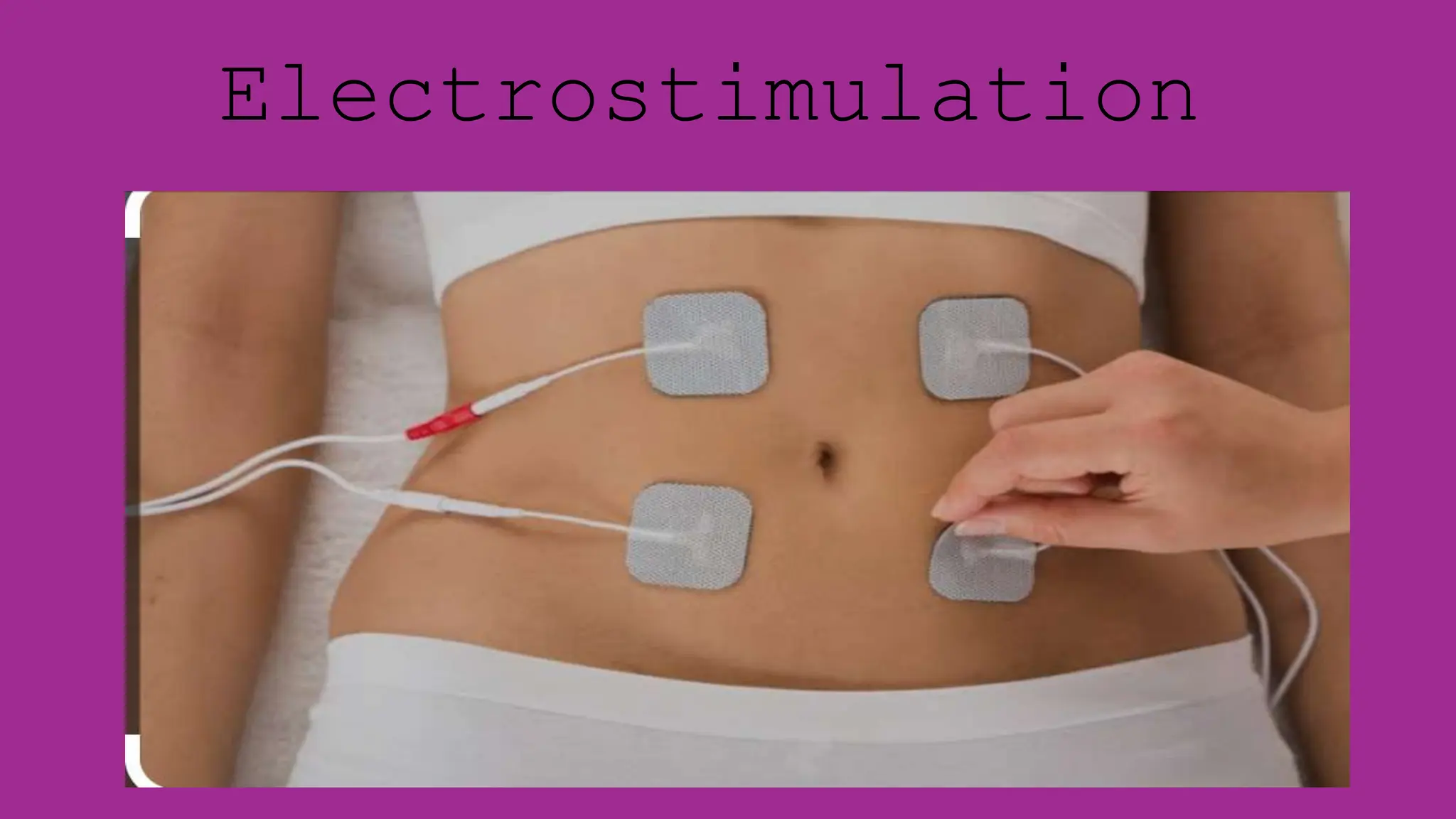
Electrostimulation
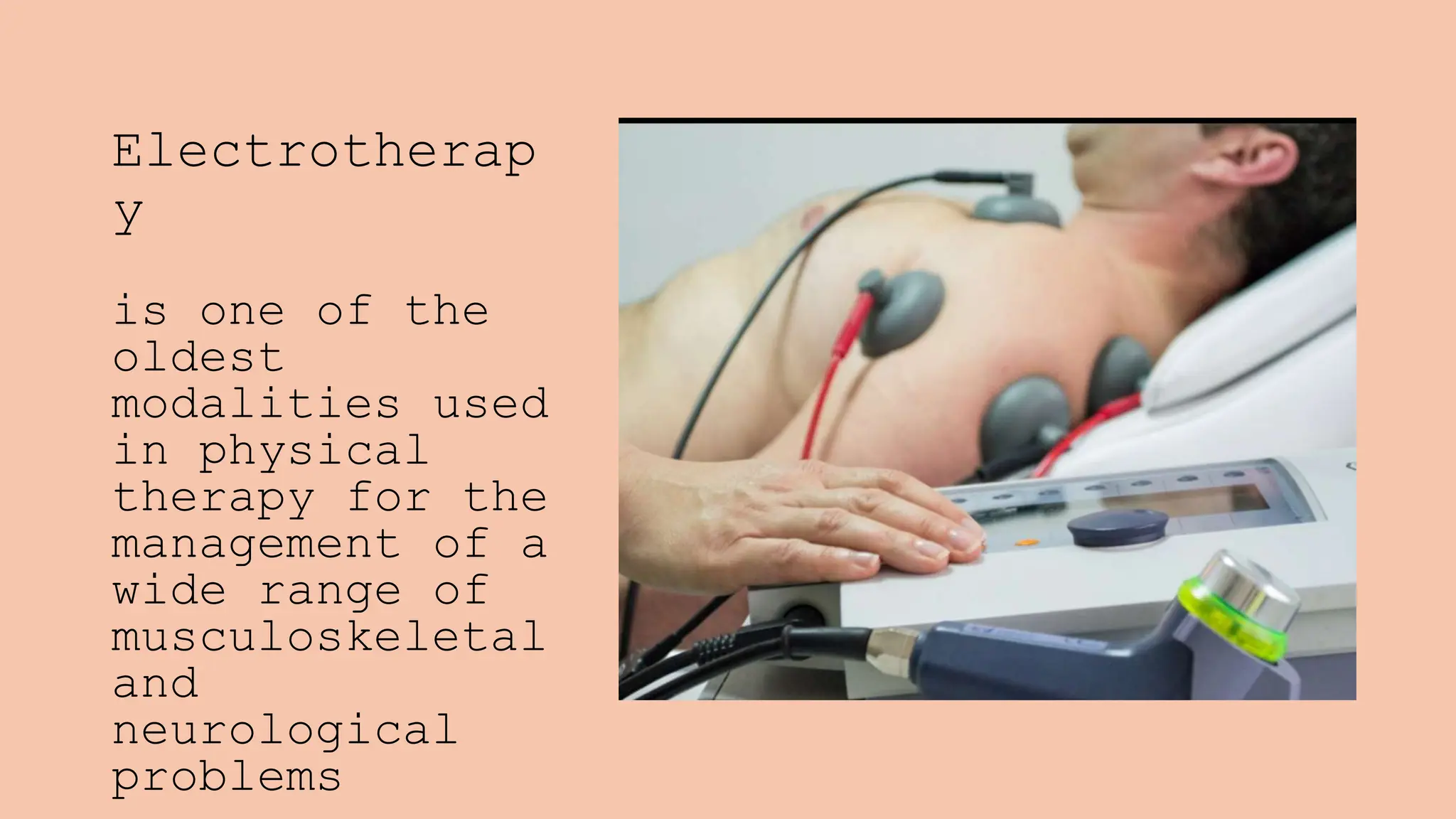
Electrotherap
y
is one of the
oldest
modalities used
in physical
therapy for the
management of a
wide range of
musculoskeletal
and
neurological
problems
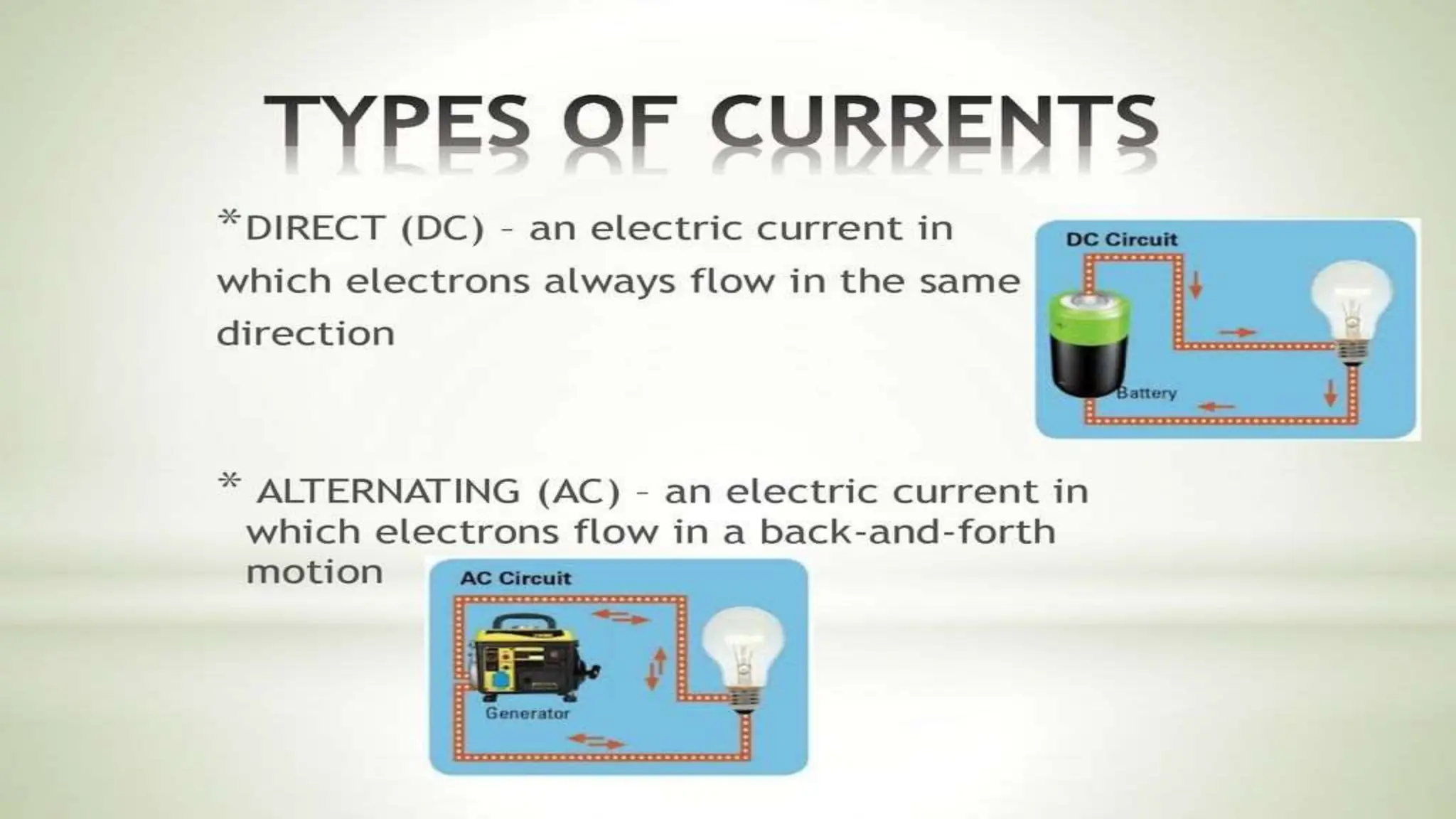
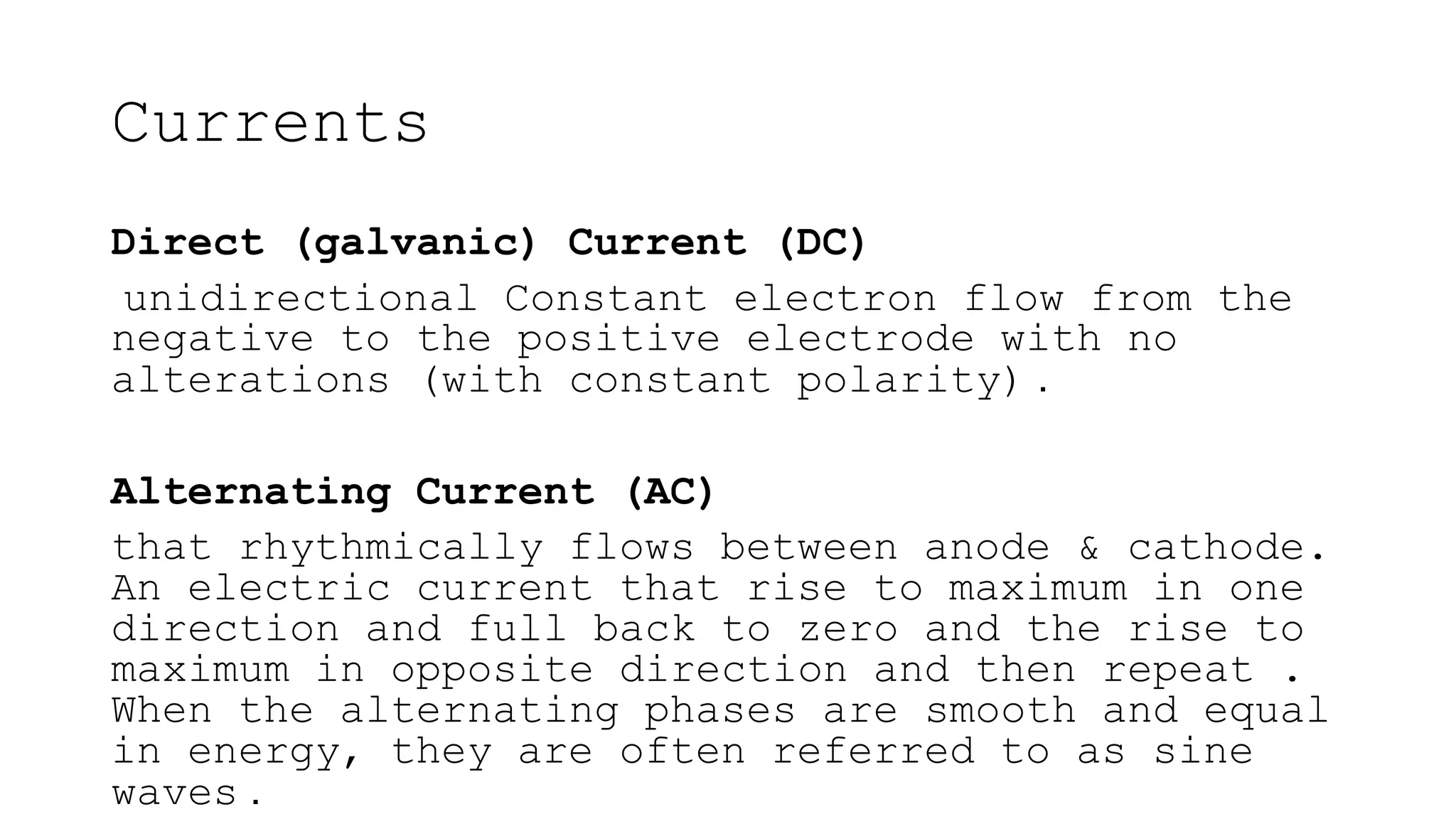
Direct (galvanic) Current (DC)
unidirectional Constant electron flow from the
negative to the positive electrode with no
alterations (with constant polarity) .
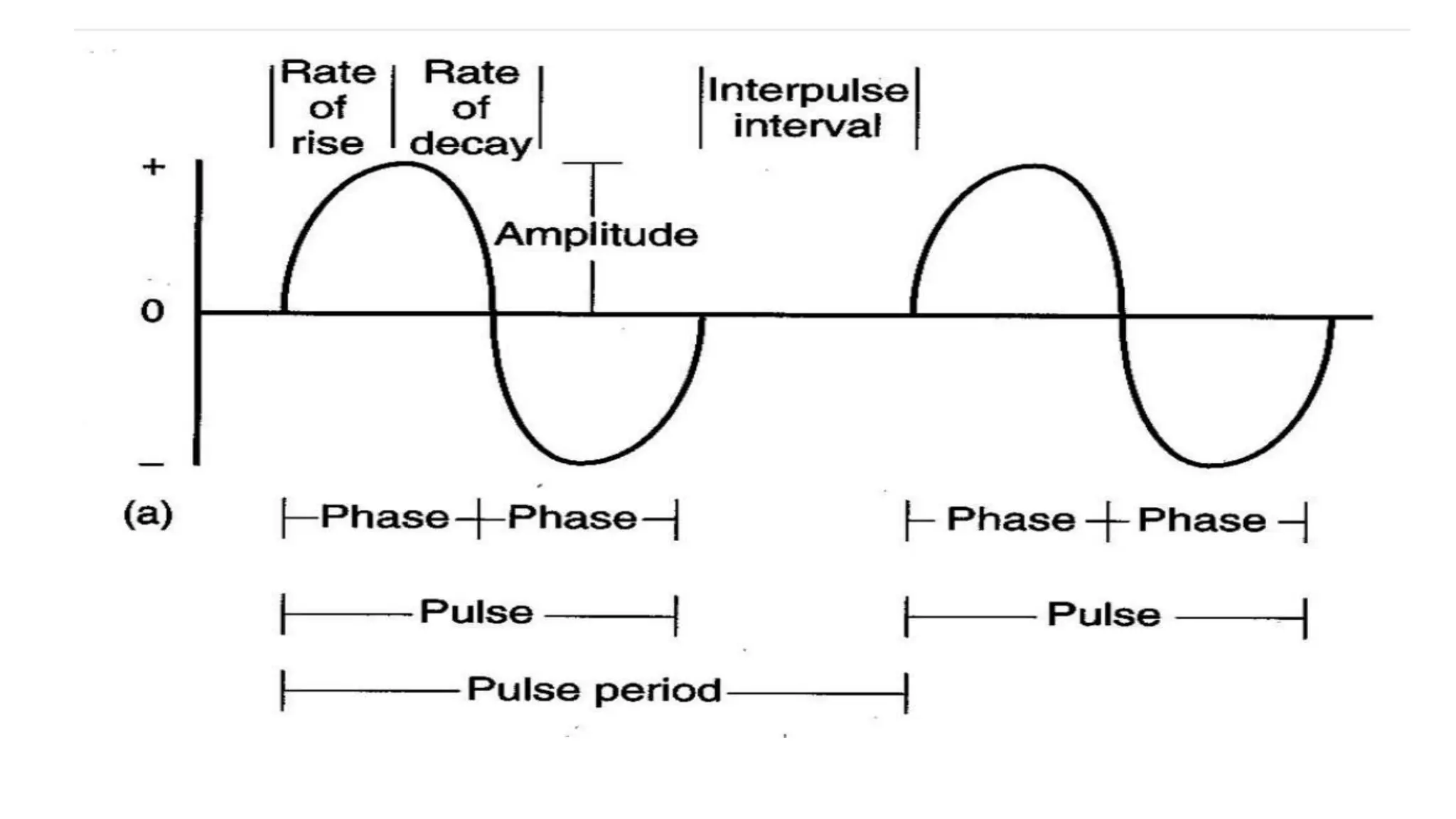
Alternating Current (AC)
that rhythmically flows between anode & cathode.
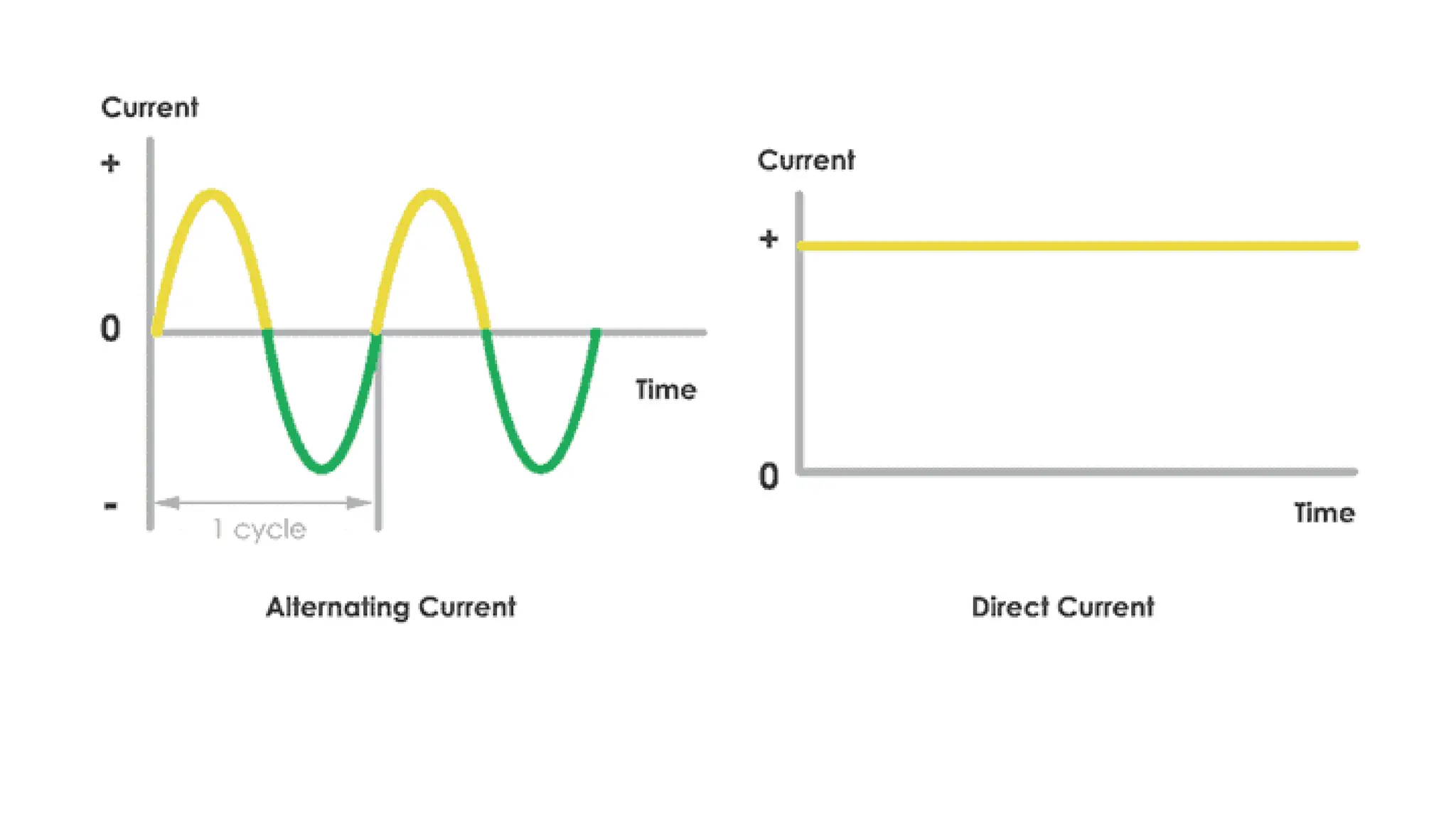
An electric current that rise to maximum in one
direction and full back to zero and the rise to
maximum in opposite direction and then repeat .
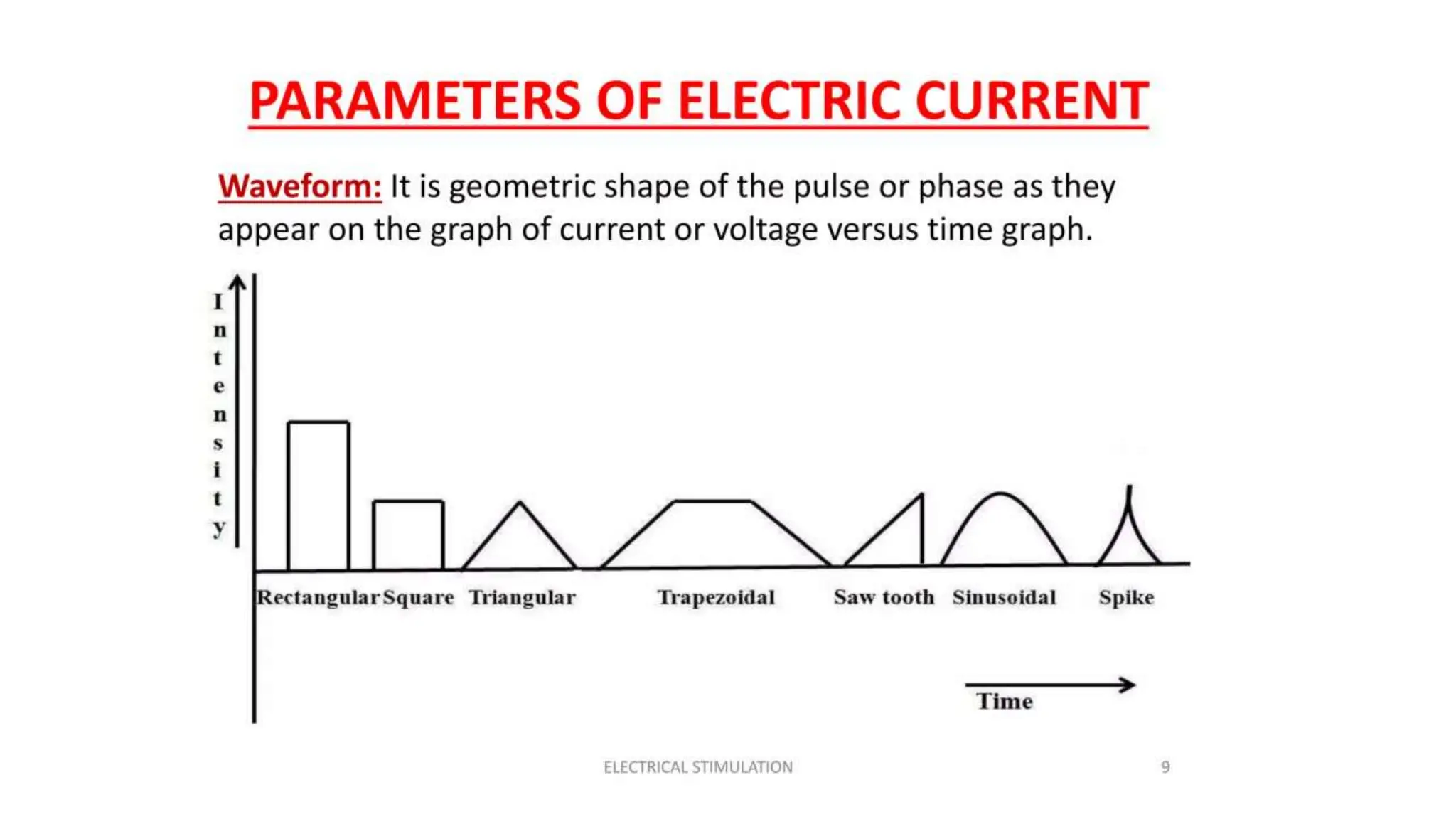
When the alternating phases are smooth and equal
in energy, they are often referred to as sine
waves .
Currents
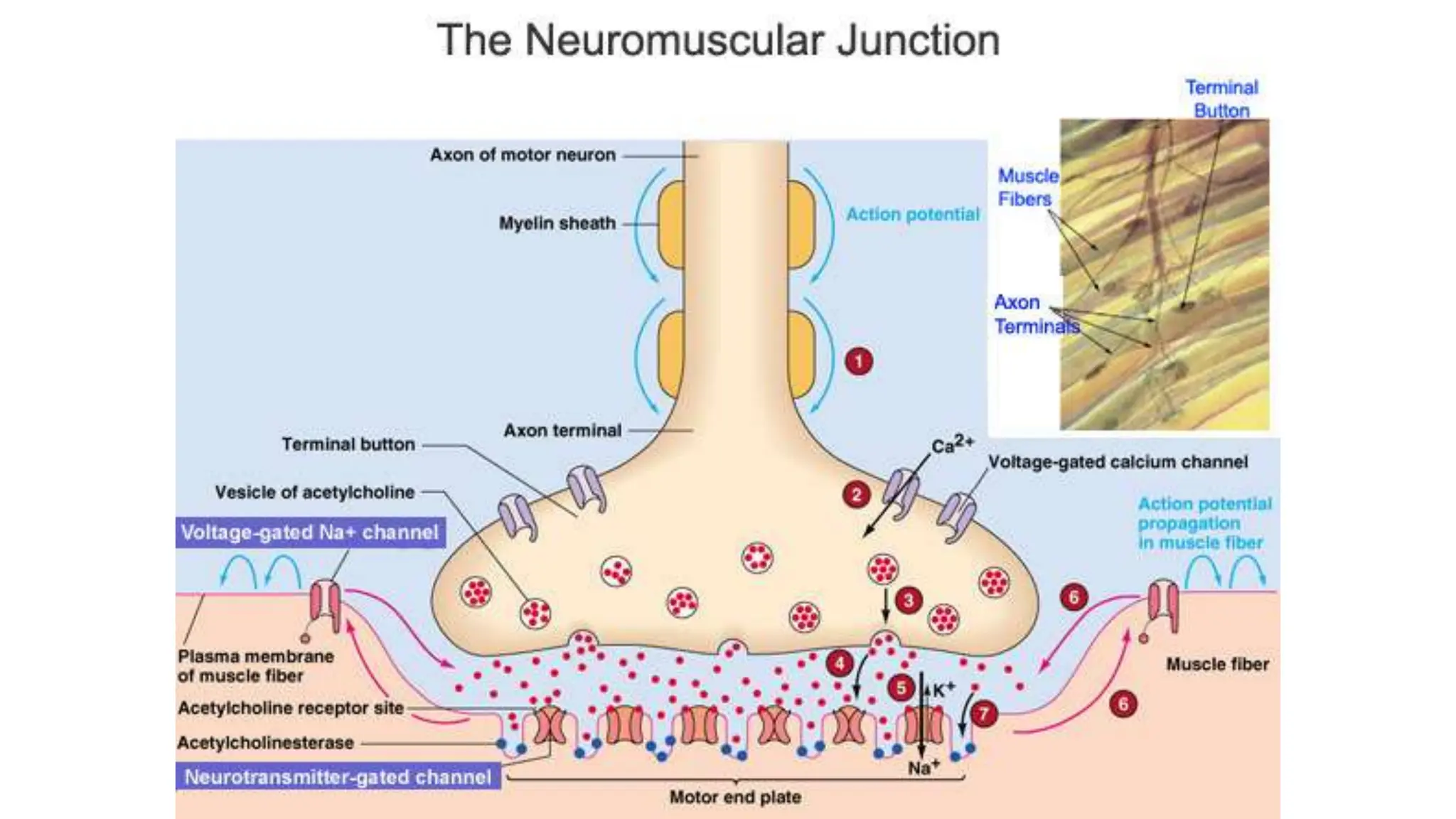
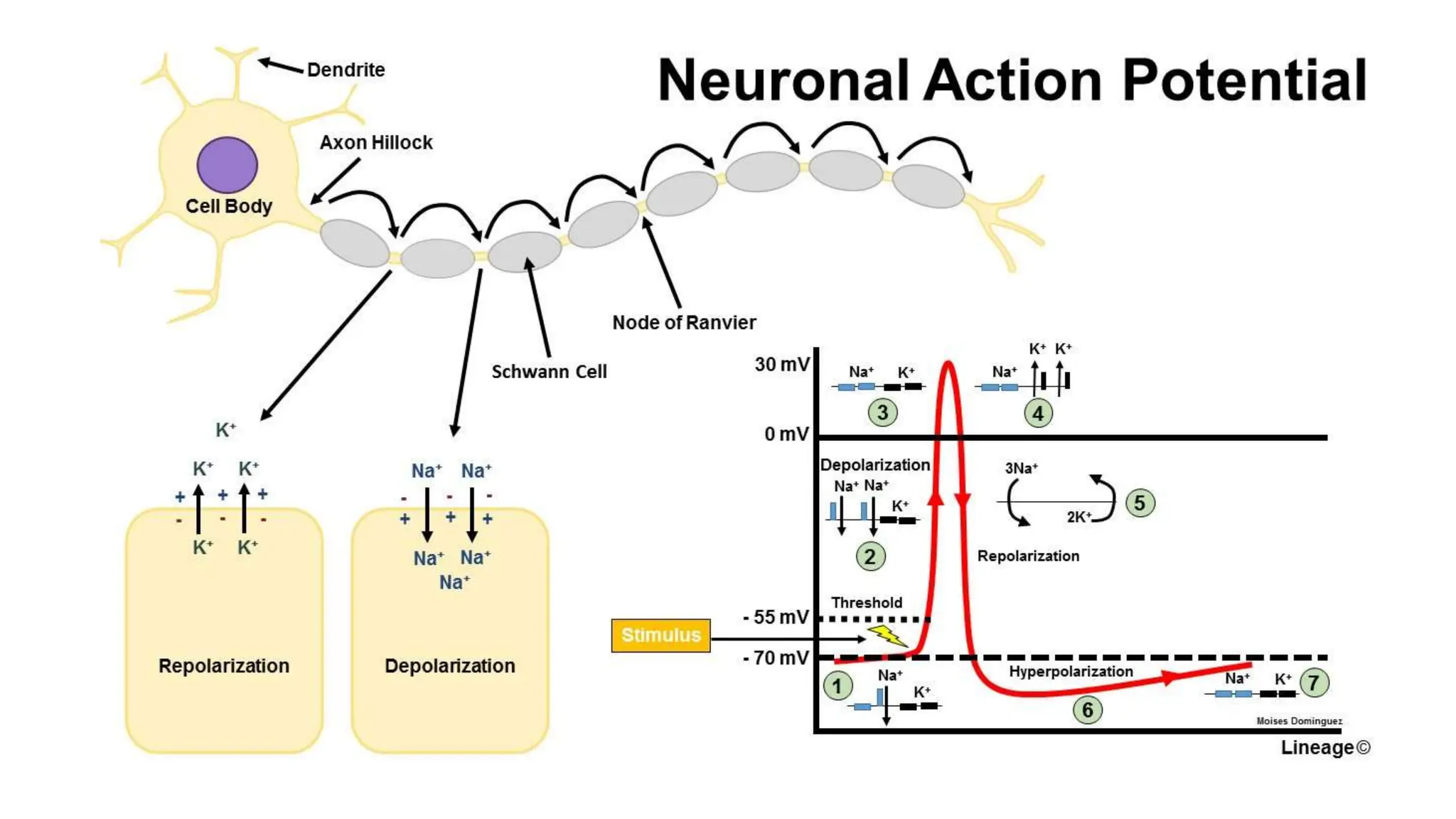
Physiology
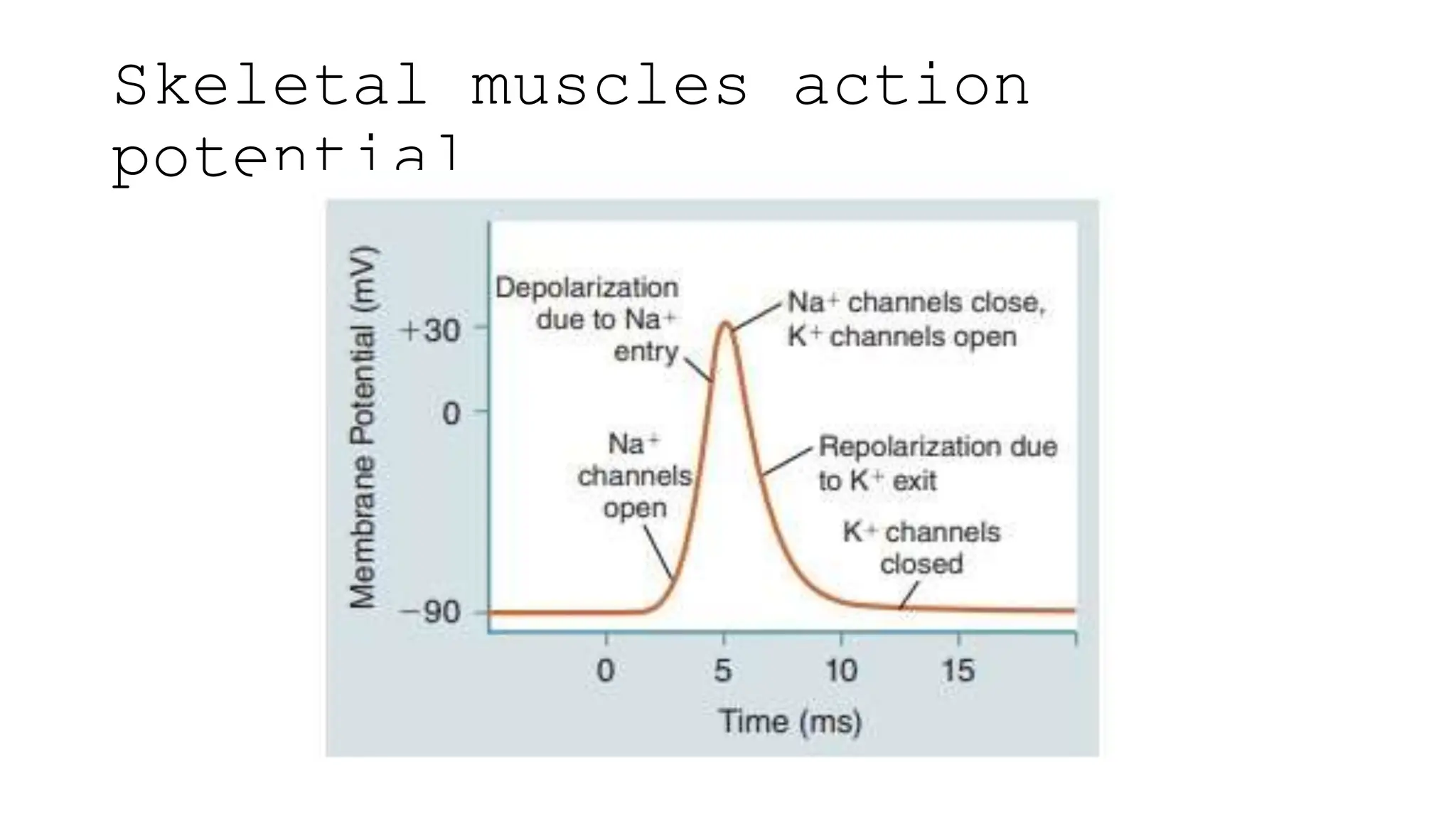
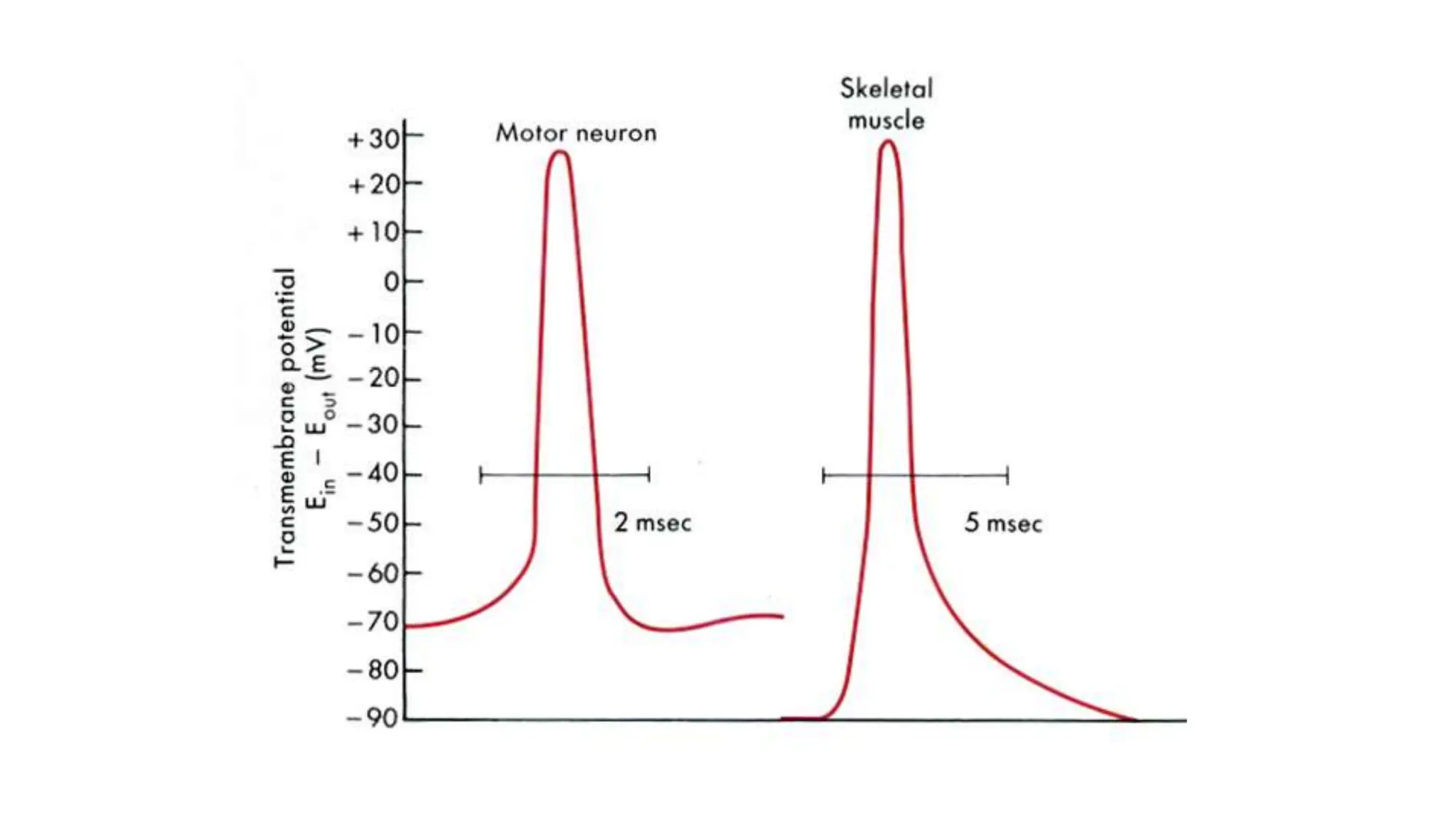
Skeletal muscles action
potential
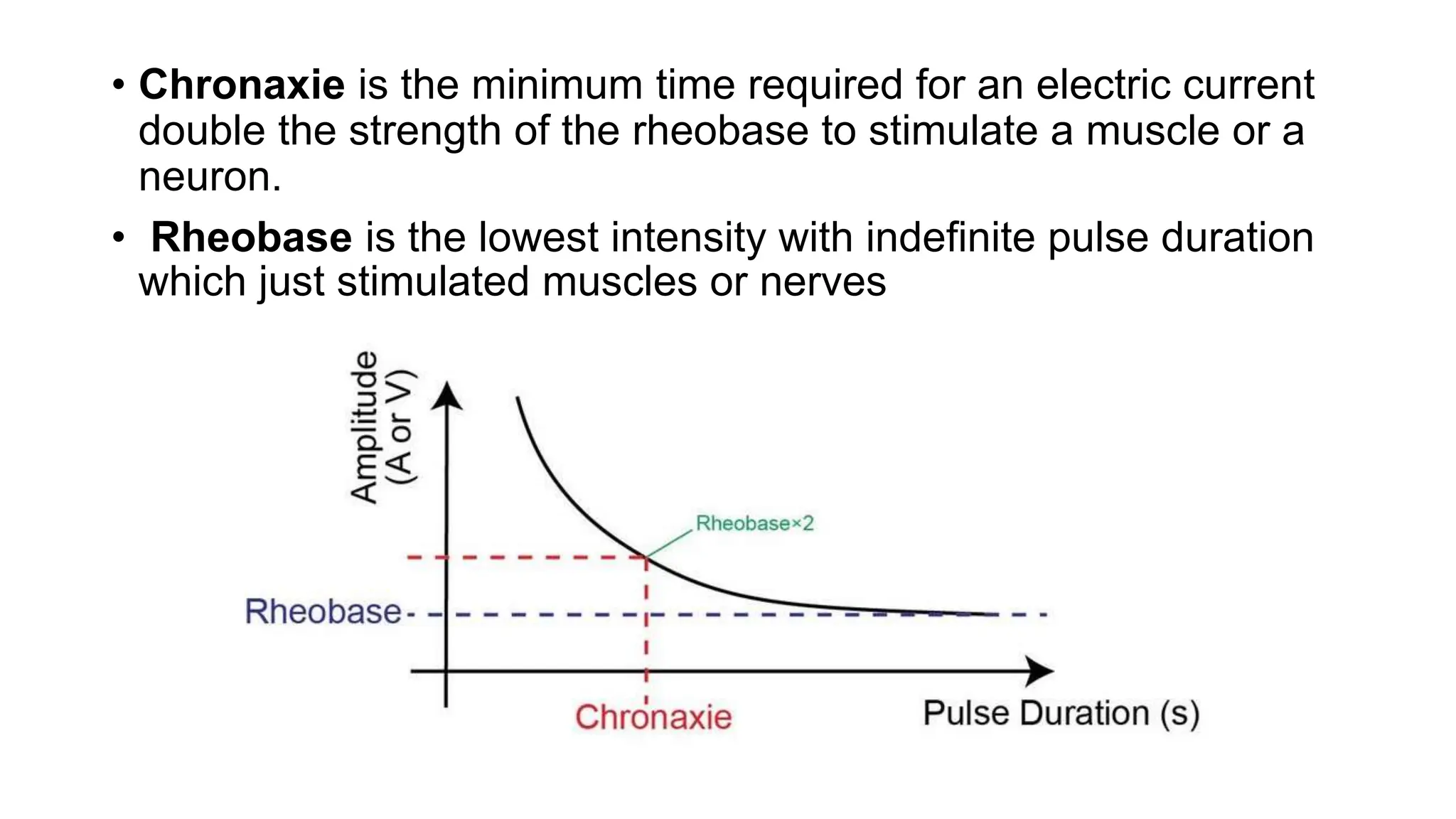
• Chronaxie is the minimum time required for an electric current
double the strength of the rheobase to stimulate a muscle or a
neuron.
• Rheobase is the lowest intensity with indefinite pulse duration
which just stimulated muscles or nerves
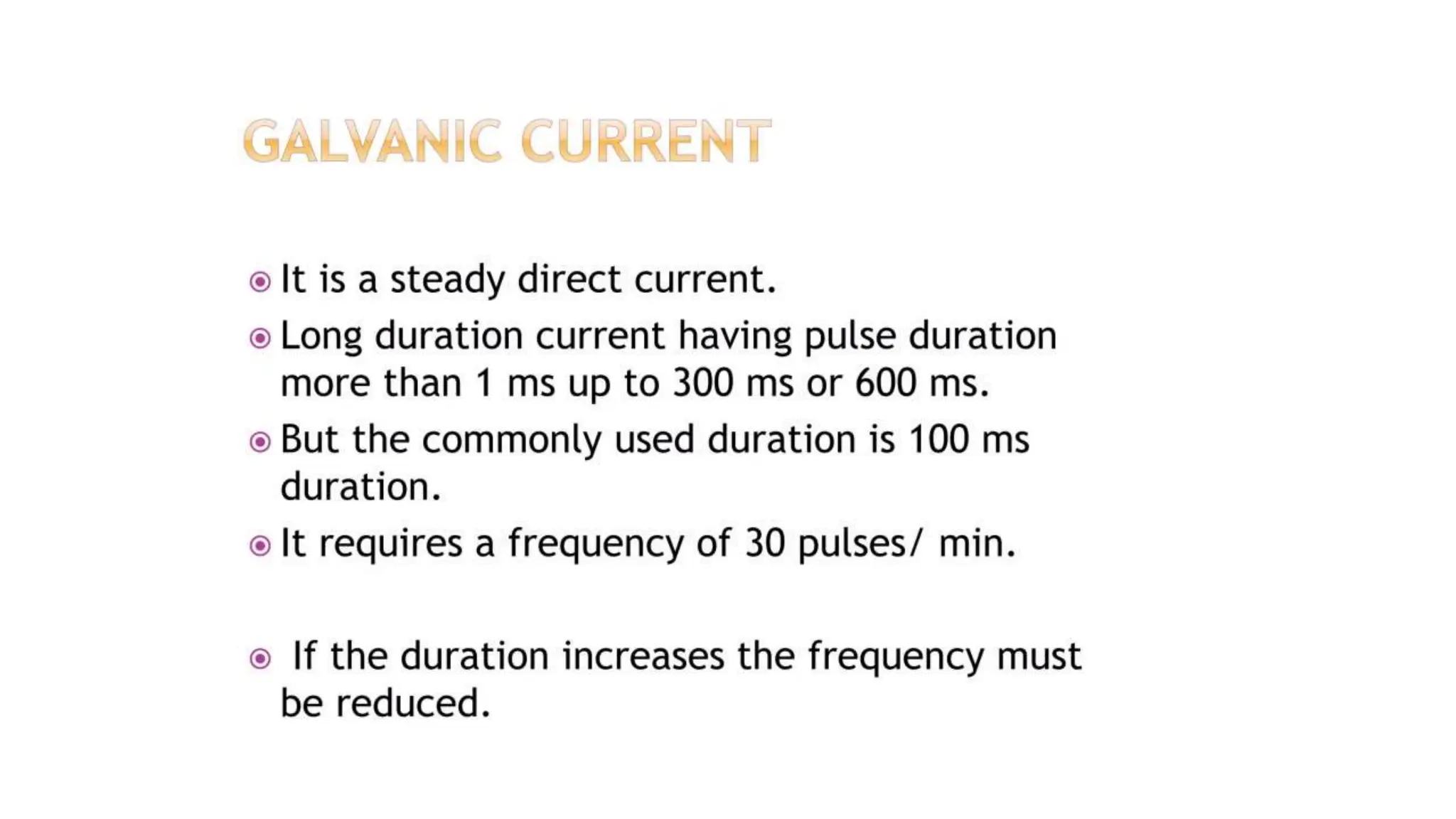
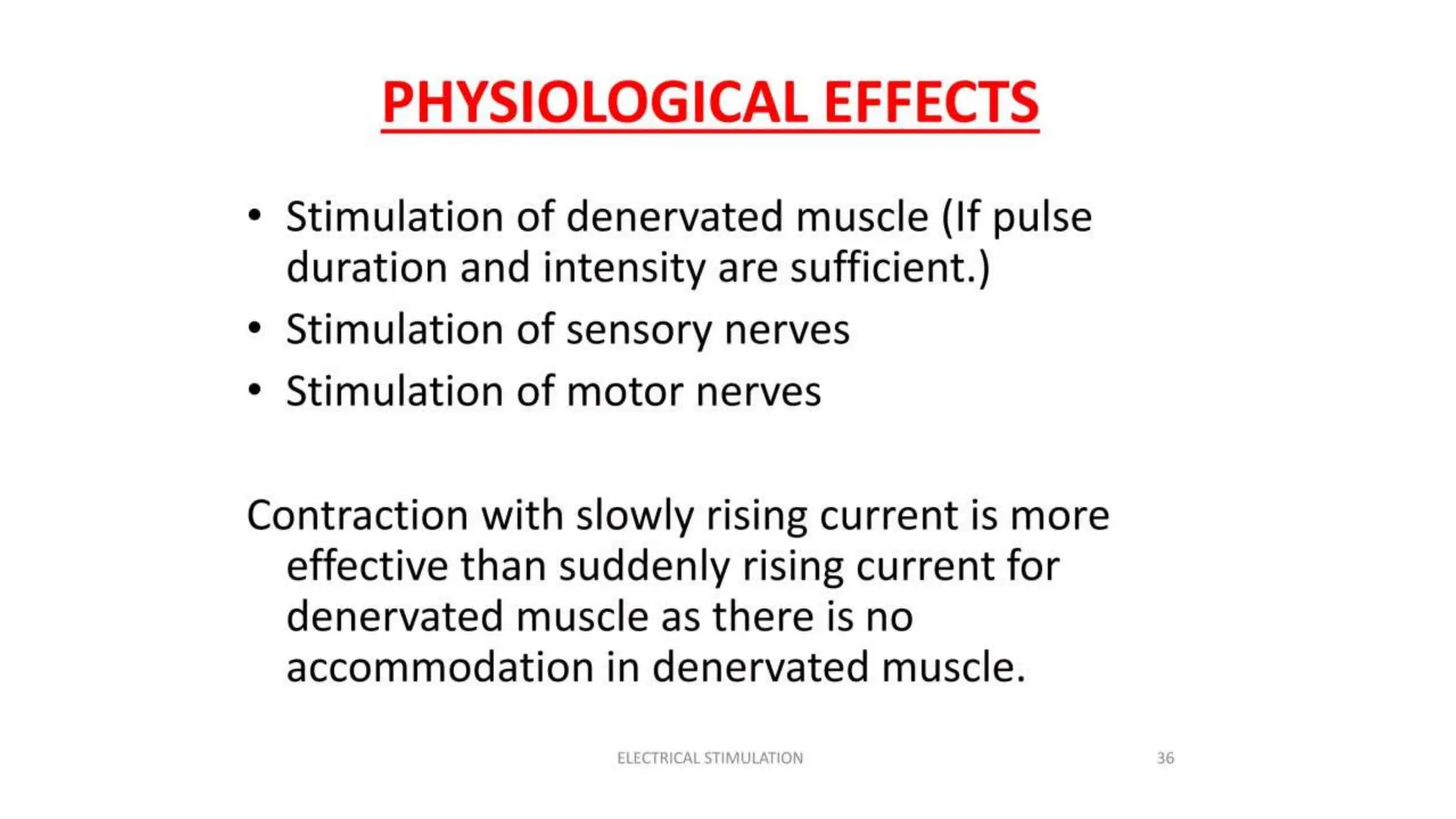
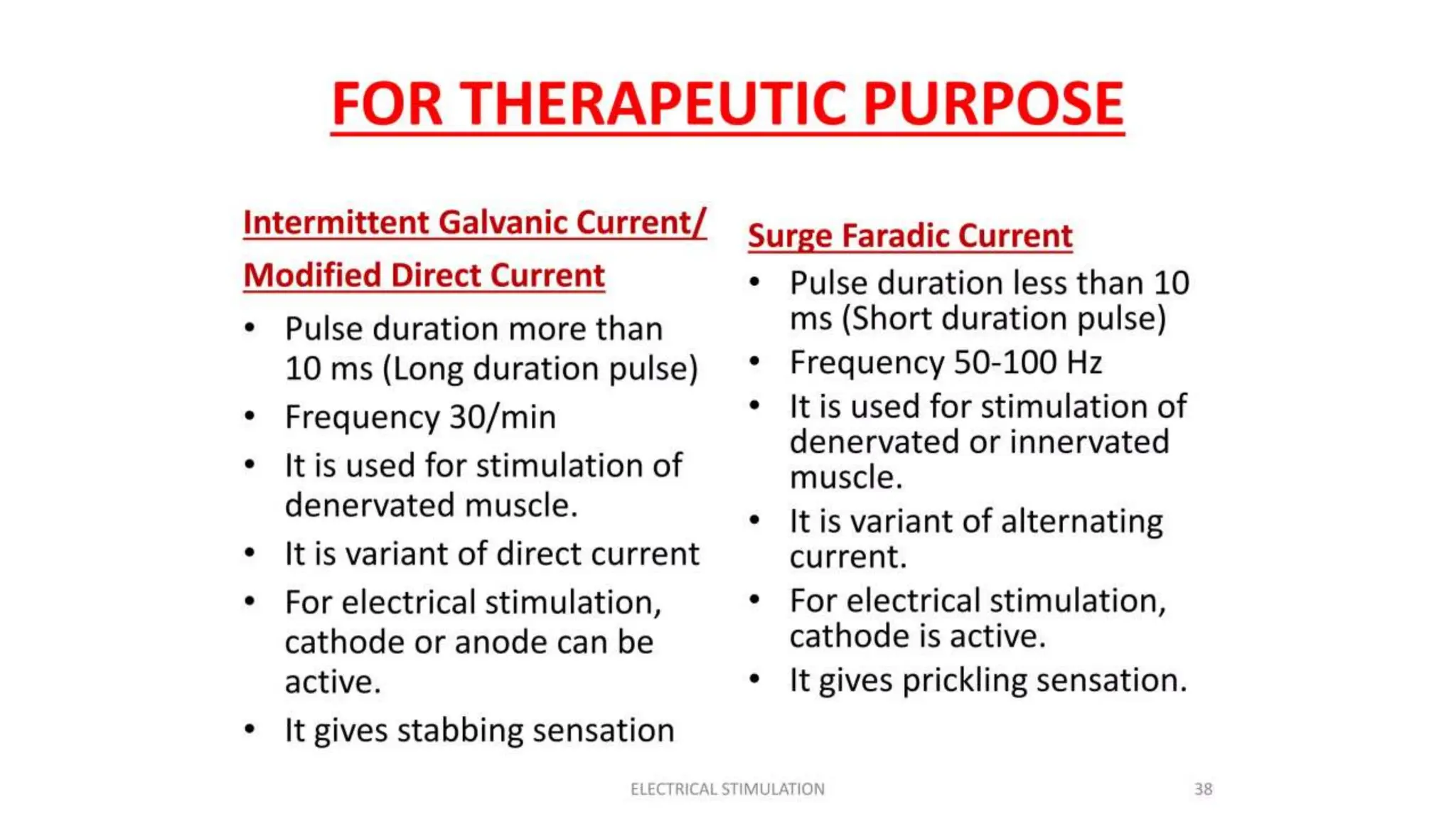
Galvanic current
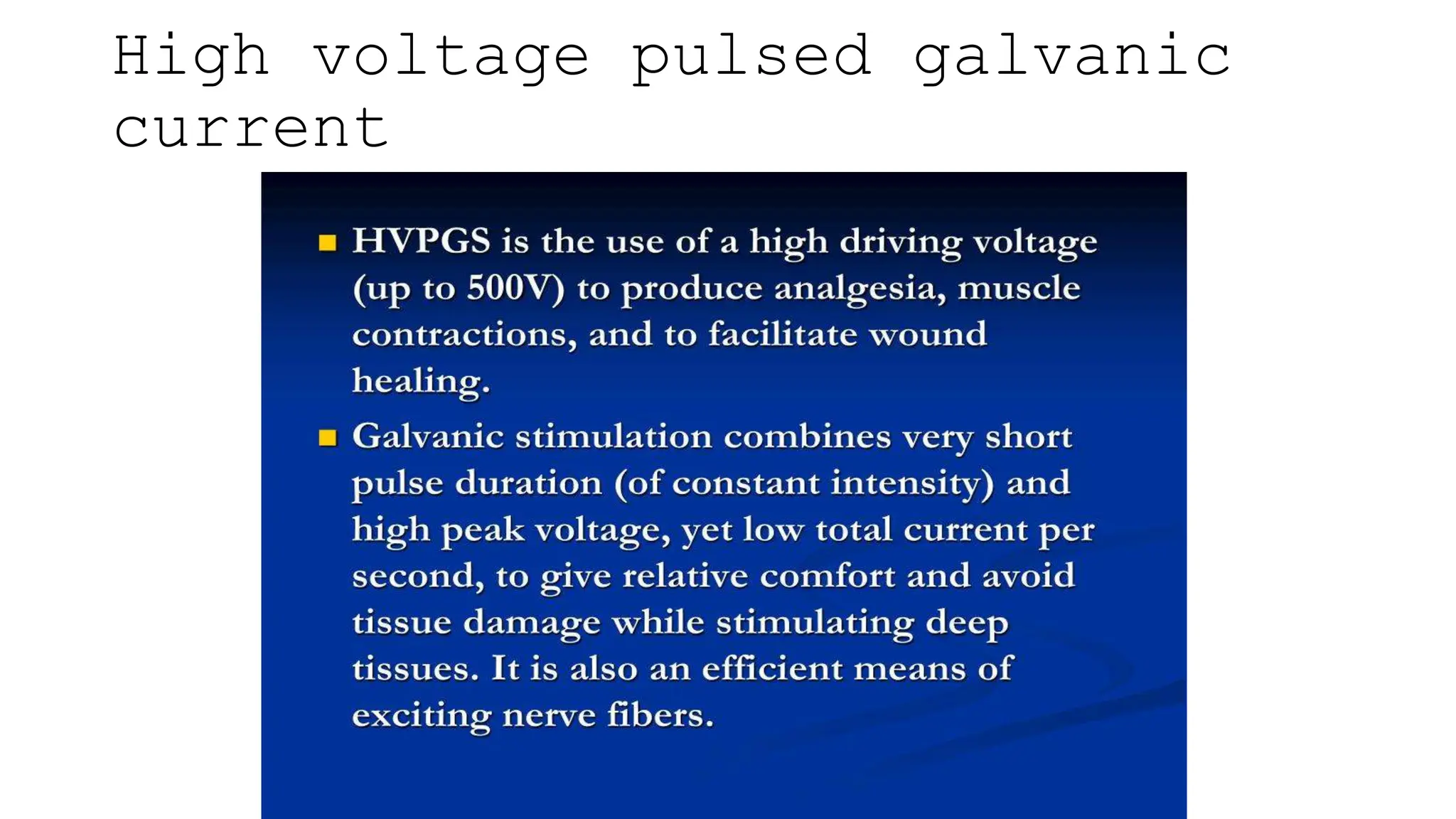
High voltage pulsed galvanic
current
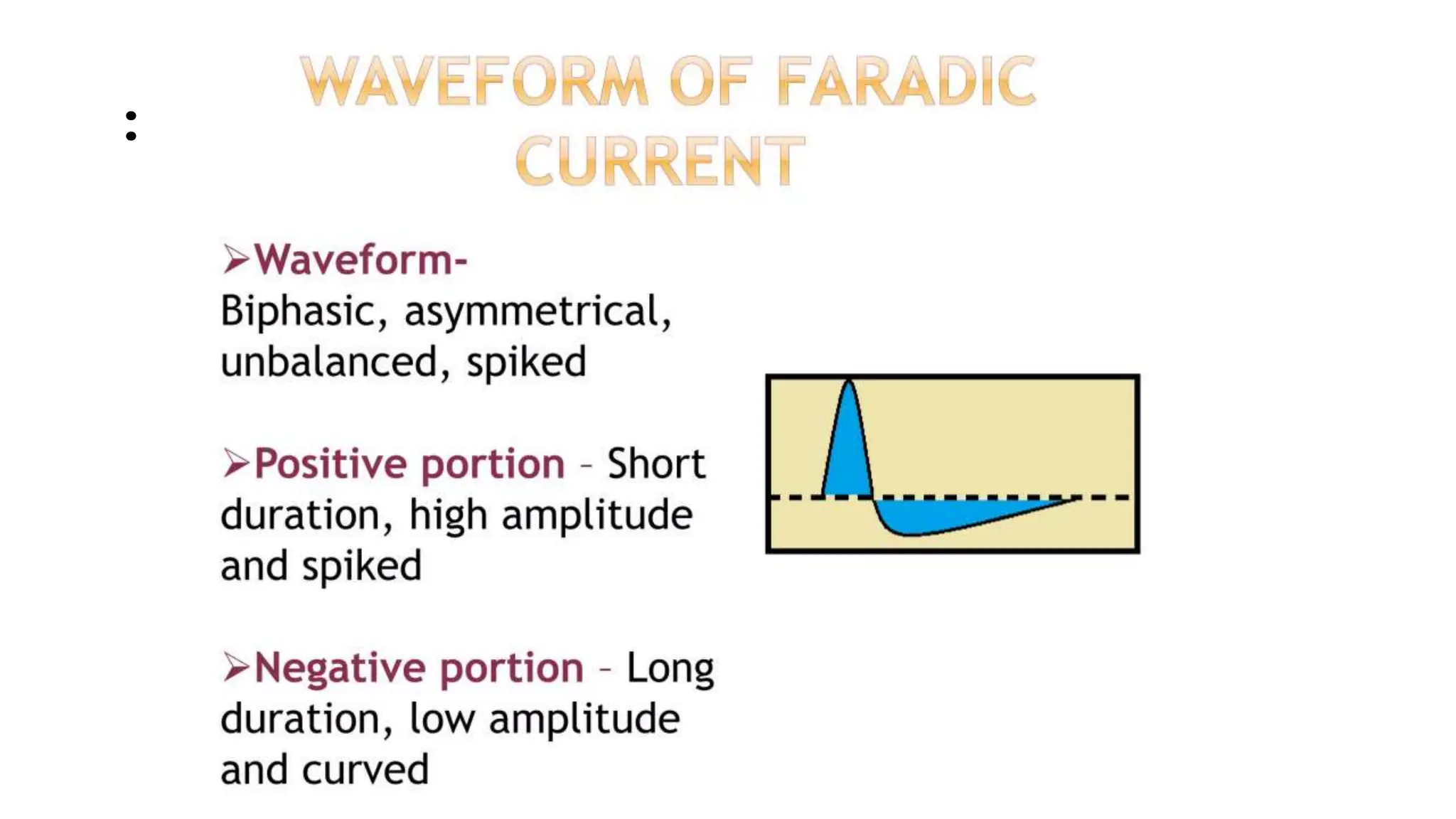
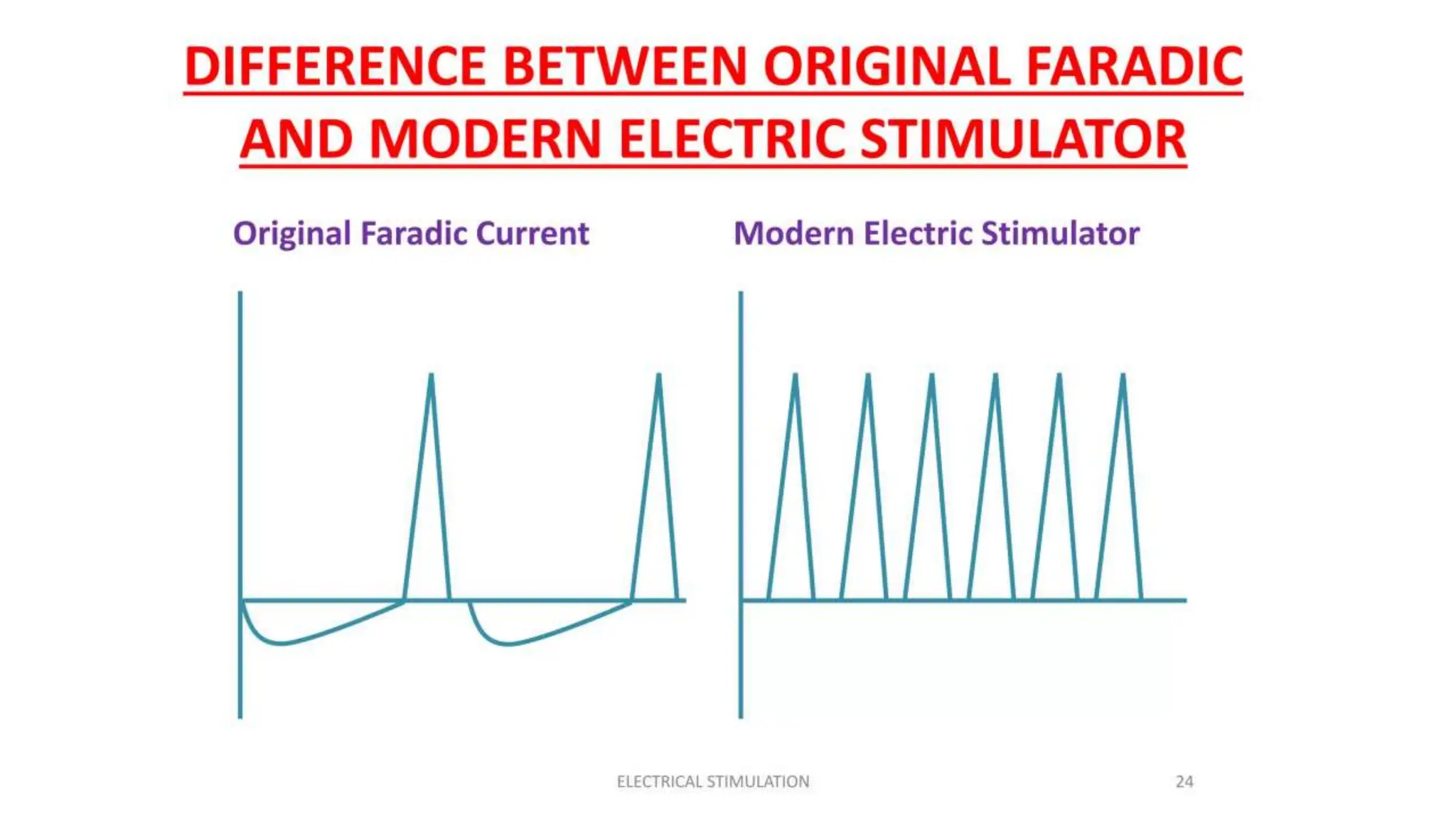
Faradic current
:
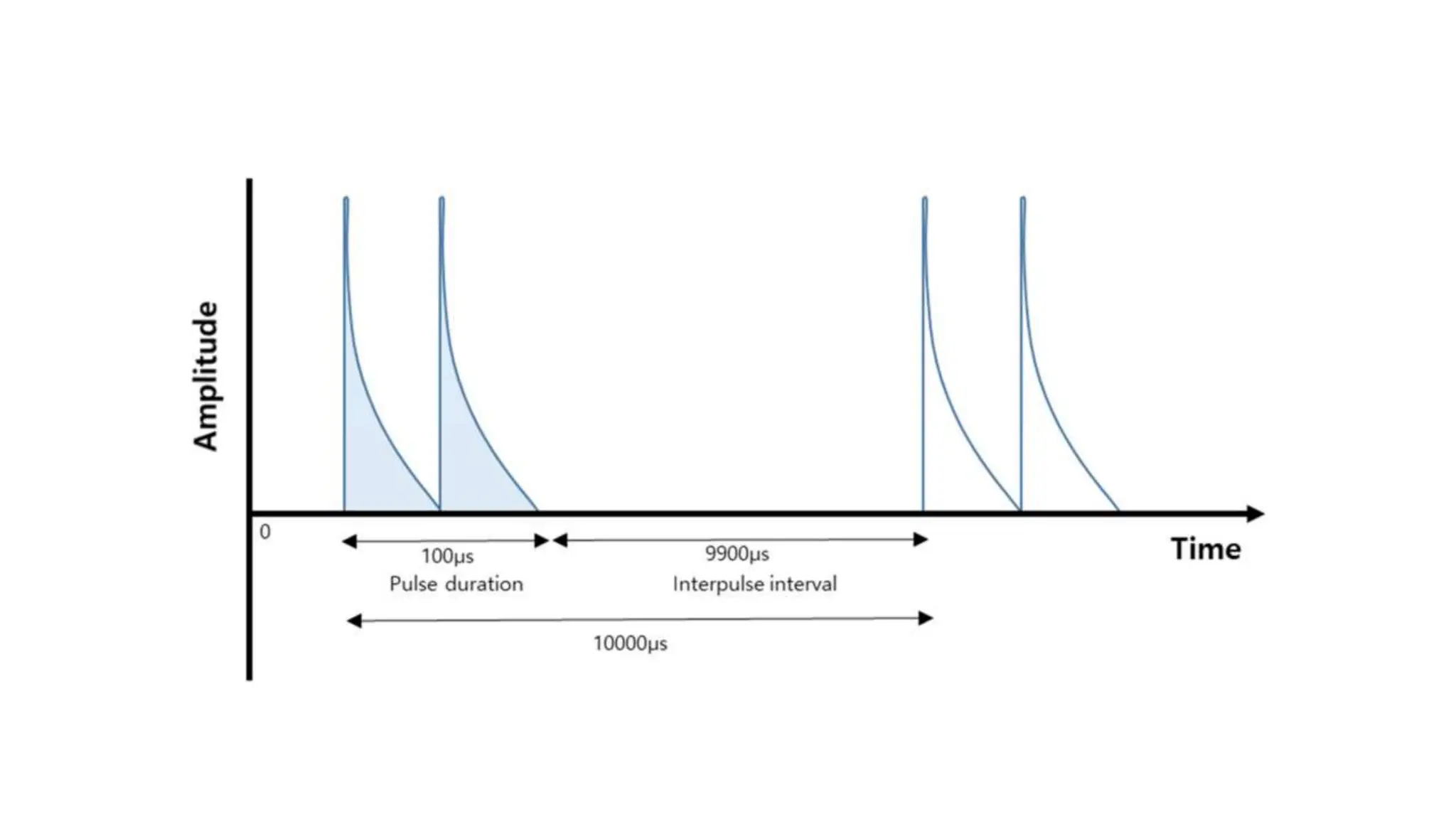
Burst AC
Created by flow of
current for a few
milliseconds and then
stop to flow (inter burst
interval or pause period)
and repeat cycle again.
The clinical example of
burst modulation is
Russian Current.
Interrupted AC
Done when the current flow for few seconds then
stop to flow for 1 second or more. This
interrupted AC is differ from burst AC because
the inter-pulse interval is longer than the
inter burst interval and this is an advantage
for the interrupted AC because it permits
relaxation from muscle contraction .
The most common example of amplitude modulated
AC is to mix two AC current with different
frequency, and known as interferential current
(IFC) .
Tissue response to
electrostimulation
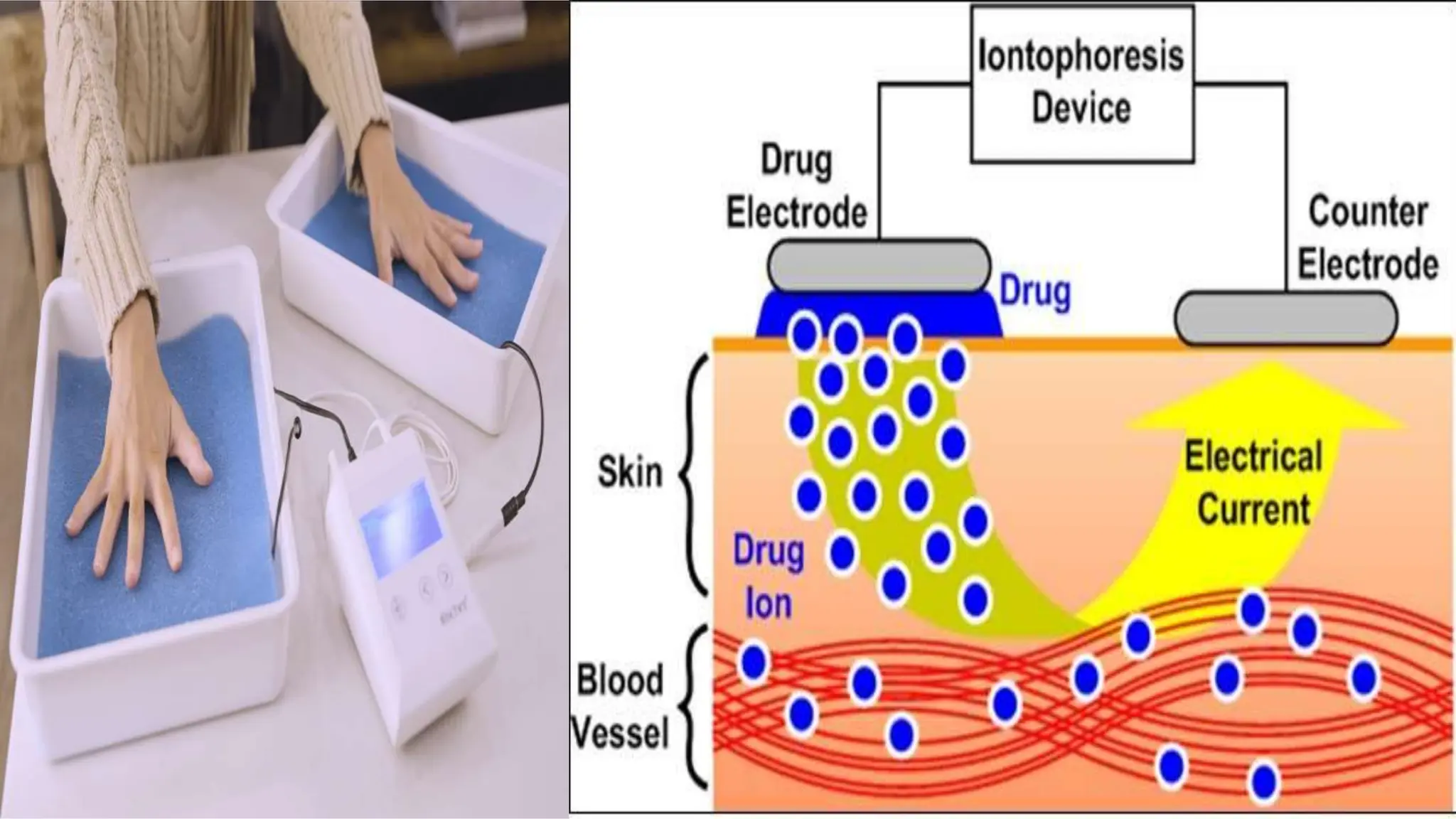
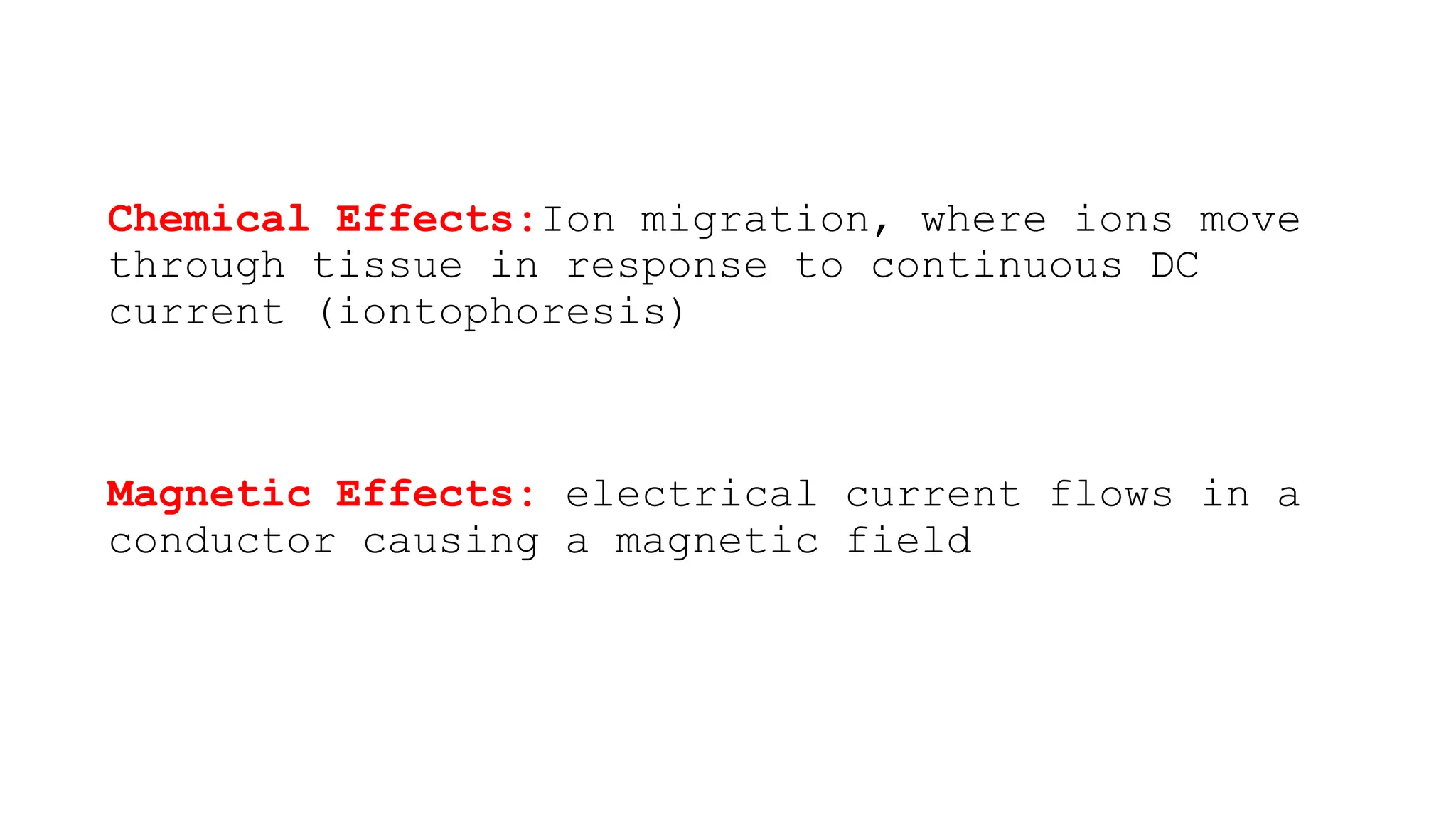
Chemical Effects:Ion migration, where ions move
through tissue in response to continuous DC
current (iontophoresis)
Magnetic Effects: electrical current flows in a
conductor causing a magnetic field
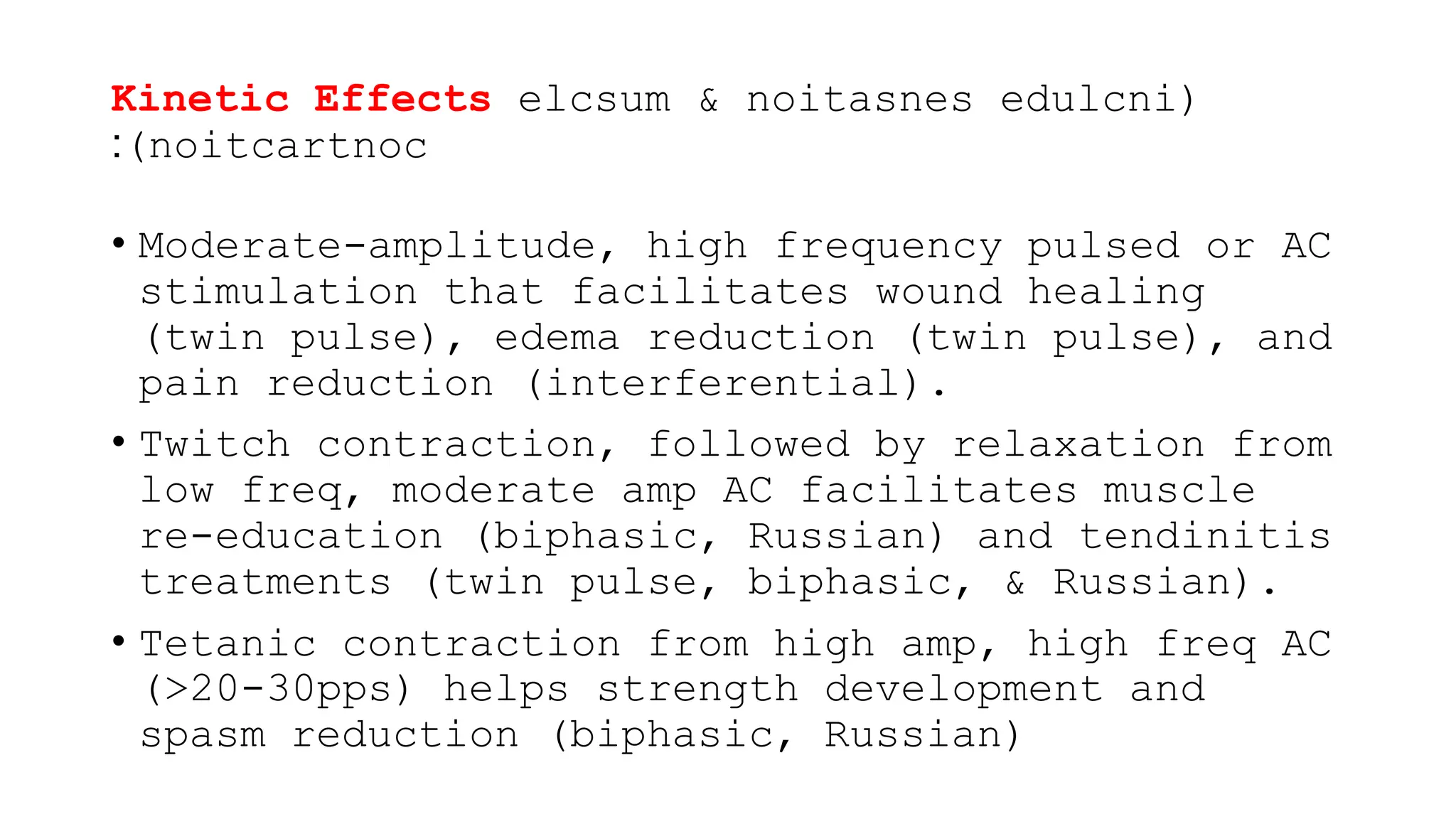
Kinetic Effects elcsum & noitasnes edulcni(
)noitcartnoc
:
• Moderate-amplitude, high frequency pulsed or AC
stimulation that facilitates wound healing
(twin pulse), edema reduction (twin pulse), and
pain reduction (interferential).
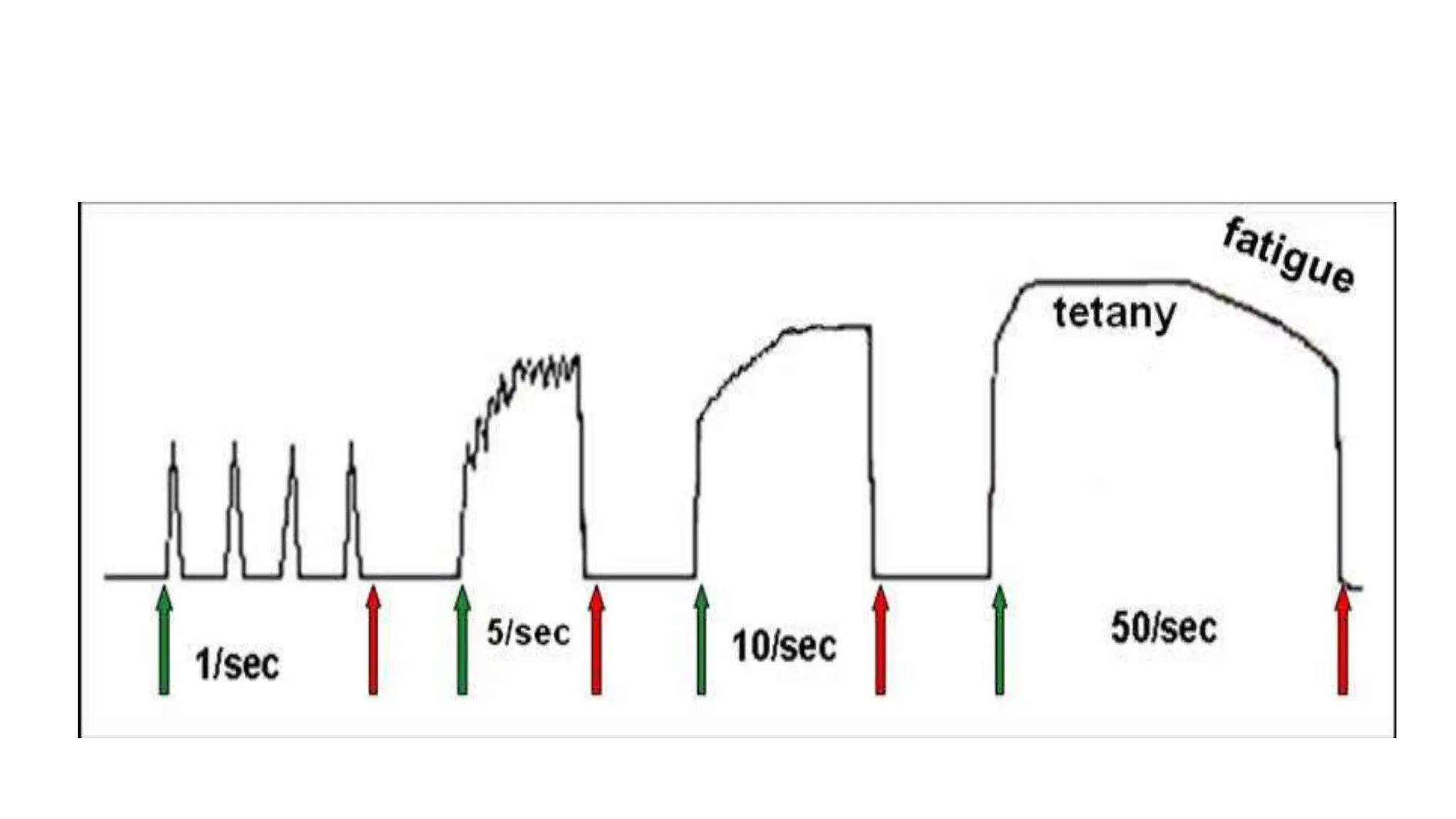
• Twitch contraction, followed by relaxation from
low freq, moderate amp AC facilitates muscle
re-education (biphasic, Russian) and tendinitis
treatments (twin pulse, biphasic, & Russian).
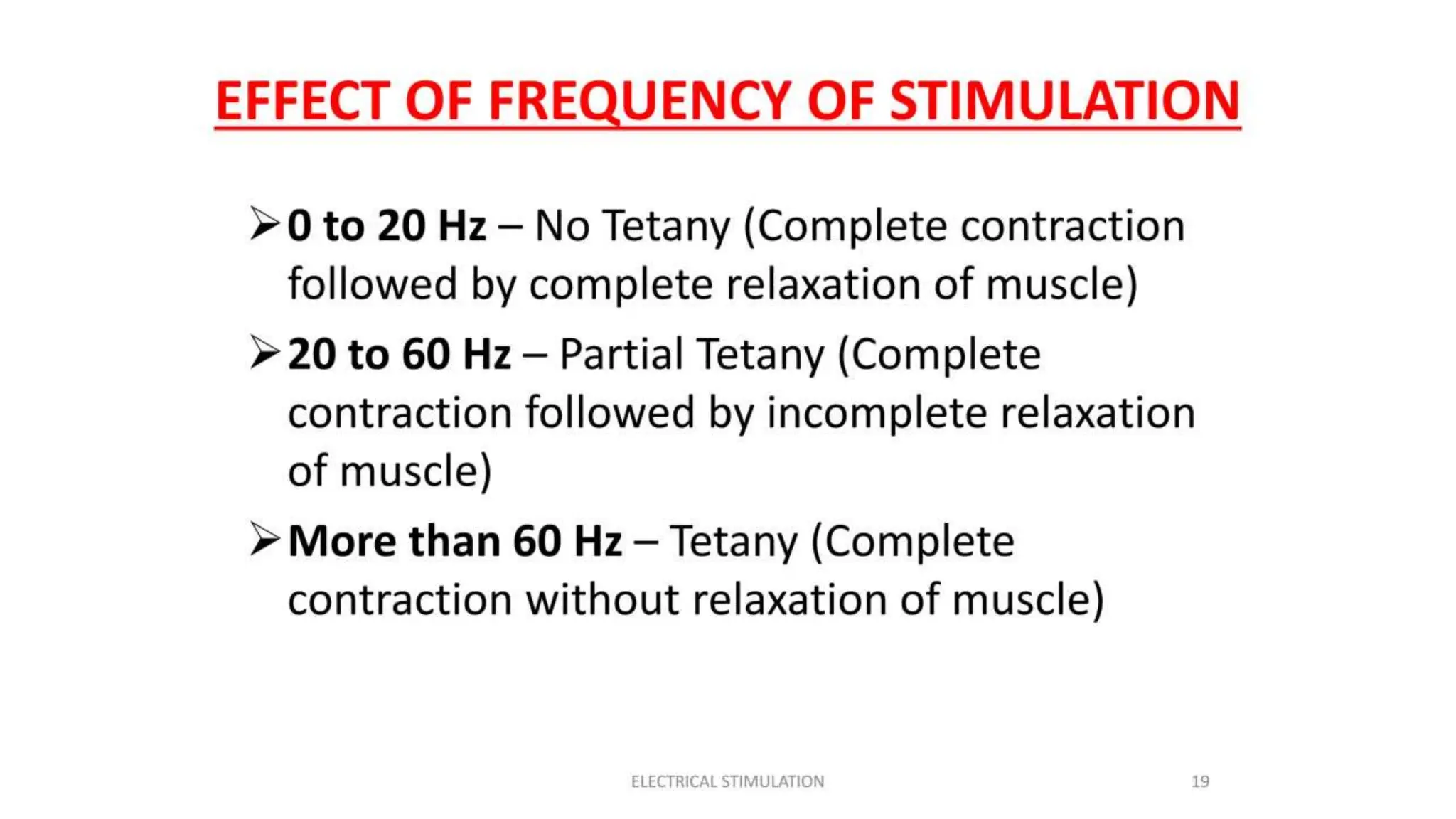
• Tetanic contraction from high amp, high freq AC
(>20-30pps) helps strength development and
spasm reduction (biphasic, Russian)
Indications
Galvanic current
Faradic current
FES (Functional Electro-
Stimulation).
Is electrical stimulation of muscle deprived of
normal control to prouduce a functional useful
contraction FES serve to provoke contraction of
paralyzed muscle and to affect sensory pathway
contributing to the normalization of basic
reflex motor activity In this technique, the
application of the electrical stimulus is
combined with activty on the part of patient
Precautions
• Burning of the skin
• Electrical discharges (sparks) may occur
• Do not use in the presence of inflammable
anesthetics
• Do not apply over an area where the hair has
been shaved in the past 24hours.
• Known skin allergie
Treatment
procedures
Preparation of The patient
The skin in the area of electrode placement
should be cleaned thoroughly.
Special gels, sprays or water is applied to the
skin as a condition medium for better
stimulation.
Electrodes should be fixed in position, using
mending tapes to maintain good contact
throughout the treatment period.
Securing the device
These devices are needed to prevent movement of
the electrodes during treatment. They have to be
of an insulating material coverage to prevent
current conduction on their surfaces.
-Soft-rubber sandbags.
-Lightweight sandbags.
-Adhesive tapes.
-Velcro bands.
-Adhesive gels .
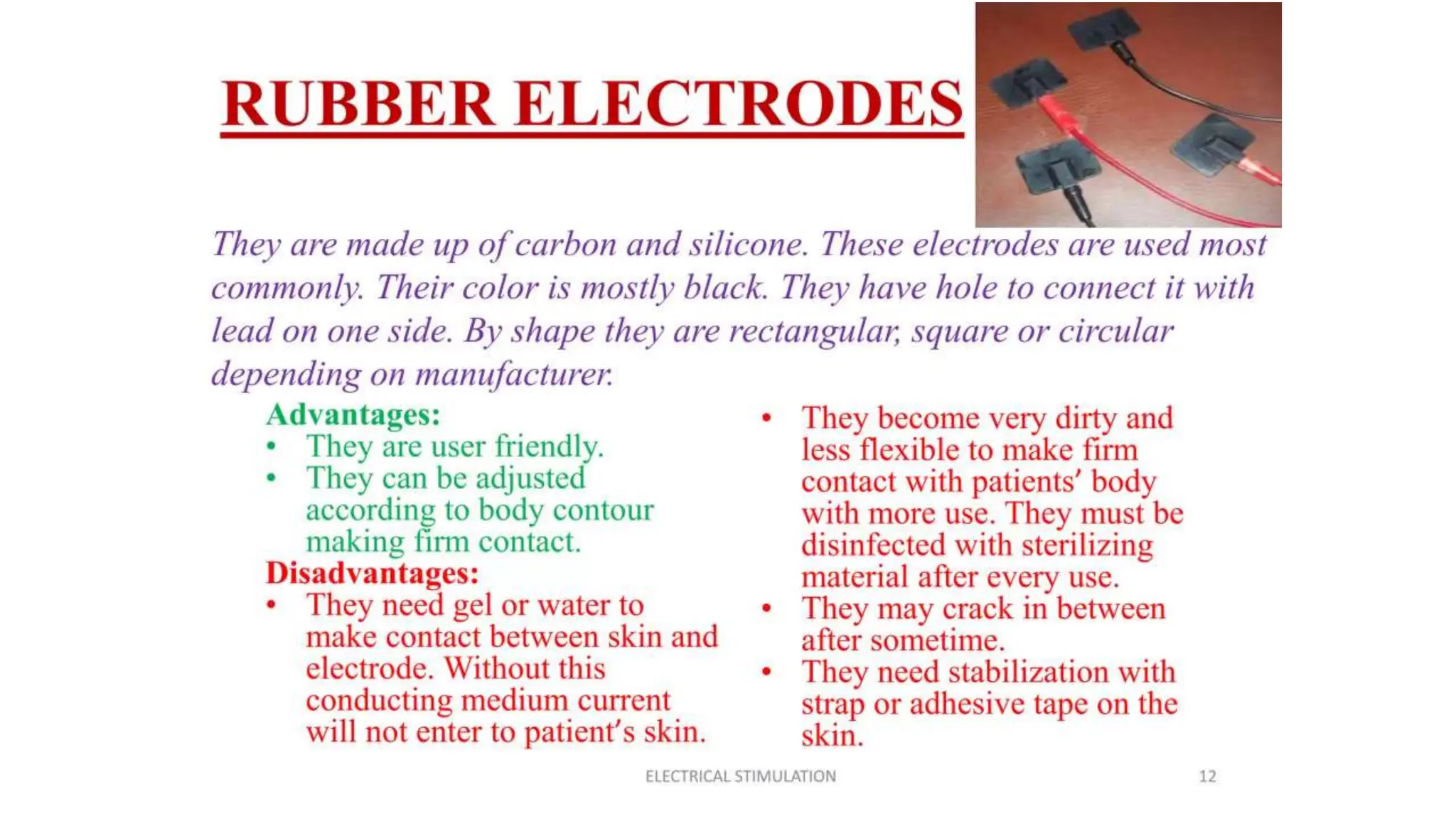
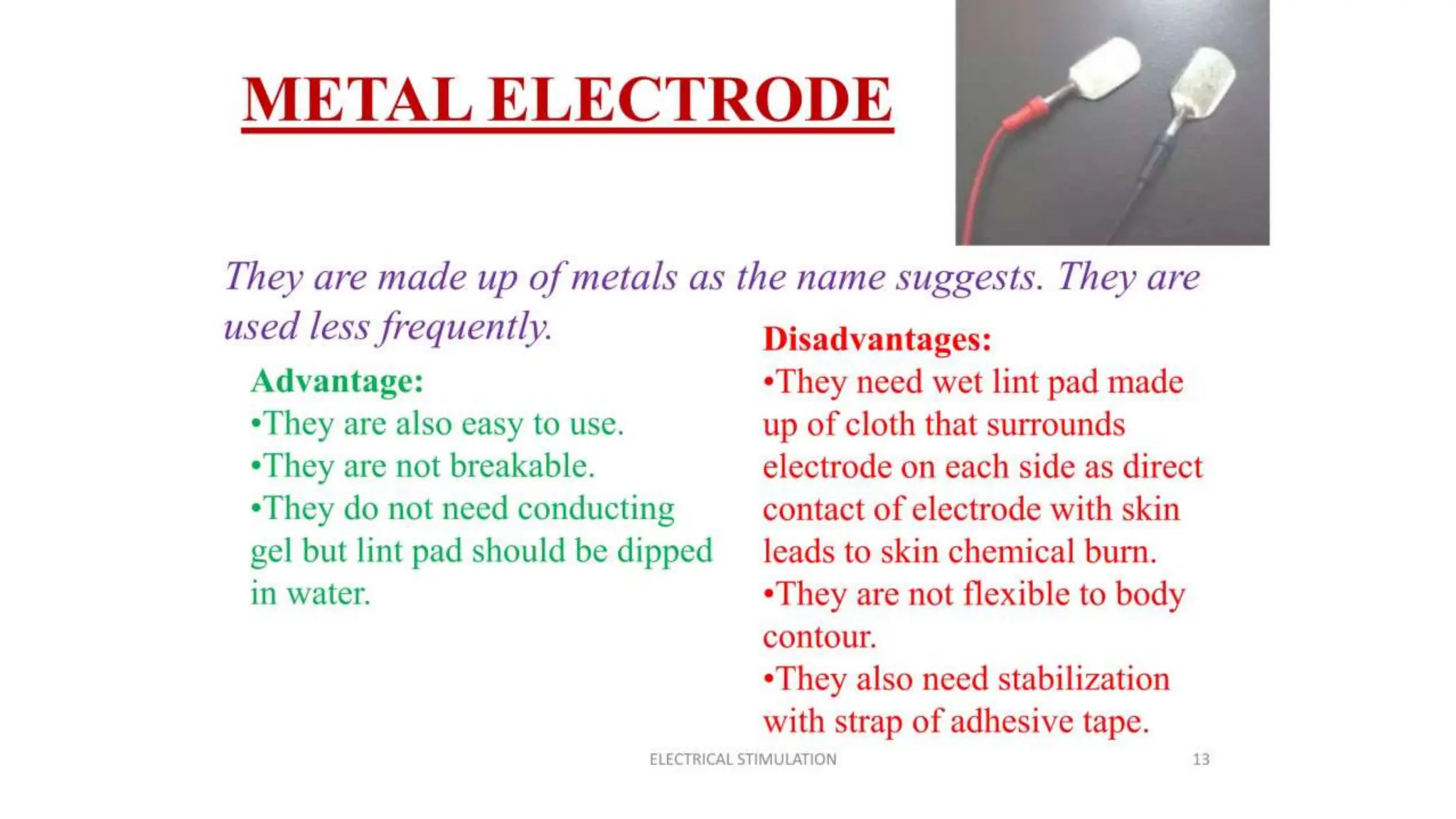
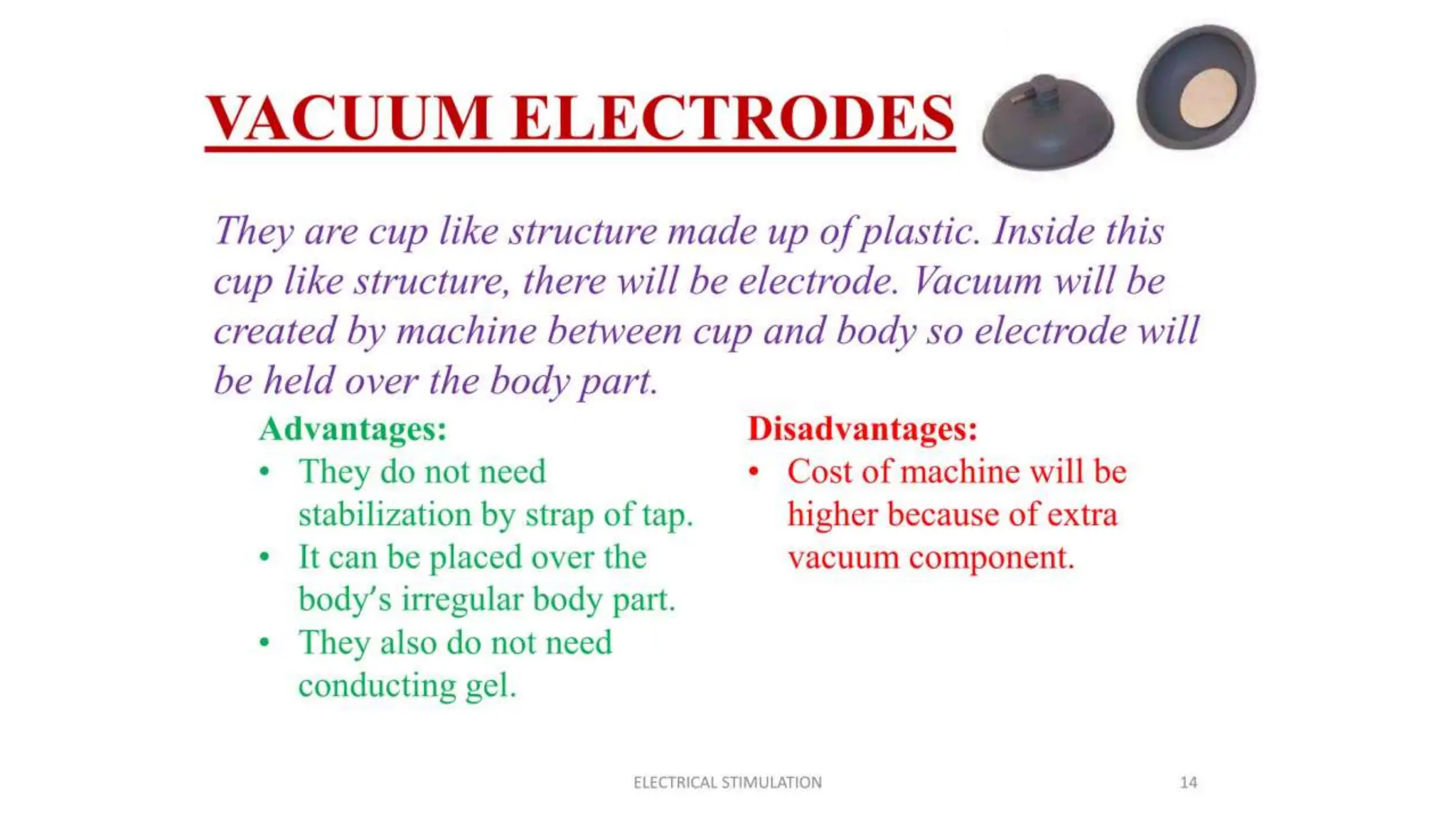
Electrodes types
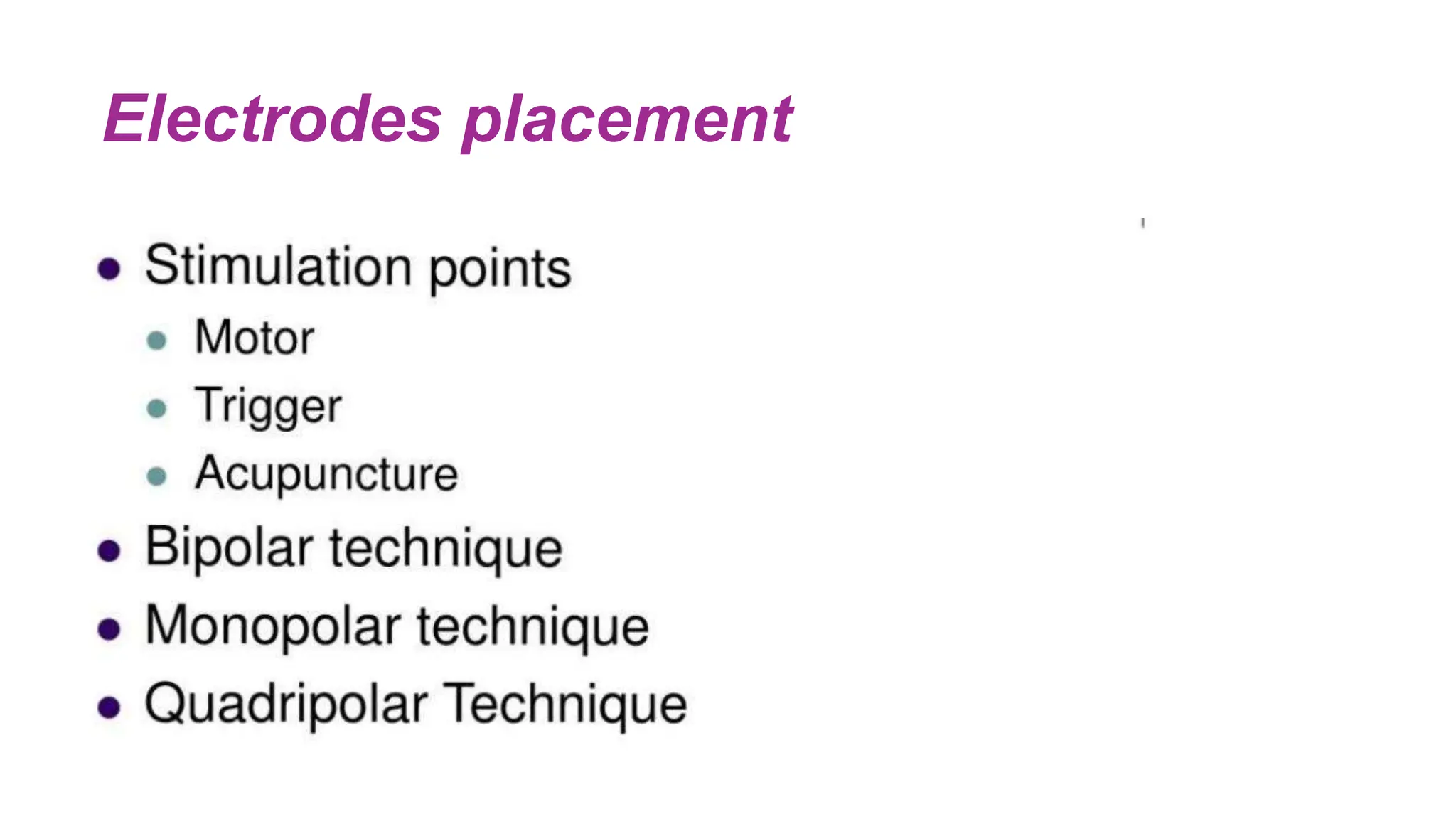
Electrodes placement
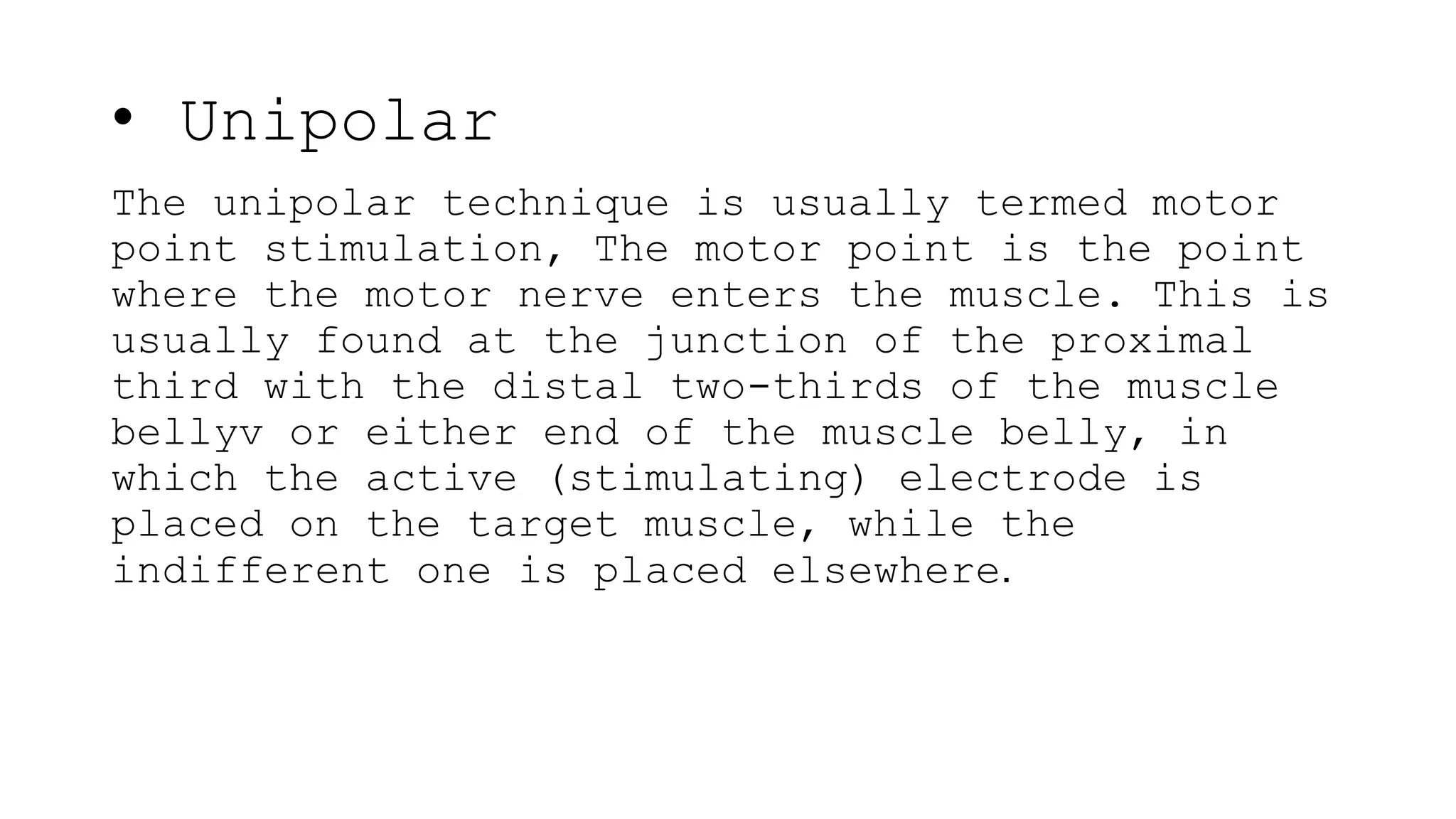
• Unipolar
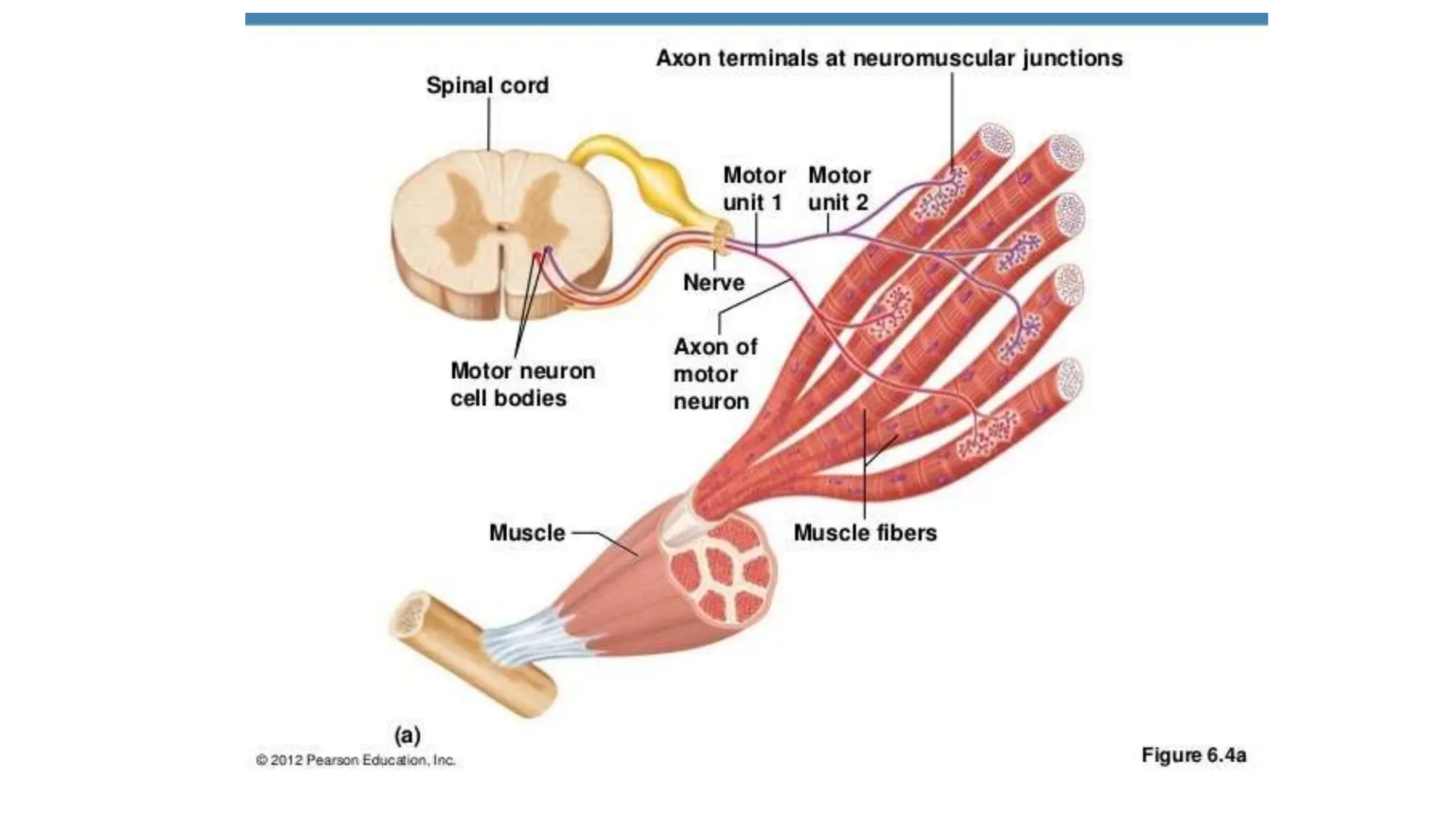
The unipolar technique is usually termed motor
point stimulation, The motor point is the point
where the motor nerve enters the muscle. This is
usually found at the junction of the proximal
third with the distal two-thirds of the muscle
bellyv or either end of the muscle belly, in
which the active (stimulating) electrode is
placed on the target muscle, while the
indifferent one is placed elsewhere.
•Bipolar:
In such a technique, two electrodes are placed
on the target muscle, close to origin /
insertion.
• Bilateral unipolar :
The electrodes are placed on each of two separate
muscles or muscle groups.
•Reciprocal :
In which an active electrode is placed on each of
two separate muscles or muscle groups, either
agonist / antagonist or bilaterally, with the
indifferent electrode placed elsewhere as in
uniploar technique.
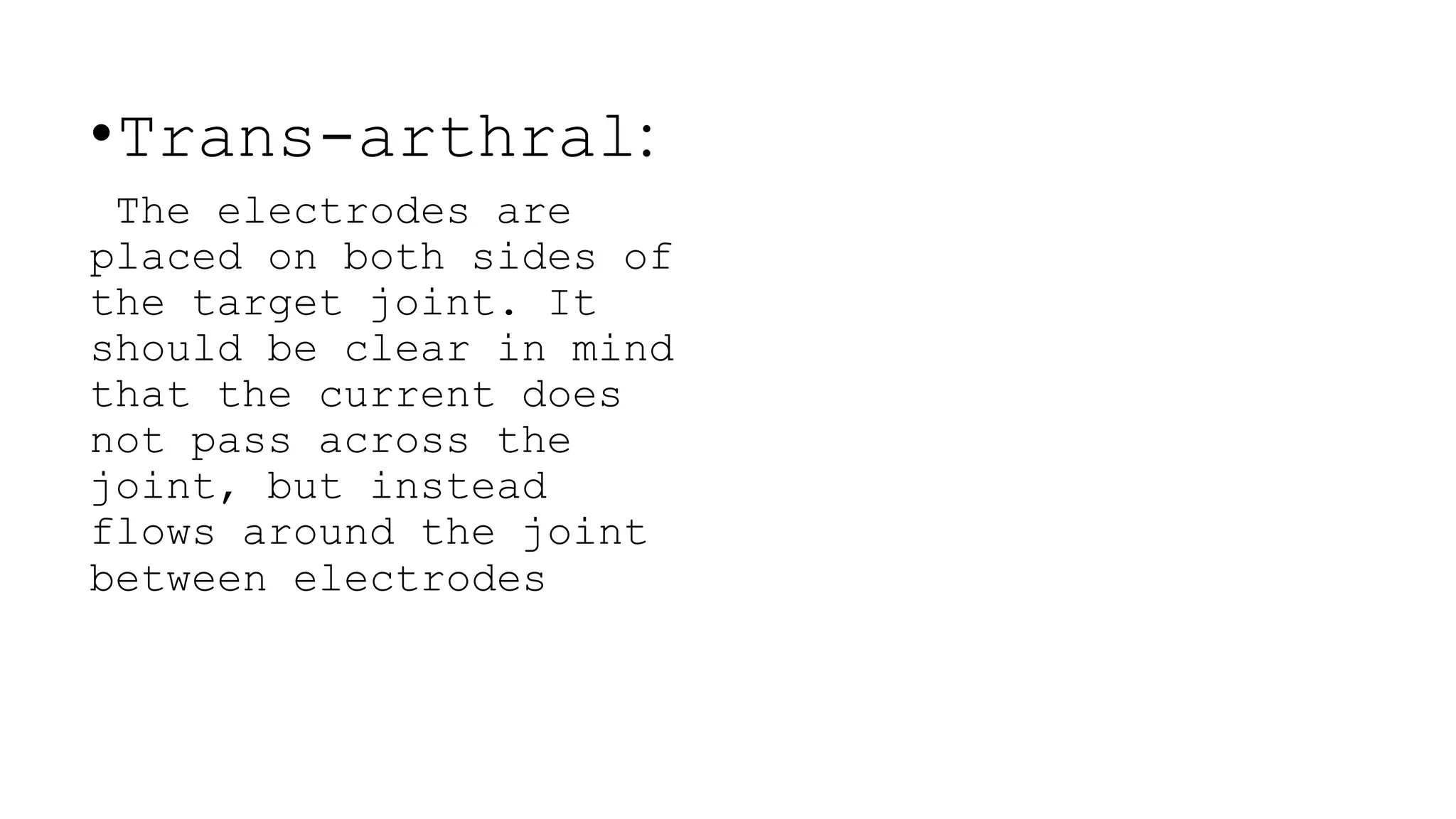
•Trans-arthral:
The electrodes are
placed on both sides of
the target joint. It
should be clear in mind
that the current does
not pass across the
joint, but instead
flows around the joint
between electrodes
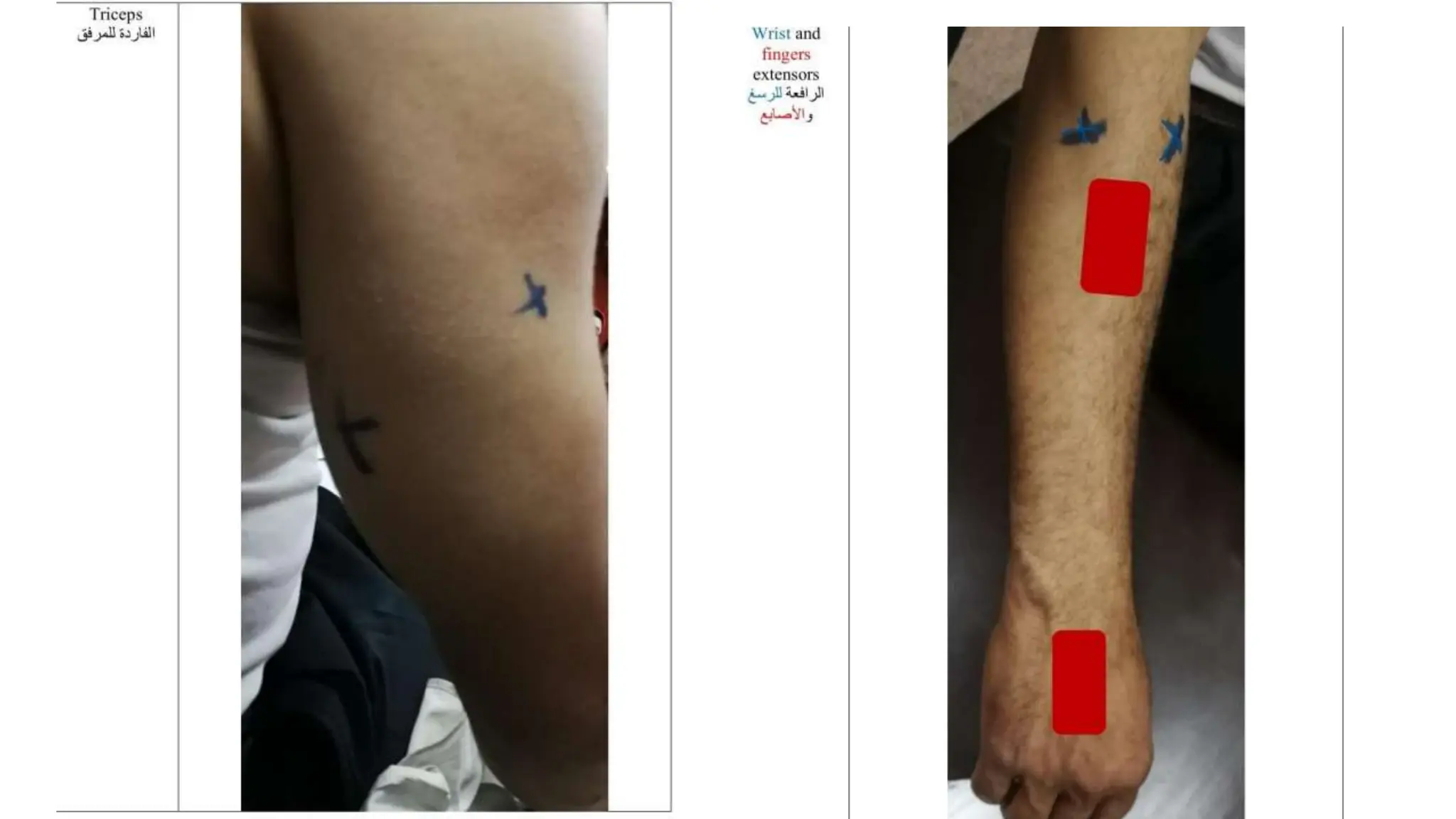
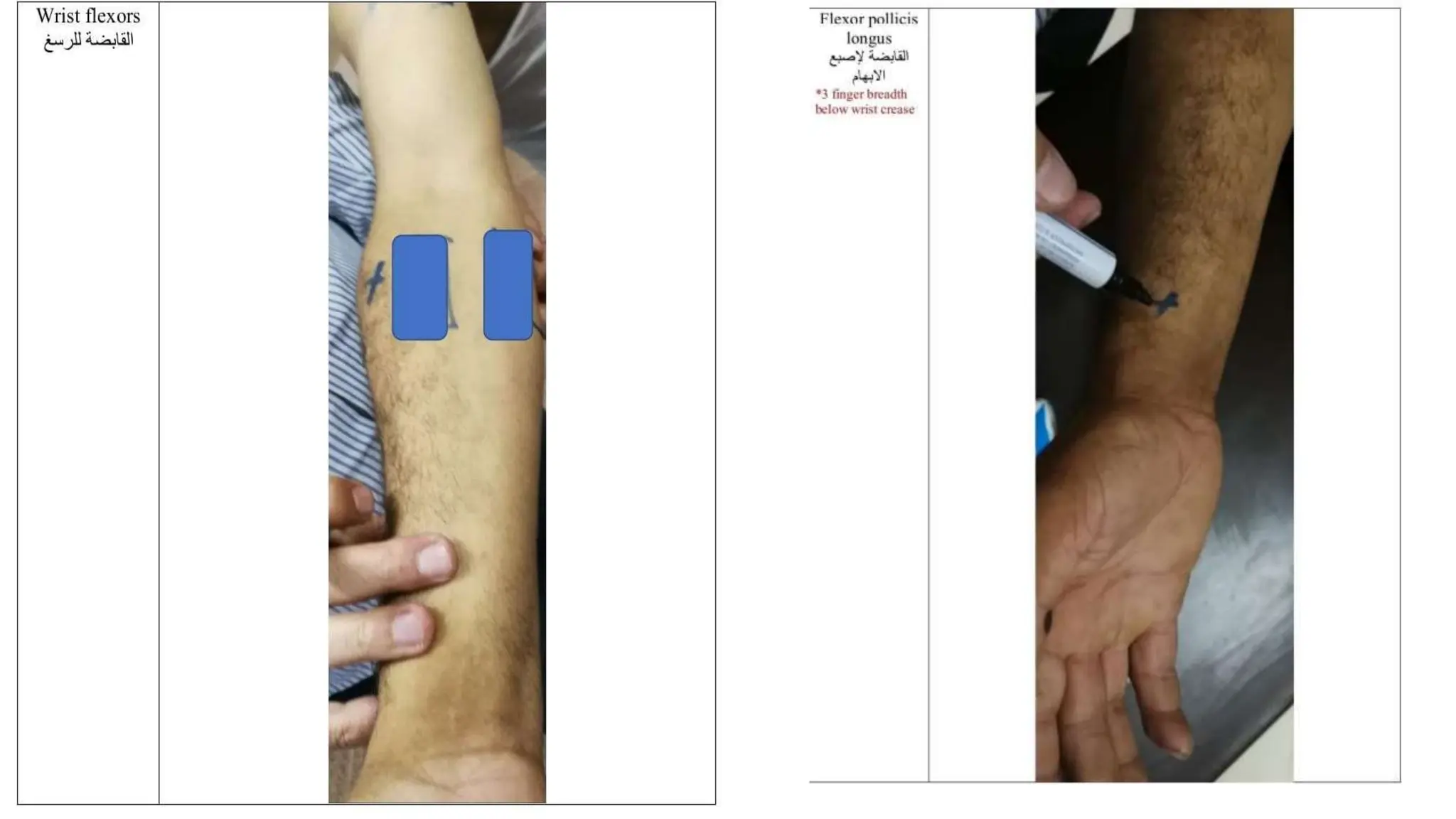
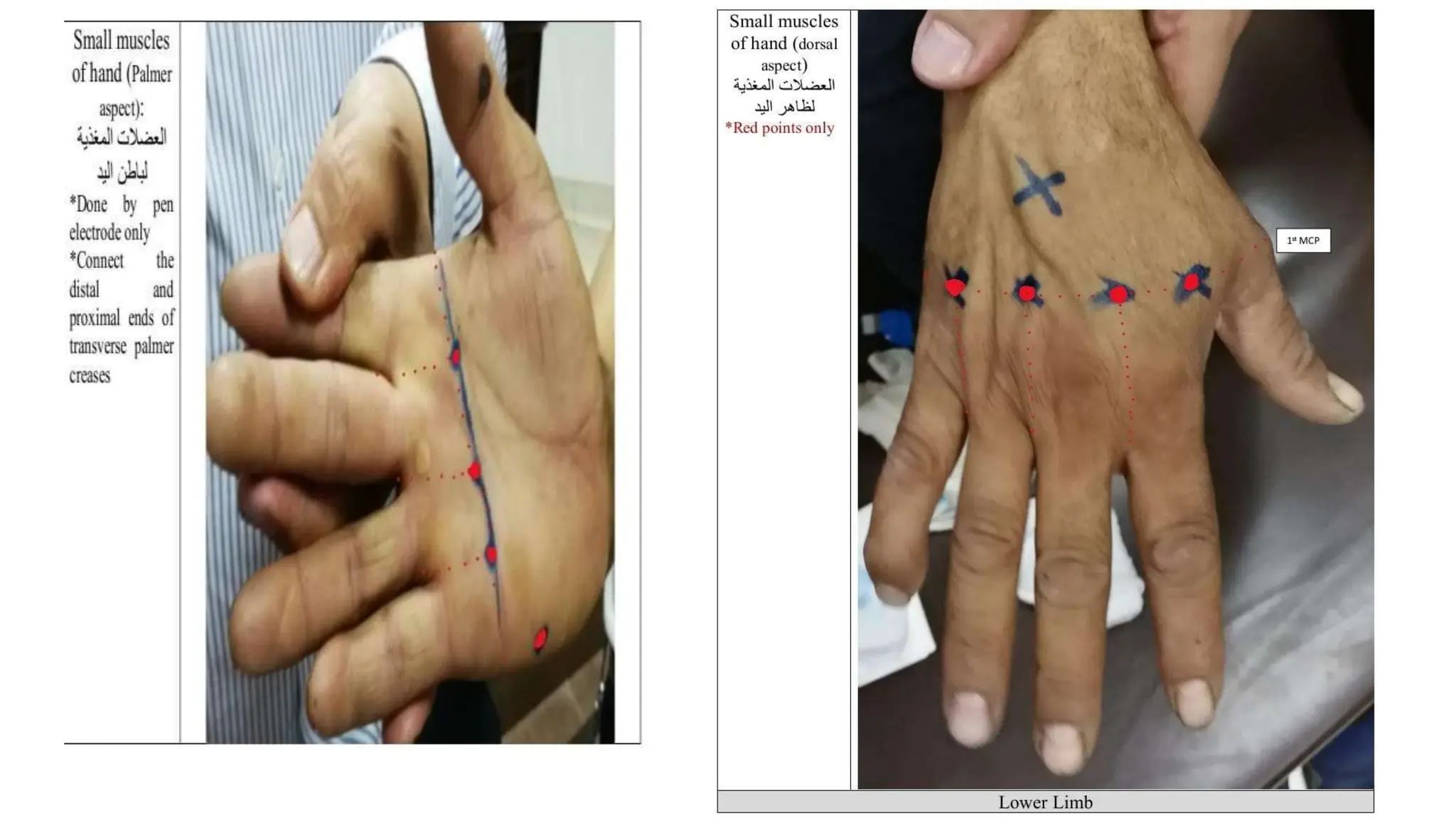
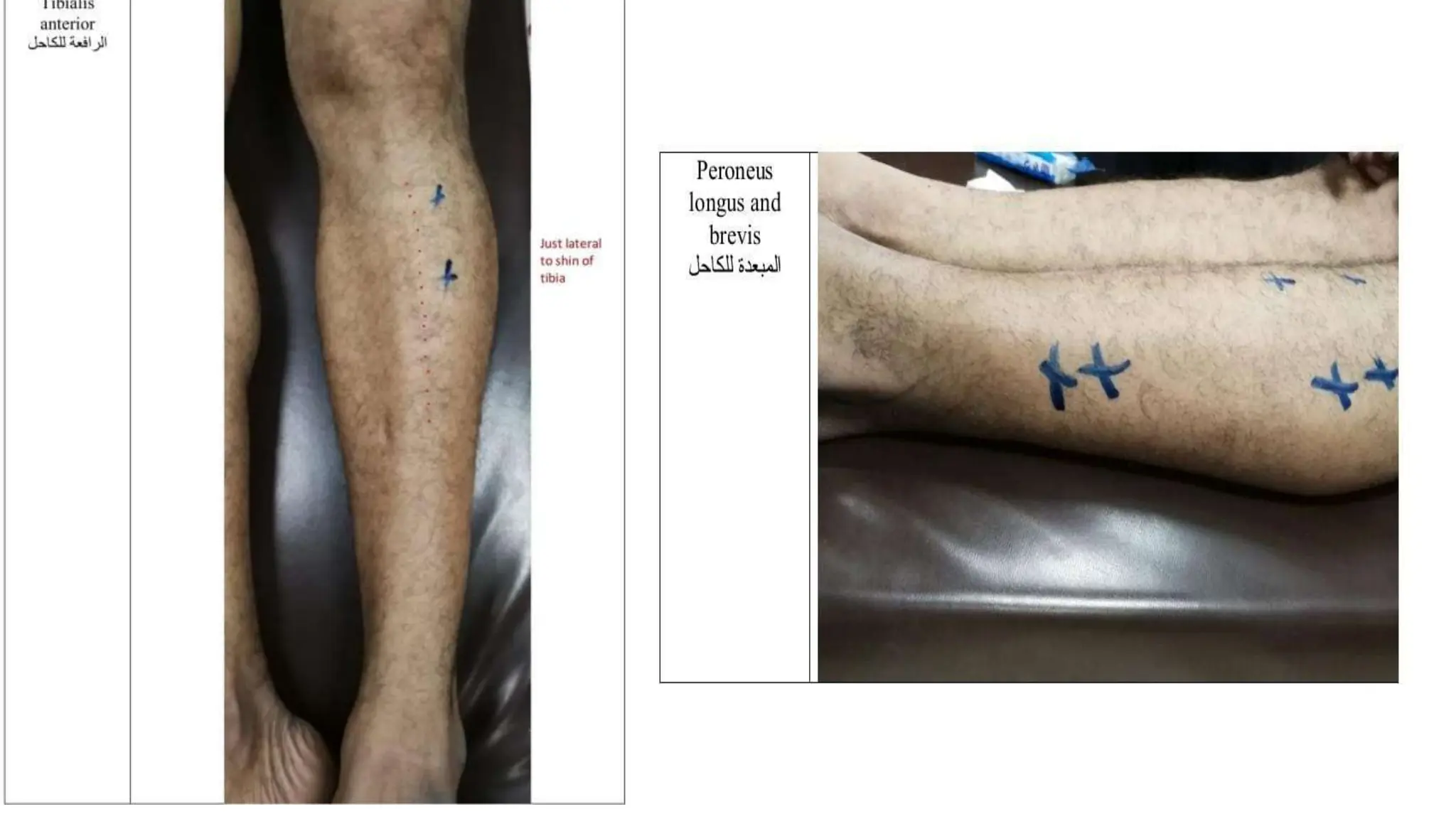
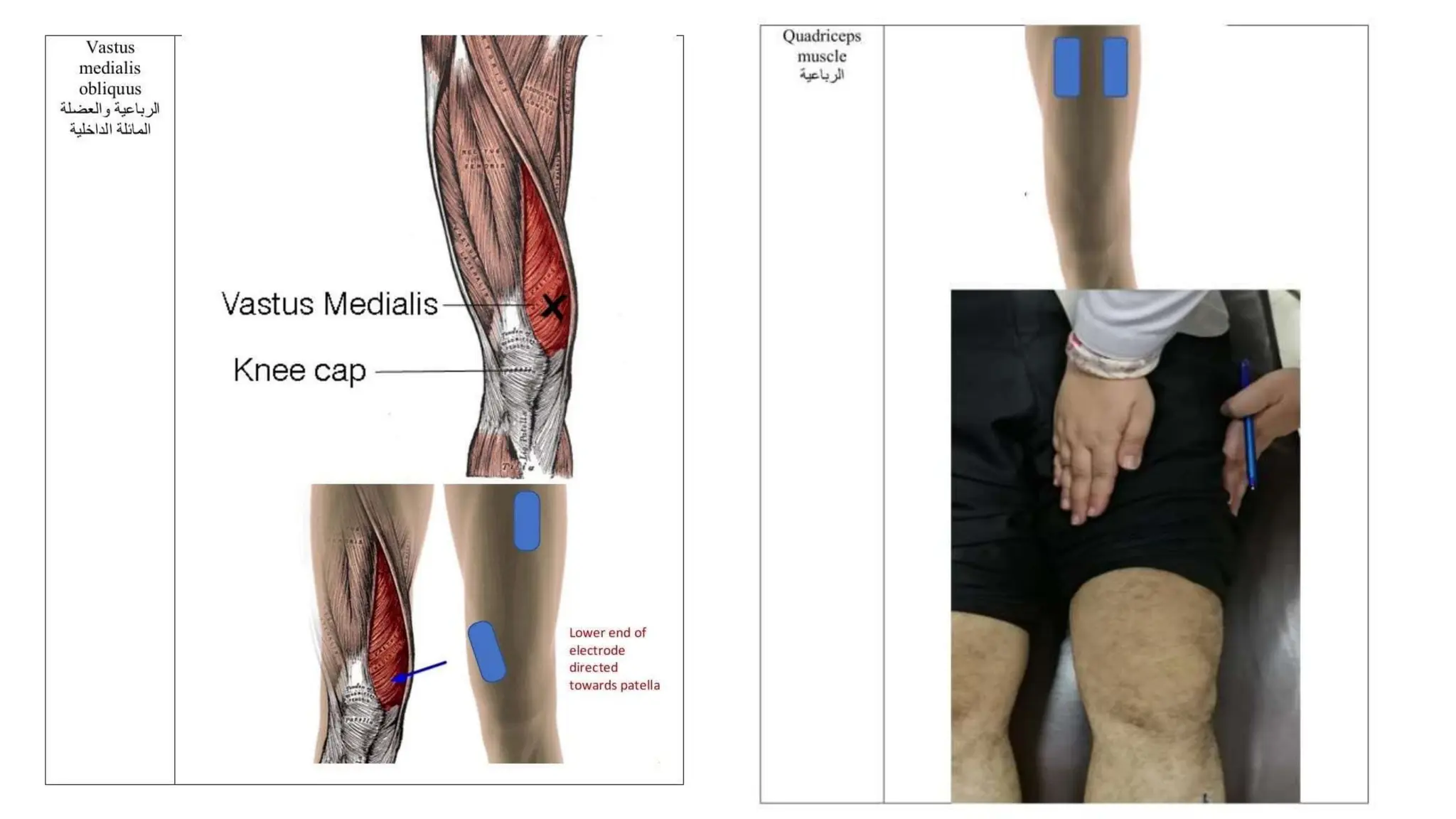
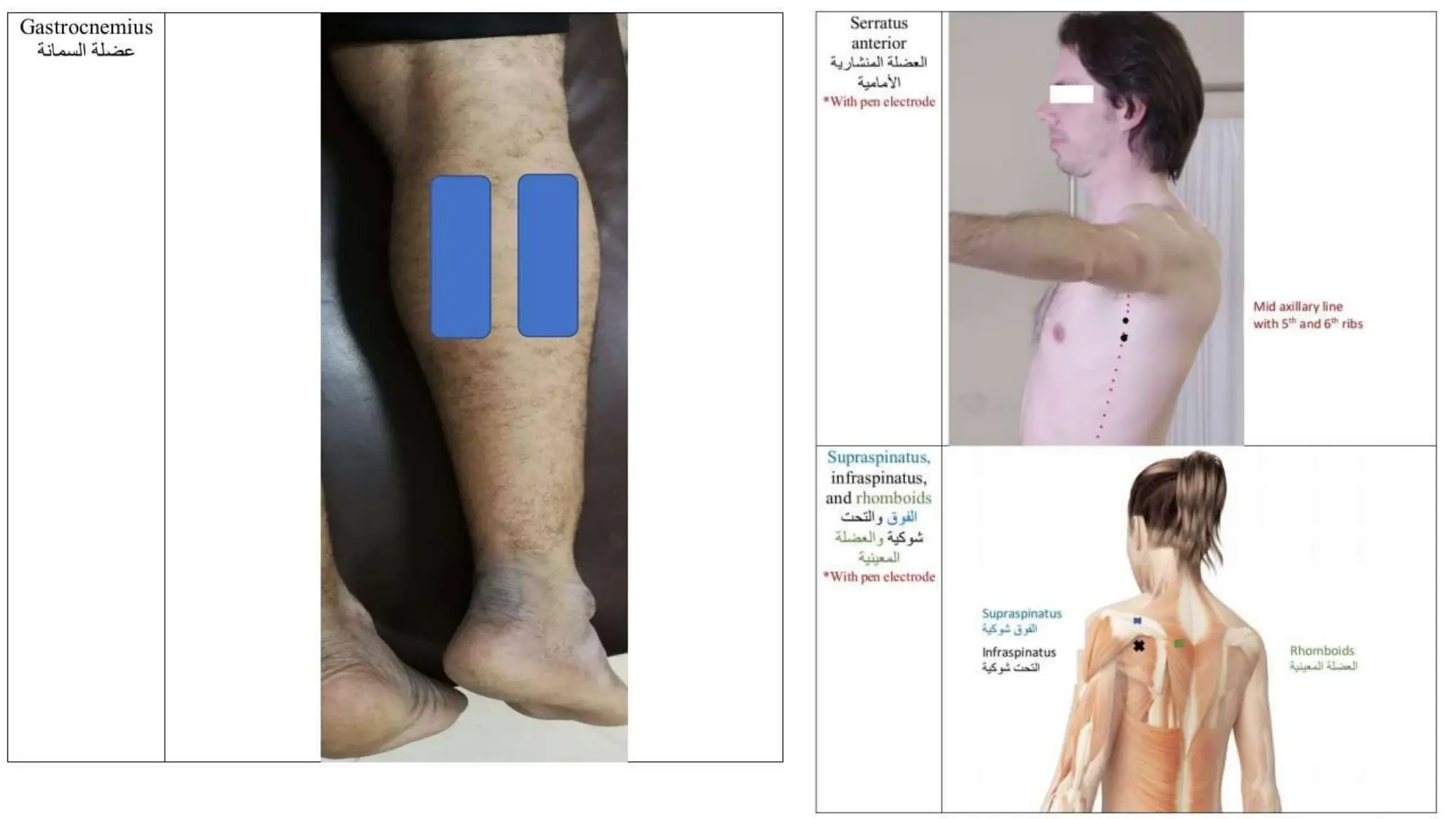
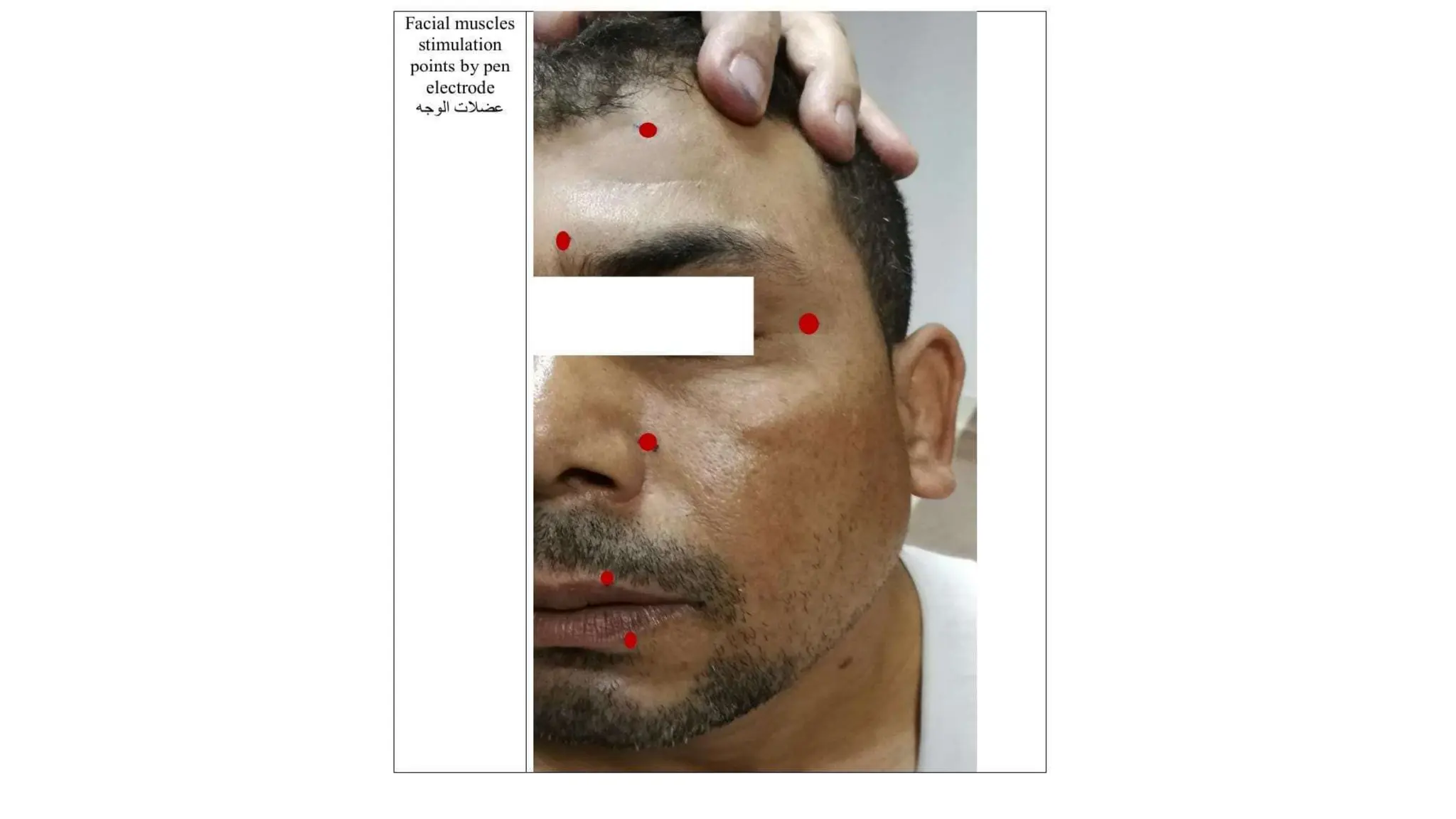
Motor points for electrodes
placement
Presentation (1) (1).pptx electrotherapy

Presentation (1) (1).pptx electrotherapy

  • 1.
  • 2.
    Electrotherap y is one ofthe oldest modalities used in physical therapy for the management of a wide range of musculoskeletal and neurological problems
  • 8.
    Direct (galvanic) Current(DC) unidirectional Constant electron flow from the negative to the positive electrode with no alterations (with constant polarity) . Alternating Current (AC) that rhythmically flows between anode & cathode. An electric current that rise to maximum in one direction and full back to zero and the rise to maximum in opposite direction and then repeat . When the alternating phases are smooth and equal in energy, they are often referred to as sine waves . Currents
  • 16.
  • 20.
  • 22.
    • Chronaxie isthe minimum time required for an electric current double the strength of the rheobase to stimulate a muscle or a neuron. • Rheobase is the lowest intensity with indefinite pulse duration which just stimulated muscles or nerves
  • 23.
  • 27.
    High voltage pulsedgalvanic current
  • 30.
  • 32.
  • 35.
    Burst AC Created byflow of current for a few milliseconds and then stop to flow (inter burst interval or pause period) and repeat cycle again. The clinical example of burst modulation is Russian Current.
  • 36.
    Interrupted AC Done whenthe current flow for few seconds then stop to flow for 1 second or more. This interrupted AC is differ from burst AC because the inter-pulse interval is longer than the inter burst interval and this is an advantage for the interrupted AC because it permits relaxation from muscle contraction . The most common example of amplitude modulated AC is to mix two AC current with different frequency, and known as interferential current (IFC) .
  • 39.
  • 40.
    Chemical Effects:Ion migration,where ions move through tissue in response to continuous DC current (iontophoresis) Magnetic Effects: electrical current flows in a conductor causing a magnetic field
  • 41.
    Kinetic Effects elcsum& noitasnes edulcni( )noitcartnoc : • Moderate-amplitude, high frequency pulsed or AC stimulation that facilitates wound healing (twin pulse), edema reduction (twin pulse), and pain reduction (interferential). • Twitch contraction, followed by relaxation from low freq, moderate amp AC facilitates muscle re-education (biphasic, Russian) and tendinitis treatments (twin pulse, biphasic, & Russian). • Tetanic contraction from high amp, high freq AC (>20-30pps) helps strength development and spasm reduction (biphasic, Russian)
  • 42.
  • 43.
  • 44.
  • 48.
    FES (Functional Electro- Stimulation). Iselectrical stimulation of muscle deprived of normal control to prouduce a functional useful contraction FES serve to provoke contraction of paralyzed muscle and to affect sensory pathway contributing to the normalization of basic reflex motor activity In this technique, the application of the electrical stimulus is combined with activty on the part of patient
  • 50.
    Precautions • Burning ofthe skin • Electrical discharges (sparks) may occur • Do not use in the presence of inflammable anesthetics • Do not apply over an area where the hair has been shaved in the past 24hours. • Known skin allergie
  • 51.
  • 52.
    Preparation of Thepatient The skin in the area of electrode placement should be cleaned thoroughly. Special gels, sprays or water is applied to the skin as a condition medium for better stimulation. Electrodes should be fixed in position, using mending tapes to maintain good contact throughout the treatment period.
  • 53.
  • 54.
    These devices areneeded to prevent movement of the electrodes during treatment. They have to be of an insulating material coverage to prevent current conduction on their surfaces. -Soft-rubber sandbags. -Lightweight sandbags. -Adhesive tapes. -Velcro bands. -Adhesive gels .
  • 55.
  • 60.
  • 61.
    • Unipolar The unipolartechnique is usually termed motor point stimulation, The motor point is the point where the motor nerve enters the muscle. This is usually found at the junction of the proximal third with the distal two-thirds of the muscle bellyv or either end of the muscle belly, in which the active (stimulating) electrode is placed on the target muscle, while the indifferent one is placed elsewhere.
  • 62.
    •Bipolar: In such atechnique, two electrodes are placed on the target muscle, close to origin / insertion. • Bilateral unipolar : The electrodes are placed on each of two separate muscles or muscle groups. •Reciprocal : In which an active electrode is placed on each of two separate muscles or muscle groups, either agonist / antagonist or bilaterally, with the indifferent electrode placed elsewhere as in uniploar technique.
  • 63.
    •Trans-arthral: The electrodes are placedon both sides of the target joint. It should be clear in mind that the current does not pass across the joint, but instead flows around the joint between electrodes
  • 64.
    Motor points forelectrodes placement