Long-term Follow-up of the RTOG
9501/Intergroup Phase III Trial: Postoperative
Concurrent Radiation Therapy and
Chemotherapy in High-Risk Squamous Cell
Carcinoma of the Head and Neck
Introduction
● In the 1990s two randomized clinical trials
were conducted looking at the role of
concurrent chemoradiation after surgery in
LAHNCC
– RTOG 9501 (Blue)
– EORTC 22931 (Yellow)
● Publications discusses results at long term
FU.
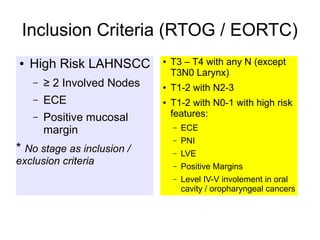
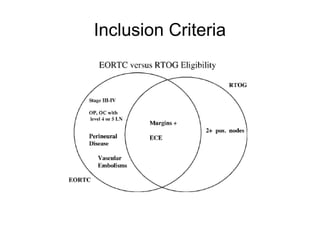
Inclusion Criteria (RTOG / EORTC)
● High Risk LAHNSCC
– ≥ 2 Involved Nodes
– ECE
– Positive mucosal
margin
* No stage as inclusion /
exclusion criteria
● T3 – T4 with any N (except
T3N0 Larynx)
● T1-2 with N2-3
● T1-2 with N0-1 with high risk
features:
– ECE
– PNI
– LVE
– Positive Margins
– Level IV-V involement in oral
cavity / oropharyngeal cancers
Inclusion Criteria
Inclusion Criteria
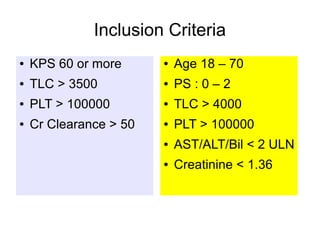
● KPS 60 or more
● TLC > 3500
● PLT > 100000
● Cr Clearance > 50
● Age 18 – 70
● PS : 0 – 2
● TLC > 4000
● PLT > 100000
● AST/ALT/Bil < 2 ULN
● Creatinine < 1.36
Radiotherapy & Chemotherapy
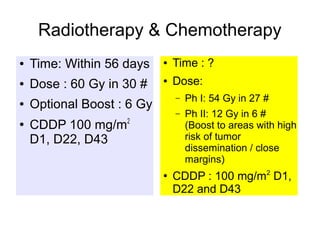
● Time: Within 56 days
● Dose : 60 Gy in 30 #
● Optional Boost : 6 Gy
●
CDDP 100 mg/m2
D1, D22, D43
● Time : ?
● Dose:
– Ph I: 54 Gy in 27 #
– Ph II: 12 Gy in 6 #
(Boost to areas with high
risk of tumor
dissemination / close
margins)
●
CDDP : 100 mg/m2
D1,
D22 and D43
Trial Design
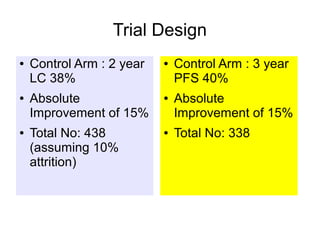
● Control Arm : 2 year
LC 38%
● Absolute
Improvement of 15%
● Total No: 438
(assuming 10%
attrition)
● Control Arm : 3 year
PFS 40%
● Absolute
Improvement of 15%
● Total No: 338
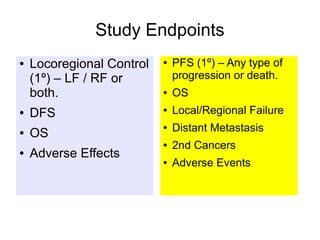
Study Endpoints
● Locoregional Control
(1º) – LF / RF or
both.
● DFS
● OS
● Adverse Effects
● PFS (1º) – Any type of
progression or death.
● OS
● Local/Regional Failure
● Distant Metastasis
● 2nd Cancers
● Adverse Events
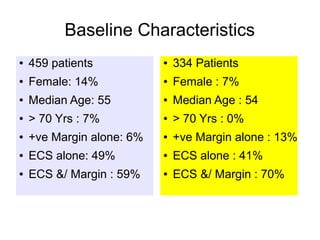
Baseline Characteristics
● 459 patients
● Female: 14%
● Median Age: 55
● > 70 Yrs : 7%
● +ve Margin alone: 6%
● ECS alone: 49%
● ECS &/ Margin : 59%
● 334 Patients
● Female : 7%
● Median Age : 54
● > 70 Yrs : 0%
● +ve Margin alone : 13%
● ECS alone : 41%
● ECS &/ Margin : 70%
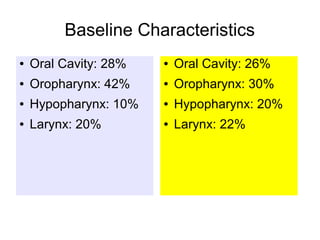
Baseline Characteristics
● Oral Cavity: 28%
● Oropharynx: 42%
● Hypopharynx: 10%
● Larynx: 20%
● Oral Cavity: 26%
● Oropharynx: 30%
● Hypopharynx: 20%
● Larynx: 22%
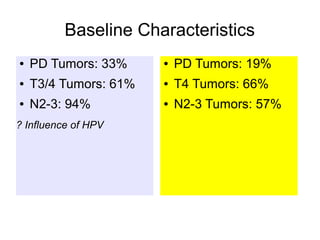
Baseline Characteristics
● PD Tumors: 33%
● T3/4 Tumors: 61%
● N2-3: 94%
? Influence of HPV
● PD Tumors: 19%
● T4 Tumors: 66%
● N2-3 Tumors: 57%
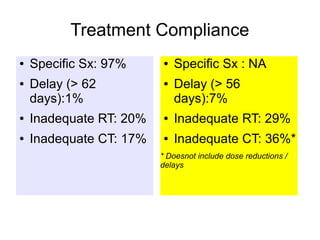
Treatment Compliance
● Specific Sx: 97%
● Delay (> 62
days):1%
● Inadequate RT: 20%
● Inadequate CT: 17%
● Specific Sx : NA
● Delay (> 56
days):7%
● Inadequate RT: 29%
● Inadequate CT: 36%*
* Doesnot include dose reductions /
delays
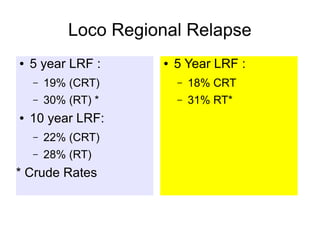
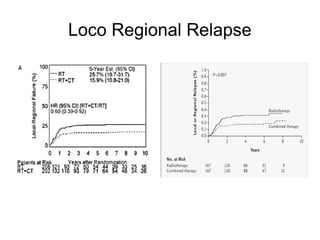
Loco Regional Relapse
● 5 year LRF :
– 19% (CRT)
– 30% (RT) *
● 10 year LRF:
– 22% (CRT)
– 28% (RT)
* Crude Rates
● 5 Year LRF :
– 18% CRT
– 31% RT*
Loco Regional Relapse
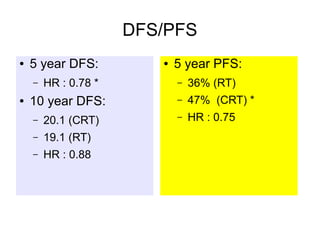
DFS/PFS
● 5 year DFS:
– HR : 0.78 *
● 10 year DFS:
– 20.1 (CRT)
– 19.1 (RT)
– HR : 0.88
● 5 year PFS:
– 36% (RT)
– 47% (CRT) *
– HR : 0.75
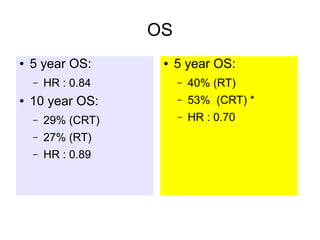
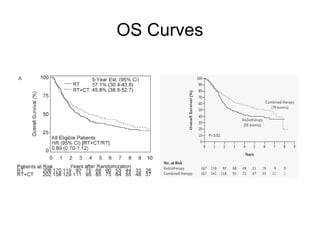
OS
● 5 year OS:
– HR : 0.84
● 10 year OS:
– 29% (CRT)
– 27% (RT)
– HR : 0.89
● 5 year OS:
– 40% (RT)
– 53% (CRT) *
– HR : 0.70
OS Curves
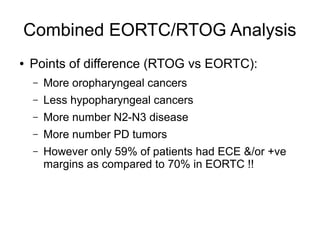
Combined EORTC/RTOG Analysis
● Points of difference (RTOG vs EORTC):
– More oropharyngeal cancers
– Less hypopharyngeal cancers
– More number N2-N3 disease
– More number PD tumors
– However only 59% of patients had ECE &/or +ve
margins as compared to 70% in EORTC !!
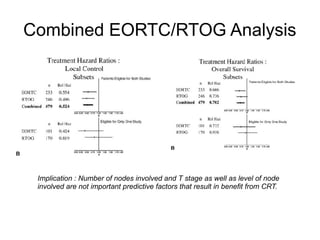
Combined EORTC/RTOG Analysis
Implication : Number of nodes involved and T stage as well as level of node
involved are not important predictive factors that result in benefit from CRT.
New RTOG Analysis
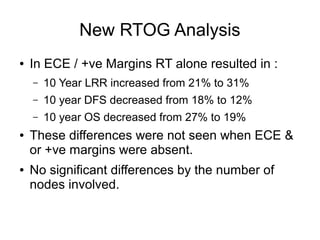
● In ECE / +ve Margins RT alone resulted in :
– 10 Year LRR increased from 21% to 31%
– 10 year DFS decreased from 18% to 12%
– 10 year OS decreased from 27% to 19%
● These differences were not seen when ECE &
or +ve margins were absent.
● No significant differences by the number of
nodes involved.
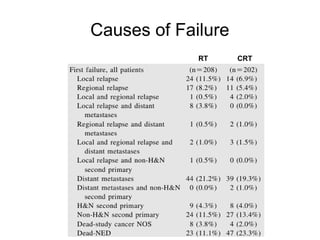
Causes of Failure
RT CRT
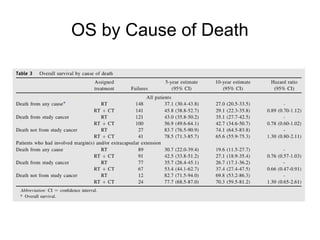
OS by Cause of Death
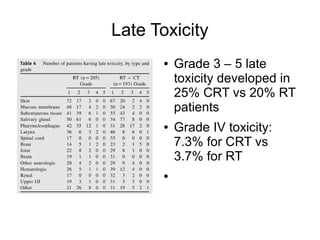
Late Toxicity
● Grade 3 – 5 late
toxicity developed in
25% CRT vs 20% RT
patients
● Grade IV toxicity:
7.3% for CRT vs
3.7% for RT
●
Conclusions
● Longer term followup has blunted the benefits
that CRT provides above RT
– However benefit in DFS / LRC in ECE/+ve
margins persist
● Late toxicity increased
– However with time increased incidence not seen
● CRT did not appear to benefit in multiple
nodes.

Concurrent Chemoradiation in Postoperative Setting In LAHNC. A comparision of the EORTC and RTOG trials.

  • 1.
    Long-term Follow-up ofthe RTOG 9501/Intergroup Phase III Trial: Postoperative Concurrent Radiation Therapy and Chemotherapy in High-Risk Squamous Cell Carcinoma of the Head and Neck
  • 2.
    Introduction ● In the1990s two randomized clinical trials were conducted looking at the role of concurrent chemoradiation after surgery in LAHNCC – RTOG 9501 (Blue) – EORTC 22931 (Yellow) ● Publications discusses results at long term FU.
  • 3.
    Inclusion Criteria (RTOG/ EORTC) ● High Risk LAHNSCC – ≥ 2 Involved Nodes – ECE – Positive mucosal margin * No stage as inclusion / exclusion criteria ● T3 – T4 with any N (except T3N0 Larynx) ● T1-2 with N2-3 ● T1-2 with N0-1 with high risk features: – ECE – PNI – LVE – Positive Margins – Level IV-V involement in oral cavity / oropharyngeal cancers
  • 4.
  • 5.
    Inclusion Criteria ● KPS60 or more ● TLC > 3500 ● PLT > 100000 ● Cr Clearance > 50 ● Age 18 – 70 ● PS : 0 – 2 ● TLC > 4000 ● PLT > 100000 ● AST/ALT/Bil < 2 ULN ● Creatinine < 1.36
  • 6.
    Radiotherapy & Chemotherapy ●Time: Within 56 days ● Dose : 60 Gy in 30 # ● Optional Boost : 6 Gy ● CDDP 100 mg/m2 D1, D22, D43 ● Time : ? ● Dose: – Ph I: 54 Gy in 27 # – Ph II: 12 Gy in 6 # (Boost to areas with high risk of tumor dissemination / close margins) ● CDDP : 100 mg/m2 D1, D22 and D43
  • 7.
    Trial Design ● ControlArm : 2 year LC 38% ● Absolute Improvement of 15% ● Total No: 438 (assuming 10% attrition) ● Control Arm : 3 year PFS 40% ● Absolute Improvement of 15% ● Total No: 338
  • 8.
    Study Endpoints ● LocoregionalControl (1º) – LF / RF or both. ● DFS ● OS ● Adverse Effects ● PFS (1º) – Any type of progression or death. ● OS ● Local/Regional Failure ● Distant Metastasis ● 2nd Cancers ● Adverse Events
  • 9.
    Baseline Characteristics ● 459patients ● Female: 14% ● Median Age: 55 ● > 70 Yrs : 7% ● +ve Margin alone: 6% ● ECS alone: 49% ● ECS &/ Margin : 59% ● 334 Patients ● Female : 7% ● Median Age : 54 ● > 70 Yrs : 0% ● +ve Margin alone : 13% ● ECS alone : 41% ● ECS &/ Margin : 70%
  • 10.
    Baseline Characteristics ● OralCavity: 28% ● Oropharynx: 42% ● Hypopharynx: 10% ● Larynx: 20% ● Oral Cavity: 26% ● Oropharynx: 30% ● Hypopharynx: 20% ● Larynx: 22%
  • 11.
    Baseline Characteristics ● PDTumors: 33% ● T3/4 Tumors: 61% ● N2-3: 94% ? Influence of HPV ● PD Tumors: 19% ● T4 Tumors: 66% ● N2-3 Tumors: 57%
  • 12.
    Treatment Compliance ● SpecificSx: 97% ● Delay (> 62 days):1% ● Inadequate RT: 20% ● Inadequate CT: 17% ● Specific Sx : NA ● Delay (> 56 days):7% ● Inadequate RT: 29% ● Inadequate CT: 36%* * Doesnot include dose reductions / delays
  • 13.
    Loco Regional Relapse ●5 year LRF : – 19% (CRT) – 30% (RT) * ● 10 year LRF: – 22% (CRT) – 28% (RT) * Crude Rates ● 5 Year LRF : – 18% CRT – 31% RT*
  • 14.
  • 15.
    DFS/PFS ● 5 yearDFS: – HR : 0.78 * ● 10 year DFS: – 20.1 (CRT) – 19.1 (RT) – HR : 0.88 ● 5 year PFS: – 36% (RT) – 47% (CRT) * – HR : 0.75
  • 16.
    OS ● 5 yearOS: – HR : 0.84 ● 10 year OS: – 29% (CRT) – 27% (RT) – HR : 0.89 ● 5 year OS: – 40% (RT) – 53% (CRT) * – HR : 0.70
  • 17.
  • 18.
    Combined EORTC/RTOG Analysis ●Points of difference (RTOG vs EORTC): – More oropharyngeal cancers – Less hypopharyngeal cancers – More number N2-N3 disease – More number PD tumors – However only 59% of patients had ECE &/or +ve margins as compared to 70% in EORTC !!
  • 19.
    Combined EORTC/RTOG Analysis Implication: Number of nodes involved and T stage as well as level of node involved are not important predictive factors that result in benefit from CRT.
  • 20.
    New RTOG Analysis ●In ECE / +ve Margins RT alone resulted in : – 10 Year LRR increased from 21% to 31% – 10 year DFS decreased from 18% to 12% – 10 year OS decreased from 27% to 19% ● These differences were not seen when ECE & or +ve margins were absent. ● No significant differences by the number of nodes involved.
  • 21.
  • 22.
    OS by Causeof Death
  • 23.
    Late Toxicity ● Grade3 – 5 late toxicity developed in 25% CRT vs 20% RT patients ● Grade IV toxicity: 7.3% for CRT vs 3.7% for RT ●
  • 24.
    Conclusions ● Longer termfollowup has blunted the benefits that CRT provides above RT – However benefit in DFS / LRC in ECE/+ve margins persist ● Late toxicity increased – However with time increased incidence not seen ● CRT did not appear to benefit in multiple nodes.