

Chemotherapy in HRPC Department of Medical oncology
Definition Hormone resistant prostate cancer A rising PSA despite androgen ablation Manifests Rising PSA Symotomatic Progression Radiological evidence of progression despite the serum testosterone been at castrate levels BUT
Defn contd Trials defined (similar) Men with advanced and progressive prostate cancer that had failed to respond to standard hormone therapy. Disease progression is observed despite castrate level of testosterone The definition of disease progression  appearance of new lesions  an increase in size (generally 25%) of existing lesions an increase in pain  reduction in performance status  Decrease in weight  an increase in PSA levels  No trial used a rising PSA level as the sole indicator of disease progression.
EAU- defn Castrate serum levels of testosterone (testosterone <50 ng/dl or <1.7 nmol/l)   Three consecutive rises of PSA, 1 wk apart, resulting in two 50% increases over the nadir   Antiandrogen withdrawal for at least 4 wk for flutamide and for at least 6 wk for bicalutamide   PSA progression, despite consecutive hormonal manipulations   Progression of osseous lesions: progression or appearance of two or more lesions on bone scan or soft tissue lesions using Response Evaluation Criteria in Solid Tumours and with nodes >2 cm in diameter
Why treat? Morbidity QOL Mortality Incurable situation Median life expectancy 12-18 months Use of chemo for palliation  Of symptoms and for survival benefit
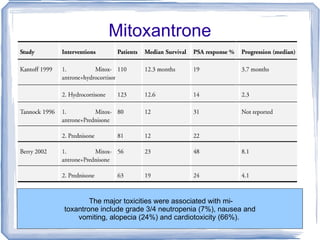
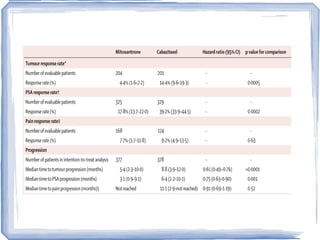
Mitoxantrone The major toxicities were associated with mi- toxantrone include grade 3/4 neutropenia (7%), nausea and vomiting, alopecia (24%) and cardiotoxicity (66%).
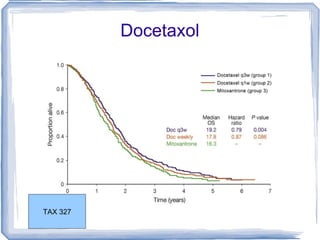
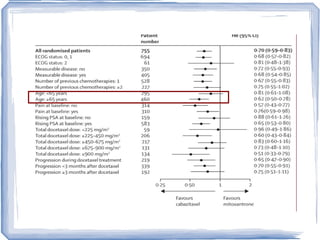
Docetaxol TAX 327
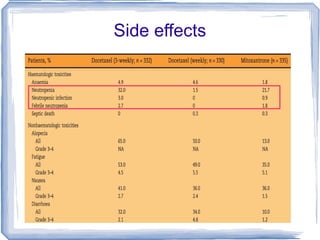
Side effects
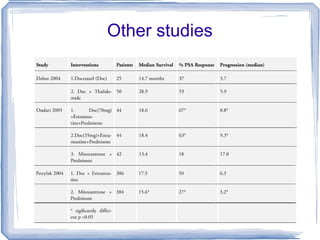
Other studies
Lesson learned? In view of the apparent lack of superior activity and greater toxicity by the addition of estramustine, docetaxel every 3 weeks plus low-dose prednisone can be considered as the current standard treatment  The optimal duration of docetaxel based chemotherapy for CRPC has not yet been established.  Tax 327  10 cycles  SWOG 99-16  12 cycles.  Standard practice is to treat patients with a fixed number of 10cycles of chemotherapy
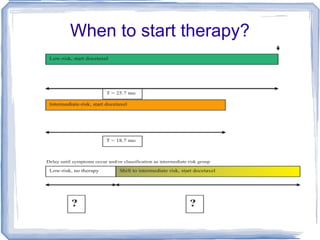
Prognostic factors TAX 327 four independent risk factors predicted for not reaching a 30% PSA decline in 3-month PSA  Significant baseline pain Visceral metastases anaemia (haemoglobin <13g/dl) bone scan progression at baseline low-risk group 0−1 risk factors – Median OS 25.7 m intermediate-risk group 2 risk factors – 18.7 m high-risk group of patients  3−4 risk factors-12.8 months,
When to start therapy?
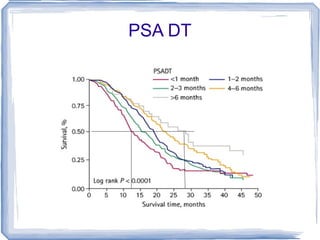
PSA DT
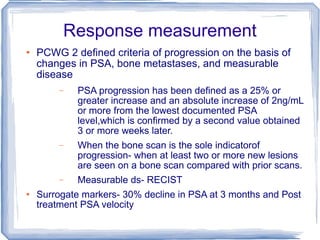
Response measurement PCWG 2 defined criteria of progression on the basis of changes in PSA, bone metastases, and measurable disease  PSA progression has been defined as a 25% or greater increase and an absolute increase of 2ng/mL or more from the lowest documented PSA level,which is confirmed by a second value obtained 3 or more weeks later.  When the bone scan is the sole indicatorof progression- when at least two or more new lesions are seen on a bone scan compared with prior scans. Measurable ds- RECIST Surrogate markers- 30% decline in PSA at 3 months and Post treatment PSA velocity
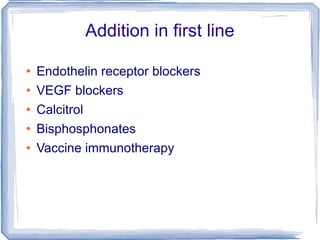
Addition in first line Endothelin receptor blockers VEGF blockers Calcitrol Bisphosphonates Vaccine immunotherapy
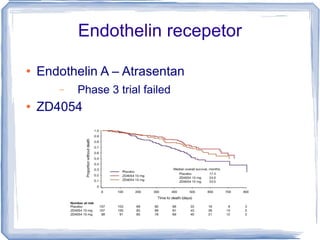
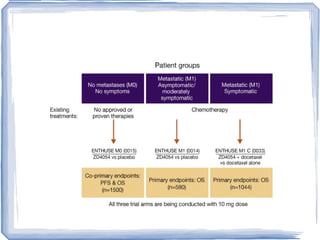
Endothelin recepetor Endothelin A – Atrasentan  Phase 3 trial failed ZD4054
 
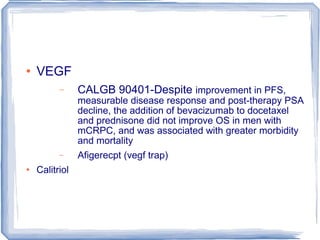
VEGF CALGB 90401-Despite  improvement in PFS, measurable disease response and post-therapy PSA decline, the addition of bevacizumab to docetaxel and prednisone did not improve OS in men with mCRPC, and was associated with greater morbidity and mortality Afigerecpt (vegf trap) Calitriol
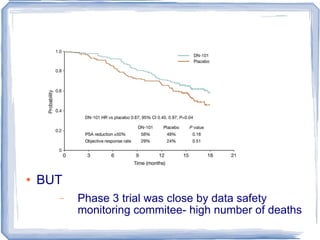
BUT Phase 3 trial was close by data safety monitoring commitee- high number of deaths
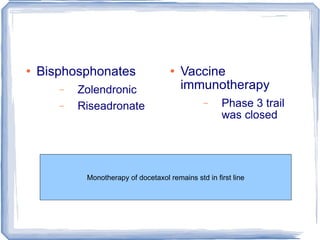
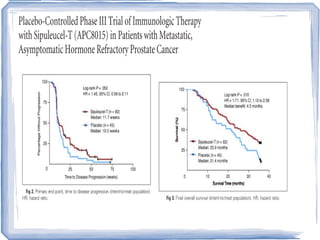
Bisphosphonates Zolendronic Riseadronate Vaccine immunotherapy Phase 3 trail was closed  Monotherapy of docetaxol remains std in first line
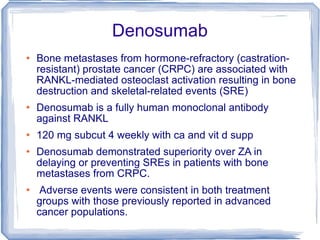
Denosumab Bone metastases from hormone-refractory (castration-resistant) prostate cancer (CRPC) are associated with RANKL-mediated osteoclast activation resulting in bone destruction and skeletal-related events (SRE)  Denosumab is a fully human monoclonal antibody against RANKL 120 mg subcut 4 weekly with ca and vit d supp Denosumab demonstrated superiority over ZA in delaying or preventing SREs in patients with bone metastases from CRPC. Adverse events were consistent in both treatment groups with those previously reported in advanced cancer populations.
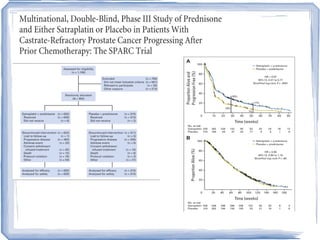
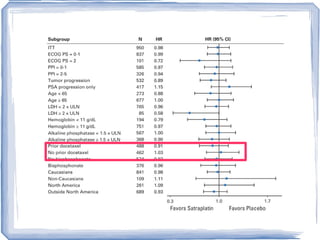
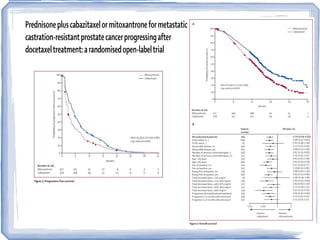
Second line therapy Issues Elderly Frail Tolerability


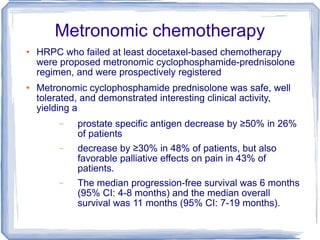
Metronomic chemotherapy HRPC who failed at least docetaxel-based chemotherapy were proposed metronomic cyclophosphamide-prednisolone regimen, and were prospectively registered Metronomic cyclophosphamide prednisolone was safe, well tolerated, and demonstrated interesting clinical activity, yielding a  prostate specific antigen decrease by ≥50% in 26% of patients  decrease by ≥30% in 48% of patients, but also favorable palliative effects on pain in 43% of patients.  The median progression-free survival was 6 months (95% CI: 4-8 months) and the median overall survival was 11 months (95% CI: 7-19 months).
 
Conclusion  Use of chemotherapy has increased survival in HRPC The quest for newer and better agents in first and second line is ongiong Use of metronomic in second line needs futher studies
 

Hormone Resistant Prostate Cancer

  • 1.
    Chemotherapy in HRPCDepartment of Medical oncology
  • 2.
    Definition Hormone resistantprostate cancer A rising PSA despite androgen ablation Manifests Rising PSA Symotomatic Progression Radiological evidence of progression despite the serum testosterone been at castrate levels BUT
  • 3.
    Defn contd Trialsdefined (similar) Men with advanced and progressive prostate cancer that had failed to respond to standard hormone therapy. Disease progression is observed despite castrate level of testosterone The definition of disease progression appearance of new lesions an increase in size (generally 25%) of existing lesions an increase in pain reduction in performance status Decrease in weight an increase in PSA levels No trial used a rising PSA level as the sole indicator of disease progression.
  • 4.
    EAU- defn Castrateserum levels of testosterone (testosterone <50 ng/dl or <1.7 nmol/l) Three consecutive rises of PSA, 1 wk apart, resulting in two 50% increases over the nadir Antiandrogen withdrawal for at least 4 wk for flutamide and for at least 6 wk for bicalutamide PSA progression, despite consecutive hormonal manipulations Progression of osseous lesions: progression or appearance of two or more lesions on bone scan or soft tissue lesions using Response Evaluation Criteria in Solid Tumours and with nodes >2 cm in diameter
  • 5.
    Why treat? MorbidityQOL Mortality Incurable situation Median life expectancy 12-18 months Use of chemo for palliation Of symptoms and for survival benefit
  • 6.
    Mitoxantrone The majortoxicities were associated with mi- toxantrone include grade 3/4 neutropenia (7%), nausea and vomiting, alopecia (24%) and cardiotoxicity (66%).
  • 7.
  • 8.
  • 9.
  • 10.
    Lesson learned? Inview of the apparent lack of superior activity and greater toxicity by the addition of estramustine, docetaxel every 3 weeks plus low-dose prednisone can be considered as the current standard treatment The optimal duration of docetaxel based chemotherapy for CRPC has not yet been established. Tax 327 10 cycles SWOG 99-16 12 cycles. Standard practice is to treat patients with a fixed number of 10cycles of chemotherapy
  • 11.
    Prognostic factors TAX327 four independent risk factors predicted for not reaching a 30% PSA decline in 3-month PSA Significant baseline pain Visceral metastases anaemia (haemoglobin <13g/dl) bone scan progression at baseline low-risk group 0−1 risk factors – Median OS 25.7 m intermediate-risk group 2 risk factors – 18.7 m high-risk group of patients 3−4 risk factors-12.8 months,
  • 12.
    When to starttherapy?
  • 13.
  • 14.
    Response measurement PCWG2 defined criteria of progression on the basis of changes in PSA, bone metastases, and measurable disease PSA progression has been defined as a 25% or greater increase and an absolute increase of 2ng/mL or more from the lowest documented PSA level,which is confirmed by a second value obtained 3 or more weeks later. When the bone scan is the sole indicatorof progression- when at least two or more new lesions are seen on a bone scan compared with prior scans. Measurable ds- RECIST Surrogate markers- 30% decline in PSA at 3 months and Post treatment PSA velocity
  • 15.
    Addition in firstline Endothelin receptor blockers VEGF blockers Calcitrol Bisphosphonates Vaccine immunotherapy
  • 16.
    Endothelin recepetor EndothelinA – Atrasentan Phase 3 trial failed ZD4054
  • 17.
  • 18.
    VEGF CALGB 90401-Despite improvement in PFS, measurable disease response and post-therapy PSA decline, the addition of bevacizumab to docetaxel and prednisone did not improve OS in men with mCRPC, and was associated with greater morbidity and mortality Afigerecpt (vegf trap) Calitriol
  • 19.
    BUT Phase 3trial was close by data safety monitoring commitee- high number of deaths
  • 20.
    Bisphosphonates Zolendronic RiseadronateVaccine immunotherapy Phase 3 trail was closed Monotherapy of docetaxol remains std in first line
  • 21.
    Denosumab Bone metastasesfrom hormone-refractory (castration-resistant) prostate cancer (CRPC) are associated with RANKL-mediated osteoclast activation resulting in bone destruction and skeletal-related events (SRE) Denosumab is a fully human monoclonal antibody against RANKL 120 mg subcut 4 weekly with ca and vit d supp Denosumab demonstrated superiority over ZA in delaying or preventing SREs in patients with bone metastases from CRPC. Adverse events were consistent in both treatment groups with those previously reported in advanced cancer populations.
  • 22.
    Second line therapyIssues Elderly Frail Tolerability
  • 23.
  • 24.
  • 25.
  • 26.
  • 27.
  • 28.
    Metronomic chemotherapy HRPCwho failed at least docetaxel-based chemotherapy were proposed metronomic cyclophosphamide-prednisolone regimen, and were prospectively registered Metronomic cyclophosphamide prednisolone was safe, well tolerated, and demonstrated interesting clinical activity, yielding a prostate specific antigen decrease by ≥50% in 26% of patients decrease by ≥30% in 48% of patients, but also favorable palliative effects on pain in 43% of patients. The median progression-free survival was 6 months (95% CI: 4-8 months) and the median overall survival was 11 months (95% CI: 7-19 months).
  • 29.
  • 30.
    Conclusion Useof chemotherapy has increased survival in HRPC The quest for newer and better agents in first and second line is ongiong Use of metronomic in second line needs futher studies
  • 31.