IGRT in Lung
Cancer
Dr Santam Chakraborty
Assistant Professor
Radiation Oncology
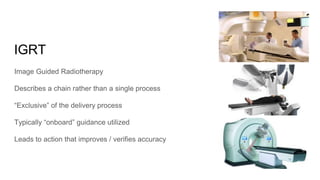
IGRT
Image Guided Radiotherapy
Describes a chain rather than a single process
“Exclusive” of the delivery process
Typically “onboard” guidance utilized
Leads to action that improves / verifies accuracy
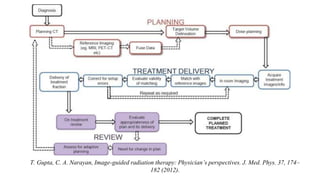
T. Gupta, C. A. Narayan, Image-guided radiation therapy: Physician’s perspectives. J. Med. Phys. 37, 174–
182 (2012).
Why IGRT
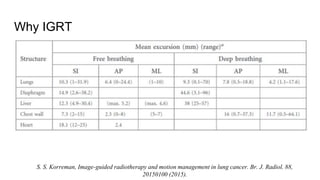
S. S. Korreman, Image-guided radiotherapy and motion management in lung cancer. Br. J. Radiol. 88,
20150100 (2015).
Why IGRT ...
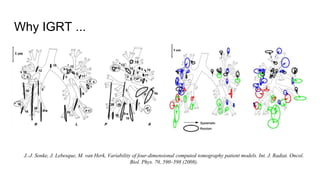
J.-J. Sonke, J. Lebesque, M. van Herk, Variability of four-dimensional computed tomography patient models. Int. J. Radiat. Oncol.
Biol. Phys. 70, 590–598 (2008).
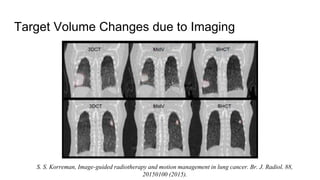
Target Volume Changes due to Imaging
S. S. Korreman, Image-guided radiotherapy and motion management in lung cancer. Br. J. Radiol. 88,
20150100 (2015).
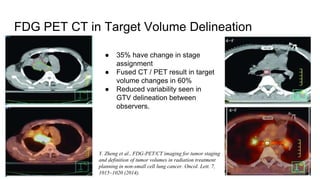
FDG PET CT in Target Volume Delineation
Y. Zheng et al., FDG-PET/CT imaging for tumor staging
and definition of tumor volumes in radiation treatment
planning in non-small cell lung cancer. Oncol. Lett. 7,
1015–1020 (2014).
● 35% have change in stage
assignment
● Fused CT / PET result in target
volume changes in 60%
● Reduced variability seen in
GTV delineation between
observers.
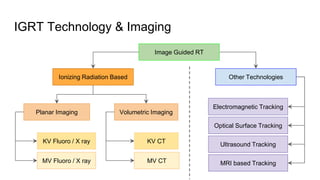
IGRT Technology & Imaging
Image Guided RT
Ionizing Radiation Based Other Technologies
Planar Imaging Volumetric Imaging
KV Fluoro / X ray
MV Fluoro / X ray
KV CT
MV CT
Electromagnetic Tracking
Optical Surface Tracking
Ultrasound Tracking
MRI based Tracking
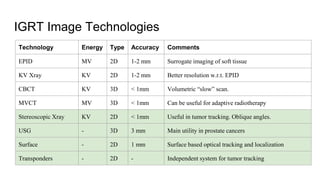
IGRT Image Technologies
Technology Energy Type Accuracy Comments
EPID MV 2D 1-2 mm Surrogate imaging of soft tissue
KV Xray KV 2D 1-2 mm Better resolution w.r.t. EPID
CBCT KV 3D < 1mm Volumetric “slow” scan.
MVCT MV 3D < 1mm Can be useful for adaptive radiotherapy
Stereoscopic Xray KV 2D < 1mm Useful in tumor tracking. Oblique angles.
USG - 3D 3 mm Main utility in prostate cancers
Surface - 2D 1 mm Surface based optical tracking and localization
Transponders - 2D - Independent system for tumor tracking
IGRT Issues in Lung Cancer
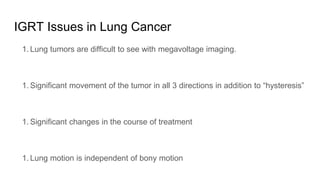
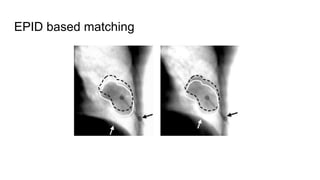
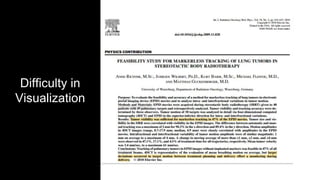
1. Lung tumors are difficult to see with megavoltage imaging.
1. Significant movement of the tumor in all 3 directions in addition to “hysteresis”
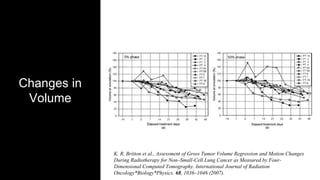
1. Significant changes in the course of treatment
1. Lung motion is independent of bony motion
Difficulty in
Visualization
EPID based matching
Difficulty in
Visualization
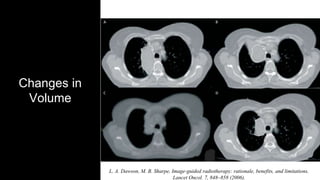
Changes in
Volume
K. R. Britton et al., Assessment of Gross Tumor Volume Regression and Motion Changes
During Radiotherapy for Non–Small-Cell Lung Cancer as Measured by Four-
Dimensional Computed Tomography. International Journal of Radiation
Oncology*Biology*Physics. 68, 1036–1046 (2007).
Changes in
Volume
L. A. Dawson, M. B. Sharpe, Image-guided radiotherapy: rationale, benefits, and limitations.
Lancet Oncol. 7, 848–858 (2006).
Changes in
Volume
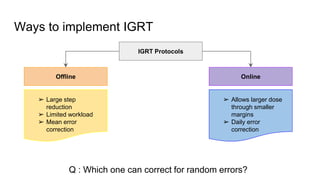
Ways to implement IGRT
IGRT Protocols
Offline Online
Q : Which one can correct for random errors?
➢ Large step
reduction
➢ Limited workload
➢ Mean error
correction
➢ Allows larger dose
through smaller
margins
➢ Daily error
correction
Basic points prior to Imaging
1. Reproducible comfortable positioning with immobilization
2. Tattoos help but skin marks mobile over bone (~ 5 mm)
3. Laser alignment is must
4. Rigid couchtop with indexed immobilization
5. Assume setup is incorrect unless proven otherwise
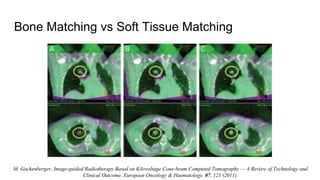
Bone Matching vs Soft Tissue Matching
M. Guckenberger, Image-guided Radiotherapy Based on Kilovoltage Cone-beam Computed Tomography — A Review of Technology and
Clinical Outcome. European Oncology & Haematology. 07, 121 (2011).
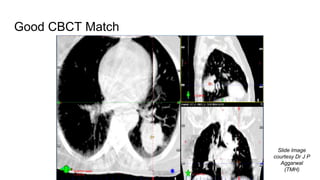
Good CBCT Match
Slide Image
courtesy Dr J P
Aggarwal
(TMH)
What to match on CBCT
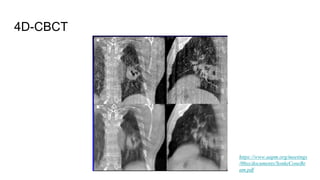
4D-CBCT
https://www.aapm.org/meetings
/06ss/documents/SonkeConeBe
am.pdf
Systematic vs Random Error
Systematic error : Reproducible, consistent errors, occurring in the same
direction and of similar magnitude.
It affects the dose distribution by producing a “miss”
Defined as the AVERAGE of a set of displacement.
Random error: Varies in direction and magnitude in each fraction.
It affects the dose distribution by producing a “blur”
Defined as the STANDARD DEVIATION of a set of displacements
Example Systematic & Random Error
https://docs.google.com/spreadsheets/d/1_w1dJzakVPJeMqFFRr5PZs4MVmKrN4lFPIMr0tRHZWA/edit?usp=sharing
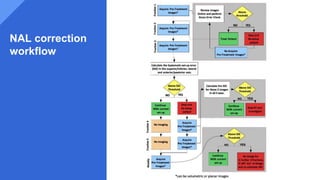
NAL correction
workflow
Example of a NAL protocol
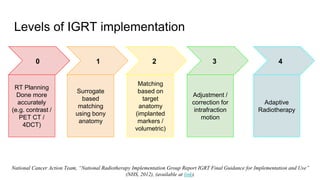
Levels of IGRT implementation
0 1 2
RT Planning
Done more
accurately
(e.g. contrast /
PET CT /
4DCT)
3 4
Surrogate
based
matching
using bony
anatomy
Matching
based on
target
anatomy
(implanted
markers /
volumetric)
Adjustment /
correction for
intrafraction
motion
Adaptive
Radiotherapy
National Cancer Action Team, “National Radiotherapy Implementation Group Report IGRT Final Guidance for Implementation and Use”
(NHS, 2012), (available at link).
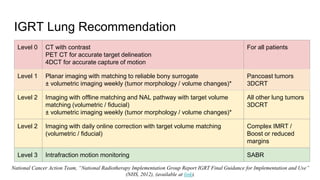
IGRT Lung Recommendation
Level 0 CT with contrast
PET CT for accurate target delineation
4DCT for accurate capture of motion
For all patients
Level 1 Planar imaging with matching to reliable bony surrogate
± volumetric imaging weekly (tumor morphology / volume changes)*
Pancoast tumors
3DCRT
Level 2 Imaging with offline matching and NAL pathway with target volume
matching (volumetric / fiducial)
± volumetric imaging weekly (tumor morphology / volume changes)*
All other lung tumors
3DCRT
Level 2 Imaging with daily online correction with target volume matching
(volumetric / fiducial)
Complex IMRT /
Boost or reduced
margins
Level 3 Intrafraction motion monitoring SABR
National Cancer Action Team, “National Radiotherapy Implementation Group Report IGRT Final Guidance for Implementation and Use”
(NHS, 2012), (available at link).
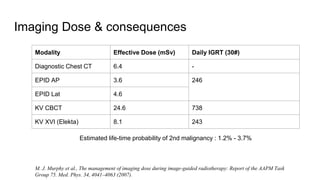
Imaging Dose & consequences
Modality Effective Dose (mSv) Daily IGRT (30#)
Diagnostic Chest CT 6.4 -
EPID AP 3.6 246
EPID Lat 4.6
KV CBCT 24.6 738
KV XVI (Elekta) 8.1 243
Estimated life-time probability of 2nd malignancy : 1.2% - 3.7%
M. J. Murphy et al., The management of imaging dose during image-guided radiotherapy: Report of the AAPM Task
Group 75. Med. Phys. 34, 4041–4063 (2007).
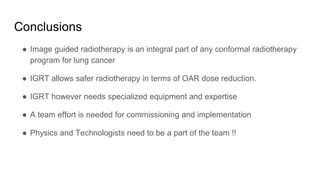
Conclusions
● Image guided radiotherapy is an integral part of any conformal radiotherapy
program for lung cancer
● IGRT allows safer radiotherapy in terms of OAR dose reduction.
● IGRT however needs specialized equipment and expertise
● A team effort is needed for commissioning and implementation
● Physics and Technologists need to be a part of the team !!

IGRT in lung cancer

  • 1.
    IGRT in Lung Cancer DrSantam Chakraborty Assistant Professor Radiation Oncology
  • 2.
    IGRT Image Guided Radiotherapy Describesa chain rather than a single process “Exclusive” of the delivery process Typically “onboard” guidance utilized Leads to action that improves / verifies accuracy
  • 3.
    T. Gupta, C.A. Narayan, Image-guided radiation therapy: Physician’s perspectives. J. Med. Phys. 37, 174– 182 (2012).
  • 4.
    Why IGRT S. S.Korreman, Image-guided radiotherapy and motion management in lung cancer. Br. J. Radiol. 88, 20150100 (2015).
  • 5.
    Why IGRT ... J.-J.Sonke, J. Lebesque, M. van Herk, Variability of four-dimensional computed tomography patient models. Int. J. Radiat. Oncol. Biol. Phys. 70, 590–598 (2008).
  • 6.
    Target Volume Changesdue to Imaging S. S. Korreman, Image-guided radiotherapy and motion management in lung cancer. Br. J. Radiol. 88, 20150100 (2015).
  • 7.
    FDG PET CTin Target Volume Delineation Y. Zheng et al., FDG-PET/CT imaging for tumor staging and definition of tumor volumes in radiation treatment planning in non-small cell lung cancer. Oncol. Lett. 7, 1015–1020 (2014). ● 35% have change in stage assignment ● Fused CT / PET result in target volume changes in 60% ● Reduced variability seen in GTV delineation between observers.
  • 8.
    IGRT Technology &Imaging Image Guided RT Ionizing Radiation Based Other Technologies Planar Imaging Volumetric Imaging KV Fluoro / X ray MV Fluoro / X ray KV CT MV CT Electromagnetic Tracking Optical Surface Tracking Ultrasound Tracking MRI based Tracking
  • 9.
    IGRT Image Technologies TechnologyEnergy Type Accuracy Comments EPID MV 2D 1-2 mm Surrogate imaging of soft tissue KV Xray KV 2D 1-2 mm Better resolution w.r.t. EPID CBCT KV 3D < 1mm Volumetric “slow” scan. MVCT MV 3D < 1mm Can be useful for adaptive radiotherapy Stereoscopic Xray KV 2D < 1mm Useful in tumor tracking. Oblique angles. USG - 3D 3 mm Main utility in prostate cancers Surface - 2D 1 mm Surface based optical tracking and localization Transponders - 2D - Independent system for tumor tracking
  • 10.
    IGRT Issues inLung Cancer 1. Lung tumors are difficult to see with megavoltage imaging. 1. Significant movement of the tumor in all 3 directions in addition to “hysteresis” 1. Significant changes in the course of treatment 1. Lung motion is independent of bony motion
  • 11.
  • 12.
  • 13.
  • 14.
    Changes in Volume K. R.Britton et al., Assessment of Gross Tumor Volume Regression and Motion Changes During Radiotherapy for Non–Small-Cell Lung Cancer as Measured by Four- Dimensional Computed Tomography. International Journal of Radiation Oncology*Biology*Physics. 68, 1036–1046 (2007).
  • 15.
    Changes in Volume L. A.Dawson, M. B. Sharpe, Image-guided radiotherapy: rationale, benefits, and limitations. Lancet Oncol. 7, 848–858 (2006).
  • 16.
  • 17.
    Ways to implementIGRT IGRT Protocols Offline Online Q : Which one can correct for random errors? ➢ Large step reduction ➢ Limited workload ➢ Mean error correction ➢ Allows larger dose through smaller margins ➢ Daily error correction
  • 18.
    Basic points priorto Imaging 1. Reproducible comfortable positioning with immobilization 2. Tattoos help but skin marks mobile over bone (~ 5 mm) 3. Laser alignment is must 4. Rigid couchtop with indexed immobilization 5. Assume setup is incorrect unless proven otherwise
  • 19.
    Bone Matching vsSoft Tissue Matching M. Guckenberger, Image-guided Radiotherapy Based on Kilovoltage Cone-beam Computed Tomography — A Review of Technology and Clinical Outcome. European Oncology & Haematology. 07, 121 (2011).
  • 20.
    Good CBCT Match SlideImage courtesy Dr J P Aggarwal (TMH)
  • 21.
  • 22.
  • 23.
    Systematic vs RandomError Systematic error : Reproducible, consistent errors, occurring in the same direction and of similar magnitude. It affects the dose distribution by producing a “miss” Defined as the AVERAGE of a set of displacement. Random error: Varies in direction and magnitude in each fraction. It affects the dose distribution by producing a “blur” Defined as the STANDARD DEVIATION of a set of displacements
  • 24.
    Example Systematic &Random Error https://docs.google.com/spreadsheets/d/1_w1dJzakVPJeMqFFRr5PZs4MVmKrN4lFPIMr0tRHZWA/edit?usp=sharing
  • 25.
  • 26.
    Example of aNAL protocol
  • 27.
    Levels of IGRTimplementation 0 1 2 RT Planning Done more accurately (e.g. contrast / PET CT / 4DCT) 3 4 Surrogate based matching using bony anatomy Matching based on target anatomy (implanted markers / volumetric) Adjustment / correction for intrafraction motion Adaptive Radiotherapy National Cancer Action Team, “National Radiotherapy Implementation Group Report IGRT Final Guidance for Implementation and Use” (NHS, 2012), (available at link).
  • 28.
    IGRT Lung Recommendation Level0 CT with contrast PET CT for accurate target delineation 4DCT for accurate capture of motion For all patients Level 1 Planar imaging with matching to reliable bony surrogate ± volumetric imaging weekly (tumor morphology / volume changes)* Pancoast tumors 3DCRT Level 2 Imaging with offline matching and NAL pathway with target volume matching (volumetric / fiducial) ± volumetric imaging weekly (tumor morphology / volume changes)* All other lung tumors 3DCRT Level 2 Imaging with daily online correction with target volume matching (volumetric / fiducial) Complex IMRT / Boost or reduced margins Level 3 Intrafraction motion monitoring SABR National Cancer Action Team, “National Radiotherapy Implementation Group Report IGRT Final Guidance for Implementation and Use” (NHS, 2012), (available at link).
  • 29.
    Imaging Dose &consequences Modality Effective Dose (mSv) Daily IGRT (30#) Diagnostic Chest CT 6.4 - EPID AP 3.6 246 EPID Lat 4.6 KV CBCT 24.6 738 KV XVI (Elekta) 8.1 243 Estimated life-time probability of 2nd malignancy : 1.2% - 3.7% M. J. Murphy et al., The management of imaging dose during image-guided radiotherapy: Report of the AAPM Task Group 75. Med. Phys. 34, 4041–4063 (2007).
  • 30.
    Conclusions ● Image guidedradiotherapy is an integral part of any conformal radiotherapy program for lung cancer ● IGRT allows safer radiotherapy in terms of OAR dose reduction. ● IGRT however needs specialized equipment and expertise ● A team effort is needed for commissioning and implementation ● Physics and Technologists need to be a part of the team !!

Editor's Notes

  • #5 In addition to the range of excursion experienced by the organ as noted in this table, the tumor can move in essentially unpredictable ways as it experiences the phenomenon of shrinkage, resolution of atelectasis, pneumonitis as well as natural variations in the breathing pattern over time. Cycle to cycle variability in breathing can be to the tune of 20% of the mean total motion over the cycle.
  • #6 The first image on the left shows the phenomenon of “hysteresis” where the tumor motion can “lag behind” the motion of the organ or vice versa. This is not a predictable phenomenon and is a function of the location of the tumor as well as its relationships with the adjacent structures. The consequence of this unpredictability is noted in the varying degree of random and systematic error for these tumors in which colors represent the magnitude of the error.
  • #7 As discussed in the talk on 4D image acquisition we see that the visualization of the tumors can change dramatically as per the conditions in which the CT scan was acquired. As can be seen the breath hold CT on the extreme right results in a significantly less tumor volume with implications when using IGRT with soft tissue matching.
  • #12 This study clearly demonstrates that with conventional EPIDs less than 20% of the patients had their tumor visualized.
  • #14 The authors investigated how well they could track the tumor motion on MV EPIDs taken during delivery of SRS. The EPIDS were matched against a DRR in which the tumor outline had been drawn. EPID based tumor tracking was feasible only in half of the beams and continuous monitoring from all angles possible only in 16% of the tumors.
  • #15 In this study employing fractionated radiotherapy the authors showed a 40% decrease in the tumor volume during the course of radiotherapy with no discernible time trends or correlation with the initial tumor volume.
  • #16 This image shows a series of images taken for a given patient at different stages of the therapy and shows the dramatic shape and volume changes that can happen during the course of radiotherapy.
  • #17 The results of a small study in 22 patients undergoing SRS for NSCLC at our center which demonstrate that 81% of the patients may have an increase in the volume of the GTV as delineated on the cone beam CT and rougly half of these patients have an increase in the size of the GTV mid treatment.
  • #20 Bone matching results in signifcant residual errors at the level of the tumor. If using CBCT it is better to match with the soft tissues.