(EORTC 10981-22023 AMAROS):
Radiotherapy or surgery of the axilla
after a positive sentinel node in breast
cancer :a randomised, multicentre, open-
label, phase 3 non-inferiority trial
Dr Kiran Kumar BR
Back Ground
• Sentinel lymph node biopsy is standard method for
assessment of axillary lymph node status in clinically node
negative breast cancers.
• If treatment of the axilla is indicated in patients with breast
cancer who have a positive sentinel node, axillary lymph node
dissection is the present standard.
• Axillary lymph node dissection is associated with harmful and
often persistent side-effects, particularly lymphedema and
restriction in shoulder mobility.
• ACOSOG Z0011 trial and the IBCSG 23-01 trial showed
that patients with limited disease in the sentinel node or
nodes who are treated with breast-conserving surgery,
whole breast irradiation, and adjuvant systemic
treatment can be spared axillary lymph node dissection
without compromising locoregional control or survival.
• Involvement of the axillary lymph nodes is suggested to be
predicted on the basis of factors such as tumour size, type,
grade, vascular invasion, and extracapsular extension of
cancer in the sentinel nodes
AIM OF STUDY
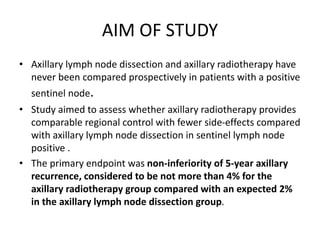
• Axillary lymph node dissection and axillary radiotherapy have
never been compared prospectively in patients with a positive
sentinel node.
• Study aimed to assess whether axillary radiotherapy provides
comparable regional control with fewer side-effects compared
with axillary lymph node dissection in sentinel lymph node
positive .
• The primary endpoint was non-inferiority of 5-year axillary
recurrence, considered to be not more than 4% for the
axillary radiotherapy group compared with an expected 2%
in the axillary lymph node dissection group.
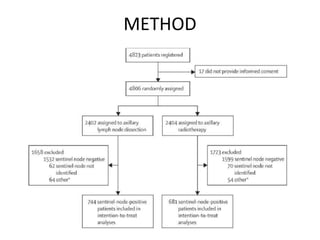
METHOD
Method
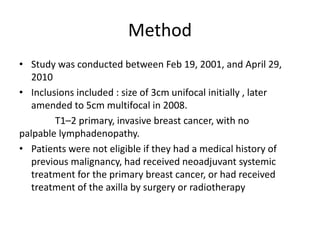
• Study was conducted between Feb 19, 2001, and April 29,
2010
• Inclusions included : size of 3cm unifocal initially , later
amended to 5cm multifocal in 2008.
T1–2 primary, invasive breast cancer, with no
palpable lymphadenopathy.
• Patients were not eligible if they had a medical history of
previous malignancy, had received neoadjuvant systemic
treatment for the primary breast cancer, or had received
treatment of the axilla by surgery or radiotherapy
Randomization
• Patients were randomly assigned (1:1) by a computer-
generated allocation schedule at the EORTC headquarters to
axillary lymph node dissection or axillary radiotherapy before
sentinel node biopsy.
• selection bias
• one-stage procedure with sentinel node biopsy, frozen section
and, in case of a positive sentinel node, immediate axillary
lymph node dissection could be done .
• omitting axillary treatment in a non-selected group of patients
with a negative sentinel node could be prospectively
analysed.
Procedures
• The sentinel node procedure had to be done with a
radioactive isotope, preferably combined with blue dye
(patent blue dye).
• Local treatment of the breast consisted of breast-conserving
treatment including whole-breast radiotherapy or
mastectomy with or without irradiation of the chest wall.
• Combined axillary treatment (axillary lymph node dissection
followed by axillary radiotherapy) was administered to 41
patients randomly assigned to the axillary lymph node
dissection group and 12 patients in the axillary radiotherapy
group.
Procedures
• Axillary treatment for patients with a tumour-positive sentinel
node had to start within 12 weeks after the sentinel node
biopsy. Consequently, systemic treatment, if indicated, was
administered after completing the axillary treatment.
• Axillary radiotherapy included the contents of all three levels
of the axilla and the medial part of the supraclavicular fossa.
The prescribed dose was 25 fractions of 2 Gy.
• Adjuvant axillary radiotherapy after axillary lymph node
dissection was allowed when at least four positive
• Axillary lymph node dissection was defined as a dissection of
at least anatomical levels I and II including at least ten nodes.
Follow up and Assessments
• Median follow-up was 6·1 years for the patients with positive
sentinel lymph nodes.
• Assessments of lymphoedema and shoulder mobility were
done at baseline and at 1, 3, 5, and 10 years by study
clinicians.
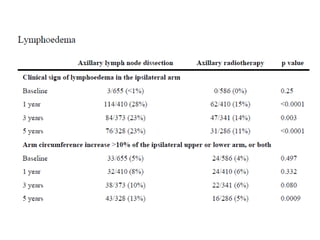
• An increase in arm circumference of at least 10% in the lower
arm or the upper arm, or both, compared with the
contralateral arm at the same timepoint was judged to be
clinically significant lymphoedema.
Assessments
• For shoulder mobility, the range of motion in both arms was
measured in four excursions: abduction, adduction, anteversion,
and retroversion. For each of the excursions, the range of
movement was compared between arms.
• Done at 1 and 5 yrs.
• QoL was assessed using the EORTC quality-of-life questionnaire
(EORTC-QLQ-C30; version 3) and breast cancer module (QLQ-BR23).
• The selected scales were pain, body image, and arm symptoms. The
arm symptoms scale was composed of three items: pain in arm or
shoulder, swollen arm or hand, and dificulties moving arm.
• Questionnaires were completed at baseline and at years 1, 2, 3, 5,
and 10.
End Points
• The primary endpoint in the group of patients with a positive
sentinel node was 5-year axillary recurrence, defined as
tumour recurrence in lymph nodes in the ipsilateral axilla,
infraclavicular fossa, or interpectoral area
• Secondary endpoints were axillary recurrence-free survival,
disease-free survival (DFS), overall survival, shoulder mobility,
lymphoedema, and QoL.
End Points
• The primary objective of the trial was to show non-inferiority
of axillary radiotherapy compared with axillary lymph node
dissection with respect to 5-year axillary recurrence in
patients with a positive sentinel node.
• 5-year axillary recurrence of 2% was assumed in the axillary
lymph node dissection group and non-inferiority was defined
as an axillary recurrence not higher than 4% in the axillary
radiotherapy group.
RESULTS
• Between Feb 19, 2001, and April 29, 2010, 4823 patients were
enrolled at 34 centres from nine European countries,
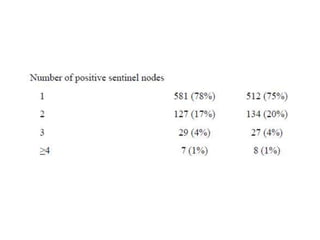
• In 859 (60%) of 1425 patients with a positive sentinel node,
preoperative staging of the axilla included ultrasound
examination.
• Median follow-up was 6·1 years (IQR 4·1–8·0) in the patients
who were sentinel node positive and 5·1 years (3·9–6·3) in
those who were sentinel node.
Axillary Recurrence
• Axillary recurrence occurred in four of 744 patients in the axillary
lymph node dissection group and seven of 681 in the axillary
radiotherapy group over the entire follow-up period.
• Two of the four recurrences in the axillary lymph node dissection
group and two of the seven recurrences in the axillary radiotherapy
group were isolated axillary recurrence as a first event.
• 5-year axillary recurrence was 0·43% in the axillary lymph node
dissection group and 1·19% in the axillary radiotherapy group .
• In the group of 3131 patients with a negative sentinel node, 25
axillary recurrences occurred during the entire follow-up period
(axillary recurrence rate 0·72%)
DFS
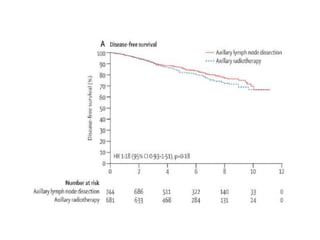
• There were no significant differences between treatment
groups in DFS and overall survival.
• 5-year DFS was 86·9% (95% CI 84·1–89·3) in the axillary lymph
node dissection group and 82·7% (79·3–85·5) in the axillary
radiotherapy group (HR 1·18, )
• 71 (10%) of 744 patients in the axillary lymph node dissection
group and 76 (11%) of 681 in the axillary radiotherapy group
died.
• Death due to breast cancer occurred in 53 (7%) patients in the
axillary lymph node dissection group and 54 (8%) in the
axillary radiotherapy group.
OS
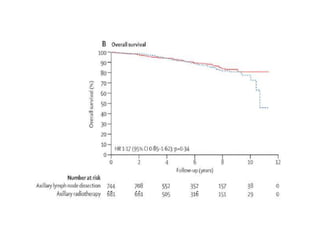
• 5-year overall survival was 93·3% (95% CI 91·0–95·0) in the
axillary lymph node dissection group and 92·5% (90·0–94·4) in
the axillary radiotherapy group (HR 1·17, 95% CI 0·85–1·62;
p=0·34; figure 2B).
• sentinel node negative, 5-year DFS was 87·9% (95% CI 86·6–
89·1) and overall survival was 95·4% (94·4–96·1).
DISCUSSION
• Axillary radiotherapy and axillary lymph node dissection both
provided excellent and comparable
locoregional control in patients with T1–2 primary breast
cancer
no palpable lymphadenopathy who are found to have a
positive sentinel node .
• No significant differences between the two groups in 5-year
axillary recurrence, DFS, and overall survival, and this finding
was similar in all subgroups .
• Significant difference in the incidence and severity of lymph
edema in favour of the axillary radiotherapy group,
• These results are in accordance with findings from two
randomised trials from before the introduction of sentinel
node biopsy that compared axillary radio-therapy with axillary
lymph node dissection in clinically node-negative patients: the
NSABP-04 trial and a French trial.
• In the NSAPB-04 trial, the axillary recurrence rate after a 25-
year follow-up was 4% in both treatment groups.
• In the French trial, with a 15-year follow-up, a better axillary
control was noted in the axillary lymph node dissection group
(1% vs 3% in the axillary radiotherapy group; p=0·04).
• The results of the AMAROS trial confirm that the type of
axillary management (axillary radiotherapy or axillary lymph
node dissection) in patients with a positive sentinel node does
not have an effect on survival.
• Signs of lymphoedema were noted at 5 years in 23% of the
patients after axillary lymph node dissection and 11% of those
after axillary radiotherapy.
• No significant differences in range of motion were recorded
between the two treatment groups in all four excursions.
• The finding of twice as few patients in the axillary radiotherapy
group having lymphoedema does not translate into a clinically
significant difference in QoL is remarkable.
• The present QoL measures might not have been sensitive enough
to detect a change in QoL resulting from lymphoedema.
• Another possible explanation is a situation usually referred to as
response shift in QoL.
• Patients adapt to their disorders and change their internal
standards. Such response shifts affect QoL outcome measurement
because changes over time represent not only the symptom itself,
but also the coping and acceptance level of that symptom by a
patient
Criticism
• The extensive irradiation including the periclavicular area
might be regarded as overtreatment since, apart from level 1
and 2, which are also treated in an axillary lymph node
dissection, level 3 and the supraclavicular nodes were also
treated.
• An imbalance was noted in the distribution of sentinel-node-
positive patients in the two treatment groups: more patients
with a positive sentinel node were allocated to the axillary
lymph node dissection group than to the axillary radiotherapy
group.
• 5-year axillary recurrences were far less common than what was
hypothesized and therefore the trial’s primary test was
underpowered.
• The AMAROS trial was designed to test non-inferiority based on an
assumption of a 2% 5-year axillary recurrence in the axillary lymph
node dissection group.
• As per data, that rate was an overestimation in both groups since
both did better than this baseline assumption.
• Since axillary recurrence seems to be an early event that occurs a
median of 15–30 months after treatment further follow-up is
unlikely to result in enough axillary recurrences to create suficient
power to test for a statistically and clinically significant difference
between the two treatment groups.
Conclusion
• The AMAROS trial cannot answer the remaining
question of which subset of clinically node-
negative, sentinel-node-positive patients still
require axillary treatments.
• In these cases , axillary radiotherapy could be
chosen instead of axillary lymph node dissection
because it provides comparable axillary control
and less morbidity.

Amaros trial jc- Kiran

  • 1.
    (EORTC 10981-22023 AMAROS): Radiotherapyor surgery of the axilla after a positive sentinel node in breast cancer :a randomised, multicentre, open- label, phase 3 non-inferiority trial Dr Kiran Kumar BR
  • 2.
    Back Ground • Sentinellymph node biopsy is standard method for assessment of axillary lymph node status in clinically node negative breast cancers. • If treatment of the axilla is indicated in patients with breast cancer who have a positive sentinel node, axillary lymph node dissection is the present standard. • Axillary lymph node dissection is associated with harmful and often persistent side-effects, particularly lymphedema and restriction in shoulder mobility.
  • 3.
    • ACOSOG Z0011trial and the IBCSG 23-01 trial showed that patients with limited disease in the sentinel node or nodes who are treated with breast-conserving surgery, whole breast irradiation, and adjuvant systemic treatment can be spared axillary lymph node dissection without compromising locoregional control or survival. • Involvement of the axillary lymph nodes is suggested to be predicted on the basis of factors such as tumour size, type, grade, vascular invasion, and extracapsular extension of cancer in the sentinel nodes
  • 4.
    AIM OF STUDY •Axillary lymph node dissection and axillary radiotherapy have never been compared prospectively in patients with a positive sentinel node. • Study aimed to assess whether axillary radiotherapy provides comparable regional control with fewer side-effects compared with axillary lymph node dissection in sentinel lymph node positive . • The primary endpoint was non-inferiority of 5-year axillary recurrence, considered to be not more than 4% for the axillary radiotherapy group compared with an expected 2% in the axillary lymph node dissection group.
  • 5.
  • 6.
    Method • Study wasconducted between Feb 19, 2001, and April 29, 2010 • Inclusions included : size of 3cm unifocal initially , later amended to 5cm multifocal in 2008. T1–2 primary, invasive breast cancer, with no palpable lymphadenopathy. • Patients were not eligible if they had a medical history of previous malignancy, had received neoadjuvant systemic treatment for the primary breast cancer, or had received treatment of the axilla by surgery or radiotherapy
  • 9.
    Randomization • Patients wererandomly assigned (1:1) by a computer- generated allocation schedule at the EORTC headquarters to axillary lymph node dissection or axillary radiotherapy before sentinel node biopsy. • selection bias • one-stage procedure with sentinel node biopsy, frozen section and, in case of a positive sentinel node, immediate axillary lymph node dissection could be done . • omitting axillary treatment in a non-selected group of patients with a negative sentinel node could be prospectively analysed.
  • 10.
    Procedures • The sentinelnode procedure had to be done with a radioactive isotope, preferably combined with blue dye (patent blue dye). • Local treatment of the breast consisted of breast-conserving treatment including whole-breast radiotherapy or mastectomy with or without irradiation of the chest wall. • Combined axillary treatment (axillary lymph node dissection followed by axillary radiotherapy) was administered to 41 patients randomly assigned to the axillary lymph node dissection group and 12 patients in the axillary radiotherapy group.
  • 11.
    Procedures • Axillary treatmentfor patients with a tumour-positive sentinel node had to start within 12 weeks after the sentinel node biopsy. Consequently, systemic treatment, if indicated, was administered after completing the axillary treatment. • Axillary radiotherapy included the contents of all three levels of the axilla and the medial part of the supraclavicular fossa. The prescribed dose was 25 fractions of 2 Gy. • Adjuvant axillary radiotherapy after axillary lymph node dissection was allowed when at least four positive • Axillary lymph node dissection was defined as a dissection of at least anatomical levels I and II including at least ten nodes.
  • 12.
    Follow up andAssessments • Median follow-up was 6·1 years for the patients with positive sentinel lymph nodes. • Assessments of lymphoedema and shoulder mobility were done at baseline and at 1, 3, 5, and 10 years by study clinicians. • An increase in arm circumference of at least 10% in the lower arm or the upper arm, or both, compared with the contralateral arm at the same timepoint was judged to be clinically significant lymphoedema.
  • 13.
    Assessments • For shouldermobility, the range of motion in both arms was measured in four excursions: abduction, adduction, anteversion, and retroversion. For each of the excursions, the range of movement was compared between arms. • Done at 1 and 5 yrs. • QoL was assessed using the EORTC quality-of-life questionnaire (EORTC-QLQ-C30; version 3) and breast cancer module (QLQ-BR23). • The selected scales were pain, body image, and arm symptoms. The arm symptoms scale was composed of three items: pain in arm or shoulder, swollen arm or hand, and dificulties moving arm. • Questionnaires were completed at baseline and at years 1, 2, 3, 5, and 10.
  • 14.
    End Points • Theprimary endpoint in the group of patients with a positive sentinel node was 5-year axillary recurrence, defined as tumour recurrence in lymph nodes in the ipsilateral axilla, infraclavicular fossa, or interpectoral area • Secondary endpoints were axillary recurrence-free survival, disease-free survival (DFS), overall survival, shoulder mobility, lymphoedema, and QoL.
  • 15.
    End Points • Theprimary objective of the trial was to show non-inferiority of axillary radiotherapy compared with axillary lymph node dissection with respect to 5-year axillary recurrence in patients with a positive sentinel node. • 5-year axillary recurrence of 2% was assumed in the axillary lymph node dissection group and non-inferiority was defined as an axillary recurrence not higher than 4% in the axillary radiotherapy group.
  • 16.
    RESULTS • Between Feb19, 2001, and April 29, 2010, 4823 patients were enrolled at 34 centres from nine European countries, • In 859 (60%) of 1425 patients with a positive sentinel node, preoperative staging of the axilla included ultrasound examination. • Median follow-up was 6·1 years (IQR 4·1–8·0) in the patients who were sentinel node positive and 5·1 years (3·9–6·3) in those who were sentinel node.
  • 17.
    Axillary Recurrence • Axillaryrecurrence occurred in four of 744 patients in the axillary lymph node dissection group and seven of 681 in the axillary radiotherapy group over the entire follow-up period. • Two of the four recurrences in the axillary lymph node dissection group and two of the seven recurrences in the axillary radiotherapy group were isolated axillary recurrence as a first event. • 5-year axillary recurrence was 0·43% in the axillary lymph node dissection group and 1·19% in the axillary radiotherapy group . • In the group of 3131 patients with a negative sentinel node, 25 axillary recurrences occurred during the entire follow-up period (axillary recurrence rate 0·72%)
  • 18.
    DFS • There wereno significant differences between treatment groups in DFS and overall survival. • 5-year DFS was 86·9% (95% CI 84·1–89·3) in the axillary lymph node dissection group and 82·7% (79·3–85·5) in the axillary radiotherapy group (HR 1·18, ) • 71 (10%) of 744 patients in the axillary lymph node dissection group and 76 (11%) of 681 in the axillary radiotherapy group died. • Death due to breast cancer occurred in 53 (7%) patients in the axillary lymph node dissection group and 54 (8%) in the axillary radiotherapy group.
  • 20.
    OS • 5-year overallsurvival was 93·3% (95% CI 91·0–95·0) in the axillary lymph node dissection group and 92·5% (90·0–94·4) in the axillary radiotherapy group (HR 1·17, 95% CI 0·85–1·62; p=0·34; figure 2B). • sentinel node negative, 5-year DFS was 87·9% (95% CI 86·6– 89·1) and overall survival was 95·4% (94·4–96·1).
  • 23.
    DISCUSSION • Axillary radiotherapyand axillary lymph node dissection both provided excellent and comparable locoregional control in patients with T1–2 primary breast cancer no palpable lymphadenopathy who are found to have a positive sentinel node . • No significant differences between the two groups in 5-year axillary recurrence, DFS, and overall survival, and this finding was similar in all subgroups . • Significant difference in the incidence and severity of lymph edema in favour of the axillary radiotherapy group,
  • 24.
    • These resultsare in accordance with findings from two randomised trials from before the introduction of sentinel node biopsy that compared axillary radio-therapy with axillary lymph node dissection in clinically node-negative patients: the NSABP-04 trial and a French trial. • In the NSAPB-04 trial, the axillary recurrence rate after a 25- year follow-up was 4% in both treatment groups. • In the French trial, with a 15-year follow-up, a better axillary control was noted in the axillary lymph node dissection group (1% vs 3% in the axillary radiotherapy group; p=0·04).
  • 25.
    • The resultsof the AMAROS trial confirm that the type of axillary management (axillary radiotherapy or axillary lymph node dissection) in patients with a positive sentinel node does not have an effect on survival. • Signs of lymphoedema were noted at 5 years in 23% of the patients after axillary lymph node dissection and 11% of those after axillary radiotherapy. • No significant differences in range of motion were recorded between the two treatment groups in all four excursions.
  • 26.
    • The findingof twice as few patients in the axillary radiotherapy group having lymphoedema does not translate into a clinically significant difference in QoL is remarkable. • The present QoL measures might not have been sensitive enough to detect a change in QoL resulting from lymphoedema. • Another possible explanation is a situation usually referred to as response shift in QoL. • Patients adapt to their disorders and change their internal standards. Such response shifts affect QoL outcome measurement because changes over time represent not only the symptom itself, but also the coping and acceptance level of that symptom by a patient
  • 27.
    Criticism • The extensiveirradiation including the periclavicular area might be regarded as overtreatment since, apart from level 1 and 2, which are also treated in an axillary lymph node dissection, level 3 and the supraclavicular nodes were also treated. • An imbalance was noted in the distribution of sentinel-node- positive patients in the two treatment groups: more patients with a positive sentinel node were allocated to the axillary lymph node dissection group than to the axillary radiotherapy group.
  • 29.
    • 5-year axillaryrecurrences were far less common than what was hypothesized and therefore the trial’s primary test was underpowered. • The AMAROS trial was designed to test non-inferiority based on an assumption of a 2% 5-year axillary recurrence in the axillary lymph node dissection group. • As per data, that rate was an overestimation in both groups since both did better than this baseline assumption. • Since axillary recurrence seems to be an early event that occurs a median of 15–30 months after treatment further follow-up is unlikely to result in enough axillary recurrences to create suficient power to test for a statistically and clinically significant difference between the two treatment groups.
  • 30.
    Conclusion • The AMAROStrial cannot answer the remaining question of which subset of clinically node- negative, sentinel-node-positive patients still require axillary treatments. • In these cases , axillary radiotherapy could be chosen instead of axillary lymph node dissection because it provides comparable axillary control and less morbidity.