
Recursive Partitioning Analysis
By Dr Nilesh
Definition
• A statistical tool that allows for the identifcation of
signifcant prognostic factors and subsequent
classifcation of patients into groups with similar
outcomes
• RPA is Used in HGG as a one of prognostic factor to
determine median survival and overall 5 years survival
• It is also used in Brain mets patients with different
Primary cancers
Which are most common HGG ?
• Anaplastic astrocytoma (WHO grade III)
– IDH-wild type
– IDH-Mutant
• Anaplastic oligodendroglioma (WHO III)
– IDH-Mutant
– 1p/19q-codeleted
• Anaplastic oligoastrocytoma (WHO grade III)
• Glioblastoma (GBM) (WHO grade IV)
– IDH-wildtype
– IDH-mutant
What are other prognostic factors ?
 Age
Tumor type
 Tumor grade
Seizure symptoms
Duration of symptoms
Performance status
Extent of surgery performed and irradiation dose
RPA
Molecular alterations
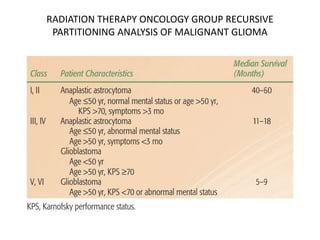
• Curran et al. used nonparametric recursive
partitioning analysis to analyze data from three
RTOG trials that included 1,578 patients with
malignant gliomas.
• Age was the most important predictor of
survival, with patients younger than 50 years
faring best; KPS ≥70 was the next-most-signifcant
prognostic factor.
• Taking into account these and other variables, it
is possible to divide patients into groups with
similar outcome.
RADIATION THERAPY ONCOLOGY GROUP RECURSIVE
PARTITIONING ANALYSIS OF MALIGNANT GLIOMA
Limitation of RPA in HGG
• It did not include
– identification of tumor site
– Molecular alterations
– Chemotherapy status
In recent times…
By bell et al.
OBJECTIVE :- To refine the existing clinically based recursive partitioning analysis (RPA) model
by incorporating molecular variables
METHOD :- a randomized clinical trial, 22 proteins were analyzed by quantitative
immunohistochemistry using 452 patient’s specimens and assessed for prognostic
significance of overall survival.
CONCLUSIONS AND RELEVANCE
• This new NRG-GBM-RPA model improves outcome
stratification over both the current RTOG RPA model
and MGMT promoter methylation, respectively, for
patients with GBM treated with radiation and
temozolomide and was biologically validated in an
independent data set.
• The revised RPA has the potential to contribute to
improving the accurate assessment of prognostic
groups in patients with GBM treated with radiation and
temozolomide and to influence clinical decision making
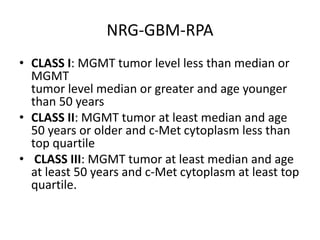
NRG-GBM-RPA
• CLASS I: MGMT tumor level less than median or
MGMT
tumor level median or greater and age younger
than 50 years
• CLASS II: MGMT tumor at least median and age
50 years or older and c-Met cytoplasm less than
top quartile
• CLASS III: MGMT tumor at least median and age
at least 50 years and c-Met cytoplasm at least top
quartile.
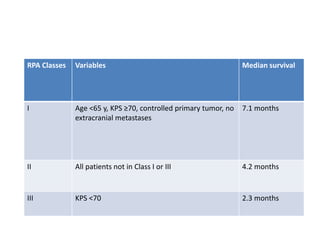
RPA for Brain Mets.
• Overall, Karnofsky performance status (KPS),
age, control of primary and the status of extra
cranial disease were found to impact survival )
in those patients who were treated with
whole brain radiation therapy (WBRT) for BM
(Gaspar et al.) (RTOG trials (79-16, 85-28, and
89-05)
RPA Classes Variables Median survival
I Age <65 y, KPS ≥70, controlled primary tumor, no
extracranial metastases
7.1 months
II All patients not in Class I or III 4.2 months
III KPS <70 2.3 months
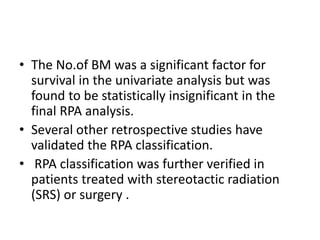
• The No.of BM was a significant factor for
survival in the univariate analysis but was
found to be statistically insignificant in the
final RPA analysis.
• Several other retrospective studies have
validated the RPA classification.
• RPA classification was further verified in
patients treated with stereotactic radiation
(SRS) or surgery .
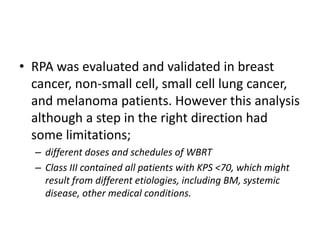
• RPA was evaluated and validated in breast
cancer, non-small cell, small cell lung cancer,
and melanoma patients. However this analysis
although a step in the right direction had
some limitations;
– different doses and schedules of WBRT
– Class III contained all patients with KPS <70, which might
result from different etiologies, including BM, systemic
disease, other medical conditions.
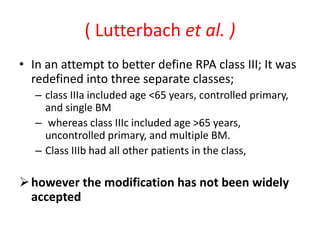
( Lutterbach et al. )
• In an attempt to better define RPA class III; It was
redefined into three separate classes;
– class IIIa included age <65 years, controlled primary,
and single BM
– whereas class IIIc included age >65 years,
uncontrolled primary, and multiple BM.
– Class IIIb had all other patients in the class,
however the modification has not been widely
accepted
• Even though RPA has been widely accepted
and used in multiple clinical trials in the past,
multiple indices have been proposed to
address the above-mentioned limitations.
• RTOG 9508, a randomized trial of WBRT with
or without SRS boost for patients with one to
three BM concluded that No. of BM was
significant for prognosis and RPA, did not
include No. of BM in the prognostic score.
• In 2007, a new scoring system called the GPA
was proposed
 The GPA incorporated four factors:
I. age,
II. KPS,
III. ECM
IV. No.of BM
• All the indices compared were prognostic with
GPA being as prognostic as RPA.
• Since then various studies have validated the
GPA .
• The authors concluded that “GPA is least
subjective, most quantitative and easiest to
use”. Since that time GPA has become one of
the most commonly used prognostic index in
clinical practice.
Disease specific Graded Prognostic
Assessment (ds-GPA)
• Survival results following treatment for brain
metastases are highly heterogeneous and
depend in part upon the primary tumor.
• Multivariate analysis using the same criteria as
in the RPA analysis, plus the primary diagnosis,
led to the establishment of separate criteria
for patients different primaries.
Significant prognostic factors in this
model included the following:
• Lung cancer – Age, KPS, presence of extracranial
metastases, No. of brain metastases
• Melanoma – KPS and No.of brain metastases
• Renal cell carcinoma – KPS and No. of brain
metastases
• Breast cancer – KPS, subtype (based upon
estrogen receptor/progesterone receptor, HER2
status), and age
• Gastrointestinal cancers – KPS
Limitation of Ds-GPA
• The ds-GPA was formulated for BM from
different primary malignancies but did not consider the
role of mutations.
• Another limitation of prognostic indices is that all the
factors are derived based on survival and there is no
scores that address endpoints other than survival.
• in recent year more studies have attempted to clarify
the role of mutations or tumor subtypes similar to the
breast specifc GPA
THANK YOU

Recursive partitioning analysis

  • 1.
  • 2.
    Definition • A statisticaltool that allows for the identifcation of signifcant prognostic factors and subsequent classifcation of patients into groups with similar outcomes • RPA is Used in HGG as a one of prognostic factor to determine median survival and overall 5 years survival • It is also used in Brain mets patients with different Primary cancers
  • 3.
    Which are mostcommon HGG ? • Anaplastic astrocytoma (WHO grade III) – IDH-wild type – IDH-Mutant • Anaplastic oligodendroglioma (WHO III) – IDH-Mutant – 1p/19q-codeleted • Anaplastic oligoastrocytoma (WHO grade III) • Glioblastoma (GBM) (WHO grade IV) – IDH-wildtype – IDH-mutant
  • 4.
    What are otherprognostic factors ?  Age Tumor type  Tumor grade Seizure symptoms Duration of symptoms Performance status Extent of surgery performed and irradiation dose RPA Molecular alterations
  • 5.
    • Curran etal. used nonparametric recursive partitioning analysis to analyze data from three RTOG trials that included 1,578 patients with malignant gliomas. • Age was the most important predictor of survival, with patients younger than 50 years faring best; KPS ≥70 was the next-most-signifcant prognostic factor. • Taking into account these and other variables, it is possible to divide patients into groups with similar outcome.
  • 6.
    RADIATION THERAPY ONCOLOGYGROUP RECURSIVE PARTITIONING ANALYSIS OF MALIGNANT GLIOMA
  • 7.
    Limitation of RPAin HGG • It did not include – identification of tumor site – Molecular alterations – Chemotherapy status
  • 8.
    In recent times… Bybell et al. OBJECTIVE :- To refine the existing clinically based recursive partitioning analysis (RPA) model by incorporating molecular variables METHOD :- a randomized clinical trial, 22 proteins were analyzed by quantitative immunohistochemistry using 452 patient’s specimens and assessed for prognostic significance of overall survival.
  • 9.
    CONCLUSIONS AND RELEVANCE •This new NRG-GBM-RPA model improves outcome stratification over both the current RTOG RPA model and MGMT promoter methylation, respectively, for patients with GBM treated with radiation and temozolomide and was biologically validated in an independent data set. • The revised RPA has the potential to contribute to improving the accurate assessment of prognostic groups in patients with GBM treated with radiation and temozolomide and to influence clinical decision making
  • 10.
    NRG-GBM-RPA • CLASS I:MGMT tumor level less than median or MGMT tumor level median or greater and age younger than 50 years • CLASS II: MGMT tumor at least median and age 50 years or older and c-Met cytoplasm less than top quartile • CLASS III: MGMT tumor at least median and age at least 50 years and c-Met cytoplasm at least top quartile.
  • 11.
    RPA for BrainMets. • Overall, Karnofsky performance status (KPS), age, control of primary and the status of extra cranial disease were found to impact survival ) in those patients who were treated with whole brain radiation therapy (WBRT) for BM (Gaspar et al.) (RTOG trials (79-16, 85-28, and 89-05)
  • 12.
    RPA Classes VariablesMedian survival I Age <65 y, KPS ≥70, controlled primary tumor, no extracranial metastases 7.1 months II All patients not in Class I or III 4.2 months III KPS <70 2.3 months
  • 13.
    • The No.ofBM was a significant factor for survival in the univariate analysis but was found to be statistically insignificant in the final RPA analysis. • Several other retrospective studies have validated the RPA classification. • RPA classification was further verified in patients treated with stereotactic radiation (SRS) or surgery .
  • 14.
    • RPA wasevaluated and validated in breast cancer, non-small cell, small cell lung cancer, and melanoma patients. However this analysis although a step in the right direction had some limitations; – different doses and schedules of WBRT – Class III contained all patients with KPS <70, which might result from different etiologies, including BM, systemic disease, other medical conditions.
  • 15.
    ( Lutterbach etal. ) • In an attempt to better define RPA class III; It was redefined into three separate classes; – class IIIa included age <65 years, controlled primary, and single BM – whereas class IIIc included age >65 years, uncontrolled primary, and multiple BM. – Class IIIb had all other patients in the class, however the modification has not been widely accepted
  • 16.
    • Even thoughRPA has been widely accepted and used in multiple clinical trials in the past, multiple indices have been proposed to address the above-mentioned limitations. • RTOG 9508, a randomized trial of WBRT with or without SRS boost for patients with one to three BM concluded that No. of BM was significant for prognosis and RPA, did not include No. of BM in the prognostic score.
  • 17.
    • In 2007,a new scoring system called the GPA was proposed  The GPA incorporated four factors: I. age, II. KPS, III. ECM IV. No.of BM
  • 18.
    • All theindices compared were prognostic with GPA being as prognostic as RPA. • Since then various studies have validated the GPA . • The authors concluded that “GPA is least subjective, most quantitative and easiest to use”. Since that time GPA has become one of the most commonly used prognostic index in clinical practice.
  • 19.
    Disease specific GradedPrognostic Assessment (ds-GPA) • Survival results following treatment for brain metastases are highly heterogeneous and depend in part upon the primary tumor. • Multivariate analysis using the same criteria as in the RPA analysis, plus the primary diagnosis, led to the establishment of separate criteria for patients different primaries.
  • 20.
    Significant prognostic factorsin this model included the following: • Lung cancer – Age, KPS, presence of extracranial metastases, No. of brain metastases • Melanoma – KPS and No.of brain metastases • Renal cell carcinoma – KPS and No. of brain metastases • Breast cancer – KPS, subtype (based upon estrogen receptor/progesterone receptor, HER2 status), and age • Gastrointestinal cancers – KPS
  • 22.
    Limitation of Ds-GPA •The ds-GPA was formulated for BM from different primary malignancies but did not consider the role of mutations. • Another limitation of prognostic indices is that all the factors are derived based on survival and there is no scores that address endpoints other than survival. • in recent year more studies have attempted to clarify the role of mutations or tumor subtypes similar to the breast specifc GPA
  • 23.