The role of an international
partnership in developing academic
capacity in open distance learning
Geesje Van den Berg - Unisa
Muriel Joffe - UMUC
Stella C.S. Porto - IDB & UMUC
Overview
● Background
● How does the partnership work?
● Research methodology
● Findings
● Overall value of the programme
● Final remarks
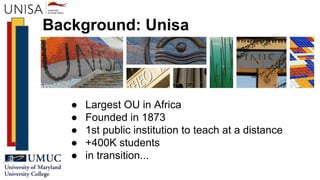
Background: Unisa
● Largest OU in Africa
● Founded in 1873
● 1st public institution to teach at a distance
● +400K students
● in transition...
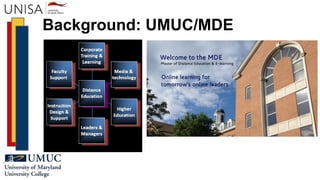
Background: UMUC/MDE
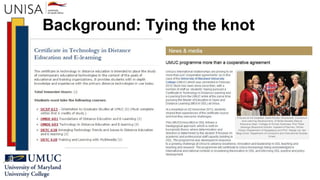
Background: Tying the knot
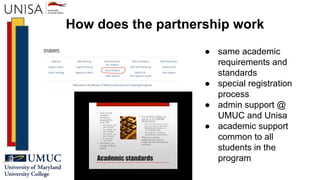
How does the partnership work
● same academic
requirements and
standards
● special registration
process
● admin support @
UMUC and Unisa
● academic support
common to all
students in the
program
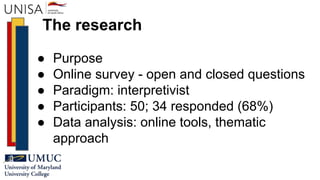
The research
● Purpose
● Online survey - open and closed questions
● Paradigm: interpretivist
● Participants: 50; 34 responded (68%)
● Data analysis: online tools, thematic
approach
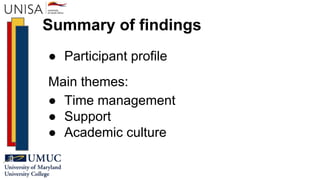
Summary of findings
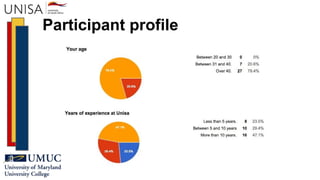
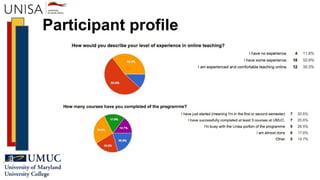
● Participant profile
Main themes:
● Time management
● Support
● Academic culture
Participant profile
Participant profile
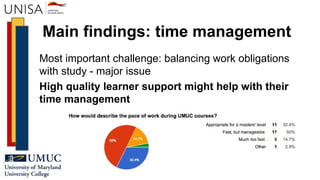
Main findings: time management
Most important challenge: balancing work obligations
with study - major issue
High quality learner support might help with their
time management
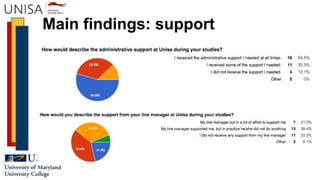
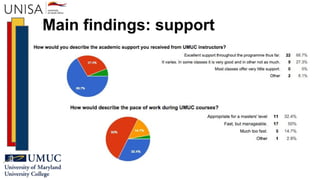
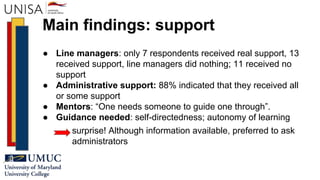
Main findings: support
● Line managers: only 7 respondents received real support, 13
received support, line managers did nothing; 11 received no
support
● Administrative support: 88% indicated that they received all
or some support
● Mentors: “One needs someone to guide one through”.
● Guidance needed: self-directedness; autonomy of learning
surprise! Although information available, preferred to ask
administrators
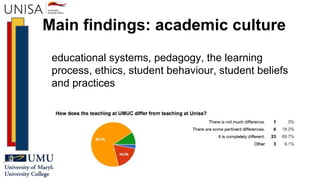
Main findings: academic culture
educational systems, pedagogy, the learning
process, ethics, student behaviour, student beliefs
and practices
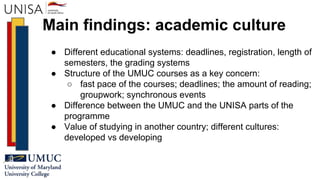
Main findings: academic culture
● Different educational systems: deadlines, registration, length of
semesters, the grading systems
● Structure of the UMUC courses as a key concern:
○ fast pace of the courses; deadlines; the amount of reading;
groupwork; synchronous events
● Difference between the UMUC and the UNISA parts of the
programme
● Value of studying in another country; different cultures:
developed vs developing
Overall value of the programme
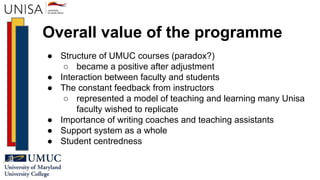
● Structure of UMUC courses (paradox?)
○ became a positive after adjustment
● Interaction between faculty and students
● The constant feedback from instructors
○ represented a model of teaching and learning many Unisa
faculty wished to replicate
● Importance of writing coaches and teaching assistants
● Support system as a whole
● Student centredness
Overall value of the programme
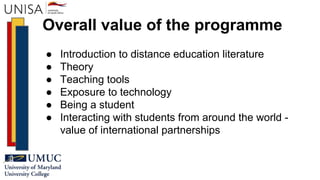
● Introduction to distance education literature
● Theory
● Teaching tools
● Exposure to technology
● Being a student
● Interacting with students from around the world -
value of international partnerships
Final remarks
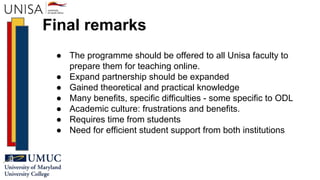
● The programme should be offered to all Unisa faculty to
prepare them for teaching online.
● Expand partnership should be expanded
● Gained theoretical and practical knowledge
● Many benefits, specific difficulties - some specific to ODL
● Academic culture: frustrations and benefits.
● Requires time from students
● Need for efficient student support from both institutions
Final remarks
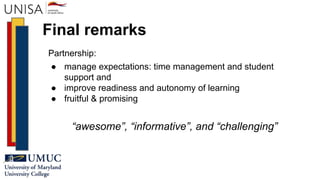
Partnership:
● manage expectations: time management and student
support and
● improve readiness and autonomy of learning
● fruitful & promising
“awesome”, “informative”, and “challenging”
Final remarks
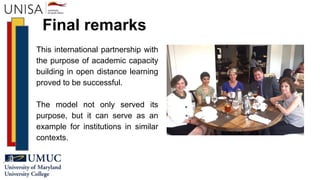
This international partnership with
the purpose of academic capacity
building in open distance learning
proved to be successful.
The model not only served its
purpose, but it can serve as an
example for institutions in similar
contexts.
Thank you!
Questions?
vdberg@unisa.ac.za
muriel.joffe@umuc.edu
stella.porto@faculty.umuc.edu

ICDE 2015 - International Partnership

  • 1.
    The role ofan international partnership in developing academic capacity in open distance learning Geesje Van den Berg - Unisa Muriel Joffe - UMUC Stella C.S. Porto - IDB & UMUC
  • 2.
    Overview ● Background ● Howdoes the partnership work? ● Research methodology ● Findings ● Overall value of the programme ● Final remarks
  • 3.
    Background: Unisa ● LargestOU in Africa ● Founded in 1873 ● 1st public institution to teach at a distance ● +400K students ● in transition...
  • 4.
  • 5.
  • 6.
    How does thepartnership work ● same academic requirements and standards ● special registration process ● admin support @ UMUC and Unisa ● academic support common to all students in the program
  • 7.
    The research ● Purpose ●Online survey - open and closed questions ● Paradigm: interpretivist ● Participants: 50; 34 responded (68%) ● Data analysis: online tools, thematic approach
  • 8.
    Summary of findings ●Participant profile Main themes: ● Time management ● Support ● Academic culture
  • 9.
  • 10.
  • 11.
    Main findings: timemanagement Most important challenge: balancing work obligations with study - major issue High quality learner support might help with their time management
  • 12.
  • 13.
  • 14.
    Main findings: support ●Line managers: only 7 respondents received real support, 13 received support, line managers did nothing; 11 received no support ● Administrative support: 88% indicated that they received all or some support ● Mentors: “One needs someone to guide one through”. ● Guidance needed: self-directedness; autonomy of learning surprise! Although information available, preferred to ask administrators
  • 15.
    Main findings: academicculture educational systems, pedagogy, the learning process, ethics, student behaviour, student beliefs and practices
  • 16.
    Main findings: academicculture ● Different educational systems: deadlines, registration, length of semesters, the grading systems ● Structure of the UMUC courses as a key concern: ○ fast pace of the courses; deadlines; the amount of reading; groupwork; synchronous events ● Difference between the UMUC and the UNISA parts of the programme ● Value of studying in another country; different cultures: developed vs developing
  • 17.
    Overall value ofthe programme ● Structure of UMUC courses (paradox?) ○ became a positive after adjustment ● Interaction between faculty and students ● The constant feedback from instructors ○ represented a model of teaching and learning many Unisa faculty wished to replicate ● Importance of writing coaches and teaching assistants ● Support system as a whole ● Student centredness
  • 18.
    Overall value ofthe programme ● Introduction to distance education literature ● Theory ● Teaching tools ● Exposure to technology ● Being a student ● Interacting with students from around the world - value of international partnerships
  • 19.
    Final remarks ● Theprogramme should be offered to all Unisa faculty to prepare them for teaching online. ● Expand partnership should be expanded ● Gained theoretical and practical knowledge ● Many benefits, specific difficulties - some specific to ODL ● Academic culture: frustrations and benefits. ● Requires time from students ● Need for efficient student support from both institutions
  • 20.
    Final remarks Partnership: ● manageexpectations: time management and student support and ● improve readiness and autonomy of learning ● fruitful & promising “awesome”, “informative”, and “challenging”
  • 21.
    Final remarks This internationalpartnership with the purpose of academic capacity building in open distance learning proved to be successful. The model not only served its purpose, but it can serve as an example for institutions in similar contexts.
  • 22.