PRESENT TENSE Indicative Mood
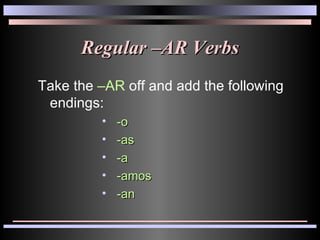
Regular –AR Verbs Take the  –AR  off and add the following endings: -o -as -a -amos -an
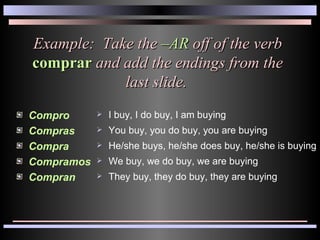
Example:  Take the  –AR  off of the verb  comprar  and add the endings from the last slide. Compro Compras Compra Compramos Compran I buy, I do buy, I am buying You buy, you do buy, you are buying He/she buys, he/she does buy, he/she is buying We buy, we do buy, we are buying They buy, they do buy, they are buying
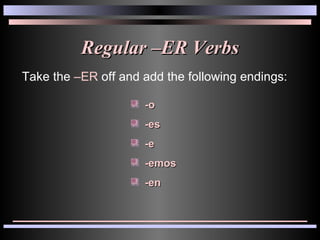
Regular –ER Verbs Take the  –ER  off and add the following endings: -o -es -e -emos -en
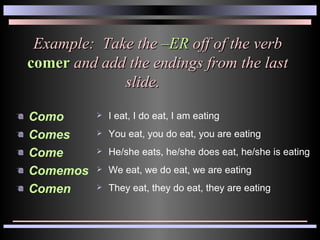
Example:  Take the  –ER  off of the verb  comer  and add the endings from the last slide. Como Comes Come Comemos Comen I eat, I do eat, I am eating You eat, you do eat, you are eating He/she eats, he/she does eat, he/she is eating We eat, we do eat, we are eating They eat, they do eat, they are eating
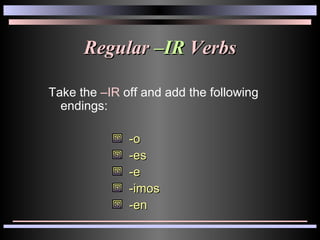
Regular  –IR  Verbs Take the  –IR  off and add the following endings: -o -es -e -imos -en
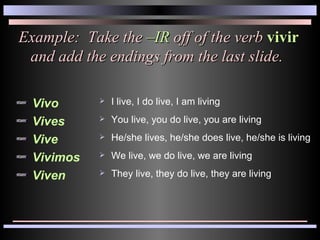
Example:  Take the  –IR  off of the verb  vivir  and add the endings from the last slide. Vivo Vives Vive Vivimos Viven I live, I do live, I am living You live, you do live, you are living He/she lives, he/she does live, he/she is living We live, we do live, we are living They live, they do live, they are living
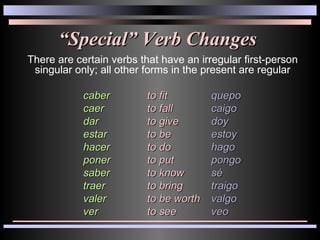
“ Special” Verb Changes There are certain verbs that have an irregular first-person singular only; all other forms in the present are regular caber to fit quepo caer to fall caigo dar to give doy estar to be estoy hacer to do hago poner to put pongo saber to know sé traer to bring traigo valer to be worth valgo ver to see veo
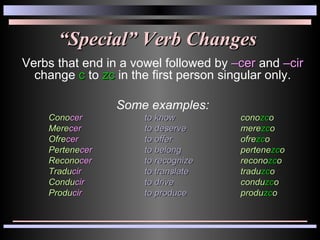
“ Special” Verb Changes Verbs that end in a vowel followed by  –cer  and  –cir  change  c  to  zc  in the first person singular only. Some examples: Cono cer to know cono zc o Mere cer to deserve mere zc o Ofre cer to offer ofre zc o Pertene cer to belong pertene zc o Recono cer to recognize recono zc o Tradu cir to translate tradu zc o Condu cir to drive condu zc o Produ cir to produce produ zc o
“ Special” Verb Changes Some common irregular verbs in the present tense are:   DECIR IR   OíR   SER   TENER VENIR   (to say) (to go)   (to hear)   (to be)   (to have) (to come) Yo    digo voy   oigo   soy   tengo vengo Tú    dices vas   oyes   eres   tienes vienes Él    dice va   oye   es   tiene viene Nosotros  decimos vamos   oímos   somos  tenemos venimos Ellos    dicen van   oyen   son   tienen vienen Note that the verb  “haber”  is also irregular.  The present tense form of  “hay”  means  “there is”  and  “there are”.
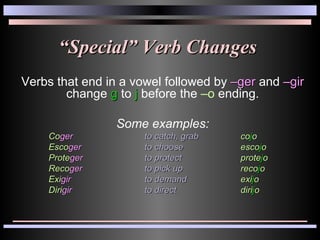
“ Special” Verb Changes Verbs that end in a vowel followed by  –ger  and  –gir  change  g  to  j  before the  –o  ending. Some examples: Co ger to catch, grab co j o Esco ger to choose esco j o Prote ger to protect prote j o Reco ger to pick up reco j o Exi gir to demand exi j o Diri gir to direct diri j o
“ Special” Verb Changes Verbs ending in  –guir  change  gu  to  g   before the  –o  ending. Some examples: Distin guir to distinguish distin g o Extin guir to extinguish extin g o
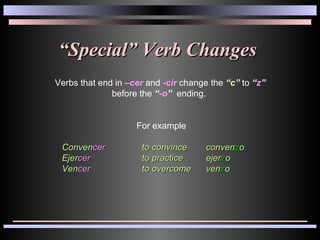
“ Special” Verb Changes Verbs that end in  –cer  and  -cir  change the  “ c ”  to  “ z ”   before the  “ -o ”  ending.  For example Conven cer to convince conven z o Ejer cer to practice ejer z o Ven cer to overcome  ven z o
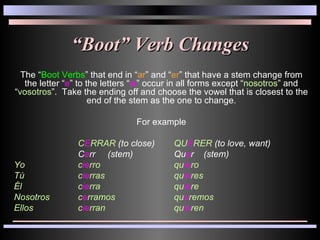
“ Boot” Verb Changes The “ Boot Verbs ” that end in “ ar ” and “ er ” that have a stem change from the letter “ e ” to the letters “ ie ” occur in all forms except “ nosotros ” and “ vosotros ”.  Take the ending off and choose the vowel that is closest to the end of the stem as the one to change. For example C E RRAR  (to close) QU E RER  (to love, want) C e rr  (stem) Qu e r  (stem) Yo c ie rro qu ie ro Tú c ie rras qu ie res Él c ie rra qu ie re Nosotros c e rramos qu e remos Ellos c ie rran qu ie ren
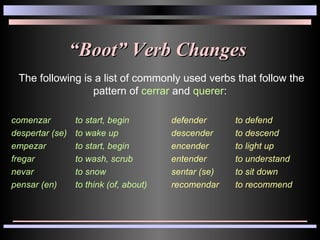
“ Boot” Verb Changes The following is a list of commonly used verbs that follow the pattern of  cerrar  and  querer : comenzar to start, begin defender to defend despertar (se) to wake up descender to descend empezar to start, begin encender to light up fregar to wash, scrub entender to understand nevar to snow sentar (se) to sit down pensar (en) to think (of, about) recomendar to recommend
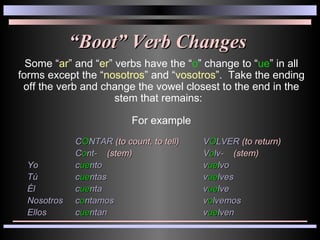
“ Boot” Verb Changes Some “ ar ” and “ er ” verbs have the “ o ” change to “ ue ” in all forms except the “ nosotros ” and “ vosotros ”.  Take the ending off the verb and change the vowel closest to the end in the stem that remains:  For example C O NTAR  (to count, to tell) V O LVER  (to return) C o nt-  (stem) V o lv-  (stem) Yo  c ue nto v ue lvo Tú  c ue ntas v ue lves Él  c ue nta v ue lve Nosotros  c o ntamos v o lvemos Ellos  c ue ntan v ue lven
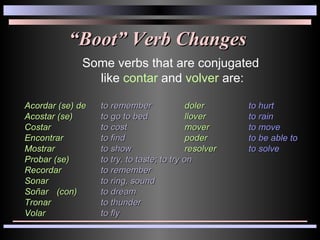
“ Boot” Verb Changes Some verbs that are conjugated like  contar  and  volver  are: Acordar (se) de   to remember doler to hurt Acostar (se)   to go to bed llover to rain Costar   to cost mover to move Encontrar    to find poder to be able to Mostrar   to show resolver to solve Probar (se)   to try, to taste; to try on Recordar   to remember Sonar   to ring, sound Soñar (con)   to dream Tronar   to thunder Volar   to fly
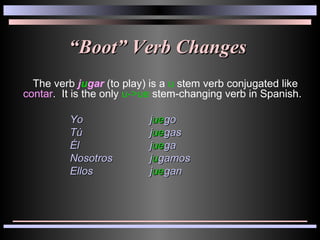
“ Boot” Verb Changes The verb  j u gar  (to play) is a  u  stem verb conjugated like  contar .  It is the only  u->ue  stem-changing verb in Spanish.  Yo   j ue go Tú   j ue gas Él  j ue ga Nosotros  j u gamos Ellos  j ue gan
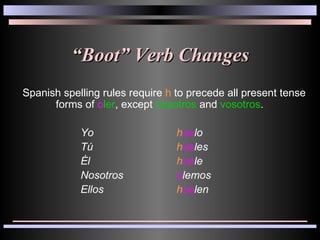
“ Boot” Verb Changes Spanish spelling rules require   h  to precede all present tense forms of  o ler , except  nosotros  and  vosotros .  Yo  h ue lo Tú  h ue les Él  h ue le  Nosotros  o lemos Ellos   h ue len
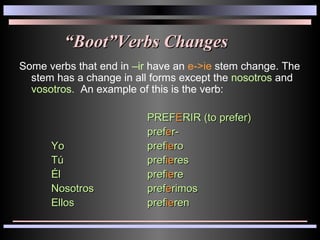
“ Boot”Verbs Changes Some verbs that end in  –ir  have an  e->ie  stem change. The stem has a change in all forms except the  nosotros  and  vosotros.   An example of this is the verb: PREF E RIR (to prefer) pref e r- Yo pref ie ro Tú pref ie res Él pref ie re Nosotros pref e rimos Ellos pref ie ren
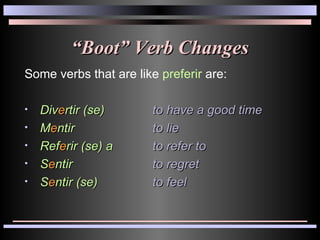
“ Boot” Verb Changes Some verbs that are like  preferir  are: Div e rtir (se) to have a good time M e ntir to lie Ref e rir (se) a to refer to S e ntir to regret S e ntir (se) to feel
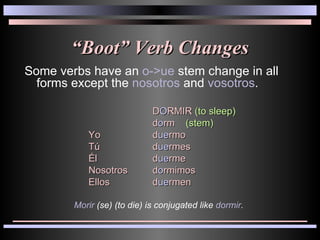
“ Boot” Verb Changes Some verbs have an  o->ue  stem change in all forms except the  nosotros  and  vosotros . D O RMIR  (to sleep) d o rm  (stem) Yo d ue rmo Tú d ue rmes Él d ue rme Nosotros d o rmimos Ellos d ue rmen Morir  (se) (to die) is conjugated like  dormir .
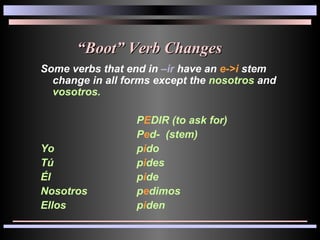
“ Boot” Verb Changes Some verbs that end in   –ir   have an   e->i   stem change in all forms except the  nosotros  and  vosotros. P E DIR (to ask for) P e d-  (stem) Yo p i do Tú p i des Él p i de Nosotros p e dimos Ellos p i den
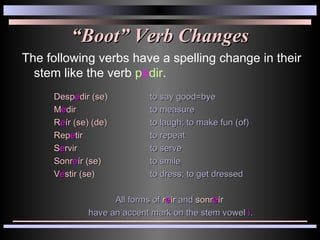
“ Boot” Verb Changes The following verbs have a spelling change in their stem like the verb  p e dir .  Desp e dir (se) to say good=bye M e dir to measure R e ír (se) (de) to laugh; to make fun (of) Rep e tir to repeat S e rvir to serve Sonr e ír (se) to smile V e stir (se) to dress; to get dressed All forms of  r e ír  and  sonr e ír  have an accent mark on the stem vowel  í .
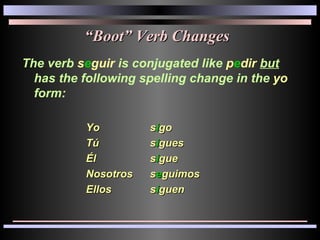
“ Boot” Verb Changes The verb  s e guir  is conjugated like  p e dir   but  has the following spelling change in the  yo  form: Yo s i go Tú s i gues Él s i gue Nosotros s e guimos Ellos s i guen
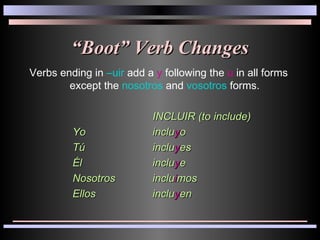
“ Boot” Verb Changes Verbs ending in  –uir  add a  y  following the  u  in all forms except the  nosotros  and  vosotros  forms. INCLUIR (to include) Yo inclu y o Tú inclu y es Él inclu y e Nosotros inclu i mos Ellos inclu y en
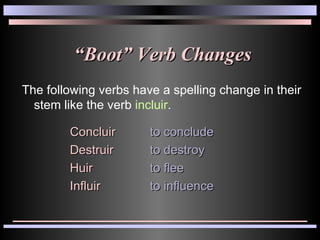
“ Boot” Verb Changes The following verbs have a spelling change in their stem like the verb  incluir .  Concluir to conclude Destruir to destroy Huir to flee Influir to influence
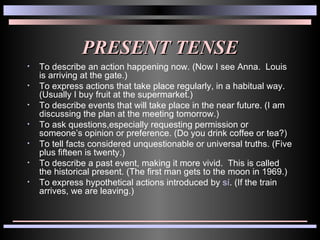
PRESENT TENSE To describe an action happening now. (Now I see Anna.  Louis is arriving at the gate.) To express actions that take place regularly, in a habitual way.  (Usually I buy fruit at the supermarket.) To describe events that will take place in the near future. (I am discussing the plan at the meeting tomorrow.) To ask questions,especially requesting permission or someone’s opinion or preference. (Do you drink coffee or tea?) To tell facts considered unquestionable or universal truths. (Five plus fifteen is twenty.) To describe a past event, making it more vivid.  This is called the historical present. (The first man gets to the moon in 1969.) To express hypothetical actions introduced by  sí . (If the train arrives, we are leaving.)
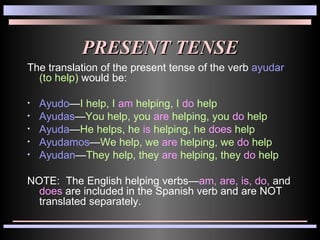
PRESENT TENSE The translation of the present tense of the verb  ayudar   (to help)  would be: Ayudo — I   help, I  am  helping, I  do  help Ayudas — You   help, you  are  helping, you  do  help Ayuda — He   helps, he  is  helping, he  does  help Ayudamos — We   help, we  are  helping, we  do  help Ayudan — They   help, they  are  helping, they  do  help NOTE:  The English helping verbs— am,   are, is, do,  and  does  are included in the Spanish verb and are NOT translated separately.

Present tense

  • 1.
  • 2.
    Regular –AR VerbsTake the –AR off and add the following endings: -o -as -a -amos -an
  • 3.
    Example: Takethe –AR off of the verb comprar and add the endings from the last slide. Compro Compras Compra Compramos Compran I buy, I do buy, I am buying You buy, you do buy, you are buying He/she buys, he/she does buy, he/she is buying We buy, we do buy, we are buying They buy, they do buy, they are buying
  • 4.
    Regular –ER VerbsTake the –ER off and add the following endings: -o -es -e -emos -en
  • 5.
    Example: Takethe –ER off of the verb comer and add the endings from the last slide. Como Comes Come Comemos Comen I eat, I do eat, I am eating You eat, you do eat, you are eating He/she eats, he/she does eat, he/she is eating We eat, we do eat, we are eating They eat, they do eat, they are eating
  • 6.
    Regular –IR Verbs Take the –IR off and add the following endings: -o -es -e -imos -en
  • 7.
    Example: Takethe –IR off of the verb vivir and add the endings from the last slide. Vivo Vives Vive Vivimos Viven I live, I do live, I am living You live, you do live, you are living He/she lives, he/she does live, he/she is living We live, we do live, we are living They live, they do live, they are living
  • 8.
    “ Special” VerbChanges There are certain verbs that have an irregular first-person singular only; all other forms in the present are regular caber to fit quepo caer to fall caigo dar to give doy estar to be estoy hacer to do hago poner to put pongo saber to know sé traer to bring traigo valer to be worth valgo ver to see veo
  • 9.
    “ Special” VerbChanges Verbs that end in a vowel followed by –cer and –cir change c to zc in the first person singular only. Some examples: Cono cer to know cono zc o Mere cer to deserve mere zc o Ofre cer to offer ofre zc o Pertene cer to belong pertene zc o Recono cer to recognize recono zc o Tradu cir to translate tradu zc o Condu cir to drive condu zc o Produ cir to produce produ zc o
  • 10.
    “ Special” VerbChanges Some common irregular verbs in the present tense are: DECIR IR OíR SER TENER VENIR (to say) (to go) (to hear) (to be) (to have) (to come) Yo digo voy oigo soy tengo vengo Tú dices vas oyes eres tienes vienes Él dice va oye es tiene viene Nosotros decimos vamos oímos somos tenemos venimos Ellos dicen van oyen son tienen vienen Note that the verb “haber” is also irregular. The present tense form of “hay” means “there is” and “there are”.
  • 11.
    “ Special” VerbChanges Verbs that end in a vowel followed by –ger and –gir change g to j before the –o ending. Some examples: Co ger to catch, grab co j o Esco ger to choose esco j o Prote ger to protect prote j o Reco ger to pick up reco j o Exi gir to demand exi j o Diri gir to direct diri j o
  • 12.
    “ Special” VerbChanges Verbs ending in –guir change gu to g before the –o ending. Some examples: Distin guir to distinguish distin g o Extin guir to extinguish extin g o
  • 13.
    “ Special” VerbChanges Verbs that end in –cer and -cir change the “ c ” to “ z ” before the “ -o ” ending. For example Conven cer to convince conven z o Ejer cer to practice ejer z o Ven cer to overcome ven z o
  • 14.
    “ Boot” VerbChanges The “ Boot Verbs ” that end in “ ar ” and “ er ” that have a stem change from the letter “ e ” to the letters “ ie ” occur in all forms except “ nosotros ” and “ vosotros ”. Take the ending off and choose the vowel that is closest to the end of the stem as the one to change. For example C E RRAR (to close) QU E RER (to love, want) C e rr (stem) Qu e r (stem) Yo c ie rro qu ie ro Tú c ie rras qu ie res Él c ie rra qu ie re Nosotros c e rramos qu e remos Ellos c ie rran qu ie ren
  • 15.
    “ Boot” VerbChanges The following is a list of commonly used verbs that follow the pattern of cerrar and querer : comenzar to start, begin defender to defend despertar (se) to wake up descender to descend empezar to start, begin encender to light up fregar to wash, scrub entender to understand nevar to snow sentar (se) to sit down pensar (en) to think (of, about) recomendar to recommend
  • 16.
    “ Boot” VerbChanges Some “ ar ” and “ er ” verbs have the “ o ” change to “ ue ” in all forms except the “ nosotros ” and “ vosotros ”. Take the ending off the verb and change the vowel closest to the end in the stem that remains: For example C O NTAR (to count, to tell) V O LVER (to return) C o nt- (stem) V o lv- (stem) Yo c ue nto v ue lvo Tú c ue ntas v ue lves Él c ue nta v ue lve Nosotros c o ntamos v o lvemos Ellos c ue ntan v ue lven
  • 17.
    “ Boot” VerbChanges Some verbs that are conjugated like contar and volver are: Acordar (se) de to remember doler to hurt Acostar (se) to go to bed llover to rain Costar to cost mover to move Encontrar to find poder to be able to Mostrar to show resolver to solve Probar (se) to try, to taste; to try on Recordar to remember Sonar to ring, sound Soñar (con) to dream Tronar to thunder Volar to fly
  • 18.
    “ Boot” VerbChanges The verb j u gar (to play) is a u stem verb conjugated like contar . It is the only u->ue stem-changing verb in Spanish. Yo j ue go Tú j ue gas Él j ue ga Nosotros j u gamos Ellos j ue gan
  • 19.
    “ Boot” VerbChanges Spanish spelling rules require h to precede all present tense forms of o ler , except nosotros and vosotros . Yo h ue lo Tú h ue les Él h ue le Nosotros o lemos Ellos h ue len
  • 20.
    “ Boot”Verbs ChangesSome verbs that end in –ir have an e->ie stem change. The stem has a change in all forms except the nosotros and vosotros. An example of this is the verb: PREF E RIR (to prefer) pref e r- Yo pref ie ro Tú pref ie res Él pref ie re Nosotros pref e rimos Ellos pref ie ren
  • 21.
    “ Boot” VerbChanges Some verbs that are like preferir are: Div e rtir (se) to have a good time M e ntir to lie Ref e rir (se) a to refer to S e ntir to regret S e ntir (se) to feel
  • 22.
    “ Boot” VerbChanges Some verbs have an o->ue stem change in all forms except the nosotros and vosotros . D O RMIR (to sleep) d o rm (stem) Yo d ue rmo Tú d ue rmes Él d ue rme Nosotros d o rmimos Ellos d ue rmen Morir (se) (to die) is conjugated like dormir .
  • 23.
    “ Boot” VerbChanges Some verbs that end in –ir have an e->i stem change in all forms except the nosotros and vosotros. P E DIR (to ask for) P e d- (stem) Yo p i do Tú p i des Él p i de Nosotros p e dimos Ellos p i den
  • 24.
    “ Boot” VerbChanges The following verbs have a spelling change in their stem like the verb p e dir . Desp e dir (se) to say good=bye M e dir to measure R e ír (se) (de) to laugh; to make fun (of) Rep e tir to repeat S e rvir to serve Sonr e ír (se) to smile V e stir (se) to dress; to get dressed All forms of r e ír and sonr e ír have an accent mark on the stem vowel í .
  • 25.
    “ Boot” VerbChanges The verb s e guir is conjugated like p e dir but has the following spelling change in the yo form: Yo s i go Tú s i gues Él s i gue Nosotros s e guimos Ellos s i guen
  • 26.
    “ Boot” VerbChanges Verbs ending in –uir add a y following the u in all forms except the nosotros and vosotros forms. INCLUIR (to include) Yo inclu y o Tú inclu y es Él inclu y e Nosotros inclu i mos Ellos inclu y en
  • 27.
    “ Boot” VerbChanges The following verbs have a spelling change in their stem like the verb incluir . Concluir to conclude Destruir to destroy Huir to flee Influir to influence
  • 28.
    PRESENT TENSE Todescribe an action happening now. (Now I see Anna. Louis is arriving at the gate.) To express actions that take place regularly, in a habitual way. (Usually I buy fruit at the supermarket.) To describe events that will take place in the near future. (I am discussing the plan at the meeting tomorrow.) To ask questions,especially requesting permission or someone’s opinion or preference. (Do you drink coffee or tea?) To tell facts considered unquestionable or universal truths. (Five plus fifteen is twenty.) To describe a past event, making it more vivid. This is called the historical present. (The first man gets to the moon in 1969.) To express hypothetical actions introduced by sí . (If the train arrives, we are leaving.)
  • 29.
    PRESENT TENSE Thetranslation of the present tense of the verb ayudar (to help) would be: Ayudo — I help, I am helping, I do help Ayudas — You help, you are helping, you do help Ayuda — He helps, he is helping, he does help Ayudamos — We help, we are helping, we do help Ayudan — They help, they are helping, they do help NOTE: The English helping verbs— am, are, is, do, and does are included in the Spanish verb and are NOT translated separately.