300 Most
mispelled
misspelled
words
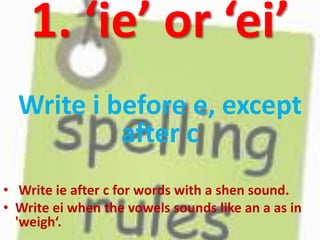
1. ‘ie’ or ‘ei’
Write i before e, except
after c
• Write ie after c for words with a shen sound.
• Write ei when the vowels sounds like an a as in
'weigh‘.
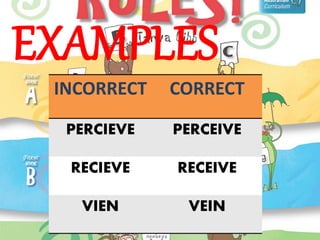
INCORRECT CORRECT
PERCIEVE PERCEIVE
RECIEVE RECEIVE
VIEN VEIN
EXAMPLES
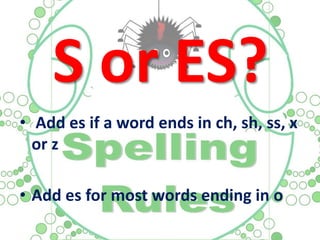
S or ES?
• Add es if a word ends in ch, sh, ss, x
or z
• Add es for most words ending in o
INCORRECT CORRECT
TOMATOS TOMATOES
ECHOS ECHOES
BUFFALOS BUFFALOES
HEROS HEROES
POTATOS POTATOES
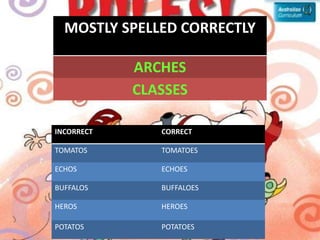
MOSTLY SPELLED CORRECTLY
ARCHES
CLASSES
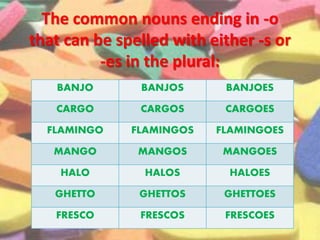
The common nouns ending in -o
that can be spelled with either -s or
-es in the plural:
BANJO BANJOS BANJOES
CARGO CARGOS CARGOES
FLAMINGO FLAMINGOS FLAMINGOES
MANGO MANGOS MANGOES
HALO HALOS HALOES
GHETTO GHETTOS GHETTOES
FRESCO FRESCOS FRESCOES
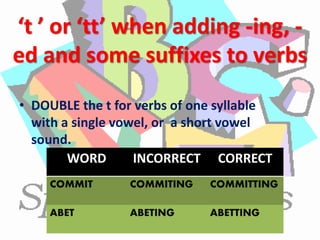
‘t ’ or ‘tt’ when adding -ing, -
ed and some suffixes to verbs
• DOUBLE the t for verbs of one syllable
with a single vowel, or a short vowel
sound.
WORD INCORRECT CORRECT
COMMIT COMMITING COMMITTING
ABET ABETING ABETTING
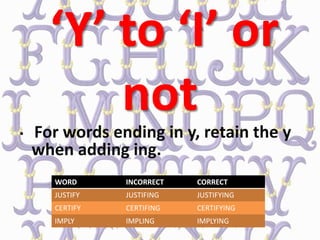
‘Y’ to ‘I’ or
not
• For words ending in y, retain the y
when adding ing.
WORD INCORRECT CORRECT
JUSTIFY JUSTIFING JUSTIFYING
CERTIFY CERTIFING CERTIFYING
IMPLY IMPLING IMPLYING
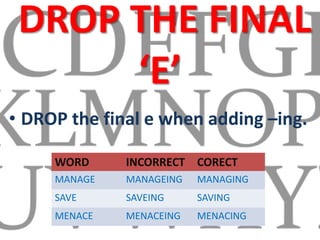
DROP THE FINAL
‘E’
• DROP the final e when adding –ing.
WORD INCORRECT CORECT
MANAGE MANAGEING MANAGING
SAVE SAVEING SAVING
MENACE MENACEING MENACING
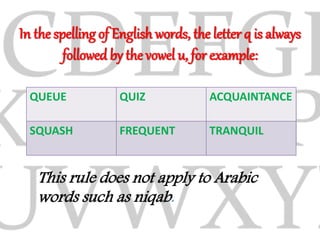
In the spelling of English words, the letter q is always
followed by the vowel u, for example:
QUEUE QUIZ ACQUAINTANCE
SQUASH FREQUENT TRANQUIL
This rule does not apply to Arabic
words such as niqab.
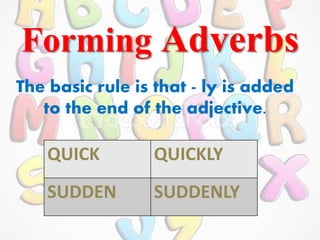
Forming Adverbs
The basic rule is that - ly is added
to the end of the adjective.
QUICK QUICKLY
SUDDEN SUDDENLY
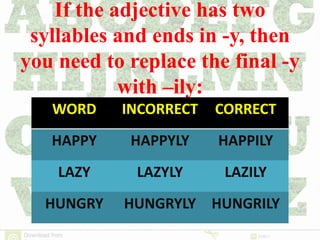
If the adjective has two
syllables and ends in -y, then
you need to replace the final -y
with –ily:
WORD INCORRECT CORRECT
HAPPY HAPPYLY HAPPILY
LAZY LAZYLY LAZILY
HUNGRY HUNGRYLY HUNGRILY
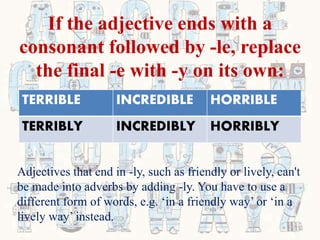
If the adjective ends with a
consonant followed by -le, replace
the final -e with -y on its own:
TERRIBLE INCREDIBLE HORRIBLE
TERRIBLY INCREDIBLY HORRIBLY
Adjectives that end in -ly, such as friendly or lively, can't
be made into adverbs by adding -ly. You have to use a
different form of words, e.g. ‘in a friendly way’ or ‘in a
lively way’ instead.
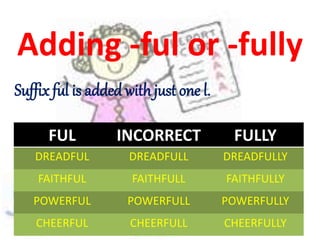
Adding -ful or -fully
Suffix ful is added with just one l.
FUL INCORRECT FULLY
DREADFUL DREADFULL DREADFULLY
FAITHFUL FAITHFULL FAITHFULLY
POWERFUL POWERFULL POWERFULLY
CHEERFUL CHEERFULL CHEERFULLY
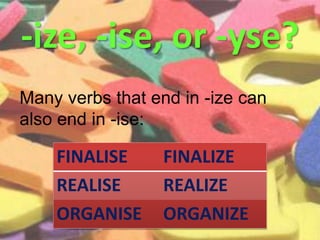
-ize, -ise, or -yse?
Many verbs that end in -ize can
also end in -ise:
FINALISE FINALIZE
REALISE REALIZE
ORGANISE ORGANIZE
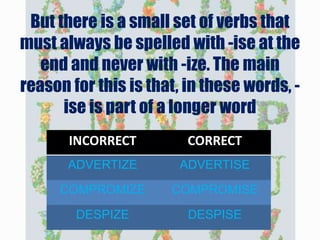
But there is a small set of verbs that
must always be spelled with -ise at the
end and never with -ize. The main
reason for this is that, in these words, -
ise is part of a longer word
INCORRECT CORRECT
ADVERTIZE ADVERTISE
COMPROMIZE COMPROMISE
DESPIZE DESPISE
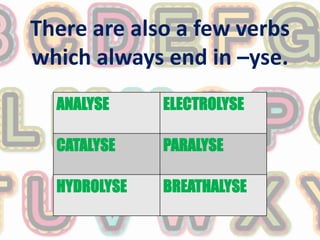
There are also a few verbs
which always end in –yse.
ANALYSE ELECTROLYSE
CATALYSE PARALYSE
HYDROLYSE BREATHALYSE
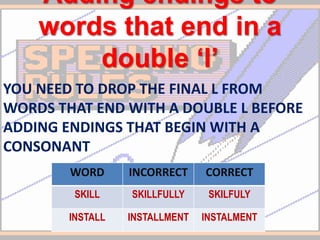
YOU NEED TO DROP THE FINAL L FROM
WORDS THAT END WITH A DOUBLE L BEFORE
ADDING ENDINGS THAT BEGIN WITH A
CONSONANT
Adding endings to
words that end in a
double ‘l’
WORD INCORRECT CORRECT
SKILL SKILLFULLY SKILFULY
INSTALL INSTALLMENT INSTALMENT
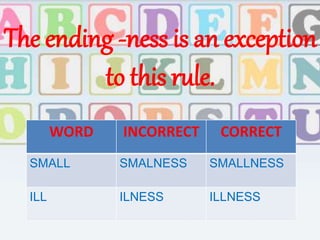
The ending -ness is an exception
to this rule.
WORD INCORRECT CORRECT
SMALL SMALNESS SMALLNESS
ILL ILNESS ILLNESS
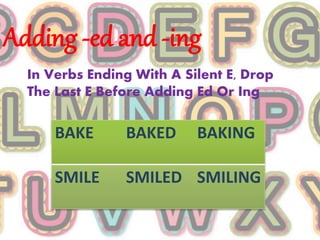
In Verbs Ending With A Silent E, Drop
The Last E Before Adding Ed Or Ing
Adding -ed and -ing
BAKE BAKED BAKING
SMILE SMILED SMILING
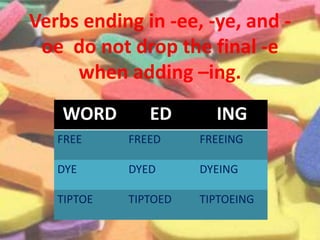
Verbs ending in -ee, -ye, and -
oe do not drop the final -e
when adding –ing.
WORD ED ING
FREE FREED FREEING
DYE DYED DYEING
TIPTOE TIPTOED TIPTOEING
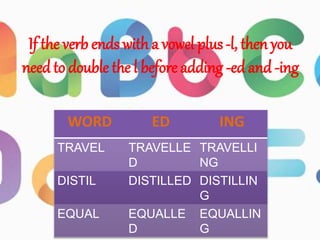
If the verb ends with a vowel plus-l, thenyou
need to double the l before adding -ed and -ing
WORD ED ING
TRAVEL TRAVELLE
D
TRAVELLI
NG
DISTIL DISTILLED DISTILLIN
G
EQUAL EQUALLE
D
EQUALLIN
G
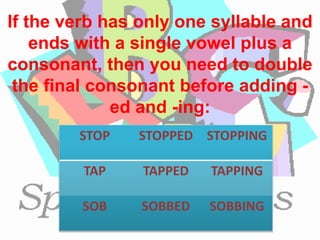
If the verb has only one syllable and
ends with a single vowel plus a
consonant, then you need to double
the final consonant before adding -
ed and -ing:
STOP STOPPED STOPPING
TAP TAPPED TAPPING
SOB SOBBED SOBBING
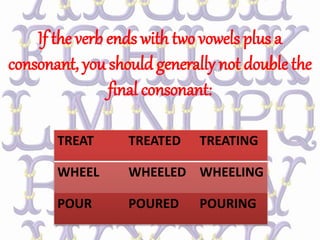
If the verb ends with two vowels plus a
consonant, you should generally not double the
final consonant:
TREAT TREATED TREATING
WHEEL WHEELED WHEELING
POUR POURED POURING
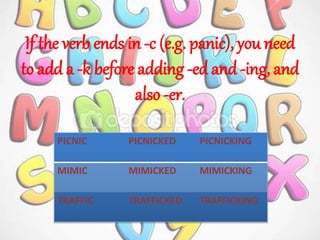
If the verb ends in-c (e.g. panic), you need
to add a -k before adding -ed and -ing, and
also -er.
PICNIC PICNICKED PICNICKING
MIMIC MIMICKED MIMICKING
TRAFFIC TRAFFICKED TRAFFICKING
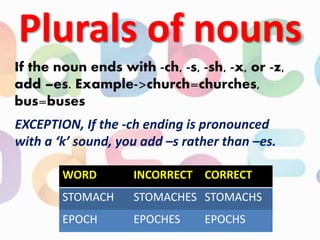
Plurals of nouns
If the noun ends with -ch, -s, -sh, -x, or -z,
add –es. Example->church=churches,
bus=buses
EXCEPTION, If the -ch ending is pronounced
with a ‘k’ sound, you add –s rather than –es.
WORD INCORRECT CORRECT
STOMACH STOMACHES STOMACHS
EPOCH EPOCHES EPOCHS
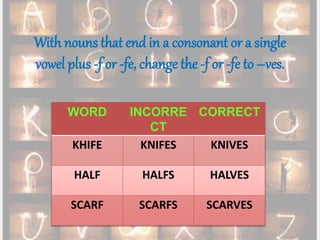
With nouns that end in a consonant or a single
vowel plus -f or -fe, change the -f or -fe to –ves.
WORD INCORRE
CT
CORRECT
KHIFE KNIFES KNIVES
HALF HALFS HALVES
SCARF SCARFS SCARVES
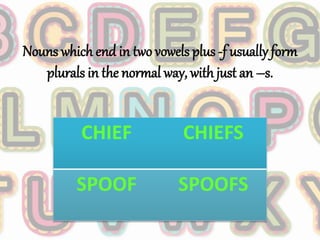
Nouns which end in two vowels plus -f usually form
plurals in the normal way, with just an –s.
CHIEF CHIEFS
SPOOF SPOOFS
CRAMMING WON’T
DO THE JOB
THANK
YOU

commonly misspelled words

  • 1.
  • 2.
    1. ‘ie’ or‘ei’ Write i before e, except after c • Write ie after c for words with a shen sound. • Write ei when the vowels sounds like an a as in 'weigh‘.
  • 3.
  • 4.
    S or ES? •Add es if a word ends in ch, sh, ss, x or z • Add es for most words ending in o
  • 5.
    INCORRECT CORRECT TOMATOS TOMATOES ECHOSECHOES BUFFALOS BUFFALOES HEROS HEROES POTATOS POTATOES MOSTLY SPELLED CORRECTLY ARCHES CLASSES
  • 6.
    The common nounsending in -o that can be spelled with either -s or -es in the plural: BANJO BANJOS BANJOES CARGO CARGOS CARGOES FLAMINGO FLAMINGOS FLAMINGOES MANGO MANGOS MANGOES HALO HALOS HALOES GHETTO GHETTOS GHETTOES FRESCO FRESCOS FRESCOES
  • 7.
    ‘t ’ or‘tt’ when adding -ing, - ed and some suffixes to verbs • DOUBLE the t for verbs of one syllable with a single vowel, or a short vowel sound. WORD INCORRECT CORRECT COMMIT COMMITING COMMITTING ABET ABETING ABETTING
  • 8.
    ‘Y’ to ‘I’or not • For words ending in y, retain the y when adding ing. WORD INCORRECT CORRECT JUSTIFY JUSTIFING JUSTIFYING CERTIFY CERTIFING CERTIFYING IMPLY IMPLING IMPLYING
  • 9.
    DROP THE FINAL ‘E’ •DROP the final e when adding –ing. WORD INCORRECT CORECT MANAGE MANAGEING MANAGING SAVE SAVEING SAVING MENACE MENACEING MENACING
  • 10.
    In the spellingof English words, the letter q is always followed by the vowel u, for example: QUEUE QUIZ ACQUAINTANCE SQUASH FREQUENT TRANQUIL This rule does not apply to Arabic words such as niqab.
  • 11.
    Forming Adverbs The basicrule is that - ly is added to the end of the adjective. QUICK QUICKLY SUDDEN SUDDENLY
  • 12.
    If the adjectivehas two syllables and ends in -y, then you need to replace the final -y with –ily: WORD INCORRECT CORRECT HAPPY HAPPYLY HAPPILY LAZY LAZYLY LAZILY HUNGRY HUNGRYLY HUNGRILY
  • 13.
    If the adjectiveends with a consonant followed by -le, replace the final -e with -y on its own: TERRIBLE INCREDIBLE HORRIBLE TERRIBLY INCREDIBLY HORRIBLY Adjectives that end in -ly, such as friendly or lively, can't be made into adverbs by adding -ly. You have to use a different form of words, e.g. ‘in a friendly way’ or ‘in a lively way’ instead.
  • 14.
    Adding -ful or-fully Suffix ful is added with just one l. FUL INCORRECT FULLY DREADFUL DREADFULL DREADFULLY FAITHFUL FAITHFULL FAITHFULLY POWERFUL POWERFULL POWERFULLY CHEERFUL CHEERFULL CHEERFULLY
  • 15.
    -ize, -ise, or-yse? Many verbs that end in -ize can also end in -ise: FINALISE FINALIZE REALISE REALIZE ORGANISE ORGANIZE
  • 16.
    But there isa small set of verbs that must always be spelled with -ise at the end and never with -ize. The main reason for this is that, in these words, - ise is part of a longer word INCORRECT CORRECT ADVERTIZE ADVERTISE COMPROMIZE COMPROMISE DESPIZE DESPISE
  • 17.
    There are alsoa few verbs which always end in –yse. ANALYSE ELECTROLYSE CATALYSE PARALYSE HYDROLYSE BREATHALYSE
  • 18.
    YOU NEED TODROP THE FINAL L FROM WORDS THAT END WITH A DOUBLE L BEFORE ADDING ENDINGS THAT BEGIN WITH A CONSONANT Adding endings to words that end in a double ‘l’ WORD INCORRECT CORRECT SKILL SKILLFULLY SKILFULY INSTALL INSTALLMENT INSTALMENT
  • 19.
    The ending -nessis an exception to this rule. WORD INCORRECT CORRECT SMALL SMALNESS SMALLNESS ILL ILNESS ILLNESS
  • 20.
    In Verbs EndingWith A Silent E, Drop The Last E Before Adding Ed Or Ing Adding -ed and -ing BAKE BAKED BAKING SMILE SMILED SMILING
  • 21.
    Verbs ending in-ee, -ye, and - oe do not drop the final -e when adding –ing. WORD ED ING FREE FREED FREEING DYE DYED DYEING TIPTOE TIPTOED TIPTOEING
  • 22.
    If the verbends with a vowel plus-l, thenyou need to double the l before adding -ed and -ing WORD ED ING TRAVEL TRAVELLE D TRAVELLI NG DISTIL DISTILLED DISTILLIN G EQUAL EQUALLE D EQUALLIN G
  • 23.
    If the verbhas only one syllable and ends with a single vowel plus a consonant, then you need to double the final consonant before adding - ed and -ing: STOP STOPPED STOPPING TAP TAPPED TAPPING SOB SOBBED SOBBING
  • 24.
    If the verbends with two vowels plus a consonant, you should generally not double the final consonant: TREAT TREATED TREATING WHEEL WHEELED WHEELING POUR POURED POURING
  • 25.
    If the verbends in-c (e.g. panic), you need to add a -k before adding -ed and -ing, and also -er. PICNIC PICNICKED PICNICKING MIMIC MIMICKED MIMICKING TRAFFIC TRAFFICKED TRAFFICKING
  • 26.
    Plurals of nouns Ifthe noun ends with -ch, -s, -sh, -x, or -z, add –es. Example->church=churches, bus=buses EXCEPTION, If the -ch ending is pronounced with a ‘k’ sound, you add –s rather than –es. WORD INCORRECT CORRECT STOMACH STOMACHES STOMACHS EPOCH EPOCHES EPOCHS
  • 27.
    With nouns thatend in a consonant or a single vowel plus -f or -fe, change the -f or -fe to –ves. WORD INCORRE CT CORRECT KHIFE KNIFES KNIVES HALF HALFS HALVES SCARF SCARFS SCARVES
  • 28.
    Nouns which endin two vowels plus -f usually form plurals in the normal way, with just an –s. CHIEF CHIEFS SPOOF SPOOFS
  • 29.
  • 30.