Spanish 3 Kimberly Parker
Culture Present tense of regular verbs Stem-changing in the present tense Irregular yo form Preterite tense of regular verbs Verbs with spelling changes in the preterite Verbs with stem changes in the preterite Irregular preterites Vocabulary
Mural Desfile Independencia Guayabera La calle ocho
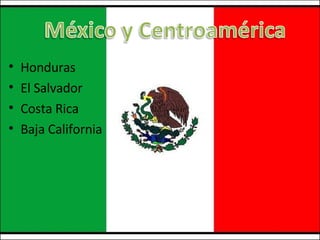
Honduras El Salvador Costa Rica Baja California
Puerto Rico La Habana República Dominicana
Uruguay Chile Los Andes Argentina
Toledo Galicia Cataluna Bilbao
Venezuela Colombia Bolivia Perú Ecuador
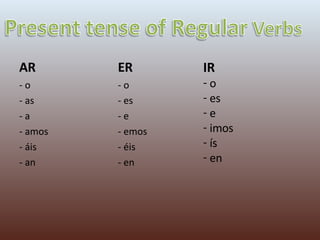
AR - o - as - a - amos - áis - an ER - o - es - e - emos - éis - en IR o es e imos ís en
e->ie Pensar P ie nso P ie nsas P ie nsa Pensamos Pensáis P ie nsan o->ue Dormir D ue rmo D ue rmes D ue rme Dormimos Dormís D ue rmen e ->i Pedir P i do P i des P i de Pedimos Pedís P i den
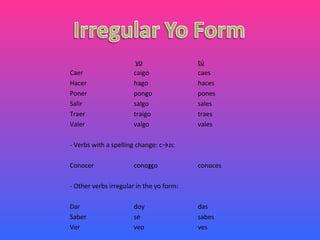
yo tú Caer caigo caes Hacer hago haces Poner pongo pones Salir salgo sales Traer traigo traes Valer valgo vales - Verbs with a spelling change: c->zc Conocer cono zc o conoces - Other verbs irregular in the yo form: Dar doy das Saber sé sabes Ver veo ves
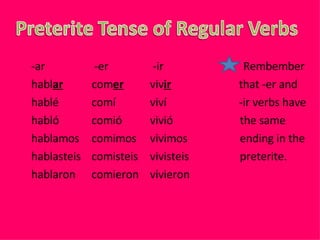
-ar   -er   -ir habl ar   com er  viv ir hablé   comí  viví habló   comió  vivió hablamos   comimos  vivimos hablasteis   comisteis  vivisteis hablaron   comieron  vivieron Rembember that -er and  -ir verbs have    the same    ending in the   preterite.
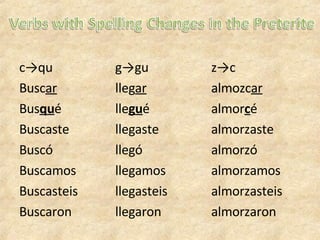
c->qu g->gu z->c Busc ar lleg ar almozc ar Bus qu é lle gu é almor c é Buscaste llegaste almorzaste Buscó llegó almorzó Buscamos llegamos almorzamos Buscasteis llegasteis almorzasteis Buscaron llegaron almorzaron
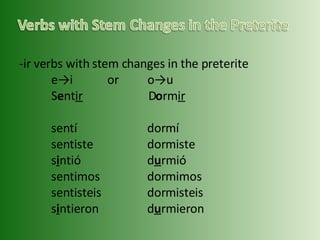
-ir verbs with stem changes in the preterite e->i   or  o->u S e nt ir   D o rm ir sentí dormí sentiste dormiste s i ntió d u rmió sentimos dormimos sentisteis dormisteis s i ntieron d u rmieron
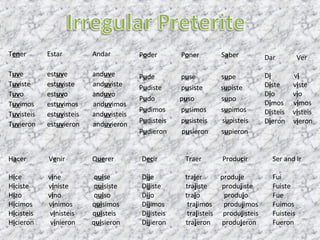
T en er    Estar   Andar T uv e   est uv e   and uv e T uv iste   est uv iste  and uv iste T uv o   est uv o   and uv o T uv imos   est uv imos  and uv imos T uv isteis   est uv isteis  and uv isteis T uv ieron   est uv ieron  and uv ieron P o der   P o ner   S a ber P u de   p u se   s u pe P u diste   p u siste  s u piste P u do  p u so   s u po P u dimos   p u simos  s u pimos P u disteis   p u sisteis  s u pisteis P u dieron  p u sieron  s u pieron H a cer   V e nir   Q ue rer H i ce  v i ne   q ui se H i ciste  v i niste   q ui siste H i zo  v i no   q ui so H i cimos  v i nimos  q ui simos H i cisteis  v i nisteis  q ui steis H i cieron  v i nieron  q ui sieron D ec ir   Traer   Produ c ir D ij e  tra j er  produ j e D ij iste  tra j iste  produ j iste D ij o   tra j o   produ j o D ij imos   tra j imos  produ j imos D ij isteis  tra j isteis  produ j isteis D ij ieron  tra j eron  produ j eron Ser and Ir Fui Fuiste Fue Fuimos Fuisteis Fueron Dar Ver D i   v i D i ste  v i ste D i o  v i o D i mos  v i mos D i steis  v i steis D i eron  v i eron
Common –ar verbs: Acampar – to camp Bailar – to dance Desear – to desire Ganar – to win Llamar – to call Common –ir verbs: Abrir – to open compartir – to share Insistir – to insist recibir – to receive Vivir – to live Common –er verbs: Common –er verbs Aprender – to learn Comer – to eat Correr – to run Leer – to read Common stem changing verbs: Cerrar (e-ie) – to close Llover (o-ue) – to rain Pensar (e-ie) – to think Recordar (o-ue) – to remember Sentarse (e-ie) – to sit down Common reflexive verbs: Afeitarse – to shave Ducharse – to take a shower Lavarse – to wash oneself Peinarse – to comb one’s hair Ponerse – to put on Common verbs with irregular yo form: caer – to fall conocer – to know o ír – to hear salir – to leave valer – to be worth Common preterite stem-changing verbs: caer – to fall conducir – to drive dormir – to sleep preferir – to prefer sentir – to feel Common spelling-change preterite verbs: Almorzar – to have lunch Buscar – to look for Cruzar – to cross Llegar – to arrive Sacar – to play Common irregular preterite verbs: andar – to walk estar – to be ir – to go ser – to be ver – to see
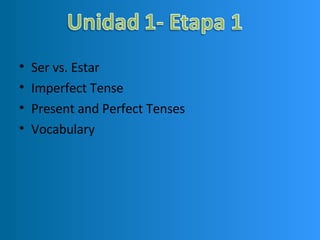
Ser vs. Estar Imperfect Tense Present and Perfect Tenses Vocabulary
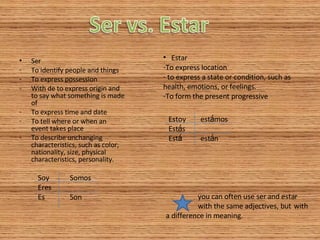
Ser To identify people and things To express possession With de to express origin and to say what something is made of To express time and date To tell where or when an event takes place To describe unchanging characteristics, such as color, nationality, size, physical characteristics, personality. Estar To express location to express a state or condition, such as health, emotions, or feelings. To form the present progressive you can often use ser and estar  with the same adjectives, but  with a difference in meaning. Soy Somos Eres Es Son Estoy est á mos Est á s Est á est á n
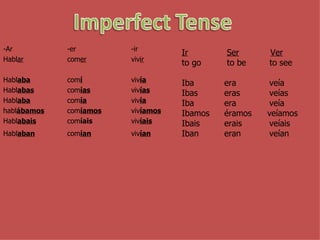
-Ar -er -ir Habl ar com er viv ir Habl aba com í   viv ía Habl abas com ías viv ías Habl aba com ía viv ía habl ábamos com íamos viv íamos Habl abais com íais viv íais Habl aban com ían viv ían Ir   Ser   Ver to go   to be  to see Iba   era   veía Ibas   eras   veías Iba   era   veía Ibamos   éramos  veíamos Ibais   erais   veíais Iban   eran   veían
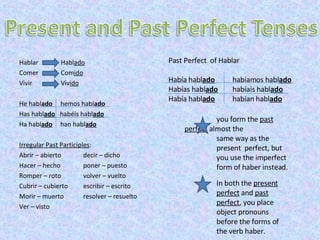
Hablar   Habl ado Comer    Com ido Vivir    Viv ido He habl ado   hemos habl ado Has habl ado   hab éis habl ado Ha habl ado   han habl ado Irregular Past Participles :  Abrir – abierto decir – dicho Hacer – hecho poner – puesto Romper – roto volver – vuelto Cubrir – cubierto escribir – escrito Morir – muerto resolver – resuelto Ver – visto Past Perfect  of Hablar Había habl ado habíamos habl ado Habías habl ado habíais habl ado Había habl ado habían habl ado you form the  past   perfect  almost the same way as the  present  perfect, but  you use the imperfect  form of haber instead. In both the  present perfect  and  past perfect , you place object pronouns before the forms of the verb haber.
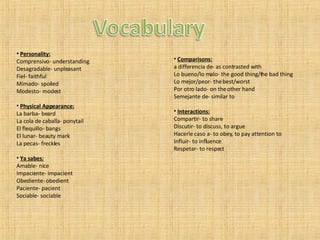
Personality: Comprensivo- understanding Desagradable- unpleasant Fiel- faithful Mimado- spoiled Modesto- modest Physical Appearance: La barba- beard La cola de caballa- ponytail El flequillo- bangs El lunar- beauty mark La pecas- freckles Ya sabes: Amable- nice Impaciente- impacient Obediente- obedient Paciente- pacient Sociable- sociable Comparisons: a differencia de- as contrasted with Lo bueno/lo malo- the good thing/the bad thing Lo mejor/peor- the best/worst Por otro lado- on the other hand Semejante de- similar to Interactions: Compartir- to share Discutir- to discuss, to argue Hacerle caso a- to obey, to pay attention to Influir- to influence Respetar- to respect
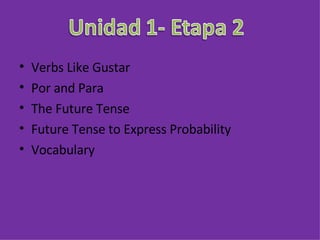
Verbs Like Gustar Por and Para The Future Tense Future Tense to Express Probability Vocabulary
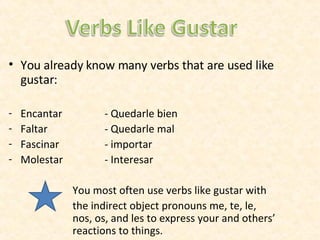
You already know many verbs that are used like gustar: Encantar - Quedarle bien Faltar - Quedarle mal Fascinar - importar Molestar - Interesar You most often use verbs like gustar with the indirect object pronouns me, te, le,  nos, os, and les to express your and others’  reactions to things.
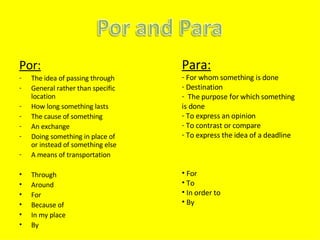
Por: The idea of passing through General rather than specific location How long something lasts The cause of something An exchange Doing something in place of or instead of something else A means of transportation Through Around For Because of In my place By Para: For whom something is done Destination The purpose for which something is done To express an opinion To contrast or compare To express the idea of a deadline For To In order to By
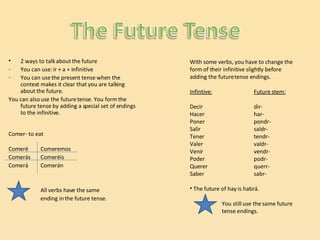
2 ways to talk about the future You can use: ir + a + infinitive You can use the present tense when the context makes it clear that you are talking about the future.  You can also use the future tense. You form the future tense by adding a special set of endings to the infinitive. Comer- to eat Comeré Comeremos Comerás Comeréis Comerá Comerán All verbs have the same ending in the future tense. With some verbs, you have to change the form of their infinitive slightly before adding the future tense endings. Infintive: Future stem: Decir dir- Hacer har- Poner pondr- Salir saldr- Tener tendr- Valer valdr- Venir vendr- Poder podr- Querer querr- Saber sabr- The future of hay is habrá. You still use the same future tense endings.
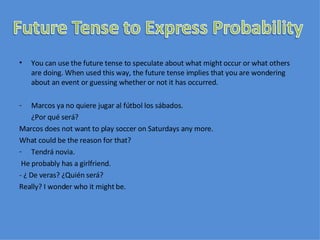
You can use the future tense to speculate about what might occur or what others are doing. When used this way, the future tense implies that you are wondering about an event or guessing whether or not it has occurred. Marcos ya no quiere jugar al fútbol los sábados. ¿Por qué será? Marcos does not want to play soccer on Saturdays any more.  What could be the reason for that? Tendrá novia. He probably has a girlfriend.  - ¿ De veras? ¿Quién será? Really? I wonder who it might be.
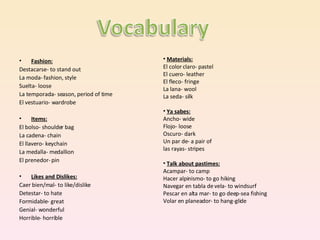
Fashion: Destacarse- to stand out La moda- fashion, style Suelta- loose La temporada- season, period of time El vestuario- wardrobe Items: El bolso- shoulder bag La cadena- chain El llavero- keychain La medalla- medallion El prenedor- pin Likes and Dislikes: Caer bien/mal- to like/dislike Detestar- to hate Formidable- great Genial- wonderful  Horrible- horrible Materials: El color claro- pastel El cuero- leather El fleco- fringe La lana- wool La seda- silk Ya sabes: Ancho- wide Flojo- loose Oscuro- dark Un par de- a pair of las rayas- stripes Talk about pastimes: Acampar- to camp Hacer alpinismo- to go hiking Navegar en tabla de vela- to windsurf Pescar en alta mar- to go deep-sea fishing Volar en planeador- to hang-glide
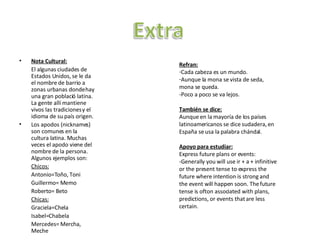
Nota Cultural: El algunas ciudades de Estados Unidos, se le da el nombre de barrio a zonas urbanas donde hay una gran poblaci ó latina. La gente allí mantiene vivos las tradiciones y el idioma de su país origen. Los apodos (nicknames) son comunes en la cultura latina. Muchas veces el apodo viene del nombre de la persona. Algunos ejemplos son: Chicos: Antonio=Toño, Toni Guillermo= Memo Roberto= Beto Chicas: Graciela=Chela Isabel=Chabela Mercedes= Mercha, Meche Refran: Cada cabeza es un mundo. Aunque la mona se vista de seda, mona se queda. - Poco a poco se va lejos.  Tambi én se dice: Aunque en la mayoría de los países latinoamericanos se dice sudadera, en España se usa la palabra chándal.  Apoyo para estudiar: Express future plans or events: -Generally you will use ir + a + infinitive or the present tense to express the future where intention is strong and the event will happen soon. The future tense is ofton associated with plans, predictions, or events that are less certain.

Repaso Midterm Español 3

  • 1.
  • 2.
    Culture Present tenseof regular verbs Stem-changing in the present tense Irregular yo form Preterite tense of regular verbs Verbs with spelling changes in the preterite Verbs with stem changes in the preterite Irregular preterites Vocabulary
  • 3.
    Mural Desfile IndependenciaGuayabera La calle ocho
  • 4.
    Honduras El SalvadorCosta Rica Baja California
  • 5.
    Puerto Rico LaHabana República Dominicana
  • 6.
    Uruguay Chile LosAndes Argentina
  • 7.
  • 8.
  • 9.
    AR - o- as - a - amos - áis - an ER - o - es - e - emos - éis - en IR o es e imos ís en
  • 10.
    e->ie Pensar Pie nso P ie nsas P ie nsa Pensamos Pensáis P ie nsan o->ue Dormir D ue rmo D ue rmes D ue rme Dormimos Dormís D ue rmen e ->i Pedir P i do P i des P i de Pedimos Pedís P i den
  • 11.
    yo tú Caercaigo caes Hacer hago haces Poner pongo pones Salir salgo sales Traer traigo traes Valer valgo vales - Verbs with a spelling change: c->zc Conocer cono zc o conoces - Other verbs irregular in the yo form: Dar doy das Saber sé sabes Ver veo ves
  • 12.
    -ar -er -ir habl ar com er viv ir hablé comí viví habló comió vivió hablamos comimos vivimos hablasteis comisteis vivisteis hablaron comieron vivieron Rembember that -er and -ir verbs have the same ending in the preterite.
  • 13.
    c->qu g->gu z->cBusc ar lleg ar almozc ar Bus qu é lle gu é almor c é Buscaste llegaste almorzaste Buscó llegó almorzó Buscamos llegamos almorzamos Buscasteis llegasteis almorzasteis Buscaron llegaron almorzaron
  • 14.
    -ir verbs withstem changes in the preterite e->i or o->u S e nt ir D o rm ir sentí dormí sentiste dormiste s i ntió d u rmió sentimos dormimos sentisteis dormisteis s i ntieron d u rmieron
  • 15.
    T en er Estar Andar T uv e est uv e and uv e T uv iste est uv iste and uv iste T uv o est uv o and uv o T uv imos est uv imos and uv imos T uv isteis est uv isteis and uv isteis T uv ieron est uv ieron and uv ieron P o der P o ner S a ber P u de p u se s u pe P u diste p u siste s u piste P u do p u so s u po P u dimos p u simos s u pimos P u disteis p u sisteis s u pisteis P u dieron p u sieron s u pieron H a cer V e nir Q ue rer H i ce v i ne q ui se H i ciste v i niste q ui siste H i zo v i no q ui so H i cimos v i nimos q ui simos H i cisteis v i nisteis q ui steis H i cieron v i nieron q ui sieron D ec ir Traer Produ c ir D ij e tra j er produ j e D ij iste tra j iste produ j iste D ij o tra j o produ j o D ij imos tra j imos produ j imos D ij isteis tra j isteis produ j isteis D ij ieron tra j eron produ j eron Ser and Ir Fui Fuiste Fue Fuimos Fuisteis Fueron Dar Ver D i v i D i ste v i ste D i o v i o D i mos v i mos D i steis v i steis D i eron v i eron
  • 16.
    Common –ar verbs:Acampar – to camp Bailar – to dance Desear – to desire Ganar – to win Llamar – to call Common –ir verbs: Abrir – to open compartir – to share Insistir – to insist recibir – to receive Vivir – to live Common –er verbs: Common –er verbs Aprender – to learn Comer – to eat Correr – to run Leer – to read Common stem changing verbs: Cerrar (e-ie) – to close Llover (o-ue) – to rain Pensar (e-ie) – to think Recordar (o-ue) – to remember Sentarse (e-ie) – to sit down Common reflexive verbs: Afeitarse – to shave Ducharse – to take a shower Lavarse – to wash oneself Peinarse – to comb one’s hair Ponerse – to put on Common verbs with irregular yo form: caer – to fall conocer – to know o ír – to hear salir – to leave valer – to be worth Common preterite stem-changing verbs: caer – to fall conducir – to drive dormir – to sleep preferir – to prefer sentir – to feel Common spelling-change preterite verbs: Almorzar – to have lunch Buscar – to look for Cruzar – to cross Llegar – to arrive Sacar – to play Common irregular preterite verbs: andar – to walk estar – to be ir – to go ser – to be ver – to see
  • 17.
    Ser vs. EstarImperfect Tense Present and Perfect Tenses Vocabulary
  • 18.
    Ser To identifypeople and things To express possession With de to express origin and to say what something is made of To express time and date To tell where or when an event takes place To describe unchanging characteristics, such as color, nationality, size, physical characteristics, personality. Estar To express location to express a state or condition, such as health, emotions, or feelings. To form the present progressive you can often use ser and estar with the same adjectives, but with a difference in meaning. Soy Somos Eres Es Son Estoy est á mos Est á s Est á est á n
  • 19.
    -Ar -er -irHabl ar com er viv ir Habl aba com í viv ía Habl abas com ías viv ías Habl aba com ía viv ía habl ábamos com íamos viv íamos Habl abais com íais viv íais Habl aban com ían viv ían Ir Ser Ver to go to be to see Iba era veía Ibas eras veías Iba era veía Ibamos éramos veíamos Ibais erais veíais Iban eran veían
  • 20.
    Hablar Habl ado Comer Com ido Vivir Viv ido He habl ado hemos habl ado Has habl ado hab éis habl ado Ha habl ado han habl ado Irregular Past Participles : Abrir – abierto decir – dicho Hacer – hecho poner – puesto Romper – roto volver – vuelto Cubrir – cubierto escribir – escrito Morir – muerto resolver – resuelto Ver – visto Past Perfect of Hablar Había habl ado habíamos habl ado Habías habl ado habíais habl ado Había habl ado habían habl ado you form the past perfect almost the same way as the present perfect, but you use the imperfect form of haber instead. In both the present perfect and past perfect , you place object pronouns before the forms of the verb haber.
  • 21.
    Personality: Comprensivo- understandingDesagradable- unpleasant Fiel- faithful Mimado- spoiled Modesto- modest Physical Appearance: La barba- beard La cola de caballa- ponytail El flequillo- bangs El lunar- beauty mark La pecas- freckles Ya sabes: Amable- nice Impaciente- impacient Obediente- obedient Paciente- pacient Sociable- sociable Comparisons: a differencia de- as contrasted with Lo bueno/lo malo- the good thing/the bad thing Lo mejor/peor- the best/worst Por otro lado- on the other hand Semejante de- similar to Interactions: Compartir- to share Discutir- to discuss, to argue Hacerle caso a- to obey, to pay attention to Influir- to influence Respetar- to respect
  • 22.
    Verbs Like GustarPor and Para The Future Tense Future Tense to Express Probability Vocabulary
  • 23.
    You already knowmany verbs that are used like gustar: Encantar - Quedarle bien Faltar - Quedarle mal Fascinar - importar Molestar - Interesar You most often use verbs like gustar with the indirect object pronouns me, te, le, nos, os, and les to express your and others’ reactions to things.
  • 24.
    Por: The ideaof passing through General rather than specific location How long something lasts The cause of something An exchange Doing something in place of or instead of something else A means of transportation Through Around For Because of In my place By Para: For whom something is done Destination The purpose for which something is done To express an opinion To contrast or compare To express the idea of a deadline For To In order to By
  • 25.
    2 ways totalk about the future You can use: ir + a + infinitive You can use the present tense when the context makes it clear that you are talking about the future. You can also use the future tense. You form the future tense by adding a special set of endings to the infinitive. Comer- to eat Comeré Comeremos Comerás Comeréis Comerá Comerán All verbs have the same ending in the future tense. With some verbs, you have to change the form of their infinitive slightly before adding the future tense endings. Infintive: Future stem: Decir dir- Hacer har- Poner pondr- Salir saldr- Tener tendr- Valer valdr- Venir vendr- Poder podr- Querer querr- Saber sabr- The future of hay is habrá. You still use the same future tense endings.
  • 26.
    You can usethe future tense to speculate about what might occur or what others are doing. When used this way, the future tense implies that you are wondering about an event or guessing whether or not it has occurred. Marcos ya no quiere jugar al fútbol los sábados. ¿Por qué será? Marcos does not want to play soccer on Saturdays any more. What could be the reason for that? Tendrá novia. He probably has a girlfriend. - ¿ De veras? ¿Quién será? Really? I wonder who it might be.
  • 27.
    Fashion: Destacarse- tostand out La moda- fashion, style Suelta- loose La temporada- season, period of time El vestuario- wardrobe Items: El bolso- shoulder bag La cadena- chain El llavero- keychain La medalla- medallion El prenedor- pin Likes and Dislikes: Caer bien/mal- to like/dislike Detestar- to hate Formidable- great Genial- wonderful Horrible- horrible Materials: El color claro- pastel El cuero- leather El fleco- fringe La lana- wool La seda- silk Ya sabes: Ancho- wide Flojo- loose Oscuro- dark Un par de- a pair of las rayas- stripes Talk about pastimes: Acampar- to camp Hacer alpinismo- to go hiking Navegar en tabla de vela- to windsurf Pescar en alta mar- to go deep-sea fishing Volar en planeador- to hang-glide
  • 28.
    Nota Cultural: Elalgunas ciudades de Estados Unidos, se le da el nombre de barrio a zonas urbanas donde hay una gran poblaci ó latina. La gente allí mantiene vivos las tradiciones y el idioma de su país origen. Los apodos (nicknames) son comunes en la cultura latina. Muchas veces el apodo viene del nombre de la persona. Algunos ejemplos son: Chicos: Antonio=Toño, Toni Guillermo= Memo Roberto= Beto Chicas: Graciela=Chela Isabel=Chabela Mercedes= Mercha, Meche Refran: Cada cabeza es un mundo. Aunque la mona se vista de seda, mona se queda. - Poco a poco se va lejos. Tambi én se dice: Aunque en la mayoría de los países latinoamericanos se dice sudadera, en España se usa la palabra chándal. Apoyo para estudiar: Express future plans or events: -Generally you will use ir + a + infinitive or the present tense to express the future where intention is strong and the event will happen soon. The future tense is ofton associated with plans, predictions, or events that are less certain.