Coming of the
Revolution
American History I
Bacon’s
Rebellion
• sometimes considered the beginning
of the revolutionary era in the
colonies
• First open defiance of of a duly
established government in the
colonies
• Bacon gathered poor freemen,
indentured servants, and some
slaves to fight against the
government of Virginia essentially
over the dealing with Native
Americans on the frontier
2
Navigation Acts
• According to the policies of mercantilism, Parliament passed the Navigation
Acts to ensure that the colonies were trading only with England
• laws were enforced using the writs of assistance which was a general search
warrant that allowed British officials to search colonists homes
• many Massachusetts merchants viewed this as an invasion of privacy
3
Navigation Acts
• No country could trade with the colonies unless the goods were shipped in
either colonial or English ships
• All vessels had to be operated by crews that were at least three-quarters
English or colonial
• The colonies could export certain products only to England
• Almost all goods traded between the colonies and Europe first had to pass
through an English port.
4
Board of
Trade
• the Board of Trade was an
advisory group that met in
England and recommended laws
to improve trade with the colonies
5
French & Indian War
• Part of a larger world war: the Seven Years War, fought on 5 continents
• England & the colonies v. France & Native-Americans
• Fought for key fertile land in the Ohio River Valley
6
Treaty of Paris 1763
• Ends the French & Indian War
(and the Seven Years Way)
• England gets control of all land
east of the Mississippi River
• France loses ALL land in North
America
7
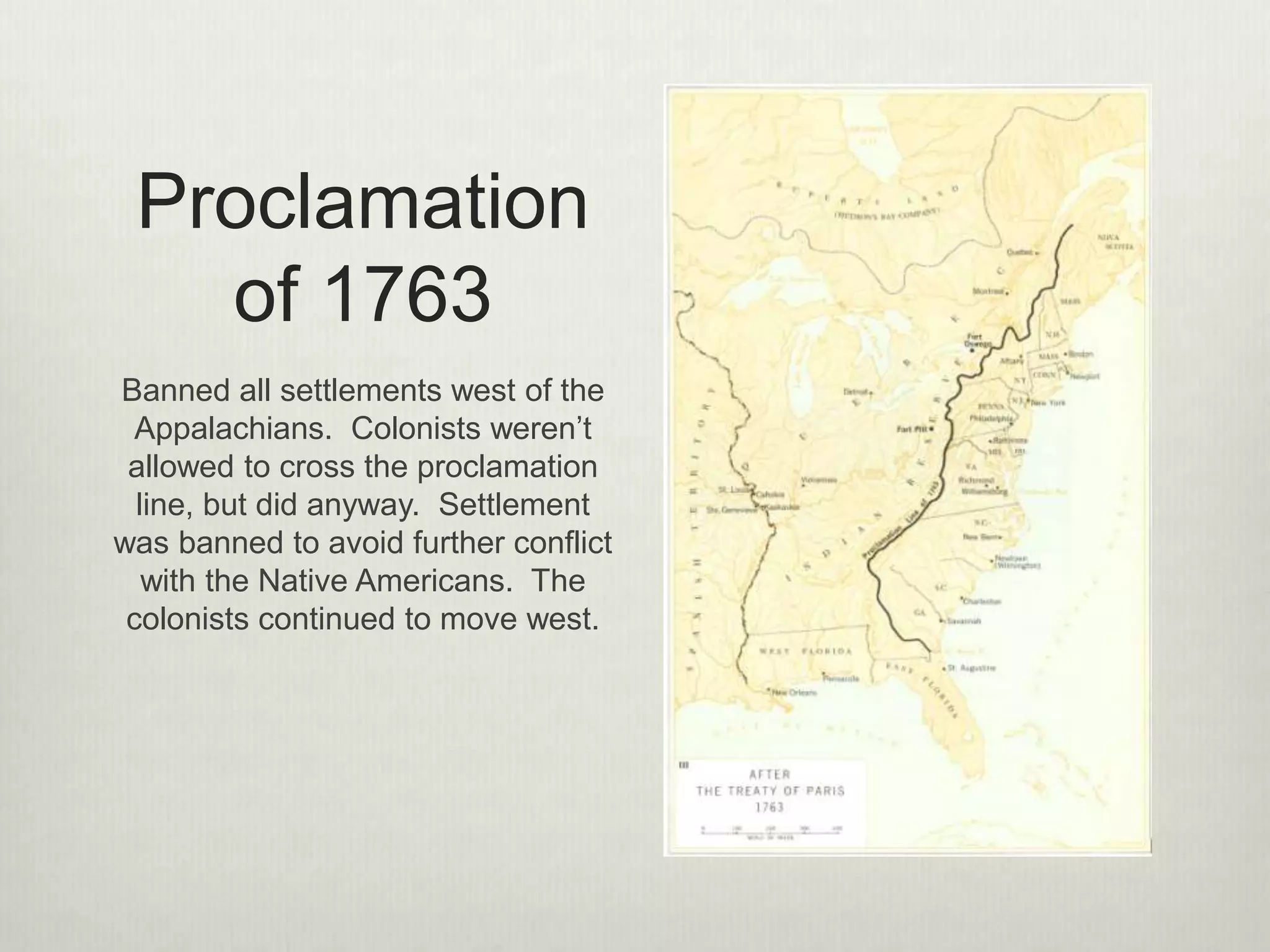
Proclamation
of 1763
• To avoid further conflict with Native
Americans.
• Forbade all settlement west of the
Appalachian Mountains.
• Proclamation by Britain at the end of the
French and Indian war that prohibited
settlement by colonists on Indian territory.
• Angered colonists who just fought to gain
the right to settle on that land
8
Sugar Act
(1764)
The three parts were:
1. It halved the duty on foreign-
made molasses
2. It placed duties on certain
imports
3. Strengthened the enforcement of
the law allowing prosecutors to
try smuggling cases in a vice-
admiralty court rather than in a
more sympathetic colonial court.
9
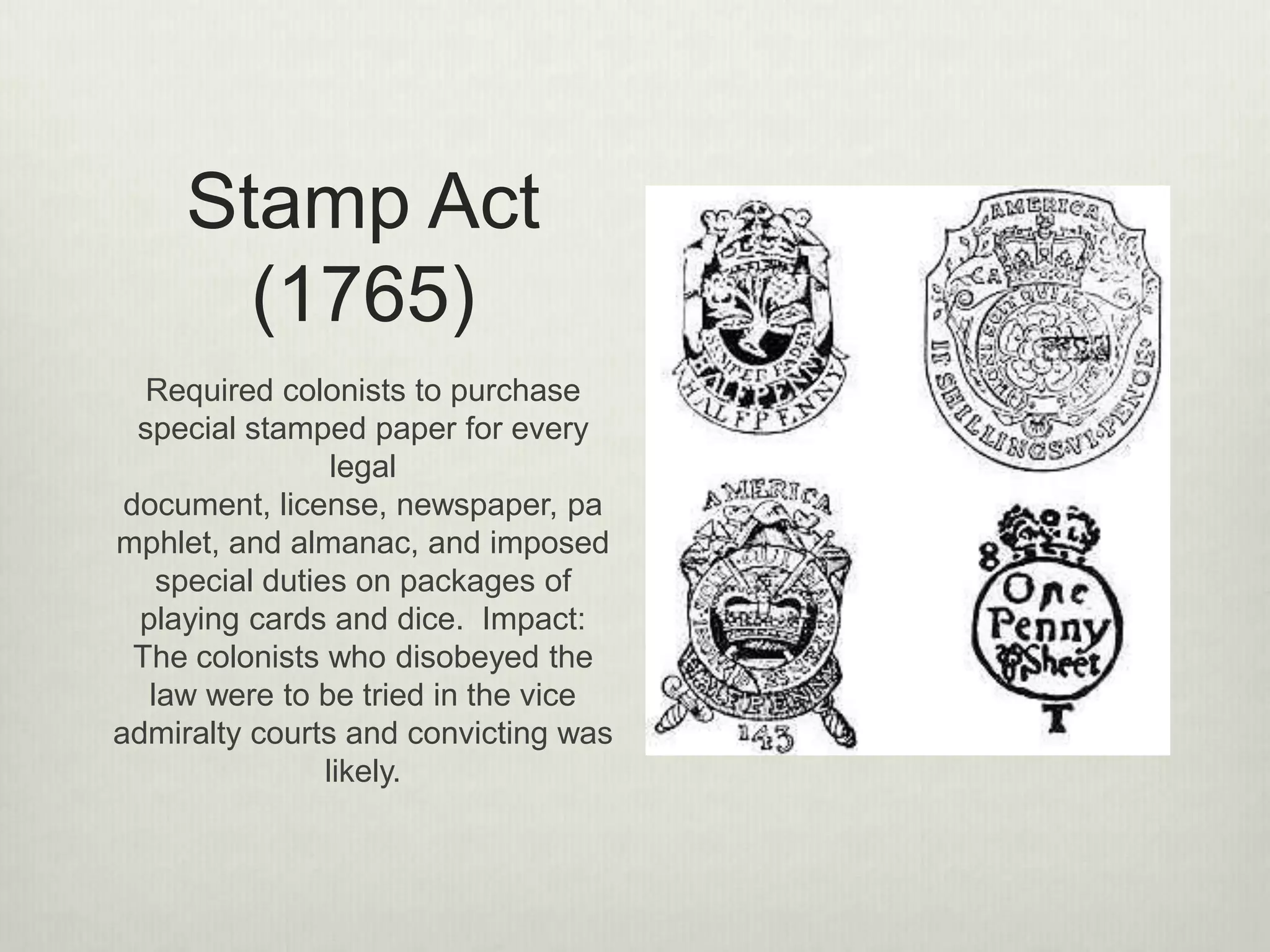
Stamp Act
(1765)
• It differed from earlier taxes
because it directly taxed
everyone.
• The tax required colonists to
purchase special stamped paper
for every legal document, license,
newspaper, pamphlet, and
almanac.
• Every colonists had to pay and
take money out their pocket.
10
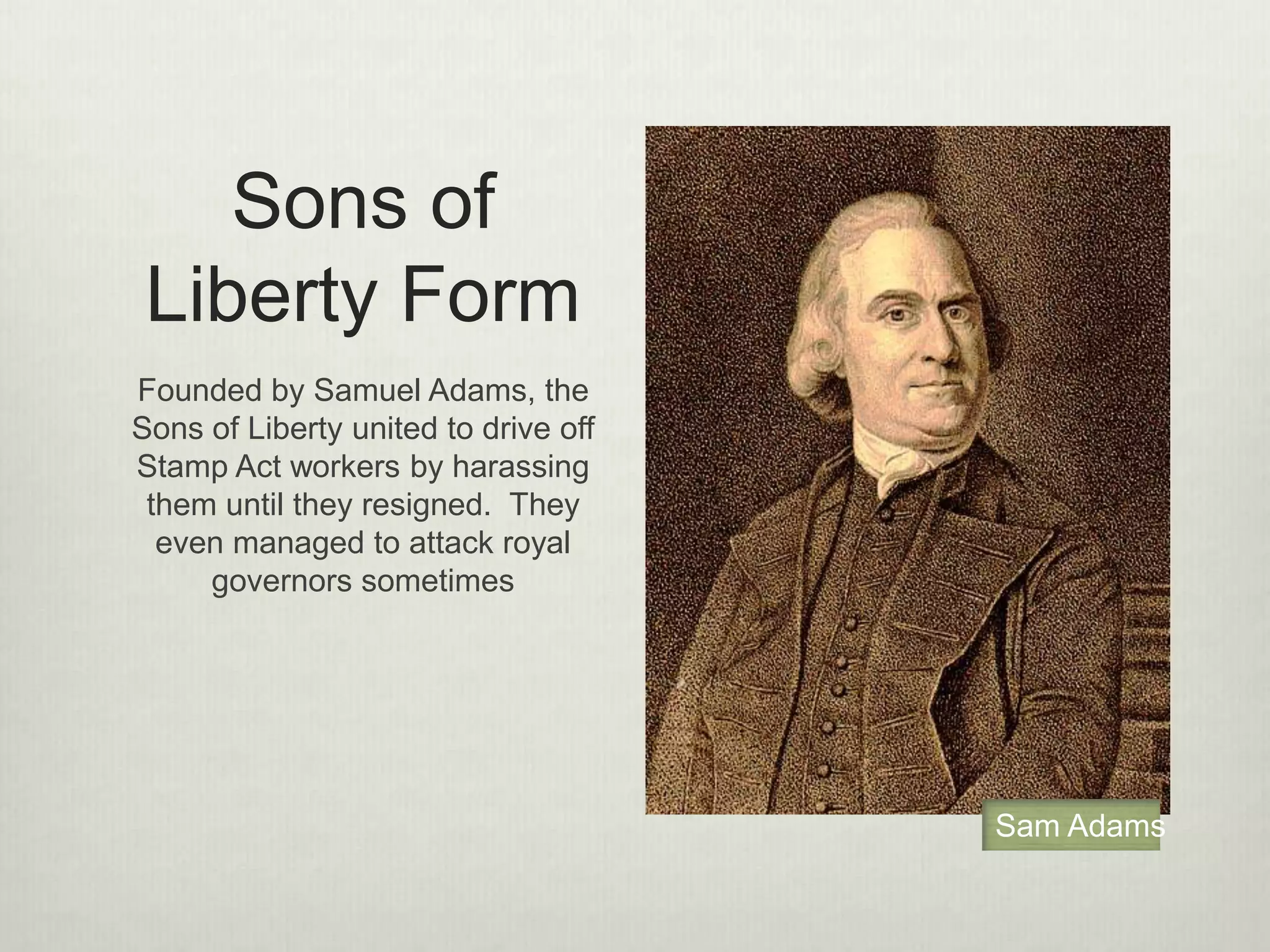
Sons of Liberty Form
• a secret resistance group to protest Stamp Act and other perceived liberties
• formed the Stamp Act Congress
• harassed customs workers, stamp agents, and royal governors (when
necessary)
• successful in preventing the Stamp Act from going into effect
11
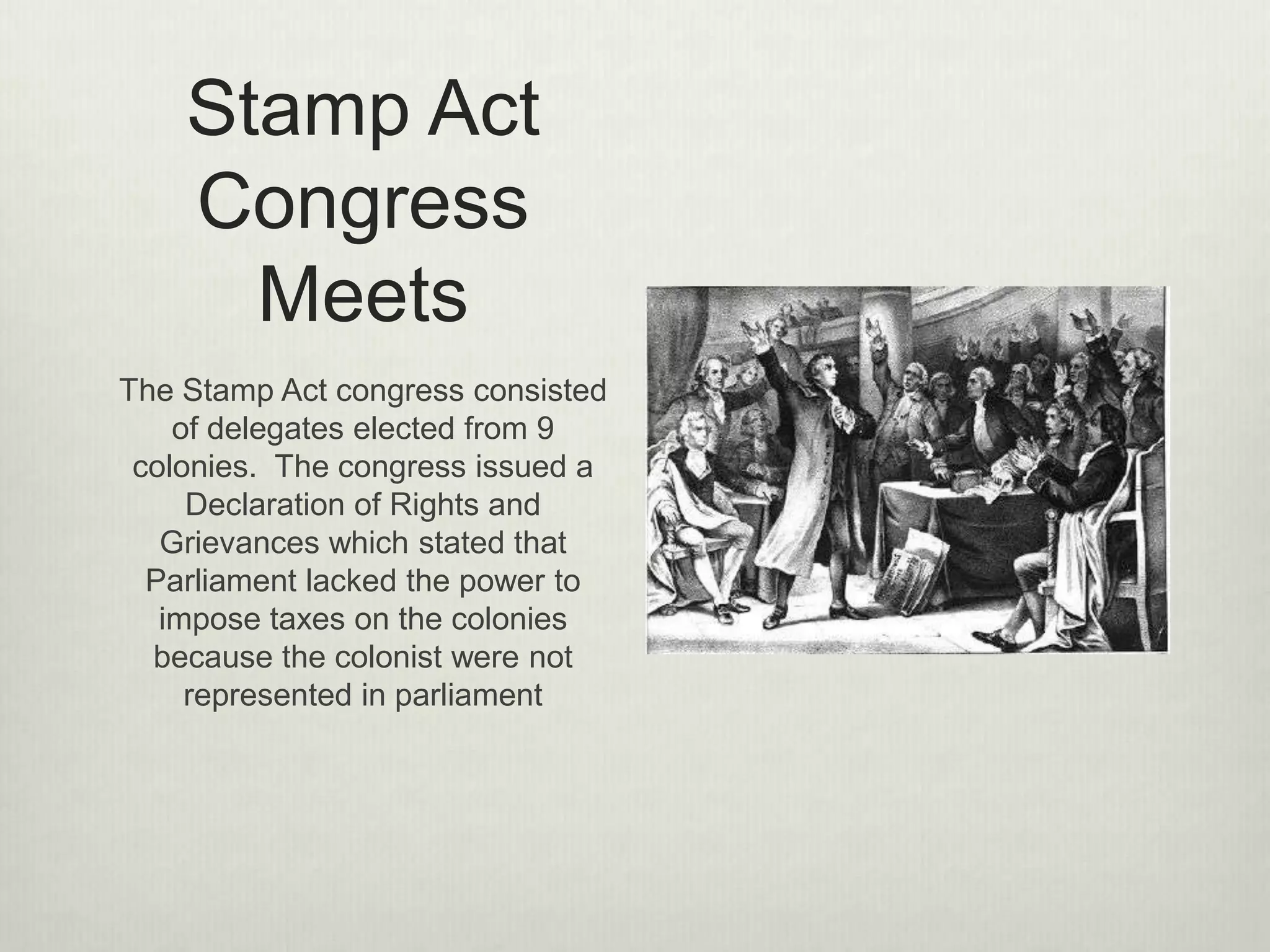
Stamp Act
Congress
Meets
• delegates from nine colonies met
and issued Declaration of Rights &
Grievances
• announced Parliament lacked the
power to tax the colonies because
the colonists were not represented
in Parliament
• conducted a boycott of British goods
• Parliament repeals the Stamp Act,
boycott ends
12
Colonists
Boycott British
Goods
• The refusal to purchase the
products of an individual ,
corporation a nation as a way to
bring economic pressure for social
or political change.
• How effective was it and why?
effective because merchants
forced Parliament to repeal the
Stamp Act.
13
Declaratory
Act
What the Declaratory Act said:
It gave the British rights to tax and
make decisions for the colonies.
Similar to the idea: “As long as you
live under my roof, you will follow
my rules!”
14
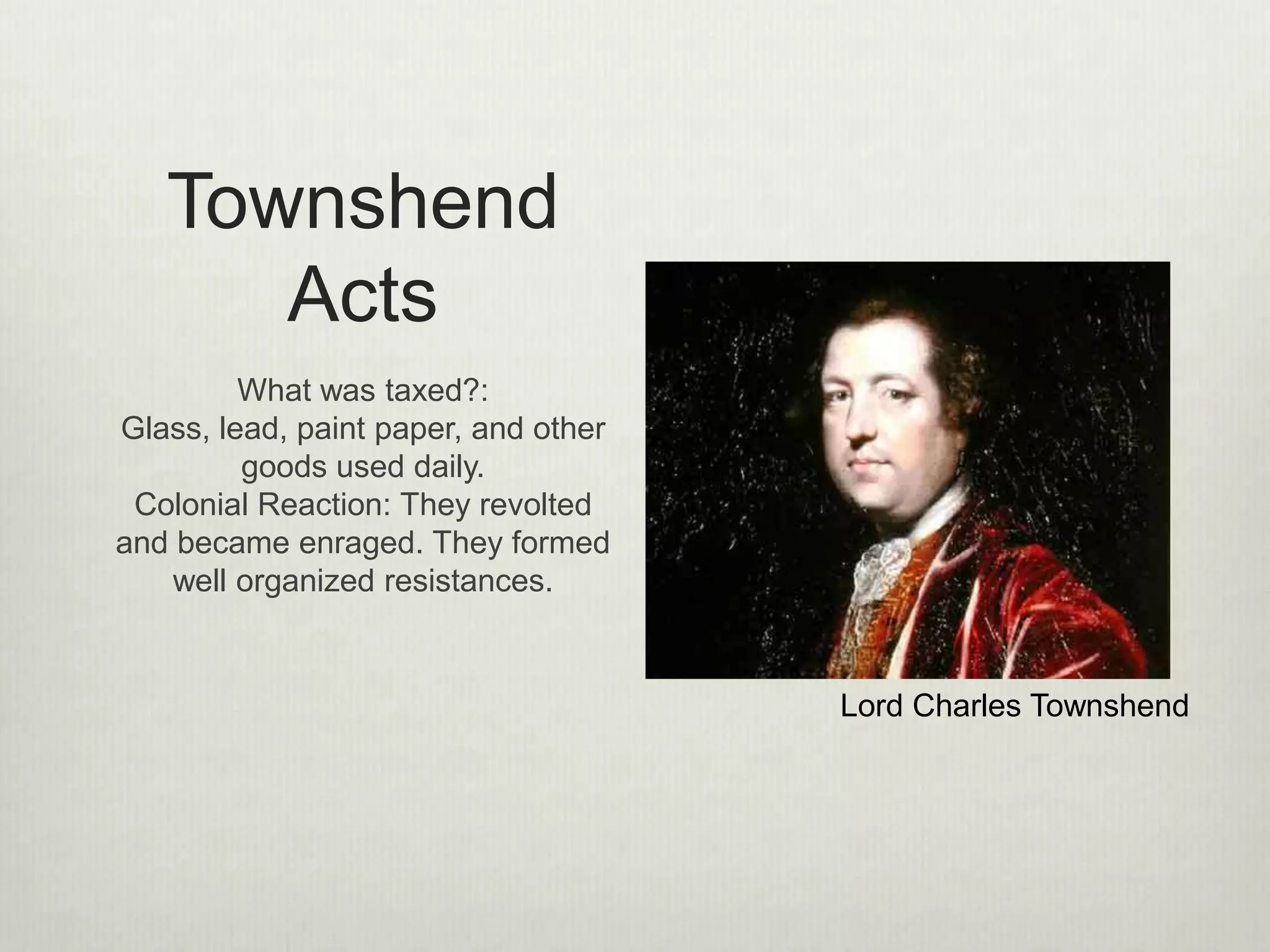
Townshend
Acts
What was taxed? Tea, glass, lead,
paper, paint
Colonial Reaction: They revolted
and became enraged. They formed
well organized resistances.
Lord Charles Townshend
15
Colonists
Renew Boycott
Examples: Colonist didn’t buy
English imports, and instead made
their own cloth, clothes, teas, etc.
British Response: The British sent
2,000 red coats (soldiers) to Boston
and arrested smugglers to restore
the control.
16
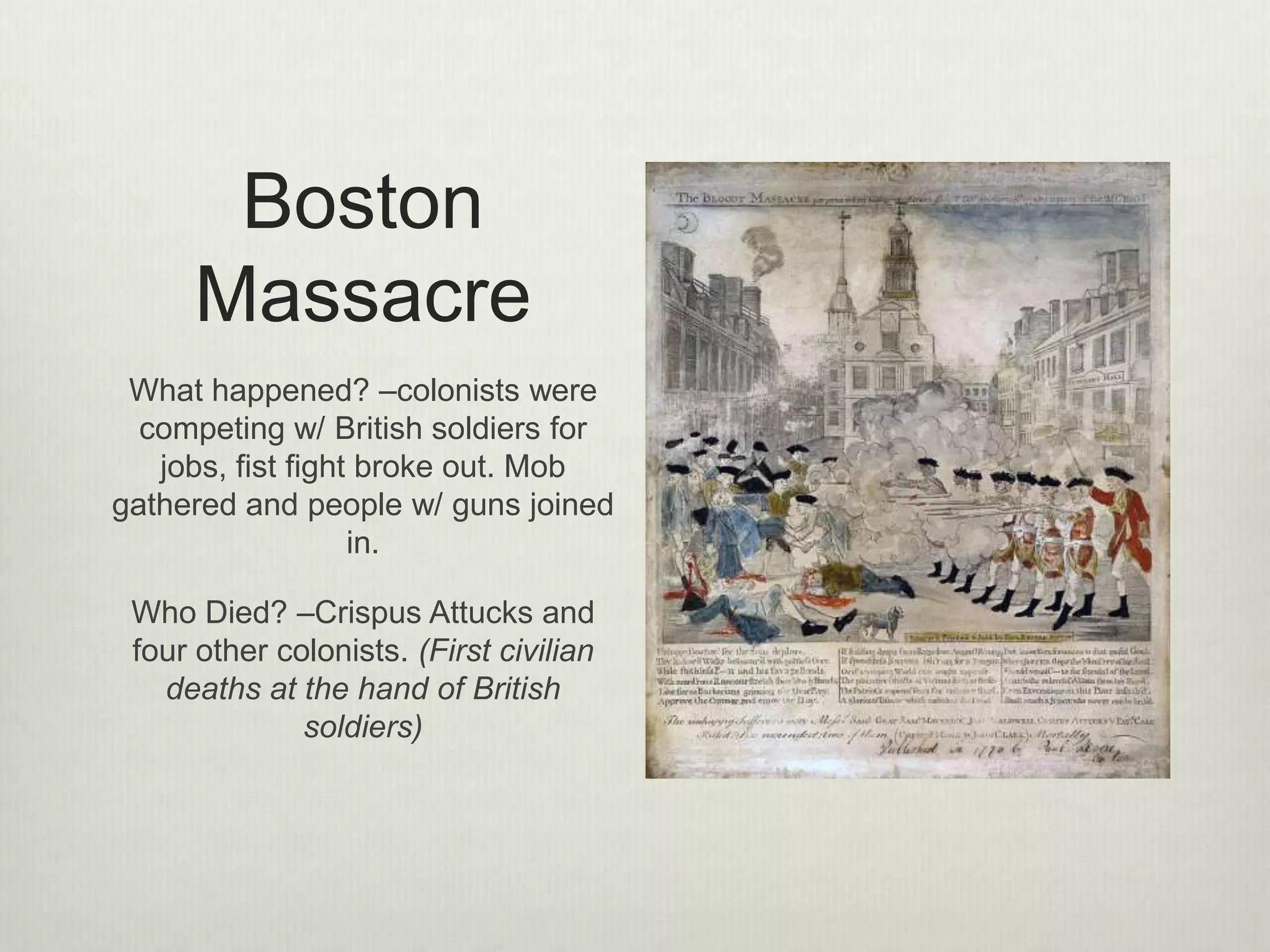
Boston Massacre
• after a fist fight between colonists & poorly paid British soldiers, a mob
gathered outside the Customs House that taunted the guards
• An armed clash erupted
• Crispus Attucks and 4 others are the first civilian deaths at the hands of
British soldiers
17
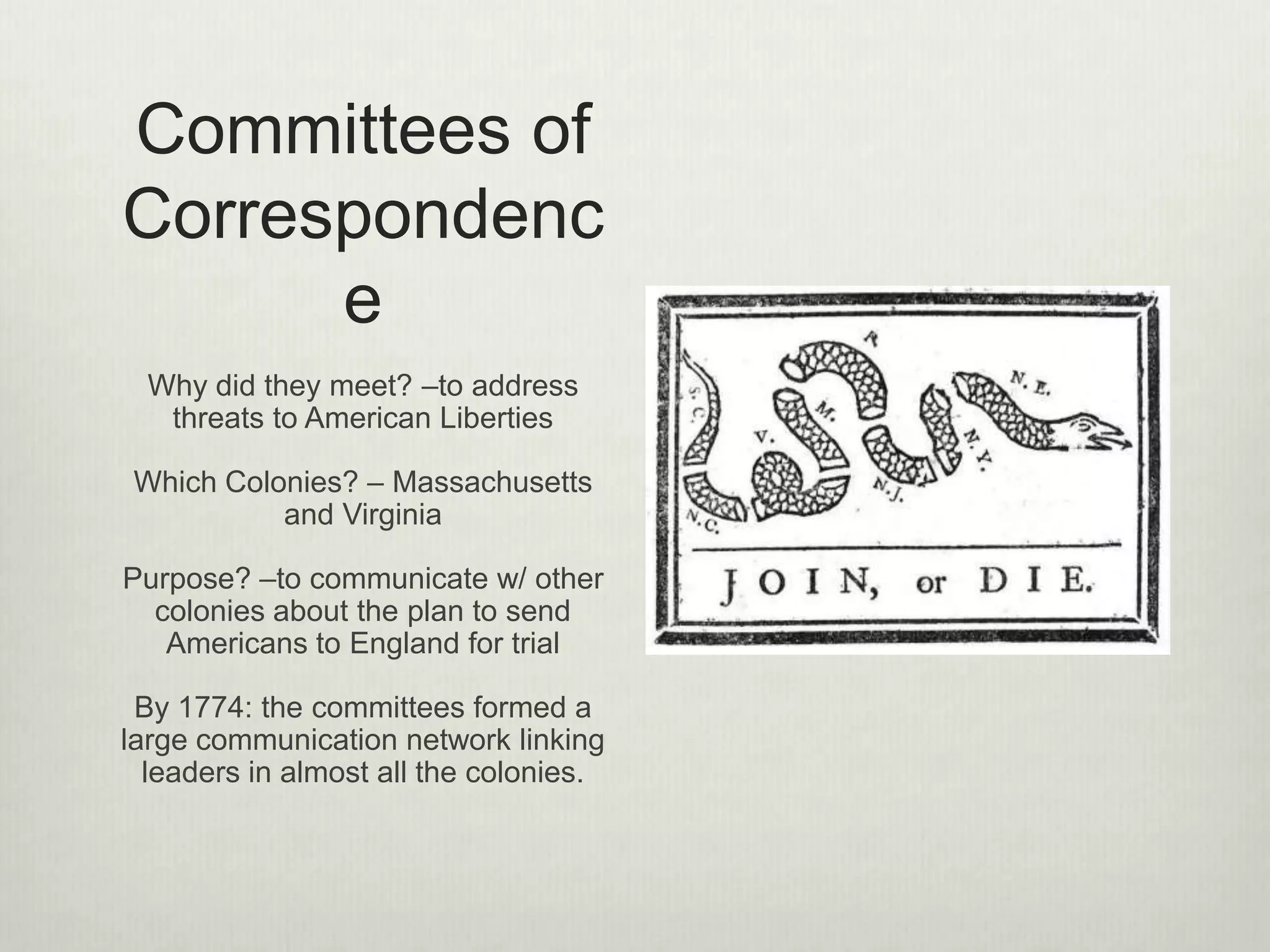
Committees of
Correspondenc
e
• To communicate with other
colonists about the Boston
massacre and other threats to
American liberties, Massachusetts
and Virginia were the two
colonies.
• The Pony Express was the way
these letters moved through the
colonies
18
Tea Act
•the British East India Company
could directly sell their tea to the
colonies without taxes while
colonial sellers still had to charge
a tax
•colonial sellers were outraged
because of their loss of sales and
profits
19
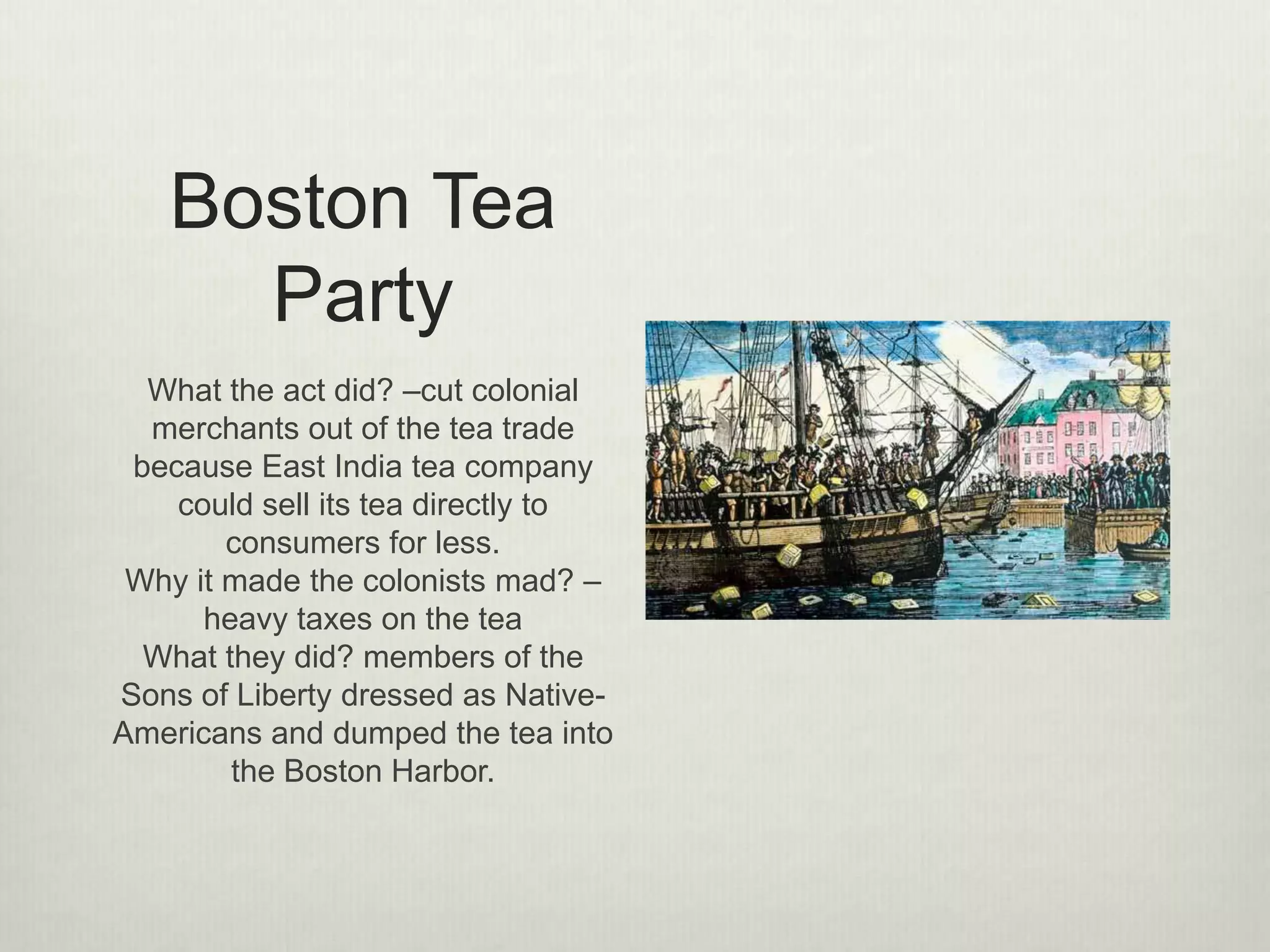
Boston Tea Party
• a protest of the Tea Act
• colonists disguised as Native
Americans, dumped 18,000 pounds
of East Indian Company tea into
Boston Harbor
20
Intolerable Acts
(1774)
Parliament’s strict response to the
Boston Tea Party had 4 Parts:
1) Shut down Boston Harbor to
American merchants.
2) Established Quartering Act,
requiring colonists to house British
soldiers.
3) Appointed Thomas Gage, British
military officer, new governor of
Massachusetts.
4) General Gage placed Boston under
martial law.
21
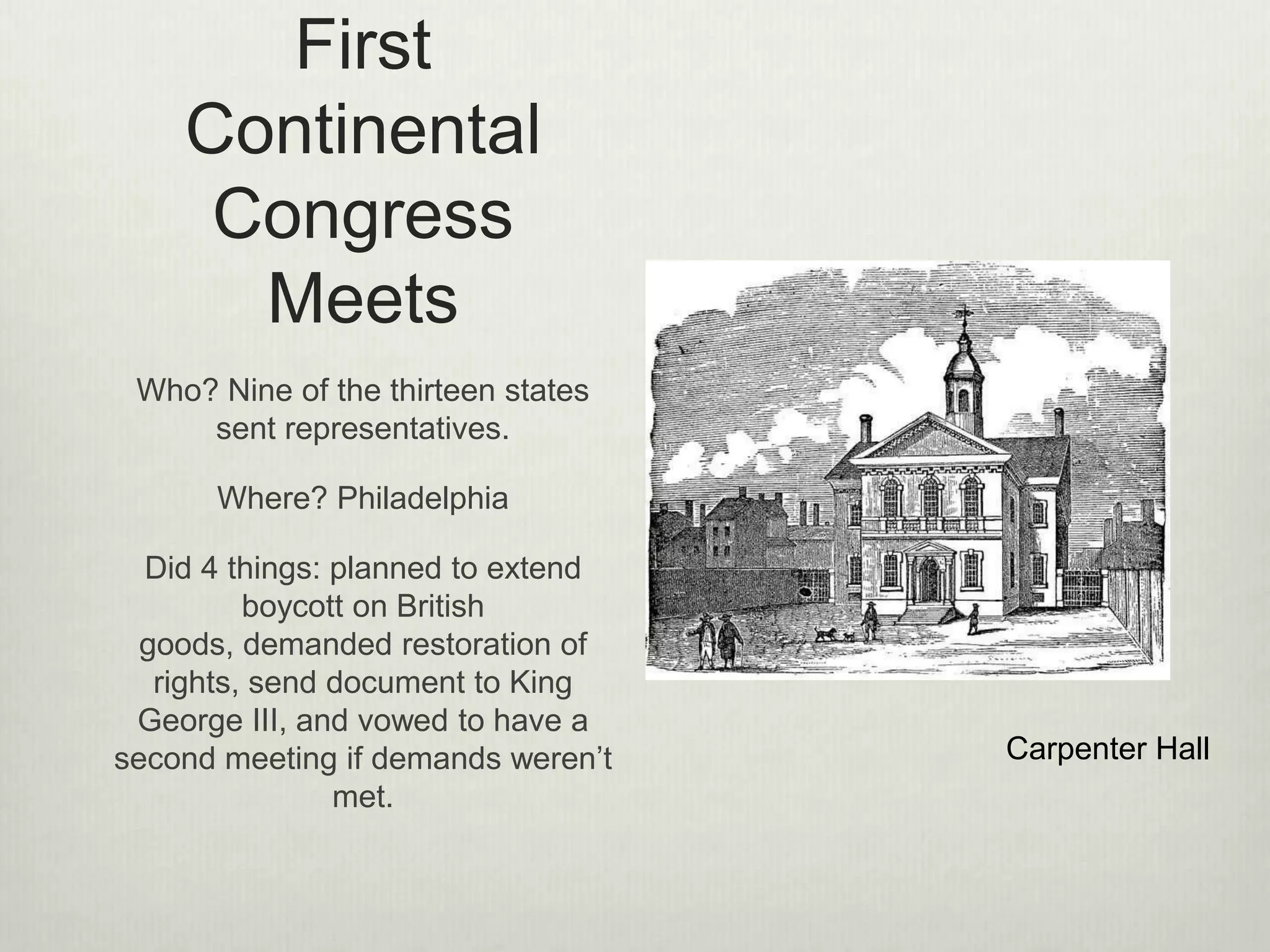
First Continental Congress Meets
56 delegates from the colonies met in
Philadelphia and decided:
1.colonies have the right to run their
own affairs
2.supported protests in
Massachusetts
3.colonies will fight back against
British if force is used
4.reconvene in May 1775 if their
demands are not met
22
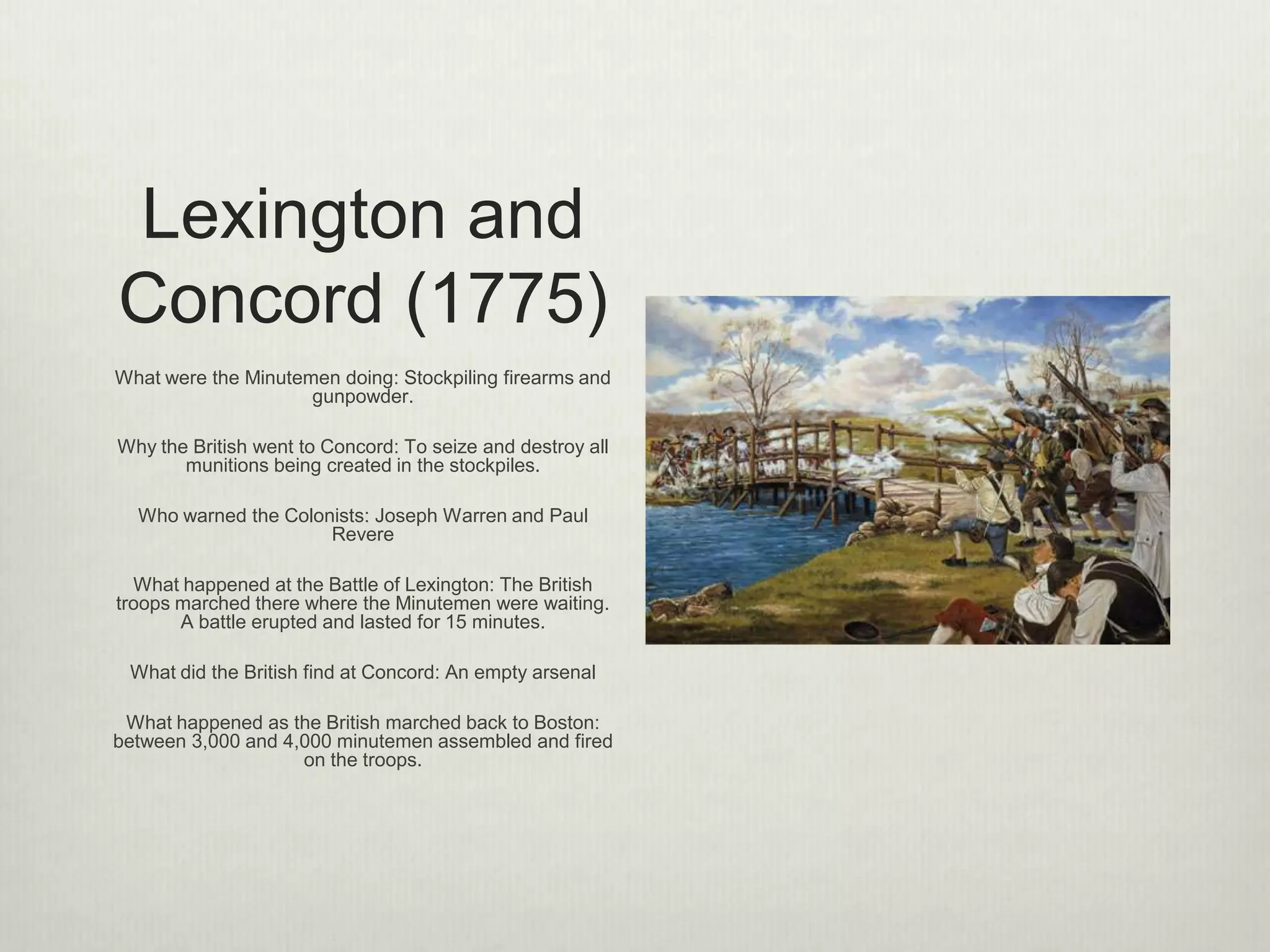
Lexington and Concord (1775)
• considered the start of the American Revolution
• British troops were sent to seize and destroy all munitions possible
• as the colonists were backing down at the command of the British, a shot
was fired and the British fired back killing 8 minutemen and injuring 10
more
• British troops were ambushed on the road back to Boston by some 3,000
– 4,000 minutemen all the way
• British soldiers fell by the dozen to the guerilla tactics of the minutemen
23
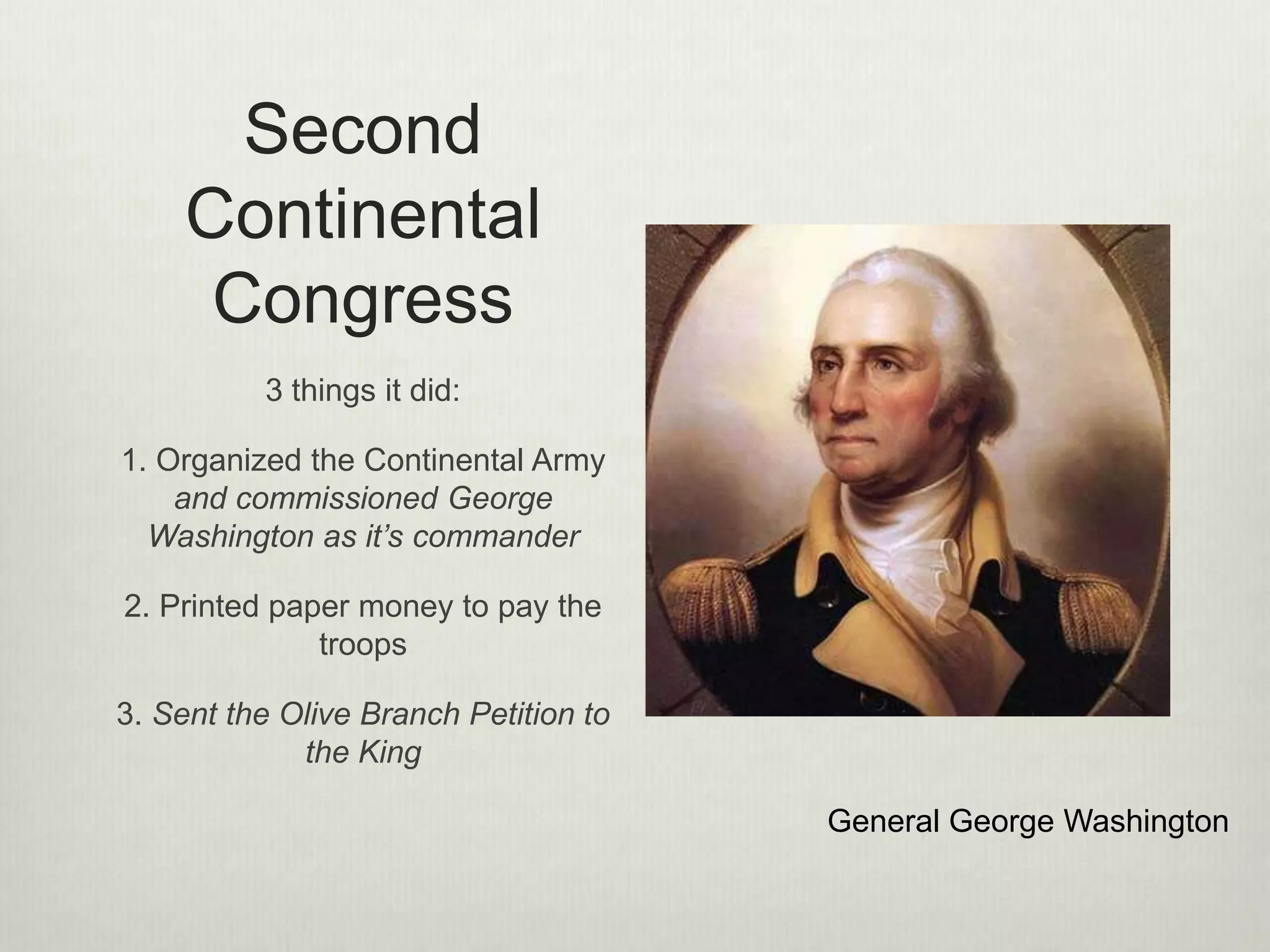
Second Continental Congress
They talked about each colony having its own government, the colonies being
independent, and money to be printed.
3 things it did:
1. Organized the Continental Army and commissioned George Washington as
it’s commander
2. Printed paper money to pay the troops
3. Sent the Olive Branch Petition to the King
24
Battle of Bunker Hill
• to disperse the militiamen,
General Gage struck out at
Bunker Hill
• the British won the Hill but took
heavier losses than the Patriots
• was the deadliest battle of the
Revolutionary War
25
Olive Branch
Petition
It is the urging of “the former
harmony” to return between Britain
and the colonies. The king flatly
rejected it.
26
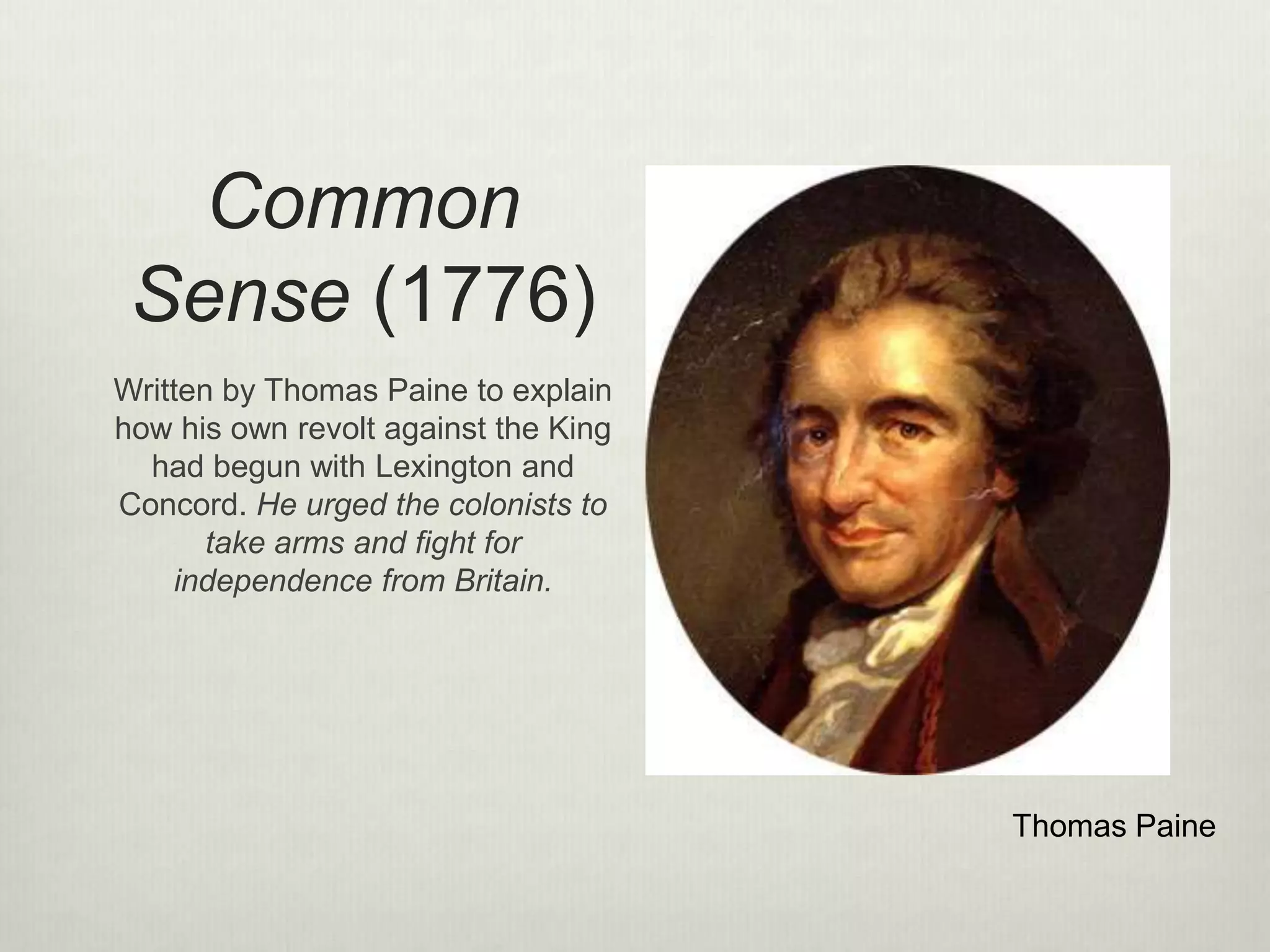
Common
Sense (1776)
Thomas Paine
27
•Written by Thomas Paine
•explains how the revolt against the
King had begun with Lexington and
Concord
•urged the colonists to take arms
and fight for independence from
Britain
Declaration of Independence
• based on the enlightenment ideas of John Locke
• written by Thomas Jefferson
• laid out the logical explanation as to why the colonies had declared
independence
• adopted July 4, 1776
28

Pre-Revolution Timeline - Period 1

  • 1.
  • 2.
    Bacon’s Rebellion • sometimes consideredthe beginning of the revolutionary era in the colonies • First open defiance of of a duly established government in the colonies • Bacon gathered poor freemen, indentured servants, and some slaves to fight against the government of Virginia essentially over the dealing with Native Americans on the frontier 2
  • 3.
    Navigation Acts • Accordingto the policies of mercantilism, Parliament passed the Navigation Acts to ensure that the colonies were trading only with England • laws were enforced using the writs of assistance which was a general search warrant that allowed British officials to search colonists homes • many Massachusetts merchants viewed this as an invasion of privacy 3
  • 4.
    Navigation Acts • Nocountry could trade with the colonies unless the goods were shipped in either colonial or English ships • All vessels had to be operated by crews that were at least three-quarters English or colonial • The colonies could export certain products only to England • Almost all goods traded between the colonies and Europe first had to pass through an English port. 4
  • 5.
    Board of Trade • theBoard of Trade was an advisory group that met in England and recommended laws to improve trade with the colonies 5
  • 6.
    French & IndianWar • Part of a larger world war: the Seven Years War, fought on 5 continents • England & the colonies v. France & Native-Americans • Fought for key fertile land in the Ohio River Valley 6
  • 7.
    Treaty of Paris1763 • Ends the French & Indian War (and the Seven Years Way) • England gets control of all land east of the Mississippi River • France loses ALL land in North America 7
  • 8.
    Proclamation of 1763 • Toavoid further conflict with Native Americans. • Forbade all settlement west of the Appalachian Mountains. • Proclamation by Britain at the end of the French and Indian war that prohibited settlement by colonists on Indian territory. • Angered colonists who just fought to gain the right to settle on that land 8
  • 9.
    Sugar Act (1764) The threeparts were: 1. It halved the duty on foreign- made molasses 2. It placed duties on certain imports 3. Strengthened the enforcement of the law allowing prosecutors to try smuggling cases in a vice- admiralty court rather than in a more sympathetic colonial court. 9
  • 10.
    Stamp Act (1765) • Itdiffered from earlier taxes because it directly taxed everyone. • The tax required colonists to purchase special stamped paper for every legal document, license, newspaper, pamphlet, and almanac. • Every colonists had to pay and take money out their pocket. 10
  • 11.
    Sons of LibertyForm • a secret resistance group to protest Stamp Act and other perceived liberties • formed the Stamp Act Congress • harassed customs workers, stamp agents, and royal governors (when necessary) • successful in preventing the Stamp Act from going into effect 11
  • 12.
    Stamp Act Congress Meets • delegatesfrom nine colonies met and issued Declaration of Rights & Grievances • announced Parliament lacked the power to tax the colonies because the colonists were not represented in Parliament • conducted a boycott of British goods • Parliament repeals the Stamp Act, boycott ends 12
  • 13.
    Colonists Boycott British Goods • Therefusal to purchase the products of an individual , corporation a nation as a way to bring economic pressure for social or political change. • How effective was it and why? effective because merchants forced Parliament to repeal the Stamp Act. 13
  • 14.
    Declaratory Act What the DeclaratoryAct said: It gave the British rights to tax and make decisions for the colonies. Similar to the idea: “As long as you live under my roof, you will follow my rules!” 14
  • 15.
    Townshend Acts What was taxed?Tea, glass, lead, paper, paint Colonial Reaction: They revolted and became enraged. They formed well organized resistances. Lord Charles Townshend 15
  • 16.
    Colonists Renew Boycott Examples: Colonistdidn’t buy English imports, and instead made their own cloth, clothes, teas, etc. British Response: The British sent 2,000 red coats (soldiers) to Boston and arrested smugglers to restore the control. 16
  • 17.
    Boston Massacre • aftera fist fight between colonists & poorly paid British soldiers, a mob gathered outside the Customs House that taunted the guards • An armed clash erupted • Crispus Attucks and 4 others are the first civilian deaths at the hands of British soldiers 17
  • 18.
    Committees of Correspondenc e • Tocommunicate with other colonists about the Boston massacre and other threats to American liberties, Massachusetts and Virginia were the two colonies. • The Pony Express was the way these letters moved through the colonies 18
  • 19.
    Tea Act •the BritishEast India Company could directly sell their tea to the colonies without taxes while colonial sellers still had to charge a tax •colonial sellers were outraged because of their loss of sales and profits 19
  • 20.
    Boston Tea Party •a protest of the Tea Act • colonists disguised as Native Americans, dumped 18,000 pounds of East Indian Company tea into Boston Harbor 20
  • 21.
    Intolerable Acts (1774) Parliament’s strictresponse to the Boston Tea Party had 4 Parts: 1) Shut down Boston Harbor to American merchants. 2) Established Quartering Act, requiring colonists to house British soldiers. 3) Appointed Thomas Gage, British military officer, new governor of Massachusetts. 4) General Gage placed Boston under martial law. 21
  • 22.
    First Continental CongressMeets 56 delegates from the colonies met in Philadelphia and decided: 1.colonies have the right to run their own affairs 2.supported protests in Massachusetts 3.colonies will fight back against British if force is used 4.reconvene in May 1775 if their demands are not met 22
  • 23.
    Lexington and Concord(1775) • considered the start of the American Revolution • British troops were sent to seize and destroy all munitions possible • as the colonists were backing down at the command of the British, a shot was fired and the British fired back killing 8 minutemen and injuring 10 more • British troops were ambushed on the road back to Boston by some 3,000 – 4,000 minutemen all the way • British soldiers fell by the dozen to the guerilla tactics of the minutemen 23
  • 24.
    Second Continental Congress Theytalked about each colony having its own government, the colonies being independent, and money to be printed. 3 things it did: 1. Organized the Continental Army and commissioned George Washington as it’s commander 2. Printed paper money to pay the troops 3. Sent the Olive Branch Petition to the King 24
  • 25.
    Battle of BunkerHill • to disperse the militiamen, General Gage struck out at Bunker Hill • the British won the Hill but took heavier losses than the Patriots • was the deadliest battle of the Revolutionary War 25
  • 26.
    Olive Branch Petition It isthe urging of “the former harmony” to return between Britain and the colonies. The king flatly rejected it. 26
  • 27.
    Common Sense (1776) Thomas Paine 27 •Writtenby Thomas Paine •explains how the revolt against the King had begun with Lexington and Concord •urged the colonists to take arms and fight for independence from Britain
  • 28.
    Declaration of Independence •based on the enlightenment ideas of John Locke • written by Thomas Jefferson • laid out the logical explanation as to why the colonies had declared independence • adopted July 4, 1776 28