SUPREME COURT CASES
DRED SCOTT V. SANFORD (1857)
What happened?
• Scott was a slave taken to
live in a free state. He sued
in court for his freedom.
SCOTUS decision
• Slaves were property, not
people, meaning that their
master could take them
wherever they wanted
Importance
• Slaves are considered
property and do not have
the right to sue in court
• Missouri Compromise is
now unconstitutional, the
federal government cannot
deny a person the right to
own slaves anywhere in the
country
• It hastens the coming of
the Civil War
PLESSY V. FERGUSON (1896)
What happened?
• Plessy refused to sit
in the train car
designated for
“blacks”
• He said that
separate train cars
are not equal train
cars
SCOTUS decision
• As long as both
groups had access
to the train it did
not violate the 14th
Amendment
Importance
• “Separate but
Equal” is
constitutional
SCHENCK V. US (1919)
What happened?
• Schenck protested the
draft for WW1 claiming it
was the same as slavery
and violates the 13th
Amendment
• he was arrested and
argued that his 1st
Amendment right to free
speech was violated
SCOTUS decision
• Yes, citizens have free
speech but NOT if the use
of free speech creates a
“clear and present danger”
• It is the same as shouting
“FIRE!” in a crowded movie
theater when there is no
fire
Importance
• Free speech is protected as
long as it does no endanger
others
• The use of free speech to
violate the draft would put
the nation and others in
danger
• The draft is constitutional,
it gives Congress the ability
to protect the nation
KOREMATSU V. US (1944)
What happened?
• WW2, US government
gave military order to
confine Japanese-
Americans into
Internment Camps to
protect against
potential Japanese
espionage and
domestic attacks
SCOTUS decision
• The need to protect
the United States
from espionage and
domestic attacks was
greater than the rights
of people from
Japanese descent.
Importance
• It is constitutional to
take away rights in
cases of national
defense to protect
from espionage and
attacks
BROWN V. BOARD OF EDUCATION OF TOPEKA, KS
(1954)
What happened?
• Public schools in 1954 were
segregated according to
race.
• On behalf of black families
(including the Browns) the
NAACP challenged the
ruling in Plessy v. Ferguson
that separate schools are
not equal schools.
SCOTUS decision
• The Court decided
unanimously as long as
people are separated it
implies an inferiority of one
group from the other, thus
separate can never be
equal.
Importance
• The Plessy rule of “separate
but equal” was overturned
for public school because it
violates the fourteenth
amendment.
• This rule will begin to be
applied to other public
spaces and facilities
eventually bringing an end
to legal segregation
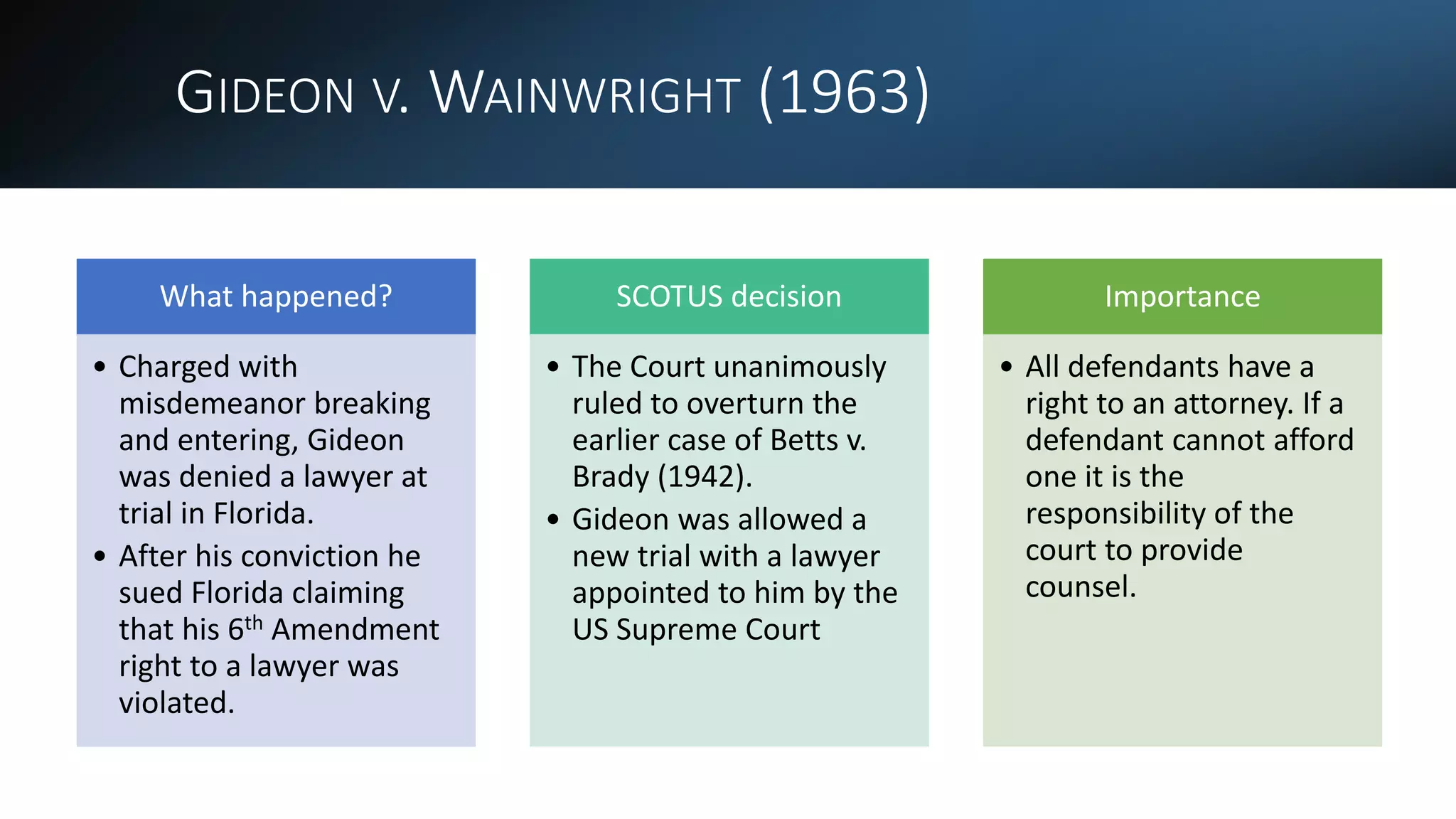
GIDEON V. WAINWRIGHT (1963)
What happened?
• Charged with
misdemeanor breaking
and entering, Gideon
was denied a lawyer at
trial in Florida.
• After his conviction he
sued Florida claiming
that his 6th Amendment
right to a lawyer was
violated.
SCOTUS decision
• The Court unanimously
ruled to overturn the
earlier case of Betts v.
Brady (1942).
• Gideon was allowed a
new trial with a lawyer
appointed to him by the
US Supreme Court
Importance
• All defendants have a
right to an attorney. If a
defendant cannot afford
one it is the
responsibility of the
court to provide
counsel.
MIRANDA V. ARIZONA (1966)
What happened?
• Ernesto Miranda was
arrested and charged
with rape and murder
• He was convicted using
a confession he was told
he had to give
SCOTUS decision
• In violation of the 5th
Amendment, the police
forced Miranda to give
evidence against
himself.
• Miranda did not know of
his legal protection from
self-incrimination and
was granted a re-trial
Importance
• To ensure that the
accused understands
their rights, arresting
officers are required to
read them their rights
upon arrest
ROE V. WADE (1973)
What happened?
• Norma McCorvey (known
as Jane Roe) argued that
the Texas law prohibiting
abortions robbed her of
her right to privacy
protected by Bill of Rights
(4th Amendment), and of
her liberty, as protected
by the Due Process Clause
of the 14th Amendment.
SCOTUS decision
• The Court agreed with
Roe’s argument that her
right to privacy and due
process had been violated
by the Texas law banning
abortions.
Importance
• woman's right to an
abortion fell within the
right to privacy protected
by the 14th Amendment.
• It gave a women total
authority over pregnancy
during the first trimester.
BOARD OF REGENTS OF CALIFORNIA V. BAKKE (1978)
What happened?
• Allan Bakke, applied to the
University of California
Medical School twice and
was rejected both times.
Bakke argued that his GPA
and test scores were higher
than several students who
gained admission because
the school reserved 16 places
in each entering class for
“qualified minorities.”
SCOTUS decision
• In part the Court agreed with
Bakke, he had been unjustly
denied admission to the
Medical School, but
affirmative action was upheld
as long as race is not the only
factor used for granting
admission to the university.
Importance
• The decision upheld
affirmative action allowing
race to be one of several
factors in college admission
policy, but not the only factor.
BUSH V. GORE (2000)
What happened?
• Faulty ballots and voting
machines in Miami-Dade
county result in ballots
that were confusing and
unable to be read by the
voting machines
• A hand recount was
ordered but George W.
Bush sued the state of
Florida to have them end
the recount
SCOTUS decision
• The Court ordered the
recount to be stopped
resulting in a win for Bush
in Florida by 537 votes.
Winning Florida gave
Bush the victory in the
2000 election over Al
Gore
Importance
• No precedent was set as
the Court specifically said
that this decision would
be a narrow decision
applied only to this one
case
• It has confused the rule of
law that is based on
precedent by not allowing
the case to be used as
precedent

Supreme Court Cases - For Florida US History

  • 1.
  • 2.
    DRED SCOTT V.SANFORD (1857) What happened? • Scott was a slave taken to live in a free state. He sued in court for his freedom. SCOTUS decision • Slaves were property, not people, meaning that their master could take them wherever they wanted Importance • Slaves are considered property and do not have the right to sue in court • Missouri Compromise is now unconstitutional, the federal government cannot deny a person the right to own slaves anywhere in the country • It hastens the coming of the Civil War
  • 3.
    PLESSY V. FERGUSON(1896) What happened? • Plessy refused to sit in the train car designated for “blacks” • He said that separate train cars are not equal train cars SCOTUS decision • As long as both groups had access to the train it did not violate the 14th Amendment Importance • “Separate but Equal” is constitutional
  • 4.
    SCHENCK V. US(1919) What happened? • Schenck protested the draft for WW1 claiming it was the same as slavery and violates the 13th Amendment • he was arrested and argued that his 1st Amendment right to free speech was violated SCOTUS decision • Yes, citizens have free speech but NOT if the use of free speech creates a “clear and present danger” • It is the same as shouting “FIRE!” in a crowded movie theater when there is no fire Importance • Free speech is protected as long as it does no endanger others • The use of free speech to violate the draft would put the nation and others in danger • The draft is constitutional, it gives Congress the ability to protect the nation
  • 5.
    KOREMATSU V. US(1944) What happened? • WW2, US government gave military order to confine Japanese- Americans into Internment Camps to protect against potential Japanese espionage and domestic attacks SCOTUS decision • The need to protect the United States from espionage and domestic attacks was greater than the rights of people from Japanese descent. Importance • It is constitutional to take away rights in cases of national defense to protect from espionage and attacks
  • 6.
    BROWN V. BOARDOF EDUCATION OF TOPEKA, KS (1954) What happened? • Public schools in 1954 were segregated according to race. • On behalf of black families (including the Browns) the NAACP challenged the ruling in Plessy v. Ferguson that separate schools are not equal schools. SCOTUS decision • The Court decided unanimously as long as people are separated it implies an inferiority of one group from the other, thus separate can never be equal. Importance • The Plessy rule of “separate but equal” was overturned for public school because it violates the fourteenth amendment. • This rule will begin to be applied to other public spaces and facilities eventually bringing an end to legal segregation
  • 7.
    GIDEON V. WAINWRIGHT(1963) What happened? • Charged with misdemeanor breaking and entering, Gideon was denied a lawyer at trial in Florida. • After his conviction he sued Florida claiming that his 6th Amendment right to a lawyer was violated. SCOTUS decision • The Court unanimously ruled to overturn the earlier case of Betts v. Brady (1942). • Gideon was allowed a new trial with a lawyer appointed to him by the US Supreme Court Importance • All defendants have a right to an attorney. If a defendant cannot afford one it is the responsibility of the court to provide counsel.
  • 8.
    MIRANDA V. ARIZONA(1966) What happened? • Ernesto Miranda was arrested and charged with rape and murder • He was convicted using a confession he was told he had to give SCOTUS decision • In violation of the 5th Amendment, the police forced Miranda to give evidence against himself. • Miranda did not know of his legal protection from self-incrimination and was granted a re-trial Importance • To ensure that the accused understands their rights, arresting officers are required to read them their rights upon arrest
  • 9.
    ROE V. WADE(1973) What happened? • Norma McCorvey (known as Jane Roe) argued that the Texas law prohibiting abortions robbed her of her right to privacy protected by Bill of Rights (4th Amendment), and of her liberty, as protected by the Due Process Clause of the 14th Amendment. SCOTUS decision • The Court agreed with Roe’s argument that her right to privacy and due process had been violated by the Texas law banning abortions. Importance • woman's right to an abortion fell within the right to privacy protected by the 14th Amendment. • It gave a women total authority over pregnancy during the first trimester.
  • 10.
    BOARD OF REGENTSOF CALIFORNIA V. BAKKE (1978) What happened? • Allan Bakke, applied to the University of California Medical School twice and was rejected both times. Bakke argued that his GPA and test scores were higher than several students who gained admission because the school reserved 16 places in each entering class for “qualified minorities.” SCOTUS decision • In part the Court agreed with Bakke, he had been unjustly denied admission to the Medical School, but affirmative action was upheld as long as race is not the only factor used for granting admission to the university. Importance • The decision upheld affirmative action allowing race to be one of several factors in college admission policy, but not the only factor.
  • 11.
    BUSH V. GORE(2000) What happened? • Faulty ballots and voting machines in Miami-Dade county result in ballots that were confusing and unable to be read by the voting machines • A hand recount was ordered but George W. Bush sued the state of Florida to have them end the recount SCOTUS decision • The Court ordered the recount to be stopped resulting in a win for Bush in Florida by 537 votes. Winning Florida gave Bush the victory in the 2000 election over Al Gore Importance • No precedent was set as the Court specifically said that this decision would be a narrow decision applied only to this one case • It has confused the rule of law that is based on precedent by not allowing the case to be used as precedent