THE REVOLUTIONARY WAR (1763-1783)
A BRIEF LIST OF IMPERIAL ACTIONS
• The Sugar Act of 1764
• The Currency Act of 1764
• The Stamp Act of 1765
• The Declaratory Act of 1766
• The Townshend Revenue Act of 1767
• The Tea Act of 1773
• The Coercive/Intolerable Acts
• The Quebec Act
REASONS FOR INCREASED TAXATION
• The Treaty of Paris (1763)
• Britain was roughly 130 million pounds in debt from the French/Indian Wars
• Britain’s solution: Tax, tax, tax!
• George Grenville was appointed by King George III to solve this minor
debt issue
• Many colonists believed they possessed the same rights as British citizens
• Independence was not declared quickly because most colonists
wanted government modification
• Choosing Sides
• Tories – those who sided with the British and were considered Loyalists
• Whigs – those who wanted independence and became known as American
patriots
REASONS FOR INCREASED TAXATION
•

Imperial Action and Colonial Rejection
• Many colonists were suspicious of King George III’s attempts to restrict liberties on
the colonies through taxation
• Parliamentary sovereignty would become the main issue between Great Britain and
the colonies
• Basically, the colonies felt the King was going to far without Parliamentary
approval (again)
• Furthermore, the colonists still wanted equal representation in Parliament
• Colonists also felt that colonial assemblies were equal to Parliament
• Thus, Parliament could not directly tax the colonies without colonial
approval

•

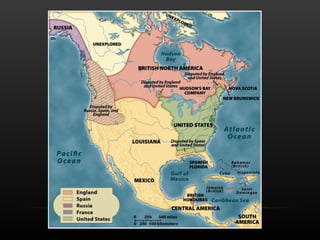
After the Treaty of Paris (1763), Spain was forced out of Florida
• Britain took possession of Louisiana
• The only two nations left in North America in 1763
• Britain and Spain (New Mexico and Texas)
IMPERIAL ACTION
•

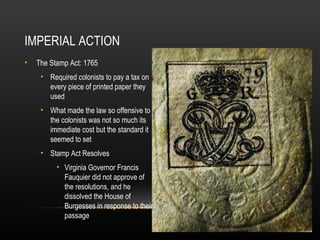
The Stamp Act: 1765
• Required colonists to pay a tax on
every piece of printed paper they
used
• What made the law so offensive to
the colonists was not so much its
immediate cost but the standard it
seemed to set
• Stamp Act Resolves
• Virginia Governor Francis
Fauquier did not approve of
the resolutions, and he
dissolved the House of
Burgesses in response to their
passage
COLONIAL REACTION
•

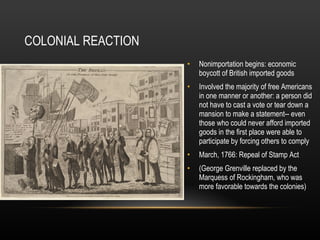
Nonimportation begins: economic
boycott of British imported goods

•

Involved the majority of free Americans
in one manner or another: a person did
not have to cast a vote or tear down a
mansion to make a statement-- even
those who could never afford imported
goods in the first place were able to
participate by forcing others to comply

•

March, 1766: Repeal of Stamp Act

•

(George Grenville replaced by the
Marquess of Rockingham, who was
more favorable towards the colonies)
COLONIAL REACTION
•

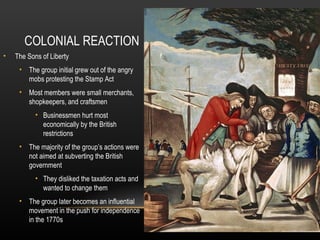
The Sons of Liberty
• The group initial grew out of the angry
mobs protesting the Stamp Act
• Most members were small merchants,
shopkeepers, and craftsmen
• Businessmen hurt most
economically by the British
restrictions
• The majority of the group’s actions were
not aimed at subverting the British
government
• They disliked the taxation acts and
wanted to change them
• The group later becomes an influential
movement in the push for independence
in the 1770s
IMPERIAL AGGRESSION
•

The Declaratory Act of 1766
• The act claimed that Parliament held sovereign power over the American colonies “in all
cases whatsoever”
• This caused friction in the colonies as the Americans believed that their colonial
legislatures were equal to Parliament
• Their logic assumed that only colonial assemblies could tax the colonists legally.
• Parliament did not have the authority to directly tax the colonists
• For slaves in the colonies, the “freedom deprivation” argument touted by the Americans
seemed ironic.
COLONIAL REACTION
•

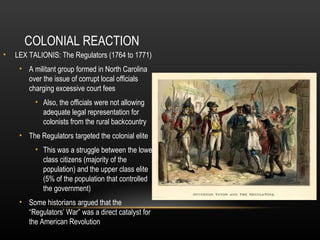
LEX TALIONIS: The Regulators (1764 to 1771)
• A militant group formed in North Carolina
over the issue of corrupt local officials
charging excessive court fees
• Also, the officials were not allowing
adequate legal representation for
colonists from the rural backcountry
• The Regulators targeted the colonial elite
• This was a struggle between the lower
class citizens (majority of the
population) and the upper class elite
(5% of the population that controlled
the government)
• Some historians argued that the
“Regulators’ War” was a direct catalyst for
the American Revolution
IMPERIAL AGGRESSION
•

Townshend Revenue Act of 1767
•

Placed taxes on glass, tea, paper, lead, and paint

•

The revenue from this tax would pay the salaries of officials, centralize colonial control, and
allow for search and seizure at any time.
• This is one of the reasons the 4th Amendment made it into the Bill of Rights

•

Colonists considered this act dangerous
• Raised revenue without the consent of colonial legislatures
• Removed law making from the colonial legislature's control
• Up to this point, only legal representatives of the colonies could impose taxes

•

Boycotts began on all items the act targeted
• Sons of Liberty grew in numbers and strength as a response
• Merchants quit ordering British goods on 1 January 1769

•
•

The boycotts successfully limited British imports by 38%

Overall, the Townshend Acts raised 21,000 pounds revenue, but cost the British ten times that
amount to enforce the acts
COLONIAL REACTION
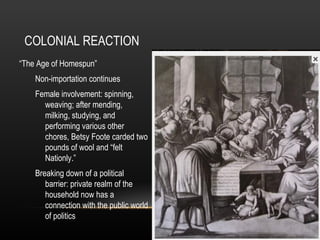
“The Age of Homespun”
Non-importation continues
Female involvement: spinning,
weaving; after mending,
milking, studying, and
performing various other
chores, Betsy Foote carded two
pounds of wool and “felt
Nationly.”
Breaking down of a political
barrier: private realm of the
household now has a
connection with the public world
of politics
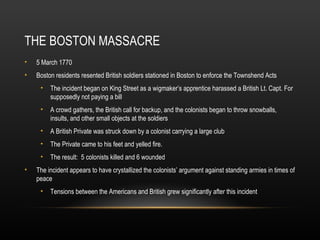
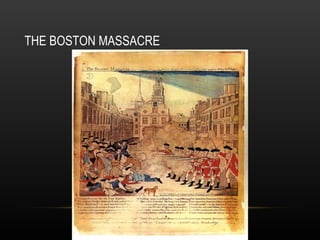
THE BOSTON MASSACRE
•

5 March 1770

•

Boston residents resented British soldiers stationed in Boston to enforce the Townshend Acts
•
•

A crowd gathers, the British call for backup, and the colonists began to throw snowballs,
insults, and other small objects at the soldiers

•

A British Private was struck down by a colonist carrying a large club

•

The Private came to his feet and yelled fire.

•
•

The incident began on King Street as a wigmaker’s apprentice harassed a British Lt. Capt. For
supposedly not paying a bill

The result: 5 colonists killed and 6 wounded

The incident appears to have crystallized the colonists’ argument against standing armies in times of
peace
•

Tensions between the Americans and British grew significantly after this incident
THE BOSTON MASSACRE
IMPERIAL AGGRESSION
•

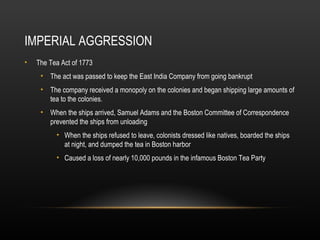
The Tea Act of 1773
• The act was passed to keep the East India Company from going bankrupt
• The company received a monopoly on the colonies and began shipping large amounts of
tea to the colonies.
• When the ships arrived, Samuel Adams and the Boston Committee of Correspondence
prevented the ships from unloading
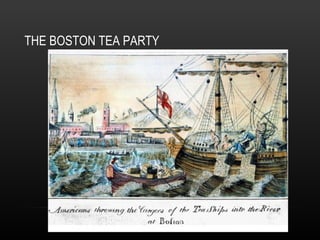
• When the ships refused to leave, colonists dressed like natives, boarded the ships
at night, and dumped the tea in Boston harbor
• Caused a loss of nearly 10,000 pounds in the infamous Boston Tea Party
THE BOSTON TEA PARTY
IMPERIAL AGGRESSION
•

The Coercive/Intolerable Acts
• After the Boston Tea Party, Parliament responded forcefully
• They closed Boston until the tea could be repaid
• Altered the colonial charters to allow Crown-appointed leaders to take control of the
colonies
• Expanded Crown-appointed control over the colonial court systems
• Allowed for trials concerning royal officials to be moved to England
• Required colonists to house British soldiers in their homes if no barracks were
available
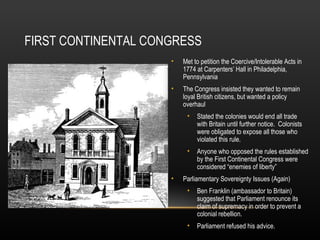
FIRST CONTINENTAL CONGRESS
•

Met to petition the Coercive/Intolerable Acts in
1774 at Carpenters’ Hall in Philadelphia,
Pennsylvania

•

The Congress insisted they wanted to remain
loyal British citizens, but wanted a policy
overhaul
•

•

•

Stated the colonies would end all trade
with Britain until further notice. Colonists
were obligated to expose all those who
violated this rule.
Anyone who opposed the rules established
by the First Continental Congress were
considered “enemies of liberty”

Parliamentary Sovereignty Issues (Again)
•

Ben Franklin (ambassador to Britain)
suggested that Parliament renounce its
claim of supremacy in order to prevent a
colonial rebellion.

•

Parliament refused his advice.
BIRTH OF A REBELLION
•

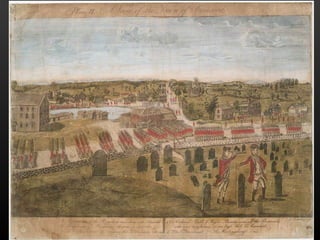
Lexington and Concord
• April 19, 1775 – Gage’s men arrive in Lexington and are met by 70 armed militiamen
• In the confusion that ensues, a shot rang out.
• It is unknown who fired first, but this became known as the “shot heard round the world”
• A small skirmish ensues
• 8 militiamen are killed, 10 wounded
• The British proceed to leave for Concord
• Along the way, a detachment of militiamen ambush them
• Many British soldiers were killed

•

After Lexington and Concord, 20,000 men signed up for the Massachusetts militia. The little army
proceeds to surround Boston.
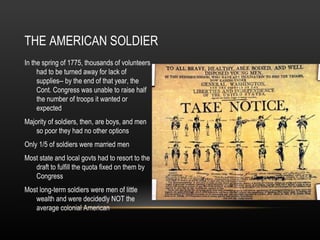
THE AMERICAN SOLDIER
In the spring of 1775, thousands of volunteers
had to be turned away for lack of
supplies-- by the end of that year, the
Cont. Congress was unable to raise half
the number of troops it wanted or
expected
Majority of soldiers, then, are boys, and men
so poor they had no other options
Only 1/5 of soldiers were married men
Most state and local govts had to resort to the
draft to fulfill the quota fixed on them by
Congress
Most long-term soldiers were men of little
wealth and were decidedly NOT the
average colonial American
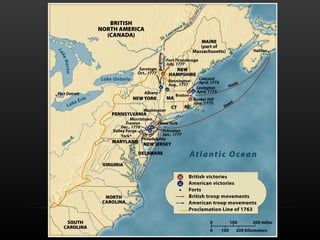
BATTLE OF SARATOGA
•

October 1777

•

The Battle of Saratoga was the turning point in the war for the Continentals

•

British General Burgoyne lost 1,000 men in two battles
• Left him outnumbered 3 to 1
• He also lost many of his effective leaders

•

17 October 1777
• Burgoyne was surrounded by Continentals and surrendered to Continental General
Horatio Gates

•

News of Burgoyne’s surrender reached France
• King Louis XVI decided to negotiate with the Americans at this point
• This resulted in the French entering the war, assisting the Americans.
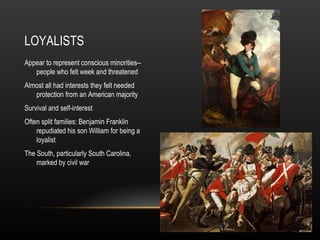
LOYALISTS
Appear to represent conscious minorities-people who felt week and threatened
Almost all had interests they felt needed
protection from an American majority
Survival and self-interest
Often split families: Benjamin Franklin
repudiated his son William for being a
loyalist
The South, particularly South Carolina,
marked by civil war
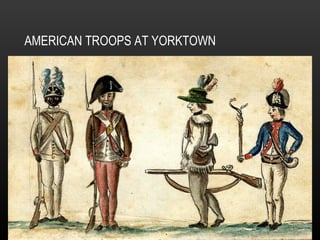
AMERICAN TROOPS AT YORKTOWN
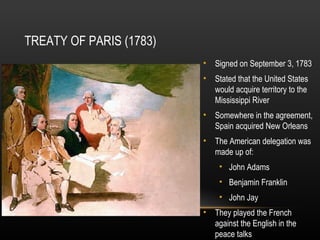
TREATY OF PARIS (1783)
• Signed on September 3, 1783
• Stated that the United States
would acquire territory to the
Mississippi River
• Somewhere in the agreement,
Spain acquired New Orleans
• The American delegation was
made up of:
• John Adams
• Benjamin Franklin
• John Jay
• They played the French
against the English in the
peace talks
The American Revolution

The American Revolution

  • 1.
  • 2.
    A BRIEF LISTOF IMPERIAL ACTIONS • The Sugar Act of 1764 • The Currency Act of 1764 • The Stamp Act of 1765 • The Declaratory Act of 1766 • The Townshend Revenue Act of 1767 • The Tea Act of 1773 • The Coercive/Intolerable Acts • The Quebec Act
  • 3.
    REASONS FOR INCREASEDTAXATION • The Treaty of Paris (1763) • Britain was roughly 130 million pounds in debt from the French/Indian Wars • Britain’s solution: Tax, tax, tax! • George Grenville was appointed by King George III to solve this minor debt issue • Many colonists believed they possessed the same rights as British citizens • Independence was not declared quickly because most colonists wanted government modification • Choosing Sides • Tories – those who sided with the British and were considered Loyalists • Whigs – those who wanted independence and became known as American patriots
  • 4.
    REASONS FOR INCREASEDTAXATION • Imperial Action and Colonial Rejection • Many colonists were suspicious of King George III’s attempts to restrict liberties on the colonies through taxation • Parliamentary sovereignty would become the main issue between Great Britain and the colonies • Basically, the colonies felt the King was going to far without Parliamentary approval (again) • Furthermore, the colonists still wanted equal representation in Parliament • Colonists also felt that colonial assemblies were equal to Parliament • Thus, Parliament could not directly tax the colonies without colonial approval • After the Treaty of Paris (1763), Spain was forced out of Florida • Britain took possession of Louisiana • The only two nations left in North America in 1763 • Britain and Spain (New Mexico and Texas)
  • 5.
    IMPERIAL ACTION • The StampAct: 1765 • Required colonists to pay a tax on every piece of printed paper they used • What made the law so offensive to the colonists was not so much its immediate cost but the standard it seemed to set • Stamp Act Resolves • Virginia Governor Francis Fauquier did not approve of the resolutions, and he dissolved the House of Burgesses in response to their passage
  • 6.
    COLONIAL REACTION • Nonimportation begins:economic boycott of British imported goods • Involved the majority of free Americans in one manner or another: a person did not have to cast a vote or tear down a mansion to make a statement-- even those who could never afford imported goods in the first place were able to participate by forcing others to comply • March, 1766: Repeal of Stamp Act • (George Grenville replaced by the Marquess of Rockingham, who was more favorable towards the colonies)
  • 7.
    COLONIAL REACTION • The Sonsof Liberty • The group initial grew out of the angry mobs protesting the Stamp Act • Most members were small merchants, shopkeepers, and craftsmen • Businessmen hurt most economically by the British restrictions • The majority of the group’s actions were not aimed at subverting the British government • They disliked the taxation acts and wanted to change them • The group later becomes an influential movement in the push for independence in the 1770s
  • 8.
    IMPERIAL AGGRESSION • The DeclaratoryAct of 1766 • The act claimed that Parliament held sovereign power over the American colonies “in all cases whatsoever” • This caused friction in the colonies as the Americans believed that their colonial legislatures were equal to Parliament • Their logic assumed that only colonial assemblies could tax the colonists legally. • Parliament did not have the authority to directly tax the colonists • For slaves in the colonies, the “freedom deprivation” argument touted by the Americans seemed ironic.
  • 9.
    COLONIAL REACTION • LEX TALIONIS:The Regulators (1764 to 1771) • A militant group formed in North Carolina over the issue of corrupt local officials charging excessive court fees • Also, the officials were not allowing adequate legal representation for colonists from the rural backcountry • The Regulators targeted the colonial elite • This was a struggle between the lower class citizens (majority of the population) and the upper class elite (5% of the population that controlled the government) • Some historians argued that the “Regulators’ War” was a direct catalyst for the American Revolution
  • 10.
    IMPERIAL AGGRESSION • Townshend RevenueAct of 1767 • Placed taxes on glass, tea, paper, lead, and paint • The revenue from this tax would pay the salaries of officials, centralize colonial control, and allow for search and seizure at any time. • This is one of the reasons the 4th Amendment made it into the Bill of Rights • Colonists considered this act dangerous • Raised revenue without the consent of colonial legislatures • Removed law making from the colonial legislature's control • Up to this point, only legal representatives of the colonies could impose taxes • Boycotts began on all items the act targeted • Sons of Liberty grew in numbers and strength as a response • Merchants quit ordering British goods on 1 January 1769 • • The boycotts successfully limited British imports by 38% Overall, the Townshend Acts raised 21,000 pounds revenue, but cost the British ten times that amount to enforce the acts
  • 11.
    COLONIAL REACTION “The Ageof Homespun” Non-importation continues Female involvement: spinning, weaving; after mending, milking, studying, and performing various other chores, Betsy Foote carded two pounds of wool and “felt Nationly.” Breaking down of a political barrier: private realm of the household now has a connection with the public world of politics
  • 12.
    THE BOSTON MASSACRE • 5March 1770 • Boston residents resented British soldiers stationed in Boston to enforce the Townshend Acts • • A crowd gathers, the British call for backup, and the colonists began to throw snowballs, insults, and other small objects at the soldiers • A British Private was struck down by a colonist carrying a large club • The Private came to his feet and yelled fire. • • The incident began on King Street as a wigmaker’s apprentice harassed a British Lt. Capt. For supposedly not paying a bill The result: 5 colonists killed and 6 wounded The incident appears to have crystallized the colonists’ argument against standing armies in times of peace • Tensions between the Americans and British grew significantly after this incident
  • 13.
  • 14.
    IMPERIAL AGGRESSION • The TeaAct of 1773 • The act was passed to keep the East India Company from going bankrupt • The company received a monopoly on the colonies and began shipping large amounts of tea to the colonies. • When the ships arrived, Samuel Adams and the Boston Committee of Correspondence prevented the ships from unloading • When the ships refused to leave, colonists dressed like natives, boarded the ships at night, and dumped the tea in Boston harbor • Caused a loss of nearly 10,000 pounds in the infamous Boston Tea Party
  • 15.
  • 16.
    IMPERIAL AGGRESSION • The Coercive/IntolerableActs • After the Boston Tea Party, Parliament responded forcefully • They closed Boston until the tea could be repaid • Altered the colonial charters to allow Crown-appointed leaders to take control of the colonies • Expanded Crown-appointed control over the colonial court systems • Allowed for trials concerning royal officials to be moved to England • Required colonists to house British soldiers in their homes if no barracks were available
  • 17.
    FIRST CONTINENTAL CONGRESS • Metto petition the Coercive/Intolerable Acts in 1774 at Carpenters’ Hall in Philadelphia, Pennsylvania • The Congress insisted they wanted to remain loyal British citizens, but wanted a policy overhaul • • • Stated the colonies would end all trade with Britain until further notice. Colonists were obligated to expose all those who violated this rule. Anyone who opposed the rules established by the First Continental Congress were considered “enemies of liberty” Parliamentary Sovereignty Issues (Again) • Ben Franklin (ambassador to Britain) suggested that Parliament renounce its claim of supremacy in order to prevent a colonial rebellion. • Parliament refused his advice.
  • 18.
    BIRTH OF AREBELLION • Lexington and Concord • April 19, 1775 – Gage’s men arrive in Lexington and are met by 70 armed militiamen • In the confusion that ensues, a shot rang out. • It is unknown who fired first, but this became known as the “shot heard round the world” • A small skirmish ensues • 8 militiamen are killed, 10 wounded • The British proceed to leave for Concord • Along the way, a detachment of militiamen ambush them • Many British soldiers were killed • After Lexington and Concord, 20,000 men signed up for the Massachusetts militia. The little army proceeds to surround Boston.
  • 20.
    THE AMERICAN SOLDIER Inthe spring of 1775, thousands of volunteers had to be turned away for lack of supplies-- by the end of that year, the Cont. Congress was unable to raise half the number of troops it wanted or expected Majority of soldiers, then, are boys, and men so poor they had no other options Only 1/5 of soldiers were married men Most state and local govts had to resort to the draft to fulfill the quota fixed on them by Congress Most long-term soldiers were men of little wealth and were decidedly NOT the average colonial American
  • 22.
    BATTLE OF SARATOGA • October1777 • The Battle of Saratoga was the turning point in the war for the Continentals • British General Burgoyne lost 1,000 men in two battles • Left him outnumbered 3 to 1 • He also lost many of his effective leaders • 17 October 1777 • Burgoyne was surrounded by Continentals and surrendered to Continental General Horatio Gates • News of Burgoyne’s surrender reached France • King Louis XVI decided to negotiate with the Americans at this point • This resulted in the French entering the war, assisting the Americans.
  • 23.
    LOYALISTS Appear to representconscious minorities-people who felt week and threatened Almost all had interests they felt needed protection from an American majority Survival and self-interest Often split families: Benjamin Franklin repudiated his son William for being a loyalist The South, particularly South Carolina, marked by civil war
  • 24.
  • 26.
    TREATY OF PARIS(1783) • Signed on September 3, 1783 • Stated that the United States would acquire territory to the Mississippi River • Somewhere in the agreement, Spain acquired New Orleans • The American delegation was made up of: • John Adams • Benjamin Franklin • John Jay • They played the French against the English in the peace talks