Civil Rights
Movement
Strange Fruit
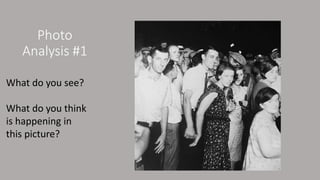
Photo
Analysis #1
What do you see?
What do you think
is happening in
this picture?
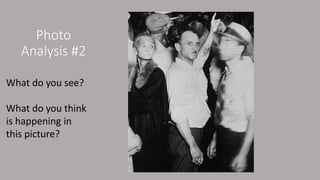
Photo
Analysis #2
What do you see?
What do you think
is happening in
this picture?
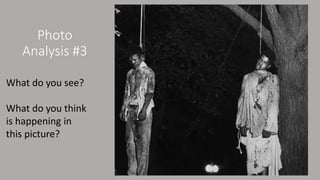
Photo
Analysis #3
What do you see?
What do you think
is happening in
this picture?
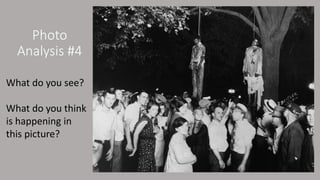
Photo
Analysis #4
What do you see?
What do you think
is happening in
this picture?
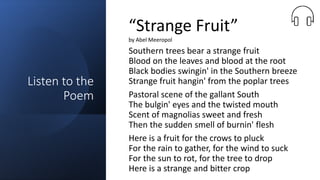
Listen to the
Poem
Southern trees bear a strange fruit
Blood on the leaves and blood at the root
Black bodies swingin' in the Southern breeze
Strange fruit hangin' from the poplar trees
Pastoral scene of the gallant South
The bulgin' eyes and the twisted mouth
Scent of magnolias sweet and fresh
Then the sudden smell of burnin' flesh
Here is a fruit for the crows to pluck
For the rain to gather, for the wind to suck
For the sun to rot, for the tree to drop
Here is a strange and bitter crop
“Strange Fruit”
by Abel Meeropol
“Strange Fruit”
What emotions does this
poem cause you to feel?
What is the author’s opinion
of Jim Crow South? What
clues in the text convey the
author’s attitude?
by Abel Meeropol
“Strange Fruit”
performed by Billie Holiday
If the video does not load, use the link https://youtu.be/Web007rzSOI
“Strange Fruit”
Does Billie Holiday’s singing of the poem
change the emotions you feel, or does it
reinforce how you feel? Explain the impact
the song had on your emotions.
What is the “Strange Fruit?”
What historic events allowed for the events
described in the poem to happen?
by Abel Meeropol
Strange Fruit
The story behind the song "Strange Fruit" is well-known.
Shocked by a postcard bearing a photograph of the lynching of
Thomas Shipp and Abraham Smith in Marion, Ind., Bronx
schoolteacher Abel Meeropol put pen to paper. Full of
unforgettable imagery, his poem "Bitter Fruit" was published
under the name Lewis Allan in 1936. He later supplied a
melody so it could be sung at political rallies, but jazz
icon Billie Holiday and her pianist Sonny White refashioned
the simple tune.
Strange Fruit
In the hands of many singers, "Strange Fruit" feels like a
period piece — more of a memorial than a protest song, a
symbol of less enlightened times. Poke around online and
you'll find that the song has found a life beyond the jazz canon
through Diana Ross, Cocteau Twins, Sting and India.Arie, just
to name a few. There's even a hip-hop collective called the
Strange Fruit Project. No matter the genre, however, rare are
the performers who have invested the song with new
meaning, fraught as it is with the legacy of America's troubled
past.

Strange Fruit

  • 1.
  • 2.
    Photo Analysis #1 What doyou see? What do you think is happening in this picture?
  • 3.
    Photo Analysis #2 What doyou see? What do you think is happening in this picture?
  • 4.
    Photo Analysis #3 What doyou see? What do you think is happening in this picture?
  • 5.
    Photo Analysis #4 What doyou see? What do you think is happening in this picture?
  • 6.
    Listen to the Poem Southerntrees bear a strange fruit Blood on the leaves and blood at the root Black bodies swingin' in the Southern breeze Strange fruit hangin' from the poplar trees Pastoral scene of the gallant South The bulgin' eyes and the twisted mouth Scent of magnolias sweet and fresh Then the sudden smell of burnin' flesh Here is a fruit for the crows to pluck For the rain to gather, for the wind to suck For the sun to rot, for the tree to drop Here is a strange and bitter crop “Strange Fruit” by Abel Meeropol
  • 7.
    “Strange Fruit” What emotionsdoes this poem cause you to feel? What is the author’s opinion of Jim Crow South? What clues in the text convey the author’s attitude? by Abel Meeropol
  • 8.
    “Strange Fruit” performed byBillie Holiday If the video does not load, use the link https://youtu.be/Web007rzSOI
  • 9.
    “Strange Fruit” Does BillieHoliday’s singing of the poem change the emotions you feel, or does it reinforce how you feel? Explain the impact the song had on your emotions. What is the “Strange Fruit?” What historic events allowed for the events described in the poem to happen? by Abel Meeropol
  • 10.
    Strange Fruit The storybehind the song "Strange Fruit" is well-known. Shocked by a postcard bearing a photograph of the lynching of Thomas Shipp and Abraham Smith in Marion, Ind., Bronx schoolteacher Abel Meeropol put pen to paper. Full of unforgettable imagery, his poem "Bitter Fruit" was published under the name Lewis Allan in 1936. He later supplied a melody so it could be sung at political rallies, but jazz icon Billie Holiday and her pianist Sonny White refashioned the simple tune.
  • 11.
    Strange Fruit In thehands of many singers, "Strange Fruit" feels like a period piece — more of a memorial than a protest song, a symbol of less enlightened times. Poke around online and you'll find that the song has found a life beyond the jazz canon through Diana Ross, Cocteau Twins, Sting and India.Arie, just to name a few. There's even a hip-hop collective called the Strange Fruit Project. No matter the genre, however, rare are the performers who have invested the song with new meaning, fraught as it is with the legacy of America's troubled past.

Editor's Notes

  • #7 Read the poem without the words being seen. Distribute poem, read again while the students follow along – reveal poem on the presentation.
  • #9 Read the poem without the words being seen. Distribute poem, read again while the students follow along – reveal poem on the presentation.