
CHAPTER 2:CHAPTER 2:
REVOLUTION AND THEREVOLUTION AND THE
EARLY REPUBLICEARLY REPUBLIC
COLONIAL RESISTANCE ANDCOLONIAL RESISTANCE AND
REBELLION – SECTION 1REBELLION – SECTION 1
 TheThe Proclamation ofProclamation of
17631763 sought to haltsought to halt
the westwardthe westward
expansion of theexpansion of the
colonist, thus thecolonist, thus the
colonist believed thecolonist believed the
British government didBritish government did
not care about theirnot care about their
needsneeds
 This was one of manyThis was one of many
measures passed bymeasures passed by
thethe English ParliamentEnglish Parliament
that would bethat would be
strenuously opposedstrenuously opposed
by the Americanby the American
ColonistsColonists
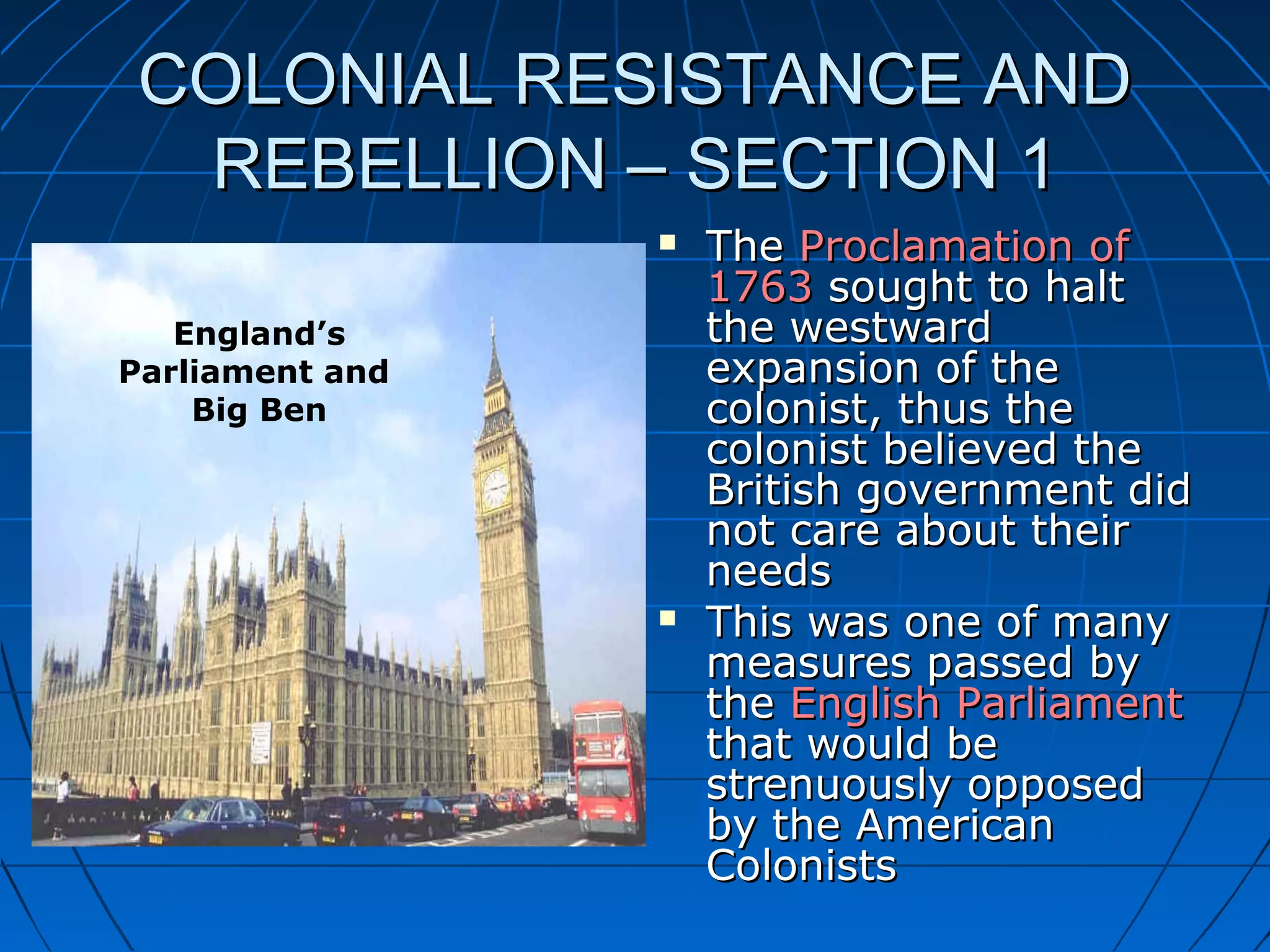
England’s
Parliament and
Big Ben
NO TAXATION WITHOUTNO TAXATION WITHOUT
REPRESENTATIONREPRESENTATION
 Huge debt from theHuge debt from the
French-Indian WarFrench-Indian War
caused the Englishcaused the English
Parliament toParliament to
impose a series ofimpose a series of
taxes on thetaxes on the
colonistscolonists
 TheThe Sugar ActSugar Act andand
thethe Stamp ActStamp Act
were two suchwere two such
taxestaxes
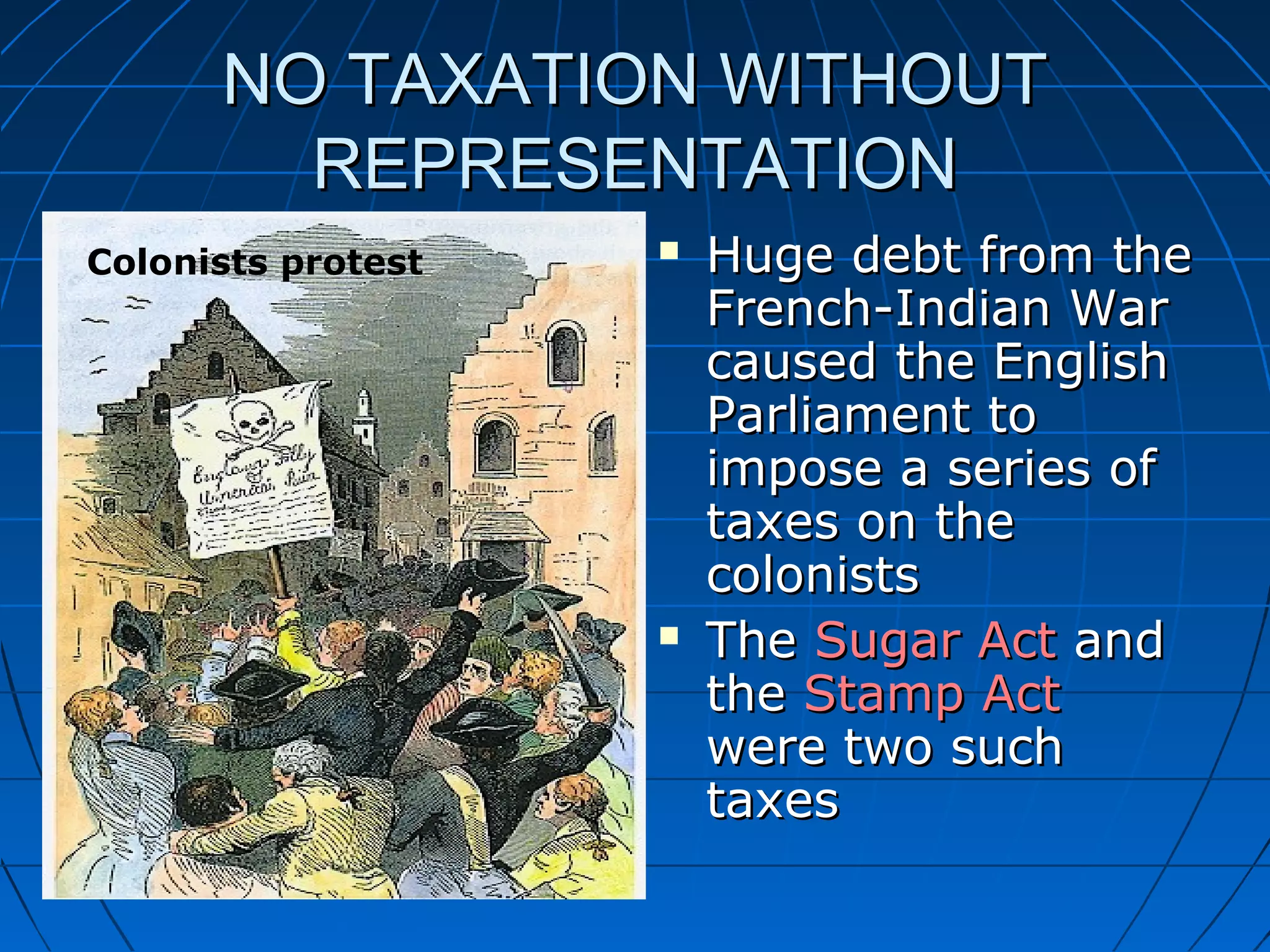
Colonists protest
THE SUGAR ACTTHE SUGAR ACT
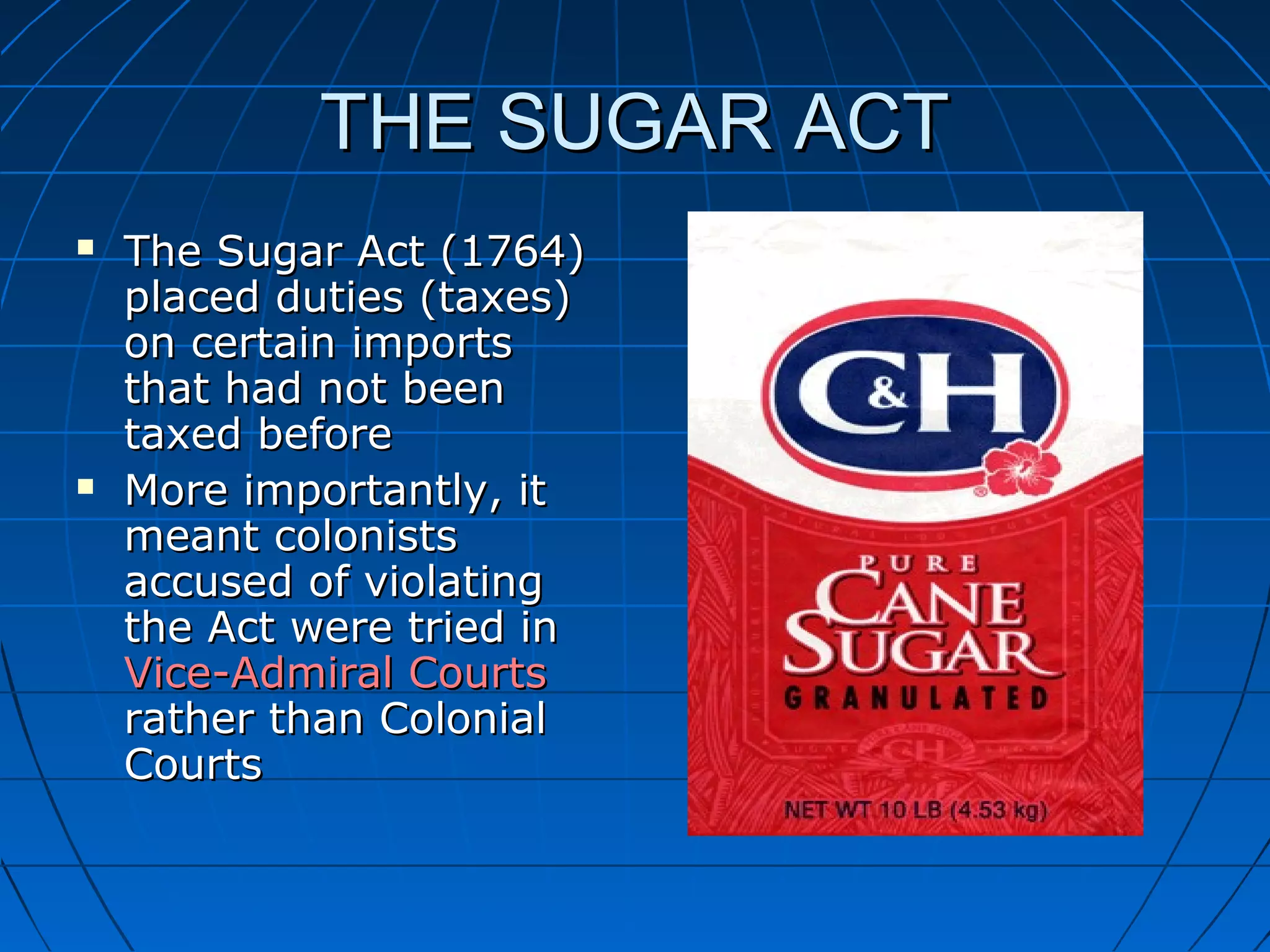
 The Sugar Act (1764)The Sugar Act (1764)
placed duties (taxes)placed duties (taxes)
on certain importson certain imports
that had not beenthat had not been
taxed beforetaxed before
 More importantly, itMore importantly, it
meant colonistsmeant colonists
accused of violatingaccused of violating
the Act were tried inthe Act were tried in
Vice-Admiral CourtsVice-Admiral Courts
rather than Colonialrather than Colonial
CourtsCourts
THE STAMP ACTTHE STAMP ACT
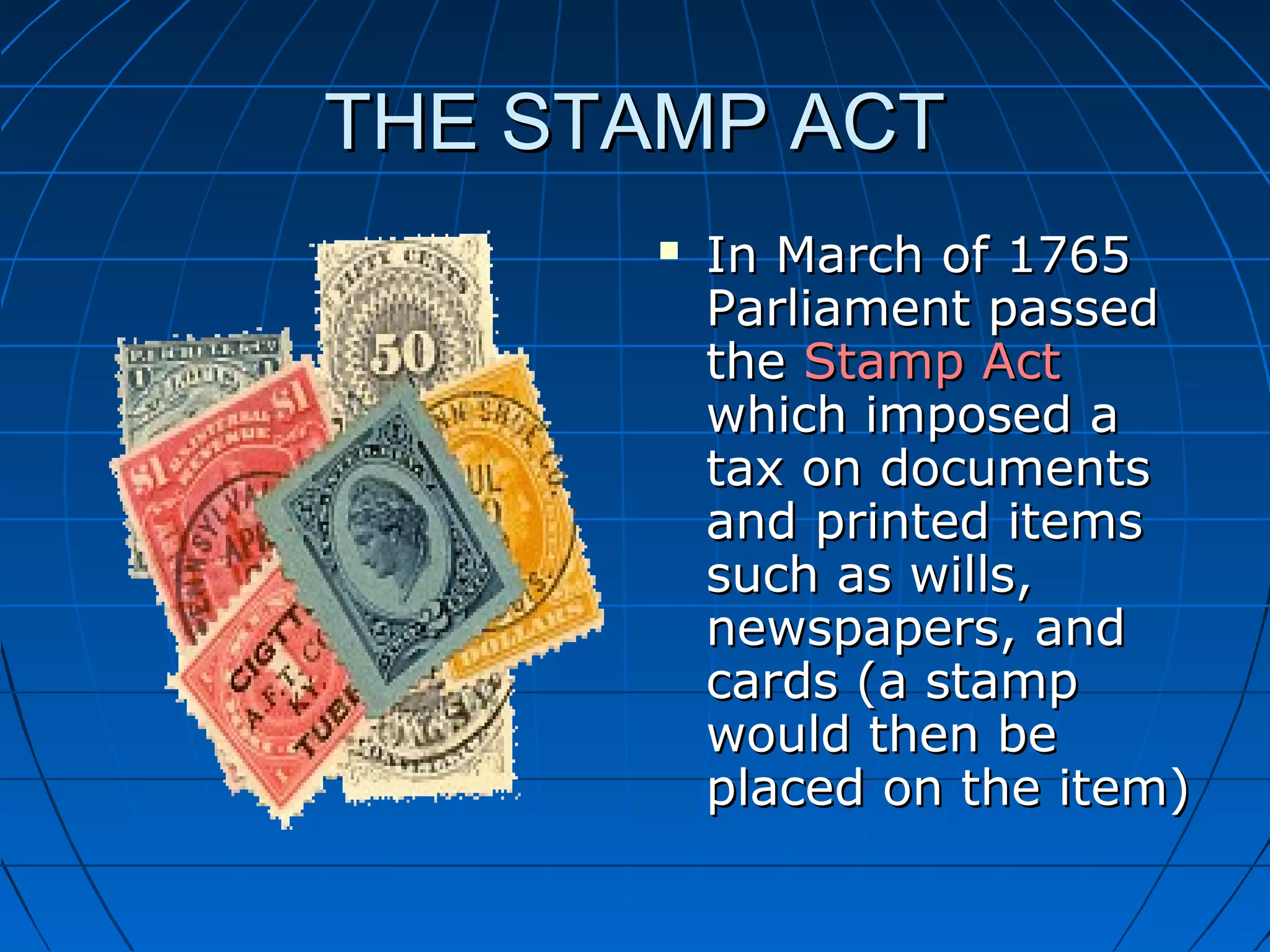
 In March of 1765In March of 1765
Parliament passedParliament passed
thethe Stamp ActStamp Act
which imposed awhich imposed a
tax on documentstax on documents
and printed itemsand printed items
such as wills,such as wills,
newspapers, andnewspapers, and
cards (a stampcards (a stamp
would then bewould then be
placed on the item)placed on the item)
RESISTANCE GROWSRESISTANCE GROWS
 In May of 1765In May of 1765
Colonists formed aColonists formed a
secret resistancesecret resistance
group called,group called, SonsSons
of Libertyof Liberty toto
protest the lawsprotest the laws
 Merchants agree toMerchants agree to
boycott Britishboycott British
goods until thegoods until the
Acts are repealedActs are repealed
MORE TAXES, MORE PROTESTSMORE TAXES, MORE PROTESTS
 More taxes andMore taxes and
acts soon followed:acts soon followed:
Declaratory ActDeclaratory Act
Townshend ActsTownshend Acts
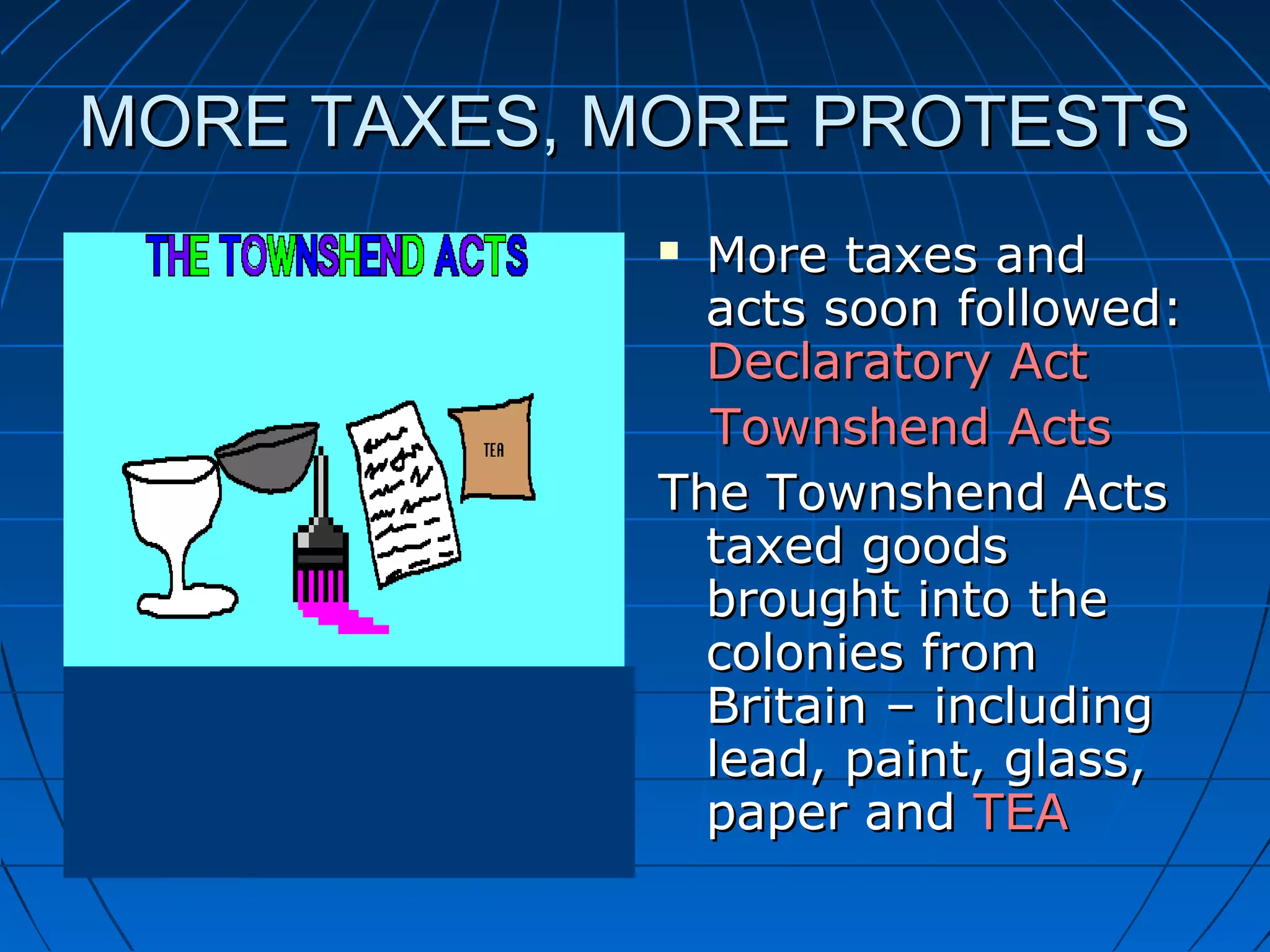
The Townshend ActsThe Townshend Acts
taxed goodstaxed goods
brought into thebrought into the
colonies fromcolonies from
Britain – includingBritain – including
lead, paint, glass,lead, paint, glass,
paper andpaper and TEATEA
TENSION MOUNTS INTENSION MOUNTS IN
MASSACHUSETTSMASSACHUSETTS
 The atmosphere inThe atmosphere in
Boston was extremelyBoston was extremely
tensetense
 The city erupted inThe city erupted in
bloody clashes and abloody clashes and a
daring tax protest, alldaring tax protest, all
of which pushed theof which pushed the
colonists and Englandcolonists and England
closer to warcloser to war
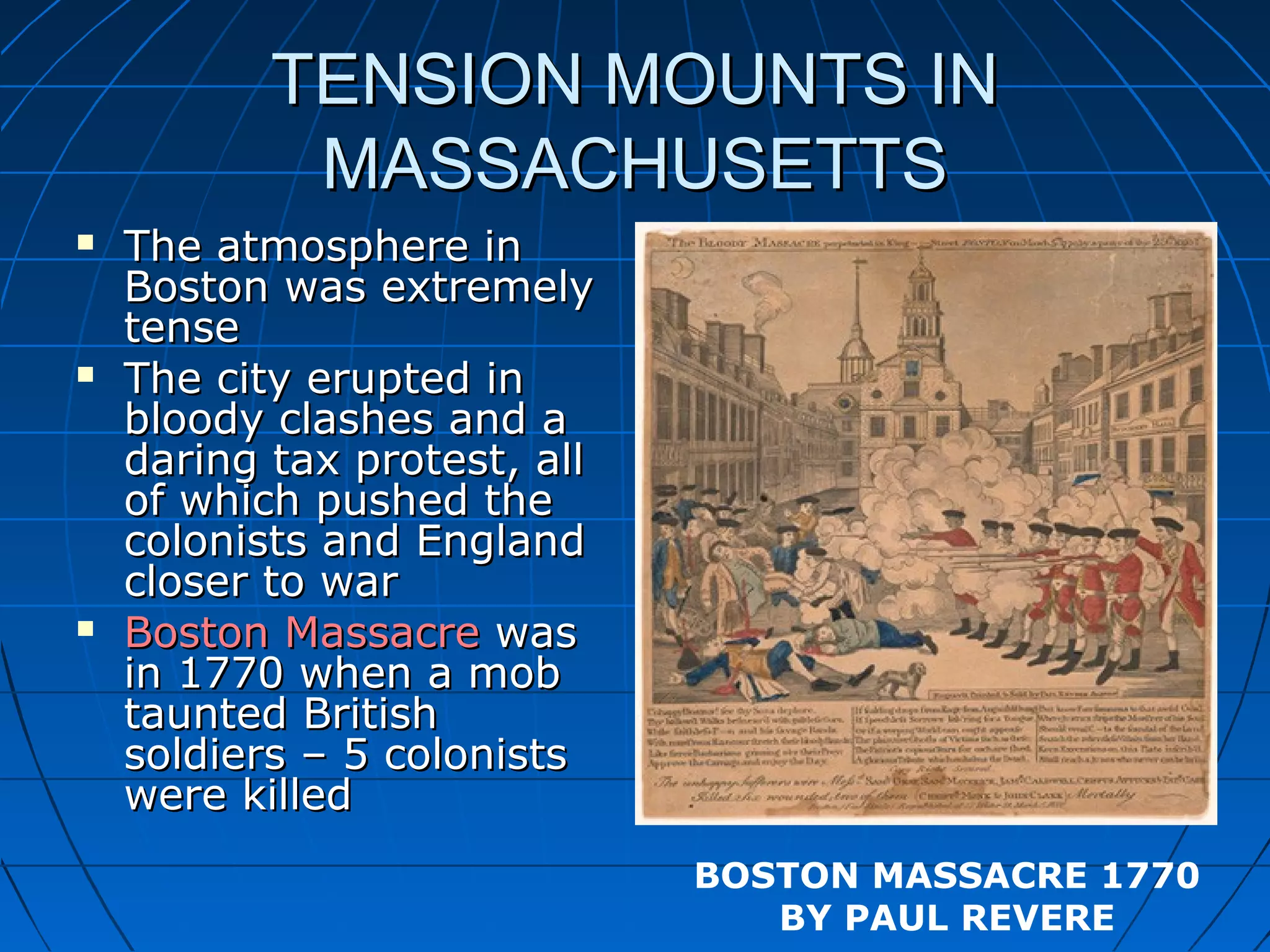
 Boston MassacreBoston Massacre waswas
in 1770 when a mobin 1770 when a mob
taunted Britishtaunted British
soldiers – 5 colonistssoldiers – 5 colonists
were killedwere killed
BOSTON MASSACRE 1770
BY PAUL REVERE
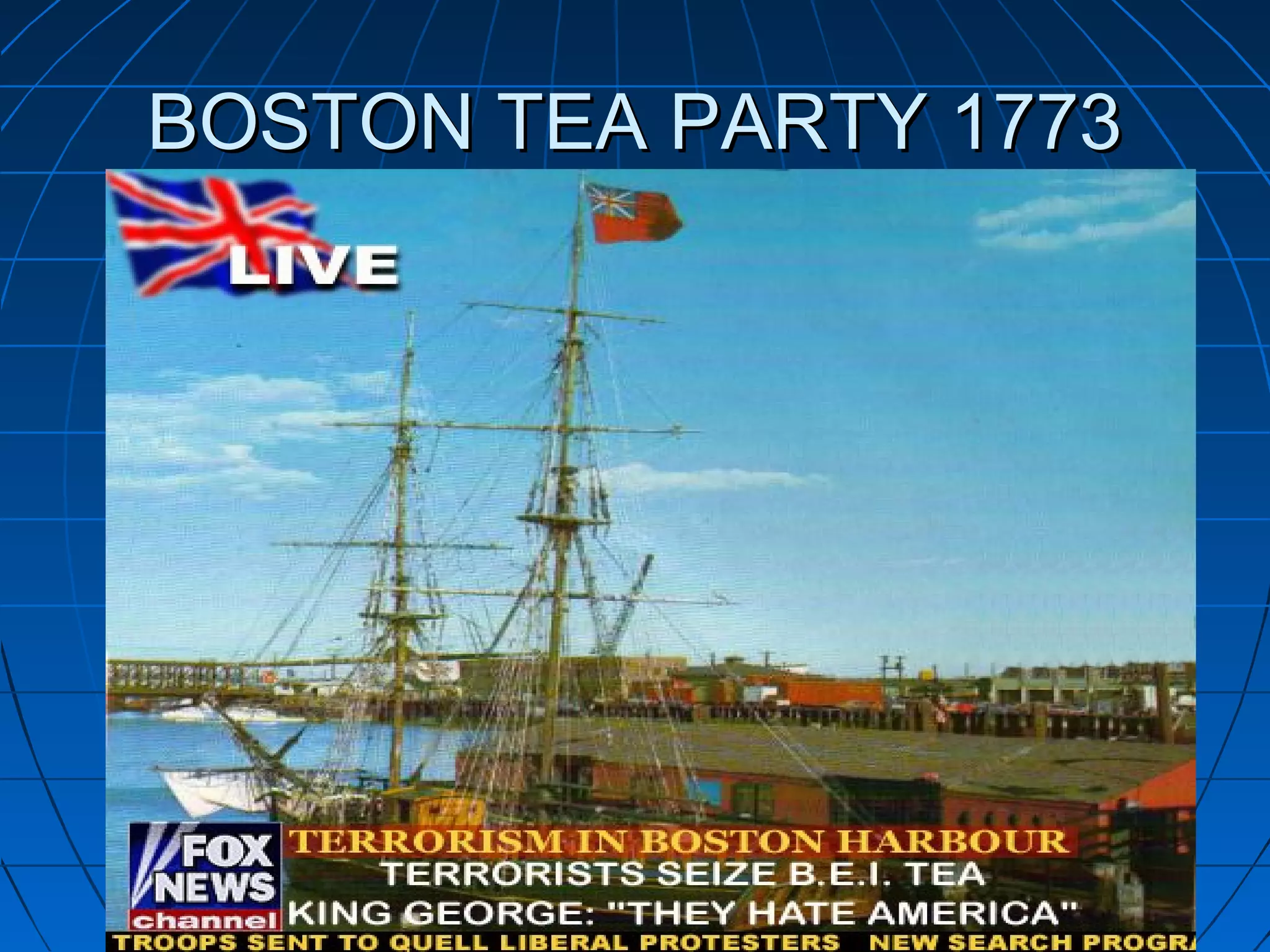
BOSTON TEA PARTY 1773BOSTON TEA PARTY 1773
BRITS RESPOND TO TEABRITS RESPOND TO TEA
VANDALSVANDALS
 After 18,000 poundsAfter 18,000 pounds
of tea was dumped byof tea was dumped by
colonists into Bostoncolonists into Boston
Harbor, King GeorgeHarbor, King George
III was infuriatedIII was infuriated
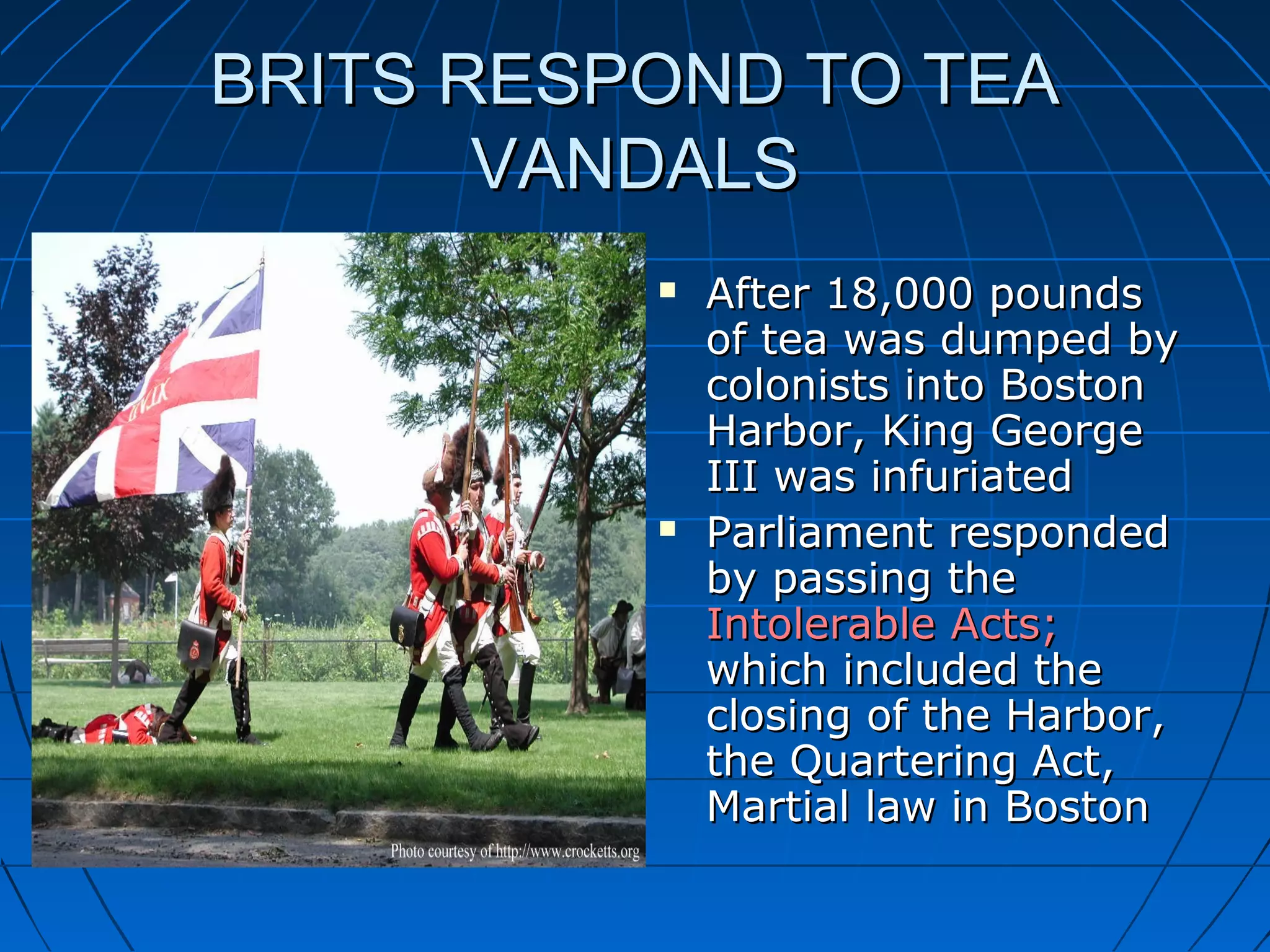
 Parliament respondedParliament responded
by passing theby passing the
Intolerable Acts;Intolerable Acts;
which included thewhich included the
closing of the Harbor,closing of the Harbor,
the Quartering Act,the Quartering Act,
Martial law in BostonMartial law in Boston
THE ROAD TO REVOLUTIONTHE ROAD TO REVOLUTION
 Colonists start toColonists start to
organize andorganize and
communicatecommunicate
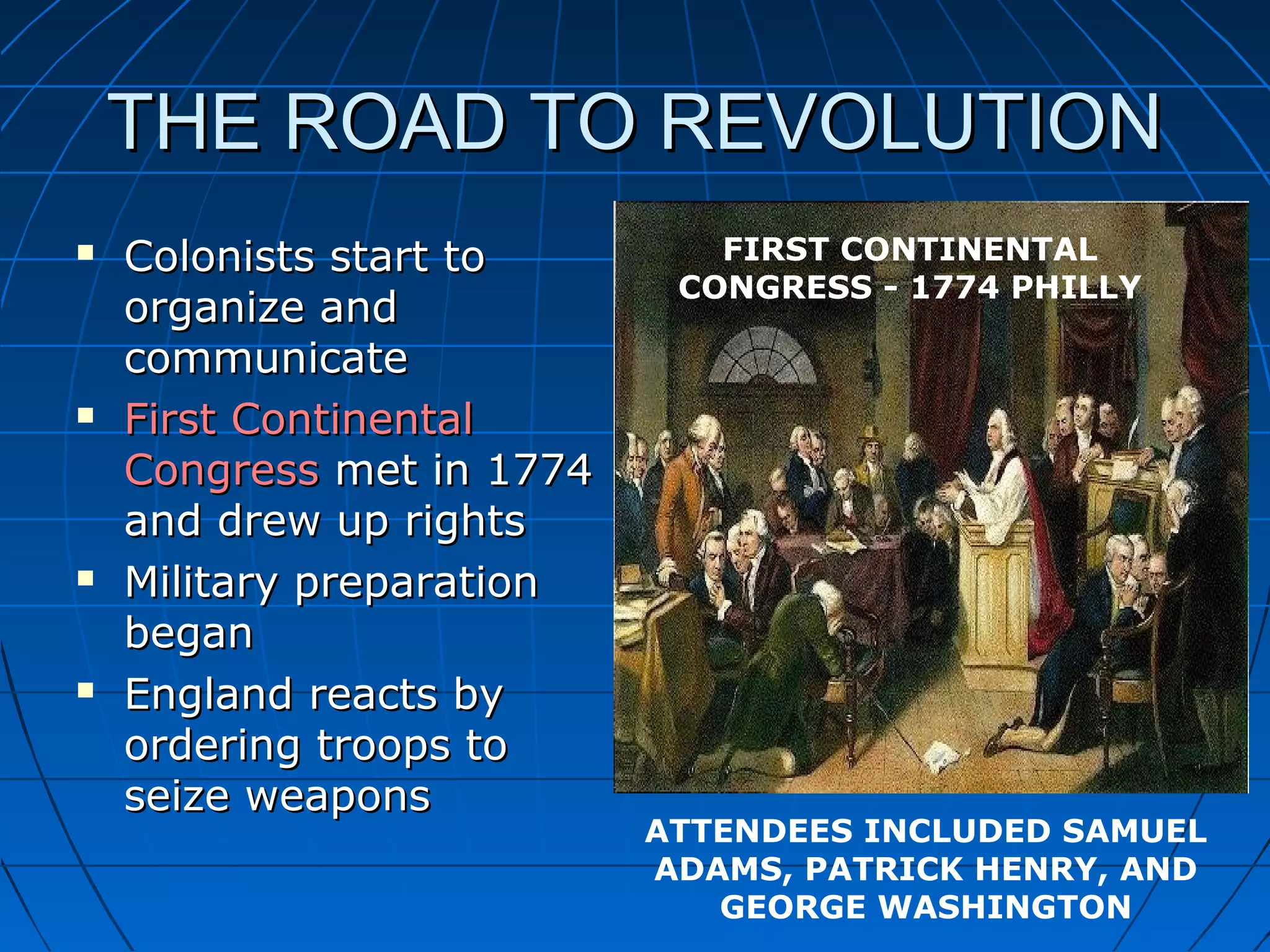
 First ContinentalFirst Continental
CongressCongress met in 1774met in 1774
and drew up rightsand drew up rights
 Military preparationMilitary preparation
beganbegan
 England reacts byEngland reacts by
ordering troops toordering troops to
seize weaponsseize weapons
ATTENDEES INCLUDED SAMUEL
ADAMS, PATRICK HENRY, AND
GEORGE WASHINGTON
FIRST CONTINENTAL
CONGRESS - 1774 PHILLY
LEXINGTON AND CONCORDLEXINGTON AND CONCORD
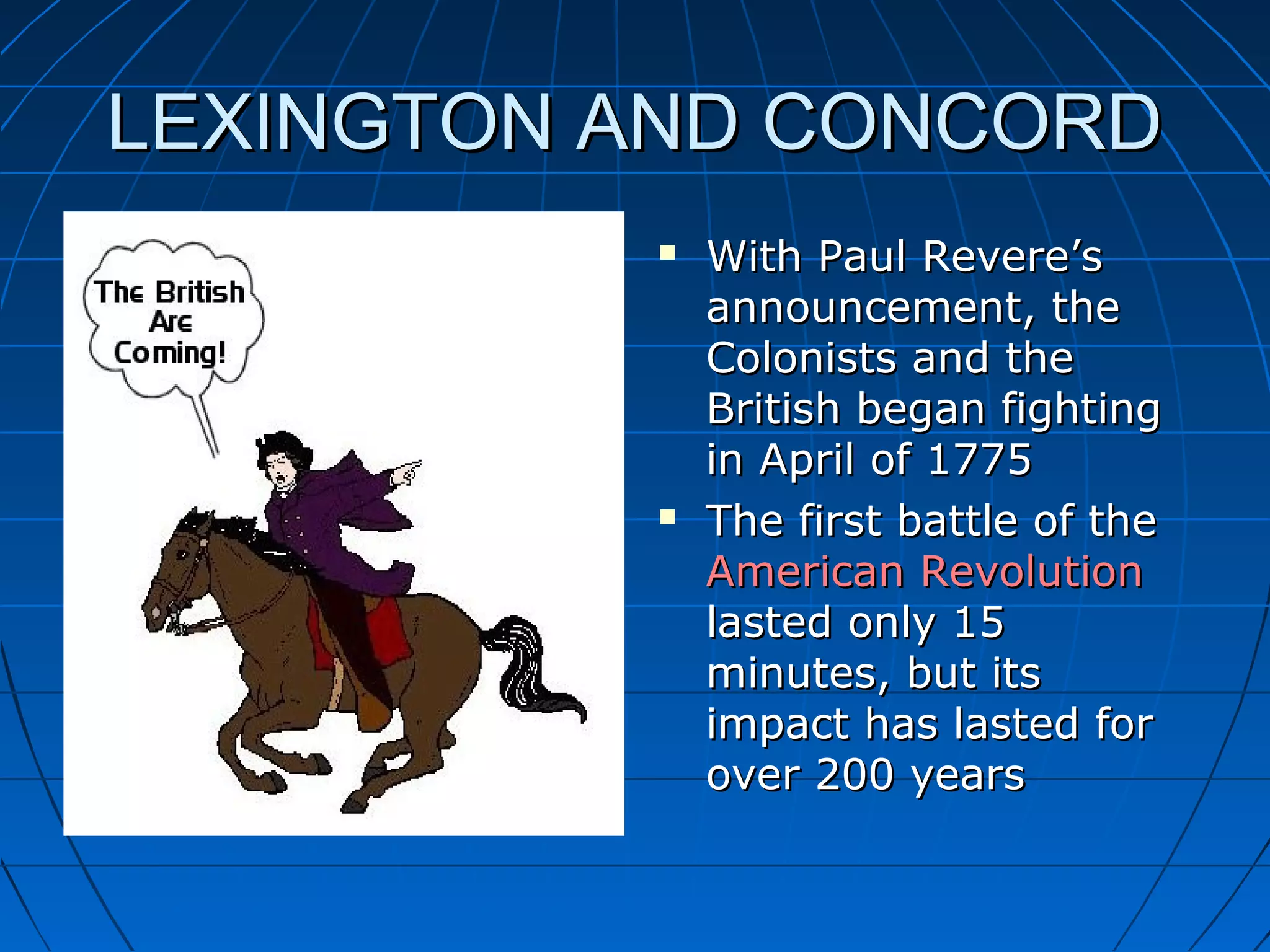
 With Paul Revere’sWith Paul Revere’s
announcement, theannouncement, the
Colonists and theColonists and the
British began fightingBritish began fighting
in April of 1775in April of 1775
 The first battle of theThe first battle of the
American RevolutionAmerican Revolution
lasted only 15lasted only 15
minutes, but itsminutes, but its
impact has lasted forimpact has lasted for
over 200 yearsover 200 years
SECOND CONTINENTALSECOND CONTINENTAL
CONGRESSCONGRESS
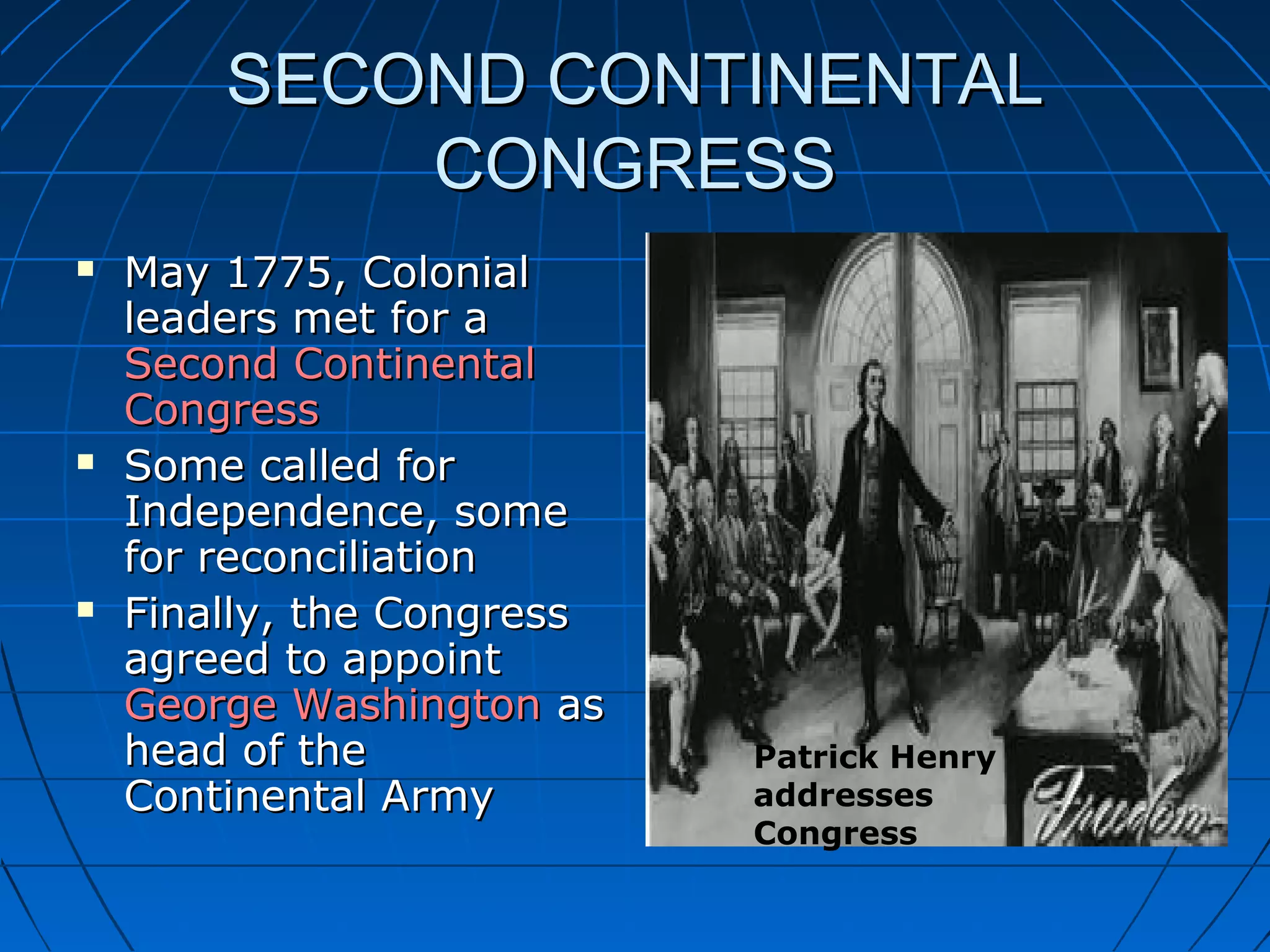
 May 1775, ColonialMay 1775, Colonial
leaders met for aleaders met for a
Second ContinentalSecond Continental
CongressCongress
 Some called forSome called for
Independence, someIndependence, some
for reconciliationfor reconciliation
 Finally, the CongressFinally, the Congress
agreed to appointagreed to appoint
George WashingtonGeorge Washington asas
head of thehead of the
Continental ArmyContinental Army
Patrick Henry
addresses
Congress
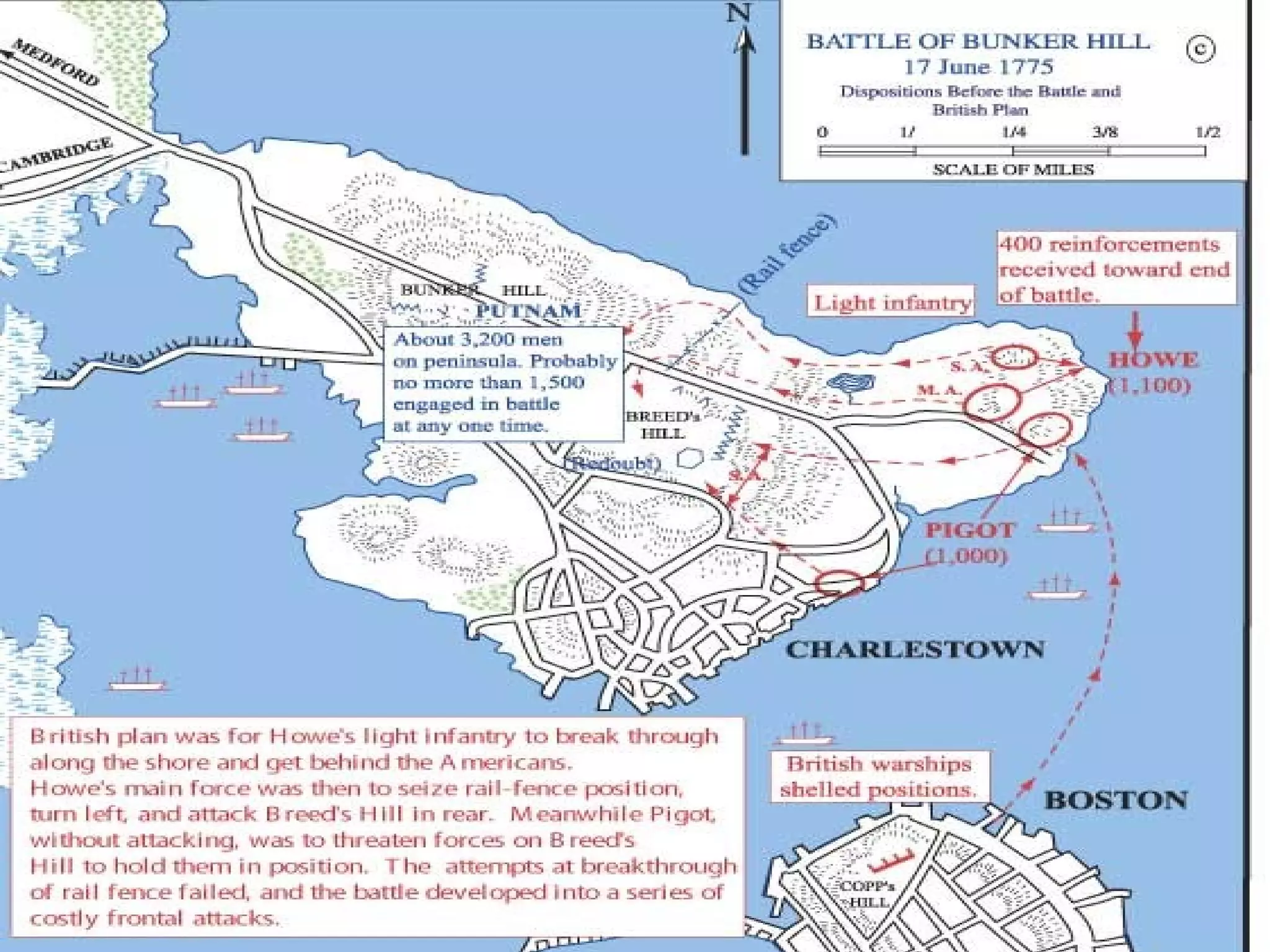
BATTLE OF BUNKER HILLBATTLE OF BUNKER HILL
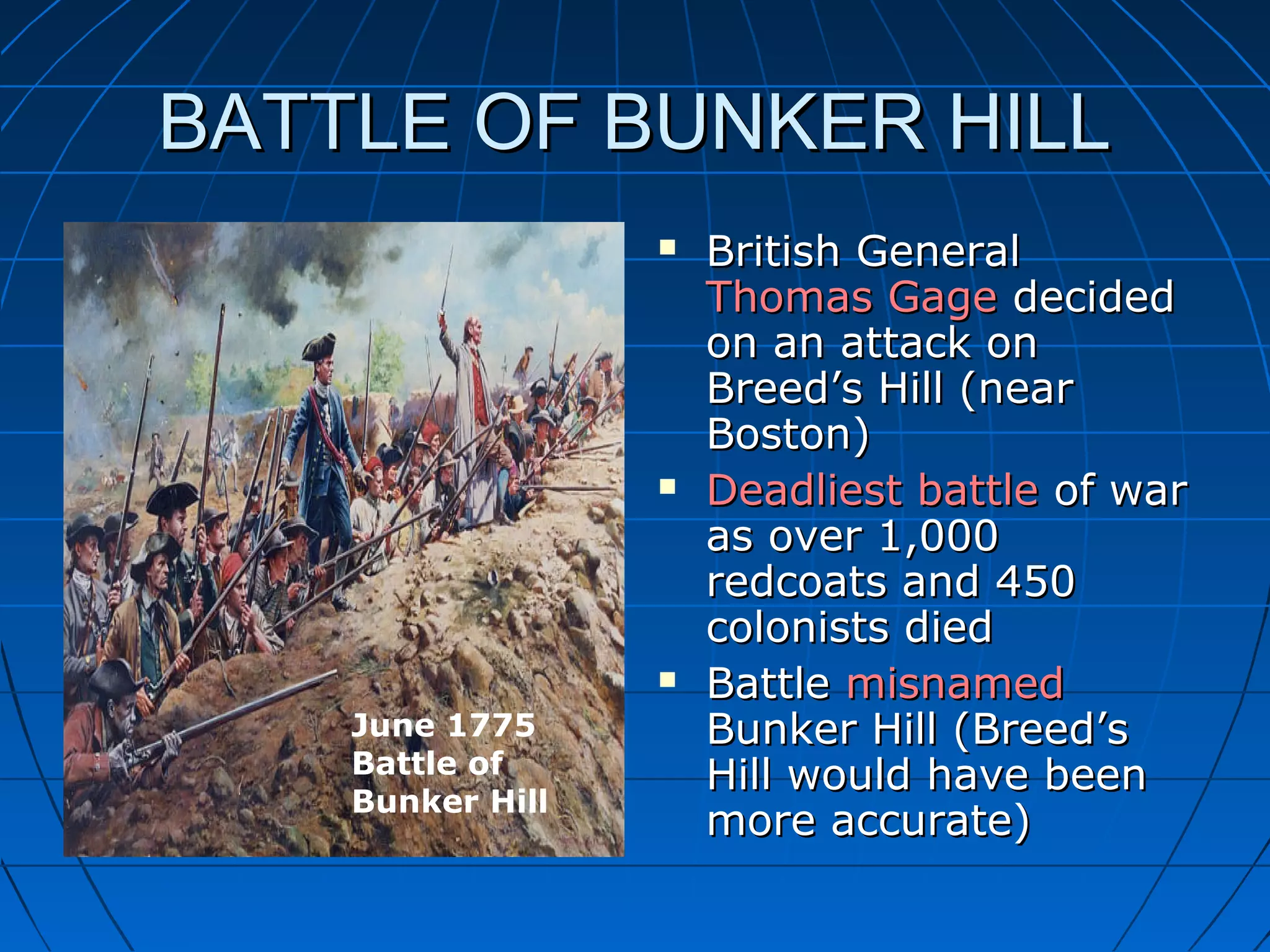
 British GeneralBritish General
Thomas GageThomas Gage decideddecided
on an attack onon an attack on
Breed’s Hill (nearBreed’s Hill (near
Boston)Boston)
 Deadliest battleDeadliest battle of warof war
as over 1,000as over 1,000
redcoats and 450redcoats and 450
colonists diedcolonists died
 BattleBattle misnamedmisnamed
Bunker Hill (Breed’sBunker Hill (Breed’s
Hill would have beenHill would have been
more accurate)more accurate)
June 1775
Battle of
Bunker Hill
OLIVE BRANCH PETITIONOLIVE BRANCH PETITION
 By July 1775, theBy July 1775, the
Second ContinentalSecond Continental
Congress wasCongress was
readying for war,readying for war,
though still hoping forthough still hoping for
peacepeace
 Most delegates deeplyMost delegates deeply
loyalloyal to King Georgeto King George
IIIIII
 July 8 –July 8 – Olive BranchOlive Branch
PetitionPetition sent to Kingsent to King
who flatly refused itwho flatly refused it
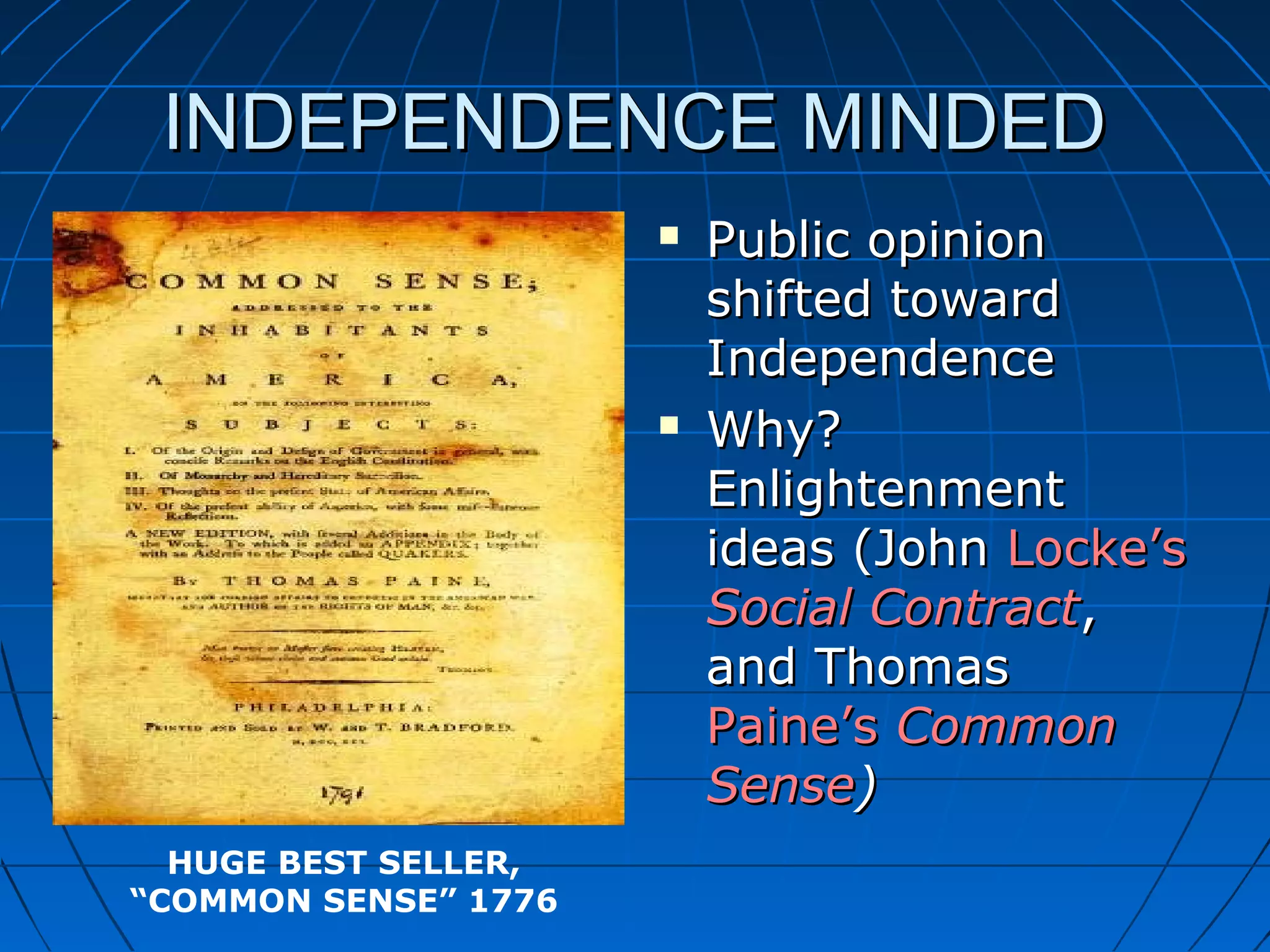
INDEPENDENCE MINDEDINDEPENDENCE MINDED
 Public opinionPublic opinion
shifted towardshifted toward
IndependenceIndependence
 Why?Why?
EnlightenmentEnlightenment
ideas (Johnideas (John Locke’sLocke’s
Social ContractSocial Contract,,
and Thomasand Thomas
Paine’sPaine’s CommonCommon
SenseSense))
HUGE BEST SELLER,
“COMMON SENSE” 1776
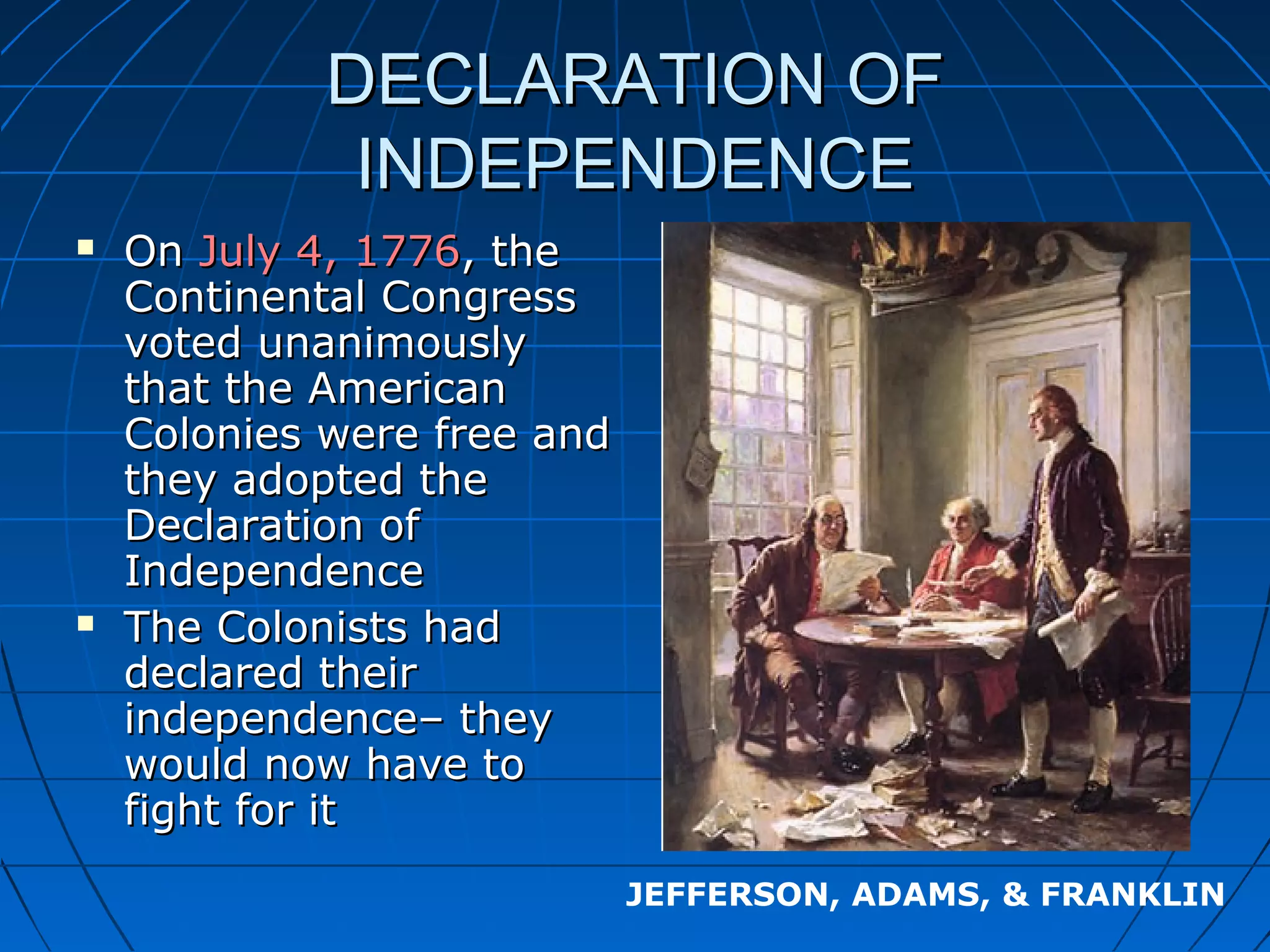
DECLARATION OFDECLARATION OF
INDEPENDENCEINDEPENDENCE
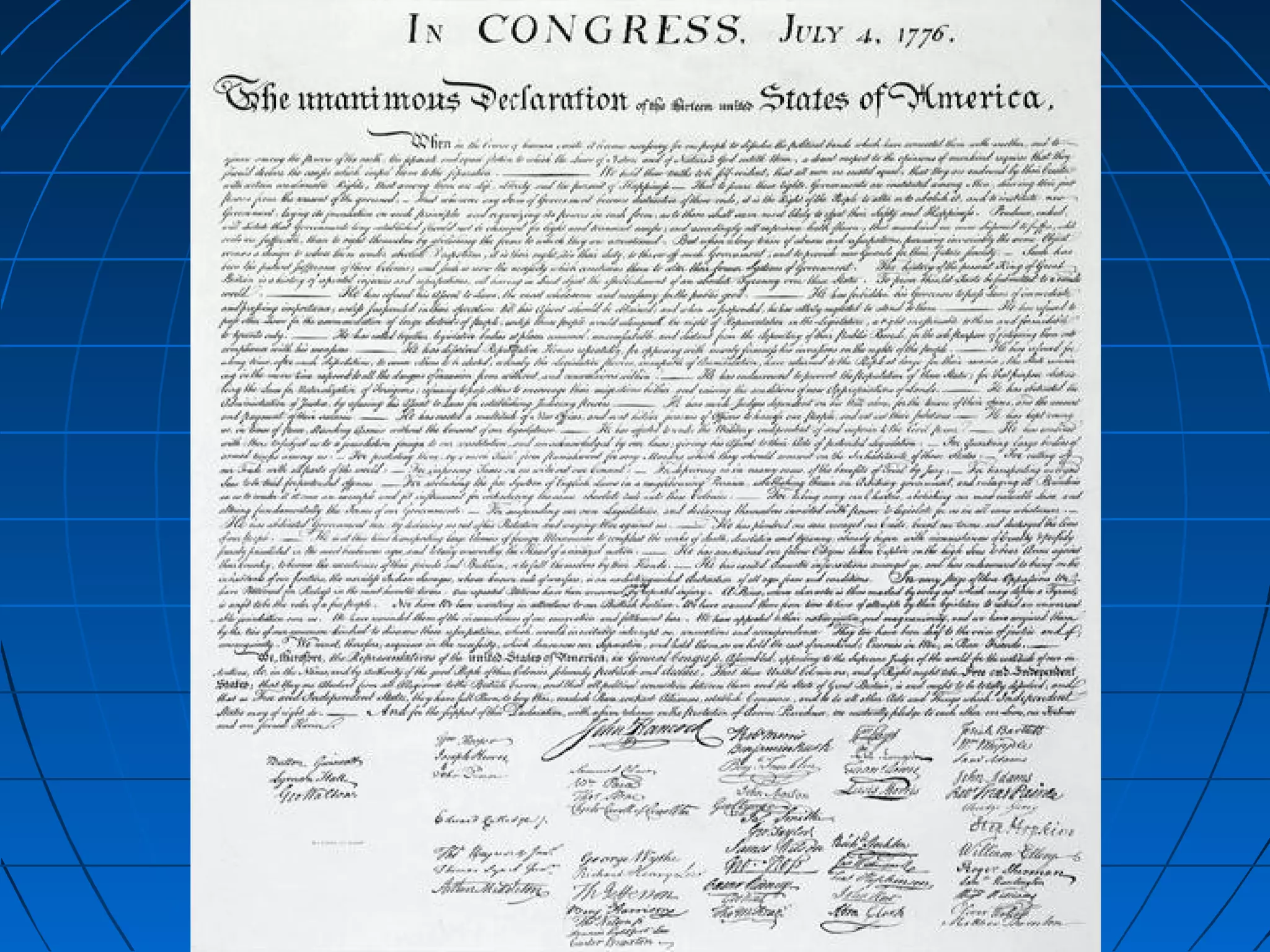
 OnOn July 4, 1776July 4, 1776, the, the
Continental CongressContinental Congress
voted unanimouslyvoted unanimously
that the Americanthat the American
Colonies were free andColonies were free and
they adopted thethey adopted the
Declaration ofDeclaration of
IndependenceIndependence
 The Colonists hadThe Colonists had
declared theirdeclared their
independence– theyindependence– they
would now have towould now have to
fight for itfight for it
JEFFERSON, ADAMS, & FRANKLIN
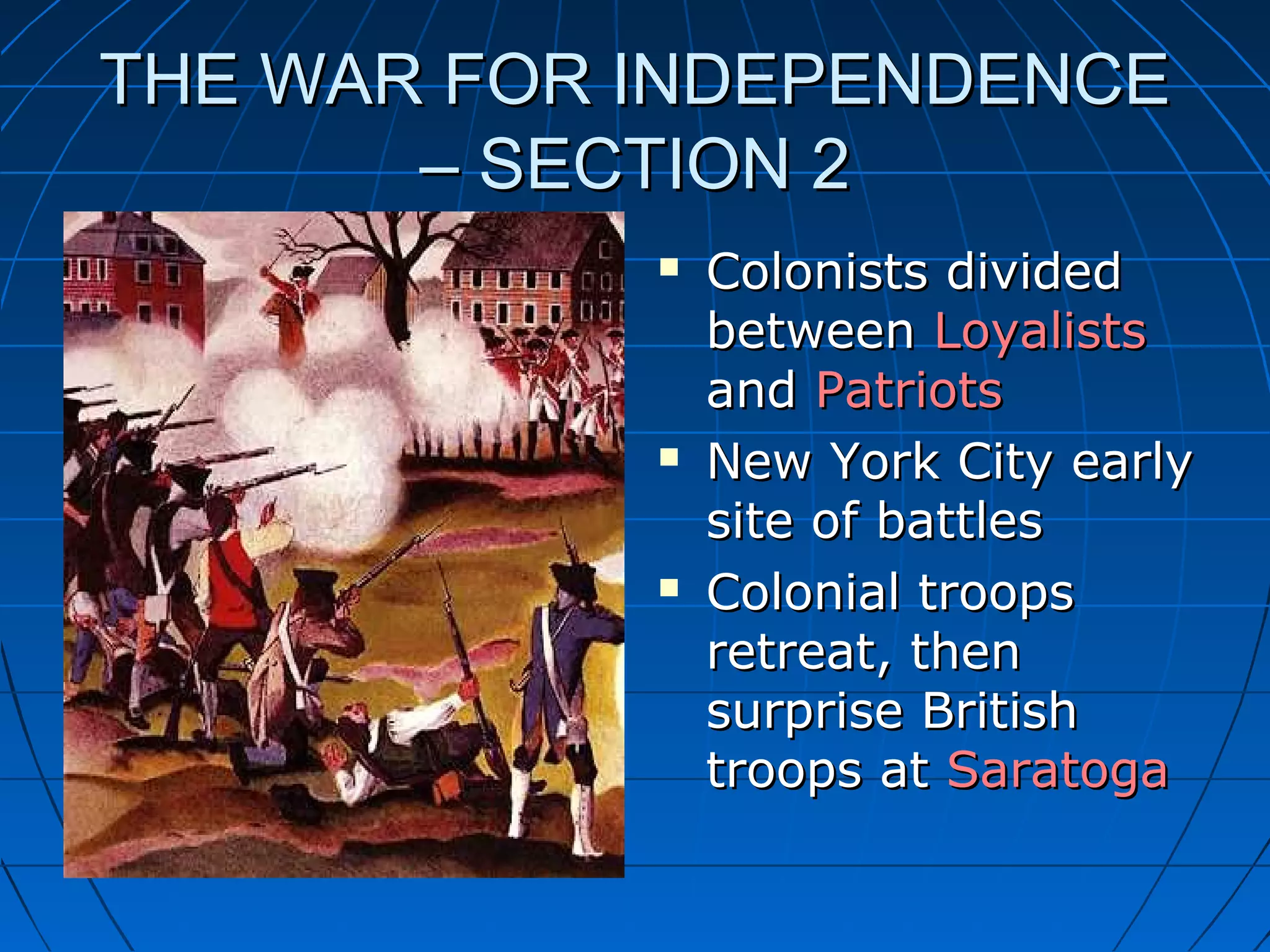
THE WAR FOR INDEPENDENCETHE WAR FOR INDEPENDENCE
– SECTION 2– SECTION 2
 Colonists dividedColonists divided
betweenbetween LoyalistsLoyalists
andand PatriotsPatriots
 New York City earlyNew York City early
site of battlessite of battles
 Colonial troopsColonial troops
retreat, thenretreat, then
surprise Britishsurprise British
troops attroops at SaratogaSaratoga
WINNING THE WARWINNING THE WAR
 With French military leaderWith French military leader
Marquis de Lafayette’sMarquis de Lafayette’s
help, Colonial troopshelp, Colonial troops
became effective fightersbecame effective fighters
 May 1780, British troopsMay 1780, British troops
successfully take Charlessuccessfully take Charles
Town, S.C.Town, S.C.
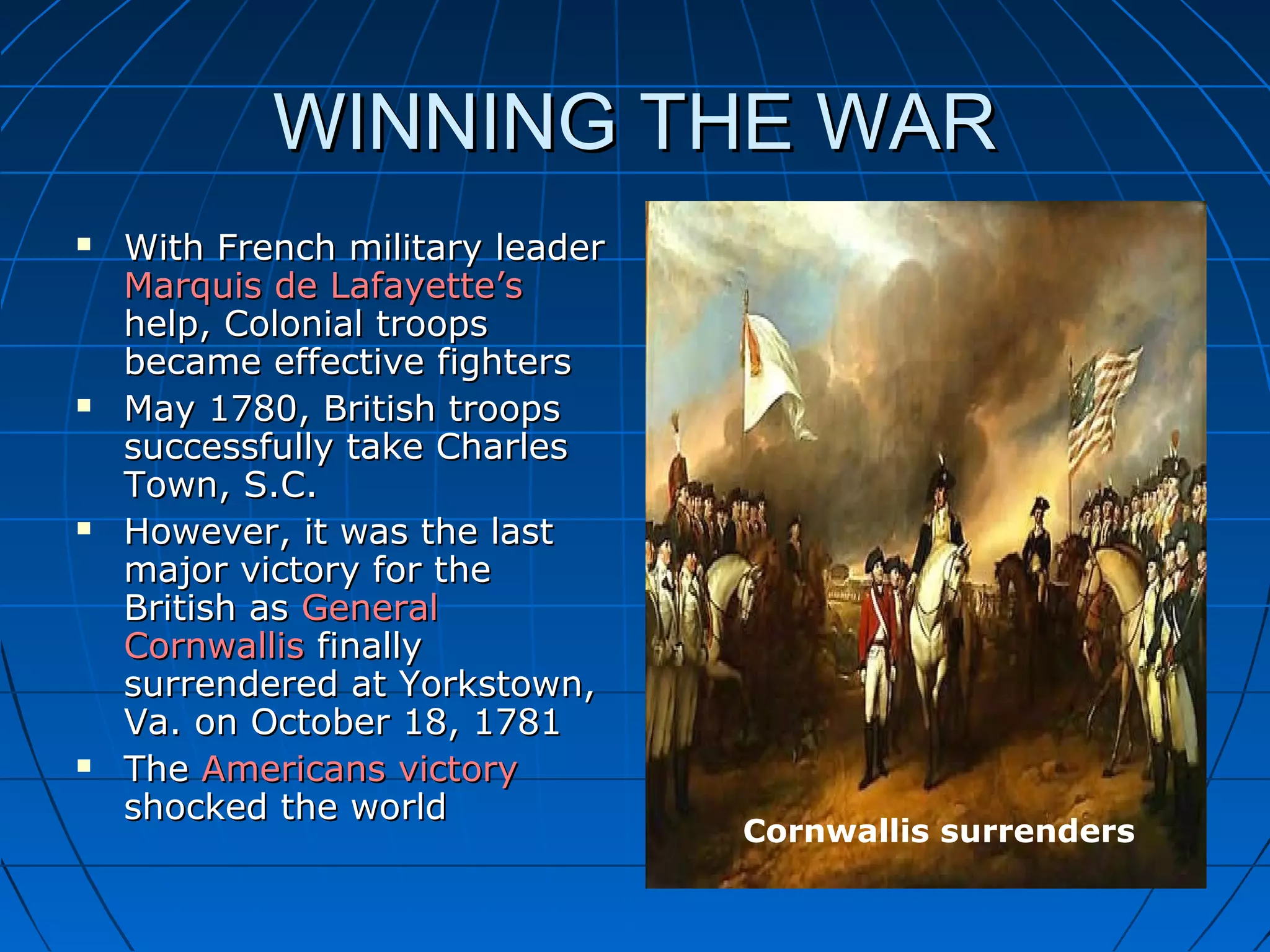
 However, it was the lastHowever, it was the last
major victory for themajor victory for the
British asBritish as GeneralGeneral
CornwallisCornwallis finallyfinally
surrendered at Yorkstown,surrendered at Yorkstown,
Va. on October 18, 1781Va. on October 18, 1781
 TheThe Americans victoryAmericans victory
shocked the worldshocked the world
Cornwallis surrenders
TREATY OF PARISTREATY OF PARIS
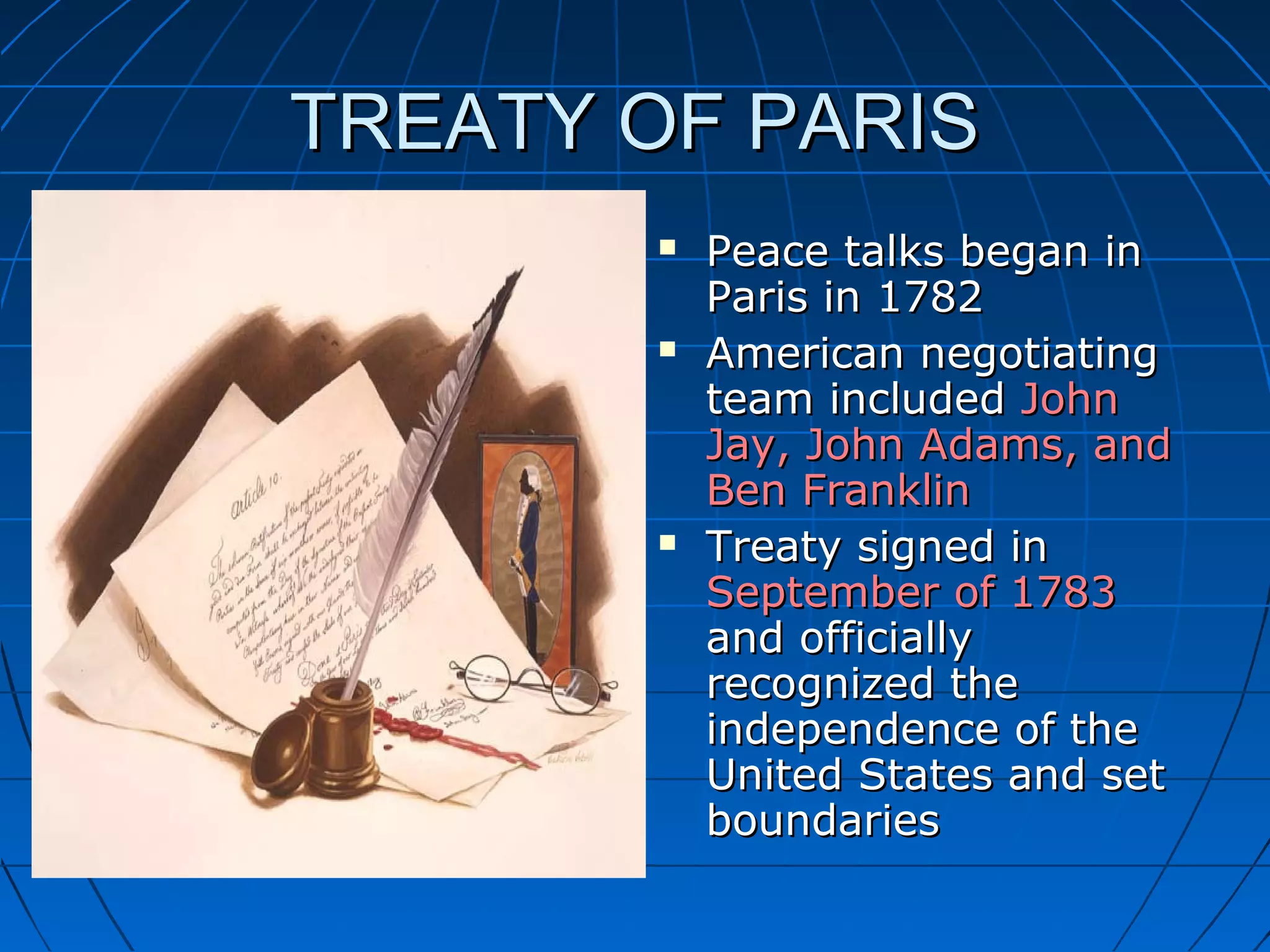
 Peace talks began inPeace talks began in
Paris in 1782Paris in 1782
 American negotiatingAmerican negotiating
team includedteam included JohnJohn
Jay, John Adams, andJay, John Adams, and
Ben FranklinBen Franklin
 Treaty signed inTreaty signed in
September of 1783September of 1783
and officiallyand officially
recognized therecognized the
independence of theindependence of the
United States and setUnited States and set
boundariesboundaries
CONFEDERATION AND THECONFEDERATION AND THE
CONSTITUTION – SECTION 3CONSTITUTION – SECTION 3
 After theAfter the
Revolution, manyRevolution, many
favored afavored a RepublicRepublic
 Some supported aSome supported a
strong federalstrong federal
governmentgovernment
(Federalists)(Federalists) whilewhile
others favoredothers favored
states rightsstates rights (Anti-(Anti-
Federalists)Federalists)
ARTICLES OF CONFEDERATIONARTICLES OF CONFEDERATION
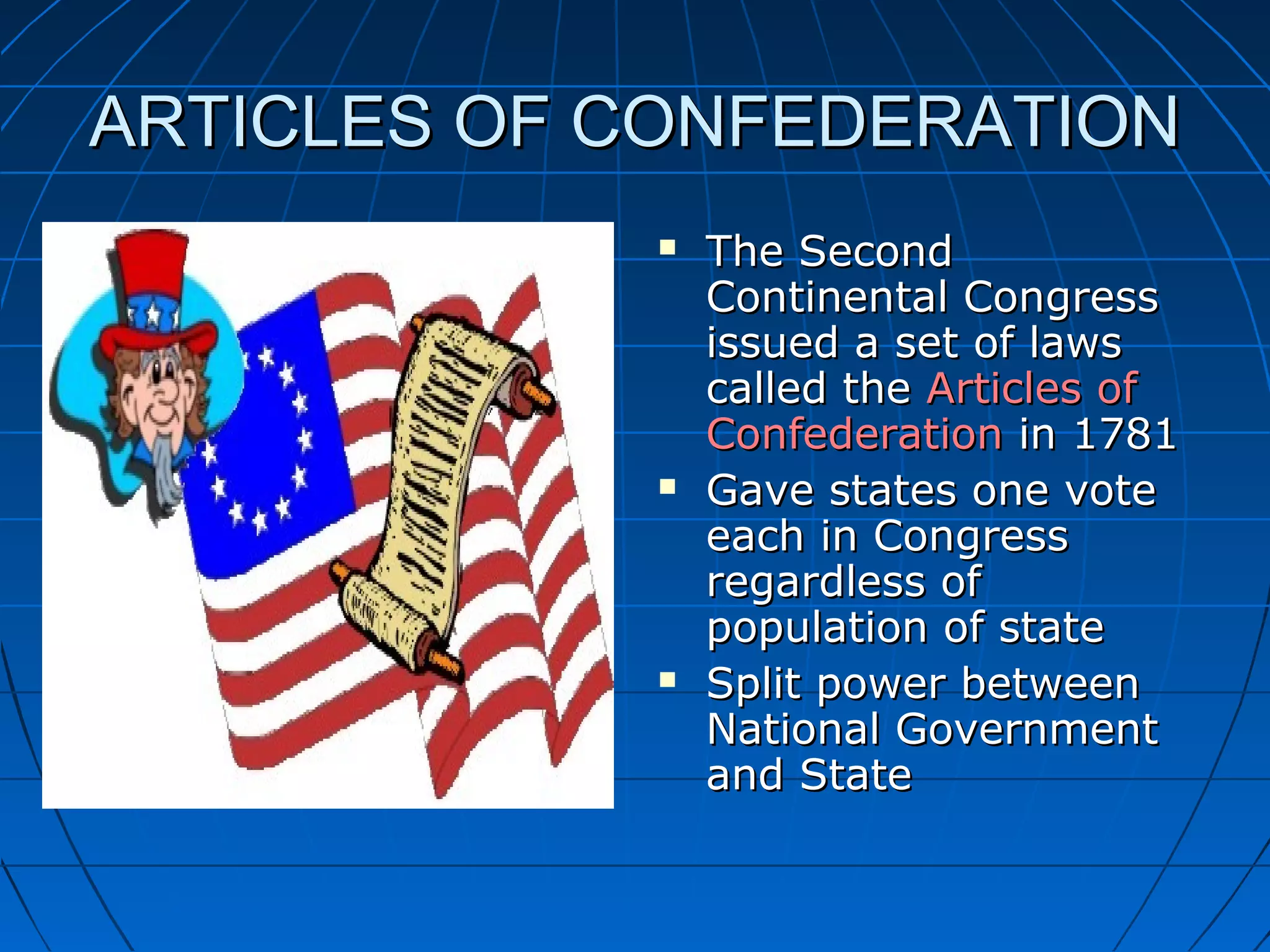
 The SecondThe Second
Continental CongressContinental Congress
issued a set of lawsissued a set of laws
called thecalled the Articles ofArticles of
ConfederationConfederation in 1781in 1781
 Gave states one voteGave states one vote
each in Congresseach in Congress
regardless ofregardless of
population of statepopulation of state
 Split power betweenSplit power between
National GovernmentNational Government
and Stateand State
ACCOMPLISHMENTS OFACCOMPLISHMENTS OF
ARTICLES OF CONFEDERATIONARTICLES OF CONFEDERATION
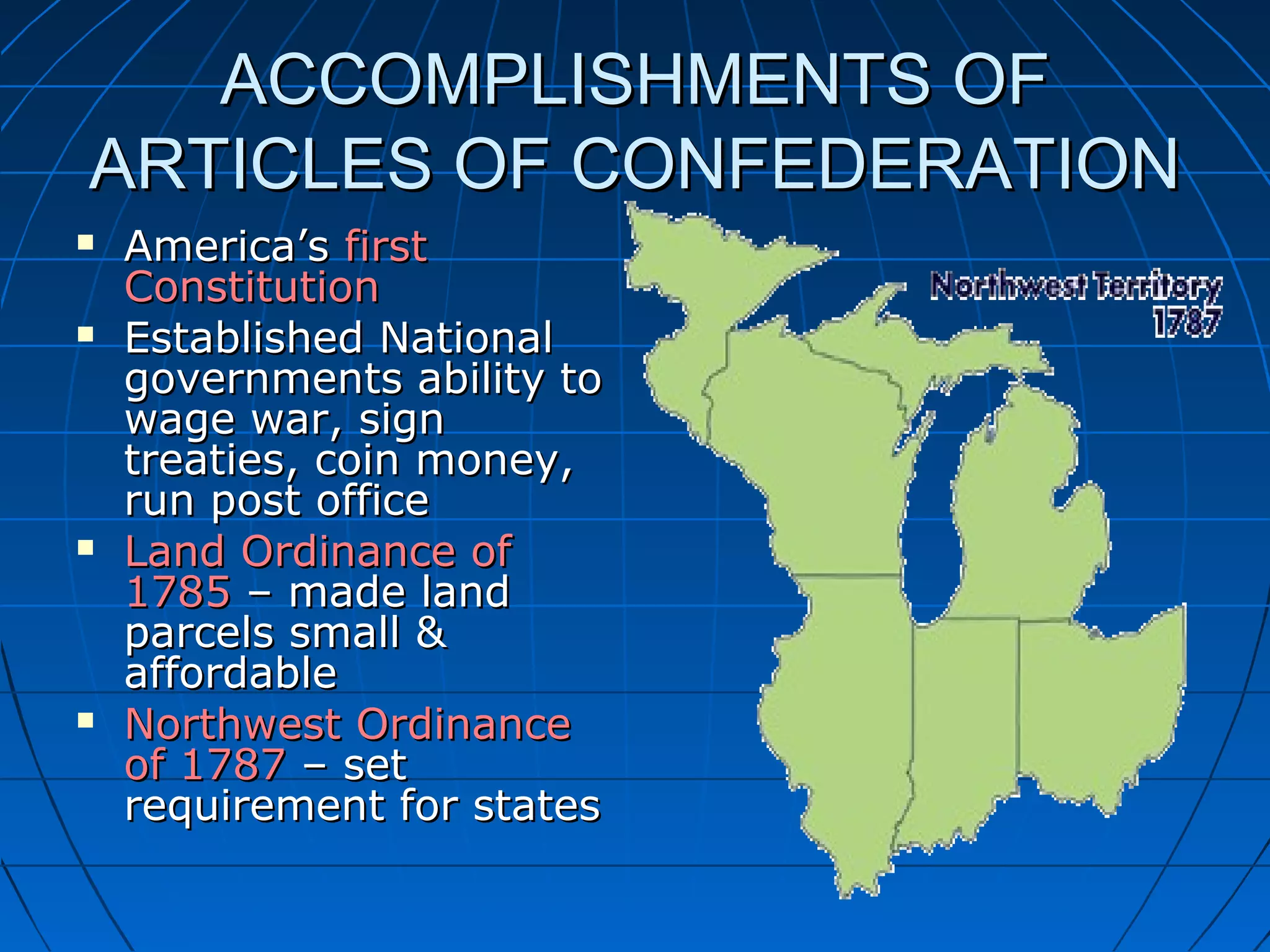
 America’sAmerica’s firstfirst
ConstitutionConstitution
 Established NationalEstablished National
governments ability togovernments ability to
wage war, signwage war, sign
treaties, coin money,treaties, coin money,
run post officerun post office
 Land Ordinance ofLand Ordinance of
17851785 – made land– made land
parcels small &parcels small &
affordableaffordable
 Northwest OrdinanceNorthwest Ordinance
of 1787of 1787 – set– set
requirement for statesrequirement for states
WEAKNESSES OF THE ARTICLEWEAKNESSES OF THE ARTICLE
OF CONFEDERATIONOF CONFEDERATION
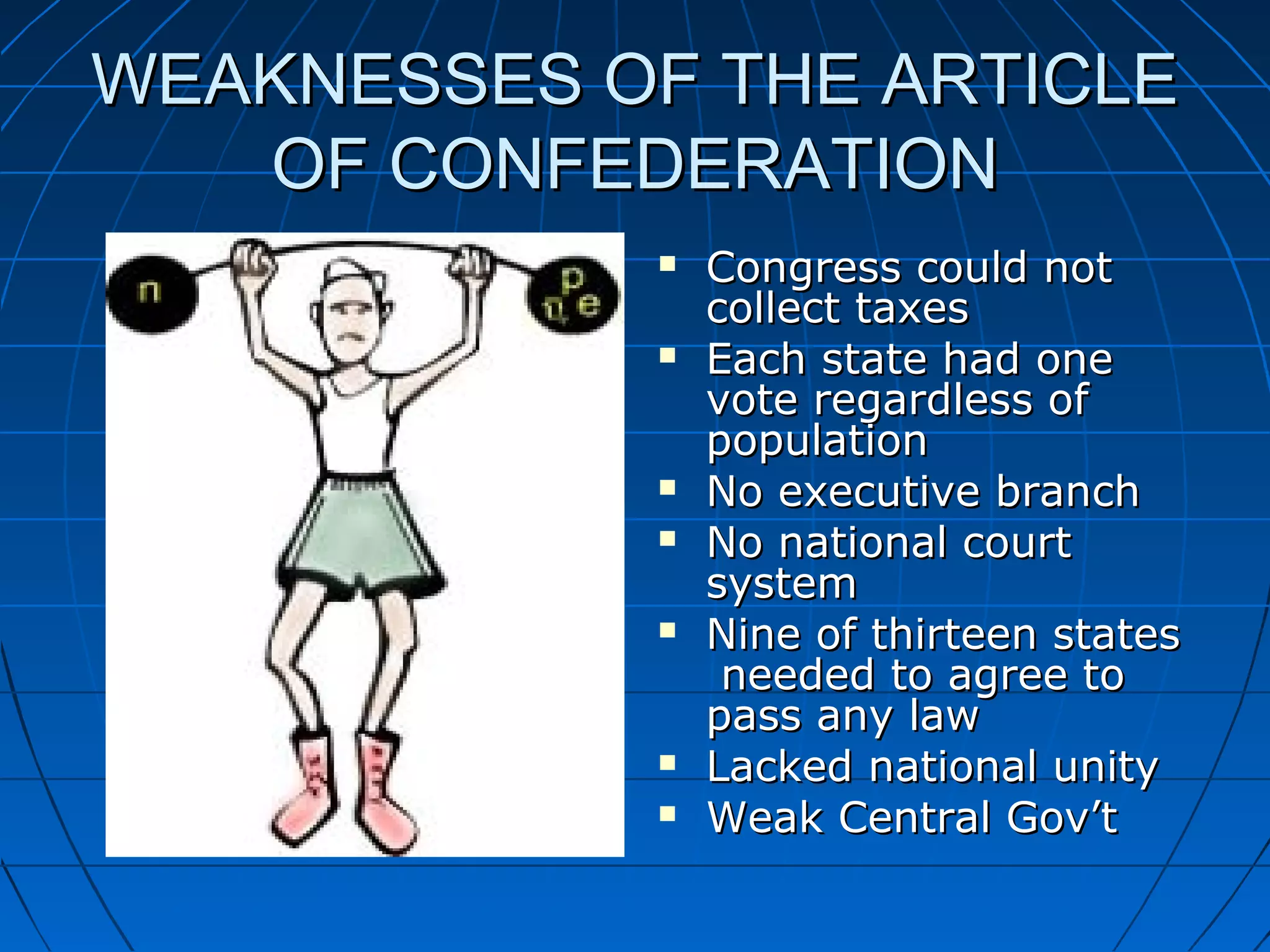
 Congress could notCongress could not
collect taxescollect taxes
 Each state had oneEach state had one
vote regardless ofvote regardless of
populationpopulation
 No executive branchNo executive branch
 No national courtNo national court
systemsystem
 Nine of thirteen statesNine of thirteen states
needed to agree toneeded to agree to
pass any lawpass any law
 Lacked national unityLacked national unity
 Weak Central Gov’tWeak Central Gov’t
SHAY’S REBELLIONSHAY’S REBELLION
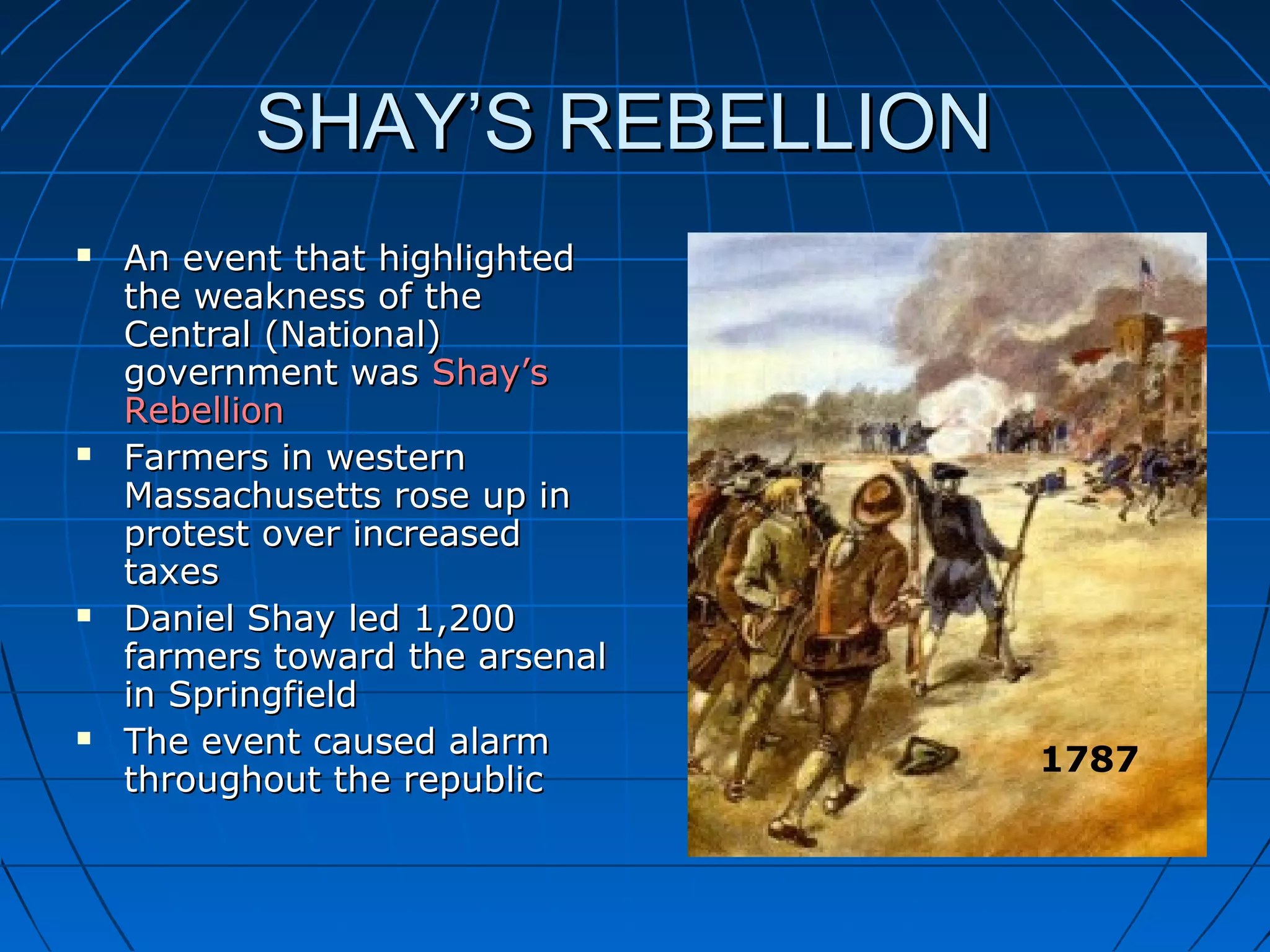
 An event that highlightedAn event that highlighted
the weakness of thethe weakness of the
Central (National)Central (National)
government wasgovernment was Shay’sShay’s
RebellionRebellion
 Farmers in westernFarmers in western
Massachusetts rose up inMassachusetts rose up in
protest over increasedprotest over increased
taxestaxes
 Daniel Shay led 1,200Daniel Shay led 1,200
farmers toward the arsenalfarmers toward the arsenal
in Springfieldin Springfield
 The event caused alarmThe event caused alarm
throughout the republicthroughout the republic
1787
CREATING A NEWCREATING A NEW
GOVERNMENTGOVERNMENT
 The delegates at theThe delegates at the
ConstitutionalConstitutional
Convention realizedConvention realized
the need tothe need to
strengthen the centralstrengthen the central
governmentgovernment
 They soon decided toThey soon decided to
create an entirely newcreate an entirely new
Constitution instead ofConstitution instead of
amending the Articlesamending the Articles
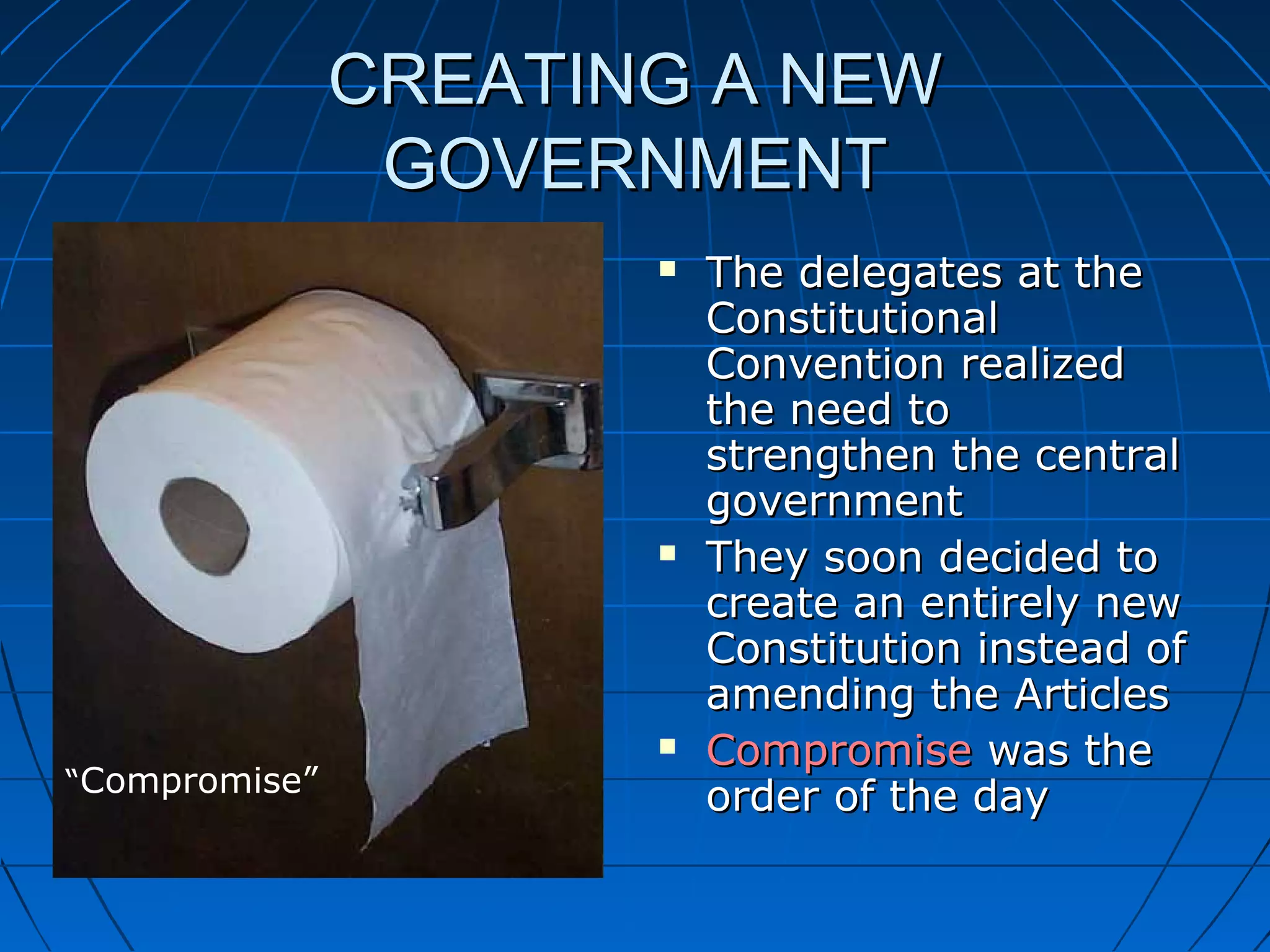
 CompromiseCompromise was thewas the
order of the dayorder of the day“Compromise”
VIRGINIA VS. NEW JERSEYVIRGINIA VS. NEW JERSEY
PLANSPLANS
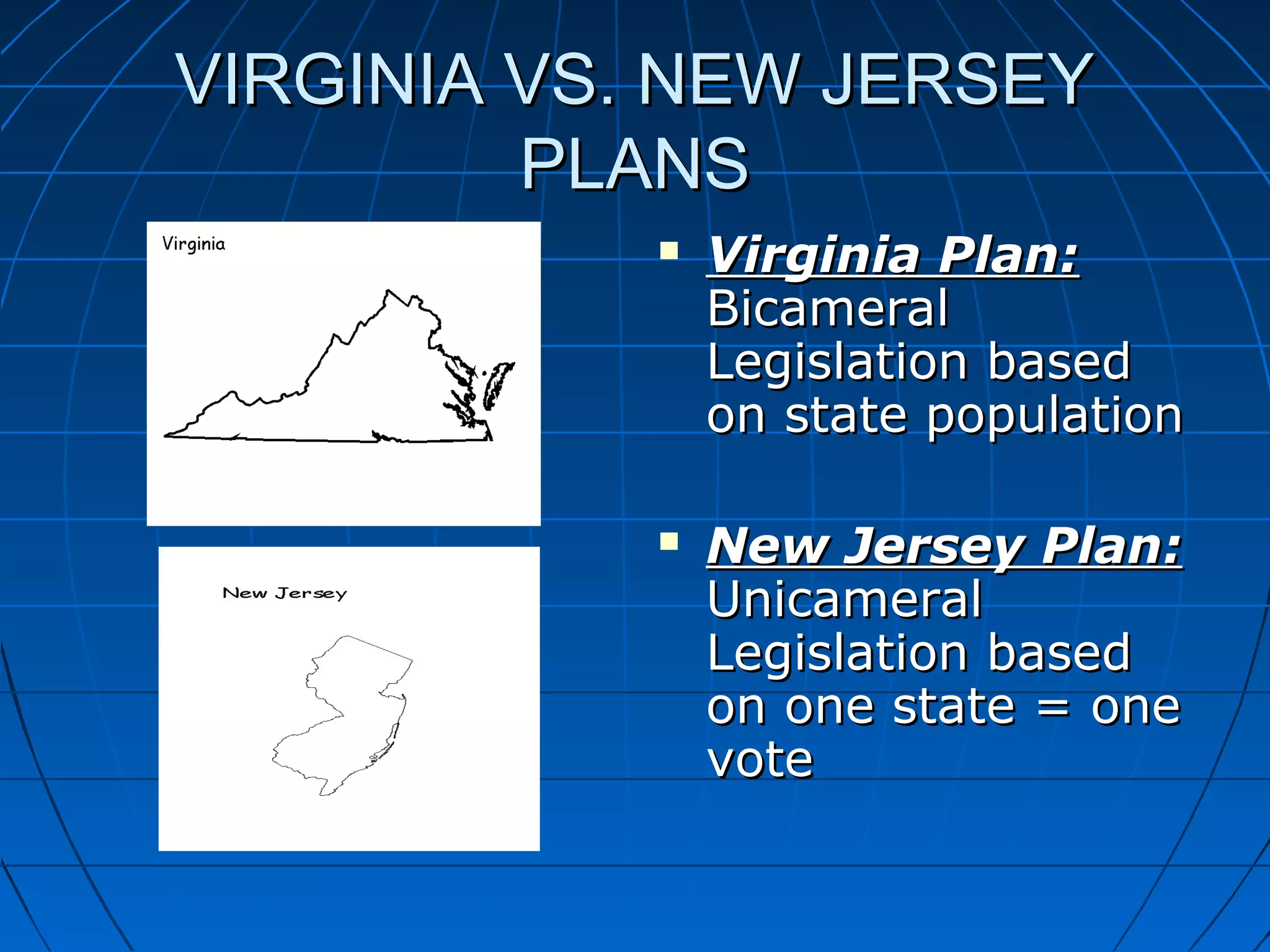
 Virginia Plan:Virginia Plan:
BicameralBicameral
Legislation basedLegislation based
on state populationon state population
 New Jersey Plan:New Jersey Plan:
UnicameralUnicameral
Legislation basedLegislation based
on one state = oneon one state = one
votevote
GREAT COMPROMISEGREAT COMPROMISE
 After a deadlockedAfter a deadlocked
that dragged on & on,that dragged on & on,
Roger ShermanRoger Sherman finallyfinally
suggested the Greatsuggested the Great
Compromise whichCompromise which
satisfied both big &satisfied both big &
small statessmall states
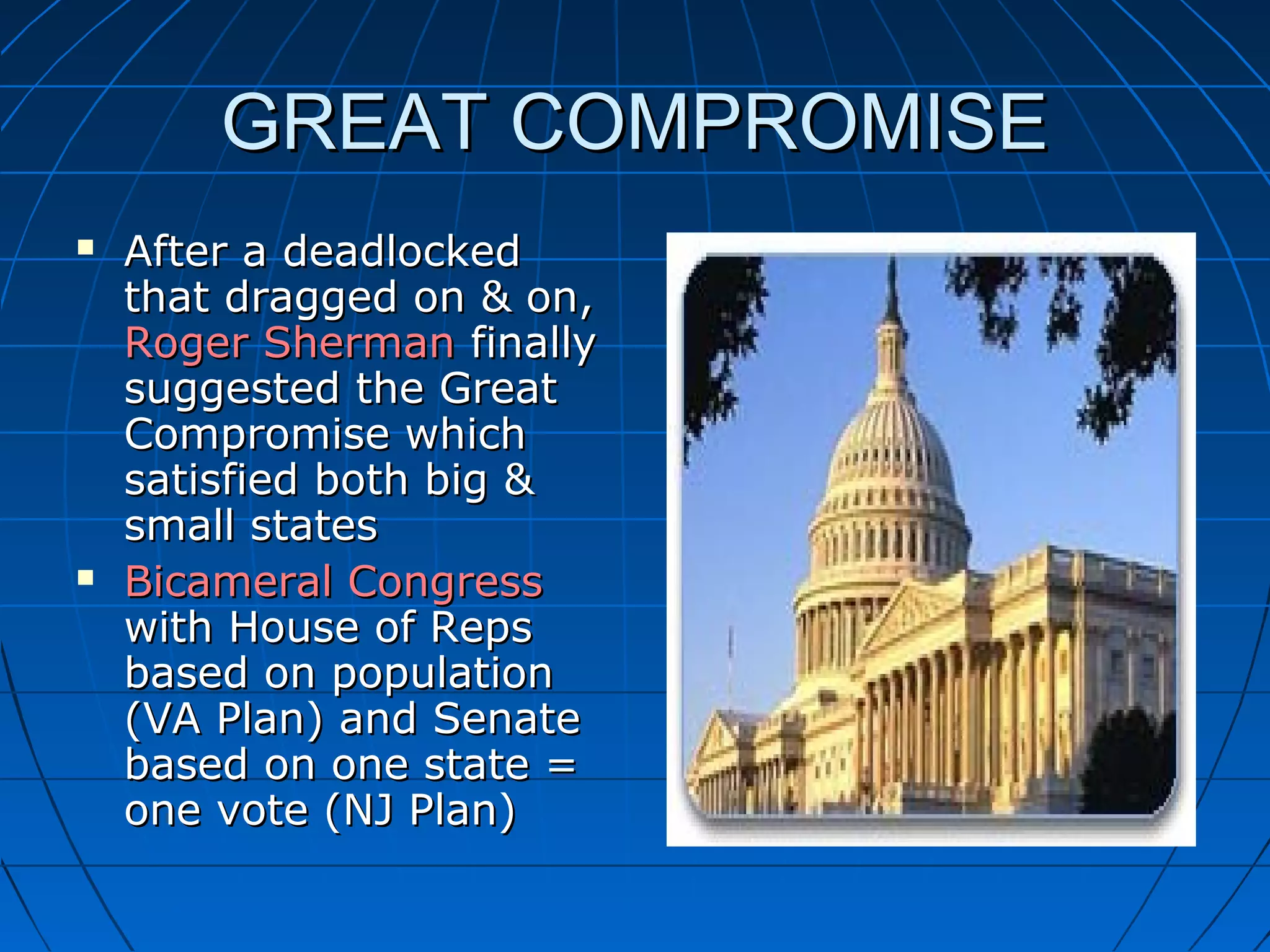
 Bicameral CongressBicameral Congress
with House of Repswith House of Reps
based on populationbased on population
(VA Plan) and Senate(VA Plan) and Senate
based on one state =based on one state =
one vote (NJ Plan)one vote (NJ Plan)
THREE-FIFTHS COMPROMISETHREE-FIFTHS COMPROMISE
 Next difficult issue:Next difficult issue:
SlaverySlavery
 Southern statesSouthern states
wanted slaveswanted slaves
included in theincluded in the
population figurespopulation figures
used to determineused to determine
RepresentativesRepresentatives
 Northern states whichNorthern states which
had few slaves,had few slaves,
disagreeddisagreed
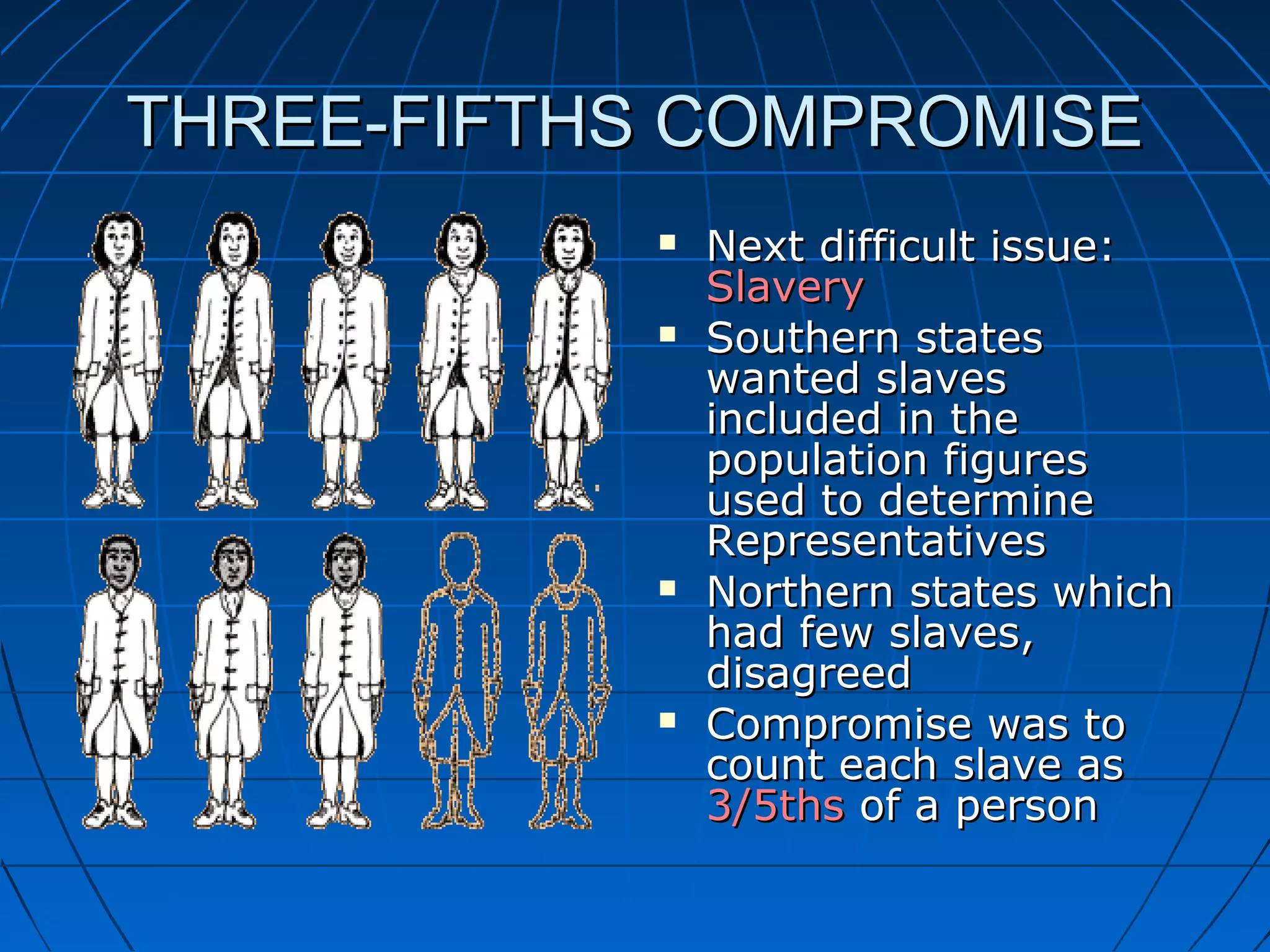
 Compromise was toCompromise was to
count each slave ascount each slave as
3/5ths3/5ths of a personof a person
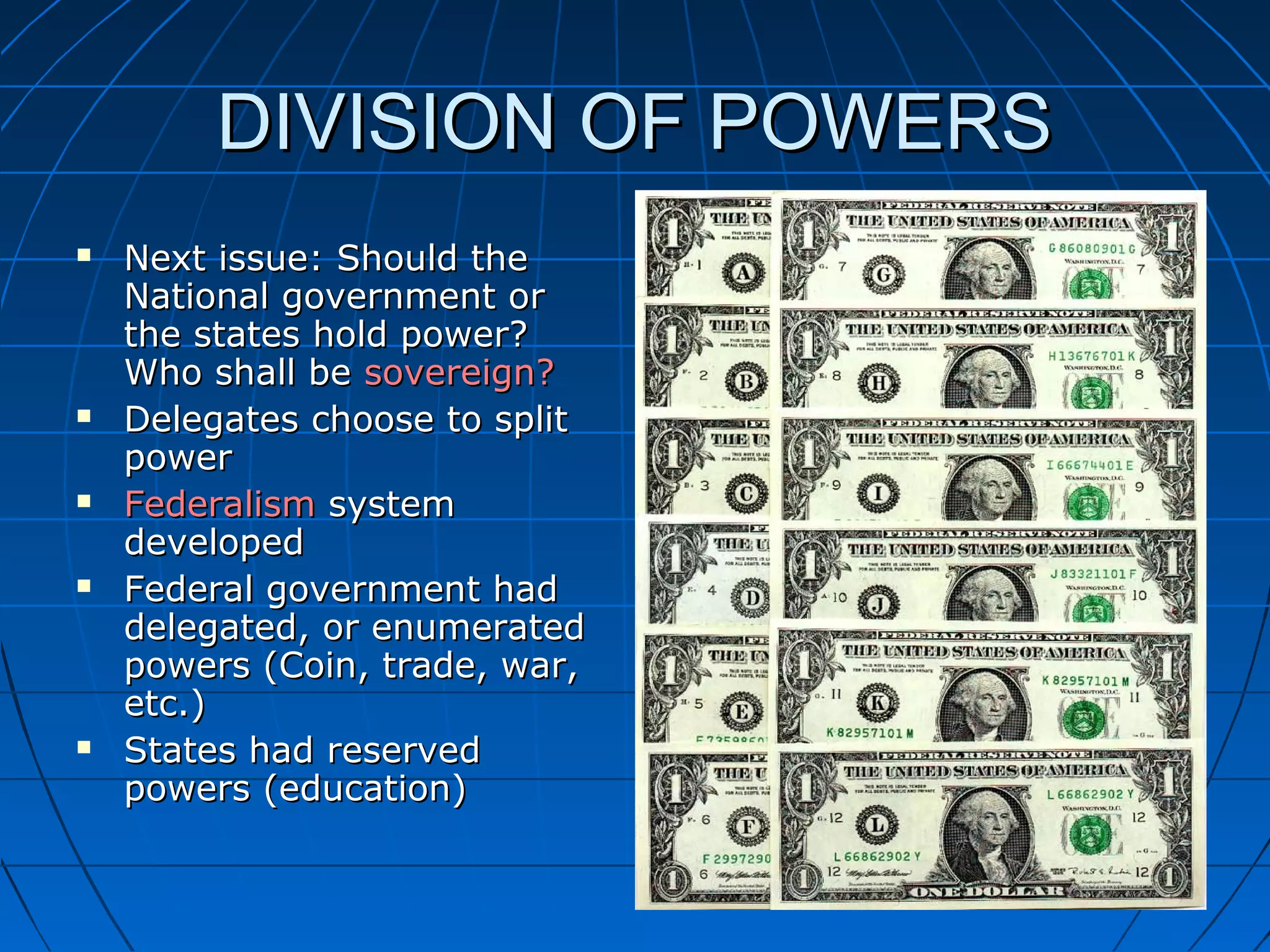
DIVISION OF POWERSDIVISION OF POWERS
 Next issue: Should theNext issue: Should the
National government orNational government or
the states hold power?the states hold power?
Who shall beWho shall be sovereign?sovereign?
 Delegates choose to splitDelegates choose to split
powerpower
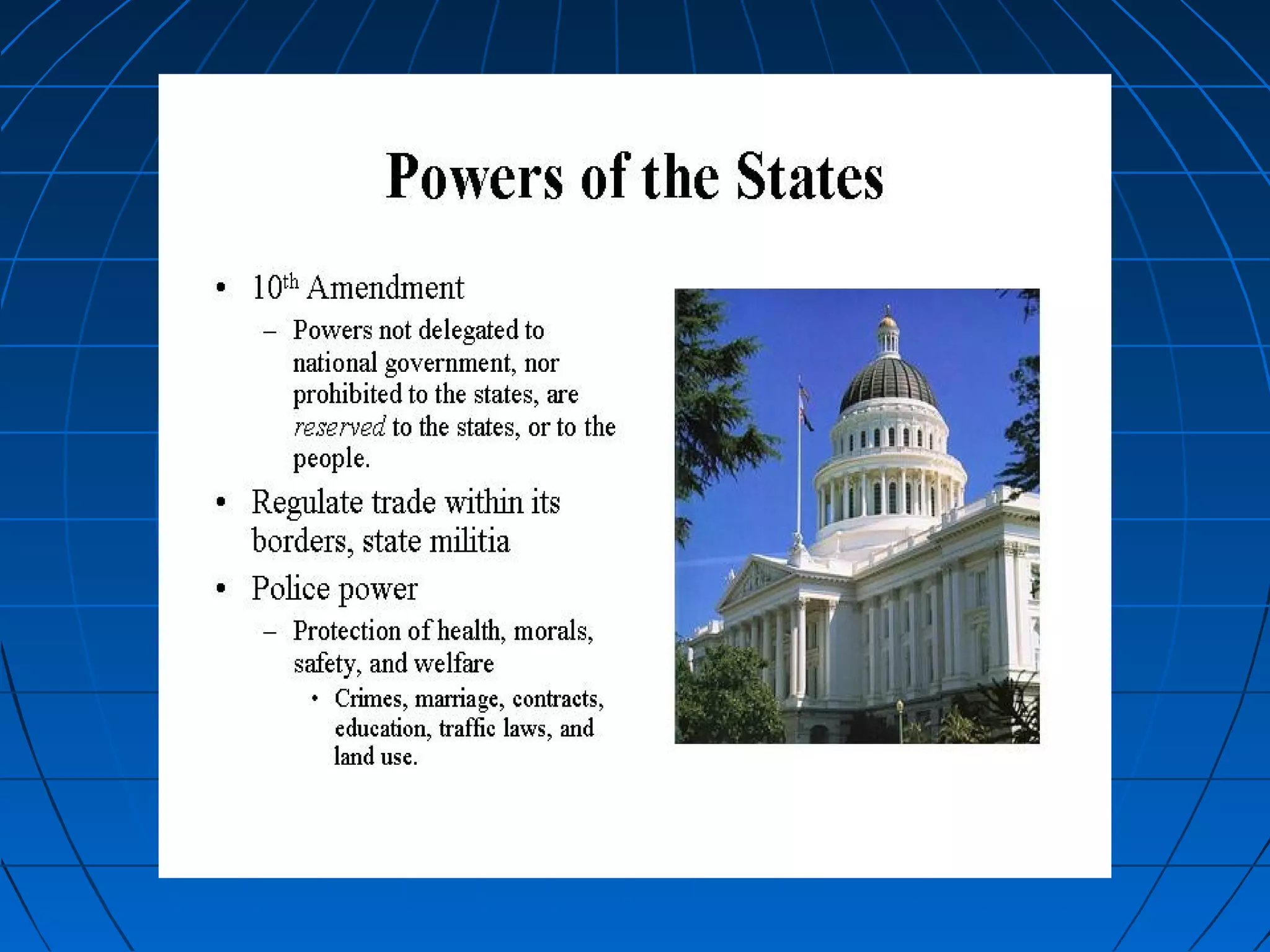
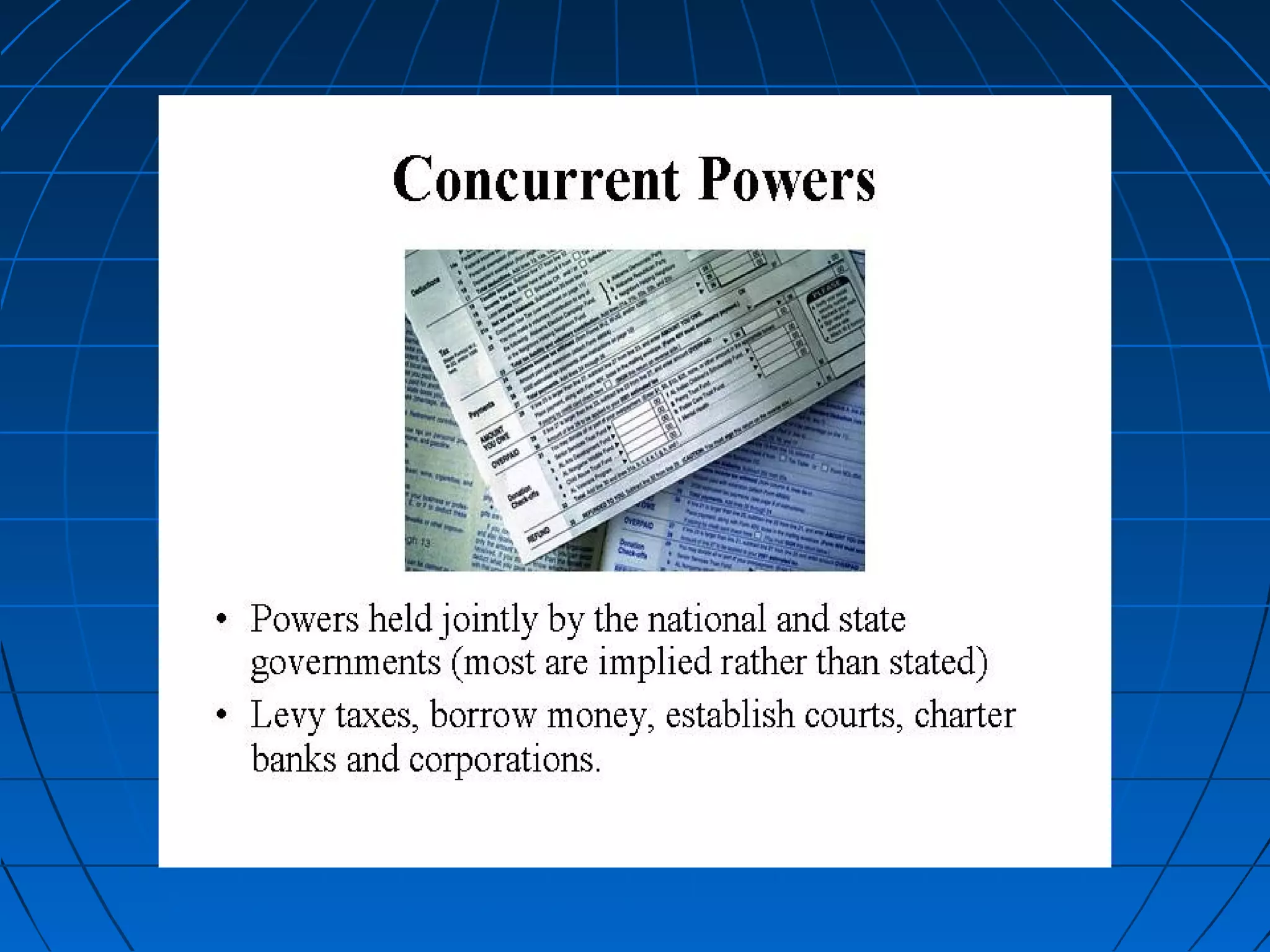
 FederalismFederalism systemsystem
developeddeveloped
 Federal government hadFederal government had
delegated, or enumerateddelegated, or enumerated
powers (Coin, trade, war,powers (Coin, trade, war,
etc.)etc.)
 States had reservedStates had reserved
powers (education)powers (education)
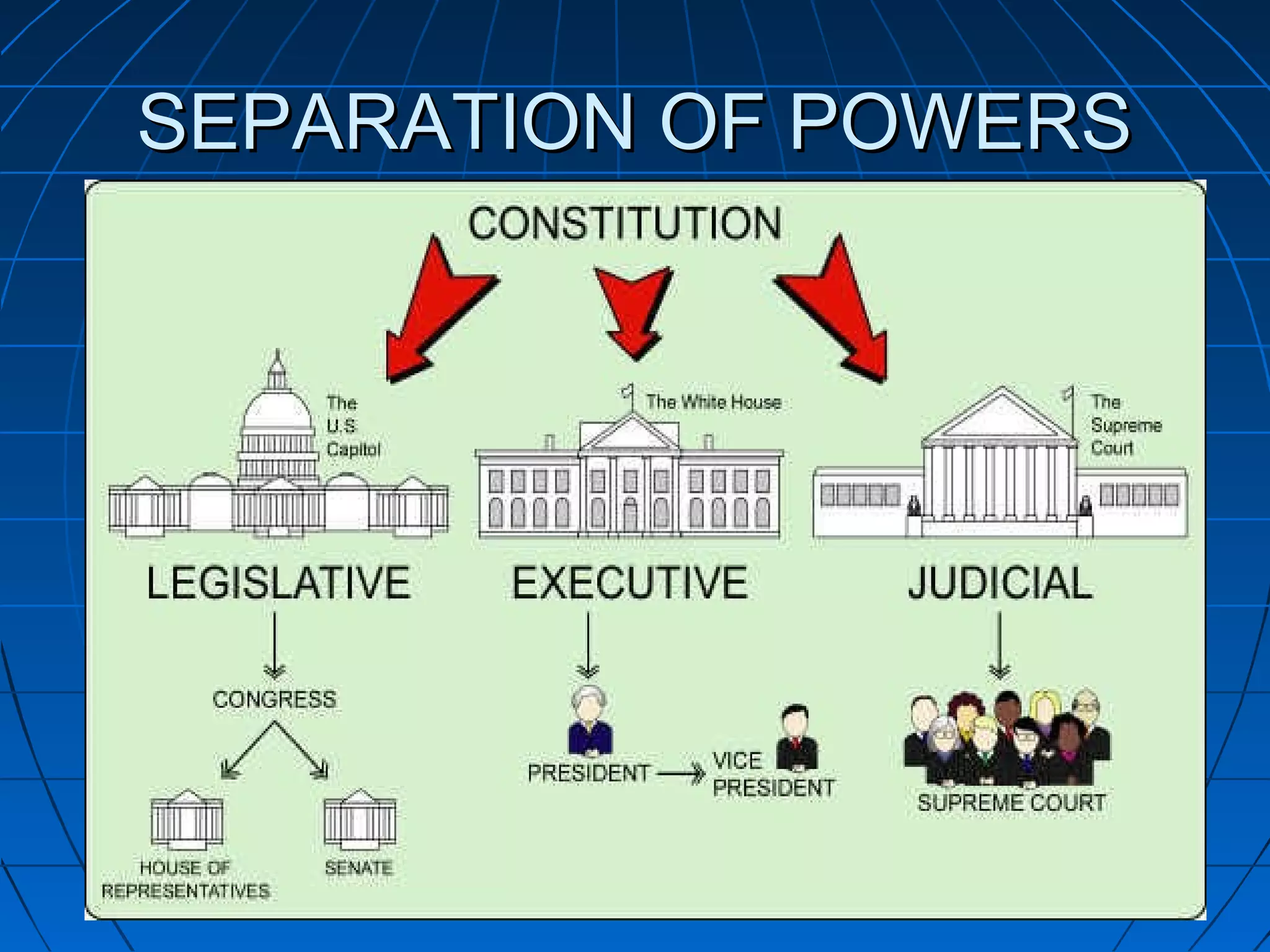
SEPARATION OF POWERSSEPARATION OF POWERS
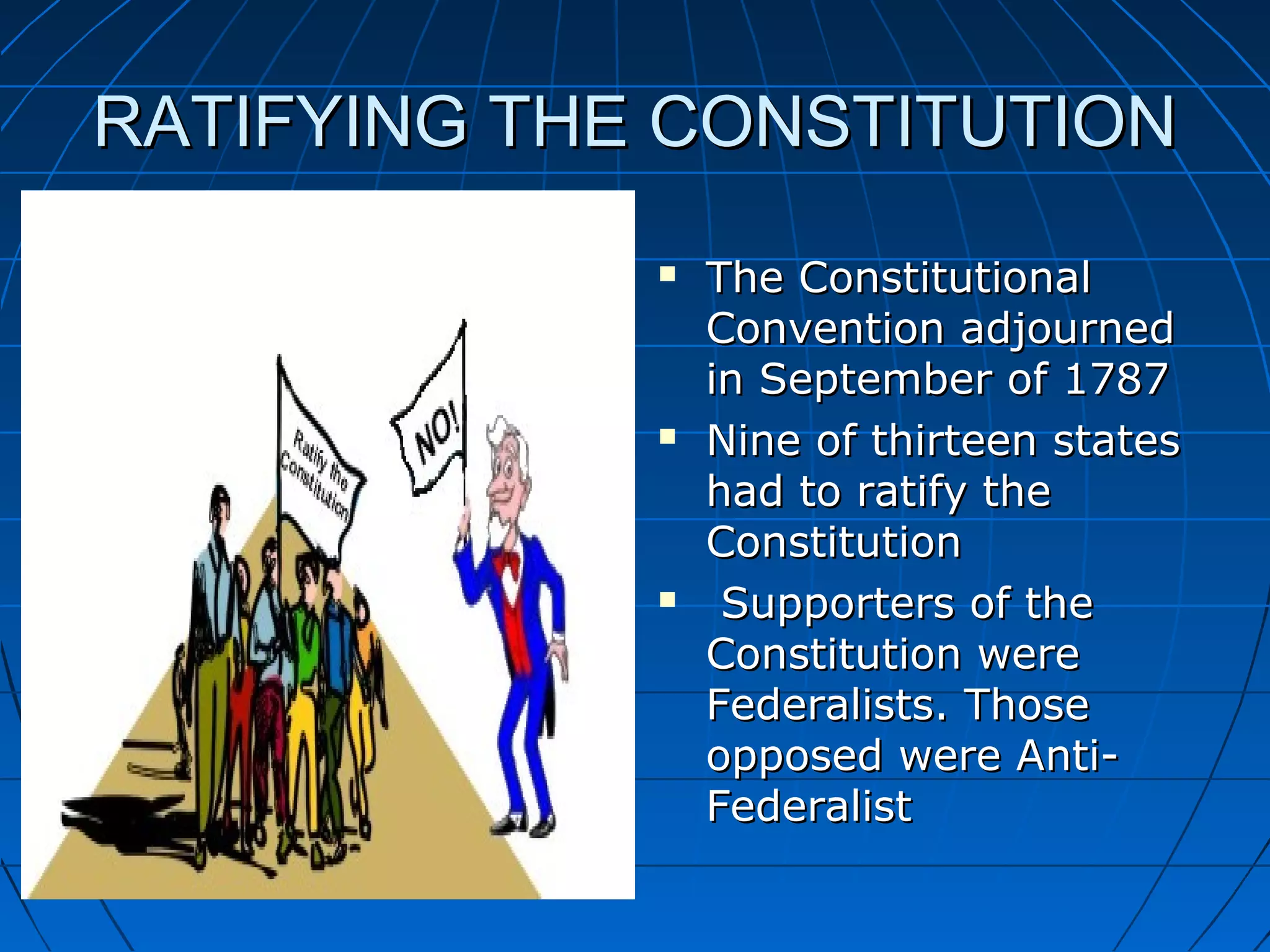
RATIFYING THE CONSTITUTIONRATIFYING THE CONSTITUTION
 The ConstitutionalThe Constitutional
Convention adjournedConvention adjourned
in September of 1787in September of 1787
 Nine of thirteen statesNine of thirteen states
had to ratify thehad to ratify the
ConstitutionConstitution
 Supporters of theSupporters of the
Constitution wereConstitution were
Federalists. ThoseFederalists. Those
opposed were Anti-opposed were Anti-
FederalistFederalist
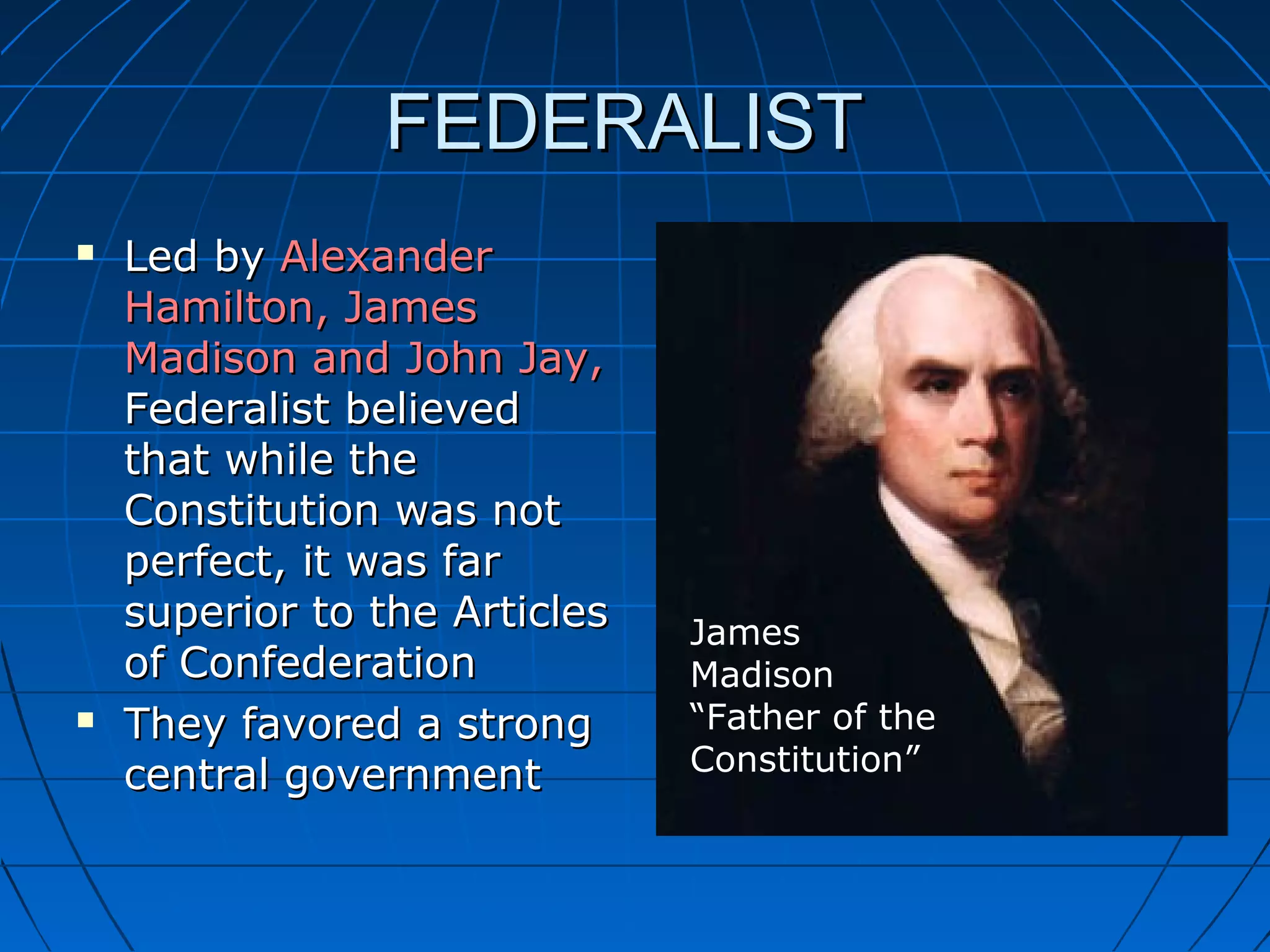
FEDERALISTFEDERALIST
 Led byLed by AlexanderAlexander
Hamilton, JamesHamilton, James
Madison and John Jay,Madison and John Jay,
Federalist believedFederalist believed
that while thethat while the
Constitution was notConstitution was not
perfect, it was farperfect, it was far
superior to the Articlessuperior to the Articles
of Confederationof Confederation
 They favored a strongThey favored a strong
central governmentcentral government
James
Madison
“Father of the
Constitution”
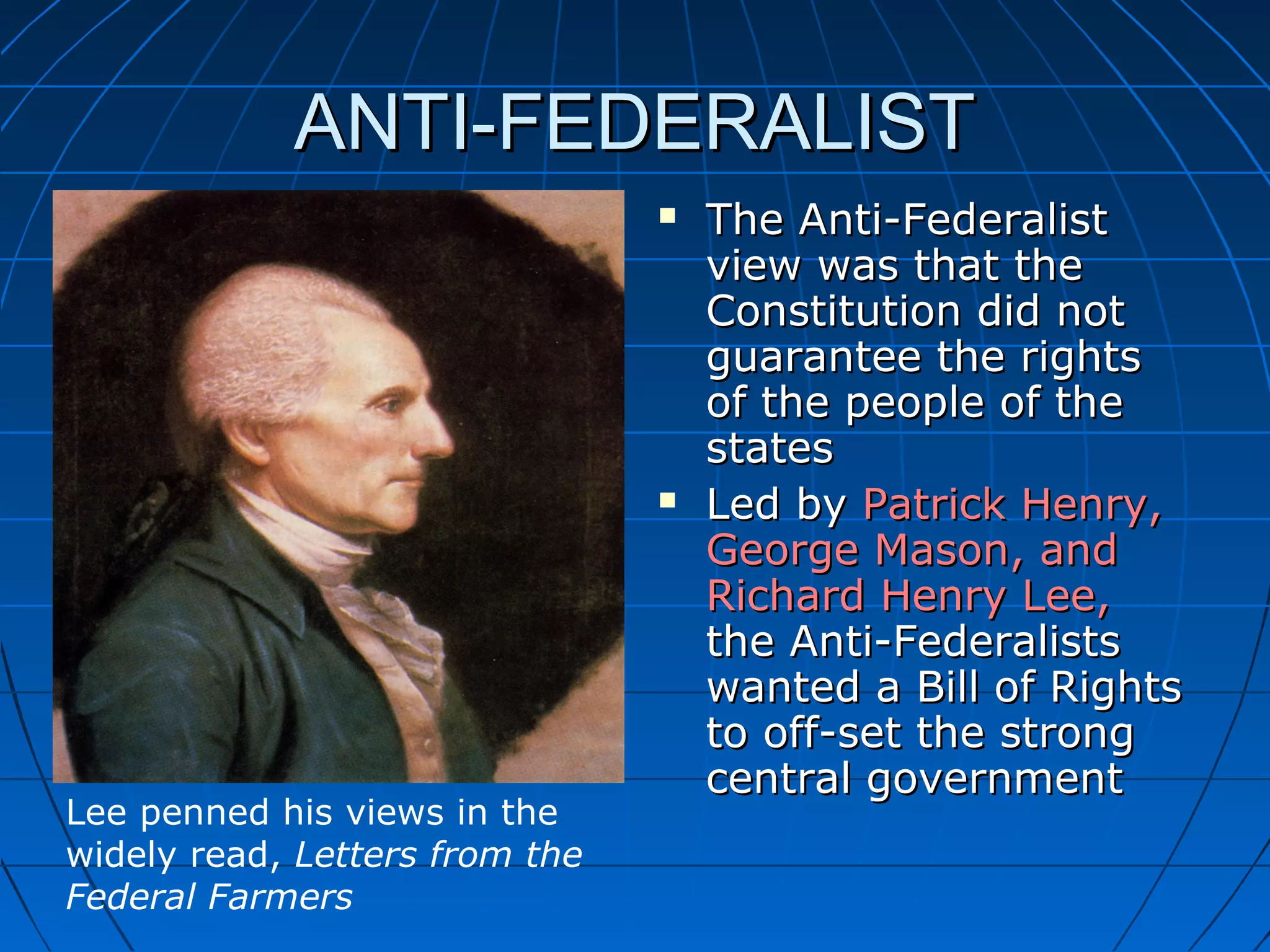
ANTI-FEDERALISTANTI-FEDERALIST
 The Anti-FederalistThe Anti-Federalist
view was that theview was that the
Constitution did notConstitution did not
guarantee the rightsguarantee the rights
of the people of theof the people of the
statesstates
 Led byLed by Patrick Henry,Patrick Henry,
George Mason, andGeorge Mason, and
Richard Henry Lee,Richard Henry Lee,
the Anti-Federaliststhe Anti-Federalists
wanted a Bill of Rightswanted a Bill of Rights
to off-set the strongto off-set the strong
central governmentcentral government
Lee penned his views in the
widely read, Letters from the
Federal Farmers
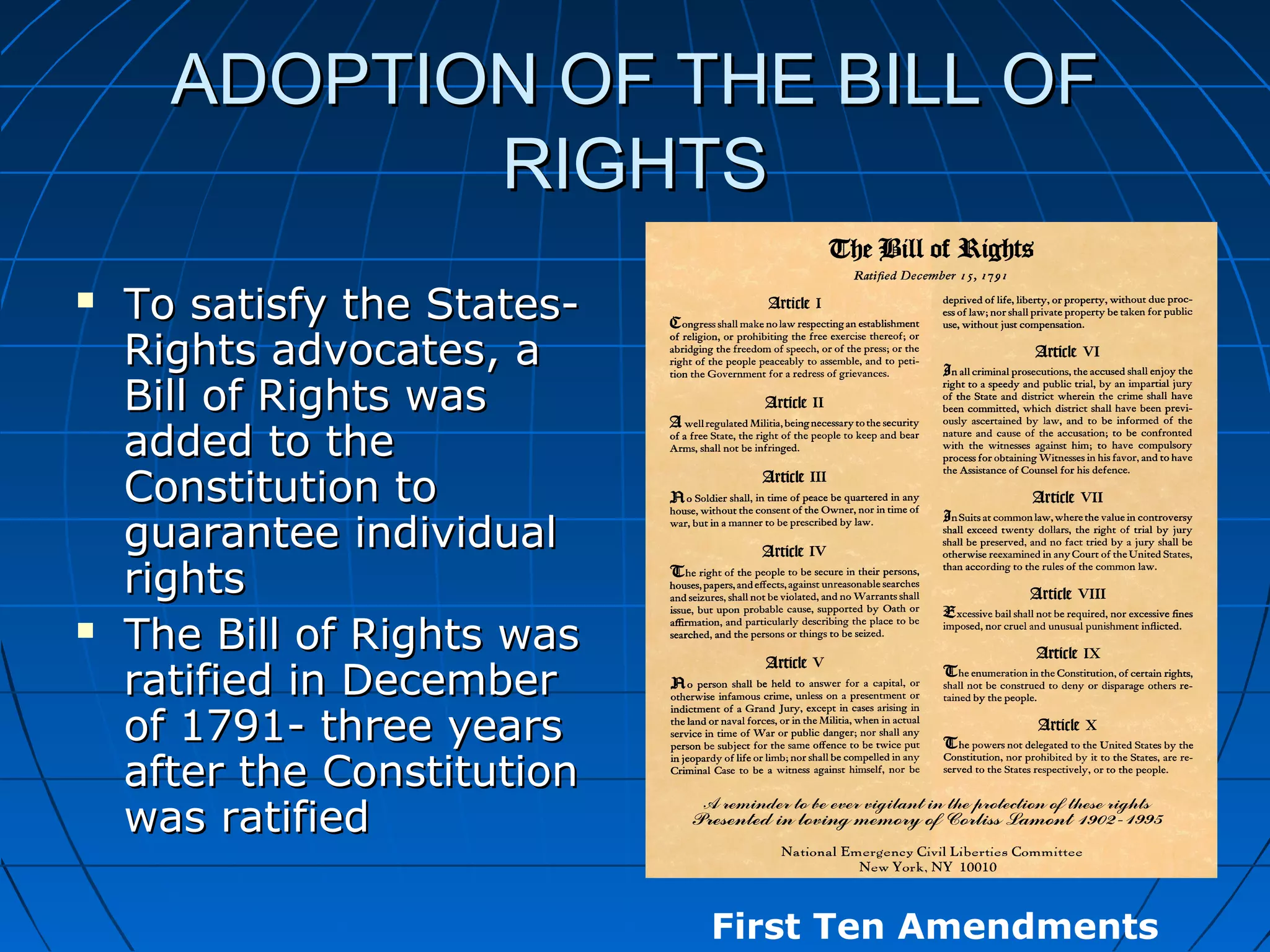
ADOPTION OF THE BILL OFADOPTION OF THE BILL OF
RIGHTSRIGHTS
 To satisfy the States-To satisfy the States-
Rights advocates, aRights advocates, a
Bill of Rights wasBill of Rights was
added to theadded to the
Constitution toConstitution to
guarantee individualguarantee individual
rightsrights
 The Bill of Rights wasThe Bill of Rights was
ratified in Decemberratified in December
of 1791- three yearsof 1791- three years
after the Constitutionafter the Constitution
was ratifiedwas ratified
First Ten Amendments
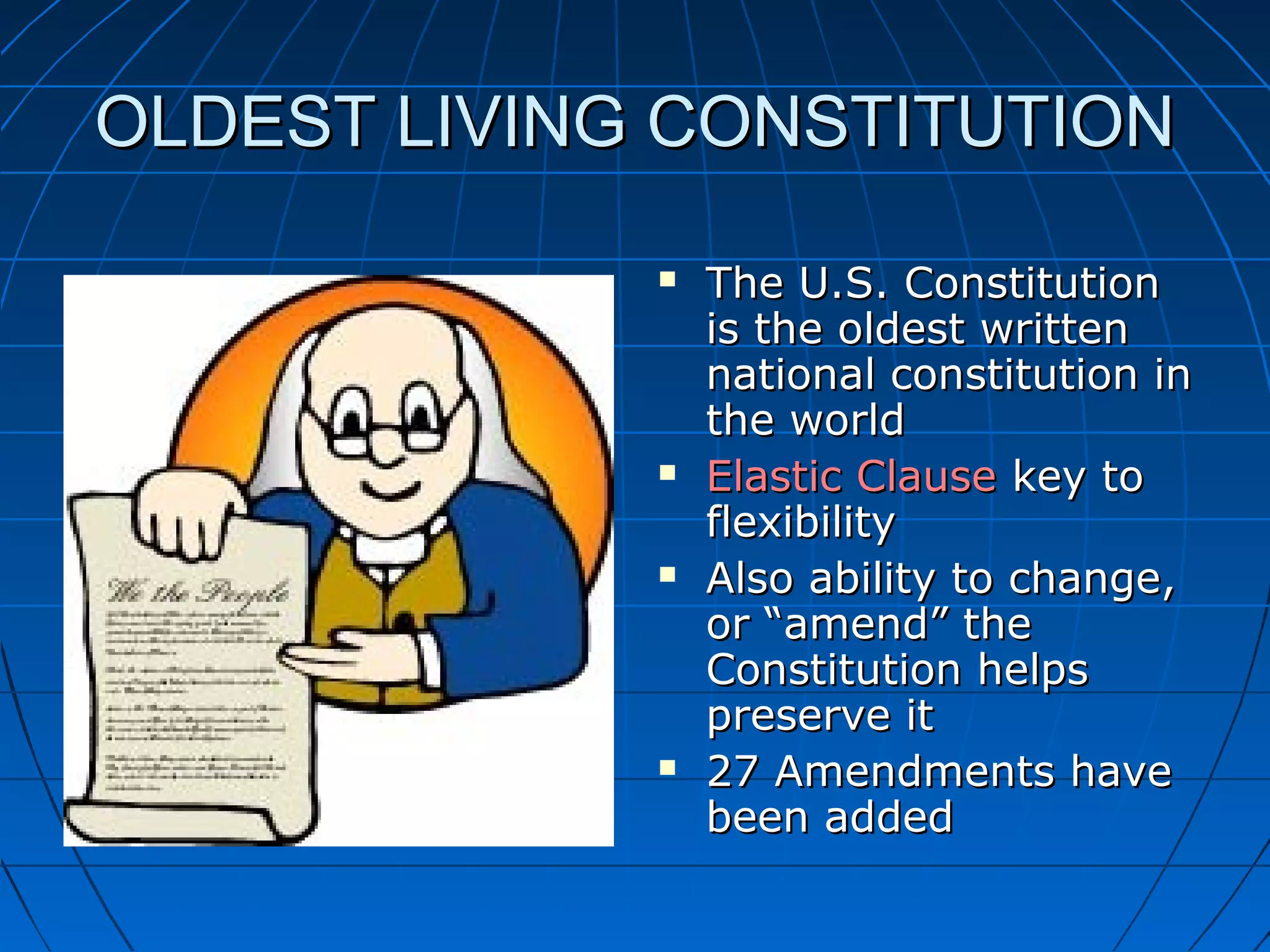
OLDEST LIVING CONSTITUTIONOLDEST LIVING CONSTITUTION
 The U.S. ConstitutionThe U.S. Constitution
is the oldest writtenis the oldest written
national constitution innational constitution in
the worldthe world
 Elastic ClauseElastic Clause key tokey to
flexibilityflexibility
 Also ability to change,Also ability to change,
or “amend” theor “amend” the
Constitution helpsConstitution helps
preserve itpreserve it
 27 Amendments have27 Amendments have
been addedbeen added
LAUNCHING THE NEW NATION –LAUNCHING THE NEW NATION –
SECTION 4SECTION 4
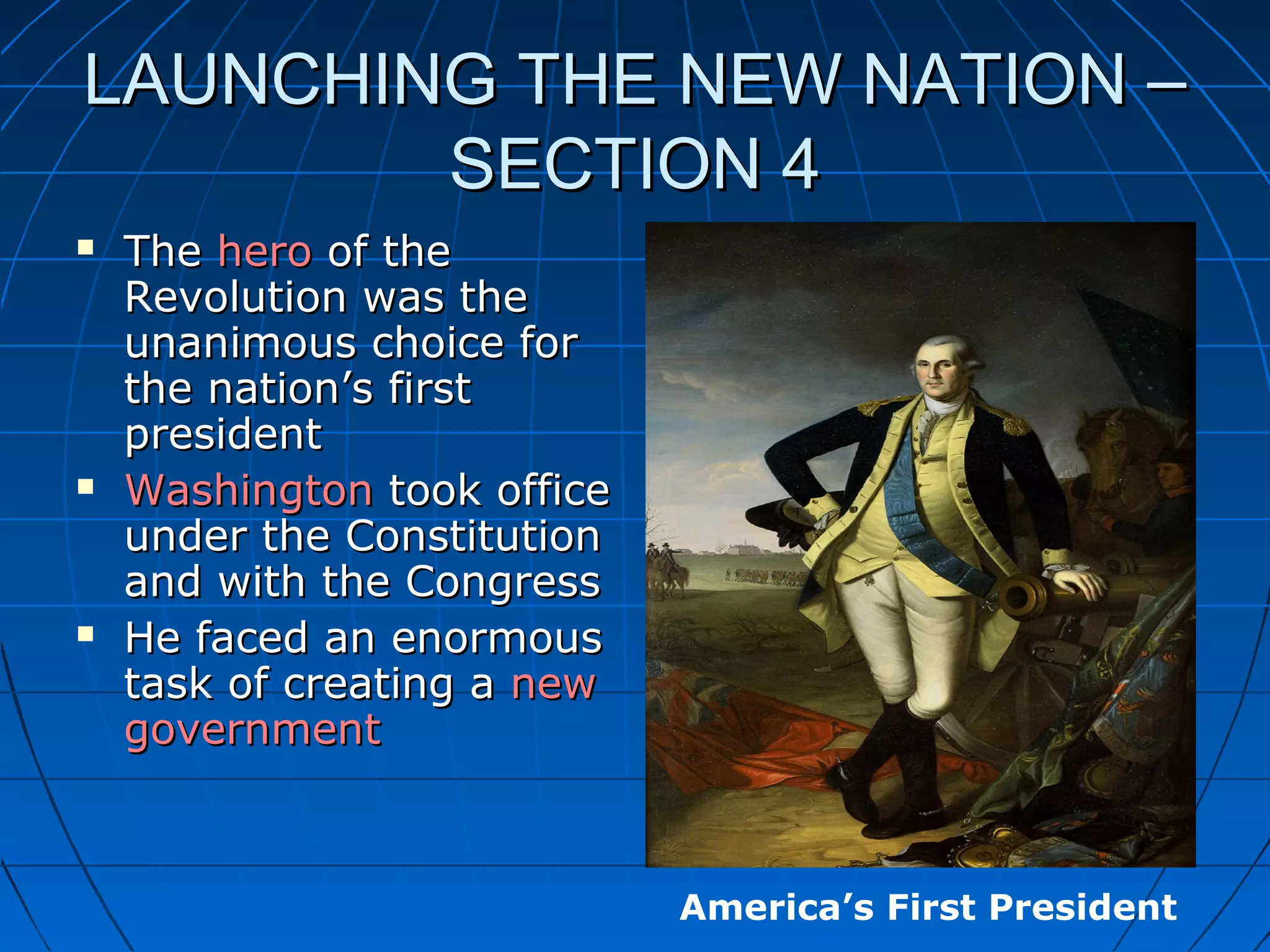
 TheThe herohero of theof the
Revolution was theRevolution was the
unanimous choice forunanimous choice for
the nation’s firstthe nation’s first
presidentpresident
 WashingtonWashington took officetook office
under the Constitutionunder the Constitution
and with the Congressand with the Congress
 He faced an enormousHe faced an enormous
task of creating atask of creating a newnew
governmentgovernment
America’s First President
JUDICIARY ACT OF 1789JUDICIARY ACT OF 1789
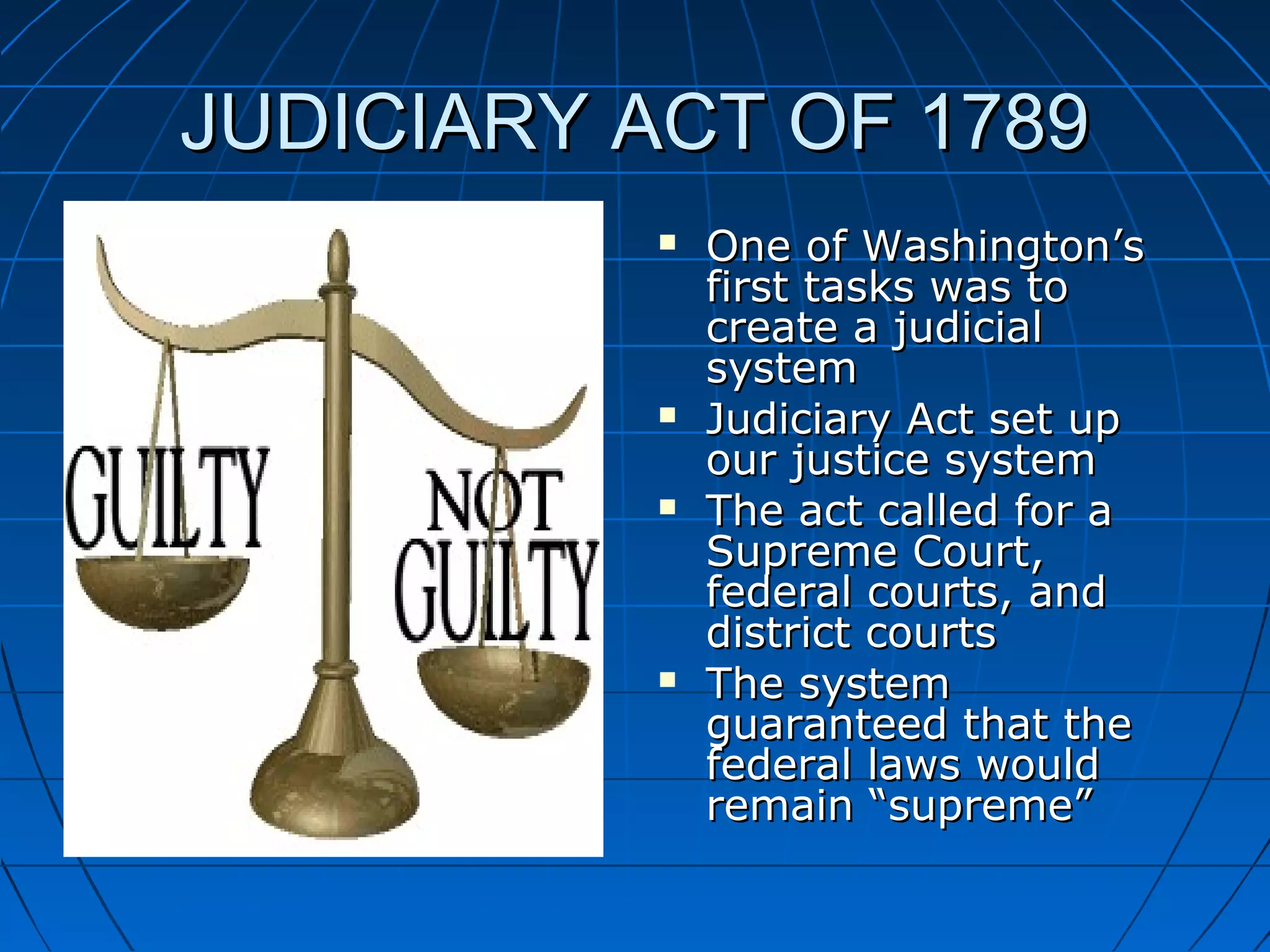
 One of Washington’sOne of Washington’s
first tasks was tofirst tasks was to
create a judicialcreate a judicial
systemsystem
 Judiciary Act set upJudiciary Act set up
our justice systemour justice system
 The act called for aThe act called for a
Supreme Court,Supreme Court,
federal courts, andfederal courts, and
district courtsdistrict courts
 The systemThe system
guaranteed that theguaranteed that the
federal laws wouldfederal laws would
remain “supreme”remain “supreme”
WASHINGTON CREATESWASHINGTON CREATES
DEPARTMENTSDEPARTMENTS
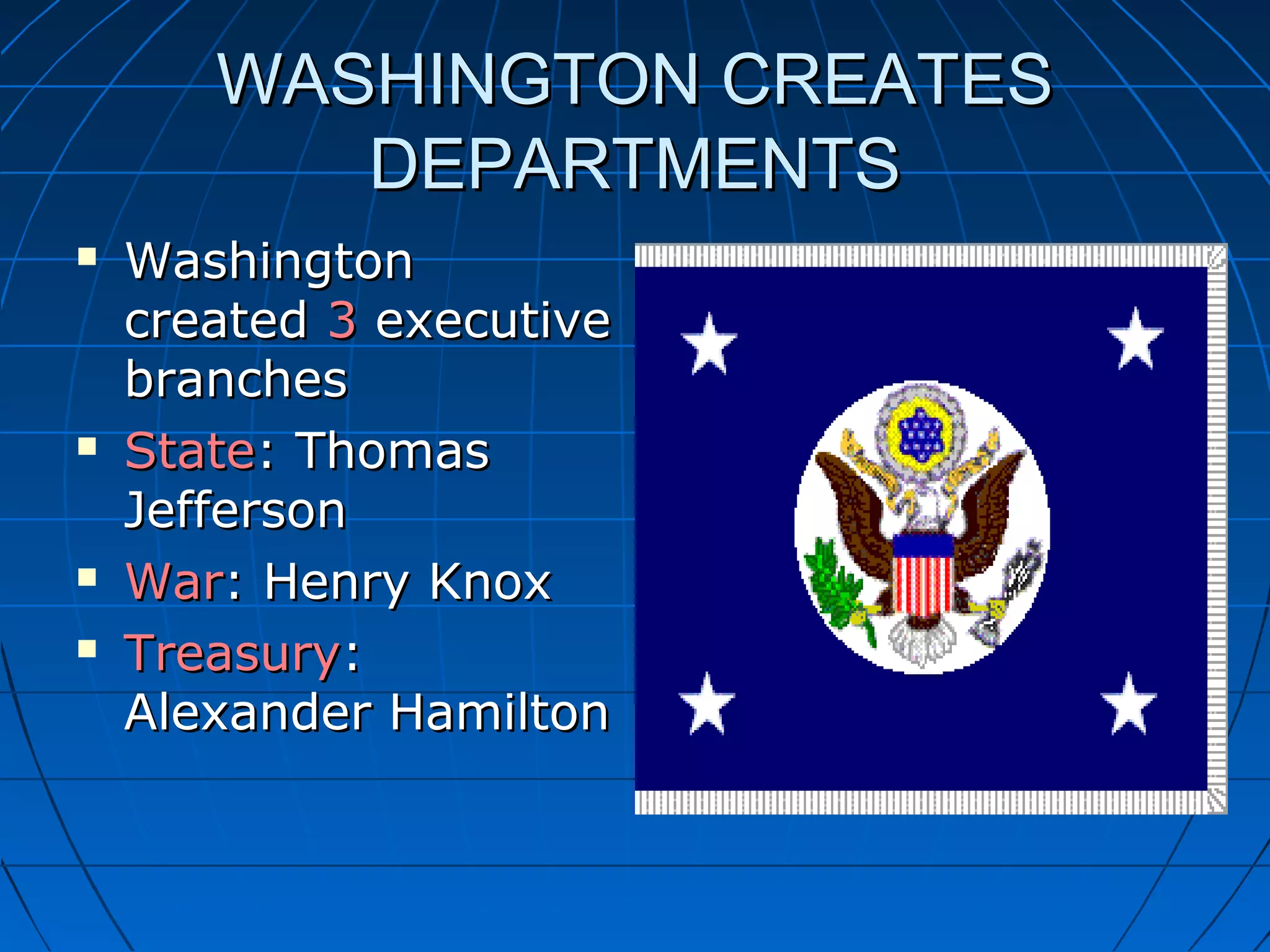
 WashingtonWashington
createdcreated 33 executiveexecutive
branchesbranches
 StateState: Thomas: Thomas
JeffersonJefferson
 WarWar: Henry Knox: Henry Knox
 TreasuryTreasury::
Alexander HamiltonAlexander Hamilton
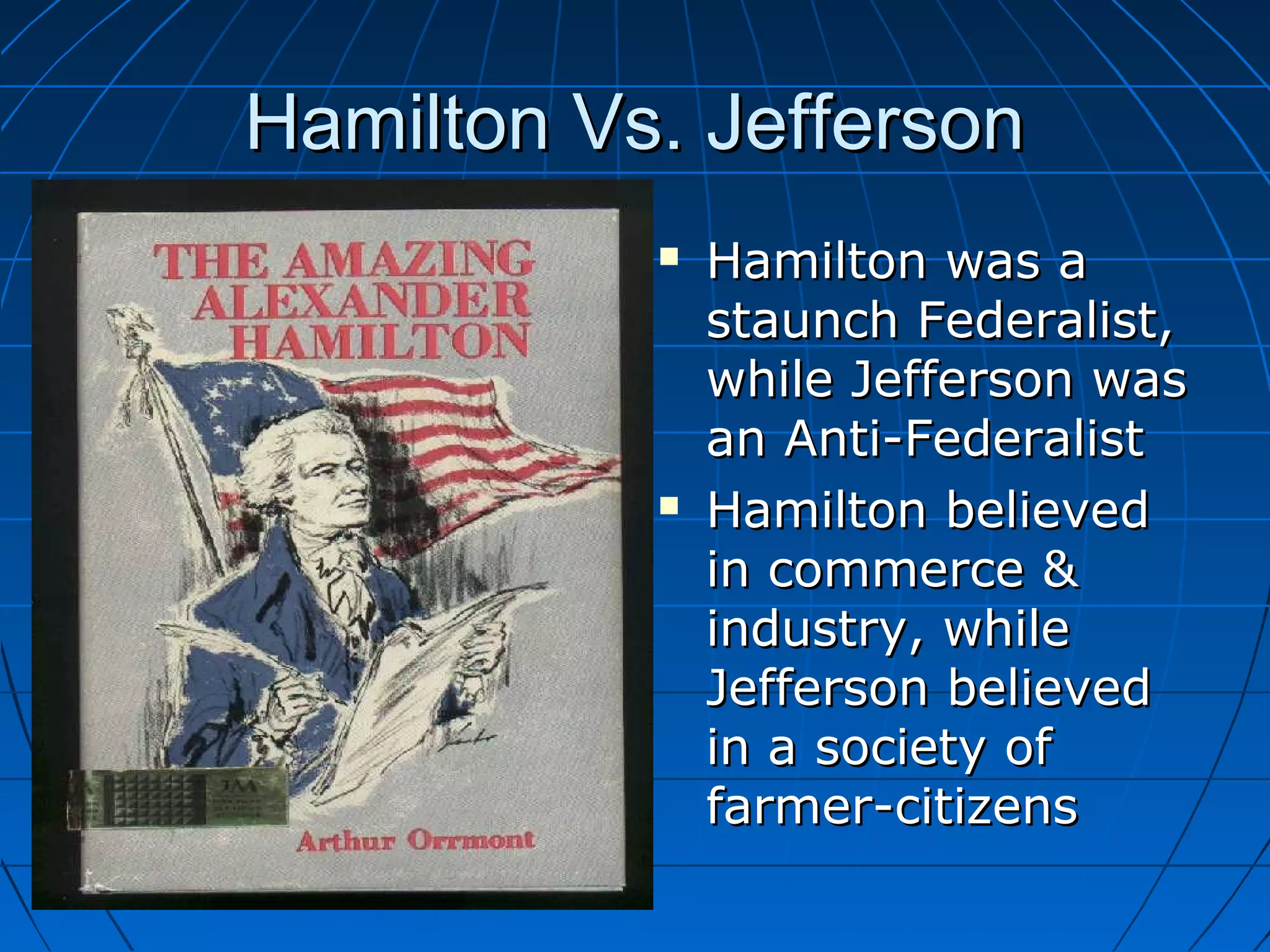
Hamilton Vs. JeffersonHamilton Vs. Jefferson
 Hamilton was aHamilton was a
staunch Federalist,staunch Federalist,
while Jefferson waswhile Jefferson was
an Anti-Federalistan Anti-Federalist
 Hamilton believedHamilton believed
in commerce &in commerce &
industry, whileindustry, while
Jefferson believedJefferson believed
in a society ofin a society of
farmer-citizensfarmer-citizens
HAMILTON’S ECONOMIC PLANHAMILTON’S ECONOMIC PLAN
 Hamilton wanted aHamilton wanted a
National BankNational Bank fullyfully
funded by thefunded by the
GovernmentGovernment
 Opponents, like JamesOpponents, like James
Madison, felt theMadison, felt the
Constitution made noConstitution made no
provisions for such aprovisions for such a
Federal bankFederal bank
 Thus begins a longThus begins a long
battle between thosebattle between those
whowho interpret theinterpret the
Constitution looselyConstitution loosely
vs. strictlyvs. strictly
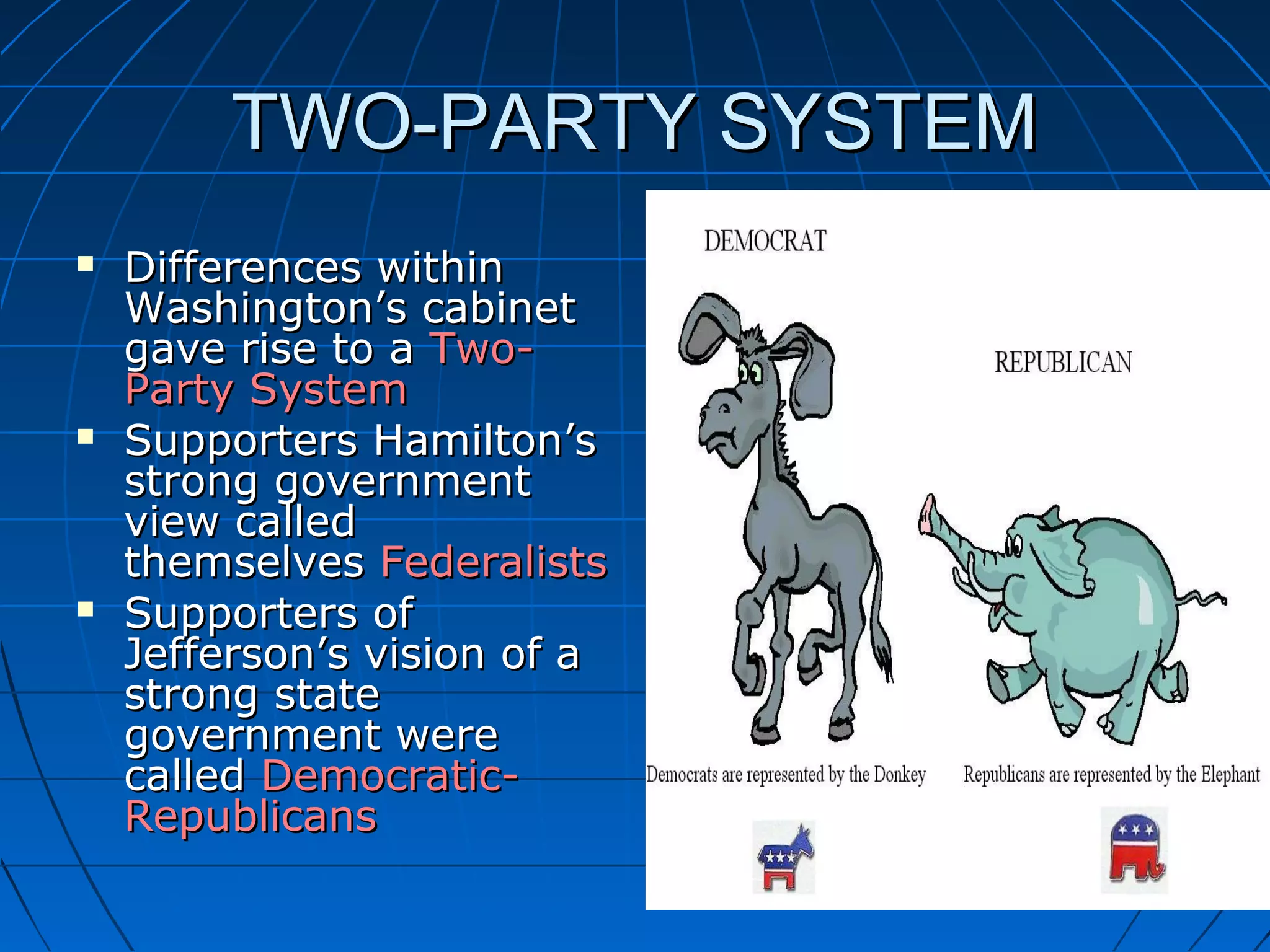
TWO-PARTY SYSTEMTWO-PARTY SYSTEM
 Differences withinDifferences within
Washington’s cabinetWashington’s cabinet
gave rise to agave rise to a Two-Two-
Party SystemParty System
 Supporters Hamilton’sSupporters Hamilton’s
strong governmentstrong government
view calledview called
themselvesthemselves FederalistsFederalists
 Supporters ofSupporters of
Jefferson’s vision of aJefferson’s vision of a
strong statestrong state
government weregovernment were
calledcalled Democratic-Democratic-
RepublicansRepublicans
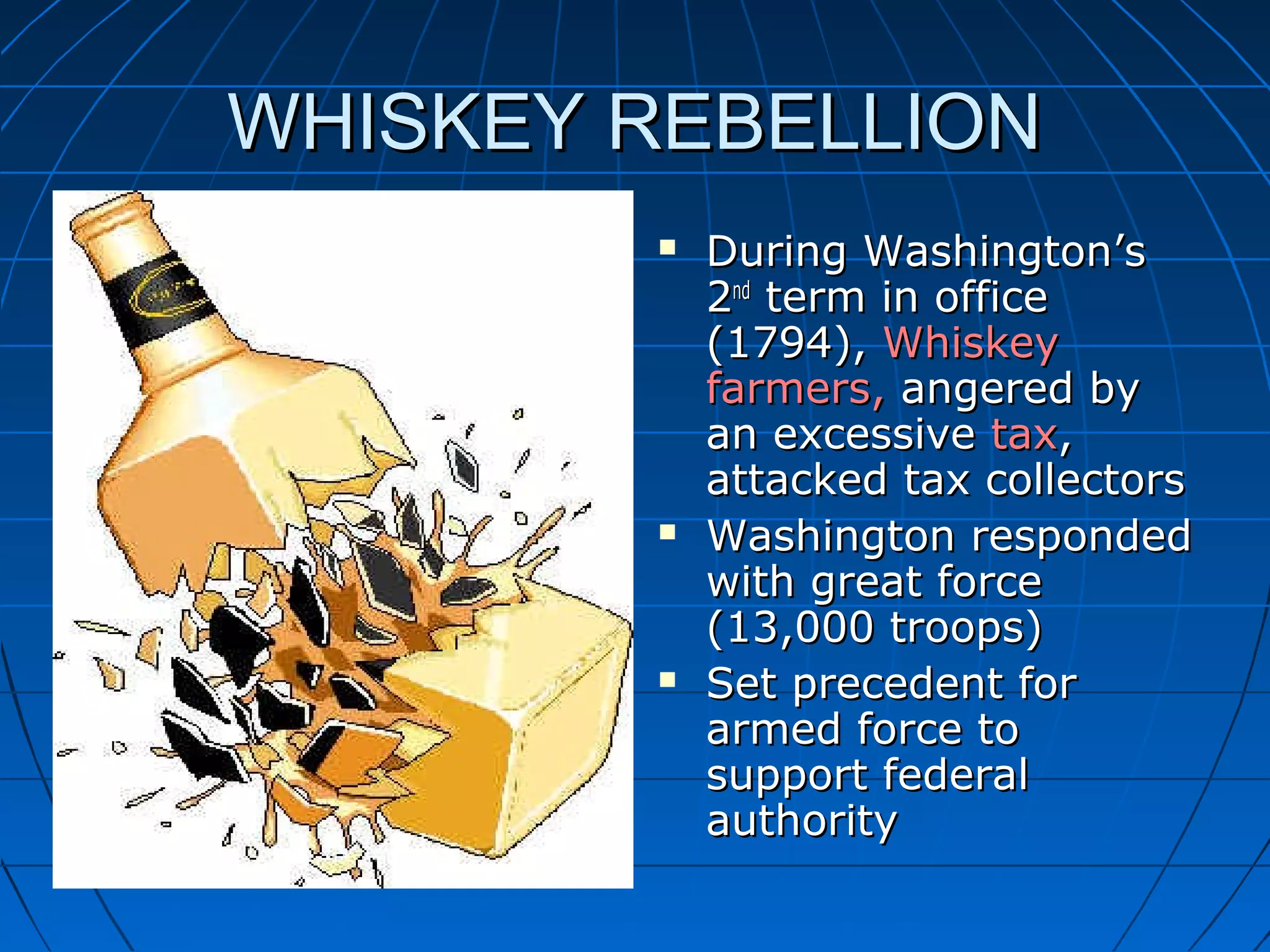
WHISKEY REBELLIONWHISKEY REBELLION
 During Washington’sDuring Washington’s
22ndnd
term in officeterm in office
(1794),(1794), WhiskeyWhiskey
farmers,farmers, angered byangered by
an excessivean excessive taxtax,,
attacked tax collectorsattacked tax collectors
 Washington respondedWashington responded
with great forcewith great force
(13,000 troops)(13,000 troops)
 Set precedent forSet precedent for
armed force toarmed force to
support federalsupport federal
authorityauthority
ELECTION OF 1796ELECTION OF 1796
 Federalists nominatedFederalists nominated
Vice President JohnVice President John
AdamsAdams
 Democratic-Democratic-
RepublicansRepublicans
nominated Thomasnominated Thomas
JeffersonJefferson
 Adams wins andAdams wins and
runner-up Jeffersonrunner-up Jefferson
becomes vice-becomes vice-
president (as lawpresident (as law
dictated)dictated)
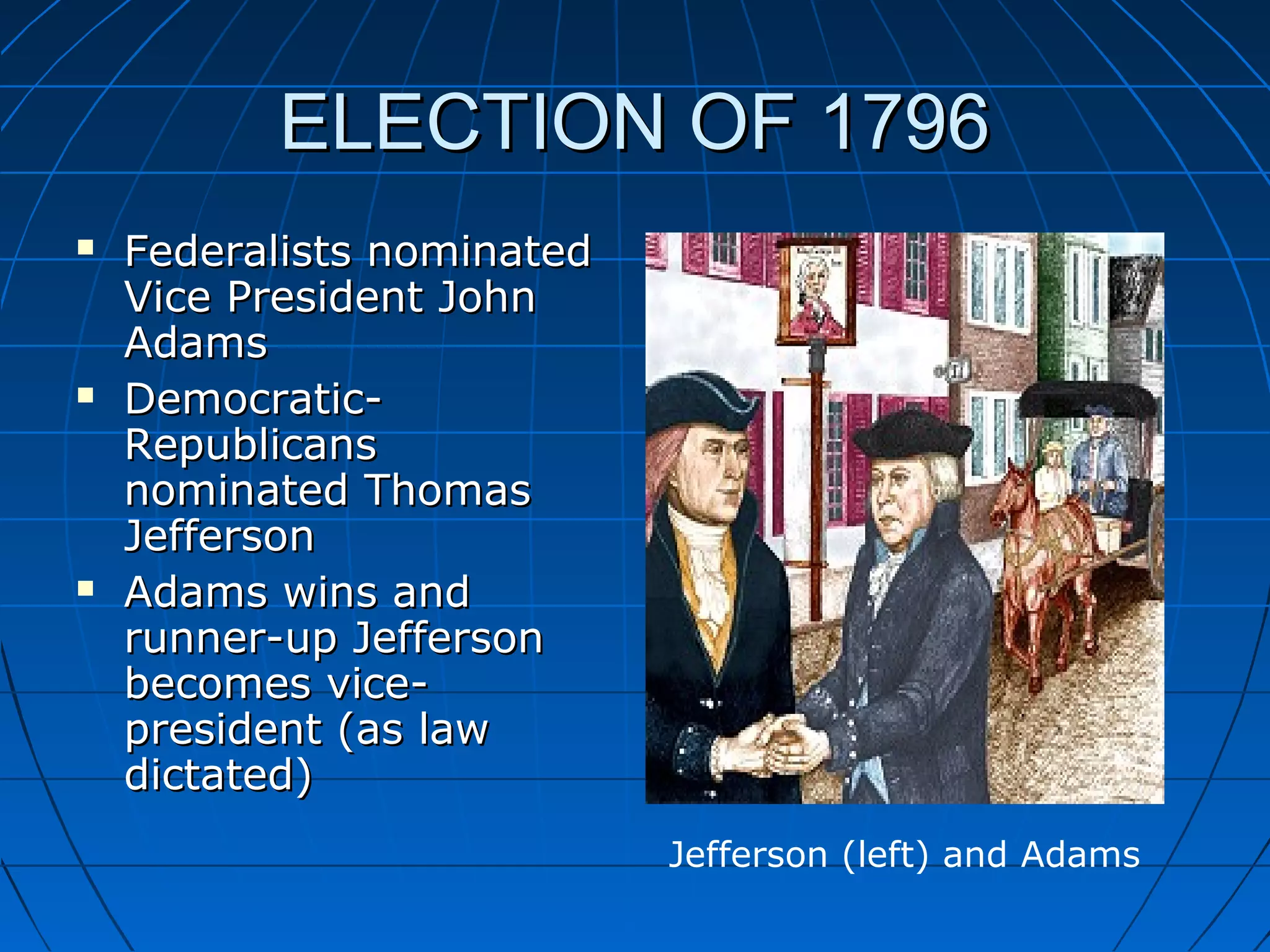
Jefferson (left) and Adams
XYZ AFFAIRXYZ AFFAIR
 Adams attempts to avoidAdams attempts to avoid
war with France afterwar with France after
France ships seizeFrance ships seize
American shipsAmerican ships
 He sends official to meetHe sends official to meet
with France foreignwith France foreign
ministerminister
 France sends three lowFrance sends three low
level officerslevel officers
 Adams is insulted andAdams is insulted and
refers to them as “X, Y,refers to them as “X, Y,
and Z”and Z”
 Next two years anNext two years an
undeclared naval warundeclared naval war
between France & U.S.between France & U.S.
was wagedwas waged
ALIEN AND SEDITION ACTSALIEN AND SEDITION ACTS
 To counter what heTo counter what he
considered a threat againstconsidered a threat against
the government, Adamsthe government, Adams
passed through Congresspassed through Congress
thethe Alien and Sedition ActsAlien and Sedition Acts
 Alien Act raised residenceAlien Act raised residence
requirements forrequirements for
citizenship from 5 to 14citizenship from 5 to 14
years and allowedyears and allowed
President to deport anyonePresident to deport anyone
 Sedition Act set fines & jailSedition Act set fines & jail
for anyone making falsefor anyone making false
statements against thestatements against the
governmentgovernment
STATES ATTEMPT TO NULLIFYSTATES ATTEMPT TO NULLIFY
ALIEN & SEDITION ACTSALIEN & SEDITION ACTS
 In an event that wouldIn an event that would
foreshadow futureforeshadow future
conflicts, twoconflicts, two
Southern States (Va,Southern States (Va,
& Ky.) asserted the& Ky.) asserted the
principle ofprinciple of
nullificationnullification
 Nullification meantNullification meant
that a state couldthat a state could
nullify, or considernullify, or consider
void, any act ofvoid, any act of
Congress theyCongress they
deemeddeemed
unconstitutionalunconstitutional
Chapter 2 powerpt - revolution and new nation

Chapter 2 powerpt - revolution and new nation

  • 1.
    CHAPTER 2:CHAPTER 2: REVOLUTIONAND THEREVOLUTION AND THE EARLY REPUBLICEARLY REPUBLIC
  • 2.
    COLONIAL RESISTANCE ANDCOLONIALRESISTANCE AND REBELLION – SECTION 1REBELLION – SECTION 1  TheThe Proclamation ofProclamation of 17631763 sought to haltsought to halt the westwardthe westward expansion of theexpansion of the colonist, thus thecolonist, thus the colonist believed thecolonist believed the British government didBritish government did not care about theirnot care about their needsneeds  This was one of manyThis was one of many measures passed bymeasures passed by thethe English ParliamentEnglish Parliament that would bethat would be strenuously opposedstrenuously opposed by the Americanby the American ColonistsColonists England’s Parliament and Big Ben
  • 3.
    NO TAXATION WITHOUTNOTAXATION WITHOUT REPRESENTATIONREPRESENTATION  Huge debt from theHuge debt from the French-Indian WarFrench-Indian War caused the Englishcaused the English Parliament toParliament to impose a series ofimpose a series of taxes on thetaxes on the colonistscolonists  TheThe Sugar ActSugar Act andand thethe Stamp ActStamp Act were two suchwere two such taxestaxes Colonists protest
  • 4.
    THE SUGAR ACTTHESUGAR ACT  The Sugar Act (1764)The Sugar Act (1764) placed duties (taxes)placed duties (taxes) on certain importson certain imports that had not beenthat had not been taxed beforetaxed before  More importantly, itMore importantly, it meant colonistsmeant colonists accused of violatingaccused of violating the Act were tried inthe Act were tried in Vice-Admiral CourtsVice-Admiral Courts rather than Colonialrather than Colonial CourtsCourts
  • 5.
    THE STAMP ACTTHESTAMP ACT  In March of 1765In March of 1765 Parliament passedParliament passed thethe Stamp ActStamp Act which imposed awhich imposed a tax on documentstax on documents and printed itemsand printed items such as wills,such as wills, newspapers, andnewspapers, and cards (a stampcards (a stamp would then bewould then be placed on the item)placed on the item)
  • 6.
    RESISTANCE GROWSRESISTANCE GROWS In May of 1765In May of 1765 Colonists formed aColonists formed a secret resistancesecret resistance group called,group called, SonsSons of Libertyof Liberty toto protest the lawsprotest the laws  Merchants agree toMerchants agree to boycott Britishboycott British goods until thegoods until the Acts are repealedActs are repealed
  • 7.
    MORE TAXES, MOREPROTESTSMORE TAXES, MORE PROTESTS  More taxes andMore taxes and acts soon followed:acts soon followed: Declaratory ActDeclaratory Act Townshend ActsTownshend Acts The Townshend ActsThe Townshend Acts taxed goodstaxed goods brought into thebrought into the colonies fromcolonies from Britain – includingBritain – including lead, paint, glass,lead, paint, glass, paper andpaper and TEATEA
  • 8.
    TENSION MOUNTS INTENSIONMOUNTS IN MASSACHUSETTSMASSACHUSETTS  The atmosphere inThe atmosphere in Boston was extremelyBoston was extremely tensetense  The city erupted inThe city erupted in bloody clashes and abloody clashes and a daring tax protest, alldaring tax protest, all of which pushed theof which pushed the colonists and Englandcolonists and England closer to warcloser to war  Boston MassacreBoston Massacre waswas in 1770 when a mobin 1770 when a mob taunted Britishtaunted British soldiers – 5 colonistssoldiers – 5 colonists were killedwere killed BOSTON MASSACRE 1770 BY PAUL REVERE
  • 9.
    BOSTON TEA PARTY1773BOSTON TEA PARTY 1773
  • 10.
    BRITS RESPOND TOTEABRITS RESPOND TO TEA VANDALSVANDALS  After 18,000 poundsAfter 18,000 pounds of tea was dumped byof tea was dumped by colonists into Bostoncolonists into Boston Harbor, King GeorgeHarbor, King George III was infuriatedIII was infuriated  Parliament respondedParliament responded by passing theby passing the Intolerable Acts;Intolerable Acts; which included thewhich included the closing of the Harbor,closing of the Harbor, the Quartering Act,the Quartering Act, Martial law in BostonMartial law in Boston
  • 11.
    THE ROAD TOREVOLUTIONTHE ROAD TO REVOLUTION  Colonists start toColonists start to organize andorganize and communicatecommunicate  First ContinentalFirst Continental CongressCongress met in 1774met in 1774 and drew up rightsand drew up rights  Military preparationMilitary preparation beganbegan  England reacts byEngland reacts by ordering troops toordering troops to seize weaponsseize weapons ATTENDEES INCLUDED SAMUEL ADAMS, PATRICK HENRY, AND GEORGE WASHINGTON FIRST CONTINENTAL CONGRESS - 1774 PHILLY
  • 12.
    LEXINGTON AND CONCORDLEXINGTONAND CONCORD  With Paul Revere’sWith Paul Revere’s announcement, theannouncement, the Colonists and theColonists and the British began fightingBritish began fighting in April of 1775in April of 1775  The first battle of theThe first battle of the American RevolutionAmerican Revolution lasted only 15lasted only 15 minutes, but itsminutes, but its impact has lasted forimpact has lasted for over 200 yearsover 200 years
  • 13.
    SECOND CONTINENTALSECOND CONTINENTAL CONGRESSCONGRESS May 1775, ColonialMay 1775, Colonial leaders met for aleaders met for a Second ContinentalSecond Continental CongressCongress  Some called forSome called for Independence, someIndependence, some for reconciliationfor reconciliation  Finally, the CongressFinally, the Congress agreed to appointagreed to appoint George WashingtonGeorge Washington asas head of thehead of the Continental ArmyContinental Army Patrick Henry addresses Congress
  • 14.
    BATTLE OF BUNKERHILLBATTLE OF BUNKER HILL  British GeneralBritish General Thomas GageThomas Gage decideddecided on an attack onon an attack on Breed’s Hill (nearBreed’s Hill (near Boston)Boston)  Deadliest battleDeadliest battle of warof war as over 1,000as over 1,000 redcoats and 450redcoats and 450 colonists diedcolonists died  BattleBattle misnamedmisnamed Bunker Hill (Breed’sBunker Hill (Breed’s Hill would have beenHill would have been more accurate)more accurate) June 1775 Battle of Bunker Hill
  • 16.
    OLIVE BRANCH PETITIONOLIVEBRANCH PETITION  By July 1775, theBy July 1775, the Second ContinentalSecond Continental Congress wasCongress was readying for war,readying for war, though still hoping forthough still hoping for peacepeace  Most delegates deeplyMost delegates deeply loyalloyal to King Georgeto King George IIIIII  July 8 –July 8 – Olive BranchOlive Branch PetitionPetition sent to Kingsent to King who flatly refused itwho flatly refused it
  • 17.
    INDEPENDENCE MINDEDINDEPENDENCE MINDED Public opinionPublic opinion shifted towardshifted toward IndependenceIndependence  Why?Why? EnlightenmentEnlightenment ideas (Johnideas (John Locke’sLocke’s Social ContractSocial Contract,, and Thomasand Thomas Paine’sPaine’s CommonCommon SenseSense)) HUGE BEST SELLER, “COMMON SENSE” 1776
  • 18.
    DECLARATION OFDECLARATION OF INDEPENDENCEINDEPENDENCE OnOn July 4, 1776July 4, 1776, the, the Continental CongressContinental Congress voted unanimouslyvoted unanimously that the Americanthat the American Colonies were free andColonies were free and they adopted thethey adopted the Declaration ofDeclaration of IndependenceIndependence  The Colonists hadThe Colonists had declared theirdeclared their independence– theyindependence– they would now have towould now have to fight for itfight for it JEFFERSON, ADAMS, & FRANKLIN
  • 20.
    THE WAR FORINDEPENDENCETHE WAR FOR INDEPENDENCE – SECTION 2– SECTION 2  Colonists dividedColonists divided betweenbetween LoyalistsLoyalists andand PatriotsPatriots  New York City earlyNew York City early site of battlessite of battles  Colonial troopsColonial troops retreat, thenretreat, then surprise Britishsurprise British troops attroops at SaratogaSaratoga
  • 21.
    WINNING THE WARWINNINGTHE WAR  With French military leaderWith French military leader Marquis de Lafayette’sMarquis de Lafayette’s help, Colonial troopshelp, Colonial troops became effective fightersbecame effective fighters  May 1780, British troopsMay 1780, British troops successfully take Charlessuccessfully take Charles Town, S.C.Town, S.C.  However, it was the lastHowever, it was the last major victory for themajor victory for the British asBritish as GeneralGeneral CornwallisCornwallis finallyfinally surrendered at Yorkstown,surrendered at Yorkstown, Va. on October 18, 1781Va. on October 18, 1781  TheThe Americans victoryAmericans victory shocked the worldshocked the world Cornwallis surrenders
  • 22.
    TREATY OF PARISTREATYOF PARIS  Peace talks began inPeace talks began in Paris in 1782Paris in 1782  American negotiatingAmerican negotiating team includedteam included JohnJohn Jay, John Adams, andJay, John Adams, and Ben FranklinBen Franklin  Treaty signed inTreaty signed in September of 1783September of 1783 and officiallyand officially recognized therecognized the independence of theindependence of the United States and setUnited States and set boundariesboundaries
  • 23.
    CONFEDERATION AND THECONFEDERATIONAND THE CONSTITUTION – SECTION 3CONSTITUTION – SECTION 3  After theAfter the Revolution, manyRevolution, many favored afavored a RepublicRepublic  Some supported aSome supported a strong federalstrong federal governmentgovernment (Federalists)(Federalists) whilewhile others favoredothers favored states rightsstates rights (Anti-(Anti- Federalists)Federalists)
  • 24.
    ARTICLES OF CONFEDERATIONARTICLESOF CONFEDERATION  The SecondThe Second Continental CongressContinental Congress issued a set of lawsissued a set of laws called thecalled the Articles ofArticles of ConfederationConfederation in 1781in 1781  Gave states one voteGave states one vote each in Congresseach in Congress regardless ofregardless of population of statepopulation of state  Split power betweenSplit power between National GovernmentNational Government and Stateand State
  • 25.
    ACCOMPLISHMENTS OFACCOMPLISHMENTS OF ARTICLESOF CONFEDERATIONARTICLES OF CONFEDERATION  America’sAmerica’s firstfirst ConstitutionConstitution  Established NationalEstablished National governments ability togovernments ability to wage war, signwage war, sign treaties, coin money,treaties, coin money, run post officerun post office  Land Ordinance ofLand Ordinance of 17851785 – made land– made land parcels small &parcels small & affordableaffordable  Northwest OrdinanceNorthwest Ordinance of 1787of 1787 – set– set requirement for statesrequirement for states
  • 26.
    WEAKNESSES OF THEARTICLEWEAKNESSES OF THE ARTICLE OF CONFEDERATIONOF CONFEDERATION  Congress could notCongress could not collect taxescollect taxes  Each state had oneEach state had one vote regardless ofvote regardless of populationpopulation  No executive branchNo executive branch  No national courtNo national court systemsystem  Nine of thirteen statesNine of thirteen states needed to agree toneeded to agree to pass any lawpass any law  Lacked national unityLacked national unity  Weak Central Gov’tWeak Central Gov’t
  • 27.
    SHAY’S REBELLIONSHAY’S REBELLION An event that highlightedAn event that highlighted the weakness of thethe weakness of the Central (National)Central (National) government wasgovernment was Shay’sShay’s RebellionRebellion  Farmers in westernFarmers in western Massachusetts rose up inMassachusetts rose up in protest over increasedprotest over increased taxestaxes  Daniel Shay led 1,200Daniel Shay led 1,200 farmers toward the arsenalfarmers toward the arsenal in Springfieldin Springfield  The event caused alarmThe event caused alarm throughout the republicthroughout the republic 1787
  • 29.
    CREATING A NEWCREATINGA NEW GOVERNMENTGOVERNMENT  The delegates at theThe delegates at the ConstitutionalConstitutional Convention realizedConvention realized the need tothe need to strengthen the centralstrengthen the central governmentgovernment  They soon decided toThey soon decided to create an entirely newcreate an entirely new Constitution instead ofConstitution instead of amending the Articlesamending the Articles  CompromiseCompromise was thewas the order of the dayorder of the day“Compromise”
  • 30.
    VIRGINIA VS. NEWJERSEYVIRGINIA VS. NEW JERSEY PLANSPLANS  Virginia Plan:Virginia Plan: BicameralBicameral Legislation basedLegislation based on state populationon state population  New Jersey Plan:New Jersey Plan: UnicameralUnicameral Legislation basedLegislation based on one state = oneon one state = one votevote
  • 31.
    GREAT COMPROMISEGREAT COMPROMISE After a deadlockedAfter a deadlocked that dragged on & on,that dragged on & on, Roger ShermanRoger Sherman finallyfinally suggested the Greatsuggested the Great Compromise whichCompromise which satisfied both big &satisfied both big & small statessmall states  Bicameral CongressBicameral Congress with House of Repswith House of Reps based on populationbased on population (VA Plan) and Senate(VA Plan) and Senate based on one state =based on one state = one vote (NJ Plan)one vote (NJ Plan)
  • 32.
    THREE-FIFTHS COMPROMISETHREE-FIFTHS COMPROMISE Next difficult issue:Next difficult issue: SlaverySlavery  Southern statesSouthern states wanted slaveswanted slaves included in theincluded in the population figurespopulation figures used to determineused to determine RepresentativesRepresentatives  Northern states whichNorthern states which had few slaves,had few slaves, disagreeddisagreed  Compromise was toCompromise was to count each slave ascount each slave as 3/5ths3/5ths of a personof a person
  • 33.
    DIVISION OF POWERSDIVISIONOF POWERS  Next issue: Should theNext issue: Should the National government orNational government or the states hold power?the states hold power? Who shall beWho shall be sovereign?sovereign?  Delegates choose to splitDelegates choose to split powerpower  FederalismFederalism systemsystem developeddeveloped  Federal government hadFederal government had delegated, or enumerateddelegated, or enumerated powers (Coin, trade, war,powers (Coin, trade, war, etc.)etc.)  States had reservedStates had reserved powers (education)powers (education)
  • 39.
  • 40.
    RATIFYING THE CONSTITUTIONRATIFYINGTHE CONSTITUTION  The ConstitutionalThe Constitutional Convention adjournedConvention adjourned in September of 1787in September of 1787  Nine of thirteen statesNine of thirteen states had to ratify thehad to ratify the ConstitutionConstitution  Supporters of theSupporters of the Constitution wereConstitution were Federalists. ThoseFederalists. Those opposed were Anti-opposed were Anti- FederalistFederalist
  • 41.
    FEDERALISTFEDERALIST  Led byLedby AlexanderAlexander Hamilton, JamesHamilton, James Madison and John Jay,Madison and John Jay, Federalist believedFederalist believed that while thethat while the Constitution was notConstitution was not perfect, it was farperfect, it was far superior to the Articlessuperior to the Articles of Confederationof Confederation  They favored a strongThey favored a strong central governmentcentral government James Madison “Father of the Constitution”
  • 42.
    ANTI-FEDERALISTANTI-FEDERALIST  The Anti-FederalistTheAnti-Federalist view was that theview was that the Constitution did notConstitution did not guarantee the rightsguarantee the rights of the people of theof the people of the statesstates  Led byLed by Patrick Henry,Patrick Henry, George Mason, andGeorge Mason, and Richard Henry Lee,Richard Henry Lee, the Anti-Federaliststhe Anti-Federalists wanted a Bill of Rightswanted a Bill of Rights to off-set the strongto off-set the strong central governmentcentral government Lee penned his views in the widely read, Letters from the Federal Farmers
  • 43.
    ADOPTION OF THEBILL OFADOPTION OF THE BILL OF RIGHTSRIGHTS  To satisfy the States-To satisfy the States- Rights advocates, aRights advocates, a Bill of Rights wasBill of Rights was added to theadded to the Constitution toConstitution to guarantee individualguarantee individual rightsrights  The Bill of Rights wasThe Bill of Rights was ratified in Decemberratified in December of 1791- three yearsof 1791- three years after the Constitutionafter the Constitution was ratifiedwas ratified First Ten Amendments
  • 44.
    OLDEST LIVING CONSTITUTIONOLDESTLIVING CONSTITUTION  The U.S. ConstitutionThe U.S. Constitution is the oldest writtenis the oldest written national constitution innational constitution in the worldthe world  Elastic ClauseElastic Clause key tokey to flexibilityflexibility  Also ability to change,Also ability to change, or “amend” theor “amend” the Constitution helpsConstitution helps preserve itpreserve it  27 Amendments have27 Amendments have been addedbeen added
  • 45.
    LAUNCHING THE NEWNATION –LAUNCHING THE NEW NATION – SECTION 4SECTION 4  TheThe herohero of theof the Revolution was theRevolution was the unanimous choice forunanimous choice for the nation’s firstthe nation’s first presidentpresident  WashingtonWashington took officetook office under the Constitutionunder the Constitution and with the Congressand with the Congress  He faced an enormousHe faced an enormous task of creating atask of creating a newnew governmentgovernment America’s First President
  • 46.
    JUDICIARY ACT OF1789JUDICIARY ACT OF 1789  One of Washington’sOne of Washington’s first tasks was tofirst tasks was to create a judicialcreate a judicial systemsystem  Judiciary Act set upJudiciary Act set up our justice systemour justice system  The act called for aThe act called for a Supreme Court,Supreme Court, federal courts, andfederal courts, and district courtsdistrict courts  The systemThe system guaranteed that theguaranteed that the federal laws wouldfederal laws would remain “supreme”remain “supreme”
  • 47.
    WASHINGTON CREATESWASHINGTON CREATES DEPARTMENTSDEPARTMENTS WashingtonWashington createdcreated 33 executiveexecutive branchesbranches  StateState: Thomas: Thomas JeffersonJefferson  WarWar: Henry Knox: Henry Knox  TreasuryTreasury:: Alexander HamiltonAlexander Hamilton
  • 49.
    Hamilton Vs. JeffersonHamiltonVs. Jefferson  Hamilton was aHamilton was a staunch Federalist,staunch Federalist, while Jefferson waswhile Jefferson was an Anti-Federalistan Anti-Federalist  Hamilton believedHamilton believed in commerce &in commerce & industry, whileindustry, while Jefferson believedJefferson believed in a society ofin a society of farmer-citizensfarmer-citizens
  • 50.
    HAMILTON’S ECONOMIC PLANHAMILTON’SECONOMIC PLAN  Hamilton wanted aHamilton wanted a National BankNational Bank fullyfully funded by thefunded by the GovernmentGovernment  Opponents, like JamesOpponents, like James Madison, felt theMadison, felt the Constitution made noConstitution made no provisions for such aprovisions for such a Federal bankFederal bank  Thus begins a longThus begins a long battle between thosebattle between those whowho interpret theinterpret the Constitution looselyConstitution loosely vs. strictlyvs. strictly
  • 51.
    TWO-PARTY SYSTEMTWO-PARTY SYSTEM Differences withinDifferences within Washington’s cabinetWashington’s cabinet gave rise to agave rise to a Two-Two- Party SystemParty System  Supporters Hamilton’sSupporters Hamilton’s strong governmentstrong government view calledview called themselvesthemselves FederalistsFederalists  Supporters ofSupporters of Jefferson’s vision of aJefferson’s vision of a strong statestrong state government weregovernment were calledcalled Democratic-Democratic- RepublicansRepublicans
  • 52.
    WHISKEY REBELLIONWHISKEY REBELLION During Washington’sDuring Washington’s 22ndnd term in officeterm in office (1794),(1794), WhiskeyWhiskey farmers,farmers, angered byangered by an excessivean excessive taxtax,, attacked tax collectorsattacked tax collectors  Washington respondedWashington responded with great forcewith great force (13,000 troops)(13,000 troops)  Set precedent forSet precedent for armed force toarmed force to support federalsupport federal authorityauthority
  • 53.
    ELECTION OF 1796ELECTIONOF 1796  Federalists nominatedFederalists nominated Vice President JohnVice President John AdamsAdams  Democratic-Democratic- RepublicansRepublicans nominated Thomasnominated Thomas JeffersonJefferson  Adams wins andAdams wins and runner-up Jeffersonrunner-up Jefferson becomes vice-becomes vice- president (as lawpresident (as law dictated)dictated) Jefferson (left) and Adams
  • 54.
    XYZ AFFAIRXYZ AFFAIR Adams attempts to avoidAdams attempts to avoid war with France afterwar with France after France ships seizeFrance ships seize American shipsAmerican ships  He sends official to meetHe sends official to meet with France foreignwith France foreign ministerminister  France sends three lowFrance sends three low level officerslevel officers  Adams is insulted andAdams is insulted and refers to them as “X, Y,refers to them as “X, Y, and Z”and Z”  Next two years anNext two years an undeclared naval warundeclared naval war between France & U.S.between France & U.S. was wagedwas waged
  • 55.
    ALIEN AND SEDITIONACTSALIEN AND SEDITION ACTS  To counter what heTo counter what he considered a threat againstconsidered a threat against the government, Adamsthe government, Adams passed through Congresspassed through Congress thethe Alien and Sedition ActsAlien and Sedition Acts  Alien Act raised residenceAlien Act raised residence requirements forrequirements for citizenship from 5 to 14citizenship from 5 to 14 years and allowedyears and allowed President to deport anyonePresident to deport anyone  Sedition Act set fines & jailSedition Act set fines & jail for anyone making falsefor anyone making false statements against thestatements against the governmentgovernment
  • 56.
    STATES ATTEMPT TONULLIFYSTATES ATTEMPT TO NULLIFY ALIEN & SEDITION ACTSALIEN & SEDITION ACTS  In an event that wouldIn an event that would foreshadow futureforeshadow future conflicts, twoconflicts, two Southern States (Va,Southern States (Va, & Ky.) asserted the& Ky.) asserted the principle ofprinciple of nullificationnullification  Nullification meantNullification meant that a state couldthat a state could nullify, or considernullify, or consider void, any act ofvoid, any act of Congress theyCongress they deemeddeemed unconstitutionalunconstitutional