The Economic Way of
Thinking (Part 1)
Introduction to Economics
What Is Economics?
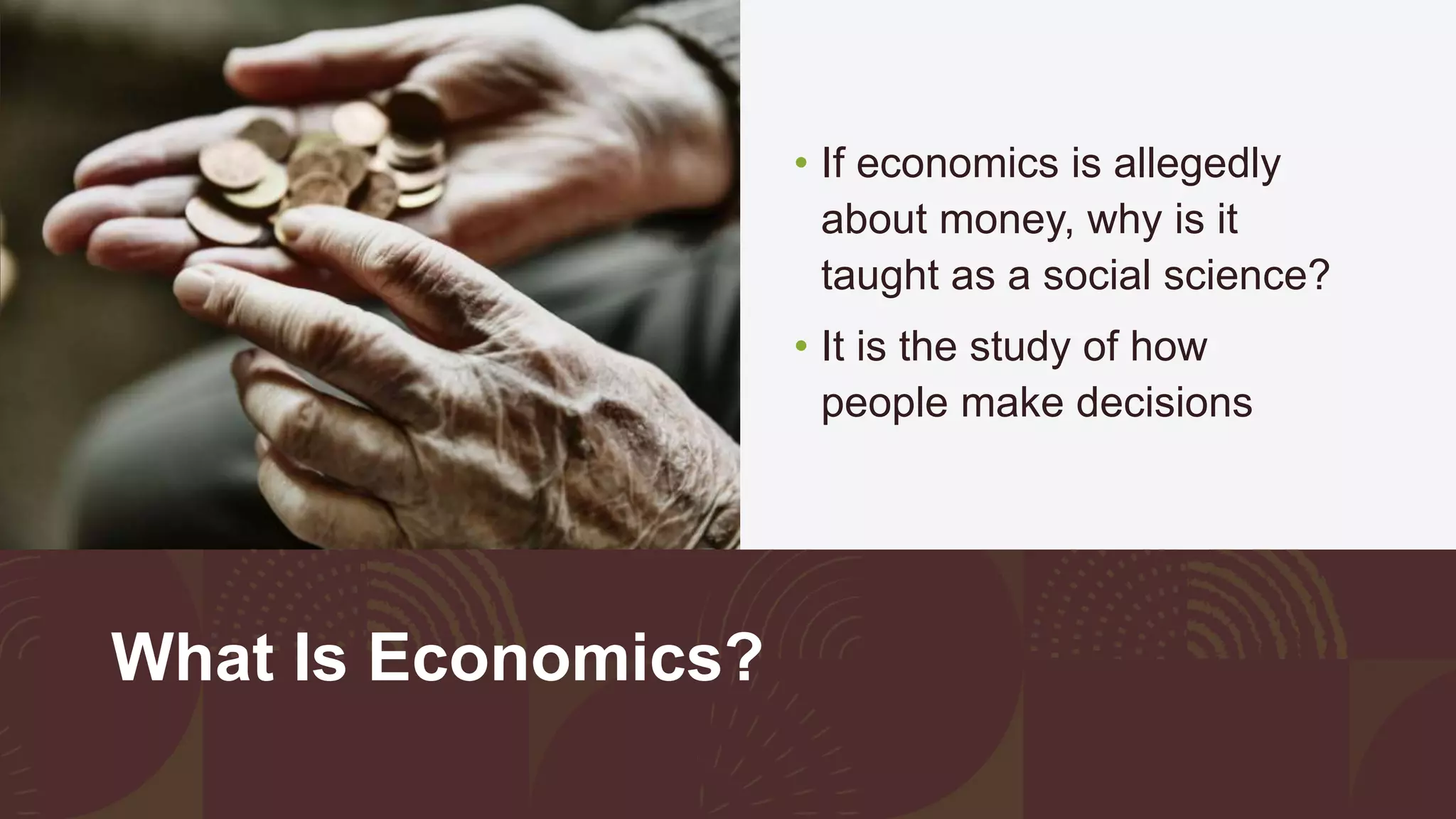
• If economics is allegedly
about money, why is it
taught as a social science?
• It is the study of how
people make decisions
What Is Economics?
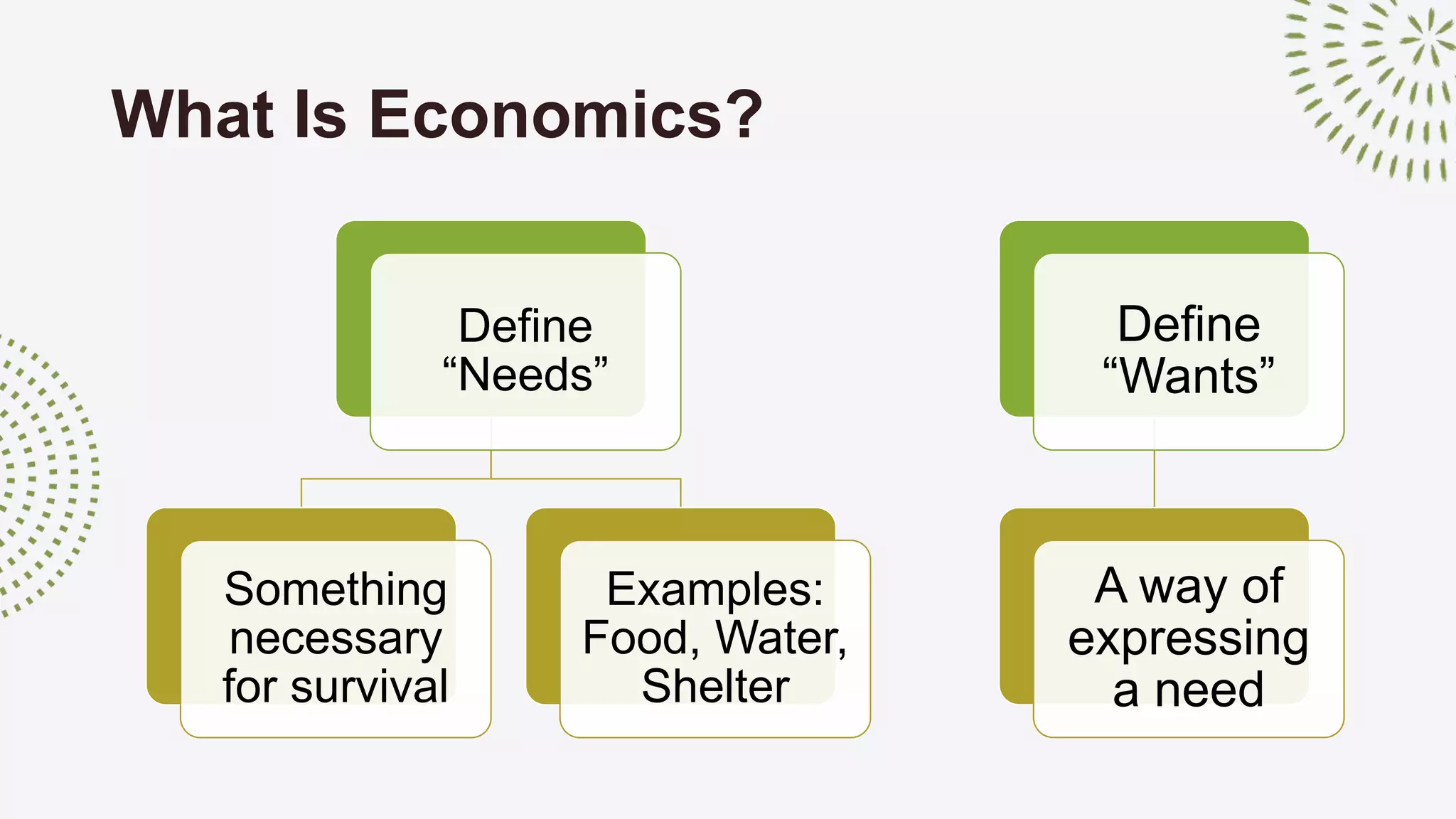
Define
“Needs”
Something
necessary
for survival
Examples:
Food, Water,
Shelter
Define
“Wants”
A way of
expressing
a need
What Is Economics?
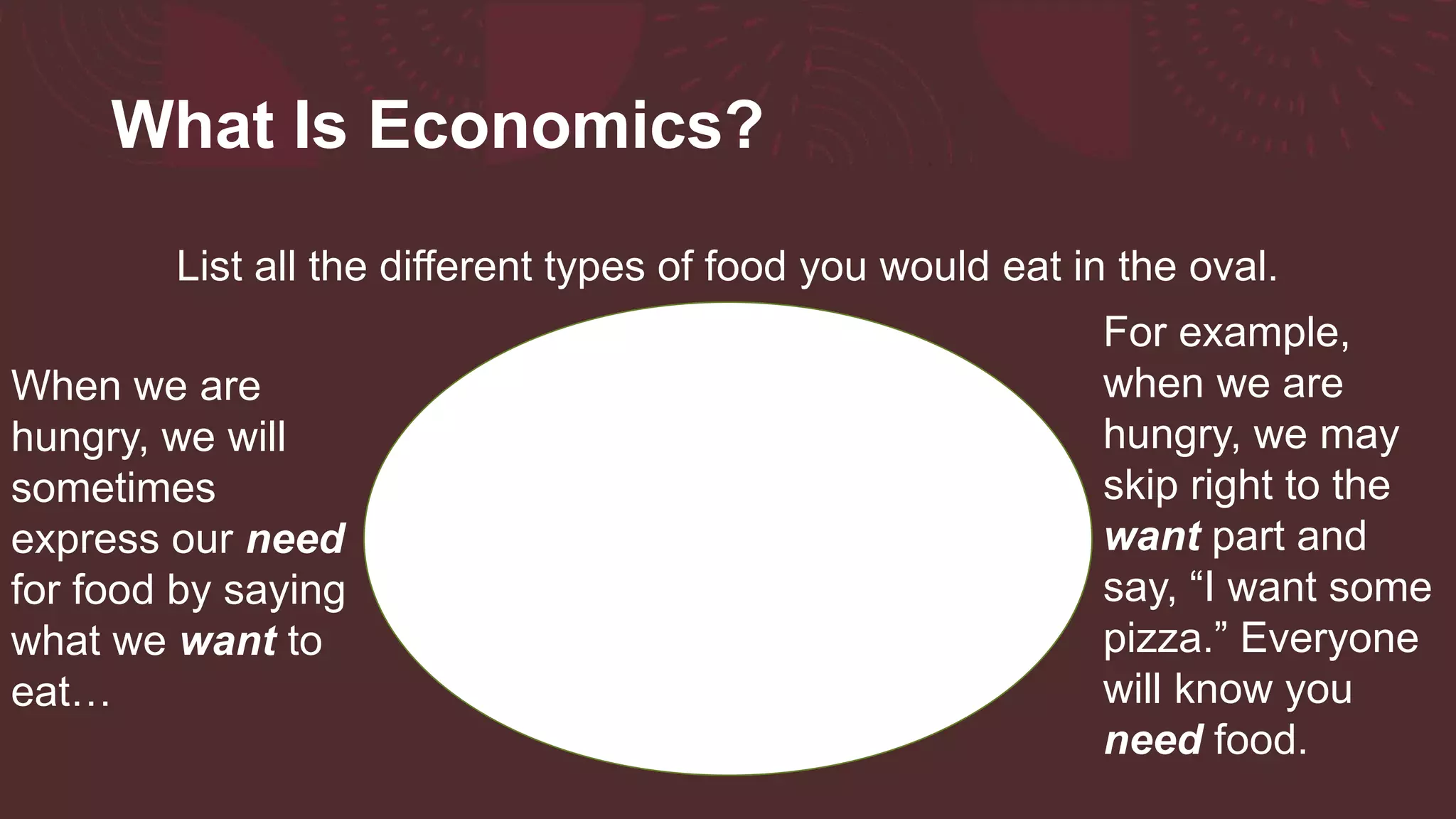
List all the different types of food you would eat in the oval.
When we are
hungry, we will
sometimes
express our need
for food by saying
what we want to
eat…
For example,
when we are
hungry, we may
skip right to the
want part and
say, “I want some
pizza.” Everyone
will know you
need food.
What Is Economics?
What are “Trade-Offs”?
• All the options to choose from
when deciding how to fulfill a
Need
• When deciding which food to
eat, all the different options are
your trade-offs.
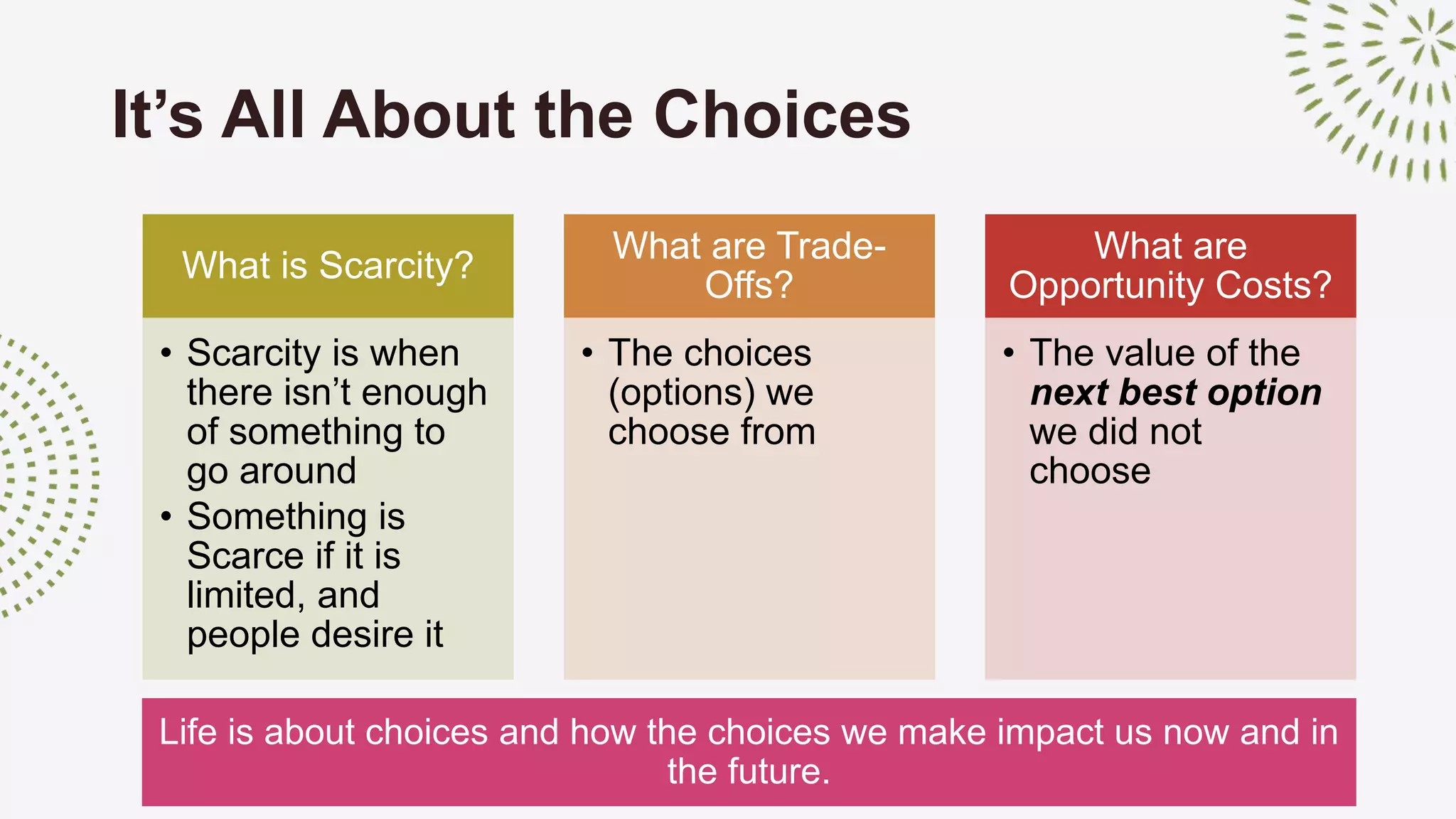
It’s All About the Choices
What is Scarcity?
• Scarcity is when
there isn’t enough
of something to
go around
• Something is
Scarce if it is
limited, and
people desire it
What are Trade-
Offs?
• The choices
(options) we
choose from
What are
Opportunity Costs?
• The value of the
next best option
we did not
choose
Life is about choices and how the choices we make impact us now and in
the future.
Basic Principles
of Economic
Reasoning
Knowledge Is
Power
The more information you have about
your trade-offs (choices), the better
decisions you can make.
1. People Choose (Everything has a
cost)
TINSTAAFL “There is not such thing as a free lunch.”
Every action costs someone time, effort, or lost opportunity to do
something else.
Opportunity Cost is the value of the next best choice you did not
make.
Not all costs are in dollars and cents.
1. People Choose (Everything has a
cost)
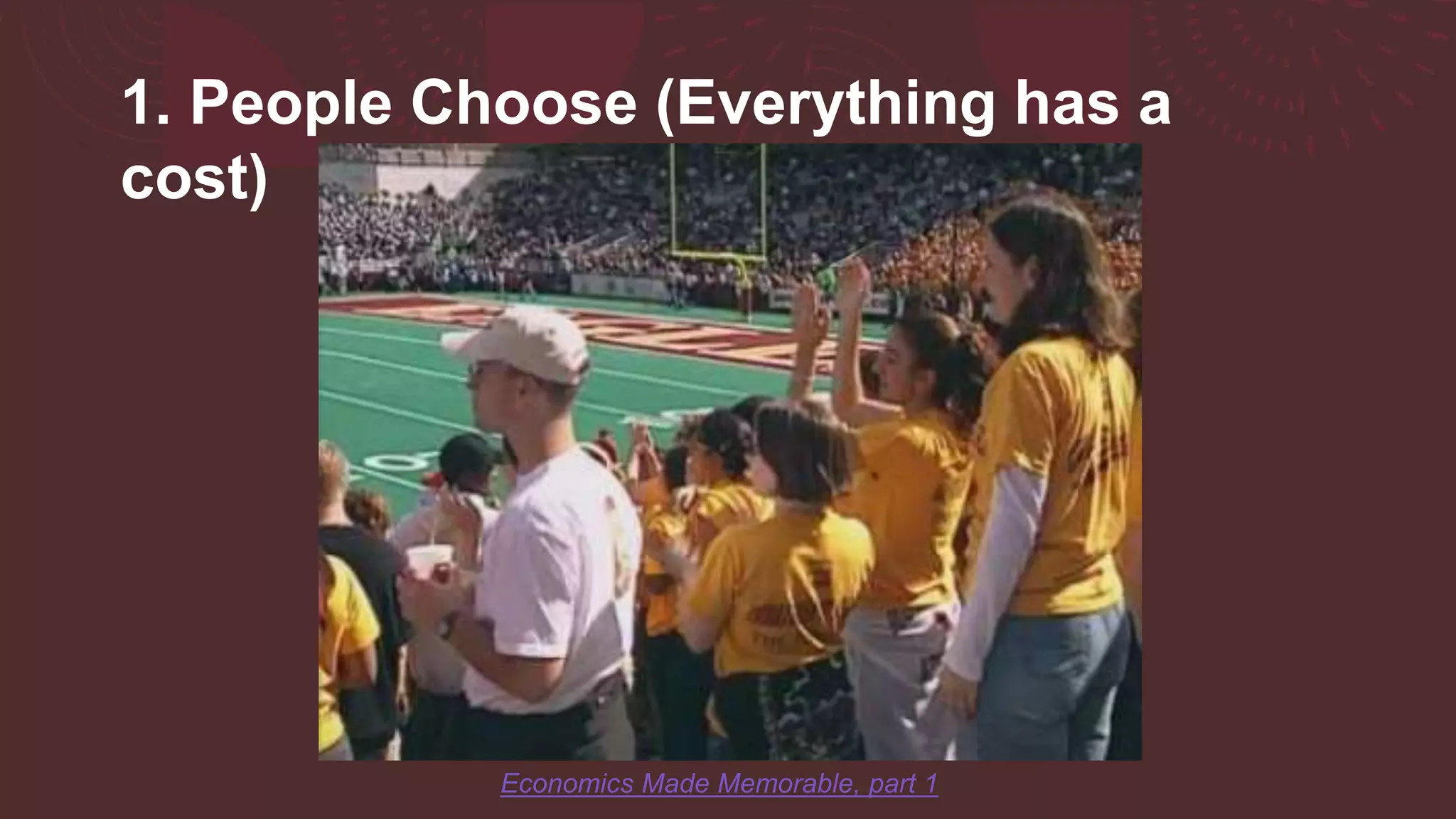
Economics Made Memorable, part 1
2. People Choose
for Good Reasons
People make decisions based on
what they believe is most
important to them
While this may vary from person
to person, it is usually the same
for most people for any given
choice
Rational Choices involve
weighing the benefits against the
costs – “cost benefit analysis”
2. People Choose for Good Reasons
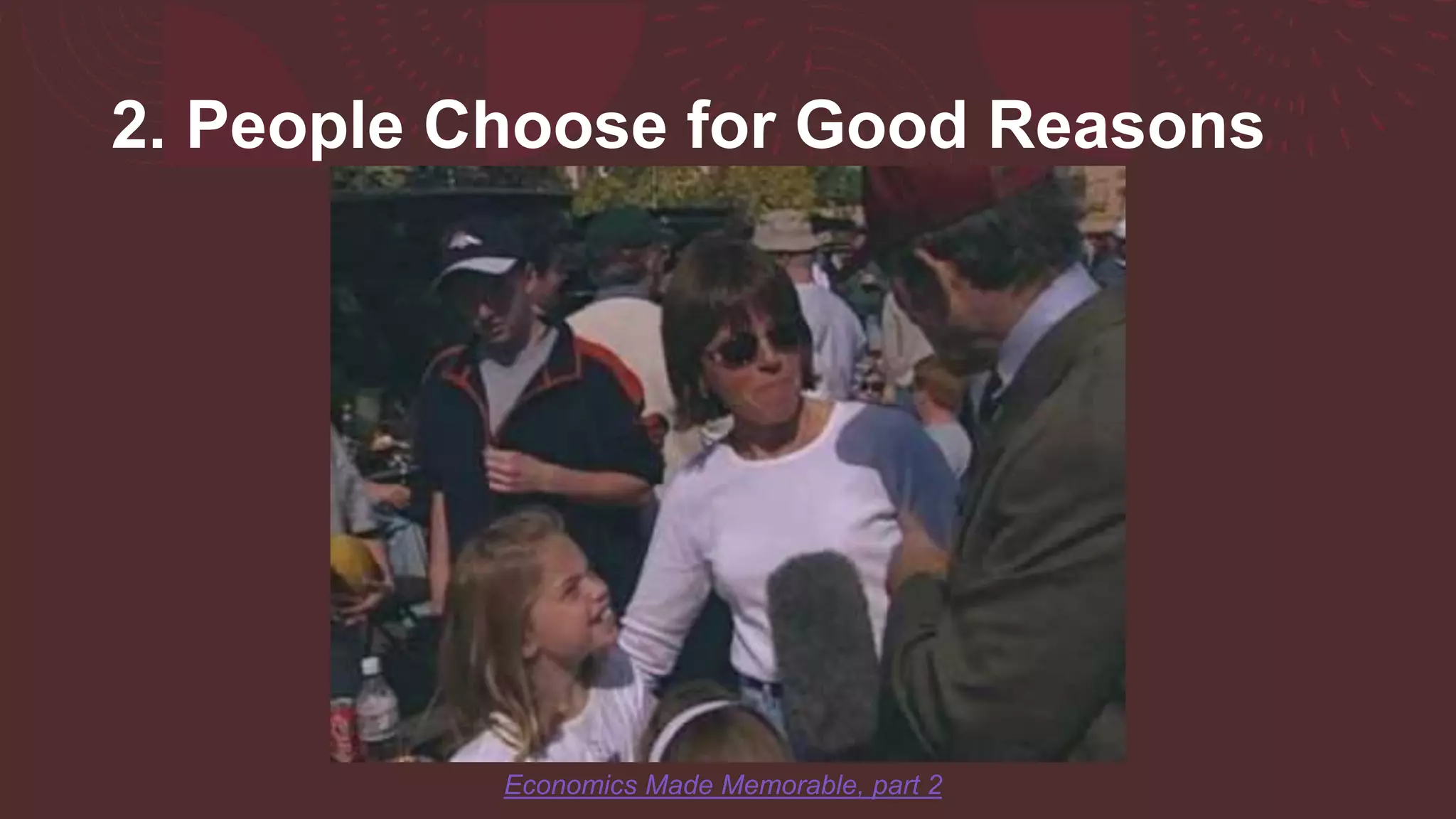
Economics Made Memorable, part 2
2. People Choose for Good Reasons
• Production Possibilities Curves (Frontiers)
3. Incentives Matter
When people make their Rational Choices, weighing the
benefits against the costs, they are comparing the
incentives involved in making the decision
When incentive change, people’s behavior changes in
predictable ways
Incentives can be positives, such as a reward or added
benefit, or a punishment or additional cost
3. Incentives
Matter
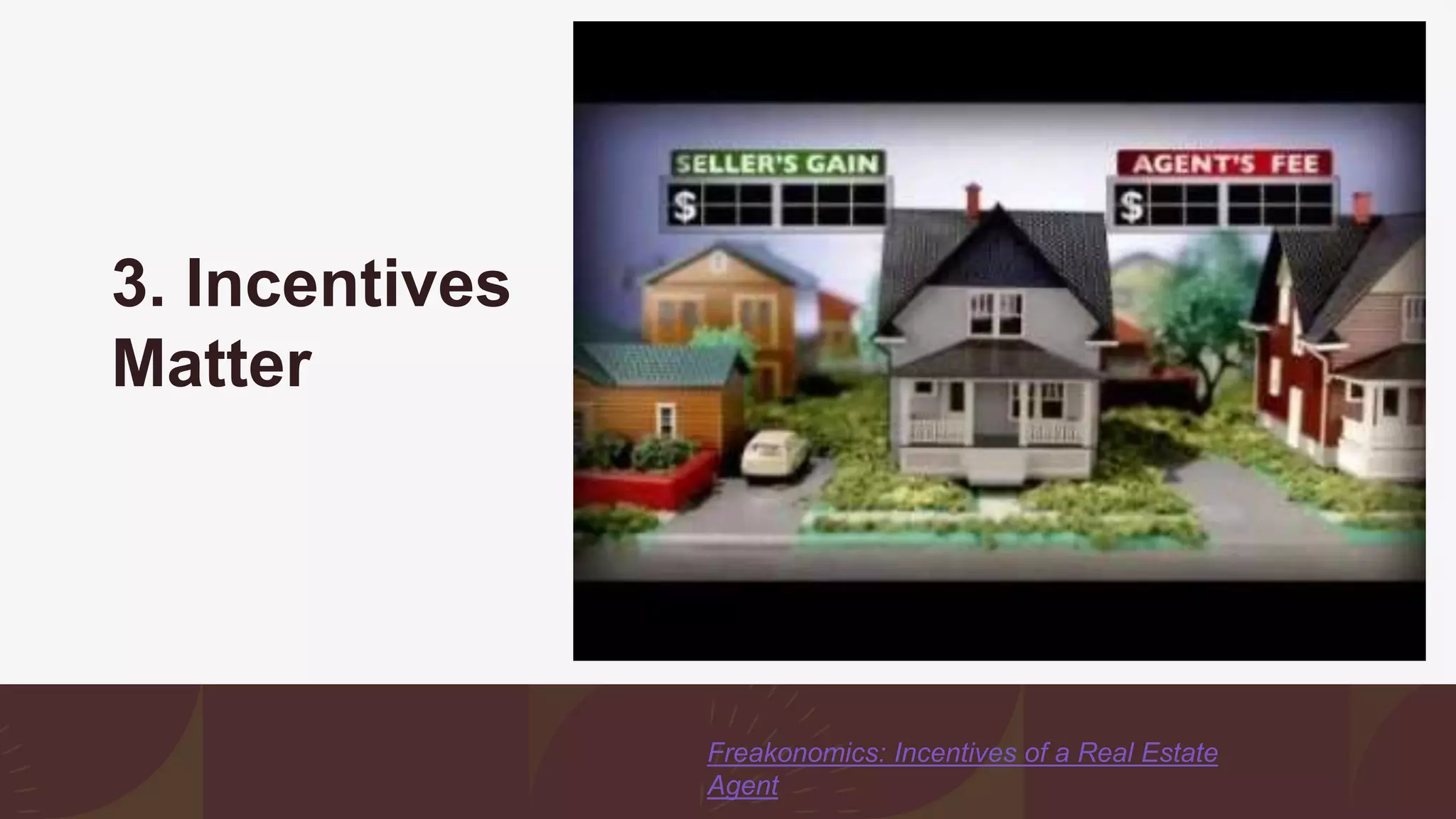
Freakonomics: Incentives of a Real Estate
Agent

The Economic Way of Thinking Part 1 v2.pptx

  • 1.
    The Economic Wayof Thinking (Part 1) Introduction to Economics
  • 2.
    What Is Economics? •If economics is allegedly about money, why is it taught as a social science? • It is the study of how people make decisions
  • 3.
    What Is Economics? Define “Needs” Something necessary forsurvival Examples: Food, Water, Shelter Define “Wants” A way of expressing a need
  • 4.
    What Is Economics? Listall the different types of food you would eat in the oval. When we are hungry, we will sometimes express our need for food by saying what we want to eat… For example, when we are hungry, we may skip right to the want part and say, “I want some pizza.” Everyone will know you need food.
  • 5.
    What Is Economics? Whatare “Trade-Offs”? • All the options to choose from when deciding how to fulfill a Need • When deciding which food to eat, all the different options are your trade-offs.
  • 6.
    It’s All Aboutthe Choices What is Scarcity? • Scarcity is when there isn’t enough of something to go around • Something is Scarce if it is limited, and people desire it What are Trade- Offs? • The choices (options) we choose from What are Opportunity Costs? • The value of the next best option we did not choose Life is about choices and how the choices we make impact us now and in the future.
  • 7.
  • 8.
    Knowledge Is Power The moreinformation you have about your trade-offs (choices), the better decisions you can make.
  • 9.
    1. People Choose(Everything has a cost) TINSTAAFL “There is not such thing as a free lunch.” Every action costs someone time, effort, or lost opportunity to do something else. Opportunity Cost is the value of the next best choice you did not make. Not all costs are in dollars and cents.
  • 10.
    1. People Choose(Everything has a cost) Economics Made Memorable, part 1
  • 11.
    2. People Choose forGood Reasons People make decisions based on what they believe is most important to them While this may vary from person to person, it is usually the same for most people for any given choice Rational Choices involve weighing the benefits against the costs – “cost benefit analysis”
  • 12.
    2. People Choosefor Good Reasons Economics Made Memorable, part 2
  • 13.
    2. People Choosefor Good Reasons • Production Possibilities Curves (Frontiers)
  • 14.
    3. Incentives Matter Whenpeople make their Rational Choices, weighing the benefits against the costs, they are comparing the incentives involved in making the decision When incentive change, people’s behavior changes in predictable ways Incentives can be positives, such as a reward or added benefit, or a punishment or additional cost
  • 15.

Editor's Notes

  • #2 The most important things student will get from this course is how to think economically. Some students already do, while others have never needed to think this way before. It is important that students learn that there are costs to every decision. This presentation accompanies guided notes that you can use to have students follow along and participate. This presentation takes more than one day, especially if you get students involved in the discussion.
  • #3 Give students a moment to process the questions ”Why is economics a social science?” They may need to be told or asked what a social science is.
  • #4 Ask students to raise their hand to define ‘needs’ Ask for examples – direct students towards “Food” “Water” “Shelter” if they cannot get to that answer on their own Ask students to raise their hand to define ‘wants’ After their definition, give them the one in the presentation. – The next slide should make this definition clearer
  • #5 Have students list as many foods as they would eat in the oval. Give them time to fill their space. Ask students share what they put in their oval, raise hands, share one item. - write their responses on the board. Reveal the text boxes – when we are hungry we don’t usually say ”I need food” instead we express our hunger by saying what we want, “I want pizza.”
  • #6 Ask the class. Call on a students to answer What are “Trade-Offs”?
  • #7 One by one give the students an opportunity to share answers, then reveal the answer before going to the next question.
  • #10 Use the article, “TINSTAAFL: There’s Always a Cost Associated with Free Shipping” Discuss hidden cost or the ideas that costs may be shifted from the individual receiving the benefit to someone else or can be shifted to another category.
  • #11 If you are unable to play the video directly in the presentation, the title below the video is a link to the video on YouTube. This is also the web address http://youtu.be/Ae-oXpyftlo There is a time stamp page I use to pause the video and emphasize some points by giving examples.
  • #13 If you are unable to play the video directly in the presentation, the title below the video is a link to the video on YouTube. This is also the web address http://youtu.be/ddvE6jChOGc There is a time stamp page I use to pause the video and emphasize some points by giving examples.
  • #14 1) This is where I introduce Production Possibility Curves. I use an example to have students choose how they use time… After school on any given Monday-Thursday you may have 4 hours of time that YOU get to decide how to spend. For simplicity's sake, let’s say you can choose to spend it on ”Leisure Activities” or “Academic Activities.” Using whole hour increments (1 hour, 2 hours, 3 hours, 4 hours), how can you choose to divide up your 4 hours after school between Leisure or Academic Activities? On the board I make a t-chart for Leisure and Academic and list the possible combinations using whole hour increments. Then I draw a graph (Which type of activity can go on either axis, it is necessary to have a specific type of activity on the x-axis or y-axis. 2) Next, we complete activity “Practice with PPFs” one side at a time.
  • #15 Matching incentives to goals can improve outcomes. When accurately aligned incentives will change people’s behaviors in predictable ways.
  • #16 If you are unable to play the video directly in the presentation, the title below the video is a link to the video on YouTube. This is also the web address https://www.youtube.com/watch?v=UVk6MoBbxbk This video illustrates how incentives that are misaligned can result in unintended outcomes.