hist
ory
of
archit
ect
ure
History of Architecture
Part I- Ancient Architecture
Lecture - I
hist
ory
of
archit
ect
ure
COURSE AIM
Analytical study of past architectural antecedents of earliest
civilizations viewed under the scope of the elements
principles and objectives of visual design.
COURSE OBJECTIVES
*To be acquainted with architectural innovations and
shortcomings of past civilizations using it as a springboard to
forge a better understanding of the present.
•Evaluate how influences such as climate, topography,
location, religion, purpose and composition affect the
architecture of a place.
*To have an understanding that the building materials
available and the technology developed to utilize them
through different civilizations largely determine the nature of
the architecture of that civilization.
*Most importantly, to inspire students to evaluate the
intentions and visual expressions of past civilizations in terms
of the elements, principles and objectives of visual design.
OUR METHOD OF STUDYING HISTORY:
To try not to memorize… but to understand
History is not a list of facts… it is a story that can be retold
over and over
REFERENCES
1. Ching, Francis D.K., A Visual Dictionary of Architecture
2. Fletcher, Bannister, A History of Architecture 20th Ed.
3. Mercado, Jose L., The Architectural Reviewer Volume
III: History & Theory of Architecture
4. Salvan, George S., Architectural Character & the History
of Architecture
5. The Children’s Atlas of World History
6. The World Atlas of Architecture
DEFINITIONS
History of Architecture
• It is the study of the chronological record of events (as
affecting a nation or people), based on a critical
examination of architectural source materials and usually
presenting an explanation of their causes from ancient
periods to the present day.
Historic Styles of Architecture
• "The particular method, the characteristics, manner of
design which prevails at a certain place and time.“
Six Influences of Architecture
• Geographical
• Geological
• Climatic
• Religious
• Social
• Historical
Four Great Constructive Principles
1. Post & Lintel Construction
2. Arch & Vault Construction
3. Corbel or Cantilever Construction
4. Trussed Construction
Introduction
hist
ory
of
archit
ect
ure
Introduction
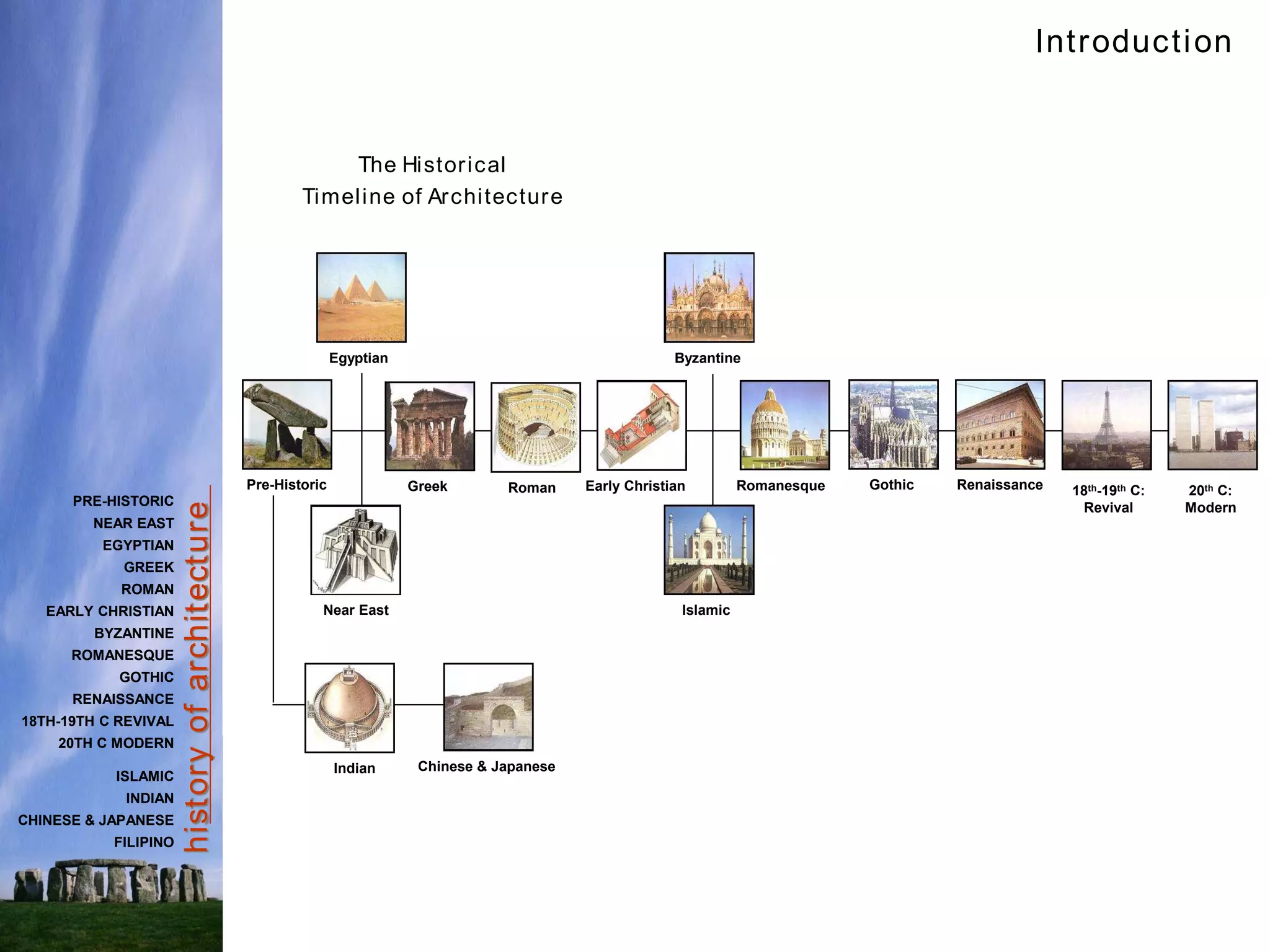
Pre-Historic
Egyptian
Near East
Gothic
Roman Renaissance 18th-19th C:
Revival
20th C:
Modern
Byzantine
Islamic
Early Christian
Chinese & Japanese
Indian
Greek Romanesque
The Historical
Timeline of Architecture
PRE-HISTORIC
NEAR EAST
EGYPTIAN
GREEK
ROMAN
EARLY CHRISTIAN
BYZANTINE
ROMANESQUE
GOTHIC
RENAISSANCE
18TH-19TH C REVIVAL
20TH C MODERN
ISLAMIC
INDIAN
CHINESE & JAPANESE
FILIPINO
hist
ory
of
archit
ect
ure
The Historical
Timeline of Architecture
Pre-historic
PRE-HISTORIC
NEAR EAST
EGYPTIAN
GREEK
ROMAN
EARLY CHRISTIAN
BYZANTINE
ROMANESQUE
GOTHIC
RENAISSANCE
18TH-19TH C REVIVAL
20TH C MODERN
ISLAMIC
INDIAN
CHINESE & JAPANESE
FILIPINO
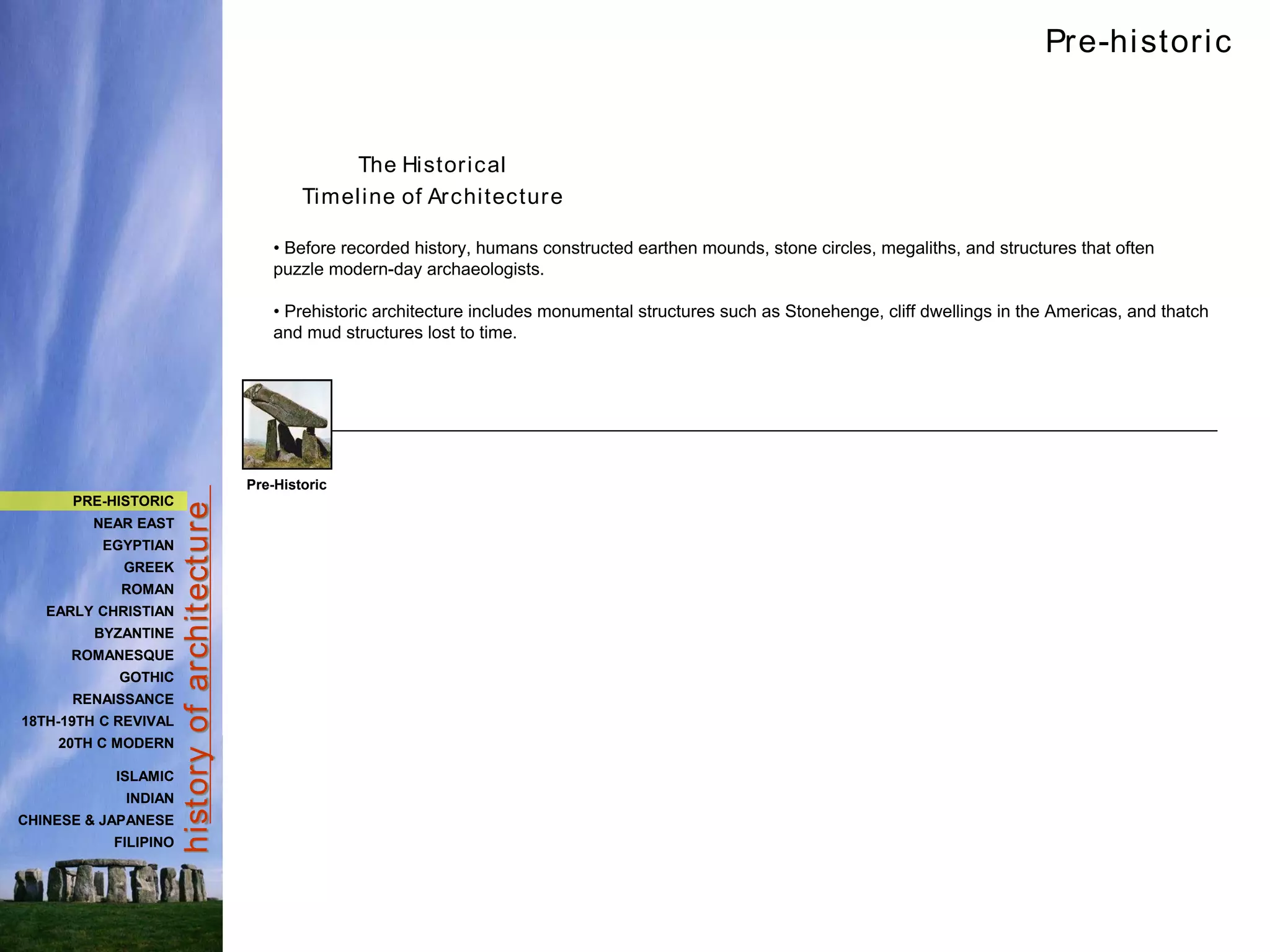
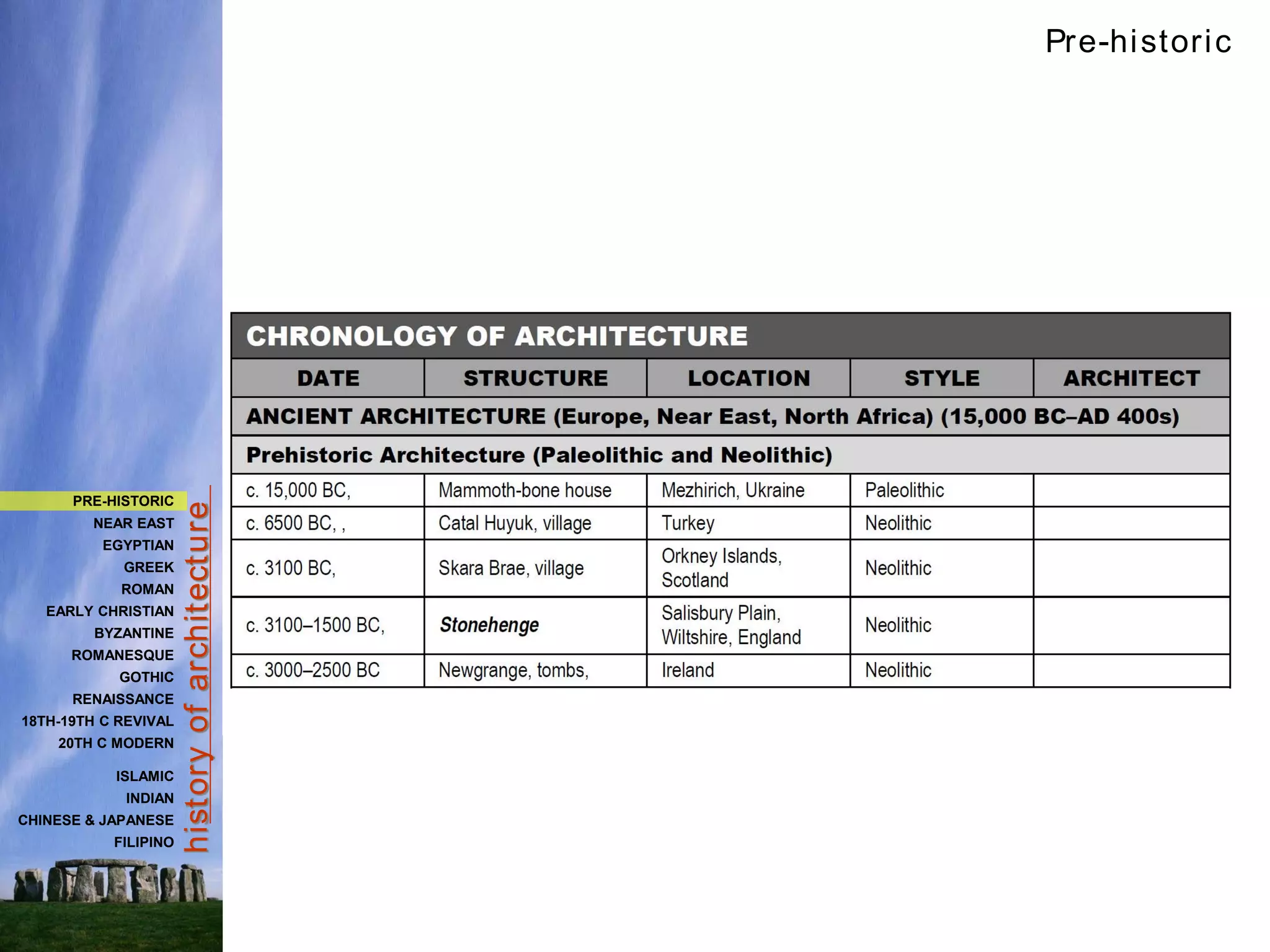
Pre-Historic
• Before recorded history, humans constructed earthen mounds, stone circles, megaliths, and structures that often
puzzle modern-day archaeologists.
• Prehistoric architecture includes monumental structures such as Stonehenge, cliff dwellings in the Americas, and thatch
and mud structures lost to time.
hist
ory
of
archit
ect
ure
INFLUENCES
HISTORY
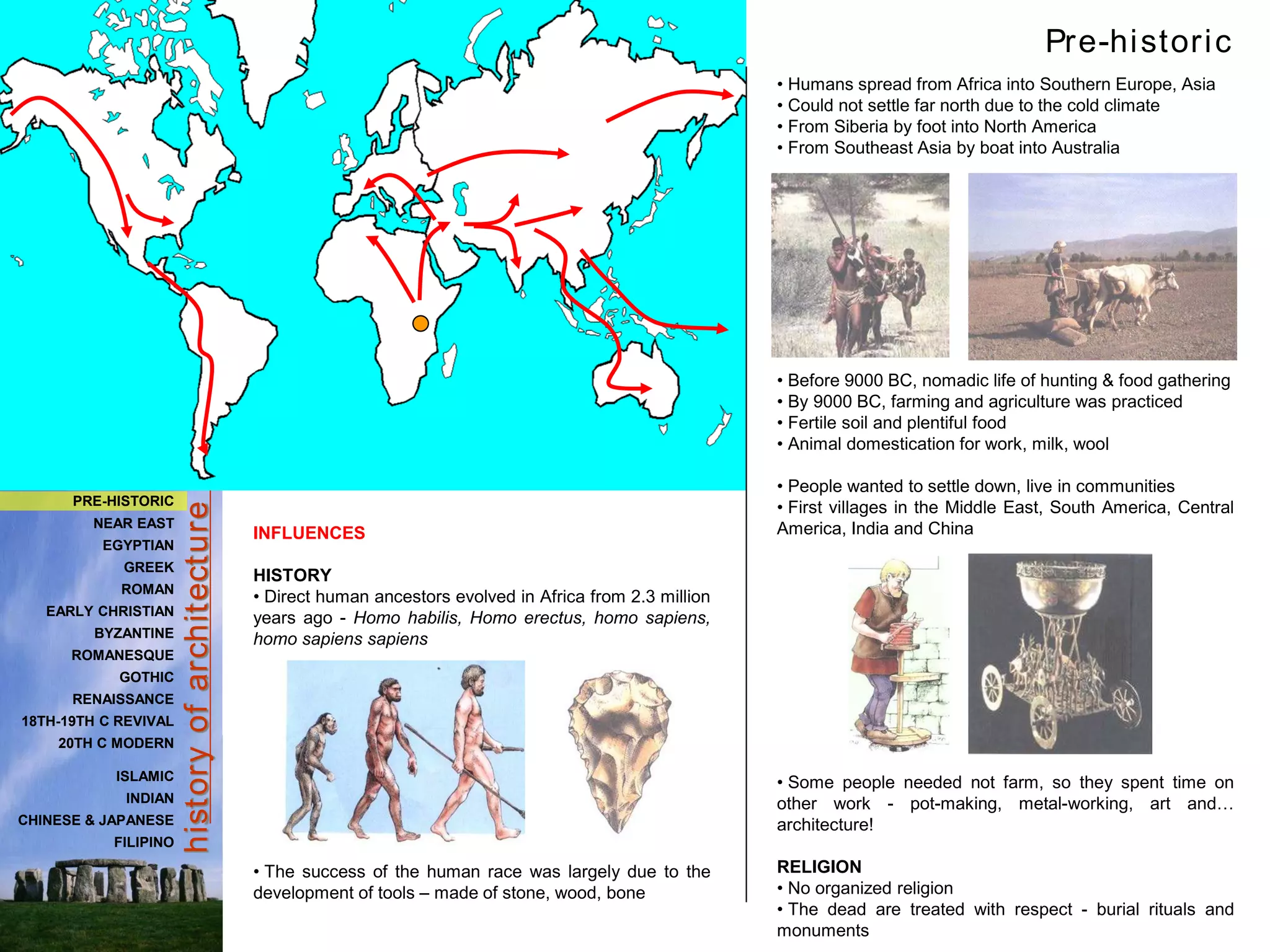
• Direct human ancestors evolved in Africa from 2.3 million
years ago - Homo habilis, Homo erectus, homo sapiens,
homo sapiens sapiens
• The success of the human race was largely due to the
development of tools – made of stone, wood, bone
• Humans spread from Africa into Southern Europe, Asia
• Could not settle far north due to the cold climate
• From Siberia by foot into North America
• From Southeast Asia by boat into Australia
• Before 9000 BC, nomadic life of hunting & food gathering
• By 9000 BC, farming and agriculture was practiced
• Fertile soil and plentiful food
• Animal domestication for work, milk, wool
• People wanted to settle down, live in communities
• First villages in the Middle East, South America, Central
America, India and China
• Some people needed not farm, so they spent time on
other work - pot-making, metal-working, art and…
architecture!
RELIGION
• No organized religion
• The dead are treated with respect - burial rituals and
monuments
Pre-historic
PRE-HISTORIC
NEAR EAST
EGYPTIAN
GREEK
ROMAN
EARLY CHRISTIAN
BYZANTINE
ROMANESQUE
GOTHIC
RENAISSANCE
18TH-19TH C REVIVAL
20TH C MODERN
ISLAMIC
INDIAN
CHINESE & JAPANESE
FILIPINO
hist
ory
of
archit
ect
ure
ARCHITECTURAL CHARACTER
MATERIALS
• Animal skins, wooden frames, animal bones
CONSTRUCTION SYSTEM
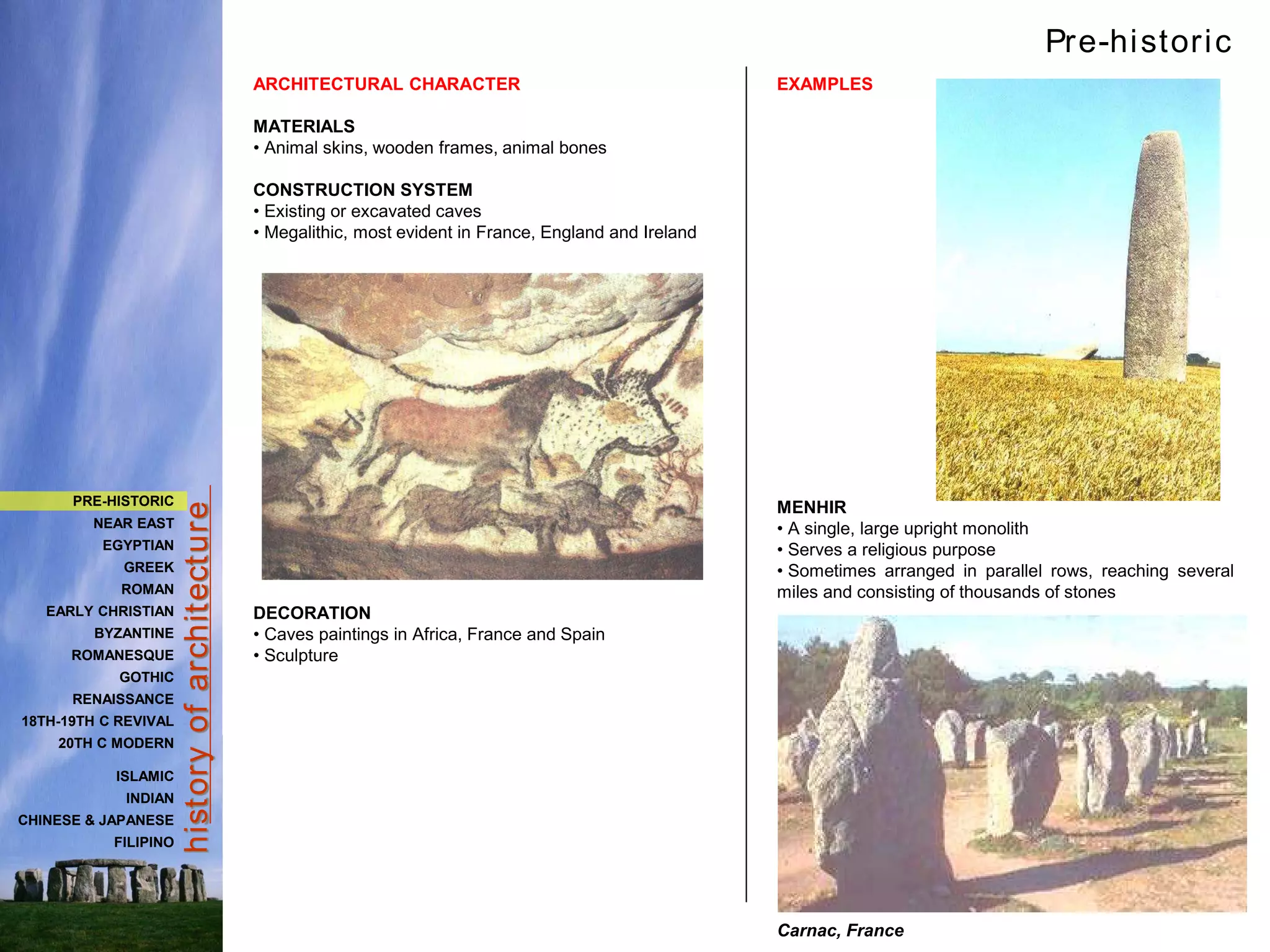
• Existing or excavated caves
• Megalithic, most evident in France, England and Ireland
DECORATION
• Caves paintings in Africa, France and Spain
• Sculpture
EXAMPLES
MENHIR
• A single, large upright monolith
• Serves a religious purpose
• Sometimes arranged in parallel rows, reaching several
miles and consisting of thousands of stones
Carnac, France
Pre-historic
PRE-HISTORIC
NEAR EAST
EGYPTIAN
GREEK
ROMAN
EARLY CHRISTIAN
BYZANTINE
ROMANESQUE
GOTHIC
RENAISSANCE
18TH-19TH C REVIVAL
20TH C MODERN
ISLAMIC
INDIAN
CHINESE & JAPANESE
FILIPINO
hist
ory
of
archit
ect
ure
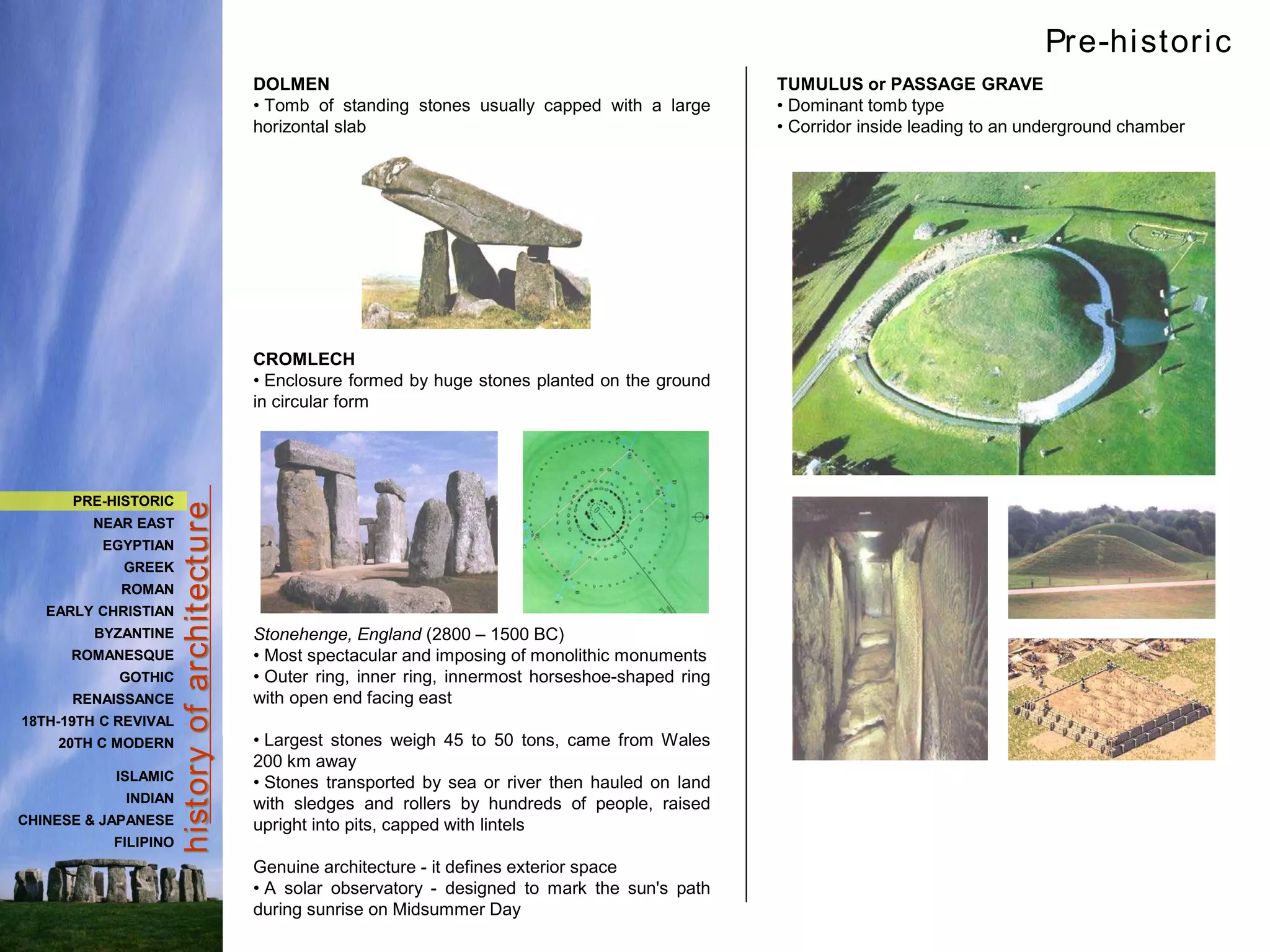
DOLMEN
• Tomb of standing stones usually capped with a large
horizontal slab
CROMLECH
• Enclosure formed by huge stones planted on the ground
in circular form
Stonehenge, England (2800 – 1500 BC)
• Most spectacular and imposing of monolithic monuments
• Outer ring, inner ring, innermost horseshoe-shaped ring
with open end facing east
• Largest stones weigh 45 to 50 tons, came from Wales
200 km away
• Stones transported by sea or river then hauled on land
with sledges and rollers by hundreds of people, raised
upright into pits, capped with lintels
Genuine architecture - it defines exterior space
• A solar observatory - designed to mark the sun's path
during sunrise on Midsummer Day
TUMULUS or PASSAGE GRAVE
• Dominant tomb type
• Corridor inside leading to an underground chamber
Pre-historic
PRE-HISTORIC
NEAR EAST
EGYPTIAN
GREEK
ROMAN
EARLY CHRISTIAN
BYZANTINE
ROMANESQUE
GOTHIC
RENAISSANCE
18TH-19TH C REVIVAL
20TH C MODERN
ISLAMIC
INDIAN
CHINESE & JAPANESE
FILIPINO
hist
ory
of
archit
ect
ure
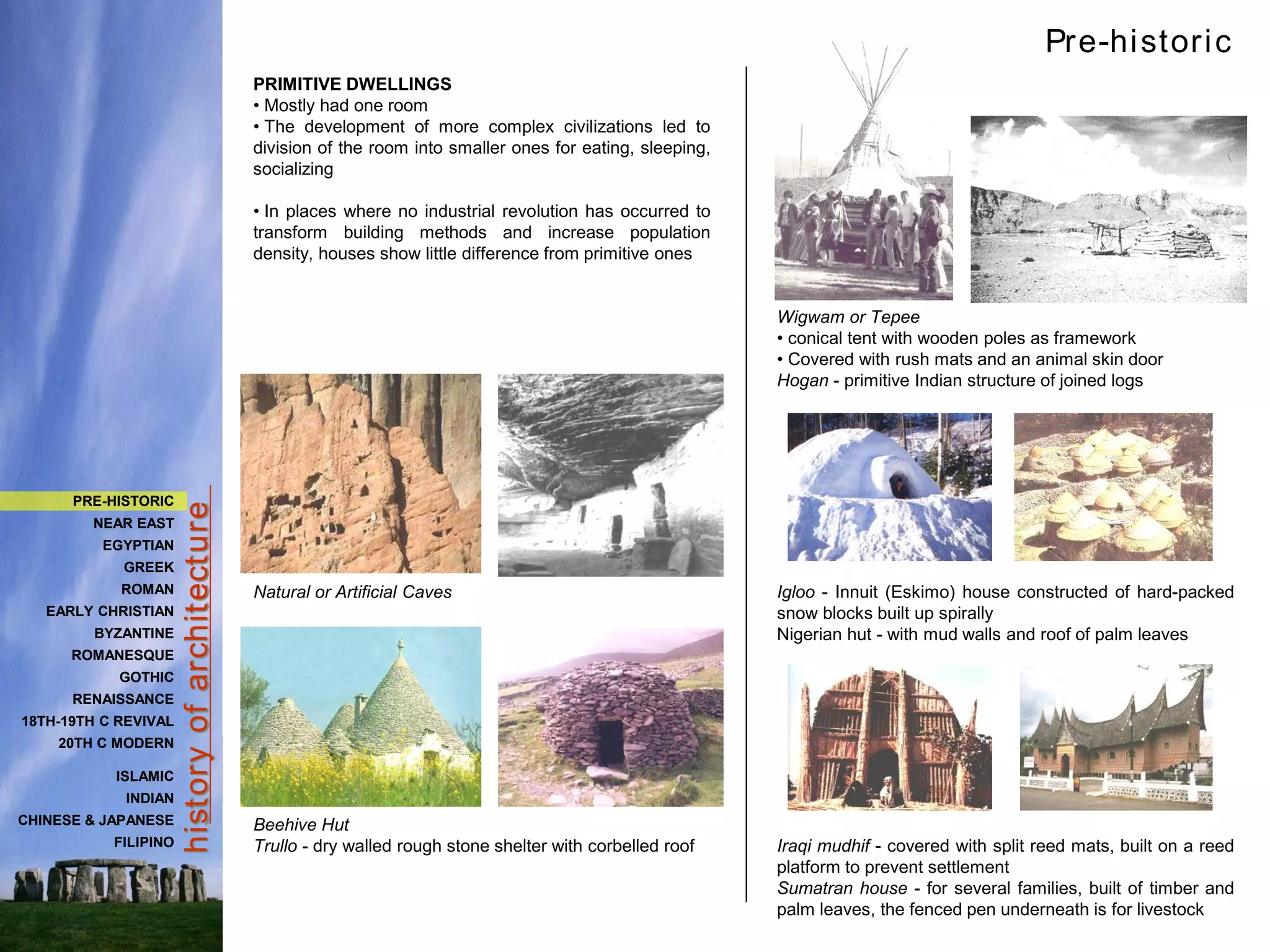
Wigwam or Tepee
• conical tent with wooden poles as framework
• Covered with rush mats and an animal skin door
Hogan - primitive Indian structure of joined logs
Igloo - Innuit (Eskimo) house constructed of hard-packed
snow blocks built up spirally
Nigerian hut - with mud walls and roof of palm leaves
Iraqi mudhif - covered with split reed mats, built on a reed
platform to prevent settlement
Sumatran house - for several families, built of timber and
palm leaves, the fenced pen underneath is for livestock
PRIMITIVE DWELLINGS
• Mostly had one room
• The development of more complex civilizations led to
division of the room into smaller ones for eating, sleeping,
socializing
• In places where no industrial revolution has occurred to
transform building methods and increase population
density, houses show little difference from primitive ones
Natural or Artificial Caves
Beehive Hut
Trullo - dry walled rough stone shelter with corbelled roof
Pre-historic
PRE-HISTORIC
NEAR EAST
EGYPTIAN
GREEK
ROMAN
EARLY CHRISTIAN
BYZANTINE
ROMANESQUE
GOTHIC
RENAISSANCE
18TH-19TH C REVIVAL
20TH C MODERN
ISLAMIC
INDIAN
CHINESE & JAPANESE
FILIPINO
hist
ory
of
archit
ect
ure
Pre-historic
PRE-HISTORIC
NEAR EAST
EGYPTIAN
GREEK
ROMAN
EARLY CHRISTIAN
BYZANTINE
ROMANESQUE
GOTHIC
RENAISSANCE
18TH-19TH C REVIVAL
20TH C MODERN
ISLAMIC
INDIAN
CHINESE & JAPANESE
FILIPINO

Lec-I_Prehistoric Architecture.pdf

  • 1.
  • 2.
    hist ory of archit ect ure COURSE AIM Analytical studyof past architectural antecedents of earliest civilizations viewed under the scope of the elements principles and objectives of visual design. COURSE OBJECTIVES *To be acquainted with architectural innovations and shortcomings of past civilizations using it as a springboard to forge a better understanding of the present. •Evaluate how influences such as climate, topography, location, religion, purpose and composition affect the architecture of a place. *To have an understanding that the building materials available and the technology developed to utilize them through different civilizations largely determine the nature of the architecture of that civilization. *Most importantly, to inspire students to evaluate the intentions and visual expressions of past civilizations in terms of the elements, principles and objectives of visual design. OUR METHOD OF STUDYING HISTORY: To try not to memorize… but to understand History is not a list of facts… it is a story that can be retold over and over REFERENCES 1. Ching, Francis D.K., A Visual Dictionary of Architecture 2. Fletcher, Bannister, A History of Architecture 20th Ed. 3. Mercado, Jose L., The Architectural Reviewer Volume III: History & Theory of Architecture 4. Salvan, George S., Architectural Character & the History of Architecture 5. The Children’s Atlas of World History 6. The World Atlas of Architecture DEFINITIONS History of Architecture • It is the study of the chronological record of events (as affecting a nation or people), based on a critical examination of architectural source materials and usually presenting an explanation of their causes from ancient periods to the present day. Historic Styles of Architecture • "The particular method, the characteristics, manner of design which prevails at a certain place and time.“ Six Influences of Architecture • Geographical • Geological • Climatic • Religious • Social • Historical Four Great Constructive Principles 1. Post & Lintel Construction 2. Arch & Vault Construction 3. Corbel or Cantilever Construction 4. Trussed Construction Introduction
  • 3.
    hist ory of archit ect ure Introduction Pre-Historic Egyptian Near East Gothic Roman Renaissance18th-19th C: Revival 20th C: Modern Byzantine Islamic Early Christian Chinese & Japanese Indian Greek Romanesque The Historical Timeline of Architecture PRE-HISTORIC NEAR EAST EGYPTIAN GREEK ROMAN EARLY CHRISTIAN BYZANTINE ROMANESQUE GOTHIC RENAISSANCE 18TH-19TH C REVIVAL 20TH C MODERN ISLAMIC INDIAN CHINESE & JAPANESE FILIPINO
  • 4.
    hist ory of archit ect ure The Historical Timeline ofArchitecture Pre-historic PRE-HISTORIC NEAR EAST EGYPTIAN GREEK ROMAN EARLY CHRISTIAN BYZANTINE ROMANESQUE GOTHIC RENAISSANCE 18TH-19TH C REVIVAL 20TH C MODERN ISLAMIC INDIAN CHINESE & JAPANESE FILIPINO Pre-Historic • Before recorded history, humans constructed earthen mounds, stone circles, megaliths, and structures that often puzzle modern-day archaeologists. • Prehistoric architecture includes monumental structures such as Stonehenge, cliff dwellings in the Americas, and thatch and mud structures lost to time.
  • 5.
    hist ory of archit ect ure INFLUENCES HISTORY • Direct humanancestors evolved in Africa from 2.3 million years ago - Homo habilis, Homo erectus, homo sapiens, homo sapiens sapiens • The success of the human race was largely due to the development of tools – made of stone, wood, bone • Humans spread from Africa into Southern Europe, Asia • Could not settle far north due to the cold climate • From Siberia by foot into North America • From Southeast Asia by boat into Australia • Before 9000 BC, nomadic life of hunting & food gathering • By 9000 BC, farming and agriculture was practiced • Fertile soil and plentiful food • Animal domestication for work, milk, wool • People wanted to settle down, live in communities • First villages in the Middle East, South America, Central America, India and China • Some people needed not farm, so they spent time on other work - pot-making, metal-working, art and… architecture! RELIGION • No organized religion • The dead are treated with respect - burial rituals and monuments Pre-historic PRE-HISTORIC NEAR EAST EGYPTIAN GREEK ROMAN EARLY CHRISTIAN BYZANTINE ROMANESQUE GOTHIC RENAISSANCE 18TH-19TH C REVIVAL 20TH C MODERN ISLAMIC INDIAN CHINESE & JAPANESE FILIPINO
  • 6.
    hist ory of archit ect ure ARCHITECTURAL CHARACTER MATERIALS • Animalskins, wooden frames, animal bones CONSTRUCTION SYSTEM • Existing or excavated caves • Megalithic, most evident in France, England and Ireland DECORATION • Caves paintings in Africa, France and Spain • Sculpture EXAMPLES MENHIR • A single, large upright monolith • Serves a religious purpose • Sometimes arranged in parallel rows, reaching several miles and consisting of thousands of stones Carnac, France Pre-historic PRE-HISTORIC NEAR EAST EGYPTIAN GREEK ROMAN EARLY CHRISTIAN BYZANTINE ROMANESQUE GOTHIC RENAISSANCE 18TH-19TH C REVIVAL 20TH C MODERN ISLAMIC INDIAN CHINESE & JAPANESE FILIPINO
  • 7.
    hist ory of archit ect ure DOLMEN • Tomb ofstanding stones usually capped with a large horizontal slab CROMLECH • Enclosure formed by huge stones planted on the ground in circular form Stonehenge, England (2800 – 1500 BC) • Most spectacular and imposing of monolithic monuments • Outer ring, inner ring, innermost horseshoe-shaped ring with open end facing east • Largest stones weigh 45 to 50 tons, came from Wales 200 km away • Stones transported by sea or river then hauled on land with sledges and rollers by hundreds of people, raised upright into pits, capped with lintels Genuine architecture - it defines exterior space • A solar observatory - designed to mark the sun's path during sunrise on Midsummer Day TUMULUS or PASSAGE GRAVE • Dominant tomb type • Corridor inside leading to an underground chamber Pre-historic PRE-HISTORIC NEAR EAST EGYPTIAN GREEK ROMAN EARLY CHRISTIAN BYZANTINE ROMANESQUE GOTHIC RENAISSANCE 18TH-19TH C REVIVAL 20TH C MODERN ISLAMIC INDIAN CHINESE & JAPANESE FILIPINO
  • 8.
    hist ory of archit ect ure Wigwam or Tepee •conical tent with wooden poles as framework • Covered with rush mats and an animal skin door Hogan - primitive Indian structure of joined logs Igloo - Innuit (Eskimo) house constructed of hard-packed snow blocks built up spirally Nigerian hut - with mud walls and roof of palm leaves Iraqi mudhif - covered with split reed mats, built on a reed platform to prevent settlement Sumatran house - for several families, built of timber and palm leaves, the fenced pen underneath is for livestock PRIMITIVE DWELLINGS • Mostly had one room • The development of more complex civilizations led to division of the room into smaller ones for eating, sleeping, socializing • In places where no industrial revolution has occurred to transform building methods and increase population density, houses show little difference from primitive ones Natural or Artificial Caves Beehive Hut Trullo - dry walled rough stone shelter with corbelled roof Pre-historic PRE-HISTORIC NEAR EAST EGYPTIAN GREEK ROMAN EARLY CHRISTIAN BYZANTINE ROMANESQUE GOTHIC RENAISSANCE 18TH-19TH C REVIVAL 20TH C MODERN ISLAMIC INDIAN CHINESE & JAPANESE FILIPINO
  • 9.