STUDY GUIDE for History Of Architecture 1 pointers
1.
HISTRORY OF ARCHITECTURE1: PREHISTORIC, MESOPOTAMIA, AND
EGYPT
POINTERS FOR P1 EXAM
PREHISTORIC ARCHITECTURE:
Ancestors evolved in Africa from 2.3 million years ago. They spread
from Africa, Southern Europe, to Asia
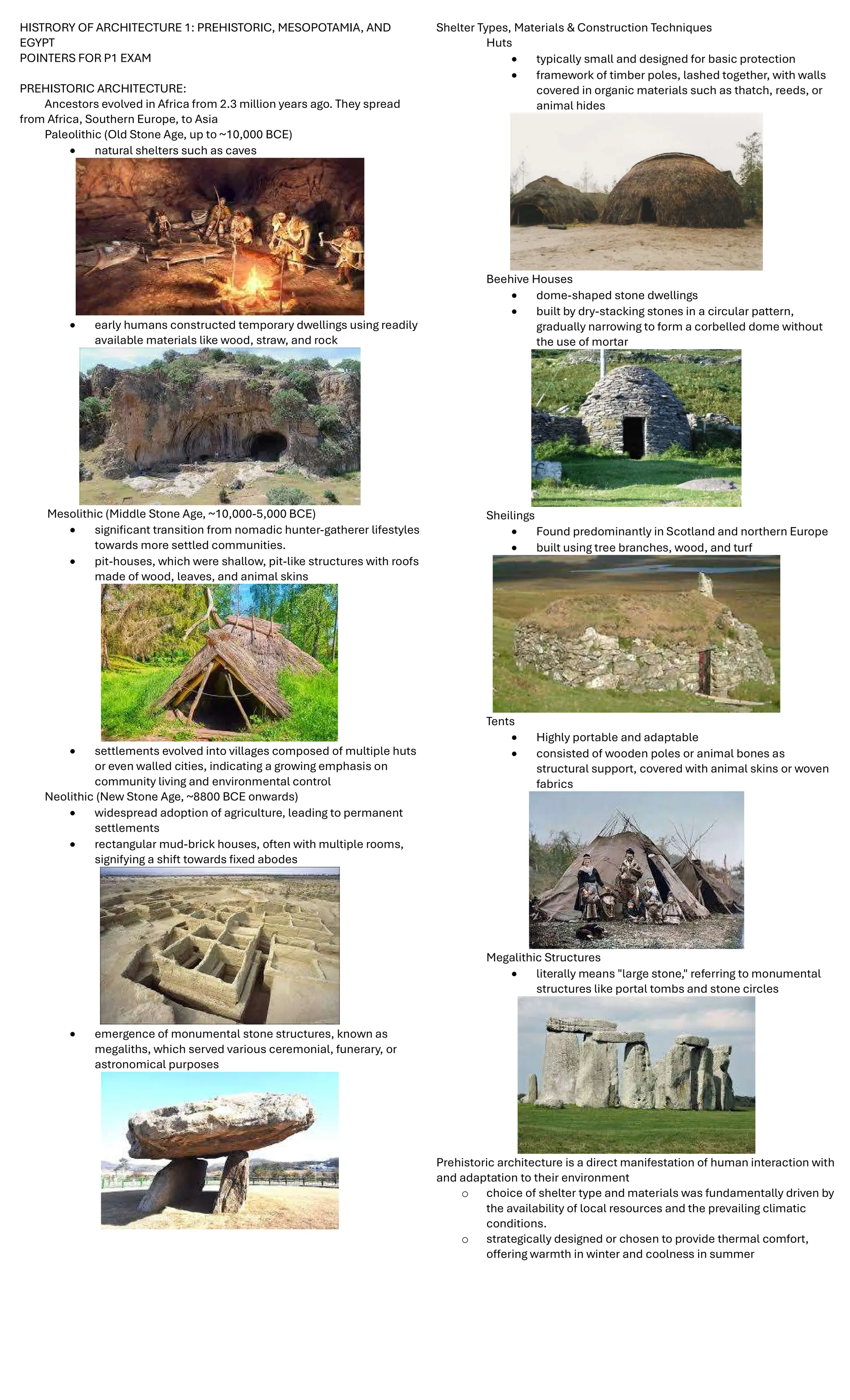
Paleolithic (Old Stone Age, up to ~10,000 BCE)
natural shelters such as caves
early humans constructed temporary dwellings using readily
available materials like wood, straw, and rock
Mesolithic (Middle Stone Age, ~10,000-5,000 BCE)
significant transition from nomadic hunter-gatherer lifestyles
towards more settled communities.
pit-houses, which were shallow, pit-like structures with roofs
made of wood, leaves, and animal skins
settlements evolved into villages composed of multiple huts
or even walled cities, indicating a growing emphasis on
community living and environmental control
Neolithic (New Stone Age, ~8800 BCE onwards)
widespread adoption of agriculture, leading to permanent
settlements
rectangular mud-brick houses, often with multiple rooms,
signifying a shift towards fixed abodes
emergence of monumental stone structures, known as
megaliths, which served various ceremonial, funerary, or
astronomical purposes
Shelter Types, Materials & Construction Techniques
Huts
typically small and designed for basic protection
framework of timber poles, lashed together, with walls
covered in organic materials such as thatch, reeds, or
animal hides
Beehive Houses
dome-shaped stone dwellings
built by dry-stacking stones in a circular pattern,
gradually narrowing to form a corbelled dome without
the use of mortar
Sheilings
Found predominantly in Scotland and northern Europe
built using tree branches, wood, and turf
Tents
Highly portable and adaptable
consisted of wooden poles or animal bones as
structural support, covered with animal skins or woven
fabrics
Megalithic Structures
literally means "large stone," referring to monumental
structures like portal tombs and stone circles
Prehistoric architecture is a direct manifestation of human interaction with
and adaptation to their environment
o choice of shelter type and materials was fundamentally driven by
the availability of local resources and the prevailing climatic
conditions.
o strategically designed or chosen to provide thermal comfort,
o ering warmth in winter and coolness in summer
2.
o Archaeological evidenceconsistently shows that early human
occupation sites were located near essential water sources such
as rivers, lakes, springs, and wetlands
Iconic Examples
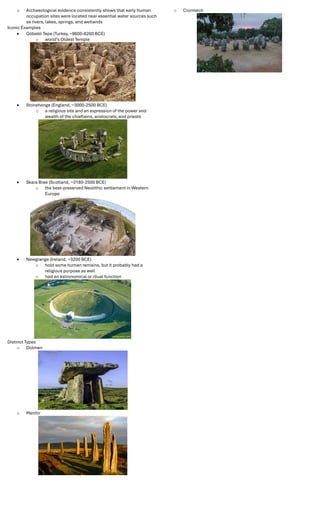
Göbekli Tepe (Turkey, ~9600-8200 BCE)
o world's Oldest Temple
Stonehenge (England, ~3000-2500 BCE)
o a religious site and an expression of the power and
wealth of the chieftains, aristocrats, and priests
Skara Brae (Scotland, ~3180-2500 BCE)
o the best-preserved Neolithic settlement in Western
Europe
Newgrange (Ireland, ~3200 BCE)
o hold some human remains, but it probably had a
religious purpose as well
o had an astronomical or ritual function
Distinct Types
o Dolmen
o Menhir
o Cromlech
3.
NEAR-EAST (MESOPOTAMIAN) ARCHITECTURE
emergingin the "Cradle of Civilization" between the Tigris and
Euphrates rivers, is celebrated for its innovation in urban planning and
monumental structures. deeply influenced by the region's unique
geography and the societal need for defense and religious expression
Defining Characteristics
o extensive use of mud bricks, a material readily available from the
fertile river plains
o Structures often featured thick walls, buttresses for stability, and
intricate drainage systems to manage water flow from the rivers
o Symmetry was a key principle, aiming to mirror the perceived
order of the universe in their built environment
Historical Periods
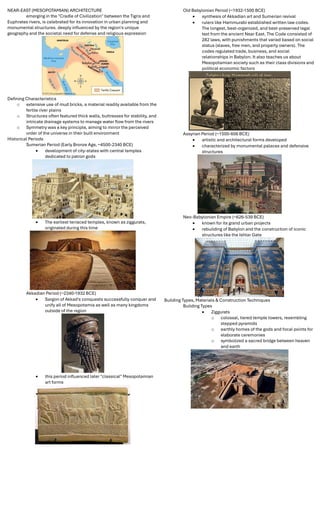
Sumerian Period (Early Bronze Age, ~4500-2340 BCE)
development of city-states with central temples
dedicated to patron gods
The earliest terraced temples, known as ziggurats,
originated during this time
Akkadian Period (~2340-1932 BCE)
Sargon of Akkad's conquests successfully conquer and
unify all of Mesopotamia as well as many kingdoms
outside of the region
this period influenced later "classical" Mesopotamian
art forms
Old Babylonian Period (~1932-1500 BCE)
synthesis of Akkadian art and Sumerian revival
rulers like Hammurabi established written law codes.
The longest, best-organized, and best-preserved legal
text from the ancient Near East. The Code consisted of
282 laws, with punishments that varied based on social
status (slaves, free men, and property owners). The
codes regulated trade, business, and social
relationships in Babylon. It also teaches us about
Mesopotamian society such as their class divisions and
political economic factors
Assyrian Period (~1500-606 BCE)
artistic and architectural forms developed
characterized by monumental palaces and defensive
structures
Neo-Babylonian Empire (~626-539 BCE)
known for its grand urban projects
rebuilding of Babylon and the construction of iconic
structures like the Ishtar Gate
Building Types, Materials & Construction Techniques
Building Types
Ziggurats
o colossal, tiered temple towers, resembling
stepped pyramids
o earthly homes of the gods and focal points for
elaborate ceremonies
o symbolized a sacred bridge between heaven
and earth
4.
Palaces
o largeand interconnected complexes with
beautiful decorations, designed for the ruling
elite and symbolizing their power
Defensive Walls
o essential for safeguarding cities against
intrusion
Houses
o typically small, with a central square living
area and surrounding rooms
Materials
Mud Bricks
o most common material, made from a mixture
of clay, water, and straw, sun-dried for
durability
o cheap, readily available, and an excellent
insulator against extreme temperatures
Baked/Fired Bricks
o Used for facings on ziggurats and for
specific decorative elements
Bitumen
o sticky, asphalt-like substance used as a
binding agent for bricks
Stone and Wood
o imported for specific structural or
decorative purposes
Construction Techniques
Thick Walls and Buttresses
o Provided stability and insulation
Arches and Vaults
Drainage Systems
o Complex networks of canals, dikes, and
levees were engineered to regulate river
flow
o supplying water for dwellings and crops
and managing unpredictable flooding
Glazed Bricks
o particularly evident on the Ishtar Gate,
where molded bricks were covered in
vibrant blue, gold, and brown glazes,
creating intricate reliefs of animals and
deities
Cultural, Religious & Environmental Influences
Environmental Factors:
o The flat, open terrain of Lower Mesopotamia made
cities vulnerable to attacks, necessitating robust
defensive walls
o The semi-arid climate and unpredictable seasonal
flooding of the Tigris and Euphrates rivers compelled
the development of sophisticated irrigation systems
Religious Beliefs
o each city having its own patron god, honoured by a
central temple or ziggurat
o depiction of deities and religious themes in art and
architecture emphasized their defining characteristics
and role in maintaining cosmic order
Cultural Values
o emphasis on symmetry in urban planning and building
design aimed to mirror the perceived organization of the
universe
Distinct Types
Cuneiform
o the earliest known writing system and was originally
developed to write the Sumerian language of southern
Mesopotamia
Iconic Examples
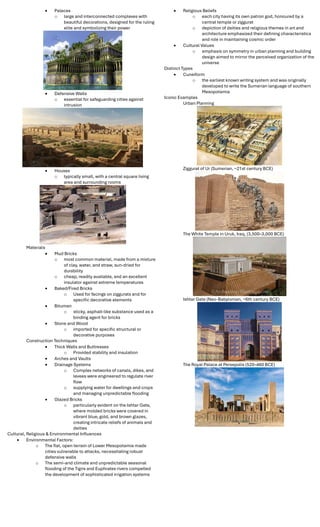
Urban Planning
Ziggurat of Ur (Sumerian, ~21st century BCE)
The White Temple in Uruk, Iraq, (3,500–3,000 BCE)
Ishtar Gate (Neo-Babylonian, ~6th century BCE)
The Royal Palace at Persepolis (520–460 BCE)
5.
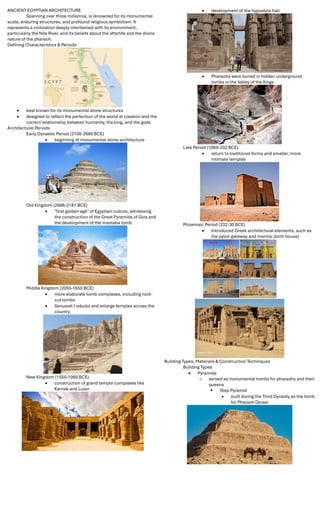
ANCIENT EGYPTIAN ARCHITECTURE
Spanningover three millennia, is renowned for its monumental
scale, enduring structures, and profound religious symbolism. It
represents a civilization deeply intertwined with its environment,
particularly the Nile River, and its beliefs about the afterlife and the divine
nature of the pharaoh.
Defining Characteristics & Periods
best known for its monumental stone structures
designed to reflect the perfection of the world at creation and the
correct relationship between humanity, the king, and the gods
Architectural Periods
Early Dynastic Period (3100-2686 BCE)
beginning of monumental stone architecture
Old Kingdom (2686-2181 BCE)
"first golden age" of Egyptian culture, witnessing
the construction of the Great Pyramids of Giza and
the development of the mastaba tomb
Middle Kingdom (2055-1650 BCE)
more elaborate tomb complexes, including rock-
cut tombs
Senusret I rebuild and enlarge temples across the
country
New Kingdom (1550-1069 BCE)
construction of grand temple complexes like
Karnak and Luxor
development of the hypostyle hall
Pharaohs were buried in hidden underground
tombs in the Valley of the Kings
Late Period (1069-332 BCE)
return to traditional forms and smaller, more
intimate temples
Ptolemaic Period (332-30 BCE)
Introduced Greek architectural elements, such as
the pylon gateway and mamisi (birth house)
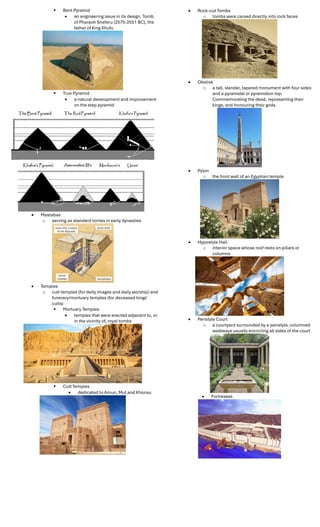
Building Types, Materials & Construction Techniques
Building Types
Pyramids
o served as monumental tombs for pharaohs and their
queens
Step Pyramid
built during the Third Dynasty as the tomb
for Pharaoh Djoser
6.
Bent Pyramid
an engineering issue in its design. Tomb
of Pharaoh Sneferu (2575-2551 BC), the
father of King Khufu
True Pyramid
a natural development and improvement
on the step pyramid
Mastabas
o serving as standard tombs in early dynasties
Temples
o cult temples (for deity images and daily worship) and
funerary/mortuary temples (for deceased kings'
cults)
Mortuary Temples
temples that were erected adjacent to, or
in the vicinity of, royal tombs
Cult Temples
dedicated to Amun, Mut and Khonsu
Rock-cut Tombs
o tombs were carved directly into rock faces
Obelisk
o a tall, slender, tapered monument with four sides
and a pyramidal or pyramidion top.
Commemorating the dead, representing their
kings, and honouring their gods.
Pylon
o the front wall of an Egyptian temple
Hypostyle Hall
o interior space whose roof rests on pillars or
columns
Peristyle Court
o a courtyard surrounded by a peristyle, columned
walkways usually encircling all sides of the court
Fortresses
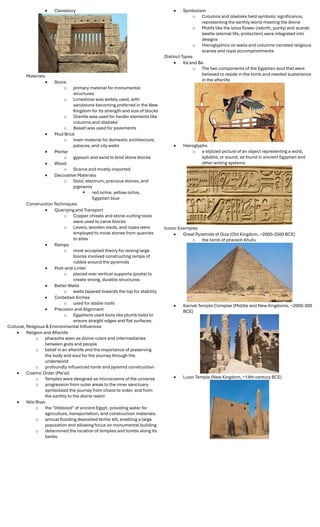
7.
Clerestory
Materials
Stone
oprimary material for monumental
structures
o Limestone was widely used, with
sandstone becoming preferred in the New
Kingdom for its strength and size of blocks
o Granite was used for harder elements like
columns and obelisks
o Basalt was used for pavements
Mud Brick
o main material for domestic architecture,
palaces, and city walls
Mortar
o gypsum and sand to bind stone blocks
Wood
o Scarce and mostly imported
Decorative Materials
o Gold, electrum, precious stones, and
pigments
red ochre, yellow ochre,
Egyptian blue
Construction Techniques
Quarrying and Transport
o Copper chisels and stone-cutting tools
were used to carve blocks
o Levers, wooden sleds, and ropes were
employed to move stones from quarries
to sites
Ramps
o most accepted theory for raising large
blocks involved constructing ramps of
rubble around the pyramids
Post-and-Lintel
o placed over vertical supports (posts) to
create strong, durable structures
Batter Walls
o walls tapered towards the top for stability
Corbelled Arches
o used for stable roofs
Precision and Alignment
o Egyptians used tools like plumb bobs to
ensure straight edges and flat surfaces.
Cultural, Religious & Environmental Influences
Religion and Afterlife
o pharaohs seen as divine rulers and intermediaries
between gods and people
o belief in an afterlife and the importance of preserving
the body and soul for the journey through the
underworld
o profoundly influenced tomb and pyramid construction
Cosmic Order (Ma'at)
o Temples were designed as microcosms of the universe
o progression from outer areas to the inner sanctuary
symbolized the journey from chaos to order, and from
the earthly to the divine realm
Nile River
o the "lifeblood" of ancient Egypt, providing water for
agriculture, transportation, and construction materials.
o annual flooding deposited fertile silt, enabling a large
population and allowing focus on monumental building
o determined the location of temples and tombs along its
banks
Symbolism
o Columns and obelisks held symbolic significance,
representing the earthly world meeting the divine
o Motifs like the lotus flower (rebirth, purity) and scarab
beetle (eternal life, protection) were integrated into
designs
o Hieroglyphics on walls and columns narrated religious
scenes and royal accomplishments
Distinct Types
Ka and Ba
o The two components of the Egyptian soul that were
believed to reside in the tomb and needed sustenance
in the afterlife
Hieroglyphs
o a stylized picture of an object representing a word,
syllable, or sound, as found in ancient Egyptian and
other writing systems
Iconic Examples
Great Pyramids of Giza (Old Kingdom, ~2600-2500 BCE)
o the tomb of pharaoh Khufu
Karnak Temple Complex (Middle and New Kingdoms, ~2000-300
BCE)
Luxor Temple (New Kingdom, ~14th century BCE)