PHARMACOLOGY
MRS. MONALI B. PARBHANE
Asst. Professor
Dept. of Pharmaceutics
STCOP, SHIRUR
Scope:
 Course enables the student to understand and
appreciate the influence of pharmaceutical
additives and various pharmaceutical dosage
forms on the performance of the drug product.
2
 Objectives:
 Upon completion of the course the
student shall be able to
 1. Know the various pharmaceutical
dosage forms and their manufacturing
techniques.
 2. Know various considerations in
development of pharmaceutical dosage
forms
 3. Formulate solid, liquid and semisolid
dosage forms and evaluate them for their
quality
3
How drugs work?
Or
How do they ‘know’ to go from my stomach
to my head and not my foot?
Basic Pharmaceutics
5
Objective of Drug Therapy
To deliver the right drug, in the right concentration, to the right
site of action and at the right time to produce the desired effect.
(of course in the right patient!)
6
General Overview/Definitions
Industrial pharmacy is a discipline which includes manufacturing,
development, marketing and distribution of drug products including
quality assurance of these activities .
Industrial pharmacy is concerned with the preparation of medicines.
AIMS OF PHARMACEUTICAL INDUSTRY
1. To discover safe and effective new drugs.
2. To promote drug research.
3. To discover new ways ,technologies and products to manage
health.
4. To develop new drugs into effective medicines.
5. To guarantee patient safety by producing a safe product.
7
BIO-AVAILABILITY
THE RATE OF DRUG ABSORPTION
EXTEND OF DRUG ABSORPTION.
8
Plasma drug concentration profile
9
Preformulation Studies:
Introduction to preformulation, goals and objectives, study of
physicochemical characteristics of drug substances.
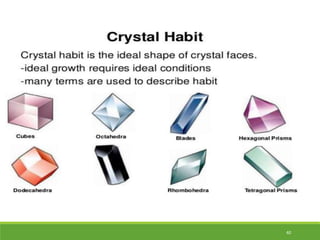
a. Physical properties: Physical form (crystal & amorphous),
particle size, shape, flow properties, solubility profile (pKa, pH,
partition coefficient), polymorphism
b. Chemical Properties: Hydrolysis, oxidation, reduction,
racemisation, polymerization
BCS classification of drugs & its significant
Application of preformulation considerations in the development
of solid, liquid oral and
parenteral dosage forms and its impact on stability of dosage
forms.
10
11
INTRODUCTION
• Preformulation testing is the first step
in the rational development of dosage
forms.
• It can be defined as an investigation of
physical and chemical property of a
drug substance alone and when
combined with excipients.
• Physiochemical properties are those
that can be determined from in vitro
experiments.
12
OBJECTIVES
The main objective is to generate
information useful to the formulation in
developing most stable and
bioavailable dosage form that mass
can be produced.
13
Why is Preformulation Important ?
•It describes the process of optimizing the delivery of
drug thorough determination of physical, chemical
properties of new drug molecule that affect drug
performance and development of an efficacious stable
and safe dosage form.
•Preformulation studies on a new drug molecule
provide useful information for subsequent formulation
of a physicochemically stable and biopharmaceutically
suitable dosage form.
14
PREFORMULATION -It was introduced at 1960
Preformulation testing is the first step in the
rational development of dosage form of a drug
substance.
Preformulation forms an indespensible part of the
inovator companey as well as generic companies.
The necessity of preformulation is not only
acknowledged by most companies it is to a certain
extent prerequisite and forms back bone for R&D.
15
16
17
Program of Analytical Preformulation
18
19
20
21
22
23
24
25
26
27
28
29
30
31
32
33
34
35
36
37
38
39
40
41
42
43
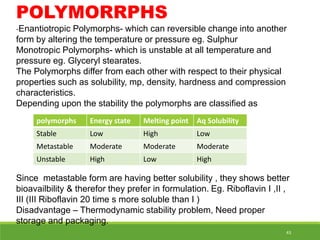
POLYMORRPHS
-Enantiotropic Polymorphs- which can reversible change into another
form by altering the temperature or pressure eg. Sulphur
Monotropic Polymorphs- which is unstable at all temperature and
pressure eg. Glyceryl stearates.
The Polymorphs differ from each other with respect to their physical
properties such as solubility, mp, density, hardness and compression
characteristics.
Depending upon the stability the polymorphs are classified as
Since metastable form are having better solubility , they shows better
bioavailbility & therefor they prefer in formulation. Eg. Riboflavin I ,II ,
III (III Riboflavin 20 time s more soluble than I )
Disadvantage – Thermodynamic stability problem, Need proper
storage and packaging.
polymorphs Energy state Melting point Aq Solubility
Stable Low High Low
Metastable Moderate Moderate Moderate
Unstable High Low High
44
AMORPHOUS FORM-Supercooled
liquids- having no internal structure.
Such drugs represent highest energy state.
They have greatest aq solubility than crystalline forms because they require
less energy to break the non crystaline form than crystalline form.
Thus, order for dissolution of different solid forms are-
Amorphous›Metastable›Stable
Hydrates / Solvates ( pseudopolymorphs )
The stoichiomatric types of adduct where the solvent molecules are
incorporated in the crystal lattice of the solid are called as the solvates. The
solvates can exist in different crystalline forms called as
pseudopolymorphs.
When the solvent in association with the drug is water , the solvates is
known as a hydrate.
Solubility profile-
Anhydrous ›Hydtates› Solvates.
45
46
47
48
49
SOLUBILIZATION
50
51
52
53
54
If you have a solution and solute in equilibrium,
adding a common ion (an ion that
is common with the dissolving solid) decreases
the solubility of the solute.
55
56
57
58
59
60
61
62
63
64
65
66
67
68
69
70
71
72
73
74
75
76
77
78
79
80
81
82
83
84
85
86
87
88
89
90

PREFORMULATION STUDY

  • 1.
    PHARMACOLOGY MRS. MONALI B.PARBHANE Asst. Professor Dept. of Pharmaceutics STCOP, SHIRUR
  • 2.
    Scope:  Course enablesthe student to understand and appreciate the influence of pharmaceutical additives and various pharmaceutical dosage forms on the performance of the drug product. 2
  • 3.
     Objectives:  Uponcompletion of the course the student shall be able to  1. Know the various pharmaceutical dosage forms and their manufacturing techniques.  2. Know various considerations in development of pharmaceutical dosage forms  3. Formulate solid, liquid and semisolid dosage forms and evaluate them for their quality 3
  • 4.
    How drugs work? Or Howdo they ‘know’ to go from my stomach to my head and not my foot?
  • 5.
  • 6.
    Objective of DrugTherapy To deliver the right drug, in the right concentration, to the right site of action and at the right time to produce the desired effect. (of course in the right patient!) 6
  • 7.
    General Overview/Definitions Industrial pharmacyis a discipline which includes manufacturing, development, marketing and distribution of drug products including quality assurance of these activities . Industrial pharmacy is concerned with the preparation of medicines. AIMS OF PHARMACEUTICAL INDUSTRY 1. To discover safe and effective new drugs. 2. To promote drug research. 3. To discover new ways ,technologies and products to manage health. 4. To develop new drugs into effective medicines. 5. To guarantee patient safety by producing a safe product. 7
  • 8.
    BIO-AVAILABILITY THE RATE OFDRUG ABSORPTION EXTEND OF DRUG ABSORPTION. 8
  • 9.
  • 10.
    Preformulation Studies: Introduction topreformulation, goals and objectives, study of physicochemical characteristics of drug substances. a. Physical properties: Physical form (crystal & amorphous), particle size, shape, flow properties, solubility profile (pKa, pH, partition coefficient), polymorphism b. Chemical Properties: Hydrolysis, oxidation, reduction, racemisation, polymerization BCS classification of drugs & its significant Application of preformulation considerations in the development of solid, liquid oral and parenteral dosage forms and its impact on stability of dosage forms. 10
  • 11.
    11 INTRODUCTION • Preformulation testingis the first step in the rational development of dosage forms. • It can be defined as an investigation of physical and chemical property of a drug substance alone and when combined with excipients. • Physiochemical properties are those that can be determined from in vitro experiments.
  • 12.
    12 OBJECTIVES The main objectiveis to generate information useful to the formulation in developing most stable and bioavailable dosage form that mass can be produced.
  • 13.
    13 Why is PreformulationImportant ? •It describes the process of optimizing the delivery of drug thorough determination of physical, chemical properties of new drug molecule that affect drug performance and development of an efficacious stable and safe dosage form. •Preformulation studies on a new drug molecule provide useful information for subsequent formulation of a physicochemically stable and biopharmaceutically suitable dosage form.
  • 14.
    14 PREFORMULATION -It wasintroduced at 1960 Preformulation testing is the first step in the rational development of dosage form of a drug substance. Preformulation forms an indespensible part of the inovator companey as well as generic companies. The necessity of preformulation is not only acknowledged by most companies it is to a certain extent prerequisite and forms back bone for R&D.
  • 15.
  • 16.
  • 17.
  • 18.
  • 19.
  • 20.
  • 21.
  • 22.
  • 23.
  • 24.
  • 25.
  • 26.
  • 27.
  • 28.
  • 29.
  • 30.
  • 31.
  • 32.
  • 33.
  • 34.
  • 35.
  • 36.
  • 37.
  • 38.
  • 39.
  • 40.
  • 41.
  • 42.
  • 43.
    43 POLYMORRPHS -Enantiotropic Polymorphs- whichcan reversible change into another form by altering the temperature or pressure eg. Sulphur Monotropic Polymorphs- which is unstable at all temperature and pressure eg. Glyceryl stearates. The Polymorphs differ from each other with respect to their physical properties such as solubility, mp, density, hardness and compression characteristics. Depending upon the stability the polymorphs are classified as Since metastable form are having better solubility , they shows better bioavailbility & therefor they prefer in formulation. Eg. Riboflavin I ,II , III (III Riboflavin 20 time s more soluble than I ) Disadvantage – Thermodynamic stability problem, Need proper storage and packaging. polymorphs Energy state Melting point Aq Solubility Stable Low High Low Metastable Moderate Moderate Moderate Unstable High Low High
  • 44.
    44 AMORPHOUS FORM-Supercooled liquids- havingno internal structure. Such drugs represent highest energy state. They have greatest aq solubility than crystalline forms because they require less energy to break the non crystaline form than crystalline form. Thus, order for dissolution of different solid forms are- Amorphous›Metastable›Stable Hydrates / Solvates ( pseudopolymorphs ) The stoichiomatric types of adduct where the solvent molecules are incorporated in the crystal lattice of the solid are called as the solvates. The solvates can exist in different crystalline forms called as pseudopolymorphs. When the solvent in association with the drug is water , the solvates is known as a hydrate. Solubility profile- Anhydrous ›Hydtates› Solvates.
  • 45.
  • 46.
  • 47.
  • 48.
  • 49.
  • 50.
  • 51.
  • 52.
  • 53.
  • 54.
    54 If you havea solution and solute in equilibrium, adding a common ion (an ion that is common with the dissolving solid) decreases the solubility of the solute.
  • 55.
  • 56.
  • 57.
  • 58.
  • 59.
  • 60.
  • 61.
  • 62.
  • 63.
  • 64.
  • 65.
  • 66.
  • 67.
  • 68.
  • 69.
  • 70.
  • 71.
  • 72.
  • 73.
  • 74.
  • 75.
  • 76.
  • 77.
  • 78.
  • 79.
  • 80.
  • 81.
  • 82.
  • 83.
  • 84.
  • 85.
  • 86.
  • 87.
  • 88.
  • 89.
  • 90.