INDUSTRIAL
PHARMACY-1
PREFORMULATION
MR. SUBHASISH PRAMANIK
ASSISTANT. PROFESSOR
MATA GUJRI COLLEGE OF PHARMACY
KISHANGANJ, BIHAR
Introduction
Preformulation study is define as a phase of development in which
characterized the Physico-chemical properties of new drug molecule in
order to develop safety, efficacy and stability of the dosage form.
Objectives:
1. To established Physico-chemical properties of new drug molecule.
2. To determine its kinetic & stability.
3. Compatibility of the drug with common excipients.
4. To improve the manufacturing, storage and performance of new
drug product.
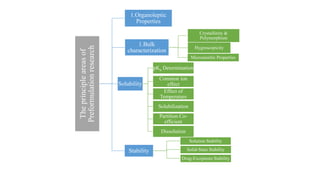
The
principle
areas
of
Preformulation
research
1.Organoleptic
Properties
1.Bulk
characterization
Crystallinity &
Polymorphism
Hygroscopicity
Micromeritic Properties
Solubility
pKa Determination
Common ion
effect
Effect of
Temperature
Solubilization
Partition Co-
efficient
Dissolution
Stability
Solution Stability
Solid-State Stability
Drug-Excipients Stability
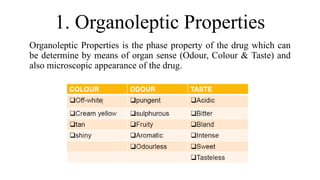
1. Organoleptic Properties
Organoleptic Properties is the phase property of the drug which can
be determine by means of organ sense (Odour, Colour & Taste) and
also microscopic appearance of the drug.
2. Bulk Characterization
Bulk properties of a solid form i.e. Particle size, Bulk density, Surface morphology
are also likely to change during process development. Therefore, bulk
characterization is necessary to avoid the misleading prediction of stability and
solubility.
Crystallinity:
Crystallinity refers to the degree of structural order of a solid. Crystal habit &
internal structure of drug can affect bulk & physicochemical property of molecule.
 Crystal habit is description of outer appearance of crystal.
 Internal structure is molecular arrangement within the solid.
 Change with internal structure usually alters crystal habit.
Ex. Conversion sodium salt to free acid form produce both change Crystal habit
and Internal structure.
Internal structure:
• Depending upon the internal structure, crystallinity are two types Crystalline and
Amorphous.
• Crystalline compound are characterized by repeatating spacing of constituent
atom or molecule in three dimensional array. It is true solid. Ex. Sugar,
Paracetamol etc.
• In Amorphous form atom or molecule are randomly placed. It is pseudo solid.
Ex. Polymer, Nifedipine.
• Amorphous form is more soluble and high dissolution rate and also high
thermodynamic energy compare to crystalline.
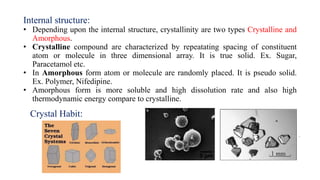
Crystal Habit:
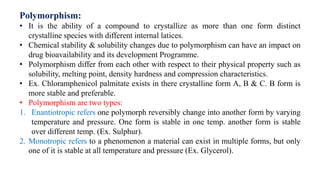
Polymorphism:
• It is the ability of a compound to crystallize as more than one form distinct
crystalline species with different internal latices.
• Chemical stability & solubility changes due to polymorphism can have an impact on
drug bioavailability and its development Programme.
• Polymorphism differ from each other with respect to their physical property such as
solubility, melting point, density hardness and compression characteristics.
• Ex. Chloramphenicol palmitate exists in there crystalline form A, B & C. B form is
more stable and preferable.
• Polymorphism are two types:
1. Enantiotropic refers one polymorph reversibly change into another form by varying
temperature and pressure. One form is stable in one temp. another form is stable
over different temp. (Ex. Sulphur).
2. Monotropic refers to a phenomenon a material can exist in multiple forms, but only
one of it is stable at all temperature and pressure (Ex. Glycerol).
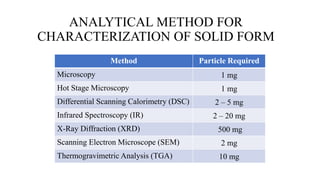
ANALYTICAL METHOD FOR
CHARACTERIZATION OF SOLID FORM
Method Particle Required
Microscopy 1 mg
Hot Stage Microscopy 1 mg
Differential Scanning Calorimetry (DSC) 2 – 5 mg
Infrared Spectroscopy (IR) 2 – 20 mg
X-Ray Diffraction (XRD) 500 mg
Scanning Electron Microscope (SEM) 2 mg
Thermogravimetric Analysis (TGA) 10 mg
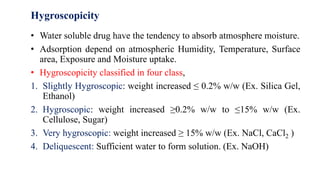
Hygroscopicity
• Water soluble drug have the tendency to absorb atmosphere moisture.
• Adsorption depend on atmospheric Humidity, Temperature, Surface
area, Exposure and Moisture uptake.
• Hygroscopicity classified in four class,
1. Slightly Hygroscopic: weight increased ≤ 0.2% w/w (Ex. Silica Gel,
Ethanol)
2. Hygroscopic: weight increased ≥0.2% w/w to ≤15% w/w (Ex.
Cellulose, Sugar)
3. Very hygroscopic: weight increased ≥ 15% w/w (Ex. NaCl, CaCl2 )
4. Deliquescent: Sufficient water to form solution. (Ex. NaOH)
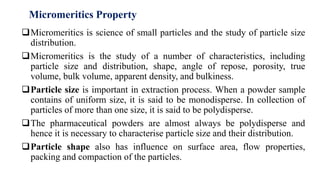
Micromeritics Property
Micromeritics is science of small particles and the study of particle size
distribution.
Micromeritics is the study of a number of characteristics, including
particle size and distribution, shape, angle of repose, porosity, true
volume, bulk volume, apparent density, and bulkiness.
Particle size is important in extraction process. When a powder sample
contains of uniform size, it is said to be monodisperse. In collection of
particles of more than one size, it is said to be polydisperse.
The pharmaceutical powders are almost always be polydisperse and
hence it is necessary to characterise particle size and their distribution.
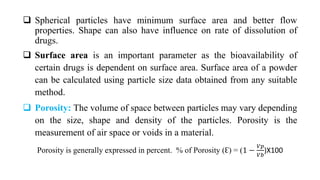
Particle shape also has influence on surface area, flow properties,
packing and compaction of the particles.
 Spherical particles have minimum surface area and better flow
properties. Shape can also have influence on rate of dissolution of
drugs.
 Surface area is an important parameter as the bioavailability of
certain drugs is dependent on surface area. Surface area of a powder
can be calculated using particle size data obtained from any suitable
method.
 Porosity: The volume of space between particles may vary depending
on the size, shape and density of the particles. Porosity is the
measurement of air space or voids in a material.
Porosity is generally expressed in percent. % of Porosity (Ɛ) = (1 −
𝑉𝑝
𝑉𝑏
)X100
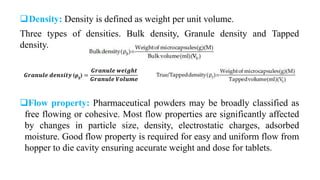
Density: Density is defined as weight per unit volume.
Three types of densities. Bulk density, Granule density and Tapped
density.
Flow property: Pharmaceutical powders may be broadly classified as
free flowing or cohesive. Most flow properties are significantly affected
by changes in particle size, density, electrostatic charges, adsorbed
moisture. Good flow property is required for easy and uniform flow from
hopper to die cavity ensuring accurate weight and dose for tablets.
𝑮𝒓𝒂𝒏𝒖𝒍𝒆 𝒅𝒆𝒏𝒔𝒊𝒕𝒚 (ρg) =
𝑮𝒓𝒂𝒏𝒖𝒍𝒆 𝒘𝒆𝒊𝒈𝒉𝒕
𝑮𝒓𝒂𝒏𝒖𝒍𝒆 𝑽𝒐𝒍𝒖𝒎𝒆
Angle of repose: It is defined as the maximum angle possible between
the surface of a pile of the powder and the horizontal plane. Angle of
repose is calculated for estimating flow properties.
Percentage compressibility: Compressibility is the ability of the
powder to decrease the volume under pressure. It is measured by
%Carr’s Index.
%𝐶𝑎𝑟𝑟′ 𝑠 𝐼𝑛𝑑𝑒𝑥 = ((𝑇𝑎𝑝𝑝𝑒𝑑 𝑑𝑒𝑛𝑠𝑖𝑡𝑦−𝐵𝑢𝑙𝑘 𝑑𝑒𝑛𝑠𝑖𝑡𝑦)/(𝑇𝑎𝑝𝑝𝑒𝑑 𝑑𝑒𝑛𝑠𝑖𝑡𝑦))X100
Hausner Ratio: it is the important parameter to measure flow property.
It affects the mass of uniformity of the dose.
𝐻𝑎𝑢𝑠𝑛𝑒𝑟 𝑟𝑎𝑡𝑖𝑜 = (𝑇𝑎𝑝𝑝𝑒𝑑 𝑑𝑒𝑛𝑠𝑖𝑡𝑦/𝐵𝑢𝑙𝑘 𝑑𝑒𝑛𝑠𝑖𝑡𝑦)
Angle of Repose (θ) Flow Property
<25 Excellent
25-30 Good
31-40 Satisfactory
41-50 Poor
>51 Very Poor
%Carr’s Index Flow Property Hausner Ratio
<10 Excellent 1.00 - 1.11
11-15 Good 1.12 - 1.18
16-20 Fair 1.19 - 1.25
21-25 Passable 1.26 - 1.34
26-31 Poor 1.35 - 1.45
32-37 Very poor >1.45
>37 Extremely Poor -
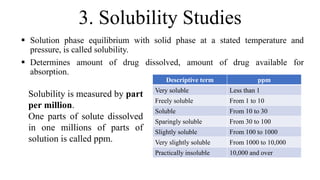
3. Solubility Studies
 Solution phase equilibrium with solid phase at a stated temperature and
pressure, is called solubility.
 Determines amount of drug dissolved, amount of drug available for
absorption.
Descriptive term ppm
Very soluble Less than 1
Freely soluble From 1 to 10
Soluble From 10 to 30
Sparingly soluble From 30 to 100
Slightly soluble From 100 to 1000
Very slightly soluble From 1000 to 10,000
Practically insoluble 10,000 and over
Solubility is measured by part
per million.
One parts of solute dissolved
in one millions of parts of
solution is called ppm.
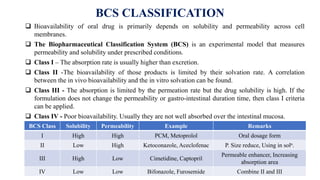
BCS CLASSIFICATION
BCS Class Solubility Permeability Example Remarks
I High High PCM, Metoprolol Oral dosage form
II Low High Ketoconazole, Aceclofenac P. Size reduce, Using in soln.
III High Low Cimetidine, Captopril
Permeable enhancer, Increasing
absorption area
IV Low Low Bifonazole, Furosemide Combine II and III
 Bioavailability of oral drug is primarily depends on solubility and permeability across cell
membranes.
 The Biopharmaceutical Classification System (BCS) is an experimental model that measures
permeability and solubility under prescribed conditions.
 Class I – The absorption rate is usually higher than excretion.
 Class II -The bioavailability of those products is limited by their solvation rate. A correlation
between the in vivo bioavailability and the in vitro solvation can be found.
 Class III - The absorption is limited by the permeation rate but the drug solubility is high. If the
formulation does not change the permeability or gastro-intestinal duration time, then class I criteria
can be applied.
 Class IV - Poor bioavailability. Usually they are not well absorbed over the intestinal mucosa.
pKa Determination
 The solubility and absorption can be altered with changing pH.
 pKa is dissociation constant of drug.
 Unionized drug is lipid soluble that is permeate through lipid membrane. But ionized
drug is lipid insoluble, slow permeation.
 Acidic substance become ionized by [H+] release and basic substance become
unionized by accept [H+].
 Weak acid become ionized in alkaline environment. Weak base become ionized in
acidic environment.
 Henderson-Hasselbalch equation:
For base: pH = pKa + log
[𝑖𝑜𝑛𝑖𝑧𝑒𝑑]
[𝑢𝑛𝑖𝑜𝑛𝑖𝑧𝑒𝑑]
For acid: pH = pKa + log
[𝑢𝑛𝑖𝑜𝑛𝑖𝑧𝑒𝑑]
[𝑖𝑜𝑛𝑖𝑧𝑒𝑑]
 % ionized =
10pH−pKa
1+10pK−pHaX100
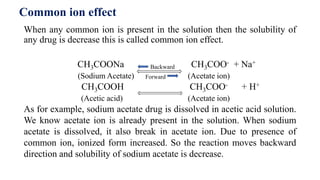
Common ion effect
When any common ion is present in the solution then the solubility of
any drug is decrease this is called common ion effect.
CH3COONa CH3COO- + Na+
(Sodium Acetate) (Acetate ion)
CH3COOH CH3COO- + H+
(Acetic acid) (Acetate ion)
As for example, sodium acetate drug is dissolved in acetic acid solution.
We know acetate ion is already present in the solution. When sodium
acetate is dissolved, it also break in acetate ion. Due to presence of
common ion, ionized form increased. So the reaction moves backward
direction and solubility of sodium acetate is decrease.
Backward
Forward
Thermal effect
o The heat of solution, ΔHs represent the heat release or absorbed when a mole solute
is dissolved in large quantity solvent.
o The solution process is endothermic or ΔHs positive i.e. increasing solution
temperature increased solubility.
o Hydrochloride salt are exothermic process or ΔHs negative i.e. higher temperature
suppress the solubility.
Solubilization
o Increase the solubility of poor water soluble substance with surface active agent
(co-solvent). The cosolvent disrupting the hydrophobic interaction.
o When surfactants are added to the liquid at low concentration they tend to orient at
the air-liquid interface.
o On further addition of surfactant the interface becomes completely occupied and
excess molecules are forced into the bulk of liquid.
o Solubilization is use for the drug substance with either poor water solubility or
insufficient solubility.
o The poorly water soluble non-electrolyte can often be improve by order of
magnitude with suitable co-solvent i.e. ethanol, propanol etc.
o The extent of solubilization due to addition of co-solvent depends on chemical
structure of drug that is more non-polar increased solubilization by co-solvent.
Partition-coefficient:
 Measurement of drug lipophilicity and an indication of its ability to cross cell
membranes is done by Oil/Water partition coefficient.
 Partition coefficient (log P) is defined as the ratio of unionized drug distributed
between lipid and aqueous phase at equilibrium.
Po/w =
𝑪 𝒐𝒊𝒍
𝑪 𝒘𝒂𝒕𝒆𝒓
o For acidic: log D = log P – log (1+10pH-pKa)
o For basic: log D = log P – log (1+10pKa-pH) , log D = distribution coefficient
o As for example, if log P is -2 that is 100 times more soluble in aqueous. If log p is 5
that is more soluble in lipid.
o Lipophilic/hydrophilic balance show higher rate and extent of drug absorption.
Dissolution:
• Dissolution is the process which involves solubilization of drug after its release from
dosage form before being absorbed through the GIT.
dc/dt=dissolution rate
h=diffusion layer thickness
C=solute concentration in bulk solution
V=volume of the dissolution medium
D=diffusion coefficient
A=surface area of the dissolving solid
Cs=solute concentration in the diffusion layer
• Dissolution is time depended but solubility amount depended.
• Dissolution rate is defined as the amount of the drug dissolve in solution
per unit time under standard.
It is derived by Noyes-Withney equation:
ⅆ𝑪
ⅆ𝒕
=
𝑫𝑨
𝒉𝒗
𝑪𝒔 − 𝑪
4. Stability Studies
Solution stability
A. Hydrolysis:
Most important in system containing suspension, emulsion, solution etc. Also for drugs, which
are affected by moisture from atmosphere.
It is usually catalyzed by hydrogen ion (acid) or hydroxyl ion (base).
Main classes of the drugs that undergo hydrolysis are Ester, Amide, alkali, Acid.
Ester hydrolysis: R.COOH (Ester) + H20 → RCOOH (Acid) + ROH (Alcohol)
Amide Hydrolysis: RCONHR (Amide) + H2O → RCOOH + NH2R (Amine)
B. Oxidation:
Oxidation is the loss of electrons while reduction is the gain of electrons. Either the addition of
oxygen or removal of hydrogen. Occurs when exposed to atmospheric oxygen ( Example of
drug: Vitamin A, B12; Heparin, Morphine).
Oxidation is controlled by environment i.e. light, trace element, oxygen and oxidizing agent.
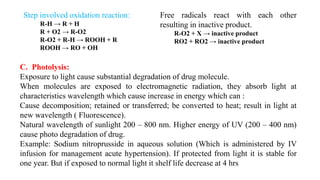
Step involved oxidation reaction:
R-H → R + H
R + O2 → R-O2
R-O2 + R-H → ROOH + R
ROOH → RO + OH
Free radicals react with each other
resulting in inactive product.
R-O2 + X → inactive product
RO2 + RO2 → inactive product
C. Photolysis:
Exposure to light cause substantial degradation of drug molecule.
When molecules are exposed to electromagnetic radiation, they absorb light at
characteristics wavelength which cause increase in energy which can :
Cause decomposition; retained or transferred; be converted to heat; result in light at
new wavelength ( Fluorescence).
Natural wavelength of sunlight 200 – 800 nm. Higher energy of UV (200 – 400 nm)
cause photo degradation of drug.
Example: Sodium nitroprusside in aqueous solution (Which is administered by IV
infusion for management acute hypertension). If protected from light it is stable for
one year. But if exposed to normal light it shelf life decrease at 4 hrs
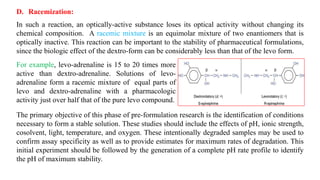
D. Racemization:
In such a reaction, an optically-active substance loses its optical activity without changing its
chemical composition. A racemic mixture is an equimolar mixture of two enantiomers that is
optically inactive. This reaction can be important to the stability of pharmaceutical formulations,
since the biologic effect of the dextro-form can be considerably less than that of the levo form.
The primary objective of this phase of pre-formulation research is the identification of conditions
necessary to form a stable solution. These studies should include the effects of pH, ionic strength,
cosolvent, light, temperature, and oxygen. These intentionally degraded samples may be used to
confirm assay specificity as well as to provide estimates for maximum rates of degradation. This
initial experiment should be followed by the generation of a complete pH rate profile to identify
the pH of maximum stability.
For example, levo-adrenaline is 15 to 20 times more
active than dextro-adrenaline. Solutions of levo-
adrenaline form a racemic mixture of equal parts of
levo and dextro-adrenaline with a pharmacologic
activity just over half that of the pure levo compound.
Solid state stability
 The primary objective of this investigation are identification of stable storage
condition for drug and identification of compatibility excipients for a formulation.
 Solid state reactions are much slower and more difficult to interpret than solution-
state reaction, owing to reduced number of molecular contacts between drug and
excipient molecules and to the occurrence multiple-phase reaction.
 The polymorphic changes of the sample is detected by Infrared analysis (IR). In
case of discoloration due to oxidation or reaction with excipients is studied by
HPLC.
 To determine the solid state stability profile of new compound, weighed samples
are placed in open vials and are exposed directly to variety of temperature (i.e.,
5°C, 22 °C, 37 °C, 50 °C, 70 °C etc.) and light intensities for 12 weeks. 5 to 10 mg
sample at each data point analysis by HPLC and 10 to 50 mg sample for
polymorph evaluation by DSC and IR.
Drug-Excipient Compatibility Study:
Drug-excipient compatibility study is very much important stage of formulation development
of drug product in combination of excipients. It's significant phase of pre-formulation study
Drug product not only contains active pharmaceutical ingredient (API) but it's combination of
different forms of excipients. it's important to study the physical and chemical interaction
between API and excipient. Generally, for excipient compatibility study combination of binary
mix in ratio of 1:1 is assessed. In some instances, to check the extreme interaction and
complications, multiple excipient mixture in presence of API were appraised.
Importance of excipients and it's compatibility with API:
1. Selection of appropriate excipients could be done by performing the drug excipient
compatibility study. It supports to prevent the expected last-minute complications
throughout the process of formulation development.
2. Drug-excipient compatibility study require to predict probable degradation pathways of the
drug product,
3. This study supports to recognize the selection of appropriate excipients and helps to
understand the interaction between drug and excipients and the storage condition of the
product.
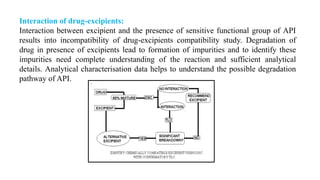
Interaction of drug-excipients:
Interaction between excipient and the presence of sensitive functional group of API
results into incompatibility of drug-excipients compatibility study. Degradation of
drug in presence of excipients lead to formation of impurities and to identify these
impurities need complete understanding of the reaction and sufficient analytical
details. Analytical characterisation data helps to understand the possible degradation
pathway of API.

Unit-1 Preformulation.pptx

  • 1.
    INDUSTRIAL PHARMACY-1 PREFORMULATION MR. SUBHASISH PRAMANIK ASSISTANT.PROFESSOR MATA GUJRI COLLEGE OF PHARMACY KISHANGANJ, BIHAR
  • 3.
    Introduction Preformulation study isdefine as a phase of development in which characterized the Physico-chemical properties of new drug molecule in order to develop safety, efficacy and stability of the dosage form. Objectives: 1. To established Physico-chemical properties of new drug molecule. 2. To determine its kinetic & stability. 3. Compatibility of the drug with common excipients. 4. To improve the manufacturing, storage and performance of new drug product.
  • 4.
    The principle areas of Preformulation research 1.Organoleptic Properties 1.Bulk characterization Crystallinity & Polymorphism Hygroscopicity Micromeritic Properties Solubility pKaDetermination Common ion effect Effect of Temperature Solubilization Partition Co- efficient Dissolution Stability Solution Stability Solid-State Stability Drug-Excipients Stability
  • 5.
    1. Organoleptic Properties OrganolepticProperties is the phase property of the drug which can be determine by means of organ sense (Odour, Colour & Taste) and also microscopic appearance of the drug.
  • 6.
    2. Bulk Characterization Bulkproperties of a solid form i.e. Particle size, Bulk density, Surface morphology are also likely to change during process development. Therefore, bulk characterization is necessary to avoid the misleading prediction of stability and solubility. Crystallinity: Crystallinity refers to the degree of structural order of a solid. Crystal habit & internal structure of drug can affect bulk & physicochemical property of molecule.  Crystal habit is description of outer appearance of crystal.  Internal structure is molecular arrangement within the solid.  Change with internal structure usually alters crystal habit. Ex. Conversion sodium salt to free acid form produce both change Crystal habit and Internal structure.
  • 7.
    Internal structure: • Dependingupon the internal structure, crystallinity are two types Crystalline and Amorphous. • Crystalline compound are characterized by repeatating spacing of constituent atom or molecule in three dimensional array. It is true solid. Ex. Sugar, Paracetamol etc. • In Amorphous form atom or molecule are randomly placed. It is pseudo solid. Ex. Polymer, Nifedipine. • Amorphous form is more soluble and high dissolution rate and also high thermodynamic energy compare to crystalline. Crystal Habit:
  • 8.
    Polymorphism: • It isthe ability of a compound to crystallize as more than one form distinct crystalline species with different internal latices. • Chemical stability & solubility changes due to polymorphism can have an impact on drug bioavailability and its development Programme. • Polymorphism differ from each other with respect to their physical property such as solubility, melting point, density hardness and compression characteristics. • Ex. Chloramphenicol palmitate exists in there crystalline form A, B & C. B form is more stable and preferable. • Polymorphism are two types: 1. Enantiotropic refers one polymorph reversibly change into another form by varying temperature and pressure. One form is stable in one temp. another form is stable over different temp. (Ex. Sulphur). 2. Monotropic refers to a phenomenon a material can exist in multiple forms, but only one of it is stable at all temperature and pressure (Ex. Glycerol).
  • 9.
    ANALYTICAL METHOD FOR CHARACTERIZATIONOF SOLID FORM Method Particle Required Microscopy 1 mg Hot Stage Microscopy 1 mg Differential Scanning Calorimetry (DSC) 2 – 5 mg Infrared Spectroscopy (IR) 2 – 20 mg X-Ray Diffraction (XRD) 500 mg Scanning Electron Microscope (SEM) 2 mg Thermogravimetric Analysis (TGA) 10 mg
  • 10.
    Hygroscopicity • Water solubledrug have the tendency to absorb atmosphere moisture. • Adsorption depend on atmospheric Humidity, Temperature, Surface area, Exposure and Moisture uptake. • Hygroscopicity classified in four class, 1. Slightly Hygroscopic: weight increased ≤ 0.2% w/w (Ex. Silica Gel, Ethanol) 2. Hygroscopic: weight increased ≥0.2% w/w to ≤15% w/w (Ex. Cellulose, Sugar) 3. Very hygroscopic: weight increased ≥ 15% w/w (Ex. NaCl, CaCl2 ) 4. Deliquescent: Sufficient water to form solution. (Ex. NaOH)
  • 11.
    Micromeritics Property Micromeritics isscience of small particles and the study of particle size distribution. Micromeritics is the study of a number of characteristics, including particle size and distribution, shape, angle of repose, porosity, true volume, bulk volume, apparent density, and bulkiness. Particle size is important in extraction process. When a powder sample contains of uniform size, it is said to be monodisperse. In collection of particles of more than one size, it is said to be polydisperse. The pharmaceutical powders are almost always be polydisperse and hence it is necessary to characterise particle size and their distribution. Particle shape also has influence on surface area, flow properties, packing and compaction of the particles.
  • 12.
     Spherical particleshave minimum surface area and better flow properties. Shape can also have influence on rate of dissolution of drugs.  Surface area is an important parameter as the bioavailability of certain drugs is dependent on surface area. Surface area of a powder can be calculated using particle size data obtained from any suitable method.  Porosity: The volume of space between particles may vary depending on the size, shape and density of the particles. Porosity is the measurement of air space or voids in a material. Porosity is generally expressed in percent. % of Porosity (Ɛ) = (1 − 𝑉𝑝 𝑉𝑏 )X100
  • 13.
    Density: Density isdefined as weight per unit volume. Three types of densities. Bulk density, Granule density and Tapped density. Flow property: Pharmaceutical powders may be broadly classified as free flowing or cohesive. Most flow properties are significantly affected by changes in particle size, density, electrostatic charges, adsorbed moisture. Good flow property is required for easy and uniform flow from hopper to die cavity ensuring accurate weight and dose for tablets. 𝑮𝒓𝒂𝒏𝒖𝒍𝒆 𝒅𝒆𝒏𝒔𝒊𝒕𝒚 (ρg) = 𝑮𝒓𝒂𝒏𝒖𝒍𝒆 𝒘𝒆𝒊𝒈𝒉𝒕 𝑮𝒓𝒂𝒏𝒖𝒍𝒆 𝑽𝒐𝒍𝒖𝒎𝒆
  • 14.
    Angle of repose:It is defined as the maximum angle possible between the surface of a pile of the powder and the horizontal plane. Angle of repose is calculated for estimating flow properties. Percentage compressibility: Compressibility is the ability of the powder to decrease the volume under pressure. It is measured by %Carr’s Index. %𝐶𝑎𝑟𝑟′ 𝑠 𝐼𝑛𝑑𝑒𝑥 = ((𝑇𝑎𝑝𝑝𝑒𝑑 𝑑𝑒𝑛𝑠𝑖𝑡𝑦−𝐵𝑢𝑙𝑘 𝑑𝑒𝑛𝑠𝑖𝑡𝑦)/(𝑇𝑎𝑝𝑝𝑒𝑑 𝑑𝑒𝑛𝑠𝑖𝑡𝑦))X100 Hausner Ratio: it is the important parameter to measure flow property. It affects the mass of uniformity of the dose. 𝐻𝑎𝑢𝑠𝑛𝑒𝑟 𝑟𝑎𝑡𝑖𝑜 = (𝑇𝑎𝑝𝑝𝑒𝑑 𝑑𝑒𝑛𝑠𝑖𝑡𝑦/𝐵𝑢𝑙𝑘 𝑑𝑒𝑛𝑠𝑖𝑡𝑦)
  • 15.
    Angle of Repose(θ) Flow Property <25 Excellent 25-30 Good 31-40 Satisfactory 41-50 Poor >51 Very Poor %Carr’s Index Flow Property Hausner Ratio <10 Excellent 1.00 - 1.11 11-15 Good 1.12 - 1.18 16-20 Fair 1.19 - 1.25 21-25 Passable 1.26 - 1.34 26-31 Poor 1.35 - 1.45 32-37 Very poor >1.45 >37 Extremely Poor -
  • 16.
    3. Solubility Studies Solution phase equilibrium with solid phase at a stated temperature and pressure, is called solubility.  Determines amount of drug dissolved, amount of drug available for absorption. Descriptive term ppm Very soluble Less than 1 Freely soluble From 1 to 10 Soluble From 10 to 30 Sparingly soluble From 30 to 100 Slightly soluble From 100 to 1000 Very slightly soluble From 1000 to 10,000 Practically insoluble 10,000 and over Solubility is measured by part per million. One parts of solute dissolved in one millions of parts of solution is called ppm.
  • 17.
    BCS CLASSIFICATION BCS ClassSolubility Permeability Example Remarks I High High PCM, Metoprolol Oral dosage form II Low High Ketoconazole, Aceclofenac P. Size reduce, Using in soln. III High Low Cimetidine, Captopril Permeable enhancer, Increasing absorption area IV Low Low Bifonazole, Furosemide Combine II and III  Bioavailability of oral drug is primarily depends on solubility and permeability across cell membranes.  The Biopharmaceutical Classification System (BCS) is an experimental model that measures permeability and solubility under prescribed conditions.  Class I – The absorption rate is usually higher than excretion.  Class II -The bioavailability of those products is limited by their solvation rate. A correlation between the in vivo bioavailability and the in vitro solvation can be found.  Class III - The absorption is limited by the permeation rate but the drug solubility is high. If the formulation does not change the permeability or gastro-intestinal duration time, then class I criteria can be applied.  Class IV - Poor bioavailability. Usually they are not well absorbed over the intestinal mucosa.
  • 18.
    pKa Determination  Thesolubility and absorption can be altered with changing pH.  pKa is dissociation constant of drug.  Unionized drug is lipid soluble that is permeate through lipid membrane. But ionized drug is lipid insoluble, slow permeation.  Acidic substance become ionized by [H+] release and basic substance become unionized by accept [H+].  Weak acid become ionized in alkaline environment. Weak base become ionized in acidic environment.  Henderson-Hasselbalch equation: For base: pH = pKa + log [𝑖𝑜𝑛𝑖𝑧𝑒𝑑] [𝑢𝑛𝑖𝑜𝑛𝑖𝑧𝑒𝑑] For acid: pH = pKa + log [𝑢𝑛𝑖𝑜𝑛𝑖𝑧𝑒𝑑] [𝑖𝑜𝑛𝑖𝑧𝑒𝑑]  % ionized = 10pH−pKa 1+10pK−pHaX100
  • 19.
    Common ion effect Whenany common ion is present in the solution then the solubility of any drug is decrease this is called common ion effect. CH3COONa CH3COO- + Na+ (Sodium Acetate) (Acetate ion) CH3COOH CH3COO- + H+ (Acetic acid) (Acetate ion) As for example, sodium acetate drug is dissolved in acetic acid solution. We know acetate ion is already present in the solution. When sodium acetate is dissolved, it also break in acetate ion. Due to presence of common ion, ionized form increased. So the reaction moves backward direction and solubility of sodium acetate is decrease. Backward Forward
  • 20.
    Thermal effect o Theheat of solution, ΔHs represent the heat release or absorbed when a mole solute is dissolved in large quantity solvent. o The solution process is endothermic or ΔHs positive i.e. increasing solution temperature increased solubility. o Hydrochloride salt are exothermic process or ΔHs negative i.e. higher temperature suppress the solubility. Solubilization o Increase the solubility of poor water soluble substance with surface active agent (co-solvent). The cosolvent disrupting the hydrophobic interaction. o When surfactants are added to the liquid at low concentration they tend to orient at the air-liquid interface. o On further addition of surfactant the interface becomes completely occupied and excess molecules are forced into the bulk of liquid.
  • 21.
    o Solubilization isuse for the drug substance with either poor water solubility or insufficient solubility. o The poorly water soluble non-electrolyte can often be improve by order of magnitude with suitable co-solvent i.e. ethanol, propanol etc. o The extent of solubilization due to addition of co-solvent depends on chemical structure of drug that is more non-polar increased solubilization by co-solvent. Partition-coefficient:  Measurement of drug lipophilicity and an indication of its ability to cross cell membranes is done by Oil/Water partition coefficient.  Partition coefficient (log P) is defined as the ratio of unionized drug distributed between lipid and aqueous phase at equilibrium. Po/w = 𝑪 𝒐𝒊𝒍 𝑪 𝒘𝒂𝒕𝒆𝒓
  • 22.
    o For acidic:log D = log P – log (1+10pH-pKa) o For basic: log D = log P – log (1+10pKa-pH) , log D = distribution coefficient o As for example, if log P is -2 that is 100 times more soluble in aqueous. If log p is 5 that is more soluble in lipid. o Lipophilic/hydrophilic balance show higher rate and extent of drug absorption. Dissolution: • Dissolution is the process which involves solubilization of drug after its release from dosage form before being absorbed through the GIT. dc/dt=dissolution rate h=diffusion layer thickness C=solute concentration in bulk solution V=volume of the dissolution medium D=diffusion coefficient A=surface area of the dissolving solid Cs=solute concentration in the diffusion layer • Dissolution is time depended but solubility amount depended. • Dissolution rate is defined as the amount of the drug dissolve in solution per unit time under standard. It is derived by Noyes-Withney equation: ⅆ𝑪 ⅆ𝒕 = 𝑫𝑨 𝒉𝒗 𝑪𝒔 − 𝑪
  • 23.
    4. Stability Studies Solutionstability A. Hydrolysis: Most important in system containing suspension, emulsion, solution etc. Also for drugs, which are affected by moisture from atmosphere. It is usually catalyzed by hydrogen ion (acid) or hydroxyl ion (base). Main classes of the drugs that undergo hydrolysis are Ester, Amide, alkali, Acid. Ester hydrolysis: R.COOH (Ester) + H20 → RCOOH (Acid) + ROH (Alcohol) Amide Hydrolysis: RCONHR (Amide) + H2O → RCOOH + NH2R (Amine) B. Oxidation: Oxidation is the loss of electrons while reduction is the gain of electrons. Either the addition of oxygen or removal of hydrogen. Occurs when exposed to atmospheric oxygen ( Example of drug: Vitamin A, B12; Heparin, Morphine). Oxidation is controlled by environment i.e. light, trace element, oxygen and oxidizing agent.
  • 24.
    Step involved oxidationreaction: R-H → R + H R + O2 → R-O2 R-O2 + R-H → ROOH + R ROOH → RO + OH Free radicals react with each other resulting in inactive product. R-O2 + X → inactive product RO2 + RO2 → inactive product C. Photolysis: Exposure to light cause substantial degradation of drug molecule. When molecules are exposed to electromagnetic radiation, they absorb light at characteristics wavelength which cause increase in energy which can : Cause decomposition; retained or transferred; be converted to heat; result in light at new wavelength ( Fluorescence). Natural wavelength of sunlight 200 – 800 nm. Higher energy of UV (200 – 400 nm) cause photo degradation of drug. Example: Sodium nitroprusside in aqueous solution (Which is administered by IV infusion for management acute hypertension). If protected from light it is stable for one year. But if exposed to normal light it shelf life decrease at 4 hrs
  • 25.
    D. Racemization: In sucha reaction, an optically-active substance loses its optical activity without changing its chemical composition. A racemic mixture is an equimolar mixture of two enantiomers that is optically inactive. This reaction can be important to the stability of pharmaceutical formulations, since the biologic effect of the dextro-form can be considerably less than that of the levo form. The primary objective of this phase of pre-formulation research is the identification of conditions necessary to form a stable solution. These studies should include the effects of pH, ionic strength, cosolvent, light, temperature, and oxygen. These intentionally degraded samples may be used to confirm assay specificity as well as to provide estimates for maximum rates of degradation. This initial experiment should be followed by the generation of a complete pH rate profile to identify the pH of maximum stability. For example, levo-adrenaline is 15 to 20 times more active than dextro-adrenaline. Solutions of levo- adrenaline form a racemic mixture of equal parts of levo and dextro-adrenaline with a pharmacologic activity just over half that of the pure levo compound.
  • 26.
    Solid state stability The primary objective of this investigation are identification of stable storage condition for drug and identification of compatibility excipients for a formulation.  Solid state reactions are much slower and more difficult to interpret than solution- state reaction, owing to reduced number of molecular contacts between drug and excipient molecules and to the occurrence multiple-phase reaction.  The polymorphic changes of the sample is detected by Infrared analysis (IR). In case of discoloration due to oxidation or reaction with excipients is studied by HPLC.  To determine the solid state stability profile of new compound, weighed samples are placed in open vials and are exposed directly to variety of temperature (i.e., 5°C, 22 °C, 37 °C, 50 °C, 70 °C etc.) and light intensities for 12 weeks. 5 to 10 mg sample at each data point analysis by HPLC and 10 to 50 mg sample for polymorph evaluation by DSC and IR.
  • 27.
    Drug-Excipient Compatibility Study: Drug-excipientcompatibility study is very much important stage of formulation development of drug product in combination of excipients. It's significant phase of pre-formulation study Drug product not only contains active pharmaceutical ingredient (API) but it's combination of different forms of excipients. it's important to study the physical and chemical interaction between API and excipient. Generally, for excipient compatibility study combination of binary mix in ratio of 1:1 is assessed. In some instances, to check the extreme interaction and complications, multiple excipient mixture in presence of API were appraised. Importance of excipients and it's compatibility with API: 1. Selection of appropriate excipients could be done by performing the drug excipient compatibility study. It supports to prevent the expected last-minute complications throughout the process of formulation development. 2. Drug-excipient compatibility study require to predict probable degradation pathways of the drug product, 3. This study supports to recognize the selection of appropriate excipients and helps to understand the interaction between drug and excipients and the storage condition of the product.
  • 28.
    Interaction of drug-excipients: Interactionbetween excipient and the presence of sensitive functional group of API results into incompatibility of drug-excipients compatibility study. Degradation of drug in presence of excipients lead to formation of impurities and to identify these impurities need complete understanding of the reaction and sufficient analytical details. Analytical characterisation data helps to understand the possible degradation pathway of API.