Preanalytics in the
Analysis of
Arterial Blood Gases
Meqat General Hospital December 2016
By
Prof. Asmaa El Reweny, MD
Professor & Consultant of Clinical & Chemical Pathology,
Faculty of Medicine, Cairo University & AMS, Taibah University (2006-2016)
Objectives
By the end of this lecture you will be able to:
1. Recognize why the sample of ABGs
analysis is so special sample ?
2. Identify important precautions before,
during & after sampling for ABGs.
3. Recognize potential errors & how to avoid
them.
2Prof Asmaa El Reweny, MD
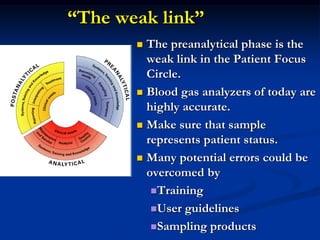
“The weak link”
 The preanalytical phase is the
weak link in the Patient Focus
Circle.
 Blood gas analyzers of today are
highly accurate.
 Make sure that sample
represents patient status.
 Many potential errors could be
overcomed by
Training
User guidelines
Sampling products
Aterial Blood Gases Analysis
“Collection of blood, as well as its handling and transport are key
factors in the accuracy of clinical laboratory analysis and ultimately
in delivering quality patient care”
”Arterial blood is one of the most critical specimens sent to the
clinical laboratory”
”Blood gas and pH analysis has an immediate effect on
patient care than any other laboratory test”
”In blood gas and pH analysis an incorrect result
can often be worse for the patient than no result at
all”
4Prof Asmaa El Reweny, MD
What is so special about blood gases?
 NOT like other blood samples
 STAT Test
 Must be analyzed within a
short time
 Short Turn Around Time
 pO2, pCO2, pH, LAC, GLU
 Sample composition changes
 Patient status changes
5Prof Asmaa El Reweny, MD
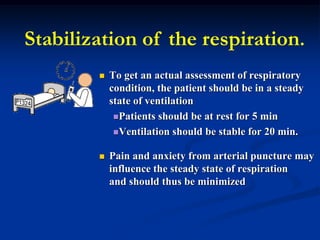
 To get an actual assessment of respiratory
condition, the patient should be in a steady
state of ventilation
Patients should be at rest for 5 min
Ventilation should be stable for 20 min.
 Pain and anxiety from arterial puncture may
influence the steady state of respiration
and should thus be minimized
Stabilization of the respiration.
Special Handling of Blood
Specimens:
 ABG will require chilled tube in order
to maintain the stability of the analytes.
 A slurry of ice and water is
recommended for chilling the tubes of
blood.
7Prof Asmaa El Reweny, MD
Blood Specimen Transport
Specimens for ABG must be transported
immediately .
8Prof Asmaa El Reweny, MD
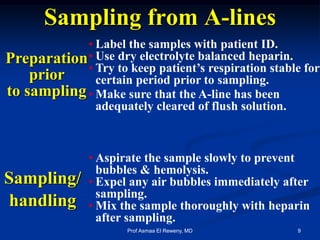
Sampling from A-lines
Preparation
prior
to sampling
Sampling/
handling
• Label the samples with patient ID.
• Use dry electrolyte balanced heparin.
• Try to keep patient’s respiration stable for
certain period prior to sampling.
• Make sure that the A-line has been
adequately cleared of flush solution.
• Aspirate the sample slowly to prevent
bubbles & hemolysis.
• Expel any air bubbles immediately after
sampling.
• Mix the sample thoroughly with heparin
after sampling.
9Prof Asmaa El Reweny, MD
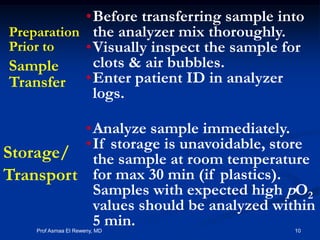
Preparation
Prior to
Sample
Transfer
•Before transferring sample into
the analyzer mix thoroughly.
•Visually inspect the sample for
clots & air bubbles.
•Enter patient ID in analyzer
logs.
Storage/
Transport
•Analyze sample immediately.
•If storage is unavoidable, store
the sample at room temperature
for max 30 min (if plastics).
Samples with expected high pO2
values should be analyzed within
5 min. 10Prof Asmaa El Reweny, MD
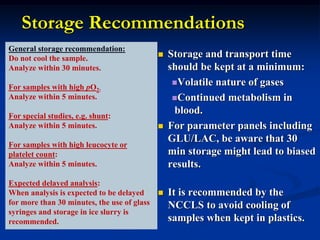
Storage Recommendations
 Storage and transport time
should be kept at a minimum:
Volatile nature of gases
Continued metabolism in
blood.
 For parameter panels including
GLU/LAC, be aware that 30
min storage might lead to biased
results.
 It is recommended by the
NCCLS to avoid cooling of
samples when kept in plastics.
General storage recommendation:
Do not cool the sample.
Analyze within 30 minutes.
For samples with high pO2:
Analyze within 5 minutes.
For special studies, e.g. shunt:
Analyze within 5 minutes.
For samples with high leucocyte or
platelet count:
Analyze within 5 minutes.
Expected delayed analysis:
When analysis is expected to be delayed
for more than 30 minutes, the use of glass
syringes and storage in ice slurry is
recommended.
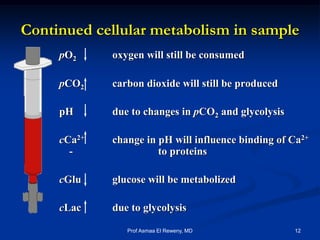
pO2 oxygen will still be consumed
pCO2 carbon dioxide will still be produced
pH due to changes in pCO2 and glycolysis
cCa2+ change in pH will influence binding of Ca2+
- to proteins
cGlu glucose will be metabolized
cLac due to glycolysis
Continued cellular metabolism in sample
12Prof Asmaa El Reweny, MD
Slowing down the metabolism
 Blood gas samples in glass samplers
could be cooled: storing the sample
at lower temperature (0-4 °C) will
slow down metabolism by at least a
factor of 10 [NCCLS].
 Cool samples in an ice slurry or
other suitable coolant.
 Never store the samples directly on
ice as this causes hemolysis of blood
cells.
NCCLS Document C27-A; Blood Gas Pre-Analytical Considerations: Specimen Collection, Calibrations and Controls; Approved Guideline
25 C
0-4 C
pO2
Time
13Prof Asmaa El Reweny, MD
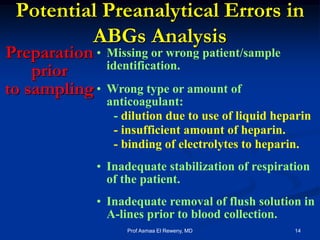
Potential Preanalytical Errors in
ABGs Analysis
Preparation
prior
to sampling
• Missing or wrong patient/sample
identification.
• Wrong type or amount of
anticoagulant:
- dilution due to use of liquid heparin
- insufficient amount of heparin.
- binding of electrolytes to heparin.
• Inadequate stabilization of respiration
of the patient.
• Inadequate removal of flush solution in
A-lines prior to blood collection.
14Prof Asmaa El Reweny, MD
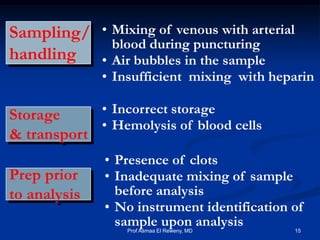
Sampling/
handling
• Mixing of venous with arterial
blood during puncturing
• Air bubbles in the sample
• Insufficient mixing with heparin
• Incorrect storage
• Hemolysis of blood cells
Storage
& transport
Prep prior
to analysis
• Presence of clots
• Inadequate mixing of sample
before analysis
• No instrument identification of
sample upon analysis 15Prof Asmaa El Reweny, MD
Mixing venous and arterial blood
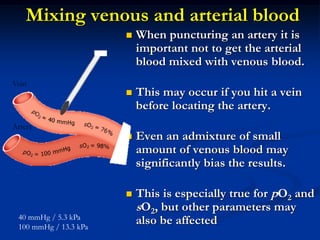
 When puncturing an artery it is
important not to get the arterial
blood mixed with venous blood.
 This may occur if you hit a vein
before locating the artery.
 Even an admixture of small
amount of venous blood may
significantly bias the results.
 This is especially true for pO2 and
sO2, but other parameters may
also be affected
Vein
Artery
40 mmHg / 5.3 kPa
100 mmHg / 13.3 kPa
Mixing venous and arterial blood
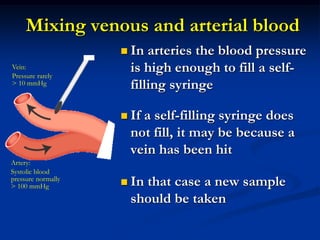
 In arteries the blood pressure
is high enough to fill a self-
filling syringe
 If a self-filling syringe does
not fill, it may be because a
vein has been hit
 In that case a new sample
should be taken
Vein:
Pressure rarely
> 10 mmHg
Artery:
Systolic blood
pressure normally
> 100 mmHg
Inadequate removal of flush solution
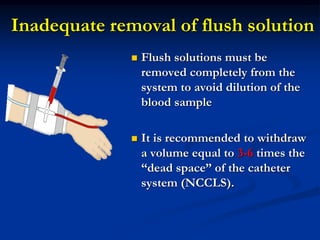
 Flush solutions must be
removed completely from the
system to avoid dilution of the
blood sample
 It is recommended to withdraw
a volume equal to 3-6 times the
“dead space” of the catheter
system (NCCLS).
Inadequate removal of flush solutions
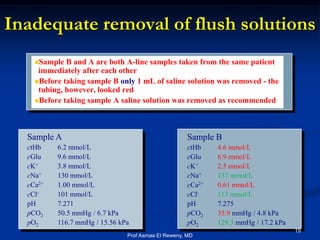
Sample B and A are both A-line samples taken from the same patient
immediately after each other
Before taking sample B only 1 mL of saline solution was removed - the
tubing, however, looked red
Before taking sample A saline solution was removed as recommended
Sample A
ctHb 6.2 mmol/L
cGlu 9.6 mmol/L
cK+ 3.8 mmol/L
cNa+ 130 mmol/L
cCa2+ 1.00 mmol/L
cCl- 101 mmol/L
pH 7.271
pCO2 50.5 mmHg / 6.7 kPa
pO2 116.7 mmHg / 15.56 kPa
Sample B
ctHb 4.6 mmol/L
cGlu 6.9 mmol/L
cK+ 2.5 mmol/L
cNa+ 137 mmol/L
cCa2+ 0.61 mmol/L
cCl- 113 mmol/L
pH 7.275
pCO2 35.9 mmHg / 4.8 kPa
pO2 129.3 mmHg / 17.2 kPa
19
Prof Asmaa El Reweny, MD
Air bubbles
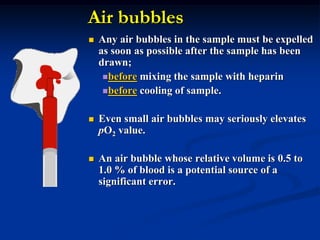
 Any air bubbles in the sample must be expelled
as soon as possible after the sample has been
drawn;
before mixing the sample with heparin
before cooling of sample.
 Even small air bubbles may seriously elevates
pO2 value.
 An air bubble whose relative volume is 0.5 to
1.0 % of blood is a potential source of a
significant error.
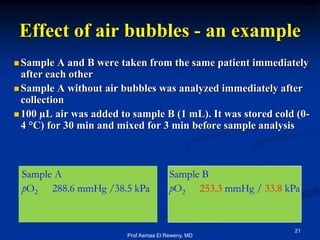
Effect of air bubbles - an example
 Sample A and B were taken from the same patient immediately
after each other
 Sample A without air bubbles was analyzed immediately after
collection
 100 µL air was added to sample B (1 mL). It was stored cold (0-
4 °C) for 30 min and mixed for 3 min before sample analysis
Sample A
pO2 288.6 mmHg /38.5 kPa
Sample B
pO2 253.3 mmHg / 33.8 kPa
21
Prof Asmaa El Reweny, MD
Insufficient mixing with heparin
 Insufficient mixing can
produce clots.
 It is recommended to
mix the blood sample
thoroughly with heparin
 Invert the syringe 10
times and roll it between
your palms
22Prof Asmaa El Reweny, MD
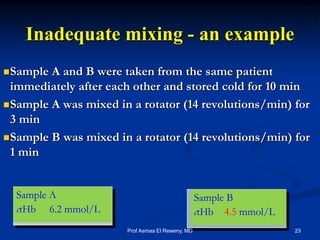
Inadequate mixing - an example
Sample A and B were taken from the same patient
immediately after each other and stored cold for 10 min
Sample A was mixed in a rotator (14 revolutions/min) for
3 min
Sample B was mixed in a rotator (14 revolutions/min) for
1 min
Sample B
ctHb 4.5 mmol/L
Sample A
ctHb 6.2 mmol/L
23Prof Asmaa El Reweny, MD
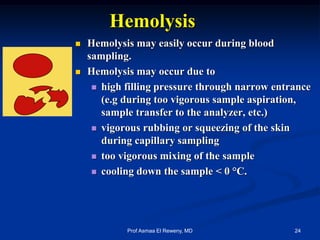
Hemolysis
 Hemolysis may easily occur during blood
sampling.
 Hemolysis may occur due to
 high filling pressure through narrow entrance
(e.g during too vigorous sample aspiration,
sample transfer to the analyzer, etc.)
 vigorous rubbing or squeezing of the skin
during capillary sampling
 too vigorous mixing of the sample
 cooling down the sample < 0 °C.
24Prof Asmaa El Reweny, MD
Finally…
 The human role in sample collection makes
complete elimination of errors associated
with laboratory testing unrealistic
 However, good practices and compliance
with the new strategies for error prevention
can lead to a substantial reduction in pre-
analytical errors.
25Prof Asmaa El Reweny, MD
‫العالمين‬ ‫رب‬ ‫هلل‬ ‫الحمد‬
Thank You
26Prof Asmaa El Reweny, MD

Preanalytical errors ab gs

  • 1.
    Preanalytics in the Analysisof Arterial Blood Gases Meqat General Hospital December 2016 By Prof. Asmaa El Reweny, MD Professor & Consultant of Clinical & Chemical Pathology, Faculty of Medicine, Cairo University & AMS, Taibah University (2006-2016)
  • 2.
    Objectives By the endof this lecture you will be able to: 1. Recognize why the sample of ABGs analysis is so special sample ? 2. Identify important precautions before, during & after sampling for ABGs. 3. Recognize potential errors & how to avoid them. 2Prof Asmaa El Reweny, MD
  • 3.
    “The weak link” The preanalytical phase is the weak link in the Patient Focus Circle.  Blood gas analyzers of today are highly accurate.  Make sure that sample represents patient status.  Many potential errors could be overcomed by Training User guidelines Sampling products
  • 4.
    Aterial Blood GasesAnalysis “Collection of blood, as well as its handling and transport are key factors in the accuracy of clinical laboratory analysis and ultimately in delivering quality patient care” ”Arterial blood is one of the most critical specimens sent to the clinical laboratory” ”Blood gas and pH analysis has an immediate effect on patient care than any other laboratory test” ”In blood gas and pH analysis an incorrect result can often be worse for the patient than no result at all” 4Prof Asmaa El Reweny, MD
  • 5.
    What is sospecial about blood gases?  NOT like other blood samples  STAT Test  Must be analyzed within a short time  Short Turn Around Time  pO2, pCO2, pH, LAC, GLU  Sample composition changes  Patient status changes 5Prof Asmaa El Reweny, MD
  • 6.
     To getan actual assessment of respiratory condition, the patient should be in a steady state of ventilation Patients should be at rest for 5 min Ventilation should be stable for 20 min.  Pain and anxiety from arterial puncture may influence the steady state of respiration and should thus be minimized Stabilization of the respiration.
  • 7.
    Special Handling ofBlood Specimens:  ABG will require chilled tube in order to maintain the stability of the analytes.  A slurry of ice and water is recommended for chilling the tubes of blood. 7Prof Asmaa El Reweny, MD
  • 8.
    Blood Specimen Transport Specimensfor ABG must be transported immediately . 8Prof Asmaa El Reweny, MD
  • 9.
    Sampling from A-lines Preparation prior tosampling Sampling/ handling • Label the samples with patient ID. • Use dry electrolyte balanced heparin. • Try to keep patient’s respiration stable for certain period prior to sampling. • Make sure that the A-line has been adequately cleared of flush solution. • Aspirate the sample slowly to prevent bubbles & hemolysis. • Expel any air bubbles immediately after sampling. • Mix the sample thoroughly with heparin after sampling. 9Prof Asmaa El Reweny, MD
  • 10.
    Preparation Prior to Sample Transfer •Before transferringsample into the analyzer mix thoroughly. •Visually inspect the sample for clots & air bubbles. •Enter patient ID in analyzer logs. Storage/ Transport •Analyze sample immediately. •If storage is unavoidable, store the sample at room temperature for max 30 min (if plastics). Samples with expected high pO2 values should be analyzed within 5 min. 10Prof Asmaa El Reweny, MD
  • 11.
    Storage Recommendations  Storageand transport time should be kept at a minimum: Volatile nature of gases Continued metabolism in blood.  For parameter panels including GLU/LAC, be aware that 30 min storage might lead to biased results.  It is recommended by the NCCLS to avoid cooling of samples when kept in plastics. General storage recommendation: Do not cool the sample. Analyze within 30 minutes. For samples with high pO2: Analyze within 5 minutes. For special studies, e.g. shunt: Analyze within 5 minutes. For samples with high leucocyte or platelet count: Analyze within 5 minutes. Expected delayed analysis: When analysis is expected to be delayed for more than 30 minutes, the use of glass syringes and storage in ice slurry is recommended.
  • 12.
    pO2 oxygen willstill be consumed pCO2 carbon dioxide will still be produced pH due to changes in pCO2 and glycolysis cCa2+ change in pH will influence binding of Ca2+ - to proteins cGlu glucose will be metabolized cLac due to glycolysis Continued cellular metabolism in sample 12Prof Asmaa El Reweny, MD
  • 13.
    Slowing down themetabolism  Blood gas samples in glass samplers could be cooled: storing the sample at lower temperature (0-4 °C) will slow down metabolism by at least a factor of 10 [NCCLS].  Cool samples in an ice slurry or other suitable coolant.  Never store the samples directly on ice as this causes hemolysis of blood cells. NCCLS Document C27-A; Blood Gas Pre-Analytical Considerations: Specimen Collection, Calibrations and Controls; Approved Guideline 25 C 0-4 C pO2 Time 13Prof Asmaa El Reweny, MD
  • 14.
    Potential Preanalytical Errorsin ABGs Analysis Preparation prior to sampling • Missing or wrong patient/sample identification. • Wrong type or amount of anticoagulant: - dilution due to use of liquid heparin - insufficient amount of heparin. - binding of electrolytes to heparin. • Inadequate stabilization of respiration of the patient. • Inadequate removal of flush solution in A-lines prior to blood collection. 14Prof Asmaa El Reweny, MD
  • 15.
    Sampling/ handling • Mixing ofvenous with arterial blood during puncturing • Air bubbles in the sample • Insufficient mixing with heparin • Incorrect storage • Hemolysis of blood cells Storage & transport Prep prior to analysis • Presence of clots • Inadequate mixing of sample before analysis • No instrument identification of sample upon analysis 15Prof Asmaa El Reweny, MD
  • 16.
    Mixing venous andarterial blood  When puncturing an artery it is important not to get the arterial blood mixed with venous blood.  This may occur if you hit a vein before locating the artery.  Even an admixture of small amount of venous blood may significantly bias the results.  This is especially true for pO2 and sO2, but other parameters may also be affected Vein Artery 40 mmHg / 5.3 kPa 100 mmHg / 13.3 kPa
  • 17.
    Mixing venous andarterial blood  In arteries the blood pressure is high enough to fill a self- filling syringe  If a self-filling syringe does not fill, it may be because a vein has been hit  In that case a new sample should be taken Vein: Pressure rarely > 10 mmHg Artery: Systolic blood pressure normally > 100 mmHg
  • 18.
    Inadequate removal offlush solution  Flush solutions must be removed completely from the system to avoid dilution of the blood sample  It is recommended to withdraw a volume equal to 3-6 times the “dead space” of the catheter system (NCCLS).
  • 19.
    Inadequate removal offlush solutions Sample B and A are both A-line samples taken from the same patient immediately after each other Before taking sample B only 1 mL of saline solution was removed - the tubing, however, looked red Before taking sample A saline solution was removed as recommended Sample A ctHb 6.2 mmol/L cGlu 9.6 mmol/L cK+ 3.8 mmol/L cNa+ 130 mmol/L cCa2+ 1.00 mmol/L cCl- 101 mmol/L pH 7.271 pCO2 50.5 mmHg / 6.7 kPa pO2 116.7 mmHg / 15.56 kPa Sample B ctHb 4.6 mmol/L cGlu 6.9 mmol/L cK+ 2.5 mmol/L cNa+ 137 mmol/L cCa2+ 0.61 mmol/L cCl- 113 mmol/L pH 7.275 pCO2 35.9 mmHg / 4.8 kPa pO2 129.3 mmHg / 17.2 kPa 19 Prof Asmaa El Reweny, MD
  • 20.
    Air bubbles  Anyair bubbles in the sample must be expelled as soon as possible after the sample has been drawn; before mixing the sample with heparin before cooling of sample.  Even small air bubbles may seriously elevates pO2 value.  An air bubble whose relative volume is 0.5 to 1.0 % of blood is a potential source of a significant error.
  • 21.
    Effect of airbubbles - an example  Sample A and B were taken from the same patient immediately after each other  Sample A without air bubbles was analyzed immediately after collection  100 µL air was added to sample B (1 mL). It was stored cold (0- 4 °C) for 30 min and mixed for 3 min before sample analysis Sample A pO2 288.6 mmHg /38.5 kPa Sample B pO2 253.3 mmHg / 33.8 kPa 21 Prof Asmaa El Reweny, MD
  • 22.
    Insufficient mixing withheparin  Insufficient mixing can produce clots.  It is recommended to mix the blood sample thoroughly with heparin  Invert the syringe 10 times and roll it between your palms 22Prof Asmaa El Reweny, MD
  • 23.
    Inadequate mixing -an example Sample A and B were taken from the same patient immediately after each other and stored cold for 10 min Sample A was mixed in a rotator (14 revolutions/min) for 3 min Sample B was mixed in a rotator (14 revolutions/min) for 1 min Sample B ctHb 4.5 mmol/L Sample A ctHb 6.2 mmol/L 23Prof Asmaa El Reweny, MD
  • 24.
    Hemolysis  Hemolysis mayeasily occur during blood sampling.  Hemolysis may occur due to  high filling pressure through narrow entrance (e.g during too vigorous sample aspiration, sample transfer to the analyzer, etc.)  vigorous rubbing or squeezing of the skin during capillary sampling  too vigorous mixing of the sample  cooling down the sample < 0 °C. 24Prof Asmaa El Reweny, MD
  • 25.
    Finally…  The humanrole in sample collection makes complete elimination of errors associated with laboratory testing unrealistic  However, good practices and compliance with the new strategies for error prevention can lead to a substantial reduction in pre- analytical errors. 25Prof Asmaa El Reweny, MD
  • 26.
    ‫العالمين‬ ‫رب‬ ‫هلل‬‫الحمد‬ Thank You 26Prof Asmaa El Reweny, MD