PREPARED BY:
Areej aloraini
 To identify what is the crash cart consist of
 To identify how to arrange crash cart contents
according to policy listed from CBAHI
 To determine role of nurse during checking on the
crash cart
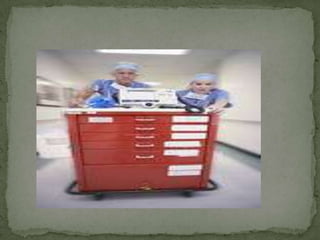
 Definition of the crash cart
 History of the crash cart
 Policy about crash cart
 Arrangement of the crash cart
It is a means of storing and
transporting vital equipment
and drugs which may be
required during a code blue (
cardiac emergency ) to the
location of the emergency .
The crash cart should be kept in
an easily accessible position
which is central to the patient
care areas .
 The first cardiac crash cart was created in 1962 at
Bethany Medical Center in Kansas City, Kansas,
home to the first Cardiac Care Unit in the country.The
first crash cart was fabricated by one of the doctor's
fathers. It contained an Ambu bag, defibrillator
paddles, a bed board and endotracheal tubes
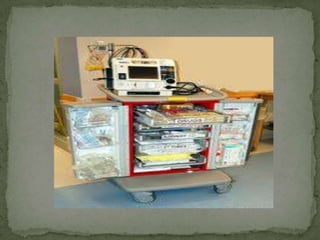
The function of a crash cart is to
provide a mobile station within the
hospital that contains everything
needed to treat a life-threatening
situation. The advantage of mobility
is that it allows the treatment to
come to the patient when needed.
The arrangement of the equipment
in the crash carts should be
standardized throughout the
institution .
1. Crash cart must be checked by head nursestaff
nurse every shift and document in checklist.
2. Standarization must be maintained.
3. Defibrillator will be checked by biomed department
regularly or as necessary.
4. crash cart items must be checked monthly for expiry
dates.
5. Each unit will have crash cart placed in an easily
place acceaaible location.
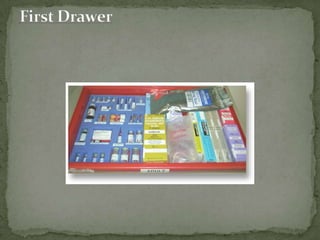
 Top shelf
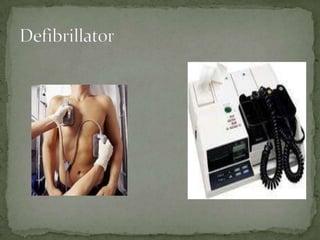
 Defibrillator
 Spo2 Probe
 ECG strips
 Ultrasound Jelly for DC shock
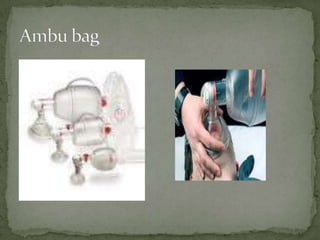
 Ambu bag Adult with mask
 Ambu bag pedia with mask
 Chest leads
 Chest electrodes
 Conductive gel
 ECG recording paper
 Defibrillator paddles
 , to know rhythm and or delivering shock
 Adrenaline
 Atropine sulfate
 Adenosine
 Amiodarone
 Verapamil
 Digoxin
 Dopamine
 Dobutamine
 Levophed
 Calcium Gluconate
 Lasix
 Hydrocortisone
 Dilantin
 Dextrose 50%
 Lidocaine 1%
 Plasil
 Potassium Chloride KCL
 Sodium Bicarbonate
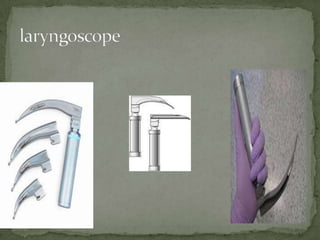
 Laryngoscope (various sizes of blade)
 Elecrtrodes
 Xylocaine jelly
 Stylet
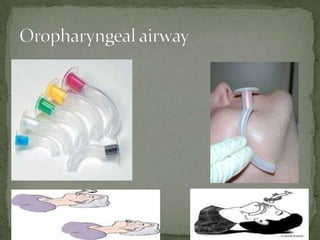
 Oropharyngeal Airway
 Gauze bandage
 Plaster
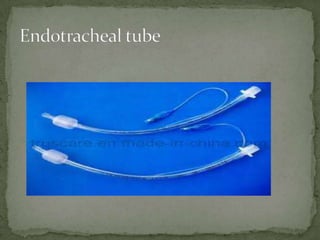
 ETT ( various sizes)
 Tracheostomy Tube
 Airway
 Suction Catheter (all sizes)
 Gloves
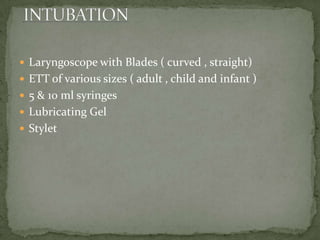
 Laryngoscope with Blades ( curved , straight)
 ETT of various sizes ( adult , child and infant )
 5 & 10 ml syringes
 Lubricating Gel
 Stylet
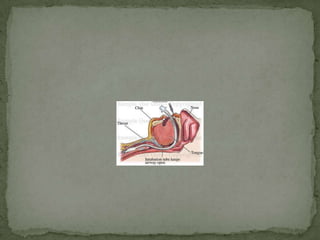
 The endotracheal tube serves as an open passage through
upper airway. The purpose of endotracheal intubation is
to permits air to pass freely to and from the lungs in order
to ventilate the lungs .
1. EPINEPHRINE Adrenergic agent of choice for
cardiac arrest, vasopressor used in Pulsless
VT/VF, Asystole and PEA: 1 mg IV every 3-5 min.
Or more frequently. May be given endotracheal
route.
Stocked 1 mg/10 ml 1:10,000. If using for
hypersensitivity reaction 0.1-0.25mg SQ, SIVP.
 Drug classes
 Parasympatholytic.
 Anticholinergic.
 Antidote
 Agent used for symptomatic bradycardia,
 PEA: 0.5-1 mg IV push
 , repeat at 3-5 min.
 Intervals to max. Total dose of .04 mg/kg
 . May be given via endotracheal route. Stocked 1
mg/10 ml.
Atrpoine is antidote for
organophosphate poisoning.
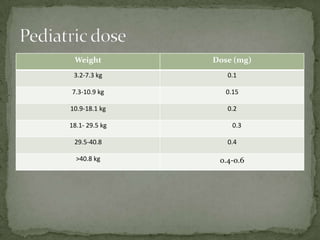
Dose (mg)Weight
0.13.2-7.3 kg
0.157.3-10.9 kg
0.210.9-18.1 kg
0.318.1- 29.5 kg
0.429.5-40.8
0.4-0.6>40.8 kg
 Drug class:
 Antianginal
 Antiarrhythmic
 Antihypertensive
 Calcium Channel blocker
 Therapeutic actions:
 Inhibits the movement of calcium ions across the
membranes of cardiac and arterial muscle cells.
Indications:
Treatment of SVT
Essential hypertension
Adult Dose:
I.V : initial dose , 5-10 mg over 2 min ; may repeat dose of 10 mg
30 min after first dose.
Pediatric Dose:
1 year and younger : initial dose 0.1 -0.2 mgkg over 2 min.
1-15 years : initial dose 0.1-0.3 mg kg over 2 min .Do not exceed 5
mg .Repeat above dose 30 min after initial dose if response is
not adequate. Repeat dose should not exceed 10 mg.
 Monitor patient carefully ( BP , cardiac rhythm , and
 Output)
 Protect IV solution from light
 Monitor patients with renal or hepatic impairment
carefully for possible drug accumulation and adverse
reactions.
-Drug Classes:
Adrenergic blocker
Antiarrhythmic
-Therapeutic action:
Type III antiarrhythmic. Acts directly on cardiac cell membrane.
-Indications :
Only for treatment of the following documented life-threatening
recurrent ventricular arrhythmias.
Recurrent ventricular fibrillation.
Unstable ventricular tachycardia.
-Dose :
IV (Adult)
150 mg loading dose over 10 min , followed by 360 mg over 6 hr
at rate of 1 mg/ min .
For maintenance infusion 540 mg at 0.5 mg / min over 18 hr.
Remember
Amiodarone should be diluted with D5W)
-Drug class and indications:
Antiarrhythmic
Conversion to sinus rhythm of paroxysmal
supraventricular tachycardia.
-Dose :
6 mg by rapid IV bolus ; for repeat dose , use 12 mg by IV
bolus within 1 – 2 min
Vasopressor: IV infusion: 500 mg Dobutamine in
250 ml IV solution. Usual dose 2-5mcg/kg/min.
May titrate to upper dose of 20mcg/kg/min.
Primarily stimulates B-1 receptors in the heart
and is used for inotropic support with mild
chronotropic effect. Adequate hydration of
patient imperative in blood pressure support.
When mixing more than 500mg. Dobutamine in
IV solution, equal volume must be removed (e.g.
1gm/40ml Dobutamine, remove 40ml from IV
solution).
Vasopressor, IV infusion: Usual dose in code situation
is 5-20mcg/kg/min. Renal perfusion dosing 2-
5mcg/kg/min, increase of cardiac output 5-
10mcg/kg/min and peripheral vasoconstriction 10-
20mcg/kg/min. As approaching 20mcg/kg/min assess
urine output. Extravasation treatment is with
phentolamine. Adequate hydration of patient
imperative in blood pressure support. Premix drip of
400 mg Dobutamine in 250 ml IV solution.
Thecrashcart

Thecrashcart

  • 2.
  • 3.
     To identifywhat is the crash cart consist of  To identify how to arrange crash cart contents according to policy listed from CBAHI  To determine role of nurse during checking on the crash cart
  • 4.
     Definition ofthe crash cart  History of the crash cart  Policy about crash cart  Arrangement of the crash cart
  • 6.
    It is ameans of storing and transporting vital equipment and drugs which may be required during a code blue ( cardiac emergency ) to the location of the emergency .
  • 8.
    The crash cartshould be kept in an easily accessible position which is central to the patient care areas .
  • 9.
     The firstcardiac crash cart was created in 1962 at Bethany Medical Center in Kansas City, Kansas, home to the first Cardiac Care Unit in the country.The first crash cart was fabricated by one of the doctor's fathers. It contained an Ambu bag, defibrillator paddles, a bed board and endotracheal tubes
  • 10.
    The function ofa crash cart is to provide a mobile station within the hospital that contains everything needed to treat a life-threatening situation. The advantage of mobility is that it allows the treatment to come to the patient when needed.
  • 11.
    The arrangement ofthe equipment in the crash carts should be standardized throughout the institution .
  • 12.
    1. Crash cartmust be checked by head nursestaff nurse every shift and document in checklist. 2. Standarization must be maintained. 3. Defibrillator will be checked by biomed department regularly or as necessary. 4. crash cart items must be checked monthly for expiry dates. 5. Each unit will have crash cart placed in an easily place acceaaible location.
  • 13.
     Top shelf Defibrillator  Spo2 Probe  ECG strips  Ultrasound Jelly for DC shock  Ambu bag Adult with mask  Ambu bag pedia with mask
  • 15.
     Chest leads Chest electrodes  Conductive gel  ECG recording paper  Defibrillator paddles  , to know rhythm and or delivering shock
  • 18.
     Adrenaline  Atropinesulfate  Adenosine  Amiodarone  Verapamil  Digoxin  Dopamine  Dobutamine  Levophed  Calcium Gluconate  Lasix  Hydrocortisone  Dilantin
  • 19.
     Dextrose 50% Lidocaine 1%  Plasil  Potassium Chloride KCL  Sodium Bicarbonate
  • 20.
     Laryngoscope (varioussizes of blade)  Elecrtrodes  Xylocaine jelly  Stylet  Oropharyngeal Airway  Gauze bandage  Plaster
  • 23.
     ETT (various sizes)  Tracheostomy Tube  Airway  Suction Catheter (all sizes)  Gloves
  • 25.
     Laryngoscope withBlades ( curved , straight)  ETT of various sizes ( adult , child and infant )  5 & 10 ml syringes  Lubricating Gel  Stylet
  • 27.
     The endotrachealtube serves as an open passage through upper airway. The purpose of endotracheal intubation is to permits air to pass freely to and from the lungs in order to ventilate the lungs .
  • 28.
    1. EPINEPHRINE Adrenergicagent of choice for cardiac arrest, vasopressor used in Pulsless VT/VF, Asystole and PEA: 1 mg IV every 3-5 min. Or more frequently. May be given endotracheal route. Stocked 1 mg/10 ml 1:10,000. If using for hypersensitivity reaction 0.1-0.25mg SQ, SIVP.
  • 29.
     Drug classes Parasympatholytic.  Anticholinergic.  Antidote  Agent used for symptomatic bradycardia,  PEA: 0.5-1 mg IV push  , repeat at 3-5 min.  Intervals to max. Total dose of .04 mg/kg  . May be given via endotracheal route. Stocked 1 mg/10 ml.
  • 30.
    Atrpoine is antidotefor organophosphate poisoning.
  • 31.
    Dose (mg)Weight 0.13.2-7.3 kg 0.157.3-10.9kg 0.210.9-18.1 kg 0.318.1- 29.5 kg 0.429.5-40.8 0.4-0.6>40.8 kg
  • 32.
     Drug class: Antianginal  Antiarrhythmic  Antihypertensive  Calcium Channel blocker  Therapeutic actions:  Inhibits the movement of calcium ions across the membranes of cardiac and arterial muscle cells.
  • 33.
    Indications: Treatment of SVT Essentialhypertension Adult Dose: I.V : initial dose , 5-10 mg over 2 min ; may repeat dose of 10 mg 30 min after first dose. Pediatric Dose: 1 year and younger : initial dose 0.1 -0.2 mgkg over 2 min. 1-15 years : initial dose 0.1-0.3 mg kg over 2 min .Do not exceed 5 mg .Repeat above dose 30 min after initial dose if response is not adequate. Repeat dose should not exceed 10 mg.
  • 34.
     Monitor patientcarefully ( BP , cardiac rhythm , and  Output)  Protect IV solution from light  Monitor patients with renal or hepatic impairment carefully for possible drug accumulation and adverse reactions.
  • 35.
    -Drug Classes: Adrenergic blocker Antiarrhythmic -Therapeuticaction: Type III antiarrhythmic. Acts directly on cardiac cell membrane. -Indications : Only for treatment of the following documented life-threatening recurrent ventricular arrhythmias. Recurrent ventricular fibrillation. Unstable ventricular tachycardia.
  • 36.
    -Dose : IV (Adult) 150mg loading dose over 10 min , followed by 360 mg over 6 hr at rate of 1 mg/ min . For maintenance infusion 540 mg at 0.5 mg / min over 18 hr. Remember Amiodarone should be diluted with D5W)
  • 37.
    -Drug class andindications: Antiarrhythmic Conversion to sinus rhythm of paroxysmal supraventricular tachycardia. -Dose : 6 mg by rapid IV bolus ; for repeat dose , use 12 mg by IV bolus within 1 – 2 min
  • 38.
    Vasopressor: IV infusion:500 mg Dobutamine in 250 ml IV solution. Usual dose 2-5mcg/kg/min. May titrate to upper dose of 20mcg/kg/min. Primarily stimulates B-1 receptors in the heart and is used for inotropic support with mild chronotropic effect. Adequate hydration of patient imperative in blood pressure support. When mixing more than 500mg. Dobutamine in IV solution, equal volume must be removed (e.g. 1gm/40ml Dobutamine, remove 40ml from IV solution).
  • 39.
    Vasopressor, IV infusion:Usual dose in code situation is 5-20mcg/kg/min. Renal perfusion dosing 2- 5mcg/kg/min, increase of cardiac output 5- 10mcg/kg/min and peripheral vasoconstriction 10- 20mcg/kg/min. As approaching 20mcg/kg/min assess urine output. Extravasation treatment is with phentolamine. Adequate hydration of patient imperative in blood pressure support. Premix drip of 400 mg Dobutamine in 250 ml IV solution.