UNIT 1
GOOD LABORATORY PRACTICES
Course outcomes
• On completion of course student will be able to:
1. Perform estimation of Haemoglobin
2. Perform total RBC and WBC Count, Differential WBC ount
and Calculate blood indices.
3. Determination of Blood Group.
4. Perform Erythrocyte sedimentation rate [ESR] And PCV
5. Determination of Clotting Time and Bleeding time
6. Perform Auscultation for Heart Sounds and Blood
pressure
7. Perform Electrocardiogram and Determination of vital
capacity.
Learning outcomes
• Upon completion of this lecture, the students will be
able to:
1. Understand the principles of GLP and its regulatory
basis
2. Understand the structure of GLP as compared to ISO
3. Understand the requirements of a laboratory facility
4. Understand the QA programs documentations, such as
Standard Operating Procedures, protocols, study plans,
data quality and integrity, auditing, archival, etc.
5. Understand the regulatory inspections
Objective
 To provide the knowledge in the principles of
Good Laboratory Practices (GLP) and
understanding in the requirements and its
regulations.
Contents
• Definition of GCLP
• Purpose of GCLP
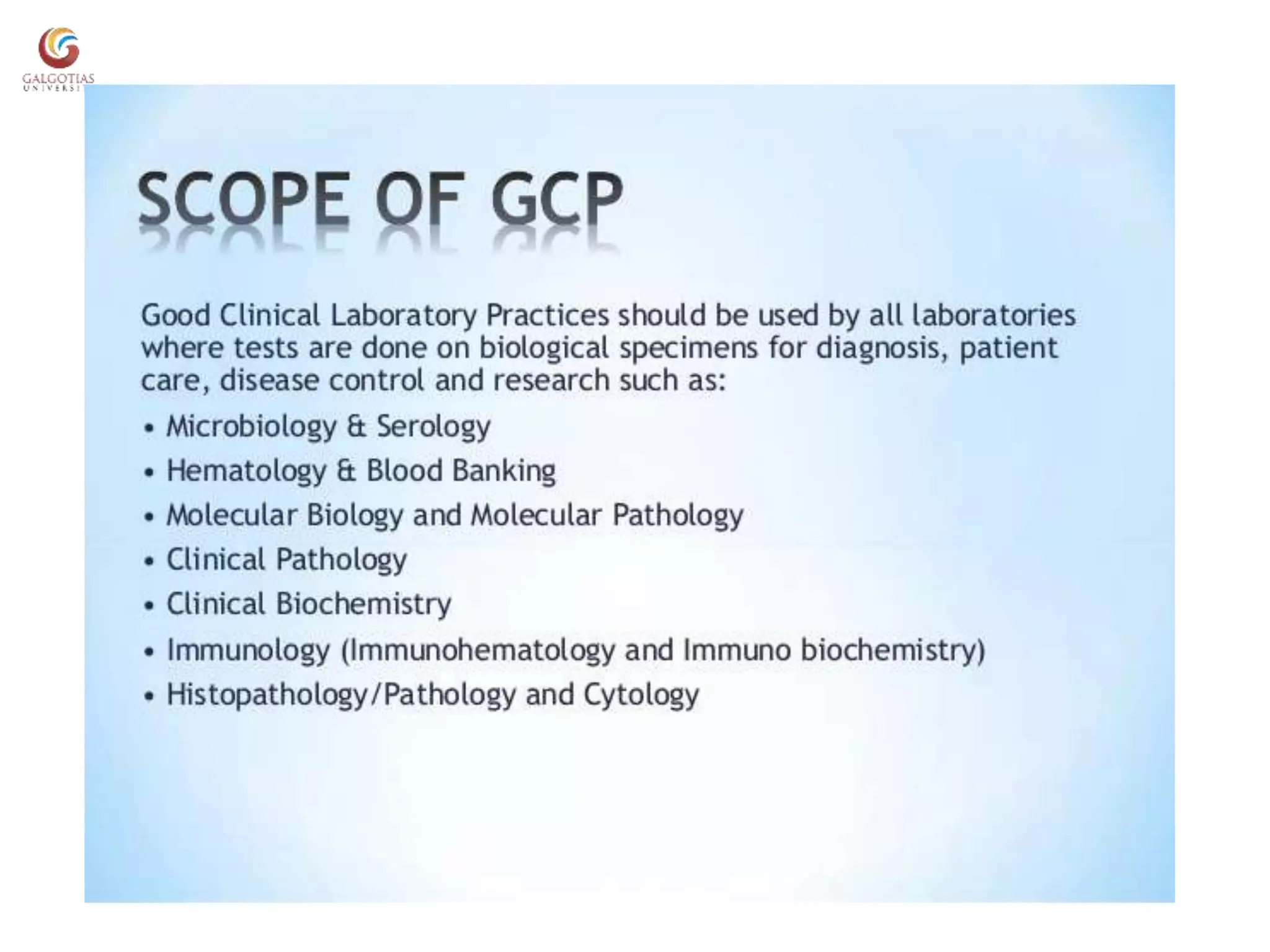
• Scope of GCLP
• Principles of GCLP
i. 1. Test Facility Organisation and Personnel.
ii. 2. Quality Assurance Programme(QAP).
iii. 3. Facilities.
iv. 4. Apparatus, Material and Reagents.
v. 5. Test systems.
vi. 6. Test and Reference Substances.
vii. 7. Standard Operating Procedures(SOP).
viii. 8. Performance of The Study.
ix. 9. Reporting of Study Results.
x. 10. Storage and Retention of Records and materials.
Definition of GLP
• GLP embodies a set of principles that provides
a frame work within which laboratory studies
are planned performed, monitored, and
archived and reported.
Purpose of GLPs:
• GLP is to certify that every step of the analysis
is valid or Not.
• Assure the quality & integrity of data
submitted to FDA in support of the safety of
regulated products.
• GLPs have heavy emphasis on data recording,
record & specimen retention.
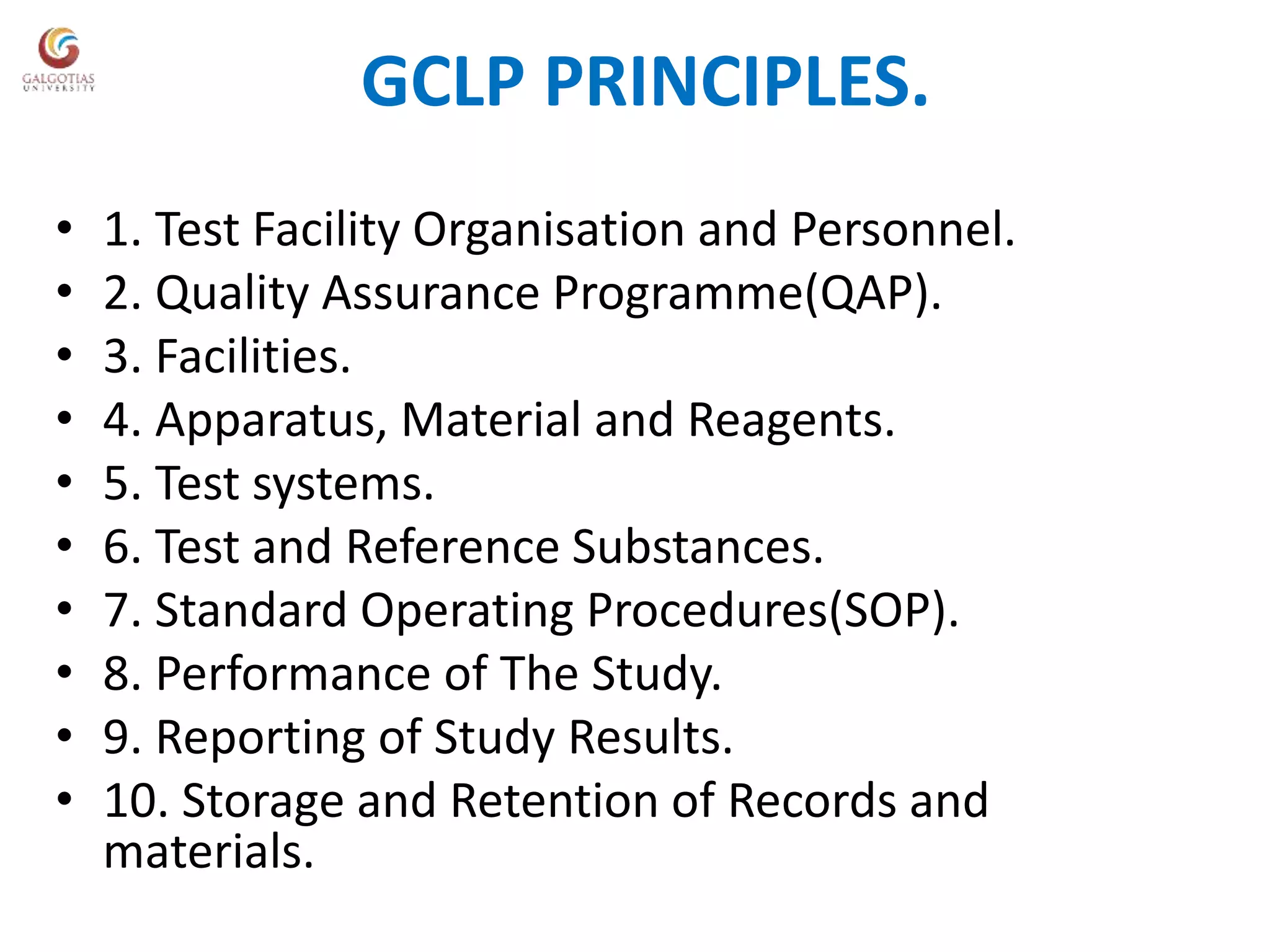
GCLP PRINCIPLES.
• 1. Test Facility Organisation and Personnel.
• 2. Quality Assurance Programme(QAP).
• 3. Facilities.
• 4. Apparatus, Material and Reagents.
• 5. Test systems.
• 6. Test and Reference Substances.
• 7. Standard Operating Procedures(SOP).
• 8. Performance of The Study.
• 9. Reporting of Study Results.
• 10. Storage and Retention of Records and
materials.
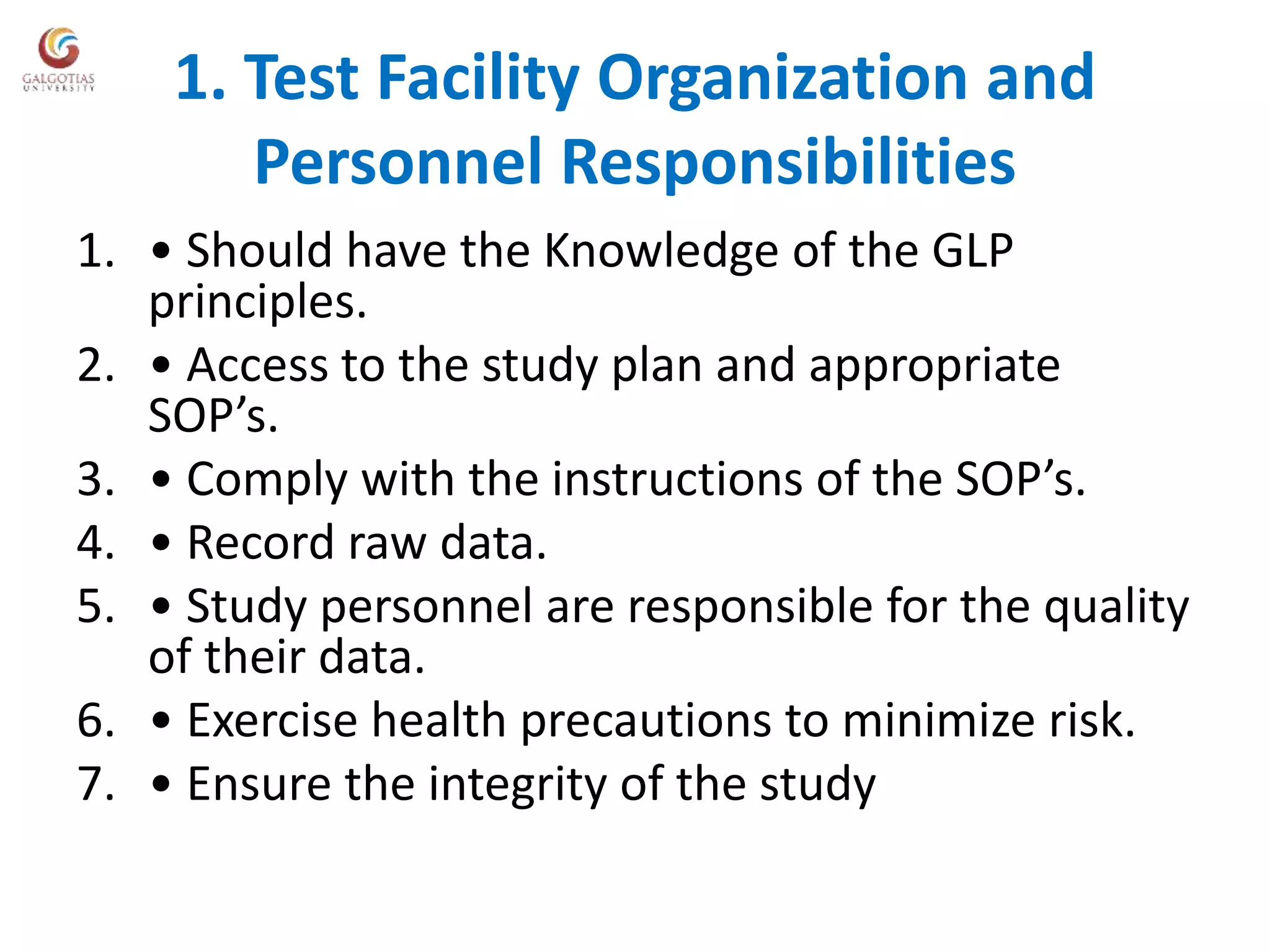
1. Test Facility Organization and
Personnel Responsibilities
1. • Should have the Knowledge of the GLP
principles.
2. • Access to the study plan and appropriate
SOP’s.
3. • Comply with the instructions of the SOP’s.
4. • Record raw data.
5. • Study personnel are responsible for the quality
of their data.
6. • Exercise health precautions to minimize risk.
7. • Ensure the integrity of the study
2.Quality Assurance Program
Responsibilities of the QA Personnel
1. • Access to the updated study plans and SOP’s.
2. • Documented verification of the compliance of study
plan to the GLP principles.
3. • Inspections to determine compliance of the study
with GLP principles.
4. • Three types of inspection. – Study-based inspections.
– Facility-based inspections. – Process-based
inspections.
5. • Inspection of the final reports for accurate and full
description.
6. • Report the inspection results to the management
7. Statements.
3. Facilities
1. • Suitable size, construction and location.
2. • Adequate degree of separation of the
different activities.
3. • Isolation of test systems and individual
projects to protect from biological hazards.
4. • Suitable rooms for the diagnosis, treatment
and control of diseases.
5. • Storage rooms.
4. Apparatus, Materials and Reagents
1. • Apparatus of appropriate design and
adequate capacity.
2. • Documented Inspection, cleaning,
maintenance and calibration of apparatus.
3. • Apparatus and materials not to interfere
with the test systems.
4. • Chemicals, reagent and solutions should be
labeled to indicate identity, expiry and
specific storage instructions.
5. Test Systems
1. • Physical and chemical test systems.
2. • Biological test systems.
3. • Records of source, date of arrival, and
arrival conditions of test systems.
4. • Proper identification of test systems in
their container or when removed.
5. • Cleaning and sanitization of containers.
6. • Pest control agents to be documented.
6. Test and Reference Items
• Receipt, handling, sampling and storage
• Characterization.
• Known stability of test and reference items.
• Stability of the test item in its vehicle (container).
• Experiments to determine stability in tank mixers
used in the field studies.
• Samples for analytical purposes for each batch.
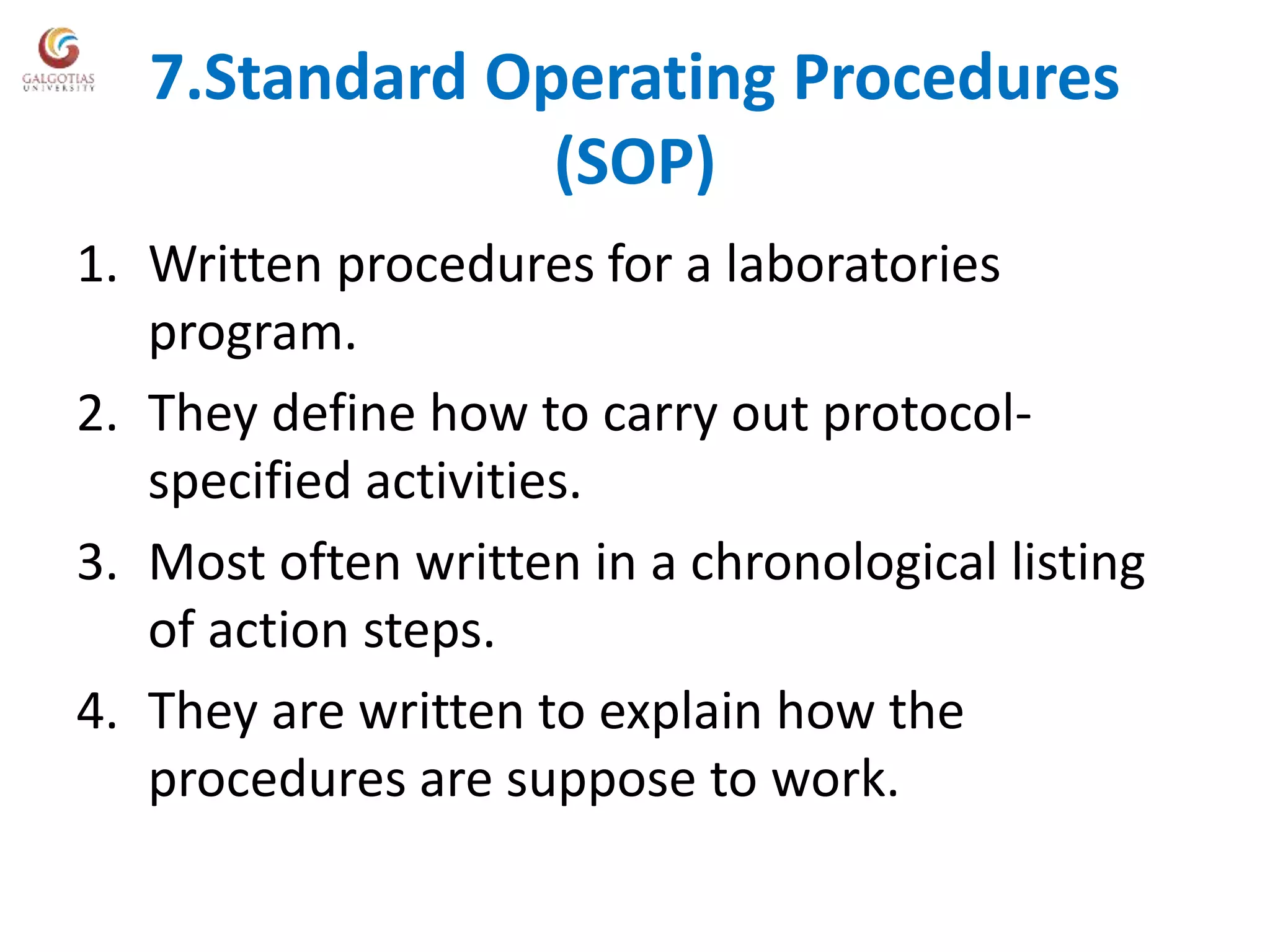
7.Standard Operating Procedures
(SOP)
1. Written procedures for a laboratories
program.
2. They define how to carry out protocol-
specified activities.
3. Most often written in a chronological listing
of action steps.
4. They are written to explain how the
procedures are suppose to work.
SOP’s continue
• Routine inspection, cleaning, maintenance,
testing and calibration.
• Actions to be taken in response to equipment
failure.
• Keeping records, reporting, storage, mixing,
and retrieval of data.
• Definition of raw data.
• Analytical methods.
8. Performance of the Study
• • Prepare the Study plan.
• • Content of the study plan.
• › Identification of the study.
• › Records.
• › Dates.
• ›Reference to test methods.
• › Information concerning the sponsor and facility.
• • Conduct of the study.
Reporting of Study Results
• • Information on sponsor and test facility.
• • Experimental starting and completion dates.
• A Quality Assurance Program Statement.
• • Description of materials and test methods.
• • Results.
• • Storage (samples, reference items, raw data,
final reports) etc.
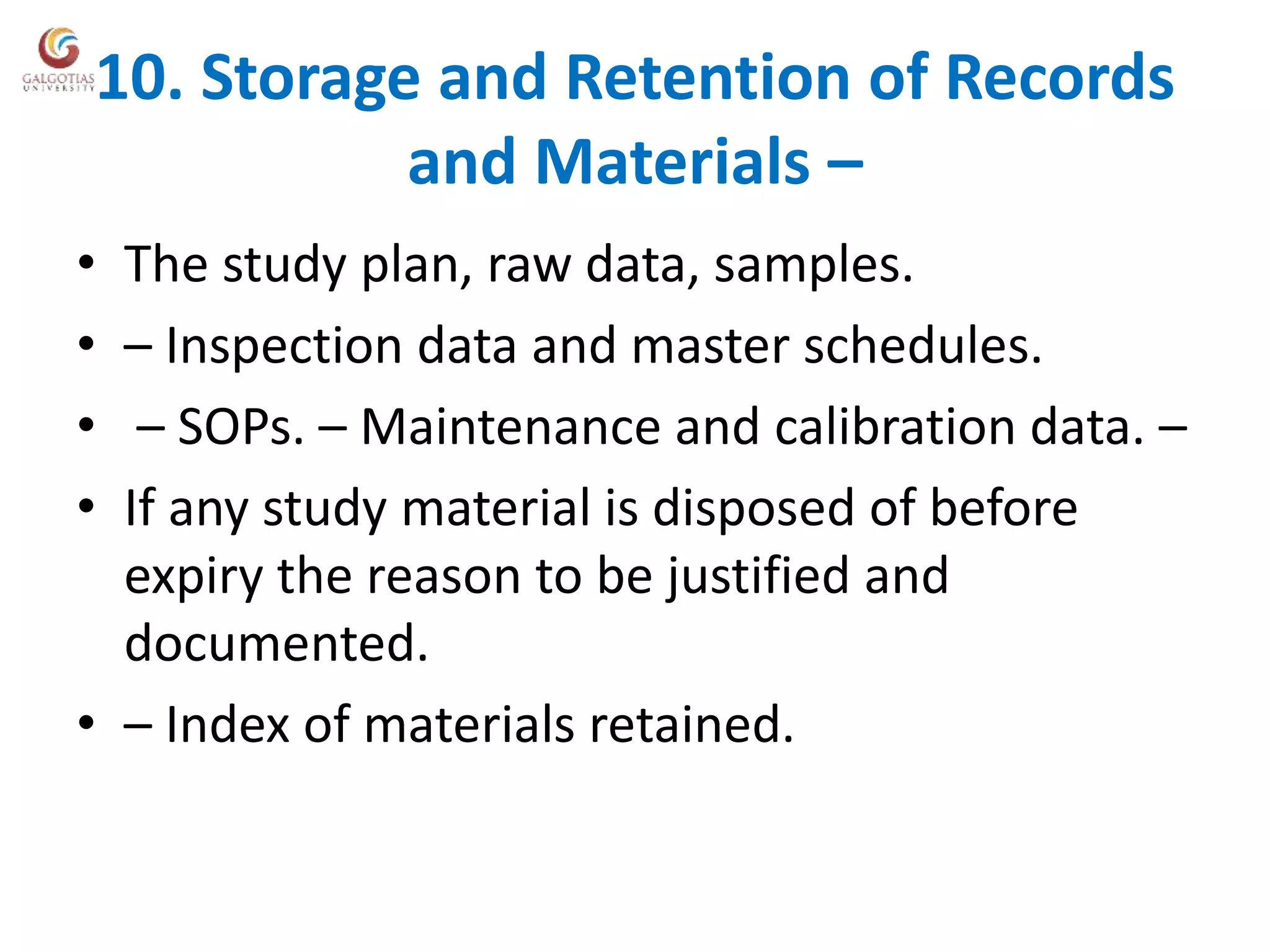
10. Storage and Retention of Records
and Materials –
• The study plan, raw data, samples.
• – Inspection data and master schedules.
• – SOPs. – Maintenance and calibration data. –
• If any study material is disposed of before
expiry the reason to be justified and
documented.
• – Index of materials retained.
What Good Laboratory Must
Contain.?
1. • Area should be free from smoke, smell, dust etc.
2. • Ensure good ventilation, proper illumination and prefer natural
light.
3. • Air conditioned the lab with humidity control.
4. • Enough space for measuring and testing instrument.
5. • Proper arrangement of testing.
6. • Take care of all safety points including proper earthing as well as
fire safety.
7. • Avoid uncleanable spots in floors, walls, ceiling.
8. Establish proper areas for storage of incoming samples as well as
test–completed samples.
9. • Also provide sample collection place as well as packing and
disposal of tested samples.
Benefits of good laboratory practices.
• • It will give better image of company as a Quality
producer in Global market.
• • Provide hot tips on analysis of data as well as
measure uncertainty and perfect record keeping.
• • Provide guideline for doing testing and
measurement in detail.
• • Provide guidelines and better control for
maintenance of instruments, environment
control, preservation of test records etc
CONCLUSION
• Gives better image of company as a Quality
producer in Global market Provide hot tips on
analysis of data as well as measure uncertainty
and perfect record keeping & guideline for doing
testing and measurement in detail.
• Finally GLP Provide guidelines and better
control for maintenance of instruments,
environment control, preservation of test
records etc.
Reference
• https://www.slideshare.net/srinivasnaik52643
/good-laboratory-practices-40435935
• https://www.icmr.nic.in/sites/default/files/gui
delines/GCLP.pdf
• https://www.slideshare.net/anubhavsingh184
007/presentation-on-good-clinical-practices-
gcp-by-anubhav-singh-mpharm-1st-year
Youtube videos
• https://www.youtube.com/watch?v=0ARXcuw
UKpQ
• https://www.youtube.com/results?search_qu
ery=good+clinical+lab+practice
Good clinical laboratory practices

Good clinical laboratory practices

  • 1.
  • 2.
    Course outcomes • Oncompletion of course student will be able to: 1. Perform estimation of Haemoglobin 2. Perform total RBC and WBC Count, Differential WBC ount and Calculate blood indices. 3. Determination of Blood Group. 4. Perform Erythrocyte sedimentation rate [ESR] And PCV 5. Determination of Clotting Time and Bleeding time 6. Perform Auscultation for Heart Sounds and Blood pressure 7. Perform Electrocardiogram and Determination of vital capacity.
  • 3.
    Learning outcomes • Uponcompletion of this lecture, the students will be able to: 1. Understand the principles of GLP and its regulatory basis 2. Understand the structure of GLP as compared to ISO 3. Understand the requirements of a laboratory facility 4. Understand the QA programs documentations, such as Standard Operating Procedures, protocols, study plans, data quality and integrity, auditing, archival, etc. 5. Understand the regulatory inspections
  • 4.
    Objective  To providethe knowledge in the principles of Good Laboratory Practices (GLP) and understanding in the requirements and its regulations.
  • 5.
    Contents • Definition ofGCLP • Purpose of GCLP • Scope of GCLP • Principles of GCLP i. 1. Test Facility Organisation and Personnel. ii. 2. Quality Assurance Programme(QAP). iii. 3. Facilities. iv. 4. Apparatus, Material and Reagents. v. 5. Test systems. vi. 6. Test and Reference Substances. vii. 7. Standard Operating Procedures(SOP). viii. 8. Performance of The Study. ix. 9. Reporting of Study Results. x. 10. Storage and Retention of Records and materials.
  • 6.
    Definition of GLP •GLP embodies a set of principles that provides a frame work within which laboratory studies are planned performed, monitored, and archived and reported.
  • 7.
    Purpose of GLPs: •GLP is to certify that every step of the analysis is valid or Not. • Assure the quality & integrity of data submitted to FDA in support of the safety of regulated products. • GLPs have heavy emphasis on data recording, record & specimen retention.
  • 9.
    GCLP PRINCIPLES. • 1.Test Facility Organisation and Personnel. • 2. Quality Assurance Programme(QAP). • 3. Facilities. • 4. Apparatus, Material and Reagents. • 5. Test systems. • 6. Test and Reference Substances. • 7. Standard Operating Procedures(SOP). • 8. Performance of The Study. • 9. Reporting of Study Results. • 10. Storage and Retention of Records and materials.
  • 10.
    1. Test FacilityOrganization and Personnel Responsibilities 1. • Should have the Knowledge of the GLP principles. 2. • Access to the study plan and appropriate SOP’s. 3. • Comply with the instructions of the SOP’s. 4. • Record raw data. 5. • Study personnel are responsible for the quality of their data. 6. • Exercise health precautions to minimize risk. 7. • Ensure the integrity of the study
  • 11.
    2.Quality Assurance Program Responsibilitiesof the QA Personnel 1. • Access to the updated study plans and SOP’s. 2. • Documented verification of the compliance of study plan to the GLP principles. 3. • Inspections to determine compliance of the study with GLP principles. 4. • Three types of inspection. – Study-based inspections. – Facility-based inspections. – Process-based inspections. 5. • Inspection of the final reports for accurate and full description. 6. • Report the inspection results to the management 7. Statements.
  • 12.
    3. Facilities 1. •Suitable size, construction and location. 2. • Adequate degree of separation of the different activities. 3. • Isolation of test systems and individual projects to protect from biological hazards. 4. • Suitable rooms for the diagnosis, treatment and control of diseases. 5. • Storage rooms.
  • 13.
    4. Apparatus, Materialsand Reagents 1. • Apparatus of appropriate design and adequate capacity. 2. • Documented Inspection, cleaning, maintenance and calibration of apparatus. 3. • Apparatus and materials not to interfere with the test systems. 4. • Chemicals, reagent and solutions should be labeled to indicate identity, expiry and specific storage instructions.
  • 14.
    5. Test Systems 1.• Physical and chemical test systems. 2. • Biological test systems. 3. • Records of source, date of arrival, and arrival conditions of test systems. 4. • Proper identification of test systems in their container or when removed. 5. • Cleaning and sanitization of containers. 6. • Pest control agents to be documented.
  • 15.
    6. Test andReference Items • Receipt, handling, sampling and storage • Characterization. • Known stability of test and reference items. • Stability of the test item in its vehicle (container). • Experiments to determine stability in tank mixers used in the field studies. • Samples for analytical purposes for each batch.
  • 16.
    7.Standard Operating Procedures (SOP) 1.Written procedures for a laboratories program. 2. They define how to carry out protocol- specified activities. 3. Most often written in a chronological listing of action steps. 4. They are written to explain how the procedures are suppose to work.
  • 17.
    SOP’s continue • Routineinspection, cleaning, maintenance, testing and calibration. • Actions to be taken in response to equipment failure. • Keeping records, reporting, storage, mixing, and retrieval of data. • Definition of raw data. • Analytical methods.
  • 18.
    8. Performance ofthe Study • • Prepare the Study plan. • • Content of the study plan. • › Identification of the study. • › Records. • › Dates. • ›Reference to test methods. • › Information concerning the sponsor and facility. • • Conduct of the study.
  • 19.
    Reporting of StudyResults • • Information on sponsor and test facility. • • Experimental starting and completion dates. • A Quality Assurance Program Statement. • • Description of materials and test methods. • • Results. • • Storage (samples, reference items, raw data, final reports) etc.
  • 20.
    10. Storage andRetention of Records and Materials – • The study plan, raw data, samples. • – Inspection data and master schedules. • – SOPs. – Maintenance and calibration data. – • If any study material is disposed of before expiry the reason to be justified and documented. • – Index of materials retained.
  • 21.
    What Good LaboratoryMust Contain.? 1. • Area should be free from smoke, smell, dust etc. 2. • Ensure good ventilation, proper illumination and prefer natural light. 3. • Air conditioned the lab with humidity control. 4. • Enough space for measuring and testing instrument. 5. • Proper arrangement of testing. 6. • Take care of all safety points including proper earthing as well as fire safety. 7. • Avoid uncleanable spots in floors, walls, ceiling. 8. Establish proper areas for storage of incoming samples as well as test–completed samples. 9. • Also provide sample collection place as well as packing and disposal of tested samples.
  • 22.
    Benefits of goodlaboratory practices. • • It will give better image of company as a Quality producer in Global market. • • Provide hot tips on analysis of data as well as measure uncertainty and perfect record keeping. • • Provide guideline for doing testing and measurement in detail. • • Provide guidelines and better control for maintenance of instruments, environment control, preservation of test records etc
  • 23.
    CONCLUSION • Gives betterimage of company as a Quality producer in Global market Provide hot tips on analysis of data as well as measure uncertainty and perfect record keeping & guideline for doing testing and measurement in detail. • Finally GLP Provide guidelines and better control for maintenance of instruments, environment control, preservation of test records etc.
  • 24.
    Reference • https://www.slideshare.net/srinivasnaik52643 /good-laboratory-practices-40435935 • https://www.icmr.nic.in/sites/default/files/gui delines/GCLP.pdf •https://www.slideshare.net/anubhavsingh184 007/presentation-on-good-clinical-practices- gcp-by-anubhav-singh-mpharm-1st-year
  • 25.
    Youtube videos • https://www.youtube.com/watch?v=0ARXcuw UKpQ •https://www.youtube.com/results?search_qu ery=good+clinical+lab+practice