ORDER OF DRAW
Jan Martin M. Justo, RMT
OBJECTIVES
• Know the importance and functions of various blood tubes
used in the laboratory including its specific components
• Understand and learn different tubes used in phlebotomy
particularly the ‘Order of Draw’
• Review basic information on Laboratory procedures and
instructions involving Phlebotomy.
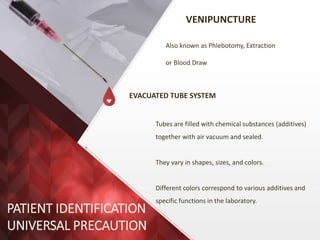
VENIPUNCTURE
Also known as Phlebotomy, Extraction
or Blood Draw
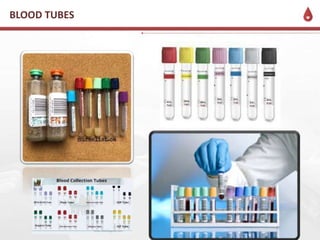
EVACUATED TUBE SYSTEM
Tubes are filled with chemical substances (additives)
together with air vacuum and sealed.
They vary in shapes, sizes, and colors.
Different colors correspond to various additives and
specific functions in the laboratory.
PATIENT IDENTIFICATION
UNIVERSAL PRECAUTION
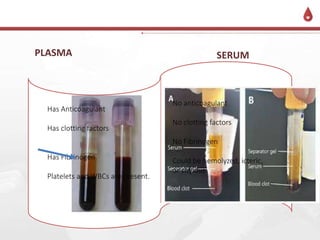
SERUM
PLASMA
Has Anticoagulant
Has clotting factors
Has Fibrinogen
Platelets and WBCs are present.
No anticoagulant
No clotting factors
No Fibrinogen
Could be hemolyzed, icteric,
or chylous
BLOOD TUBES
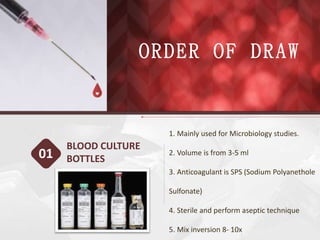
1. Mainly used for Microbiology studies.
2. Volume is from 3-5 ml
3. Anticoagulant is SPS (Sodium Polyanethole
Sulfonate)
4. Sterile and perform aseptic technique
5. Mix inversion 8- 10x
BLOOD CULTURE
BOTTLES
01
ORDER OF DRAW
02
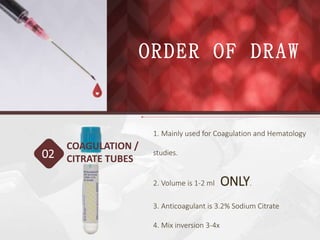
COAGULATION /
CITRATE TUBES
1. Mainly used for Coagulation and Hematology
studies.
2. Volume is 1-2 ml ONLY.
3. Anticoagulant is 3.2% Sodium Citrate
4. Mix inversion 3-4x
ORDER OF DRAW
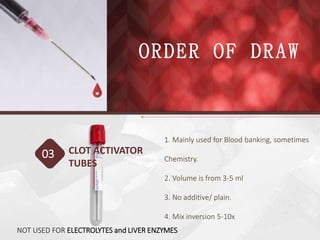
03 CLOT ACTIVATOR
TUBES
1. Mainly used for Blood banking, sometimes
Chemistry.
2. Volume is from 3-5 ml
3. No additive/ plain.
4. Mix inversion 5-10x
ORDER OF DRAW
NOT USED FOR ELECTROLYTES and LIVER ENZYMES
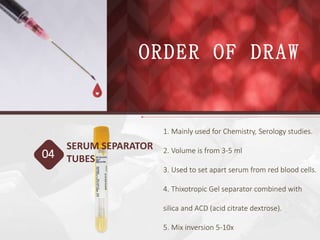
04
SERUM SEPARATOR
TUBES
1. Mainly used for Chemistry, Serology studies.
2. Volume is from 3-5 ml
3. Used to set apart serum from red blood cells.
4. Thixotropic Gel separator combined with
silica and ACD (acid citrate dextrose).
5. Mix inversion 5-10x
ORDER OF DRAW
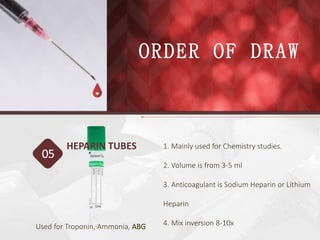
05
HEPARIN TUBES 1. Mainly used for Chemistry studies.
2. Volume is from 3-5 ml
3. Anticoagulant is Sodium Heparin or Lithium
Heparin
4. Mix inversion 8-10x
Used for Troponin, Ammonia, ABG
ORDER OF DRAW
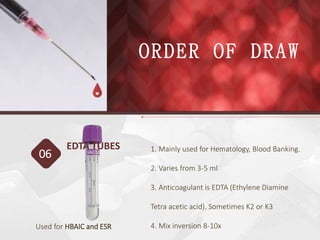
06
EDTA TUBES 1. Mainly used for Hematology, Blood Banking.
2. Varies from 3-5 ml
3. Anticoagulant is EDTA (Ethylene Diamine
Tetra acetic acid). Sometimes K2 or K3
4. Mix inversion 8-10x
Used for HBAIC and ESR
ORDER OF DRAW
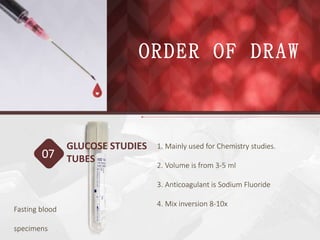
07
GLUCOSE STUDIES
TUBES
1. Mainly used for Chemistry studies.
2. Volume is from 3-5 ml
3. Anticoagulant is Sodium Fluoride
4. Mix inversion 8-10x
Fasting blood
specimens
ORDER OF DRAW
Other Blood tubes
GOLD BLACK
Special
Chemistry
tests
ESR tube
1. Mainly used for Chemistry studies.
2. Volume is from 3-5 ml.
3. Anticoagulant is Potassium Oxalate
4. Mix inversion 8-10x
Erythrocyte
Sedimentation Rate
(Westergren method)
TB Quantiferon
IMPORTANCE
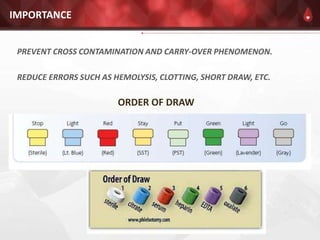
PREVENT CROSS CONTAMINATION AND CARRY-OVER PHENOMENON.
REDUCE ERRORS SUCH AS HEMOLYSIS, CLOTTING, SHORT DRAW, ETC.
ORDER OF DRAW
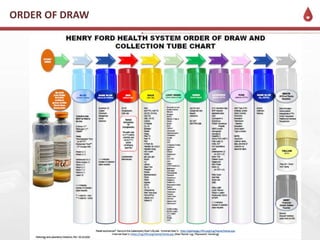
ORDER OF DRAW
ORDER OF DRAW
EXERCISES
ORDER OF DRAW
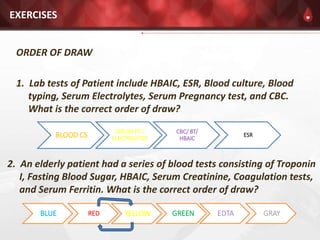
1. Lab tests of Patient include HBAIC, ESR, Blood culture, Blood
typing, Serum Electrolytes, Serum Pregnancy test, and CBC.
What is the correct order of draw?
2. An elderly patient had a series of blood tests consisting of Troponin
I, Fasting Blood Sugar, HBAIC, Serum Creatinine, Coagulation tests,
and Serum Ferritin. What is the correct order of draw?
BLOOD CS SERUM PT /
ELECTROLYTES
CBC/ BT/
HBAIC
ESR
BLUE YELLOW
RED GREEN EDTA GRAY
• Basic Principles and Practice of Clinical Chemistry (Bishop)
• Clinical and Laboratory Standards Institute Guidelines for
Phlebotomy
• BD Vacutainer ‘Order of Draw’
REFERENCES
THANK YOU

'ORDER OF DRAW'.ppsx

  • 1.
    ORDER OF DRAW JanMartin M. Justo, RMT
  • 2.
    OBJECTIVES • Know theimportance and functions of various blood tubes used in the laboratory including its specific components • Understand and learn different tubes used in phlebotomy particularly the ‘Order of Draw’ • Review basic information on Laboratory procedures and instructions involving Phlebotomy.
  • 3.
    VENIPUNCTURE Also known asPhlebotomy, Extraction or Blood Draw EVACUATED TUBE SYSTEM Tubes are filled with chemical substances (additives) together with air vacuum and sealed. They vary in shapes, sizes, and colors. Different colors correspond to various additives and specific functions in the laboratory. PATIENT IDENTIFICATION UNIVERSAL PRECAUTION
  • 4.
    SERUM PLASMA Has Anticoagulant Has clottingfactors Has Fibrinogen Platelets and WBCs are present. No anticoagulant No clotting factors No Fibrinogen Could be hemolyzed, icteric, or chylous
  • 5.
  • 6.
    1. Mainly usedfor Microbiology studies. 2. Volume is from 3-5 ml 3. Anticoagulant is SPS (Sodium Polyanethole Sulfonate) 4. Sterile and perform aseptic technique 5. Mix inversion 8- 10x BLOOD CULTURE BOTTLES 01 ORDER OF DRAW
  • 7.
    02 COAGULATION / CITRATE TUBES 1.Mainly used for Coagulation and Hematology studies. 2. Volume is 1-2 ml ONLY. 3. Anticoagulant is 3.2% Sodium Citrate 4. Mix inversion 3-4x ORDER OF DRAW
  • 8.
    03 CLOT ACTIVATOR TUBES 1.Mainly used for Blood banking, sometimes Chemistry. 2. Volume is from 3-5 ml 3. No additive/ plain. 4. Mix inversion 5-10x ORDER OF DRAW NOT USED FOR ELECTROLYTES and LIVER ENZYMES
  • 9.
    04 SERUM SEPARATOR TUBES 1. Mainlyused for Chemistry, Serology studies. 2. Volume is from 3-5 ml 3. Used to set apart serum from red blood cells. 4. Thixotropic Gel separator combined with silica and ACD (acid citrate dextrose). 5. Mix inversion 5-10x ORDER OF DRAW
  • 10.
    05 HEPARIN TUBES 1.Mainly used for Chemistry studies. 2. Volume is from 3-5 ml 3. Anticoagulant is Sodium Heparin or Lithium Heparin 4. Mix inversion 8-10x Used for Troponin, Ammonia, ABG ORDER OF DRAW
  • 11.
    06 EDTA TUBES 1.Mainly used for Hematology, Blood Banking. 2. Varies from 3-5 ml 3. Anticoagulant is EDTA (Ethylene Diamine Tetra acetic acid). Sometimes K2 or K3 4. Mix inversion 8-10x Used for HBAIC and ESR ORDER OF DRAW
  • 12.
    07 GLUCOSE STUDIES TUBES 1. Mainlyused for Chemistry studies. 2. Volume is from 3-5 ml 3. Anticoagulant is Sodium Fluoride 4. Mix inversion 8-10x Fasting blood specimens ORDER OF DRAW
  • 13.
    Other Blood tubes GOLDBLACK Special Chemistry tests ESR tube 1. Mainly used for Chemistry studies. 2. Volume is from 3-5 ml. 3. Anticoagulant is Potassium Oxalate 4. Mix inversion 8-10x Erythrocyte Sedimentation Rate (Westergren method) TB Quantiferon
  • 14.
    IMPORTANCE PREVENT CROSS CONTAMINATIONAND CARRY-OVER PHENOMENON. REDUCE ERRORS SUCH AS HEMOLYSIS, CLOTTING, SHORT DRAW, ETC. ORDER OF DRAW
  • 15.
  • 16.
  • 17.
    EXERCISES ORDER OF DRAW 1.Lab tests of Patient include HBAIC, ESR, Blood culture, Blood typing, Serum Electrolytes, Serum Pregnancy test, and CBC. What is the correct order of draw? 2. An elderly patient had a series of blood tests consisting of Troponin I, Fasting Blood Sugar, HBAIC, Serum Creatinine, Coagulation tests, and Serum Ferritin. What is the correct order of draw? BLOOD CS SERUM PT / ELECTROLYTES CBC/ BT/ HBAIC ESR BLUE YELLOW RED GREEN EDTA GRAY
  • 18.
    • Basic Principlesand Practice of Clinical Chemistry (Bishop) • Clinical and Laboratory Standards Institute Guidelines for Phlebotomy • BD Vacutainer ‘Order of Draw’ REFERENCES
  • 19.

Editor's Notes

  • #4 Multiple tube system for blood extraction. Tubes have expiration dates. Check for breaks/cracks esp for Glass and if it is sealed properly with rubber stopper.
  • #5 Centrifugation. Fibrinogen – protein that helps in blood clotting. Hemolysis – rupture of rbc Icteric – severely dark yellow coloration associated with Jaundice Chylous – from chylomicrons. White, milky or pinkish coloration due to ingestion of fat or recent food intake.
  • #7 Importance of Mixing Prevent clotting. Pay attention to the volume of blood tubes. Do not over or under fill. Samples will be rejected or repeated.
  • #13 Uncommon. Used to preserve glucose for 3 hours.
  • #14 Tan- lead determination Royal blue – toxicology Orange- Thrombin Plasma separator tubes
  • #15 Capillary order of draw: Edta, others, serum Blood – additive ratio is important. Discard tubes are sometimes used.
  • #16 Be Loving Respectful Gracious Lighthearted and Gentle
  • #17 Different Order of Draw depending on the Laboratory Protocols and availability of Blood tubes and Lab tests.
  • #18 ESR – end