EQAS
Dr Arun Sinha
Introduction
■ EQA can be called by different names
= external quality assurance
= external quality assessment
= proficiency testing scheme
 Definition
 process designed to objectively assess the quality
of results obtained by laboratories, by means of an
external agency
Objectives of EQA Programs
 Assess the laboratory’s analytical quality and reliability in
reported results
 Enhance worldwide standardization efforts in clinical testing
 Aid in identifying potential corrective actions and evaluate
their effectiveness
 Build confidence amongst the users towards lab performance
 To demonstrate a commitment for continuous
improvement and quality
Difference Between IQC &EQA
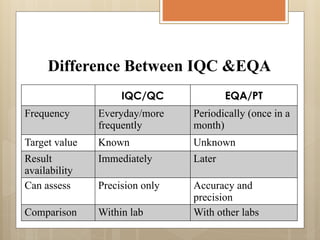
IQC/QC EQA/PT
Frequency Everyday/more
frequently
Periodically (once in a
month)
Target value Known Unknown
Result
availability
Immediately Later
Can assess Precision only Accuracy and
precision
Comparison Within lab With other labs
Iso 15189 Mandate For Eqas
 5.6.4 The laboratory shall participate in organized inter
laboratory comparisons, as external quality assessment
schemes, that encompass the extent and complexity of
examination procedures used by the laboratory.

 The laboratory management shall monitor the results of
external quality assessment and participate in the
implementation of corrective actions when control criteria
are not fulfilled.
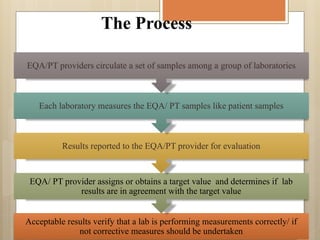
The Process
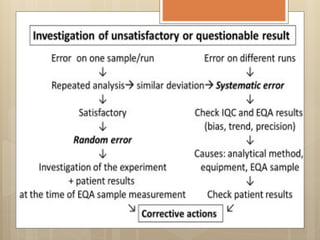
Acceptable results verify that a lab is performing measurements correctly/ if
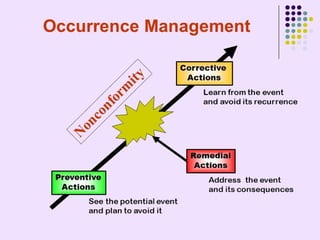
not corrective measures should be undertaken
EQA/ PT provider assigns or obtains a target value and determines if lab
results are in agreement with the target value
Results reported to the EQA/PT provider for evaluation
Each laboratory measures the EQA/ PT samples like patient samples
EQA/PT providers circulate a set of samples among a group of laboratories
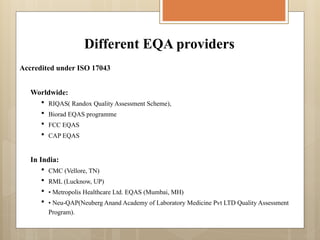
Different EQA providers
Accredited under ISO 17043
Worldwide:
 RIQAS( Randox Quality Assessment Scheme),
 Biorad EQAS programme
 FCC EQAS
 CAP EQAS
In India:
 CMC (Vellore, TN)
 RML (Lucknow, UP)
 • Metropolis Healthcare Ltd. EQAS (Mumbai, MH)
 • Neu-QAP(Neuberg Anand Academy of Laboratory Medicine Pvt LTD Quality Assessment
Program).
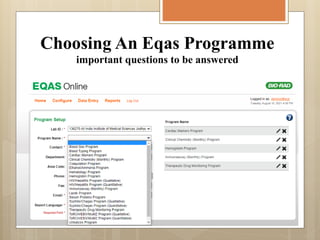
Choosing An Eqas Programme
important questions to be answered
• Choosing the parameters which the lab wants to
put for external assessment. E.g
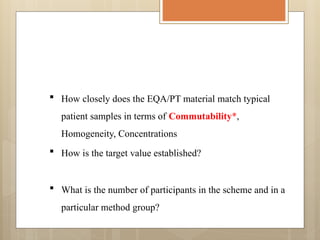
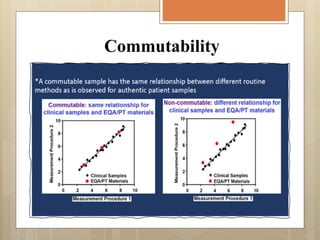
 How closely does the EQA/PT material match typical
patient samples in terms of Commutability*,
Homogeneity, Concentrations
 How is the target value established?
 What is the number of participants in the scheme and in a
particular method group?
Commutability
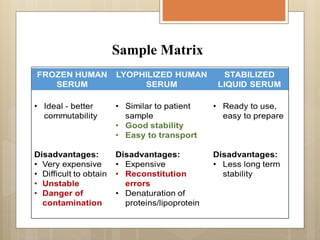
Sample Matrix
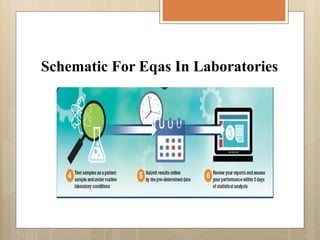
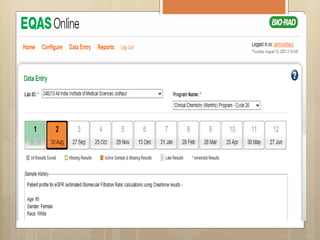
Schematic For Eqas In Laboratories
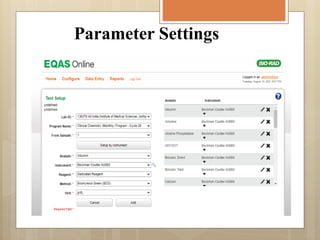
Parameter Settings
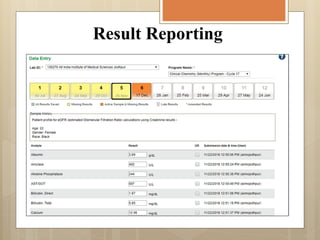
Result Reporting
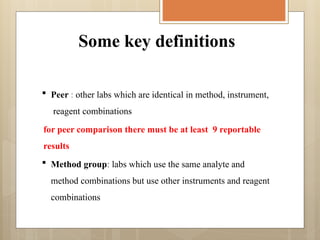
Some key definitions
 Peer : other labs which are identical in method, instrument,
reagent combinations
for peer comparison there must be at least 9 reportable
results
 Method group: labs which use the same analyte and
method combinations but use other instruments and reagent
combinations
 Mode: all labs who perform the same analyte but
use different instrument, reagents and method
combinations
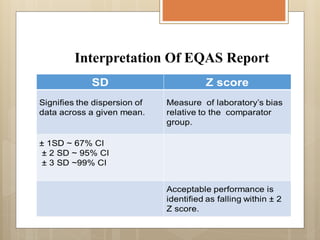
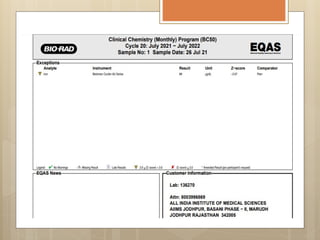
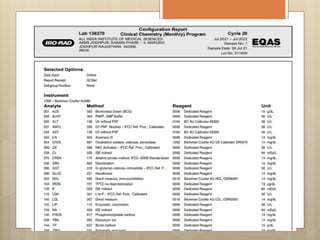
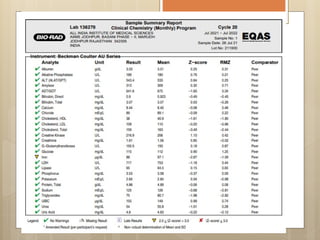
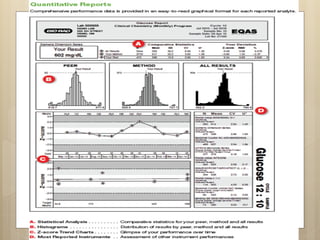
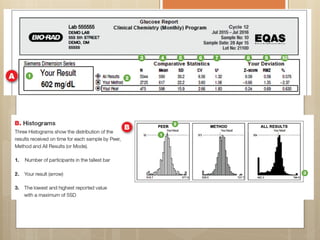
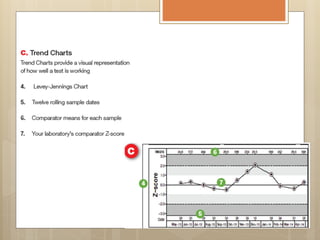
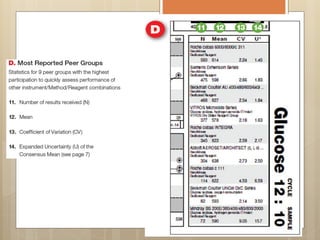
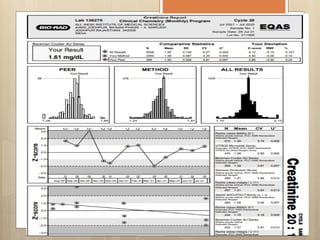
Interpretation Of EQAS Report
Take Home Message
 Eqas is an essential part of the total quality assurance
programme
 Even though it may appear cumbersome but it ensures
accuracy and precision of the reports generated by the labs
 Should be evaluated along with the IQC
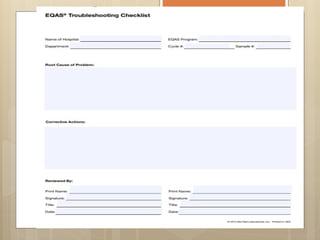
 Documentation of the corrective action is must for quality
improvement
Thank you

External quality assurance and quality control

  • 1.
  • 2.
    Introduction ■ EQA canbe called by different names = external quality assurance = external quality assessment = proficiency testing scheme
  • 3.
     Definition  processdesigned to objectively assess the quality of results obtained by laboratories, by means of an external agency
  • 4.
    Objectives of EQAPrograms  Assess the laboratory’s analytical quality and reliability in reported results  Enhance worldwide standardization efforts in clinical testing  Aid in identifying potential corrective actions and evaluate their effectiveness  Build confidence amongst the users towards lab performance
  • 5.
     To demonstratea commitment for continuous improvement and quality
  • 6.
    Difference Between IQC&EQA IQC/QC EQA/PT Frequency Everyday/more frequently Periodically (once in a month) Target value Known Unknown Result availability Immediately Later Can assess Precision only Accuracy and precision Comparison Within lab With other labs
  • 7.
    Iso 15189 MandateFor Eqas  5.6.4 The laboratory shall participate in organized inter laboratory comparisons, as external quality assessment schemes, that encompass the extent and complexity of examination procedures used by the laboratory.  The laboratory management shall monitor the results of external quality assessment and participate in the implementation of corrective actions when control criteria are not fulfilled.
  • 9.
    The Process Acceptable resultsverify that a lab is performing measurements correctly/ if not corrective measures should be undertaken EQA/ PT provider assigns or obtains a target value and determines if lab results are in agreement with the target value Results reported to the EQA/PT provider for evaluation Each laboratory measures the EQA/ PT samples like patient samples EQA/PT providers circulate a set of samples among a group of laboratories
  • 10.
    Different EQA providers Accreditedunder ISO 17043 Worldwide:  RIQAS( Randox Quality Assessment Scheme),  Biorad EQAS programme  FCC EQAS  CAP EQAS In India:  CMC (Vellore, TN)  RML (Lucknow, UP)  • Metropolis Healthcare Ltd. EQAS (Mumbai, MH)  • Neu-QAP(Neuberg Anand Academy of Laboratory Medicine Pvt LTD Quality Assessment Program).
  • 11.
    Choosing An EqasProgramme important questions to be answered • Choosing the parameters which the lab wants to put for external assessment. E.g
  • 12.
     How closelydoes the EQA/PT material match typical patient samples in terms of Commutability*, Homogeneity, Concentrations  How is the target value established?  What is the number of participants in the scheme and in a particular method group?
  • 13.
  • 14.
  • 15.
    Schematic For EqasIn Laboratories
  • 18.
  • 19.
  • 20.
    Some key definitions Peer : other labs which are identical in method, instrument, reagent combinations for peer comparison there must be at least 9 reportable results  Method group: labs which use the same analyte and method combinations but use other instruments and reagent combinations
  • 21.
     Mode: alllabs who perform the same analyte but use different instrument, reagents and method combinations
  • 22.
  • 23.
  • 40.
    Take Home Message Eqas is an essential part of the total quality assurance programme  Even though it may appear cumbersome but it ensures accuracy and precision of the reports generated by the labs  Should be evaluated along with the IQC  Documentation of the corrective action is must for quality improvement
  • 41.