MEANING IN SENTENCE LEVEL SusiloMulawarman University, Samarinda, Indonesia
UTTERANCESENTENCEPROPOSITIONImportant terms
Any stretch of talk, by one person, before and after which there is a silence on the part of that person; the use by a particular speaker, on a particular occasion, of a piece of language.UTTERANCE
It is conceived abstractly, a string of words put together by grammatical rules of a language.sentence
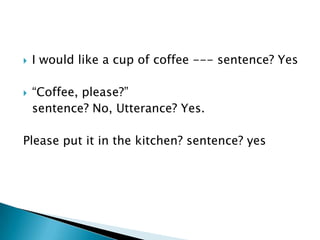
I would like a cup of coffee --- sentence? Yes“Coffee, please?”	sentence? No, Utterance? Yes.Please put it in the kitchen? sentence? yes
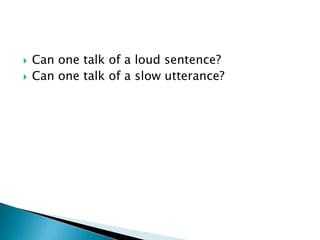
Can one talk of a loud sentence?Can one talk of a slow utterance?
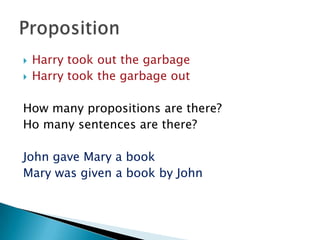
Harry took out the garbageHarry took the garbage outHow many propositions are there?Ho many sentences are there?John gave Mary a bookMary was given a book by JohnProposition
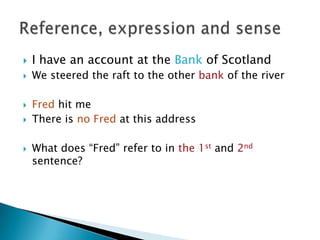
I have an account at the Bank of ScotlandWe steered the raft to the other bank of the riverFred hit meThere is no Fred at this addressWhat does “Fred” refer to in the 1stand 2ndsentence?Reference, expression and sense
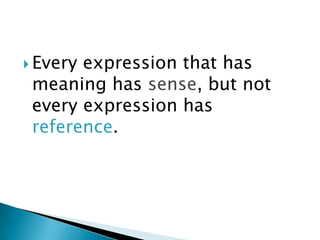
Every expression that has meaning has sense, but not every expression has reference.
SENTENCE RELATION AND TRUTH(TRUTH CONDITIONAL-SEMANTICS)
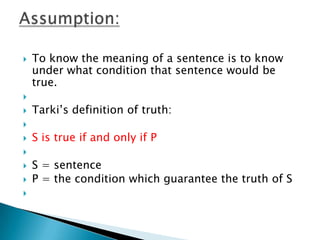
To know the meaning of a sentence is to know under what condition that sentence would be true. Tarki’s definition of truth: S is true if and only if P S = sentenceP = the condition which guarantee the truth of S Assumption:
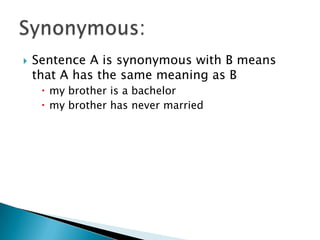
Sentence A is synonymous with B means that A has the same meaning as Bmy brother is a bachelormy brother has never marriedSynonymous:
Sentence A entails B means that if A then automatically Bthe anarchist assassinated the emperorthe emperor is diedEntailment
Sentence A contradicts B means that A is inconsistent with Bmy brother Sebastian has just come from Romemy brother Sebastian has never been to RomeContradiction
Sentence B presupposes B means that A is part of the assumed background against which A is said the Mayor of Manchester is a womenthere is a Mayor of ManchesterPresupposition
Sentence A is a tautology means that A is automatically true by virtue of its own meaning, but informationally empty Ireland is Ireland Tautology
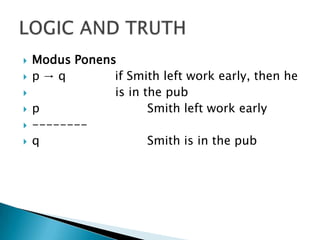
Modus Ponensp -> q             if Smith left work early, then he   			is in the pub p				Smith left work early--------q				Smith is in the pubLOGIC AND TRUTH
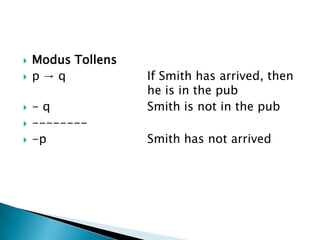
Modus Tollensp -> q			If Smith has arrived, then 				he is in the pub - q				Smith is not in the pub---------p				Smith has not arrived
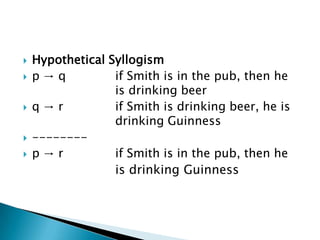
Hypothetical Syllogismp -> q		if Smith is in the pub, then he  			is drinking beerq -> r		if Smith is drinking beer, he is  			drinking Guinness--------p -> r	 	if Smith is in the pub, then he is drinking Guinness
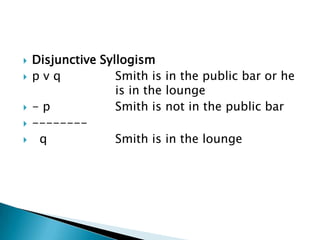
Disjunctive Syllogismp v q		Smith is in the public bar or he 			is in the lounge- p			Smith is not in the public bar--------  q			Smith is in the lounge
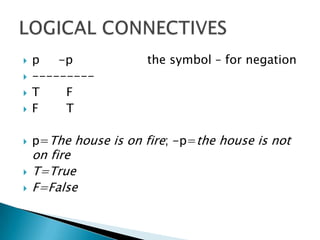
p     -p    		the symbol – for negation---------T 	    FF	    Tp=The house is on fire; -p=the house is not on fire T=TrueF=FalseLOGICAL CONNECTIVES
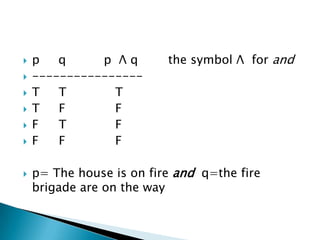
p     q          p  Λ q        the symbol Λ  for and----------------T	  TTT	  F		FF	  T		FF	  FFp= The house is on fire andq=the fire brigade are on the way
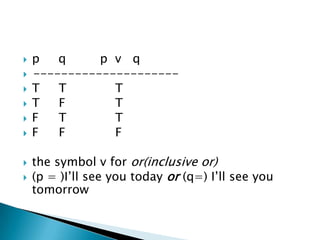
p     q         p  v   q 		---------------------T	  TTT	  F		TF	  T		TF	  FFthe symbol v for or(inclusive or) (p = )I’ll see you today or (q=) I’ll see you tomorrow
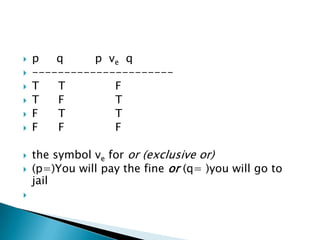
p     q         p  ve  q----------------------T	  T		FT	  F		TF	  T		TF	  FFthe symbol ve for or (exclusive or) (p=)You will pay the fine or (q= )you will go to jail 
In Semantics, to understand logic and truth, we should recognize:Truth value -----whether a sentence is being true or falseTruth Condition ----the facts that would have to obtain in reality to make a sentence true or false
Based on what a speaker knows (epistemology), truth can be:a priori truth ---Truth is known before or without experiencea posteriori truth---- Truth can only be known on the basis of empirical testingSo, there is always a couple of truth:
Necessary truth ----cannot be denied without forcing  a contradiction	Two and two make fourContingent truth -----can be contradicted, depending on the factsOrangutan is extinct Based on what the world is like (metaphysic), truth can be:
Analytic truth ---truth follows from the meaning relations within the sentence, regardless of any relationship with the world.	My father is my fatherSynthetic truth --- being true is because of the facts of the world 	My father is a sailorBased on semantic orientation (semantics), truth can be:

Sentence relation and truth

  • 1.
    MEANING IN SENTENCELEVEL SusiloMulawarman University, Samarinda, Indonesia
  • 2.
  • 3.
    Any stretch oftalk, by one person, before and after which there is a silence on the part of that person; the use by a particular speaker, on a particular occasion, of a piece of language.UTTERANCE
  • 4.
    It is conceivedabstractly, a string of words put together by grammatical rules of a language.sentence
  • 5.
    I would likea cup of coffee --- sentence? Yes“Coffee, please?” sentence? No, Utterance? Yes.Please put it in the kitchen? sentence? yes
  • 6.
    Can one talkof a loud sentence?Can one talk of a slow utterance?
  • 7.
    Harry took outthe garbageHarry took the garbage outHow many propositions are there?Ho many sentences are there?John gave Mary a bookMary was given a book by JohnProposition
  • 8.
    I have anaccount at the Bank of ScotlandWe steered the raft to the other bank of the riverFred hit meThere is no Fred at this addressWhat does “Fred” refer to in the 1stand 2ndsentence?Reference, expression and sense
  • 9.
    Every expression thathas meaning has sense, but not every expression has reference.
  • 10.
    SENTENCE RELATION ANDTRUTH(TRUTH CONDITIONAL-SEMANTICS)
  • 11.
    To know themeaning of a sentence is to know under what condition that sentence would be true. Tarki’s definition of truth: S is true if and only if P S = sentenceP = the condition which guarantee the truth of S Assumption:
  • 12.
    Sentence A issynonymous with B means that A has the same meaning as Bmy brother is a bachelormy brother has never marriedSynonymous:
  • 13.
    Sentence A entailsB means that if A then automatically Bthe anarchist assassinated the emperorthe emperor is diedEntailment
  • 14.
    Sentence A contradictsB means that A is inconsistent with Bmy brother Sebastian has just come from Romemy brother Sebastian has never been to RomeContradiction
  • 15.
    Sentence B presupposesB means that A is part of the assumed background against which A is said the Mayor of Manchester is a womenthere is a Mayor of ManchesterPresupposition
  • 16.
    Sentence A isa tautology means that A is automatically true by virtue of its own meaning, but informationally empty Ireland is Ireland Tautology
  • 17.
    Modus Ponensp ->q if Smith left work early, then he is in the pub p Smith left work early--------q Smith is in the pubLOGIC AND TRUTH
  • 18.
    Modus Tollensp ->q If Smith has arrived, then he is in the pub - q Smith is not in the pub---------p Smith has not arrived
  • 19.
    Hypothetical Syllogismp ->q if Smith is in the pub, then he is drinking beerq -> r if Smith is drinking beer, he is drinking Guinness--------p -> r if Smith is in the pub, then he is drinking Guinness
  • 20.
    Disjunctive Syllogismp vq Smith is in the public bar or he is in the lounge- p Smith is not in the public bar-------- q Smith is in the lounge
  • 21.
    p -p the symbol – for negation---------T FF Tp=The house is on fire; -p=the house is not on fire T=TrueF=FalseLOGICAL CONNECTIVES
  • 22.
    p q p Λ q the symbol Λ for and----------------T TTT F FF T FF FFp= The house is on fire andq=the fire brigade are on the way
  • 23.
    p q p v q ---------------------T TTT F TF T TF FFthe symbol v for or(inclusive or) (p = )I’ll see you today or (q=) I’ll see you tomorrow
  • 24.
    p q p ve q----------------------T T FT F TF T TF FFthe symbol ve for or (exclusive or) (p=)You will pay the fine or (q= )you will go to jail 
  • 25.
    In Semantics, tounderstand logic and truth, we should recognize:Truth value -----whether a sentence is being true or falseTruth Condition ----the facts that would have to obtain in reality to make a sentence true or false
  • 26.
    Based on whata speaker knows (epistemology), truth can be:a priori truth ---Truth is known before or without experiencea posteriori truth---- Truth can only be known on the basis of empirical testingSo, there is always a couple of truth:
  • 27.
    Necessary truth ----cannotbe denied without forcing a contradiction Two and two make fourContingent truth -----can be contradicted, depending on the factsOrangutan is extinct Based on what the world is like (metaphysic), truth can be:
  • 28.
    Analytic truth ---truthfollows from the meaning relations within the sentence, regardless of any relationship with the world. My father is my fatherSynthetic truth --- being true is because of the facts of the world My father is a sailorBased on semantic orientation (semantics), truth can be: