PRACTICAL 18:
COMPLEMENT FIXATION TEST
Microbiology & Immunology
Introduction:
 The complement fixation test (CFT) was
extensively used in syphilis serology after being
introduced by Wasserman in 1909.
 Complement is a protein (globulin) present in
normal serum.
 Whole complement system is made up of nine
components: C1 to C9
 Complement proteins are heat labile and are
destroyed by heating at 56°C for 20 – 30 minutes.
 Complement binds to Ag-Ab complex
 When the Ag is an RBC it causes lysis of RBC’s.
Principle
 Complement takes part in many of the immunological
reactions. It gets absorbed during the combination of
antigens and antibody.
 This property of antigen–antibody complex to fix the
complement is used in complement fixation test for the
identification of specific antibodies.
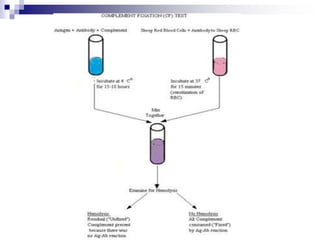
 The haemolytic system containing sheep erythrocytes
(RBC) and its corresponding antibody (amboceptor) is
used as an indicator which shows the utilization or
availability of the complement.
 If the complement is fixed then there will be no lysis of
sheep erythrocytes, thus denoting a positive test.
 If the complement is available then there will be
haemolysis which is a property of complement, denoting a
negative test.
 The test requires five reagents and is
carried out in two steps.
Components of CFT
Test System
 Antigen: It may be soluble or particulate.
 Antibody: Human serum (May or may not contain Antibody
towards specific Antigen)
 Complement: It is pooled serum obtained from 4 to 5
guinea pigs. It should be fresh or specially preserved as the
complement activity is heat labile (stored at -30 °C in small
fractions). The complement activity should be initially
standardized before using in the test.
Indicator System (Haemolytic system)
 Erythrocytes: Sheep RBC
 Amboceptor (Hemolysin): Rabbit antibody to sheep red
cells prepared by inoculating sheep erythrocytes into rabbit
under standard immunization protocol.
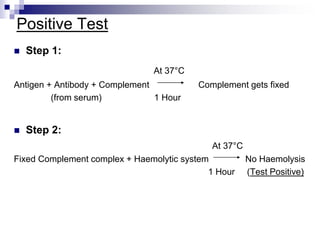
Positive Test
 Step 1:
At 37°C
Antigen + Antibody + Complement Complement gets fixed
(from serum) 1 Hour
 Step 2:
At 37°C
Fixed Complement complex + Haemolytic system No Haemolysis
1 Hour (Test Positive)
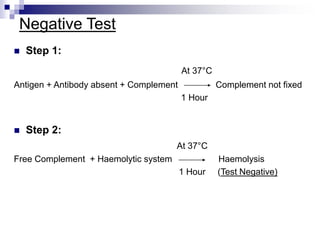
Negative Test
 Step 1:
At 37°C
Antigen + Antibody absent + Complement Complement not fixed
1 Hour
 Step 2:
At 37°C
Free Complement + Haemolytic system Haemolysis
1 Hour (Test Negative)
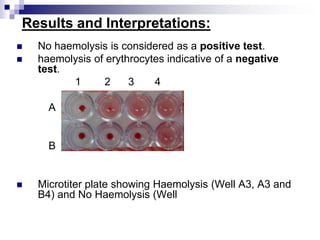
Results and Interpretations:
 No haemolysis is considered as a positive test.
 haemolysis of erythrocytes indicative of a negative
test.
1 2 3 4
A
B
 Microtiter plate showing Haemolysis (Well A3, A3 and
B4) and No Haemolysis (Well

PRACTICAL 18: COMPLEMENT FIXATION TEST.ppt

  • 1.
    PRACTICAL 18: COMPLEMENT FIXATIONTEST Microbiology & Immunology
  • 2.
    Introduction:  The complementfixation test (CFT) was extensively used in syphilis serology after being introduced by Wasserman in 1909.  Complement is a protein (globulin) present in normal serum.  Whole complement system is made up of nine components: C1 to C9  Complement proteins are heat labile and are destroyed by heating at 56°C for 20 – 30 minutes.  Complement binds to Ag-Ab complex  When the Ag is an RBC it causes lysis of RBC’s.
  • 3.
    Principle  Complement takespart in many of the immunological reactions. It gets absorbed during the combination of antigens and antibody.  This property of antigen–antibody complex to fix the complement is used in complement fixation test for the identification of specific antibodies.  The haemolytic system containing sheep erythrocytes (RBC) and its corresponding antibody (amboceptor) is used as an indicator which shows the utilization or availability of the complement.  If the complement is fixed then there will be no lysis of sheep erythrocytes, thus denoting a positive test.  If the complement is available then there will be haemolysis which is a property of complement, denoting a negative test.
  • 4.
     The testrequires five reagents and is carried out in two steps.
  • 5.
    Components of CFT TestSystem  Antigen: It may be soluble or particulate.  Antibody: Human serum (May or may not contain Antibody towards specific Antigen)  Complement: It is pooled serum obtained from 4 to 5 guinea pigs. It should be fresh or specially preserved as the complement activity is heat labile (stored at -30 °C in small fractions). The complement activity should be initially standardized before using in the test. Indicator System (Haemolytic system)  Erythrocytes: Sheep RBC  Amboceptor (Hemolysin): Rabbit antibody to sheep red cells prepared by inoculating sheep erythrocytes into rabbit under standard immunization protocol.
  • 6.
    Positive Test  Step1: At 37°C Antigen + Antibody + Complement Complement gets fixed (from serum) 1 Hour  Step 2: At 37°C Fixed Complement complex + Haemolytic system No Haemolysis 1 Hour (Test Positive)
  • 7.
    Negative Test  Step1: At 37°C Antigen + Antibody absent + Complement Complement not fixed 1 Hour  Step 2: At 37°C Free Complement + Haemolytic system Haemolysis 1 Hour (Test Negative)
  • 9.
    Results and Interpretations: No haemolysis is considered as a positive test.  haemolysis of erythrocytes indicative of a negative test. 1 2 3 4 A B  Microtiter plate showing Haemolysis (Well A3, A3 and B4) and No Haemolysis (Well