Preparation of
Suppositories
Ayyad Emad Ayaad 1240782
Amr Khalid Hanafi 1240659
Omar Shabrawy Atta 1240686
Amr Mohammed Abd-Almaksoud 1240687
Presented by
Objectives
• Introduction
• Suppository Bases
• Methods of Preparation
• Suppositories can be extemporaneously prepared by one of three
methods.
INTRODUCTION
• Suppositories are solid medications that enter the
body through the rectum, vagina, or urethra.
• Doctors recommend the different forms of
suppositories for different medical conditions and
purposes.
• Rectal suppositories are intended for localized or
systemic action to relieve pain, constipation, irritation,
inflammation, nausea and vomiting, fever, migraines,
allergies, and sedation.
Preparation of
Suppositories
HAND ROLLING
• Hand Rolling is the oldest and simplest method of suppository preparation and may be
used when only a few suppositories are to be prepared in a cocoa butter base.
• It has the advantage of avoiding the necessity of heating the cocoa butter. A plastic-like
mass is prepared by triturating grated cocoa butter and active ingredients in a mortar.
• Effective hand rolling requires considerable practice and skill. The suppository “pipe” or
cylinder tends to crack or hollow in the center, especially when the mass is insufficiently
kneaded and softened.
HAND ROLLING
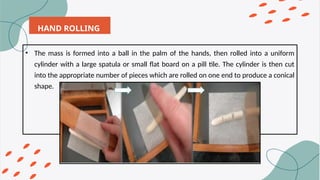
• The mass is formed into a ball in the palm of the hands, then rolled into a uniform
cylinder with a large spatula or small flat board on a pill tile. The cylinder is then cut
into the appropriate number of pieces which are rolled on one end to produce a conical
shape.
COMPRESSION
MOLDING
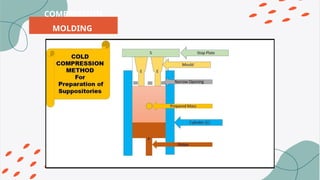
• Compression Molding is a method of preparing suppositories from a mixed mass of
grated suppository base and medicaments which is forced into a special compression
mold.
• The method requires that the capacity of the molds first be determined by compressing
a small amount of the base into the dies and weighing the finished suppositories.
• When active ingredients are added, it is necessary to omit a portion of the suppository
base, based on the density factors of the active ingredients.
COMPRESSION
MOLDING
FUSION MOLDING
• Fusion Molding involves first melting the suppository
base, and then dispersing or dissolving the drug in
the melted base. The mixture is removed from the
heat and poured into a suppository mold.
• When the mixture has congealed, the suppositories
are removed from the mold. The fusion method can
be used with all types of suppositories and must be
used with most of them.
SUPPOSITORY BASES
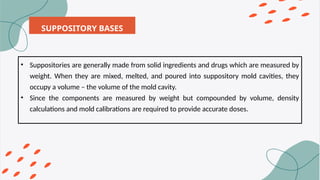
• Suppositories are generally made from solid ingredients and drugs which are measured by
weight. When they are mixed, melted, and poured into suppository mold cavities, they
occupy a volume – the volume of the mold cavity.
• Since the components are measured by weight but compounded by volume, density
calculations and mold calibrations are required to provide accurate doses.
SUPPOSITORY BASES
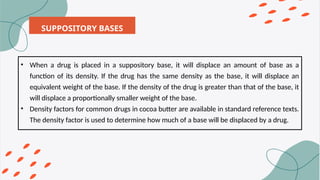
• When a drug is placed in a suppository base, it will displace an amount of base as a
function of its density. If the drug has the same density as the base, it will displace an
equivalent weight of the base. If the density of the drug is greater than that of the base, it
will displace a proportionally smaller weight of the base.
• Density factors for common drugs in cocoa butter are available in standard reference texts.
The density factor is used to determine how much of a base will be displaced by a drug.
SUPPOSITORY BASES
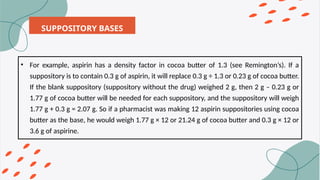
• For example, aspirin has a density factor in cocoa butter of 1.3 (see Remington’s). If a
suppository is to contain 0.3 g of aspirin, it will replace 0.3 g ÷ 1.3 or 0.23 g of cocoa butter.
If the blank suppository (suppository without the drug) weighed 2 g, then 2 g – 0.23 g or
1.77 g of cocoa butter will be needed for each suppository, and the suppository will weigh
1.77 g + 0.3 g = 2.07 g. So if a pharmacist was making 12 aspirin suppositories using cocoa
butter as the base, he would weigh 1.77 g × 12 or 21.24 g of cocoa butter and 0.3 g × 12 or
3.6 g of aspirine.
COMMON TYPES OF
SUPPOSITORIES
• 1. Rectal Suppositories: These suppositories are designed to be inserted into the rectum.
They are commonly used for various purposes, such as relieving constipation, treating
hemorrhoids, delivering medications for systemic absorption, or reducing inflammation in
the rectal area.
• 2. Vaginal Suppositories: Vaginal suppositories are meant to be inserted into the vagina.
They are used for various purposes, including treating vaginal infections, providing local
relief for vaginal dryness or irritation, or delivering medications directly to the vaginal area.
COMMON TYPES OF
SUPPOSITORIES
• 3. Urethral Suppositories: Urethral suppositories, also known as urethral inserts or
urethral sticks, are designed to be inserted into the urethra. They are primarily used for
the treatment of certain urinary conditions, such as erectile dysfunction or urinary
incontinence in men.
• 4. Nasal Suppositories: Nasal suppositories, also called nasal inserts or nasal sticks, are
inserted into the nasal cavity. They can be used for the delivery of medications, such as
nasal decongestants or antihistamines, to provide relief from nasal congestion or allergies.
COMMON TYPES OF
SUPPOSITORIES
• 5. Ear Suppositories: Ear suppositories, also known as otic suppositories, are specifically
designed for insertion into the ear canal. They are used for treating ear infections or
delivering medications to the ear for localized treatment.
USES OF SUPPOSITORIES
• 1. Topical medication administration: Supository is used to administer topical medications
such as nonsteroidal anti-inflammatory drugs (NSAIDs), antibiotics, and other topical
anesthetics. This is done to achieve a direct local effect on the anal or rectal area.
• 2. Local symptom relief: Supository can be used to provide a rapid and local effect in
relieving local symptoms such as itching, inflammation, and spasms in the anal and rectal
area.
USES OF SUPPOSITORIES
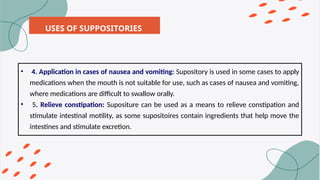
• 4. Application in cases of nausea and vomiting: Supository is used in some cases to apply
medications when the mouth is not suitable for use, such as cases of nausea and vomiting,
where medications are difficult to swallow orally.
• 5. Relieve constipation: Supositure can be used as a means to relieve constipation and
stimulate intestinal motility, as some supositoires contain ingredients that help move the
intestines and stimulate excretion.
PRECAUTIONS
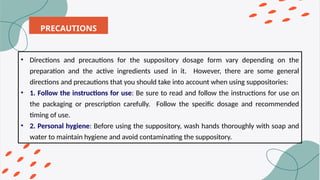
• Directions and precautions for the suppository dosage form vary depending on the
preparation and the active ingredients used in it. However, there are some general
directions and precautions that you should take into account when using suppositories:
• 1. Follow the instructions for use: Be sure to read and follow the instructions for use on
the packaging or prescription carefully. Follow the specific dosage and recommended
timing of use.
• 2. Personal hygiene: Before using the suppository, wash hands thoroughly with soap and
water to maintain hygiene and avoid contaminating the suppository.
PRECAUTIONS
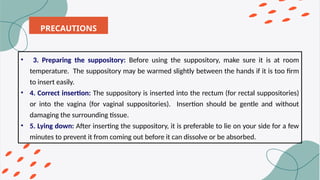
• 3. Preparing the suppository: Before using the suppository, make sure it is at room
temperature. The suppository may be warmed slightly between the hands if it is too firm
to insert easily.
• 4. Correct insertion: The suppository is inserted into the rectum (for rectal suppositories)
or into the vagina (for vaginal suppositories). Insertion should be gentle and without
damaging the surrounding tissue.
• 5. Lying down: After inserting the suppository, it is preferable to lie on your side for a few
minutes to prevent it from coming out before it can dissolve or be absorbed.
PRECAUTIONS
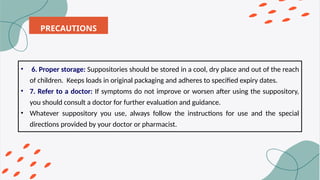
• 6. Proper storage: Suppositories should be stored in a cool, dry place and out of the reach
of children. Keeps loads in original packaging and adheres to specified expiry dates.
• 7. Refer to a doctor: If symptoms do not improve or worsen after using the suppository,
you should consult a doctor for further evaluation and guidance.
• Whatever suppository you use, always follow the instructions for use and the special
directions provided by your doctor or pharmacist.
Thanks for
listening
Overview Preparation of Suppositories.pptx

Overview Preparation of Suppositories.pptx

  • 1.
  • 2.
    Ayyad Emad Ayaad1240782 Amr Khalid Hanafi 1240659 Omar Shabrawy Atta 1240686 Amr Mohammed Abd-Almaksoud 1240687 Presented by
  • 3.
    Objectives • Introduction • SuppositoryBases • Methods of Preparation • Methods of Preparation • Suppositories can be extemporaneously prepared by one of three methods.
  • 4.
    INTRODUCTION • Suppositories aresolid medications that enter the body through the rectum, vagina, or urethra. • Doctors recommend the different forms of suppositories for different medical conditions and purposes. • Rectal suppositories are intended for localized or systemic action to relieve pain, constipation, irritation, inflammation, nausea and vomiting, fever, migraines, allergies, and sedation.
  • 5.
  • 6.
    HAND ROLLING • HandRolling is the oldest and simplest method of suppository preparation and may be used when only a few suppositories are to be prepared in a cocoa butter base. • It has the advantage of avoiding the necessity of heating the cocoa butter. A plastic-like mass is prepared by triturating grated cocoa butter and active ingredients in a mortar. • Effective hand rolling requires considerable practice and skill. The suppository “pipe” or cylinder tends to crack or hollow in the center, especially when the mass is insufficiently kneaded and softened.
  • 7.
    HAND ROLLING • Themass is formed into a ball in the palm of the hands, then rolled into a uniform cylinder with a large spatula or small flat board on a pill tile. The cylinder is then cut into the appropriate number of pieces which are rolled on one end to produce a conical shape.
  • 8.
    COMPRESSION MOLDING • Compression Moldingis a method of preparing suppositories from a mixed mass of grated suppository base and medicaments which is forced into a special compression mold. • The method requires that the capacity of the molds first be determined by compressing a small amount of the base into the dies and weighing the finished suppositories. • When active ingredients are added, it is necessary to omit a portion of the suppository base, based on the density factors of the active ingredients.
  • 9.
  • 10.
    FUSION MOLDING • FusionMolding involves first melting the suppository base, and then dispersing or dissolving the drug in the melted base. The mixture is removed from the heat and poured into a suppository mold. • When the mixture has congealed, the suppositories are removed from the mold. The fusion method can be used with all types of suppositories and must be used with most of them.
  • 11.
    SUPPOSITORY BASES • Suppositoriesare generally made from solid ingredients and drugs which are measured by weight. When they are mixed, melted, and poured into suppository mold cavities, they occupy a volume – the volume of the mold cavity. • Since the components are measured by weight but compounded by volume, density calculations and mold calibrations are required to provide accurate doses.
  • 12.
    SUPPOSITORY BASES • Whena drug is placed in a suppository base, it will displace an amount of base as a function of its density. If the drug has the same density as the base, it will displace an equivalent weight of the base. If the density of the drug is greater than that of the base, it will displace a proportionally smaller weight of the base. • Density factors for common drugs in cocoa butter are available in standard reference texts. The density factor is used to determine how much of a base will be displaced by a drug.
  • 13.
    SUPPOSITORY BASES • Forexample, aspirin has a density factor in cocoa butter of 1.3 (see Remington’s). If a suppository is to contain 0.3 g of aspirin, it will replace 0.3 g ÷ 1.3 or 0.23 g of cocoa butter. If the blank suppository (suppository without the drug) weighed 2 g, then 2 g – 0.23 g or 1.77 g of cocoa butter will be needed for each suppository, and the suppository will weigh 1.77 g + 0.3 g = 2.07 g. So if a pharmacist was making 12 aspirin suppositories using cocoa butter as the base, he would weigh 1.77 g × 12 or 21.24 g of cocoa butter and 0.3 g × 12 or 3.6 g of aspirine.
  • 14.
    COMMON TYPES OF SUPPOSITORIES •1. Rectal Suppositories: These suppositories are designed to be inserted into the rectum. They are commonly used for various purposes, such as relieving constipation, treating hemorrhoids, delivering medications for systemic absorption, or reducing inflammation in the rectal area. • 2. Vaginal Suppositories: Vaginal suppositories are meant to be inserted into the vagina. They are used for various purposes, including treating vaginal infections, providing local relief for vaginal dryness or irritation, or delivering medications directly to the vaginal area.
  • 15.
    COMMON TYPES OF SUPPOSITORIES •3. Urethral Suppositories: Urethral suppositories, also known as urethral inserts or urethral sticks, are designed to be inserted into the urethra. They are primarily used for the treatment of certain urinary conditions, such as erectile dysfunction or urinary incontinence in men. • 4. Nasal Suppositories: Nasal suppositories, also called nasal inserts or nasal sticks, are inserted into the nasal cavity. They can be used for the delivery of medications, such as nasal decongestants or antihistamines, to provide relief from nasal congestion or allergies.
  • 16.
    COMMON TYPES OF SUPPOSITORIES •5. Ear Suppositories: Ear suppositories, also known as otic suppositories, are specifically designed for insertion into the ear canal. They are used for treating ear infections or delivering medications to the ear for localized treatment.
  • 17.
    USES OF SUPPOSITORIES •1. Topical medication administration: Supository is used to administer topical medications such as nonsteroidal anti-inflammatory drugs (NSAIDs), antibiotics, and other topical anesthetics. This is done to achieve a direct local effect on the anal or rectal area. • 2. Local symptom relief: Supository can be used to provide a rapid and local effect in relieving local symptoms such as itching, inflammation, and spasms in the anal and rectal area.
  • 18.
    USES OF SUPPOSITORIES •4. Application in cases of nausea and vomiting: Supository is used in some cases to apply medications when the mouth is not suitable for use, such as cases of nausea and vomiting, where medications are difficult to swallow orally. • 5. Relieve constipation: Supositure can be used as a means to relieve constipation and stimulate intestinal motility, as some supositoires contain ingredients that help move the intestines and stimulate excretion.
  • 19.
    PRECAUTIONS • Directions andprecautions for the suppository dosage form vary depending on the preparation and the active ingredients used in it. However, there are some general directions and precautions that you should take into account when using suppositories: • 1. Follow the instructions for use: Be sure to read and follow the instructions for use on the packaging or prescription carefully. Follow the specific dosage and recommended timing of use. • 2. Personal hygiene: Before using the suppository, wash hands thoroughly with soap and water to maintain hygiene and avoid contaminating the suppository.
  • 20.
    PRECAUTIONS • 3. Preparingthe suppository: Before using the suppository, make sure it is at room temperature. The suppository may be warmed slightly between the hands if it is too firm to insert easily. • 4. Correct insertion: The suppository is inserted into the rectum (for rectal suppositories) or into the vagina (for vaginal suppositories). Insertion should be gentle and without damaging the surrounding tissue. • 5. Lying down: After inserting the suppository, it is preferable to lie on your side for a few minutes to prevent it from coming out before it can dissolve or be absorbed.
  • 21.
    PRECAUTIONS • 6. Properstorage: Suppositories should be stored in a cool, dry place and out of the reach of children. Keeps loads in original packaging and adheres to specified expiry dates. • 7. Refer to a doctor: If symptoms do not improve or worsen after using the suppository, you should consult a doctor for further evaluation and guidance. • Whatever suppository you use, always follow the instructions for use and the special directions provided by your doctor or pharmacist.
  • 22.