Sedative
Introduction
• Sedatives are a broad class of prescription
medications that slow your brain’s activity. Common
types include benzodiazepines and barbiturates.
Sedatives have several uses, ranging from treating
anxiety and insomnia to anesthesia purposes.
• These medications have addiction potential, so they
must be taken with caution.
Market Products
• MAGICPICLONE 2 MG 20 F.C.TABS.
• This medicine is used to treat sleep problems, it may
help to fall asleep faster, continue to sleep longer, and
reduce the number of times a person wakes up during
the night, so that they can get better rest during the
night.
• Zopiclone belongs to a class of drugs called
hypnotics, which acts in the brain to produce a
calming effect.
Market Products
• SIESTA 10MG 14 CAPS.
• Treatment of cases of insomnia resulting from
thinking and stress, especially in periods of tests and
mental exertion.
• In cases of difficulty in the ability to sleep normally
than usual due to eating fatty foods or because of
drinking some stimulant substances such as caffeine
and others, it works to get rid of the body of its effect
and the ability to sleep.
Market Products
• ZODIUM 10MG 10 F.C. TAB.
• Zolpidem is used to treat insomnia in adults that include
difficulty falling asleep, waking up or waking up early. It is
used for periods of time ranging from 4-8 weeks.
• It is best used in conjunction with non-pharmacological
treatments such as cognitive-behavioral therapy and others
that help get rid of insomnia.Prolonged use of zolpidem
treatment is not recommended for insomnia, unless non-
drug treatments have not worked and after the specialist
doctor so decides.
Sedative Plants
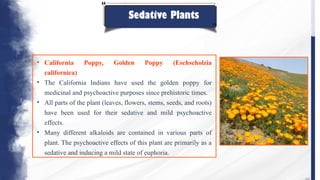
• California Poppy, Golden Poppy (Eschscholzia
californica)
• The California Indians have used the golden poppy for
medicinal and psychoactive purposes since prehistoric times.
• All parts of the plant (leaves, flowers, stems, seeds, and roots)
have been used for their sedative and mild psychoactive
effects.
• Many different alkaloids are contained in various parts of
plant. The psychoactive effects of this plant are primarily as a
sedative and inducing a mild state of euphoria.
Sedative Plants
• Active Constituent
• The flowers of the California poppy contain alkaloids between 0.5 and 1.2%, including
poppies (eschscholtzine, californidine), berberine, sanguinarine and magnoflorine. Other
components include carotenoids and flavonoids (rutin and quercetin). Eschscholzia has
anxiolytic and sedative properties.
• Side Effect
• California poppy might cause sleepiness and slowed breathing. Some medications, called
sedatives, can also cause sleepiness and slowed breathing. Taking California poppy with
sedative medications might cause breathing problems and/or too much sleepiness.
Sedative Plants
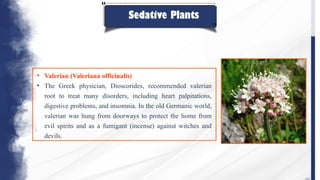
• Valerian (Valeriana officinalis)
• The Greek physician, Dioscorides, recommended valerian
root to treat many disorders, including heart palpitations,
digestive problems, and insomnia. In the old Germanic world,
valerian was hung from doorways to protect the home from
evil spirits and as a fumigant (incense) against witches and
devils.
Sedative Plants
• Active Constituent
• The known pharmacologically active compounds detected in valerian extract are alkaloids,
terpenes, organic acids and its derivatives, valepotriates and flavones. It is generally
accepted that the valepotriates are the compounds responsible for the sedative activity of
the Valerianaceae.
• Side Effect
• Side effects of valerian include headache, stomach upset, mental dullness, excitability,
uneasiness, heart disturbances, and even insomnia in some people. A few people feel
drowsy in the morning after taking valerian, especially at higher doses. Some people
experience dry mouth or vivid dreams.
Sedative Plants
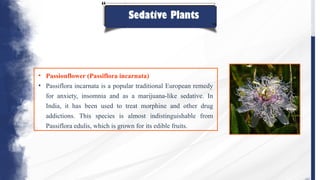
• Passionflower (Passiflora incarnata)
• Passiflora incarnata is a popular traditional European remedy
for anxiety, insomnia and as a marijuana-like sedative. In
India, it has been used to treat morphine and other drug
addictions. This species is almost indistinguishable from
Passiflora edulis, which is grown for its edible fruits.
Sedative Plants
• Active Constituent
• Active ingredients include chrysin, vitexin, coumerin, and umbelliferone (Spinella, 2001).
Chrysin is the most studied component. Along with other flavonoids, chrysin has been
shown to bind to benzodiazepine receptors sites and acts as an agonist for GABA activity,
especially at A type GABA receptors.
• Side Effect
• It may cause side effects such as drowsiness, dizziness, and confusion. When applied to the
skin: There isn't enough reliable information to know if passion flower is safe or what the
side effects might be. Pregnancy : Passion flower is possibly unsafe when taken by mouth
during pregnancy.

overview about Sedative in Pharmaceutical.pptx

  • 1.
  • 2.
    Introduction • Sedatives area broad class of prescription medications that slow your brain’s activity. Common types include benzodiazepines and barbiturates. Sedatives have several uses, ranging from treating anxiety and insomnia to anesthesia purposes. • These medications have addiction potential, so they must be taken with caution.
  • 3.
    Market Products • MAGICPICLONE2 MG 20 F.C.TABS. • This medicine is used to treat sleep problems, it may help to fall asleep faster, continue to sleep longer, and reduce the number of times a person wakes up during the night, so that they can get better rest during the night. • Zopiclone belongs to a class of drugs called hypnotics, which acts in the brain to produce a calming effect.
  • 4.
    Market Products • SIESTA10MG 14 CAPS. • Treatment of cases of insomnia resulting from thinking and stress, especially in periods of tests and mental exertion. • In cases of difficulty in the ability to sleep normally than usual due to eating fatty foods or because of drinking some stimulant substances such as caffeine and others, it works to get rid of the body of its effect and the ability to sleep.
  • 5.
    Market Products • ZODIUM10MG 10 F.C. TAB. • Zolpidem is used to treat insomnia in adults that include difficulty falling asleep, waking up or waking up early. It is used for periods of time ranging from 4-8 weeks. • It is best used in conjunction with non-pharmacological treatments such as cognitive-behavioral therapy and others that help get rid of insomnia.Prolonged use of zolpidem treatment is not recommended for insomnia, unless non- drug treatments have not worked and after the specialist doctor so decides.
  • 6.
    Sedative Plants • CaliforniaPoppy, Golden Poppy (Eschscholzia californica) • The California Indians have used the golden poppy for medicinal and psychoactive purposes since prehistoric times. • All parts of the plant (leaves, flowers, stems, seeds, and roots) have been used for their sedative and mild psychoactive effects. • Many different alkaloids are contained in various parts of plant. The psychoactive effects of this plant are primarily as a sedative and inducing a mild state of euphoria.
  • 7.
    Sedative Plants • ActiveConstituent • The flowers of the California poppy contain alkaloids between 0.5 and 1.2%, including poppies (eschscholtzine, californidine), berberine, sanguinarine and magnoflorine. Other components include carotenoids and flavonoids (rutin and quercetin). Eschscholzia has anxiolytic and sedative properties. • Side Effect • California poppy might cause sleepiness and slowed breathing. Some medications, called sedatives, can also cause sleepiness and slowed breathing. Taking California poppy with sedative medications might cause breathing problems and/or too much sleepiness.
  • 8.
    Sedative Plants • Valerian(Valeriana officinalis) • The Greek physician, Dioscorides, recommended valerian root to treat many disorders, including heart palpitations, digestive problems, and insomnia. In the old Germanic world, valerian was hung from doorways to protect the home from evil spirits and as a fumigant (incense) against witches and devils.
  • 9.
    Sedative Plants • ActiveConstituent • The known pharmacologically active compounds detected in valerian extract are alkaloids, terpenes, organic acids and its derivatives, valepotriates and flavones. It is generally accepted that the valepotriates are the compounds responsible for the sedative activity of the Valerianaceae. • Side Effect • Side effects of valerian include headache, stomach upset, mental dullness, excitability, uneasiness, heart disturbances, and even insomnia in some people. A few people feel drowsy in the morning after taking valerian, especially at higher doses. Some people experience dry mouth or vivid dreams.
  • 10.
    Sedative Plants • Passionflower(Passiflora incarnata) • Passiflora incarnata is a popular traditional European remedy for anxiety, insomnia and as a marijuana-like sedative. In India, it has been used to treat morphine and other drug addictions. This species is almost indistinguishable from Passiflora edulis, which is grown for its edible fruits.
  • 11.
    Sedative Plants • ActiveConstituent • Active ingredients include chrysin, vitexin, coumerin, and umbelliferone (Spinella, 2001). Chrysin is the most studied component. Along with other flavonoids, chrysin has been shown to bind to benzodiazepine receptors sites and acts as an agonist for GABA activity, especially at A type GABA receptors. • Side Effect • It may cause side effects such as drowsiness, dizziness, and confusion. When applied to the skin: There isn't enough reliable information to know if passion flower is safe or what the side effects might be. Pregnancy : Passion flower is possibly unsafe when taken by mouth during pregnancy.