Faster R-CNN
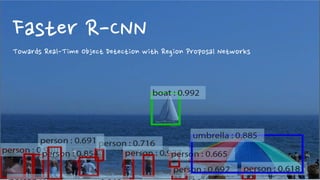
Towards Real-Time Object Detection with Region Proposal Networks
Faster R-CNN(NIPS 2015)
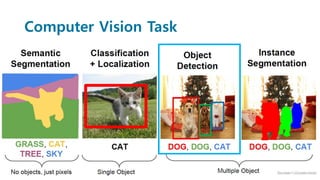
Computer Vision Task
History(?) of R-CNN
• Rich feature hierarchies for accurate object detection and
semantic segmentation(2013)
• Fast R-CNN(2015)
• Faster R-CNN: Towards Real-Time Object Detection with
Region Proposal Networks(2015)
• Mask R-CNN(2017)
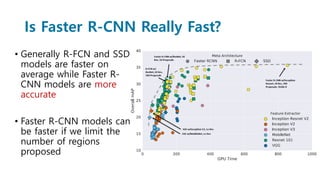
Is Faster R-CNN Really Fast?
• Generally R-FCN and SSD
models are faster on
average while Faster R-
CNN models are more
accurate
• Faster R-CNN models can
be faster if we limit the
number of regions
proposed
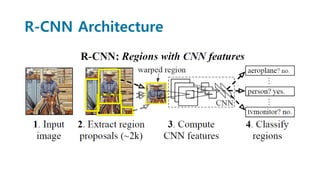
R-CNN Architecture
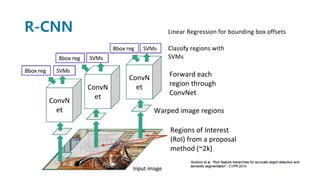
R-CNN
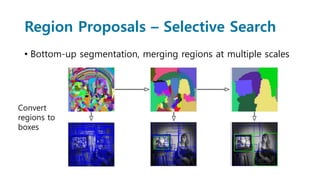
Region Proposals – Selective Search
• Bottom-up segmentation, merging regions at multiple scales
Convert
regions to
boxes
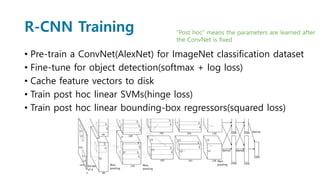
R-CNN Training
• Pre-train a ConvNet(AlexNet) for ImageNet classification dataset
• Fine-tune for object detection(softmax + log loss)
• Cache feature vectors to disk
• Train post hoc linear SVMs(hinge loss)
• Train post hoc linear bounding-box regressors(squared loss)
“Post hoc” means the parameters are learned after
the ConvNet is fixed
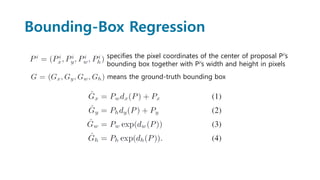
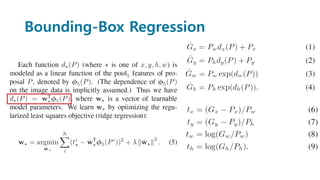
Bounding-Box Regression
specifies the pixel coordinates of the center of proposal Pi’s
bounding box together with Pi’s width and height in pixels
means the ground-truth bounding box
Bounding-Box Regression
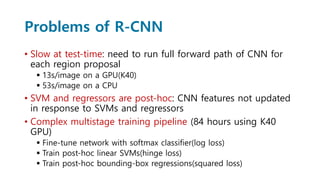
Problems of R-CNN
• Slow at test-time: need to run full forward path of CNN for
each region proposal
 13s/image on a GPU(K40)
 53s/image on a CPU
• SVM and regressors are post-hoc: CNN features not updated
in response to SVMs and regressors
• Complex multistage training pipeline (84 hours using K40
GPU)
 Fine-tune network with softmax classifier(log loss)
 Train post-hoc linear SVMs(hinge loss)
 Train post-hoc bounding-box regressions(squared loss)
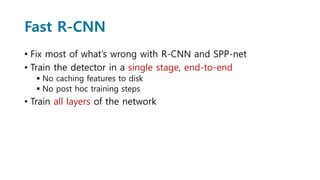
Fast R-CNN
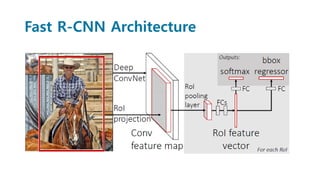
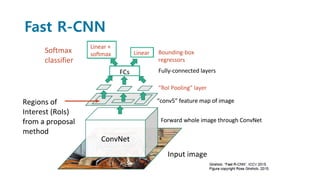
• Fix most of what’s wrong with R-CNN and SPP-net
• Train the detector in a single stage, end-to-end
 No caching features to disk
 No post hoc training steps
• Train all layers of the network
Fast R-CNN Architecture
Fast R-CNN
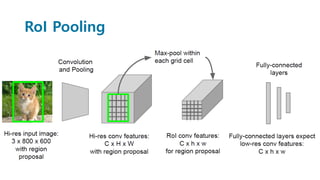
RoI Pooling
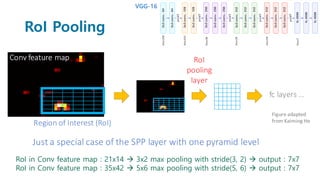
RoI Pooling
RoI in Conv feature map : 21x14  3x2 max pooling with stride(3, 2)  output : 7x7
RoI in Conv feature map : 35x42  5x6 max pooling with stride(5, 6)  output : 7x7
VGG-16
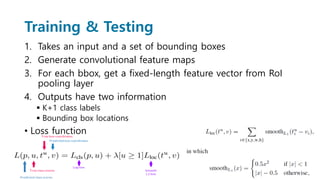
Training & Testing
1. Takes an input and a set of bounding boxes
2. Generate convolutional feature maps
3. For each bbox, get a fixed-length feature vector from RoI
pooling layer
4. Outputs have two information
 K+1 class labels
 Bounding box locations
• Loss function
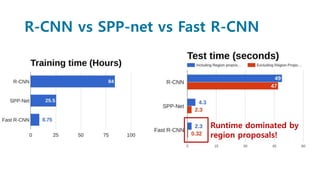
R-CNN vs SPP-net vs Fast R-CNN
Runtime dominated by
region proposals!
Problems of Fast R-CNN
• Out-of-network region proposals are the test-time
computational bottleneck
• Is it fast enough??
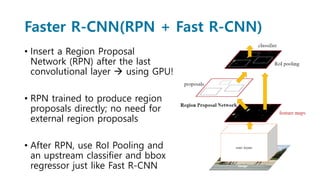
Faster R-CNN(RPN + Fast R-CNN)
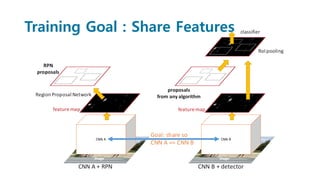
• Insert a Region Proposal
Network (RPN) after the last
convolutional layer  using GPU!
• RPN trained to produce region
proposals directly; no need for
external region proposals
• After RPN, use RoI Pooling and
an upstream classifier and bbox
regressor just like Fast R-CNN
Training Goal : Share Features
3 x 3
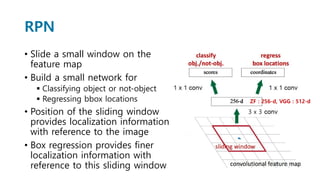
RPN
• Slide a small window on the
feature map
• Build a small network for
 Classifying object or not-object
 Regressing bbox locations
• Position of the sliding window
provides localization information
with reference to the image
• Box regression provides finer
localization information with
reference to this sliding window
ZF : 256-d, VGG : 512-d
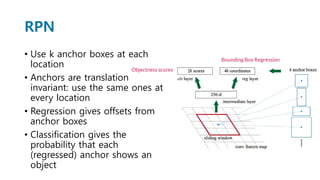
RPN
• Use k anchor boxes at each
location
• Anchors are translation
invariant: use the same ones at
every location
• Regression gives offsets from
anchor boxes
• Classification gives the
probability that each
(regressed) anchor shows an
object
3 x 3
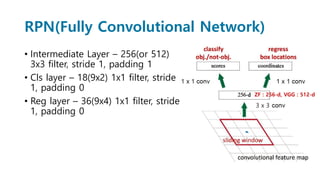
RPN(Fully Convolutional Network)
• Intermediate Layer – 256(or 512)
3x3 filter, stride 1, padding 1
• Cls layer – 18(9x2) 1x1 filter, stride
1, padding 0
• Reg layer – 36(9x4) 1x1 filter, stride
1, padding 0
ZF : 256-d, VGG : 512-d
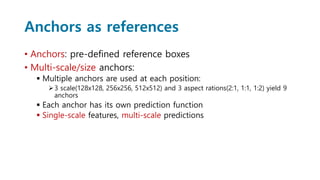
Anchors as references
• Anchors: pre-defined reference boxes
• Multi-scale/size anchors:
 Multiple anchors are used at each position:
3 scale(128x128, 256x256, 512x512) and 3 aspect rations(2:1, 1:1, 1:2) yield 9
anchors
 Each anchor has its own prediction function
 Single-scale features, multi-scale predictions
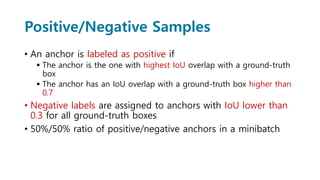
Positive/Negative Samples
• An anchor is labeled as positive if
 The anchor is the one with highest IoU overlap with a ground-truth
box
 The anchor has an IoU overlap with a ground-truth box higher than
0.7
• Negative labels are assigned to anchors with IoU lower than
0.3 for all ground-truth boxes
• 50%/50% ratio of positive/negative anchors in a minibatch
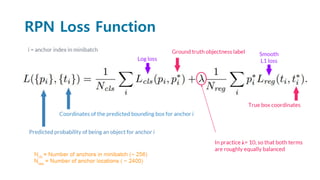
RPN Loss Function
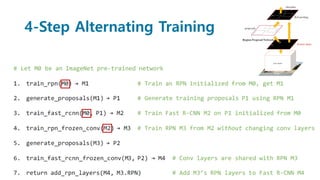
4-Step Alternating Training
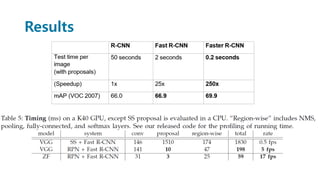
Results
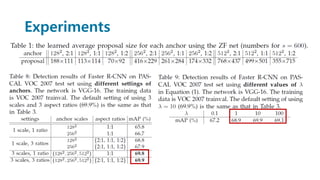
Experiments
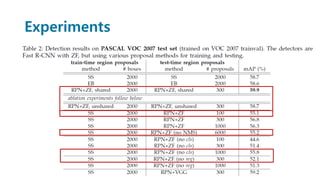
Experiments
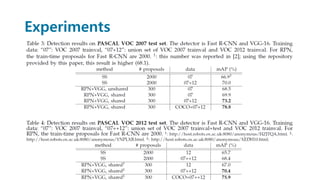
Experiments
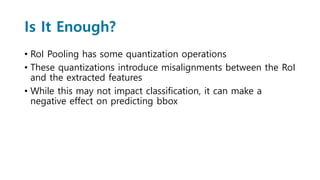
Is It Enough?
• RoI Pooling has some quantization operations
• These quantizations introduce misalignments between the RoI
and the extracted features
• While this may not impact classification, it can make a
negative effect on predicting bbox
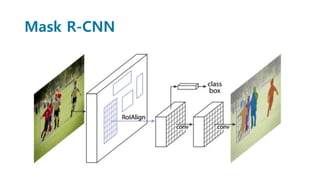
Mask R-CNN
Mask R-CNN
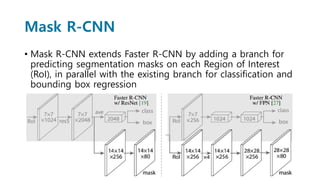
• Mask R-CNN extends Faster R-CNN by adding a branch for
predicting segmentation masks on each Region of Interest
(RoI), in parallel with the existing branch for classification and
bounding box regression
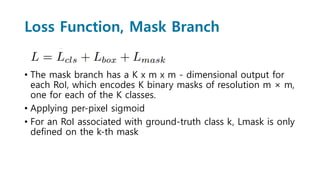
Loss Function, Mask Branch
• The mask branch has a K x m x m - dimensional output for
each RoI, which encodes K binary masks of resolution m × m,
one for each of the K classes.
• Applying per-pixel sigmoid
• For an RoI associated with ground-truth class k, Lmask is only
defined on the k-th mask
RoI Align
• RoI Align don’t use quantization of the RoI boundaries
• Bilinear interpolation is used for computing the exact values
of the input features
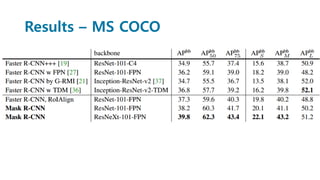
Results – MS COCO
Thank You
Thank You

Faster R-CNN - PR012

  • 1.
    Faster R-CNN Towards Real-TimeObject Detection with Region Proposal Networks
  • 2.
  • 3.
  • 4.
    History(?) of R-CNN •Rich feature hierarchies for accurate object detection and semantic segmentation(2013) • Fast R-CNN(2015) • Faster R-CNN: Towards Real-Time Object Detection with Region Proposal Networks(2015) • Mask R-CNN(2017)
  • 5.
    Is Faster R-CNNReally Fast? • Generally R-FCN and SSD models are faster on average while Faster R- CNN models are more accurate • Faster R-CNN models can be faster if we limit the number of regions proposed
  • 6.
  • 7.
  • 8.
    Region Proposals –Selective Search • Bottom-up segmentation, merging regions at multiple scales Convert regions to boxes
  • 9.
    R-CNN Training • Pre-traina ConvNet(AlexNet) for ImageNet classification dataset • Fine-tune for object detection(softmax + log loss) • Cache feature vectors to disk • Train post hoc linear SVMs(hinge loss) • Train post hoc linear bounding-box regressors(squared loss) “Post hoc” means the parameters are learned after the ConvNet is fixed
  • 10.
    Bounding-Box Regression specifies thepixel coordinates of the center of proposal Pi’s bounding box together with Pi’s width and height in pixels means the ground-truth bounding box
  • 11.
  • 12.
    Problems of R-CNN •Slow at test-time: need to run full forward path of CNN for each region proposal  13s/image on a GPU(K40)  53s/image on a CPU • SVM and regressors are post-hoc: CNN features not updated in response to SVMs and regressors • Complex multistage training pipeline (84 hours using K40 GPU)  Fine-tune network with softmax classifier(log loss)  Train post-hoc linear SVMs(hinge loss)  Train post-hoc bounding-box regressions(squared loss)
  • 13.
    Fast R-CNN • Fixmost of what’s wrong with R-CNN and SPP-net • Train the detector in a single stage, end-to-end  No caching features to disk  No post hoc training steps • Train all layers of the network
  • 14.
  • 15.
  • 16.
  • 17.
    RoI Pooling RoI inConv feature map : 21x14  3x2 max pooling with stride(3, 2)  output : 7x7 RoI in Conv feature map : 35x42  5x6 max pooling with stride(5, 6)  output : 7x7 VGG-16
  • 18.
    Training & Testing 1.Takes an input and a set of bounding boxes 2. Generate convolutional feature maps 3. For each bbox, get a fixed-length feature vector from RoI pooling layer 4. Outputs have two information  K+1 class labels  Bounding box locations • Loss function
  • 19.
    R-CNN vs SPP-netvs Fast R-CNN Runtime dominated by region proposals!
  • 20.
    Problems of FastR-CNN • Out-of-network region proposals are the test-time computational bottleneck • Is it fast enough??
  • 21.
    Faster R-CNN(RPN +Fast R-CNN) • Insert a Region Proposal Network (RPN) after the last convolutional layer  using GPU! • RPN trained to produce region proposals directly; no need for external region proposals • After RPN, use RoI Pooling and an upstream classifier and bbox regressor just like Fast R-CNN
  • 22.
    Training Goal :Share Features
  • 23.
    3 x 3 RPN •Slide a small window on the feature map • Build a small network for  Classifying object or not-object  Regressing bbox locations • Position of the sliding window provides localization information with reference to the image • Box regression provides finer localization information with reference to this sliding window ZF : 256-d, VGG : 512-d
  • 24.
    RPN • Use kanchor boxes at each location • Anchors are translation invariant: use the same ones at every location • Regression gives offsets from anchor boxes • Classification gives the probability that each (regressed) anchor shows an object
  • 25.
    3 x 3 RPN(FullyConvolutional Network) • Intermediate Layer – 256(or 512) 3x3 filter, stride 1, padding 1 • Cls layer – 18(9x2) 1x1 filter, stride 1, padding 0 • Reg layer – 36(9x4) 1x1 filter, stride 1, padding 0 ZF : 256-d, VGG : 512-d
  • 26.
    Anchors as references •Anchors: pre-defined reference boxes • Multi-scale/size anchors:  Multiple anchors are used at each position: 3 scale(128x128, 256x256, 512x512) and 3 aspect rations(2:1, 1:1, 1:2) yield 9 anchors  Each anchor has its own prediction function  Single-scale features, multi-scale predictions
  • 27.
    Positive/Negative Samples • Ananchor is labeled as positive if  The anchor is the one with highest IoU overlap with a ground-truth box  The anchor has an IoU overlap with a ground-truth box higher than 0.7 • Negative labels are assigned to anchors with IoU lower than 0.3 for all ground-truth boxes • 50%/50% ratio of positive/negative anchors in a minibatch
  • 28.
  • 29.
  • 30.
  • 31.
  • 32.
  • 33.
  • 34.
    Is It Enough? •RoI Pooling has some quantization operations • These quantizations introduce misalignments between the RoI and the extracted features • While this may not impact classification, it can make a negative effect on predicting bbox
  • 35.
  • 36.
    Mask R-CNN • MaskR-CNN extends Faster R-CNN by adding a branch for predicting segmentation masks on each Region of Interest (RoI), in parallel with the existing branch for classification and bounding box regression
  • 37.
    Loss Function, MaskBranch • The mask branch has a K x m x m - dimensional output for each RoI, which encodes K binary masks of resolution m × m, one for each of the K classes. • Applying per-pixel sigmoid • For an RoI associated with ground-truth class k, Lmask is only defined on the k-th mask
  • 38.
    RoI Align • RoIAlign don’t use quantization of the RoI boundaries • Bilinear interpolation is used for computing the exact values of the input features
  • 39.
  • 40.
  • 41.