Present by
Melaku Eneayehu
Heena
Girillage
05/21/171
Reinforcement Learning
Q-Learning
Outline
05/21/172
 Introduction
 Reinforcement Leaning
 RL model /MDP Model
 Learning Task
 Q-Learning Basic
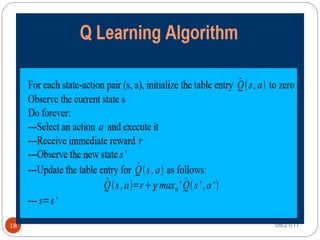
 Q-Learning Algorithm
 Key word
 Reference
Introduction
05/21/173
In some applications, the output of the system is a
sequence of actions. In such a case, a single action is
not important
game playing where a single move by itself is not that
important.
Reinforcement learning
05/21/174
in the case of the agent acts on its
environment, it receives some evaluation
of its action (reinforcement),
but is not told of which action is the
correct one to achieve its goal
Reinforcement learning
05/21/175
Task
 Learn how to behave successfully to achieve a goal
while interacting with an external environment
Learn via experiences!
Examples
Game playing: player knows whether it win or lose, but
not know how to move at each step
Control: a traffic system can measure the delay of cars,
but not know how to decrease it.
05/21/176
At the heart of RL is the following analogy:
 consider teaching a dog a new trick: cannot tell it what
to do, but you can reward/punish
Here we train a computer as if we train a dog
05/21/177
 If the dog obeys and acts according to our instructions
we encourage it by giving biscuits or we punish it by
beating or by scolding.
Similarly, if the system works well then the teacher
gives positive value (i.e. reward) or the teacher gives
negative value (i.e. punishment).
05/21/178
The learning system which gets the punishment has to
improve itself.
The reinforcement learning algorithms selectively
retain the outputs that maximize the received reward
over time.
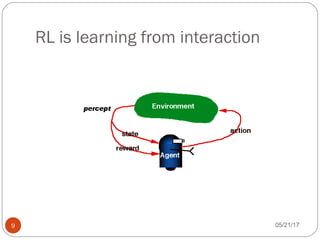
RL is learning from interaction
05/21/179
RL model
05/21/1710
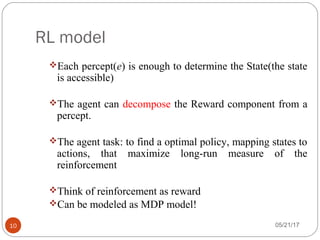
Each percept(e) is enough to determine the State(the state
is accessible)
The agent can decompose the Reward component from a
percept.
The agent task: to find a optimal policy, mapping states to
actions, that maximize long-run measure of the
reinforcement
Think of reinforcement as reward
Can be modeled as MDP model!
Review of MDP model
05/21/1711
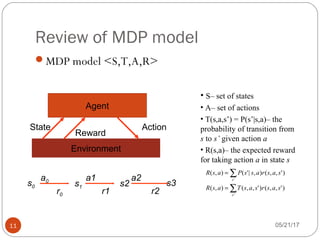
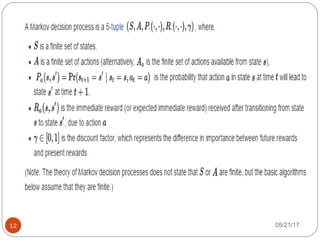
MDP model <S,T,A,R>
Agent
Environment
State
Reward
Action
s0
r0
a0
s1
a1
r1
s2
a2
r2
s3
• S– set of states
• A– set of actions
• T(s,a,s’) = P(s’|s,a)– the
probability of transition from
s to s’ given action a
• R(s,a)– the expected reward
for taking action a in state s
∑
∑
=
=
'
'
)',,()',,(),(
)',,(),|'(),(
s
s
sasrsasTasR
sasrassPasR
05/21/1712
05/21/1713
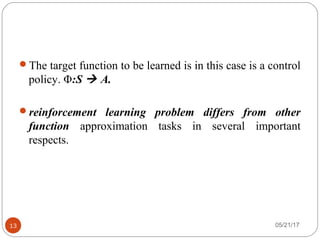
The target function to be learned is in this case is a control
policy. Φ:S  A.
reinforcement learning problem differs from other
function approximation tasks in several important
respects.
05/21/1714
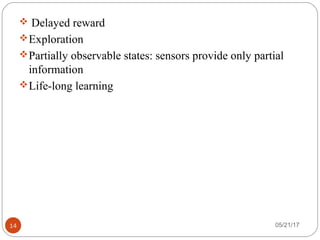
 Delayed reward
Exploration
Partially observable states: sensors provide only partial
information
Life-long learning
THE LEARNING TASK
05/21/1715
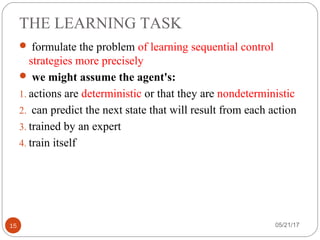
 formulate the problem of learning sequential control
strategies more precisely
 we might assume the agent's:
1. actions are deterministic or that they are nondeterministic
2. can predict the next state that will result from each action
3. trained by an expert
4. train itself
05/21/1716
05/21/1717
05/21/1718
05/21/1719
05/21/1720
05/21/1721
05/21/1722
05/21/1723
05/21/1724
05/21/1725
05/21/1726
05/21/1727
05/21/1728
05/21/1729
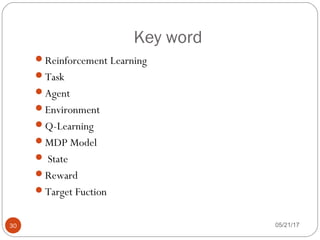
Key word
05/21/1730
Reinforcement Learning
Task
Agent
Environment
Q-Learning
MDP Model
 State
Reward
Target Fuction
References
05/21/1731
Our Text Book (Tom M.Techeel)
https://www.quora.com/
https://en.wikipedia.org/wiki/Markov_decision_process
https://www-s.acm.illinois.edu/sigart/docs/QLearning.pdf
http://www.cse.unsw.edu.au/~cs9417ml/RL1/algorithms.htm
l
http://cse-wiki.unl.edu/wiki/index.php/Q_learning
http://mnemstudio.org/path-finding-q-learning-tutorial.htm
http://artint.info/html/ArtInt_265.html
https://en.wikipedia.org/wiki/Q-learning
http://people.revoledu.com/kardi/tutorial/ReinforcementLear
ning/
10Q
05/21/1732

Reinforcement Learning Q-Learning