

Improving Region based CNN object detector
using Bayesian Optimization
AMGAD MUHAMMAD
Agenda
• Background
• Problem definition
• Proposed solution
• Baseline with an example
Background
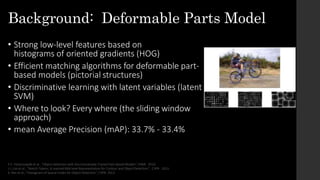
Background: Deformable Parts Model
• Strong low-level features based on
histograms of oriented gradients (HOG)
• Efficient matching algorithms for deformable part-
based models (pictorial structures)
• Discriminative learning with latent variables (latent
SVM)
• Where to look? Every where (the sliding window
approach)
• mean Average Precision (mAP): 33.7% - 33.4%
P.F. Felzenszwalb et al., “Object Detection with Discriminatively Trained Part-Based Models”, PAMI 2010.
J.J. Lim et al., “Sketch Tokens: A Learned Mid-level Representation for Contour and Object Detection”, CVPR 2013.
X. Ren et al., “Histograms of Sparse Codes for Object Detection”, CVPR 2013.
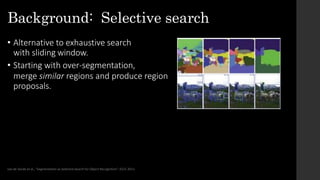
Background: Selective search
• Alternative to exhaustive search
with sliding window.
• Starting with over-segmentation,
merge similar regions and produce region
proposals.
van de Sande et al., “Segmentation as Selective Search for Object Recognition”, ICCV 2011.
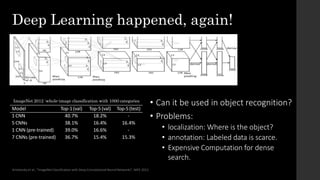
Deep Learning happened, again!
Krizhevsky et al., “ImageNet Classification with Deep Convolutional Neural Networks”, NIPS 2012.
ImageNet 2012 :whole-image classification with 1000 categories
Model Top-1(val) Top-5(val) Top-5(test)
1 CNN 40.7% 18.2% -
5 CNNs 38.1% 16.4% 16.4%
1 CNN (pre-trained) 39.0% 16.6% -
7 CNNs (pre-trained) 36.7% 15.4% 15.3%
• Can it be used in object recognition?
• Problems:
• localization: Where is the object?
• annotation: Labeled data is scarce.
• Expensive Computation for dense
search.
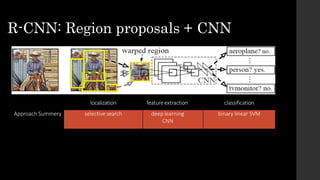
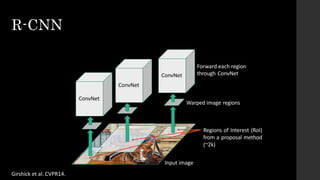
R-CNN: Region proposals + CNN
localization featureextraction classification
Approach Summery selective search deep learning
CNN
binary linear SVM
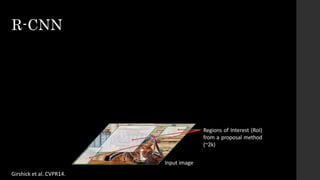
R-CNN
Input image
Girshick et al. CVPR14.
Regions of Interest (RoI)
from a proposal method
(~2k)
Input image
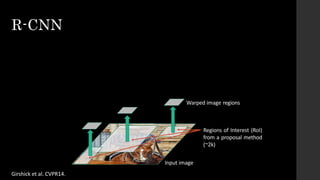
R-CNN
Girshick et al. CVPR14.
Warped image regions
Regions of Interest (RoI)
from a proposal method
(~2k)
Input image
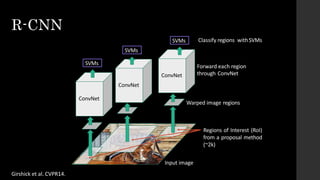
R-CNN
Girshick et al. CVPR14.
ConvNet
ConvNet
ConvNet
Warped image regions
Forward each region
through ConvNet
Regions of Interest (RoI)
from a proposal method
(~2k)
Input image
R-CNN
Girshick et al. CVPR14.
ConvNet
ConvNet
ConvNet
SVMs
SVMs
SVMs
Warped image regions
Forward each region
through ConvNet
Classify regions withSVMs
Regions of Interest (RoI)
from a proposal method
(~2k)
Input image
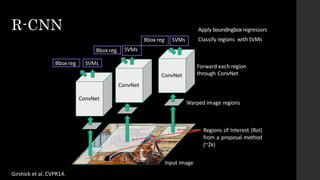
R-CNN
Girshick et al. CVPR14.
ConvNet
ConvNet
ConvNet
SVMs
Warped image regions
Forward each region
through ConvNet
Bbox reg
Bbox reg
Bbox reg SVMs
SVMs
Apply boundingboxregressors
Classify regions withSVMs
Regions of Interest (RoI)
from a proposal method
(~2k)
Input image
R-CNN
Girshick et al. CVPR14.
What’s wrong with R-CNN?
• Ad hoc training objectives
• Fine-tune network with softmax classifier (log loss)
• Train post-hoc linear SVMs (hingeloss)
• Train post-hoc bounding-box regressors (squaredloss)
What’s wrong with R-CNN?
• Ad hoc training objectives
• FineHtunenetwork with softmax classifier (log loss)
• Train postHhoclinear SVMs (hingeloss)
• Train postHhocboundingHbox regressors (squaredloss)
• Training is slow (84h), takes a lot of disk space
What’s wrong with R-CNN?
• Ad hoc training objectives
• FineHtune network with softmax classifier (log loss)
• Train postHhoclinear SVMs (hingeloss)
• Train postHhocboundingHboxregressions (least squares)
• Training is slow (84h), takes a lot of disk space
• Inference (detection) is slow
• 47s / image with VGG16 [Simonyan & Zisserman. ICLR15]
• Fixed by SPP-net[He et al. ECCV14]
~2000 ConvNet forward passes per image
What’s wrong with R-CNN?
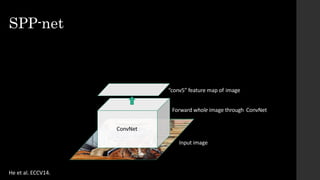
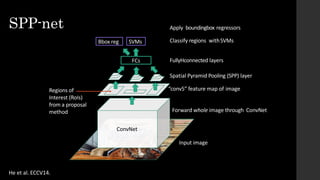
SPP-net
Input image
He et al. ECCV14.
ConvNet
Input image
“conv5” feature map of image
Forward whole image through ConvNet
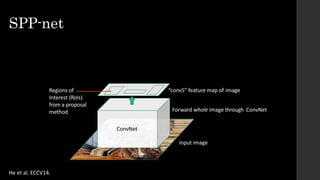
SPP-net
He et al. ECCV14.
ConvNet
Input image
Forward whole image through ConvNet
“conv5” feature map of imageRegions of
Interest (RoIs)
from a proposal
method
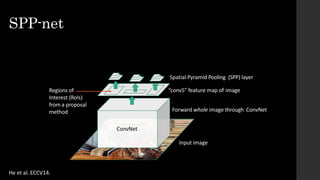
SPP-net
He et al. ECCV14.
ConvNet
Input image
Forward whole image through ConvNet
“conv5” feature map of imageRegions of
Interest (RoIs)
from a proposal
method
Spatial Pyramid Pooling (SPP) layer
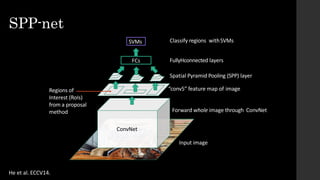
SPP-net
He et al. ECCV14.
Input image
Regions of
Interest (RoIs)
from a proposal
method
ConvNet
SVMs Classify regions withSVMs
FullyHconnected layers
Spatial Pyramid Pooling (SPP) layer
“conv5” feature map of image
Forward whole image through ConvNet
FCs
SPP-net
He et al. ECCV14.
Input image
Regions of
Interest (RoIs)
from a proposal
method
ConvNet
SVMs Classify regions withSVMs
FullyHconnected layers
Spatial Pyramid Pooling (SPP) layer
“conv5” feature map of image
Forward whole image through ConvNet
FCs
Bbox reg
Apply boundingbox regressorsSPP-net
He et al. ECCV14.
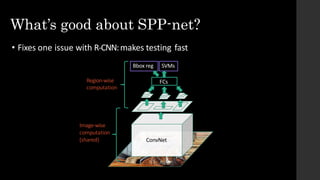
What’s good about SPP-net?
• Fixes one issue with R-CNN:makes testing fast
ConvNet
SVMs
FCs
Bbox reg
Region-wise
computation
Image-wise
computation
(shared)
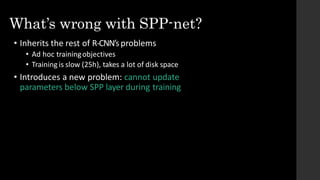
What’s wrong with SPP-net?
• Inherits the rest of R-CNN’sproblems
• Ad hoc trainingobjectives
• Training is slow (25h), takes a lot of disk space
• Introduces a new problem: cannot update
parameters below SPP layer during training
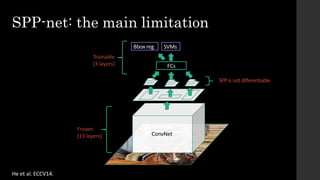
SPP-net: the main limitation
ConvNet
He et al. ECCV14.
SVMs
Trainable
(3 layers)
Frozen
(13 layers)
FCs
Bbox reg
SPPisnotdifferentiable
Fast R-CNN
• Fast test-time,like SPP-net
Fast R-CNN
• Fast test-time,like SPP-net
• One network, trained in one stage
Fast R-CNN
• Fast test-time,like SPP-net
• One network, trained in one stage
• Higher mean average precision than R-CNN and SPP-net
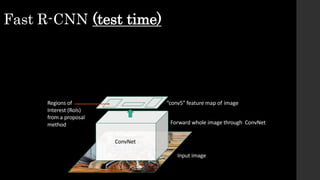
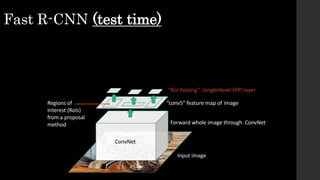
Fast R-CNN (test time)
ConvNet
Forward whole image through ConvNet
“conv5” feature map of imageRegions of
Interest (RoIs)
from a proposal
method
Input image
ConvNet
Forward whole image through ConvNet
“conv5” feature map of image
“RoI Pooling” (singleHlevel SPP) layer
Input image
Regions of
Interest (RoIs)
from a proposal
method
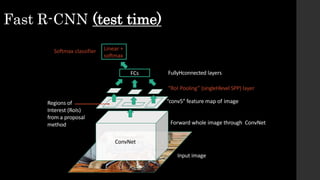
Fast R-CNN (test time)
Linear +
softmax
FCs FullyHconnected layers
“RoI Pooling” (singleHlevel SPP) layer
“conv5” feature map of image
Forward whole image through ConvNet
Input image
Softmax classifier
Regions of
Interest (RoIs)
from a proposal
method
ConvNet
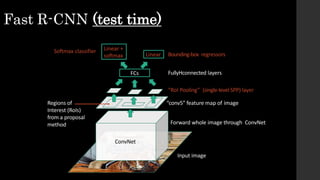
Fast R-CNN (test time)
ConvNet
Forward whole image through ConvNet
“conv5” feature map of image
“RoI Pooling” (single-level SPP) layer
Linear +
softmax
FCs FullyHconnected layers
Softmax classifier
Regions of
Interest (RoIs)
from a proposal
method
Linear
Input image
Bounding-box regressors
Fast R-CNN (test time)
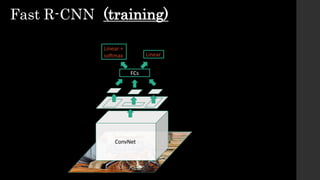
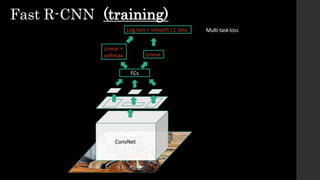
Fast R-CNN (training)
Linear +
softmax
FCs
Linear
ConvNet
Log loss + smooth L1 loss
Linear +
softmax
FCs
Linear
ConvNet
Multi-taskloss
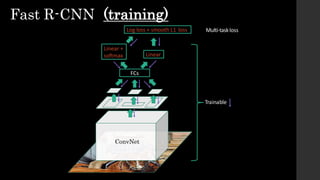
Fast R-CNN (training)
Log loss + smooth L1 loss
Linear +
softmax
FCs
Linear
Trainable
Multi-taskloss
ConvNet
Fast R-CNN (training)
What is missing from the previous
architectures?
• All the previous architectures relies on an external region
proposal algorithm.
• Proposed regions are independent from the network loss.
• No control over the regions quality.
• Fast test-time,like FastR-CNN
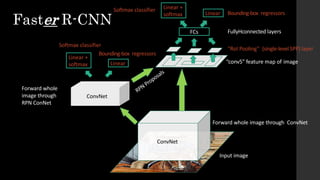
Faster R-CNN
Faster R-CNN
• Fast test-time,like FastR-CNN
• One network, trained in one stage
• Fast test-time,like FastR-CNN
• One network, trained in one stage
• Higher mean average precision than R-CNN,SPP-net,
Fast-RCNN
Faster R-CNN
• Fast test-time,like FastR-CNN
• One network, trained in one stage
• Higher mean average precision than R-CNN , SPP-
net, Fast-RCNN
• HaveadedicatedRegionProposalNetwork(RPN)trainedto
optimizethenetworkloss.
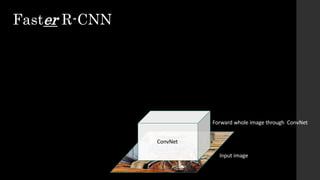
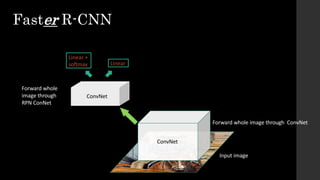
Faster R-CNN
ConvNet
Forward whole image through ConvNet
Input image
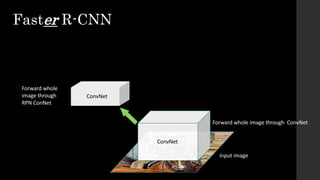
Faster R-CNN
ConvNet
Forward whole image through ConvNet
Input image
Forward whole
image through
RPN ConNet
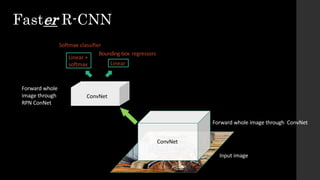
Faster R-CNN
ConvNet
ConvNet
Forward whole image through ConvNet
Input image
Linear +
softmax Linear
Faster R-CNN
Forward whole
image through
RPN ConNet
ConvNet
ConvNet
Forward whole image through ConvNet
Input image
Linear +
softmax
Softmax classifier
Linear
Bounding-box regressors
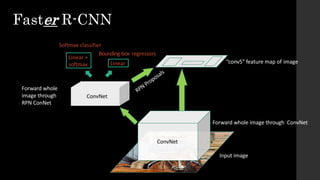
Faster R-CNN
Forward whole
image through
RPN ConNet
ConvNet
ConvNet
Forward whole image through ConvNet
Input image
“conv5” feature map of image
Linear +
softmax
Softmax classifier
Linear
Bounding-box regressors
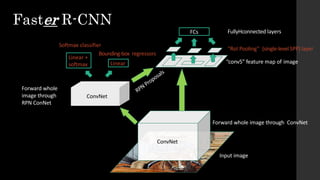
Faster R-CNN
Forward whole
image through
RPN ConNet
ConvNet
ConvNet
Forward whole image through ConvNet
Input image
“conv5” feature map of image
“RoI Pooling” (single-level SPP) layer
FCs FullyHconnected layers
Linear +
softmax
Softmax classifier
Linear
Bounding-box regressors
Faster R-CNN
Forward whole
image through
RPN ConNet
ConvNet
ConvNet
Forward whole image through ConvNet
Input image
“conv5” feature map of image
“RoI Pooling” (single-level SPP) layer
Linear +
softmax
FCs FullyHconnected layers
Softmax classifier
Linear Bounding-box regressors
Linear +
softmax
Softmax classifier
Linear
Bounding-box regressors
Faster R-CNN
Forward whole
image through
RPN ConNet
ConvNet
ConvNet
Linear +
softmax
FCs
Linear
Linear +
softmax Linear
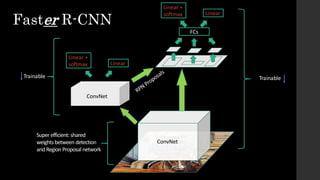
Faster R-CNN
Trainable
ConvNet
Super efficient: shared
weightsbetween detection
andRegion Proposal network
Trainable
Problem definition
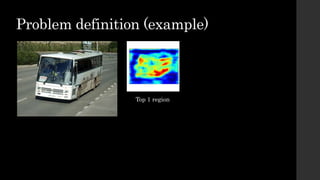
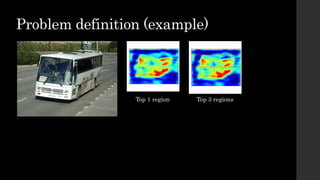
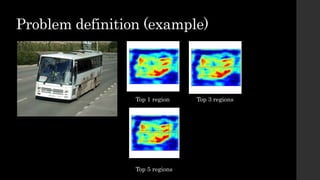
Problem definition
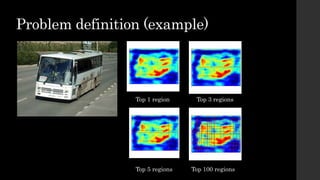
• All region based CNN object detector are dependent on the quality of
the region proposal algorithm.
• Although in the Faster R-CNN, the region proposal network was trained
to minimize a multi-task loss function (log-loss and bounding-box
regression), still ,in my experiments, the best proposed regions are ill-
localized.
Problem definition (example)
Top 1 region
Problem definition (example)
Top 1 region Top 3 regions
Problem definition (example)
Top 1 region Top 3 regions
Top 5 regions
Problem definition (example)
Top 1 region Top 3 regions
Top 5 regions Top 100 regions
Proposed Solution
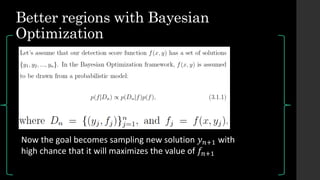
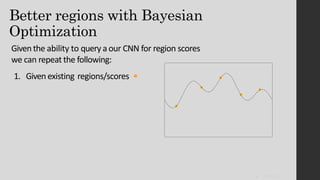
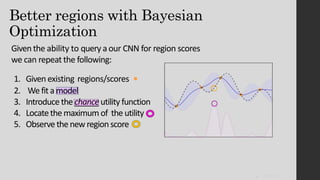
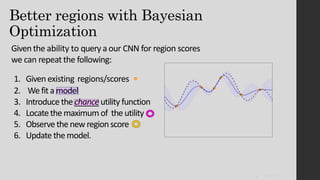
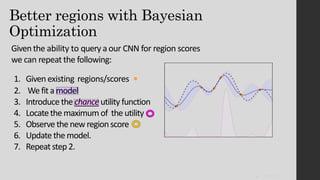
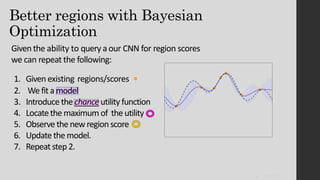
Better regions with Bayesian
Optimization
Now the goal becomes sampling new solution 𝑦 𝑛+1 with
high chance that it will maximizes the value of 𝑓𝑛+1
Better regions with Bayesian
Optimization
Given the ability to query a our CNN for region scores
we can repeat the following:
1. Given existing regions/scores •
Better regions with Bayesian
Optimization
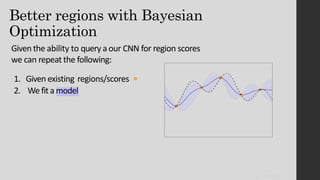
Given the ability to query a our CNN for region scores
we can repeat the following:
1. Given existing regions/scores •
2. Wefit a model
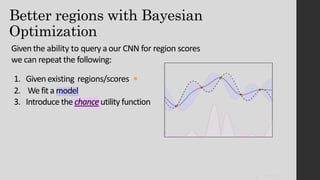
Given the ability to query a our CNN for region scores
we can repeat the following:
Better regions with Bayesian
Optimization
1. Given existing regions/scores •
2. Wefit a model
3. Introduce the chanceutility function
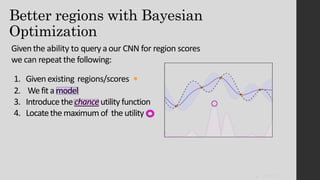
Given the ability to query a our CNN for region scores
we can repeat the following:
Better regions with Bayesian
Optimization
1. Given existing regions/scores •
2. Wefit a model
3. Introduce the chanceutility function
4. Locatethe maximum of the utility
Given the ability to query a our CNN for region scores
we can repeat the following:
Better regions with Bayesian
Optimization
1. Given existing regions/scores •
2. Wefit a model
3. Introduce the chanceutility function
4. Locatethe maximum of the utility
5. Observe the new regionscore
Given the ability to query a our CNN for region scores
we can repeat the following:
Better regions with Bayesian
Optimization
1. Given existing regions/scores •
2. Wefit a model
3. Introduce the chanceutility function
4. Locatethe maximum of the utility
5. Observe the new regionscore
6. Update the model.
Given the ability to query a our CNN for region scores
we can repeat the following:
Better regions with Bayesian
Optimization
1. Given existing regions/scores •
2. Wefit a model
3. Introduce the chanceutility function
4. Locatethe maximum of the utility
5. Observe the new regionscore
6. Update the model.
7. Repeatstep 2.
Given the ability to query a our CNN for region scores
we can repeat the following:
Better regions with Bayesian
Optimization
1. Given existing regions/scores •
2. Wefit a model
3. Introduce the chanceutility function
4. Locatethe maximum of the utility
5. Observe the new regionscore
6. Update the model.
7. Repeatstep 2.
Given the ability to query a our CNN for region scores
we can repeat the following:
Better regions with Bayesian
Optimization
Example of BO applied
to R-CNN
Yuting Zhang, Kihyuk Sohn, Ruben Villegas, Gang Pan, and Honglak Lee.
Originalimage
Yuting Zhang, Kihyuk Sohn, Ruben Villegas, Gang Pan, and Honglak Lee.
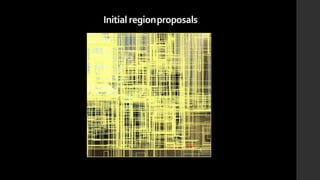
Initial regionproposals
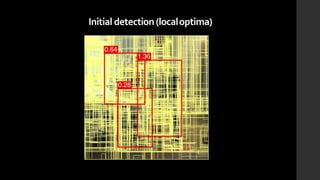
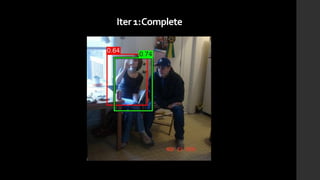
Initial detection(localoptima)
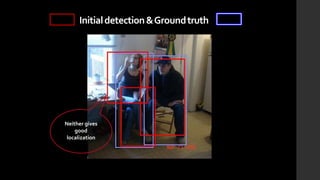
Initialdetection&Groundtruth
Neither gives
good
localization
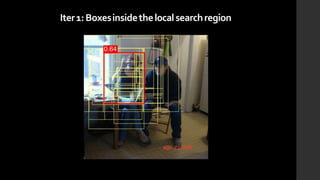
Iter1:Boxesinsidethelocalsearchregion
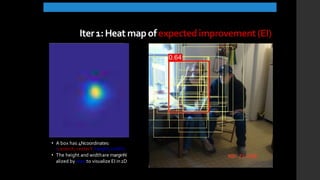
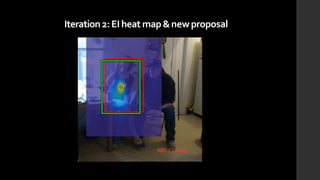
Iter1:Heat mapofexpectedimprovement(EI)
• A box has 4Ncoordinates:
(centerX, centerY, height,width)
• The height and widthare marginN
alized by max to visualize EI in2D
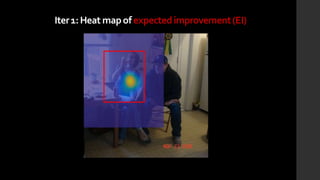
Iter1:Heat mapofexpectedimprovement(EI)
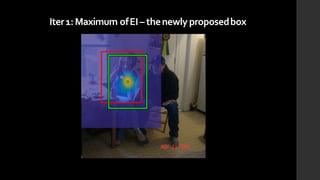
Iter1:Maximum ofEI–thenewlyproposedbox
Iter 1:Complete
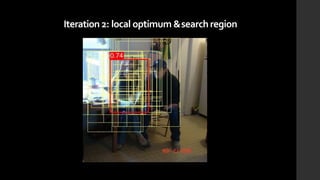
Iteration 2: local optimum &searchregion
Iteration2:EIheat map&newproposal
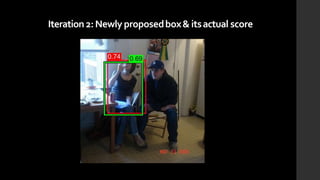
Iteration2:Newlyproposedbox& itsactual score
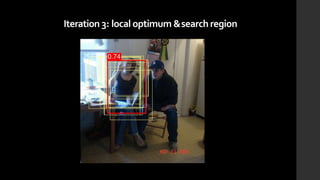
Iteration 3: local optimum &searchregion
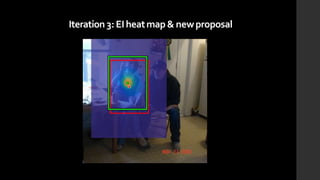
Iteration3:EIheatmap & newproposal
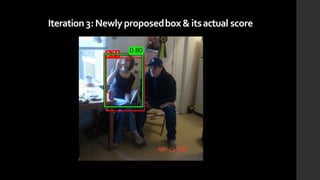
Iteration3:Newlyproposedbox& itsactual score
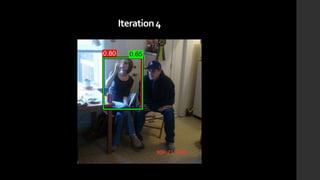
Iteration4
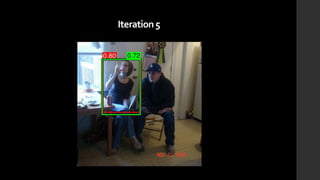
Iteration5
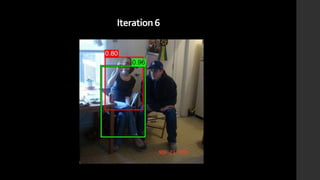
Iteration6
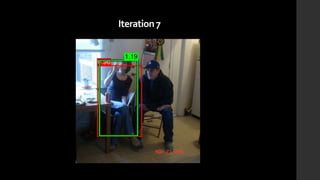
Iteration7
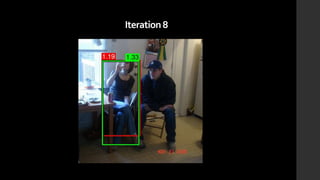
Iteration8
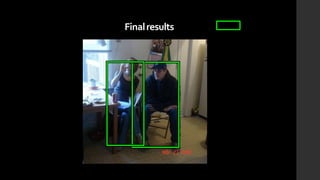
Finalresults
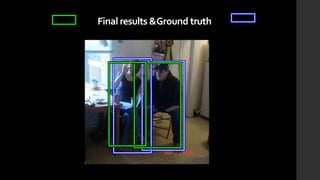
Final results &Ground truth
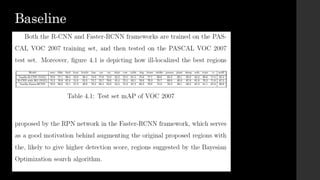
Baseline
Questions

Improving region based CNN object detector using bayesian optimization

  • 1.
    Improving Region basedCNN object detector using Bayesian Optimization AMGAD MUHAMMAD
  • 2.
    Agenda • Background • Problemdefinition • Proposed solution • Baseline with an example
  • 3.
  • 4.
    Background: Deformable PartsModel • Strong low-level features based on histograms of oriented gradients (HOG) • Efficient matching algorithms for deformable part- based models (pictorial structures) • Discriminative learning with latent variables (latent SVM) • Where to look? Every where (the sliding window approach) • mean Average Precision (mAP): 33.7% - 33.4% P.F. Felzenszwalb et al., “Object Detection with Discriminatively Trained Part-Based Models”, PAMI 2010. J.J. Lim et al., “Sketch Tokens: A Learned Mid-level Representation for Contour and Object Detection”, CVPR 2013. X. Ren et al., “Histograms of Sparse Codes for Object Detection”, CVPR 2013.
  • 5.
    Background: Selective search •Alternative to exhaustive search with sliding window. • Starting with over-segmentation, merge similar regions and produce region proposals. van de Sande et al., “Segmentation as Selective Search for Object Recognition”, ICCV 2011.
  • 6.
    Deep Learning happened,again! Krizhevsky et al., “ImageNet Classification with Deep Convolutional Neural Networks”, NIPS 2012. ImageNet 2012 :whole-image classification with 1000 categories Model Top-1(val) Top-5(val) Top-5(test) 1 CNN 40.7% 18.2% - 5 CNNs 38.1% 16.4% 16.4% 1 CNN (pre-trained) 39.0% 16.6% - 7 CNNs (pre-trained) 36.7% 15.4% 15.3% • Can it be used in object recognition? • Problems: • localization: Where is the object? • annotation: Labeled data is scarce. • Expensive Computation for dense search.
  • 7.
    R-CNN: Region proposals+ CNN localization featureextraction classification Approach Summery selective search deep learning CNN binary linear SVM
  • 8.
  • 9.
    Regions of Interest(RoI) from a proposal method (~2k) Input image R-CNN Girshick et al. CVPR14.
  • 10.
    Warped image regions Regionsof Interest (RoI) from a proposal method (~2k) Input image R-CNN Girshick et al. CVPR14.
  • 11.
    ConvNet ConvNet ConvNet Warped image regions Forwardeach region through ConvNet Regions of Interest (RoI) from a proposal method (~2k) Input image R-CNN Girshick et al. CVPR14.
  • 12.
    ConvNet ConvNet ConvNet SVMs SVMs SVMs Warped image regions Forwardeach region through ConvNet Classify regions withSVMs Regions of Interest (RoI) from a proposal method (~2k) Input image R-CNN Girshick et al. CVPR14.
  • 13.
    ConvNet ConvNet ConvNet SVMs Warped image regions Forwardeach region through ConvNet Bbox reg Bbox reg Bbox reg SVMs SVMs Apply boundingboxregressors Classify regions withSVMs Regions of Interest (RoI) from a proposal method (~2k) Input image R-CNN Girshick et al. CVPR14.
  • 14.
  • 15.
    • Ad hoctraining objectives • Fine-tune network with softmax classifier (log loss) • Train post-hoc linear SVMs (hingeloss) • Train post-hoc bounding-box regressors (squaredloss) What’s wrong with R-CNN?
  • 16.
    • Ad hoctraining objectives • FineHtunenetwork with softmax classifier (log loss) • Train postHhoclinear SVMs (hingeloss) • Train postHhocboundingHbox regressors (squaredloss) • Training is slow (84h), takes a lot of disk space What’s wrong with R-CNN?
  • 17.
    • Ad hoctraining objectives • FineHtune network with softmax classifier (log loss) • Train postHhoclinear SVMs (hingeloss) • Train postHhocboundingHboxregressions (least squares) • Training is slow (84h), takes a lot of disk space • Inference (detection) is slow • 47s / image with VGG16 [Simonyan & Zisserman. ICLR15] • Fixed by SPP-net[He et al. ECCV14] ~2000 ConvNet forward passes per image What’s wrong with R-CNN?
  • 18.
  • 19.
    ConvNet Input image “conv5” featuremap of image Forward whole image through ConvNet SPP-net He et al. ECCV14.
  • 20.
    ConvNet Input image Forward wholeimage through ConvNet “conv5” feature map of imageRegions of Interest (RoIs) from a proposal method SPP-net He et al. ECCV14.
  • 21.
    ConvNet Input image Forward wholeimage through ConvNet “conv5” feature map of imageRegions of Interest (RoIs) from a proposal method Spatial Pyramid Pooling (SPP) layer SPP-net He et al. ECCV14.
  • 22.
    Input image Regions of Interest(RoIs) from a proposal method ConvNet SVMs Classify regions withSVMs FullyHconnected layers Spatial Pyramid Pooling (SPP) layer “conv5” feature map of image Forward whole image through ConvNet FCs SPP-net He et al. ECCV14.
  • 23.
    Input image Regions of Interest(RoIs) from a proposal method ConvNet SVMs Classify regions withSVMs FullyHconnected layers Spatial Pyramid Pooling (SPP) layer “conv5” feature map of image Forward whole image through ConvNet FCs Bbox reg Apply boundingbox regressorsSPP-net He et al. ECCV14.
  • 24.
    What’s good aboutSPP-net? • Fixes one issue with R-CNN:makes testing fast ConvNet SVMs FCs Bbox reg Region-wise computation Image-wise computation (shared)
  • 25.
    What’s wrong withSPP-net? • Inherits the rest of R-CNN’sproblems • Ad hoc trainingobjectives • Training is slow (25h), takes a lot of disk space • Introduces a new problem: cannot update parameters below SPP layer during training
  • 26.
    SPP-net: the mainlimitation ConvNet He et al. ECCV14. SVMs Trainable (3 layers) Frozen (13 layers) FCs Bbox reg SPPisnotdifferentiable
  • 27.
    Fast R-CNN • Fasttest-time,like SPP-net
  • 28.
    Fast R-CNN • Fasttest-time,like SPP-net • One network, trained in one stage
  • 29.
    Fast R-CNN • Fasttest-time,like SPP-net • One network, trained in one stage • Higher mean average precision than R-CNN and SPP-net
  • 30.
    Fast R-CNN (testtime) ConvNet Forward whole image through ConvNet “conv5” feature map of imageRegions of Interest (RoIs) from a proposal method Input image
  • 31.
    ConvNet Forward whole imagethrough ConvNet “conv5” feature map of image “RoI Pooling” (singleHlevel SPP) layer Input image Regions of Interest (RoIs) from a proposal method Fast R-CNN (test time)
  • 32.
    Linear + softmax FCs FullyHconnectedlayers “RoI Pooling” (singleHlevel SPP) layer “conv5” feature map of image Forward whole image through ConvNet Input image Softmax classifier Regions of Interest (RoIs) from a proposal method ConvNet Fast R-CNN (test time)
  • 33.
    ConvNet Forward whole imagethrough ConvNet “conv5” feature map of image “RoI Pooling” (single-level SPP) layer Linear + softmax FCs FullyHconnected layers Softmax classifier Regions of Interest (RoIs) from a proposal method Linear Input image Bounding-box regressors Fast R-CNN (test time)
  • 34.
    Fast R-CNN (training) Linear+ softmax FCs Linear ConvNet
  • 35.
    Log loss +smooth L1 loss Linear + softmax FCs Linear ConvNet Multi-taskloss Fast R-CNN (training)
  • 36.
    Log loss +smooth L1 loss Linear + softmax FCs Linear Trainable Multi-taskloss ConvNet Fast R-CNN (training)
  • 37.
    What is missingfrom the previous architectures? • All the previous architectures relies on an external region proposal algorithm. • Proposed regions are independent from the network loss. • No control over the regions quality.
  • 38.
    • Fast test-time,likeFastR-CNN Faster R-CNN
  • 39.
    Faster R-CNN • Fasttest-time,like FastR-CNN • One network, trained in one stage
  • 40.
    • Fast test-time,likeFastR-CNN • One network, trained in one stage • Higher mean average precision than R-CNN,SPP-net, Fast-RCNN Faster R-CNN
  • 41.
    • Fast test-time,likeFastR-CNN • One network, trained in one stage • Higher mean average precision than R-CNN , SPP- net, Fast-RCNN • HaveadedicatedRegionProposalNetwork(RPN)trainedto optimizethenetworkloss. Faster R-CNN
  • 42.
    ConvNet Forward whole imagethrough ConvNet Input image Faster R-CNN
  • 43.
    ConvNet Forward whole imagethrough ConvNet Input image Forward whole image through RPN ConNet Faster R-CNN ConvNet
  • 44.
    ConvNet Forward whole imagethrough ConvNet Input image Linear + softmax Linear Faster R-CNN Forward whole image through RPN ConNet ConvNet
  • 45.
    ConvNet Forward whole imagethrough ConvNet Input image Linear + softmax Softmax classifier Linear Bounding-box regressors Faster R-CNN Forward whole image through RPN ConNet ConvNet
  • 46.
    ConvNet Forward whole imagethrough ConvNet Input image “conv5” feature map of image Linear + softmax Softmax classifier Linear Bounding-box regressors Faster R-CNN Forward whole image through RPN ConNet ConvNet
  • 47.
    ConvNet Forward whole imagethrough ConvNet Input image “conv5” feature map of image “RoI Pooling” (single-level SPP) layer FCs FullyHconnected layers Linear + softmax Softmax classifier Linear Bounding-box regressors Faster R-CNN Forward whole image through RPN ConNet ConvNet
  • 48.
    ConvNet Forward whole imagethrough ConvNet Input image “conv5” feature map of image “RoI Pooling” (single-level SPP) layer Linear + softmax FCs FullyHconnected layers Softmax classifier Linear Bounding-box regressors Linear + softmax Softmax classifier Linear Bounding-box regressors Faster R-CNN Forward whole image through RPN ConNet ConvNet
  • 49.
    ConvNet Linear + softmax FCs Linear Linear + softmaxLinear Faster R-CNN Trainable ConvNet Super efficient: shared weightsbetween detection andRegion Proposal network Trainable
  • 50.
  • 51.
    Problem definition • Allregion based CNN object detector are dependent on the quality of the region proposal algorithm. • Although in the Faster R-CNN, the region proposal network was trained to minimize a multi-task loss function (log-loss and bounding-box regression), still ,in my experiments, the best proposed regions are ill- localized.
  • 52.
  • 53.
    Problem definition (example) Top1 region Top 3 regions
  • 54.
    Problem definition (example) Top1 region Top 3 regions Top 5 regions
  • 55.
    Problem definition (example) Top1 region Top 3 regions Top 5 regions Top 100 regions
  • 56.
  • 57.
    Better regions withBayesian Optimization Now the goal becomes sampling new solution 𝑦 𝑛+1 with high chance that it will maximizes the value of 𝑓𝑛+1
  • 58.
    Better regions withBayesian Optimization Given the ability to query a our CNN for region scores we can repeat the following:
  • 59.
    1. Given existingregions/scores • Better regions with Bayesian Optimization Given the ability to query a our CNN for region scores we can repeat the following:
  • 60.
    1. Given existingregions/scores • 2. Wefit a model Given the ability to query a our CNN for region scores we can repeat the following: Better regions with Bayesian Optimization
  • 61.
    1. Given existingregions/scores • 2. Wefit a model 3. Introduce the chanceutility function Given the ability to query a our CNN for region scores we can repeat the following: Better regions with Bayesian Optimization
  • 62.
    1. Given existingregions/scores • 2. Wefit a model 3. Introduce the chanceutility function 4. Locatethe maximum of the utility Given the ability to query a our CNN for region scores we can repeat the following: Better regions with Bayesian Optimization
  • 63.
    1. Given existingregions/scores • 2. Wefit a model 3. Introduce the chanceutility function 4. Locatethe maximum of the utility 5. Observe the new regionscore Given the ability to query a our CNN for region scores we can repeat the following: Better regions with Bayesian Optimization
  • 64.
    1. Given existingregions/scores • 2. Wefit a model 3. Introduce the chanceutility function 4. Locatethe maximum of the utility 5. Observe the new regionscore 6. Update the model. Given the ability to query a our CNN for region scores we can repeat the following: Better regions with Bayesian Optimization
  • 65.
    1. Given existingregions/scores • 2. Wefit a model 3. Introduce the chanceutility function 4. Locatethe maximum of the utility 5. Observe the new regionscore 6. Update the model. 7. Repeatstep 2. Given the ability to query a our CNN for region scores we can repeat the following: Better regions with Bayesian Optimization
  • 66.
    1. Given existingregions/scores • 2. Wefit a model 3. Introduce the chanceutility function 4. Locatethe maximum of the utility 5. Observe the new regionscore 6. Update the model. 7. Repeatstep 2. Given the ability to query a our CNN for region scores we can repeat the following: Better regions with Bayesian Optimization
  • 67.
    Example of BOapplied to R-CNN Yuting Zhang, Kihyuk Sohn, Ruben Villegas, Gang Pan, and Honglak Lee.
  • 68.
    Originalimage Yuting Zhang, KihyukSohn, Ruben Villegas, Gang Pan, and Honglak Lee.
  • 69.
  • 70.
  • 71.
  • 72.
  • 73.
    Iter1:Heat mapofexpectedimprovement(EI) • Abox has 4Ncoordinates: (centerX, centerY, height,width) • The height and widthare marginN alized by max to visualize EI in2D
  • 74.
  • 75.
  • 76.
  • 77.
    Iteration 2: localoptimum &searchregion
  • 78.
  • 79.
  • 80.
    Iteration 3: localoptimum &searchregion
  • 81.
  • 82.
  • 83.
  • 84.
  • 85.
  • 86.
  • 87.
  • 88.
  • 89.
  • 90.
  • 91.