Deep Image Retrieval:
Learning global representations for image
search
Albert Gordo, Jon Almazan, Jerome Revaud, Diane Larlus
Slides by Albert Jiménez [GDoc]
Computer Vision Reading Group (10/05/2016)1
[arXiv]
1. Introduction
2
3
Instance Retrieval + Ranking
1.
2.
3.
4.
Image Retrieval
Slide credit: Amaia
Ranking
Image
Query
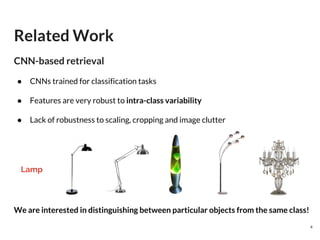
CNN-based retrieval
● CNNs trained for classification tasks
● Features are very robust to intra-class variability
● Lack of robustness to scaling, cropping and image clutter
Related Work
Lamp
We are interested in distinguishing between particular objects from the same class!
4
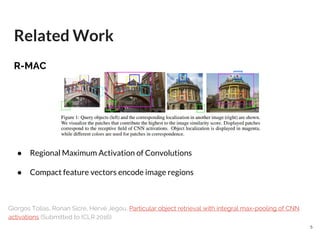
R-MAC
● Regional Maximum Activation of Convolutions
● Compact feature vectors encode image regions
Related Work
Giorgos Tolias, Ronan Sicre, Hervé Jégou, Particular object retrieval with integral max-pooling of CNN
activations (Submitted to ICLR 2016)
5
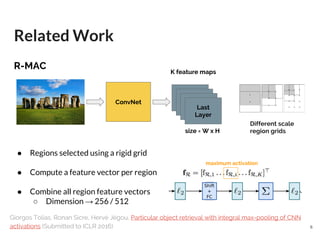
R-MAC
● Regions selected using a rigid grid
● Compute a feature vector per region
● Combine all region feature vectors
○ Dimension → 256 / 512
Related Work
Giorgos Tolias, Ronan Sicre, Hervé Jégou, Particular object retrieval with integral max-pooling of CNN
activations (Submitted to ICLR 2016)
ConvNet
Last
Layer
K feature maps
size = W x H
Different scale
region grids
maximum activation
6
2. Methodology
7
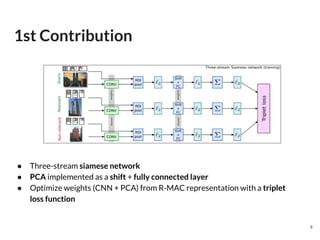
1st Contribution
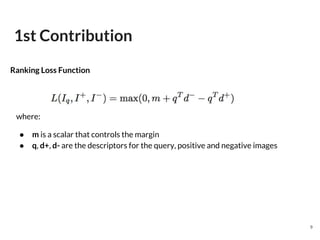
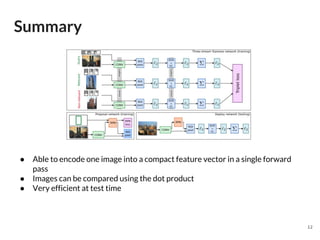
● Three-stream siamese network
● PCA implemented as a shift + fully connected layer
● Optimize weights (CNN + PCA) from R-MAC representation with a triplet
loss function
8
where:
● m is a scalar that controls the margin
● q, d+, d- are the descriptors for the query, positive and negative images
1st Contribution
Ranking Loss Function
9
2nd Contribution
● Localize regions of interest (ROIs)
● Train a Region Proposal Network with bounding boxes (Similar Fast R-CNN,
[arXiv])
In R-MAC → Rigid grid
Replace
Region Proposal Network
10
2nd Contribution
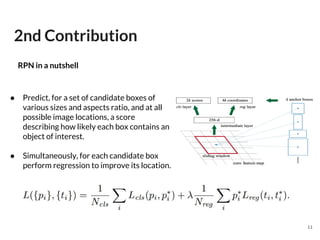
RPN in a nutshell
11
● Predict, for a set of candidate boxes of
various sizes and aspects ratio, and at all
possible image locations, a score
describing how likely each box contains an
object of interest.
● Simultaneously, for each candidate box
perform regression to improve its location.
Summary
12
● Able to encode one image into a compact feature vector in a single forward
pass
● Images can be compared using the dot product
● Very efficient at test time
3. Experiments
13
Datasets
14
● Training Landmarks dataset: 214k images from 672 landmark sites
● Testing Oxford 5k, Paris 6k, Oxford 105k, Paris 106k, INRIA Holidays
● Remove all images contained in Oxford 5k and Paris 6k datasets
○ Landmarks-full: 200k images from 592 landmarks
● Cleaning Landmarks dataset (Select most relevant images/discard incorrect)
○ SIFT + Hessian Affine keypoint det. → Construct graph of similar images
○ Landmarks-clean: 52k images from 592 landmarks
Bounding Box Estimation
15
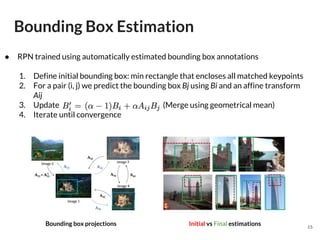
● RPN trained using automatically estimated bounding box annotations
1. Define initial bounding box: min rectangle that encloses all matched keypoints
2. For a pair (i, j) we predict the bounding box Bj using Bi and an affine transform
Aij
3. Update (Merge using geometrical mean)
4. Iterate until convergence
Bounding box projections Initial vs Final estimations
Experimental Details
16
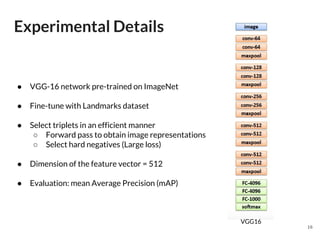
● VGG-16 network pre-trained on ImageNet
● Fine-tune with Landmarks dataset
● Select triplets in an efficient manner
○ Forward pass to obtain image representations
○ Select hard negatives (Large loss)
● Dimension of the feature vector = 512
● Evaluation: mean Average Precision (mAP)
VGG16
1st Experiment
17
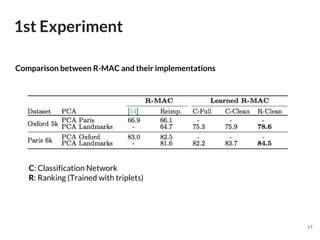
Comparison between R-MAC and their implementations
C: Classification Network
R: Ranking (Trained with triplets)
2nd Experiment
18
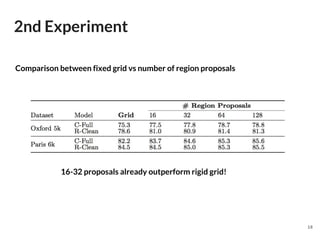
Comparison between fixed grid vs number of region proposals
16-32 proposals already outperform rigid grid!
2nd Experiment
19
meanAP - Number of triplets Recall - Number of region proposals
2nd Experiment
20
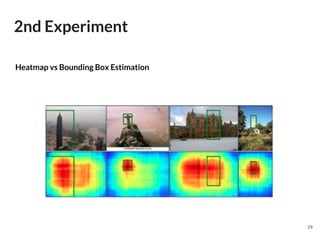
Heatmap vs Bounding Box Estimation
Comparison with state of the art
21
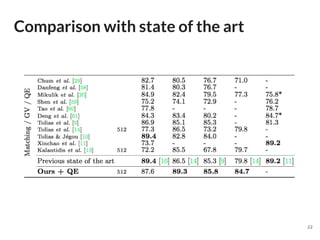
Comparison with state of the art
22
Top Retrieval Results
23
4. Conclusions
24
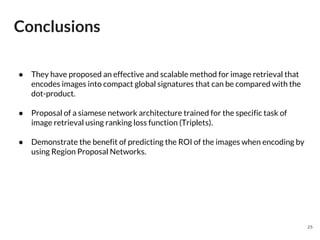
Conclusions
25
● They have proposed an effective and scalable method for image retrieval that
encodes images into compact global signatures that can be compared with the
dot-product.
● Proposal of a siamese network architecture trained for the specific task of
image retrieval using ranking loss function (Triplets).
● Demonstrate the benefit of predicting the ROI of the images when encoding by
using Region Proposal Networks.
Thank You!
Any Questions?
26

Deep image retrieval learning global representations for image search

  • 1.
    Deep Image Retrieval: Learningglobal representations for image search Albert Gordo, Jon Almazan, Jerome Revaud, Diane Larlus Slides by Albert Jiménez [GDoc] Computer Vision Reading Group (10/05/2016)1 [arXiv]
  • 2.
  • 3.
    3 Instance Retrieval +Ranking 1. 2. 3. 4. Image Retrieval Slide credit: Amaia Ranking Image Query
  • 4.
    CNN-based retrieval ● CNNstrained for classification tasks ● Features are very robust to intra-class variability ● Lack of robustness to scaling, cropping and image clutter Related Work Lamp We are interested in distinguishing between particular objects from the same class! 4
  • 5.
    R-MAC ● Regional MaximumActivation of Convolutions ● Compact feature vectors encode image regions Related Work Giorgos Tolias, Ronan Sicre, Hervé Jégou, Particular object retrieval with integral max-pooling of CNN activations (Submitted to ICLR 2016) 5
  • 6.
    R-MAC ● Regions selectedusing a rigid grid ● Compute a feature vector per region ● Combine all region feature vectors ○ Dimension → 256 / 512 Related Work Giorgos Tolias, Ronan Sicre, Hervé Jégou, Particular object retrieval with integral max-pooling of CNN activations (Submitted to ICLR 2016) ConvNet Last Layer K feature maps size = W x H Different scale region grids maximum activation 6
  • 7.
  • 8.
    1st Contribution ● Three-streamsiamese network ● PCA implemented as a shift + fully connected layer ● Optimize weights (CNN + PCA) from R-MAC representation with a triplet loss function 8
  • 9.
    where: ● m isa scalar that controls the margin ● q, d+, d- are the descriptors for the query, positive and negative images 1st Contribution Ranking Loss Function 9
  • 10.
    2nd Contribution ● Localizeregions of interest (ROIs) ● Train a Region Proposal Network with bounding boxes (Similar Fast R-CNN, [arXiv]) In R-MAC → Rigid grid Replace Region Proposal Network 10
  • 11.
    2nd Contribution RPN ina nutshell 11 ● Predict, for a set of candidate boxes of various sizes and aspects ratio, and at all possible image locations, a score describing how likely each box contains an object of interest. ● Simultaneously, for each candidate box perform regression to improve its location.
  • 12.
    Summary 12 ● Able toencode one image into a compact feature vector in a single forward pass ● Images can be compared using the dot product ● Very efficient at test time
  • 13.
  • 14.
    Datasets 14 ● Training Landmarksdataset: 214k images from 672 landmark sites ● Testing Oxford 5k, Paris 6k, Oxford 105k, Paris 106k, INRIA Holidays ● Remove all images contained in Oxford 5k and Paris 6k datasets ○ Landmarks-full: 200k images from 592 landmarks ● Cleaning Landmarks dataset (Select most relevant images/discard incorrect) ○ SIFT + Hessian Affine keypoint det. → Construct graph of similar images ○ Landmarks-clean: 52k images from 592 landmarks
  • 15.
    Bounding Box Estimation 15 ●RPN trained using automatically estimated bounding box annotations 1. Define initial bounding box: min rectangle that encloses all matched keypoints 2. For a pair (i, j) we predict the bounding box Bj using Bi and an affine transform Aij 3. Update (Merge using geometrical mean) 4. Iterate until convergence Bounding box projections Initial vs Final estimations
  • 16.
    Experimental Details 16 ● VGG-16network pre-trained on ImageNet ● Fine-tune with Landmarks dataset ● Select triplets in an efficient manner ○ Forward pass to obtain image representations ○ Select hard negatives (Large loss) ● Dimension of the feature vector = 512 ● Evaluation: mean Average Precision (mAP) VGG16
  • 17.
    1st Experiment 17 Comparison betweenR-MAC and their implementations C: Classification Network R: Ranking (Trained with triplets)
  • 18.
    2nd Experiment 18 Comparison betweenfixed grid vs number of region proposals 16-32 proposals already outperform rigid grid!
  • 19.
    2nd Experiment 19 meanAP -Number of triplets Recall - Number of region proposals
  • 20.
    2nd Experiment 20 Heatmap vsBounding Box Estimation
  • 21.
    Comparison with stateof the art 21
  • 22.
    Comparison with stateof the art 22
  • 23.
  • 24.
  • 25.
    Conclusions 25 ● They haveproposed an effective and scalable method for image retrieval that encodes images into compact global signatures that can be compared with the dot-product. ● Proposal of a siamese network architecture trained for the specific task of image retrieval using ranking loss function (Triplets). ● Demonstrate the benefit of predicting the ROI of the images when encoding by using Region Proposal Networks.
  • 26.