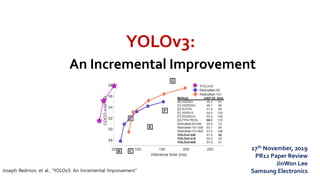
YOLOv3:
An Incremental Improvement
Joseph Redmon, et al., “YOLOv3: An Incremental Improvement”
17th November, 2019
PR12 Paper Review
JinWon Lee
Samsung Electronics
Related PR12
• PR-016:You only look once: Unified, real-time object detection :
https://youtu.be/eTDcoeqj1_w
• PR-023:YOLO9000: Better, Faster, Stronger :
https://youtu.be/6fdclSGgeio
References
• What’s new inYOLO v3?
https://towardsdatascience.com/yolo-v3-object-detection-
53fb7d3bfe6b
• How to implement aYOLO (v3) object detector from scratch in
PyTorch
https://blog.paperspace.com/how-to-implement-a-yolo-object-
detector-in-pytorch/
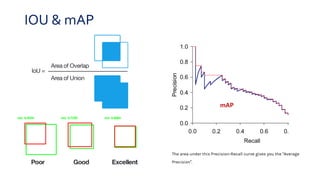
IOU & mAP
mAP
Introduction
• This is aTECH REPORT.
• “I managed to make some improvements toYOLO. But, honestly,
nothing like super interesting, just a bunch of small changes that
make it better.”
• Better, Not Faster, Stronger(?)
• The last sentence of the document: In closing, do not @me.
(Because I finally quitTwitter).
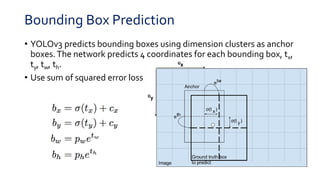
Bounding Box Prediction
• YOLOv3 predicts bounding boxes using dimension clusters as anchor
boxes.The network predicts 4 coordinates for each bounding box, tx,
ty, tw, th.
• Use sum of squared error loss
Bounding Box Prediction
• YOLOv3 predicts an objectness score for each bounding box using
logistic regression.
• This should be 1 if the bounding box prior overlaps a ground truth
object by more than any other bounding box prior.
• They use the threshold of 0.5. Unlike Faster R-CNN,YOLOv3 only
assigns one bounding box prior for each ground truth object.
Class Prediction
• YOLO v3 now performs multilabel classification for objects detected
in images.
• Softmaxing classes rests on the assumption that classes are mutually
exclusive.
• However, when we have classes like Person and Women in a dataset,
then the above assumption fails.This is the reason why the authors
ofYOLO have refrained from softmaxing the classes. Instead, each
class score is predicted using logistic regression and a threshold is
used to predict multiple labels for an object.
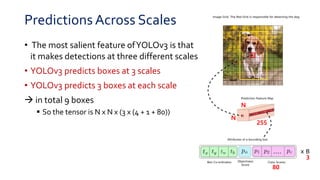
Predictions Across Scales
• The most salient feature ofYOLOv3 is that
it makes detections at three different scales.
• YOLOv3 predicts boxes at 3 scales
• YOLOv3 predicts 3 boxes at each scale
 in total 9 boxes
 So the tensor is N x N x (3 x (4 + 1 + 80))
80
3
N
N
255
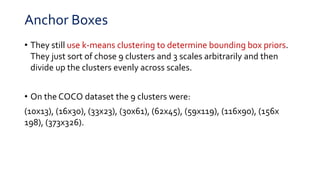
Anchor Boxes
• They still use k-means clustering to determine bounding box priors.
They just sort of chose 9 clusters and 3 scales arbitrarily and then
divide up the clusters evenly across scales.
• On the COCO dataset the 9 clusters were:
(10x13), (16x30), (33x23), (30x61), (62x45), (59x119), (116x90), (156x
198), (373x326).
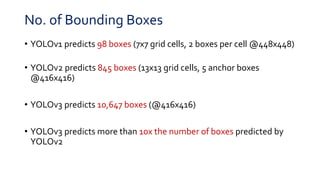
No. of Bounding Boxes
• YOLOv1 predicts 98 boxes (7x7 grid cells, 2 boxes per cell @448x448)
• YOLOv2 predicts 845 boxes (13x13 grid cells, 5 anchor boxes
@416x416)
• YOLOv3 predicts 10,647 boxes (@416x416)
• YOLOv3 predicts more than 10x the number of boxes predicted by
YOLOv2
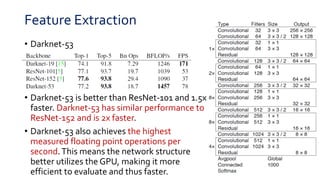
Feature Extraction
• Darknet-53
• Darknet-53 is better than ResNet-101 and 1.5x
faster. Darknet-53 has similar performance to
ResNet-152 and is 2x faster.
• Darknet-53 also achieves the highest
measured floating point operations per
second.This means the network structure
better utilizes the GPU, making it more
efficient to evaluate and thus faster.
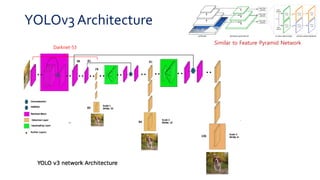
YOLOv3 Architecture
Darknet-53
Similar to Feature Pyramid Network
Training
• Authors still train on full images with no hard negative mining or any
of that stuff.
• They use multi-scale training, lots of data augmentation, batch
normalization, all the standard stuff.
Results
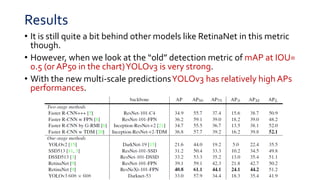
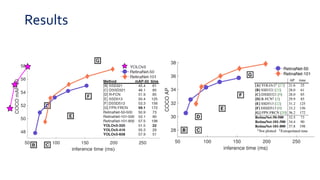
• It is still quite a bit behind other models like RetinaNet in this metric
though.
• However, when we look at the “old” detection metric of mAP at IOU=
0.5 (or AP50 in the chart)YOLOv3 is very strong.
• With the new multi-scale predictionsYOLOv3 has relatively high APs
performances.
Results
ThingsWeTriedThat Didn’tWork
• Anchor box x, y offset predictions
 Using the normal anchor box prediction mechanism where you predict the x,
y offset as a multiple of the box width or height
• Linear x, y predictions instead of logistic
• Focal loss
 Focal loss droppedYOLOv3’s mAP about 2 points
• Dual IOU thresholds and truth assignment
 Faster R-CNN uses two IOU thresholds during training. If a prediction
overlaps the ground truth by 0.7 it is as a positive example, by [0.3-0.7] it is
ignored, less than 0.3 for all ground truth objects it is a negative example.
WhatThis All Means
• YOLOv3 is a good detector. It’s fast, it’s accurate. It’s not as great on
the COCO average AP between .5 and .95 IOU metric. But it’s very
good on the old detection metric of .5 IOU.
• Russakovsky et al report that that humans have a hard time
distinguishing an IOU of .3 from .5!
 Training humans to visually inspect a bounding box with IOU of 0.3 and
distinguish it from one with IOU 0.5 is surprisingly difficult.
Rebuttal
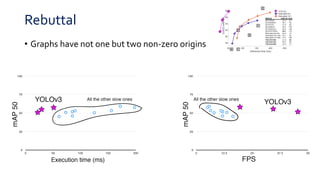
• Graphs have not one but two non-zero origins
Rebuttal
• For PASCALVOC, the IOU threshold was “set deliberately low to
account for inaccuracies in bounding boxes in the ground truth data”
• COCO can have better labelling thanVOC since COCO has
segmentation masks. But there was the lack of justification for
updating mAP.
• Emphasis must mean it de-emphasizes something else, in this case
classification accuracy. A miss-classified example is much more
obvious than a bounding box that is slightly shifted.
mAP’s Problems
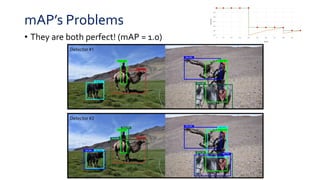
• They are both perfect! (mAP = 1.0)
A New Proposal
• mAP is screwed up because all that matters is per-class rank ordering.
• What about getting rid of per-class AP and just doing a global
average precision?
• Or doing an AP calculation per-image and averaging over that?
• Boxes are stupid anyway though, I’m probably a true believer in
masks except I can’t getYOLO to learn them.
Thank you

PR-207: YOLOv3: An Incremental Improvement

  • 1.
    YOLOv3: An Incremental Improvement JosephRedmon, et al., “YOLOv3: An Incremental Improvement” 17th November, 2019 PR12 Paper Review JinWon Lee Samsung Electronics
  • 2.
    Related PR12 • PR-016:Youonly look once: Unified, real-time object detection : https://youtu.be/eTDcoeqj1_w • PR-023:YOLO9000: Better, Faster, Stronger : https://youtu.be/6fdclSGgeio
  • 3.
    References • What’s newinYOLO v3? https://towardsdatascience.com/yolo-v3-object-detection- 53fb7d3bfe6b • How to implement aYOLO (v3) object detector from scratch in PyTorch https://blog.paperspace.com/how-to-implement-a-yolo-object- detector-in-pytorch/
  • 4.
  • 5.
    Introduction • This isaTECH REPORT. • “I managed to make some improvements toYOLO. But, honestly, nothing like super interesting, just a bunch of small changes that make it better.” • Better, Not Faster, Stronger(?) • The last sentence of the document: In closing, do not @me. (Because I finally quitTwitter).
  • 6.
    Bounding Box Prediction •YOLOv3 predicts bounding boxes using dimension clusters as anchor boxes.The network predicts 4 coordinates for each bounding box, tx, ty, tw, th. • Use sum of squared error loss
  • 7.
    Bounding Box Prediction •YOLOv3 predicts an objectness score for each bounding box using logistic regression. • This should be 1 if the bounding box prior overlaps a ground truth object by more than any other bounding box prior. • They use the threshold of 0.5. Unlike Faster R-CNN,YOLOv3 only assigns one bounding box prior for each ground truth object.
  • 8.
    Class Prediction • YOLOv3 now performs multilabel classification for objects detected in images. • Softmaxing classes rests on the assumption that classes are mutually exclusive. • However, when we have classes like Person and Women in a dataset, then the above assumption fails.This is the reason why the authors ofYOLO have refrained from softmaxing the classes. Instead, each class score is predicted using logistic regression and a threshold is used to predict multiple labels for an object.
  • 9.
    Predictions Across Scales •The most salient feature ofYOLOv3 is that it makes detections at three different scales. • YOLOv3 predicts boxes at 3 scales • YOLOv3 predicts 3 boxes at each scale  in total 9 boxes  So the tensor is N x N x (3 x (4 + 1 + 80)) 80 3 N N 255
  • 10.
    Anchor Boxes • Theystill use k-means clustering to determine bounding box priors. They just sort of chose 9 clusters and 3 scales arbitrarily and then divide up the clusters evenly across scales. • On the COCO dataset the 9 clusters were: (10x13), (16x30), (33x23), (30x61), (62x45), (59x119), (116x90), (156x 198), (373x326).
  • 11.
    No. of BoundingBoxes • YOLOv1 predicts 98 boxes (7x7 grid cells, 2 boxes per cell @448x448) • YOLOv2 predicts 845 boxes (13x13 grid cells, 5 anchor boxes @416x416) • YOLOv3 predicts 10,647 boxes (@416x416) • YOLOv3 predicts more than 10x the number of boxes predicted by YOLOv2
  • 12.
    Feature Extraction • Darknet-53 •Darknet-53 is better than ResNet-101 and 1.5x faster. Darknet-53 has similar performance to ResNet-152 and is 2x faster. • Darknet-53 also achieves the highest measured floating point operations per second.This means the network structure better utilizes the GPU, making it more efficient to evaluate and thus faster.
  • 13.
  • 14.
    Training • Authors stilltrain on full images with no hard negative mining or any of that stuff. • They use multi-scale training, lots of data augmentation, batch normalization, all the standard stuff.
  • 15.
    Results • It isstill quite a bit behind other models like RetinaNet in this metric though. • However, when we look at the “old” detection metric of mAP at IOU= 0.5 (or AP50 in the chart)YOLOv3 is very strong. • With the new multi-scale predictionsYOLOv3 has relatively high APs performances.
  • 16.
  • 17.
    ThingsWeTriedThat Didn’tWork • Anchorbox x, y offset predictions  Using the normal anchor box prediction mechanism where you predict the x, y offset as a multiple of the box width or height • Linear x, y predictions instead of logistic • Focal loss  Focal loss droppedYOLOv3’s mAP about 2 points • Dual IOU thresholds and truth assignment  Faster R-CNN uses two IOU thresholds during training. If a prediction overlaps the ground truth by 0.7 it is as a positive example, by [0.3-0.7] it is ignored, less than 0.3 for all ground truth objects it is a negative example.
  • 18.
    WhatThis All Means •YOLOv3 is a good detector. It’s fast, it’s accurate. It’s not as great on the COCO average AP between .5 and .95 IOU metric. But it’s very good on the old detection metric of .5 IOU. • Russakovsky et al report that that humans have a hard time distinguishing an IOU of .3 from .5!  Training humans to visually inspect a bounding box with IOU of 0.3 and distinguish it from one with IOU 0.5 is surprisingly difficult.
  • 19.
    Rebuttal • Graphs havenot one but two non-zero origins
  • 20.
    Rebuttal • For PASCALVOC,the IOU threshold was “set deliberately low to account for inaccuracies in bounding boxes in the ground truth data” • COCO can have better labelling thanVOC since COCO has segmentation masks. But there was the lack of justification for updating mAP. • Emphasis must mean it de-emphasizes something else, in this case classification accuracy. A miss-classified example is much more obvious than a bounding box that is slightly shifted.
  • 21.
    mAP’s Problems • Theyare both perfect! (mAP = 1.0)
  • 22.
    A New Proposal •mAP is screwed up because all that matters is per-class rank ordering. • What about getting rid of per-class AP and just doing a global average precision? • Or doing an AP calculation per-image and averaging over that? • Boxes are stupid anyway though, I’m probably a true believer in masks except I can’t getYOLO to learn them.
  • 23.