TOTAL PRODUCTIVE MAINTENANCE
PRESENTATION
BY
MANISHA HALAI
MBA
AVINASHILINGAM
UNIVERSITY
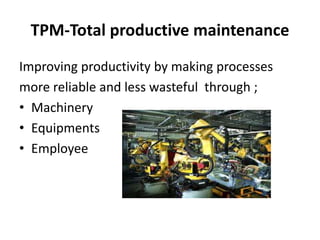
TPM-Total productive maintenance
Improving productivity by making processes
more reliable and less wasteful through ;
• Machinery
• Equipments
• Employee
Why do we need TPM?
• Avoid wastage in quickly changing
environment.
• Producing goods without reducing product
quality.
• Reduce cost of manufacturing.
• Goods send to customers must be “non-
defective”.
TPM Objective
1. Increase production , at the same time,
increasing employee morale and job
satisfaction.
2. Hold emergency & unscheduled maintenance
to a minimum.
3. Provide safe and good working environment
to the workers.
4. Achieve zero defects, zero breakdown and
zero accidents.
TPM Objective
5. Involve people in over all levels of
organisation.
6. Form different teams to reduce defects and
self maintenance.
7. To fulfil regulatory compliances.
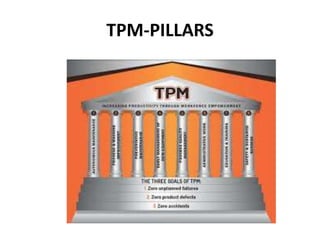
TPM-PILLARS
Pillars of TPM
PILLAR 1-Autonomous Maintenance
• A collective team activity involving production,
maintenance and engineering.
• Maintaining basic conditions on shop floor & in
machines.
• An approach that;
i ) develops operating and maintenance skill
ii) strengthens communication and soorporation
Pillars of TPM
PILLAR 2-Focussed improvement
• Improvement on everyone’s activity.
• Improvement is to eliminate production losses
and cost reduction.
• Improvement in reality, maintainability , and
cost.
Pillars of TPM
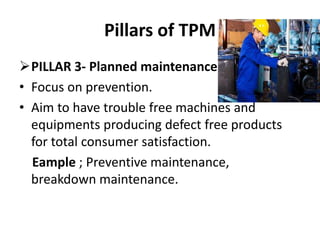
PILLAR 3- Planned maintenance
• Focus on prevention.
• Aim to have trouble free machines and
equipments producing defect free products
for total consumer satisfaction.
Eample ; Preventive maintenance,
breakdown maintenance.
Pillars of TPM
Quality maintenance ;
• Developing perfect machine for perfect quality.
• Eliminating In- Process defects and custom
complaints.
Policy;
• Defect free conditions and control of equipments
• QM activities to support quality assurance
• Focus of prevention of defects at sources
Pillars of TPM
PILLAR 5-Education and Training;
• Skills development for uniformity of work
practice on machines.
• skills for zero defects , zero breakdowns and
zero accidents.
• Multi-skilled employees in all departments.
Cont......
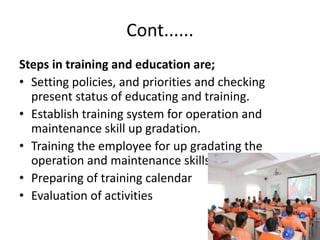
Steps in training and education are;
• Setting policies, and priorities and checking
present status of educating and training.
• Establish training system for operation and
maintenance skill up gradation.
• Training the employee for up gradating the
operation and maintenance skills
• Preparing of training calendar
• Evaluation of activities
Pillars of TPM
PILLAR 6- DEVELOPMENT MAINTENANCE
• Developing machines for “high equipment
effectiveness’
• Quick process for developing new products
Pillars of TPM
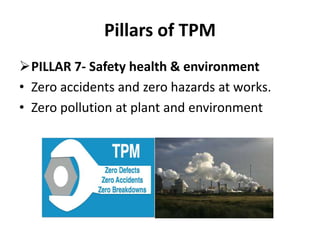
PILLAR 7- Safety health & environment
• Zero accidents and zero hazards at works.
• Zero pollution at plant and environment
Pillars of TPM
PILLAR 8- OFFICE TPM;
Office TPM should be started after activating
from other pillars of TPM. TPM must be
flowed to improve productivity, efficiency in
the administrative function and identify
eliminate losses. TPM covers 12 major losses.
They are;
1. Processing loss
2. Cost loss in areas such as procurement, accounts
marketing leading to high inventories .
3. Communication losses.
4. Idle-loss
5. Set-up loss
6. Office equipment breakdown
7. Communication channel breakdown.
Total productive maintenance

Total productive maintenance

  • 1.
    TOTAL PRODUCTIVE MAINTENANCE PRESENTATION BY MANISHAHALAI MBA AVINASHILINGAM UNIVERSITY
  • 2.
    TPM-Total productive maintenance Improvingproductivity by making processes more reliable and less wasteful through ; • Machinery • Equipments • Employee
  • 3.
    Why do weneed TPM? • Avoid wastage in quickly changing environment. • Producing goods without reducing product quality. • Reduce cost of manufacturing. • Goods send to customers must be “non- defective”.
  • 4.
    TPM Objective 1. Increaseproduction , at the same time, increasing employee morale and job satisfaction. 2. Hold emergency & unscheduled maintenance to a minimum. 3. Provide safe and good working environment to the workers. 4. Achieve zero defects, zero breakdown and zero accidents.
  • 5.
    TPM Objective 5. Involvepeople in over all levels of organisation. 6. Form different teams to reduce defects and self maintenance. 7. To fulfil regulatory compliances.
  • 6.
  • 7.
    Pillars of TPM PILLAR1-Autonomous Maintenance • A collective team activity involving production, maintenance and engineering. • Maintaining basic conditions on shop floor & in machines. • An approach that; i ) develops operating and maintenance skill ii) strengthens communication and soorporation
  • 8.
    Pillars of TPM PILLAR2-Focussed improvement • Improvement on everyone’s activity. • Improvement is to eliminate production losses and cost reduction. • Improvement in reality, maintainability , and cost.
  • 9.
    Pillars of TPM PILLAR3- Planned maintenance • Focus on prevention. • Aim to have trouble free machines and equipments producing defect free products for total consumer satisfaction. Eample ; Preventive maintenance, breakdown maintenance.
  • 10.
    Pillars of TPM Qualitymaintenance ; • Developing perfect machine for perfect quality. • Eliminating In- Process defects and custom complaints. Policy; • Defect free conditions and control of equipments • QM activities to support quality assurance • Focus of prevention of defects at sources
  • 11.
    Pillars of TPM PILLAR5-Education and Training; • Skills development for uniformity of work practice on machines. • skills for zero defects , zero breakdowns and zero accidents. • Multi-skilled employees in all departments.
  • 12.
    Cont...... Steps in trainingand education are; • Setting policies, and priorities and checking present status of educating and training. • Establish training system for operation and maintenance skill up gradation. • Training the employee for up gradating the operation and maintenance skills • Preparing of training calendar • Evaluation of activities
  • 13.
    Pillars of TPM PILLAR6- DEVELOPMENT MAINTENANCE • Developing machines for “high equipment effectiveness’ • Quick process for developing new products
  • 14.
    Pillars of TPM PILLAR7- Safety health & environment • Zero accidents and zero hazards at works. • Zero pollution at plant and environment
  • 15.
    Pillars of TPM PILLAR8- OFFICE TPM; Office TPM should be started after activating from other pillars of TPM. TPM must be flowed to improve productivity, efficiency in the administrative function and identify eliminate losses. TPM covers 12 major losses. They are;
  • 16.
    1. Processing loss 2.Cost loss in areas such as procurement, accounts marketing leading to high inventories . 3. Communication losses. 4. Idle-loss 5. Set-up loss 6. Office equipment breakdown 7. Communication channel breakdown.