TPM Policy and objectives
• To maximize overall equipment
effectiveness (Zero breakdowns and
failures, Zero accidents, Zero defects,
etc.) through total employee
involvement.
• To improve equipment reliability and
maintainability to contribute to the quality
and to raise productivity.
What is TPM?
• Total Productive Maintenance (TPM) is
Both
• TPM emphasizes proactive and
preventative maintenance to maximize the
operational efficiency of the equipment
• TPM increases Overall Equipment
Effectiveness (OEE) by reducing
Downtime, Performance Losses, and
Quality losses.
The Structure Of TPM
•Pillar 1: Autonomous Maintenance.
•Pillar 2: Process & Machine Improvement.
•Pillar 3: Preventative Maintenance.
•Pillar 4: Education & Training.
•Pillar 5: Process Quality Management.
•Pillar 6: Early Management of New Equipment.
•Pillar 7: Safety & Sustained Success.
•Pillar 8: Administrative Work.
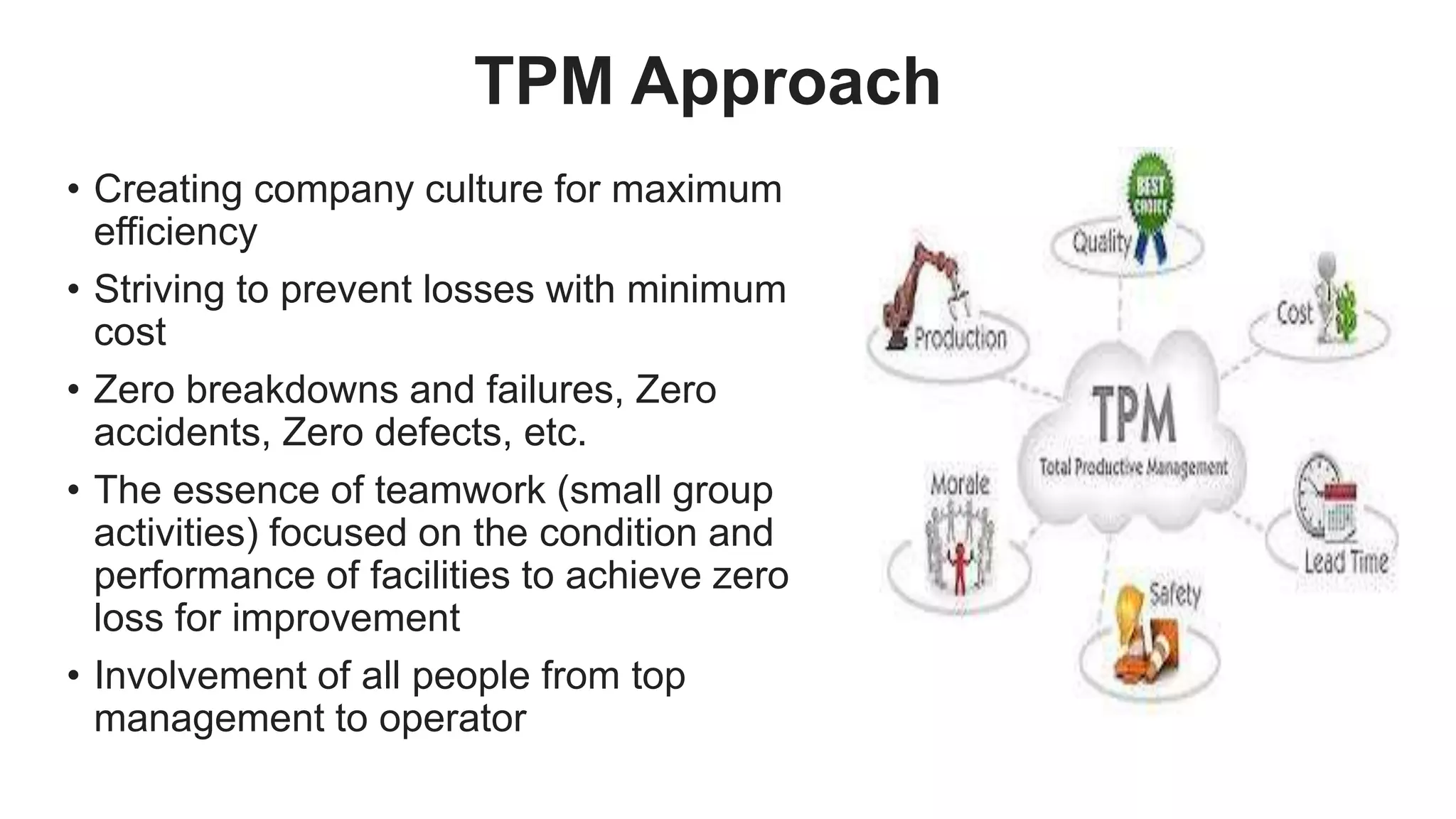
TPM Approach
• Creating company culture for maximum
efficiency
• Striving to prevent losses with minimum
cost
• Zero breakdowns and failures, Zero
accidents, Zero defects, etc.
• The essence of teamwork (small group
activities) focused on the condition and
performance of facilities to achieve zero
loss for improvement
• Involvement of all people from top
management to operator
TPM Enables or Provides
• The traditional maintenance practices to change from reactive to
proactive
* A number of mechanisms whereby
* Breakdowns are analyzed
* Causes investigated
* Actions were taken to prevent further breakdowns
* Preventive maintenance schedule to be made more meaningful
* Carry out scheduled and preventive maintenance
* Keep the system up to date
* To review cost-effectiveness
* To develop and operate a very effective maintenance system an integral
part of the manufacturing
Why is TPM Important?
• Three main reasons:
1. It guarantees dramatic results (Significant tangible results)
• Reduces equipment breakdowns
• Minimizes idle time and minor stops
• Fewer quality defects and claims
• Increases productivity
• Reduces manpower and cost
• Lower inventory
• Reduces accidents
2. Visibly transform the workplace (plant environment)
• Through TPM, reborn as a pleasant and safe working environment
• Customers and other visitors are impressed by the change
• Confidence in plant’s product increases
3. Raises the level of workers’ knowledge and skills As TPM activities begin to
yield above concrete results, it helps:
• The workers to get motivated
• Involvement of the worker increases
• Improvement suggestions multiply
• People begin to think of TPM as part of the job
TPM.pptx

TPM.pptx

  • 2.
    TPM Policy andobjectives • To maximize overall equipment effectiveness (Zero breakdowns and failures, Zero accidents, Zero defects, etc.) through total employee involvement. • To improve equipment reliability and maintainability to contribute to the quality and to raise productivity.
  • 3.
    What is TPM? •Total Productive Maintenance (TPM) is Both • TPM emphasizes proactive and preventative maintenance to maximize the operational efficiency of the equipment • TPM increases Overall Equipment Effectiveness (OEE) by reducing Downtime, Performance Losses, and Quality losses.
  • 4.
    The Structure OfTPM •Pillar 1: Autonomous Maintenance. •Pillar 2: Process & Machine Improvement. •Pillar 3: Preventative Maintenance. •Pillar 4: Education & Training. •Pillar 5: Process Quality Management. •Pillar 6: Early Management of New Equipment. •Pillar 7: Safety & Sustained Success. •Pillar 8: Administrative Work.
  • 5.
    TPM Approach • Creatingcompany culture for maximum efficiency • Striving to prevent losses with minimum cost • Zero breakdowns and failures, Zero accidents, Zero defects, etc. • The essence of teamwork (small group activities) focused on the condition and performance of facilities to achieve zero loss for improvement • Involvement of all people from top management to operator
  • 6.
    TPM Enables orProvides • The traditional maintenance practices to change from reactive to proactive * A number of mechanisms whereby * Breakdowns are analyzed * Causes investigated * Actions were taken to prevent further breakdowns * Preventive maintenance schedule to be made more meaningful * Carry out scheduled and preventive maintenance * Keep the system up to date * To review cost-effectiveness * To develop and operate a very effective maintenance system an integral part of the manufacturing
  • 7.
    Why is TPMImportant? • Three main reasons: 1. It guarantees dramatic results (Significant tangible results) • Reduces equipment breakdowns • Minimizes idle time and minor stops • Fewer quality defects and claims • Increases productivity • Reduces manpower and cost • Lower inventory • Reduces accidents 2. Visibly transform the workplace (plant environment) • Through TPM, reborn as a pleasant and safe working environment • Customers and other visitors are impressed by the change • Confidence in plant’s product increases 3. Raises the level of workers’ knowledge and skills As TPM activities begin to yield above concrete results, it helps: • The workers to get motivated • Involvement of the worker increases • Improvement suggestions multiply • People begin to think of TPM as part of the job

Editor's Notes