Chapter 2
MARKETING AND MARKETING
MANAGEMENT: CREATING CUSTOMER VALUE
AND SATISFACTION
REVIEWING PREVIOUS CHAPTER
• We learned from Chapter 1 that from its mother science,
economics, marketing has emerged as a distinct action
discipline enriched by borrowings from related disciplines such
as management, accounting, political science and the
behavioral sciences.
• We also learned that history and stages of marketing thought
are surveyed to the point to the growth and development of
marketing.
• To be successful in business, each company should deal with
customers on a daily basis, not only be customer-driven, but be
customer-obsessed. The best way to achieve this objective is to
develop a sound marketing function within the organization.
CHAPTER OBJECTIVES
At the end of the chapter, you should be able to:
• Define what marketing is and discuss its core concepts.
• Explain the relationships between customer value, satisfaction,
and quality.
• Define marketing management and understand how marketers
manage demand and build profitable customer relationships.
• Compare the five marketing management philosophies.
• Analyze the major challenges facing marketers heading into the
new “connected” millennium.
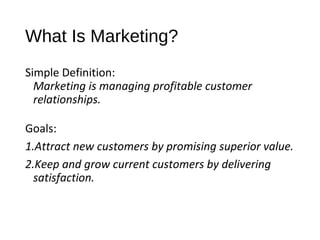
What Is Marketing?
Simple Definition:
Marketing is managing profitable customer
relationships.
Goals:
1.Attract new customers by promising superior value.
2.Keep and grow current customers by delivering
satisfaction.
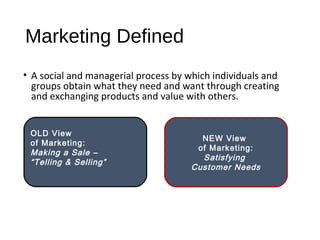
Marketing Defined
• A social and managerial process by which individuals and
groups obtain what they need and want through creating
and exchanging products and value with others.
OLD View
of Marketing:
Making a Sale –
“Telling & Selling”
New View
of Marketing:
Satisfying
NEW View
of Marketing:
Satisfying
Customer Needs
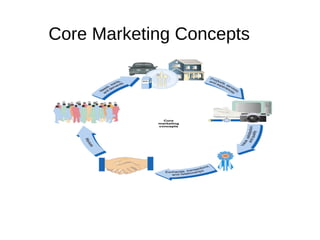
Core Marketing Concepts
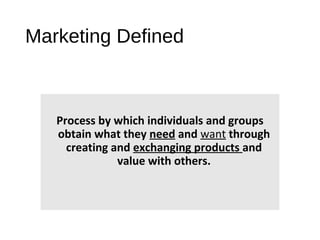
Marketing Defined
Process by which individuals and groups
obtain what they need and want through
creating and exchanging products and
value with others.
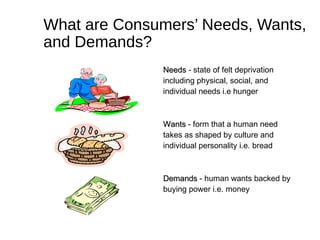
What are Consumers’ Needs, Wants,
and Demands?
NeedsNeeds - state of felt deprivation
including physical, social, and
individual needs i.e hunger
WantsWants - form that a human need
takes as shaped by culture and
individual personality i.e. bread
DemandsDemands - human wants backed by
buying power i.e. money
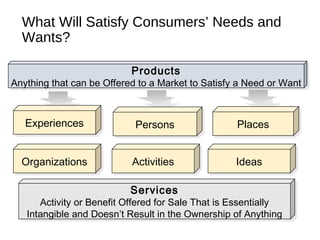
ExperiencesExperiences PersonsPersons
Products
Anything that can be Offered to a Market to Satisfy a Need or Want
Products
Anything that can be Offered to a Market to Satisfy a Need or Want
PlacesPlaces
OrganizationsOrganizations IdeasIdeasActivitiesActivities
What Will Satisfy Consumers’ Needs and
Wants?
Services
Activity or Benefit Offered for Sale That is Essentially
Intangible and Doesn’t Result in the Ownership of Anything
Services
Activity or Benefit Offered for Sale That is Essentially
Intangible and Doesn’t Result in the Ownership of Anything
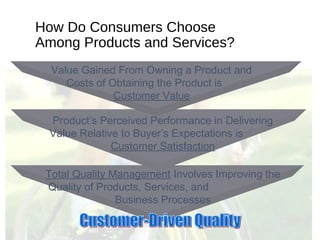
How Do Consumers Choose
Among Products and Services?
Total Quality Management Involves Improving the
Quality of Products, Services, and
Business Processes
Product’s Perceived Performance in Delivering
Value Relative to Buyer’s Expectations is
Customer Satisfaction
Value Gained From Owning a Product and
Costs of Obtaining the Product is
Customer Value
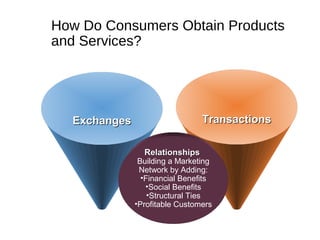
ExchangesExchanges TransactionsTransactions
RelationshipsRelationships
Building a Marketing
Network by Adding:
•Financial Benefits
•Social Benefits
•Structural Ties
•Profitable Customers
How Do Consumers Obtain Products
and Services?
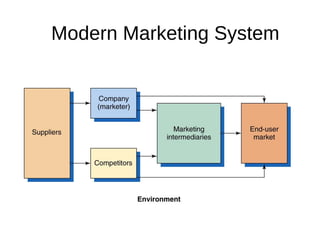
Modern Marketing System
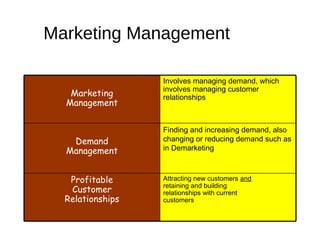
Marketing Management
Attracting new customers and
retaining and building
relationships with current
customers
Profitable
Customer
Relationships
Finding and increasing demand, also
changing or reducing demand such as
in Demarketing
Demand
Management
Involves managing demand, which
involves managing customer
relationshipsMarketing
Management
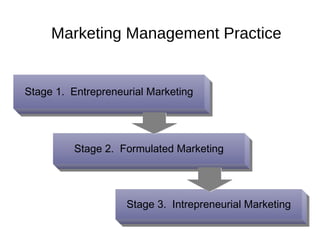
Stage 1. Entrepreneurial MarketingStage 1. Entrepreneurial Marketing
Stage 2. Formulated MarketingStage 2. Formulated Marketing
Stage 3. Intrepreneurial MarketingStage 3. Intrepreneurial Marketing
Marketing Management Practice
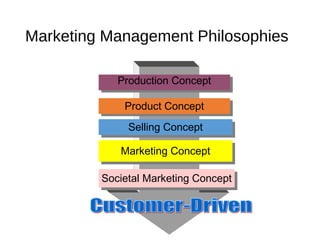
Production ConceptProduction Concept
Product ConceptProduct Concept
Selling ConceptSelling Concept
Marketing ConceptMarketing Concept
Societal Marketing ConceptSocietal Marketing Concept
Marketing Management Philosophies
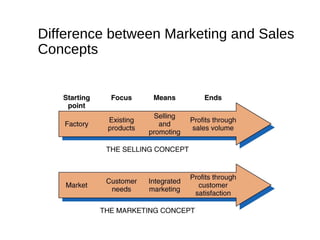
Difference between Marketing and Sales
Concepts
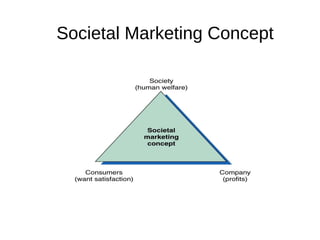
Societal Marketing Concept
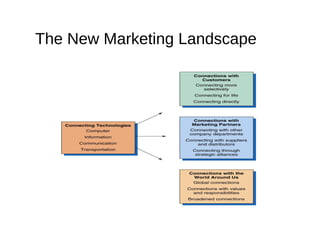
The New Marketing Landscape
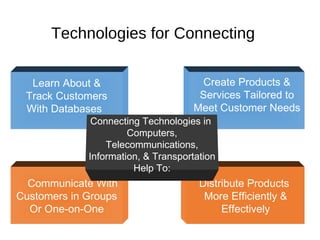
Learn About &
Track Customers
With Databases
Communicate With
Customers in Groups
Or One-on-One
Create Products &
Services Tailored to
Meet Customer Needs
Distribute Products
More Efficiently &
Effectively
Connecting Technologies in
Computers,
Telecommunications,
Information, & Transportation
Help To:
Technologies for Connecting
The Internet
• The Internet has been hailed as the technology behind a New
Economy.
• New applications include:
• “click-and-mortar” companies
• “click-only” companies
• Business-to-business e-commerce
• Business-to-business transactions online are expected to reach
$3.6 trillion in 2003.
• By 2005, 500,000 companies will use the Internet to do
business.
Connections With Customers
• Most marketers are targeting fewer,
potentially more profitable
customers.
• Asking:
• What value does the customer bring
to the organization?
• Are they worth pursuing?
• Connecting for a customer’s lifetime.
Direct Connections With Customers
• Many companies use technologies to let them connect more
directly with their customers.
• Products available via telephone, mail-order catalogs, kiosks and e-
commerce.
• Some firms sell only via direct channels (i.e. Dell Computer,
http://www.amazon.com/), others use a combination.
• Direct marketing is redefining the buyer’s role in connecting
with sellers.
• Buyers are active participants in shaping the marketing offer and
process; some buyers design their own products online such as at
http://www.us.levis.com/.
Connections With Marketing’s Partners
• Connecting Inside the
Company
• Every employee must be
customer-focused
• Teams coordinate efforts
toward customers
• Connecting With
Outside Partners
• Supply Chain
Management
• Strategic Alliances
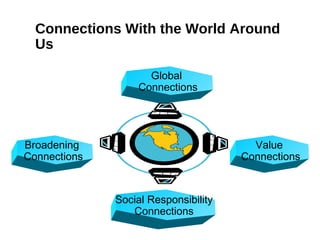
Connections With the World Around
Us
Global
Connections
Value
Connections
Social Responsibility
Connections
Broadening
Connections

Principles of Marketing Chapter 2

  • 1.
    Chapter 2 MARKETING ANDMARKETING MANAGEMENT: CREATING CUSTOMER VALUE AND SATISFACTION
  • 2.
    REVIEWING PREVIOUS CHAPTER •We learned from Chapter 1 that from its mother science, economics, marketing has emerged as a distinct action discipline enriched by borrowings from related disciplines such as management, accounting, political science and the behavioral sciences. • We also learned that history and stages of marketing thought are surveyed to the point to the growth and development of marketing. • To be successful in business, each company should deal with customers on a daily basis, not only be customer-driven, but be customer-obsessed. The best way to achieve this objective is to develop a sound marketing function within the organization.
  • 3.
    CHAPTER OBJECTIVES At theend of the chapter, you should be able to: • Define what marketing is and discuss its core concepts. • Explain the relationships between customer value, satisfaction, and quality. • Define marketing management and understand how marketers manage demand and build profitable customer relationships. • Compare the five marketing management philosophies. • Analyze the major challenges facing marketers heading into the new “connected” millennium.
  • 4.
    What Is Marketing? SimpleDefinition: Marketing is managing profitable customer relationships. Goals: 1.Attract new customers by promising superior value. 2.Keep and grow current customers by delivering satisfaction.
  • 5.
    Marketing Defined • Asocial and managerial process by which individuals and groups obtain what they need and want through creating and exchanging products and value with others. OLD View of Marketing: Making a Sale – “Telling & Selling” New View of Marketing: Satisfying NEW View of Marketing: Satisfying Customer Needs
  • 6.
  • 7.
    Marketing Defined Process bywhich individuals and groups obtain what they need and want through creating and exchanging products and value with others.
  • 8.
    What are Consumers’Needs, Wants, and Demands? NeedsNeeds - state of felt deprivation including physical, social, and individual needs i.e hunger WantsWants - form that a human need takes as shaped by culture and individual personality i.e. bread DemandsDemands - human wants backed by buying power i.e. money
  • 9.
    ExperiencesExperiences PersonsPersons Products Anything thatcan be Offered to a Market to Satisfy a Need or Want Products Anything that can be Offered to a Market to Satisfy a Need or Want PlacesPlaces OrganizationsOrganizations IdeasIdeasActivitiesActivities What Will Satisfy Consumers’ Needs and Wants? Services Activity or Benefit Offered for Sale That is Essentially Intangible and Doesn’t Result in the Ownership of Anything Services Activity or Benefit Offered for Sale That is Essentially Intangible and Doesn’t Result in the Ownership of Anything
  • 10.
    How Do ConsumersChoose Among Products and Services? Total Quality Management Involves Improving the Quality of Products, Services, and Business Processes Product’s Perceived Performance in Delivering Value Relative to Buyer’s Expectations is Customer Satisfaction Value Gained From Owning a Product and Costs of Obtaining the Product is Customer Value
  • 11.
    ExchangesExchanges TransactionsTransactions RelationshipsRelationships Building aMarketing Network by Adding: •Financial Benefits •Social Benefits •Structural Ties •Profitable Customers How Do Consumers Obtain Products and Services?
  • 12.
  • 13.
    Marketing Management Attracting newcustomers and retaining and building relationships with current customers Profitable Customer Relationships Finding and increasing demand, also changing or reducing demand such as in Demarketing Demand Management Involves managing demand, which involves managing customer relationshipsMarketing Management
  • 14.
    Stage 1. EntrepreneurialMarketingStage 1. Entrepreneurial Marketing Stage 2. Formulated MarketingStage 2. Formulated Marketing Stage 3. Intrepreneurial MarketingStage 3. Intrepreneurial Marketing Marketing Management Practice
  • 15.
    Production ConceptProduction Concept ProductConceptProduct Concept Selling ConceptSelling Concept Marketing ConceptMarketing Concept Societal Marketing ConceptSocietal Marketing Concept Marketing Management Philosophies
  • 16.
    Difference between Marketingand Sales Concepts
  • 17.
  • 18.
  • 19.
    Learn About & TrackCustomers With Databases Communicate With Customers in Groups Or One-on-One Create Products & Services Tailored to Meet Customer Needs Distribute Products More Efficiently & Effectively Connecting Technologies in Computers, Telecommunications, Information, & Transportation Help To: Technologies for Connecting
  • 20.
    The Internet • TheInternet has been hailed as the technology behind a New Economy. • New applications include: • “click-and-mortar” companies • “click-only” companies • Business-to-business e-commerce • Business-to-business transactions online are expected to reach $3.6 trillion in 2003. • By 2005, 500,000 companies will use the Internet to do business.
  • 21.
    Connections With Customers •Most marketers are targeting fewer, potentially more profitable customers. • Asking: • What value does the customer bring to the organization? • Are they worth pursuing? • Connecting for a customer’s lifetime.
  • 22.
    Direct Connections WithCustomers • Many companies use technologies to let them connect more directly with their customers. • Products available via telephone, mail-order catalogs, kiosks and e- commerce. • Some firms sell only via direct channels (i.e. Dell Computer, http://www.amazon.com/), others use a combination. • Direct marketing is redefining the buyer’s role in connecting with sellers. • Buyers are active participants in shaping the marketing offer and process; some buyers design their own products online such as at http://www.us.levis.com/.
  • 23.
    Connections With Marketing’sPartners • Connecting Inside the Company • Every employee must be customer-focused • Teams coordinate efforts toward customers • Connecting With Outside Partners • Supply Chain Management • Strategic Alliances
  • 24.
    Connections With theWorld Around Us Global Connections Value Connections Social Responsibility Connections Broadening Connections