BBYY-- 
MMrr.. AASSHHOOKK BBIISSHHNNOOII 
LLeeccttuurreerr ,,JJIINNRR
 WBC are the most important part of the immune 
system 
3 
 Neutrophils attack bacteria 
 B-lymphocytes make antibodies 
 T-lymphocytes 
ā—¦ Responsible for coordinating the immune system’s attack on 
viruses, fungi and some bacteria
4 
Important components of the immune 
system 
Lymphocytes 
T4-lymphocytes B lymphocytes 
CD4 type* CD8 type Antibodies 
HIV uses CD4 cells for replication
5
 Human: 
ā—¦ Can live only in 
humans 
 Immunodeficienc 
y: 
ā—¦ Damages the immune 
system of people it 
infects 
 Virus: 
ā—¦ Retrovirus (RNA) 
6 
Transmembrane 
Glycoprotein – gp 41 
Envelope Glycoprotein 
gp 120 
Viral genome RNA 
Nucleoid Core protein 
p 24 
Reverse 
Transcriptase
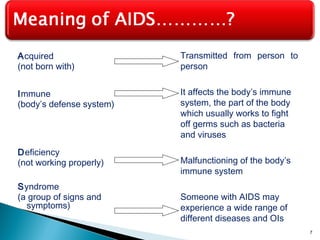
Acquired 
(not born with) 
Immune 
(body’s defense system) 
Deficiency 
(not working properly) 
Syndrome 
(a group of signs and 
symptoms) 
7 
Transmitted from person to 
person 
It affects the body’s immune 
system, the part of the body 
which usually works to fight 
off germs such as bacteria 
and viruses 
Malfunctioning of the body’s 
immune system 
Someone with AIDS may 
experience a wide range of 
different diseases and OIs
9 
 HIV is a virus and AIDS is a disease 
 HIV develops into AIDS 
 AIDS is deficiency in the body’s defense 
mechanism or immune system 
 AIDS is acquired, not hereditary
 The first AIDS case in India was detected in 1986 at Chennai 
 According to the (WHO), there were approximately 
35 millions people worldwide living with HIV/AIDS in 2013. Of these, 3.2 
million were children (<15 years old). 
 4.4 Million people living with the HIV Positive in India (2013) 
 India has the 3rd largest no of people living with HIV at the end of 2013
 In India 2,52000 death are reported on 1dec.2013 
 In M.P. 39114 peoples are living with HIV/AIDS reported 
on oct.2014 
 At the end of 2013 more then ā€œ7ā€ lakh people were on 
ARV therapy, Is the 2nd largest number of people on 
treatment in any single country
 6month to 6year
 HIV (Human Immunodeficiency Virus)
HIV 
1. Attachment 
to host CD4 
cell 
2. Reverse 
transcriptase 
makes DNA 
from the 
virus’s RNA 
3. Integration into host cell’s 
nucleus 
4. Reproduction of 
viral components 
5. Assembly of 
new HIV 
viruses 
6. Release
Viral replication (8-10 years) 
CD4 cell death 
Further impairment of immune system 
Increased likelihood of 
opportunistic infections (OIs) 
AIDS
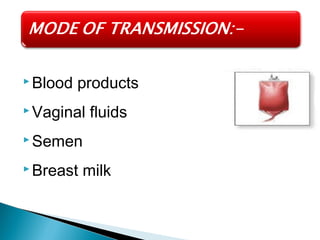
Blood products 
Vaginal fluids 
Semen 
Breast milk
During labour, delivery
 Sharing Needles 
 Unsterilized blades & razor 
Through Sex:-(Unprotected Intercourse) 
Eg, Oral & Anal sex
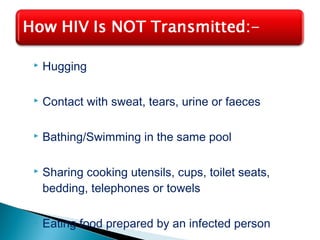
 Hugging 
 Contact with sweat, tears, urine or faeces 
 Bathing/Swimming in the same pool 
 Sharing cooking utensils, cups, toilet seats, 
bedding, telephones or towels 
 Eating food prepared by an infected person
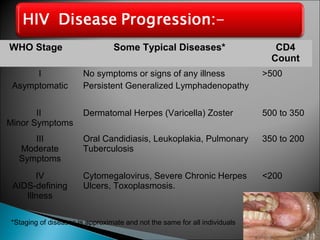
WHO Stage Some Typical Diseases* CD4 
Count 
I 
Asymptomatic 
No symptoms or signs of any illness 
Persistent Generalized Lymphadenopathy 
>500 
II 
Minor Symptoms 
Dermatomal Herpes (Varicella) Zoster 500 to 350 
III 
Moderate 
Symptoms 
Oral Candidiasis, Leukoplakia, Pulmonary 
Tuberculosis 
350 to 200 
IV 
AIDS-defining 
Illness 
Cytomegalovirus, Severe Chronic Herpes 
Ulcers, Toxoplasmosis. 
<200 
*Staging of diseases is approximate and not the same for all individuals
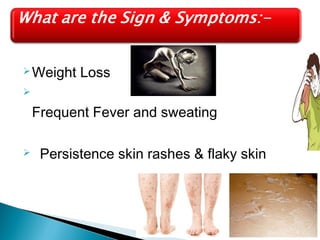
Weight Loss 
 
Frequent Fever and sweating 
 Persistence skin rashes & flaky skin
 Severe & persistence Diarrhea 
 Vision loss 
 Nausea 
 Vomiting 
 Abdominal cramps
24 
11.. HHiissttoorryy 
22.. SSoocciiaall 
HHiissttoorryy 66.. 
LLaabboorraattoorryy 
FFiinnddiinnggss 
55.. PPhhyyssiiccaall 
EExxaammiinnaattiioonn Patient 
33.. SSeexxuuaall 
HHiissttoorryy
 HIV Antibody Tests 
- HIV Rapid test 
- ELISA 
- Western Blot Test (Confirmatory Test) 
 HIV Antigen Tests 
- DNA PCR 
- P24 Antigen
 Note- (Provide infants with 4-6 weeks of once-daily 
Nevirapine or twice-daily Zidovudine ) 
 1. ART(Anti-retroviral Therapy) 
(Anti HIV drugs) 
2. Palliative care 
3. Complimentary therapy 
4. Guidance/Counselling
 Although ART dramatically improves the health 
and life expectancy for PLHIV 
-ART is NOT a cure for AIDS 
- HIV is NEVER entirely eliminated from the body 
 HIV can still be transmitted to others, even when 
the PLHIV is healthy and taking his/her medication 
regularly 
28 
 ART is to be taken lifelong
As HIV 
replication 
decreases 
immune response 
increases 
 ARVs reduce the 
ability of the HIV 
virus to replicate 
 In turn, this 
increases the 
body’s ability to 
fight disease
30
Before ART 
After ART
 Alters/reverses 
course of existing OIs 
 Decreases 
hospitalizations 
 Increases survival 
 Restores hope 
 Improves quality of 
life 
 Reduces HIV 
transmission 
 Benefits both adults 
and children 
ARVs change HIV from a terminal 
(fatal) disease to a chronic disease
2. Palliative care
End of life 
34 
Entry 
Well Continuum of care 
Death 
Palliative care 
Symptom 
Management 
Psychosocial 
Management 
Spiritual 
Management 
Pain 
Management
3. COMPLEMENTARY 
THERAPIES
 Yoga 
 Massage 
 Aromatherapy 
 Relaxation Techniques 
- Meditation 
-Visualization ( Imagery) 
 Laughter Therapy 
 Music Therapy 
 Hydrotherapy
We can reduce sexual transmission of 
HIV. 
We can prevent mothers from dying and 
babies from becoming infected with HIV. 
We can ensure that people living with 
HIV receive treatment. 
We can protect drug users from 
becoming infected with HIV.
We can remove, policies, practices, 
stigma and discrimination that block 
effective responses to AIDS. 
We can stop violence against women and 
girls. 
We can empower young people to protect 
themselves from HIV. 
We can enhance social protection for 
people affected by HIV.
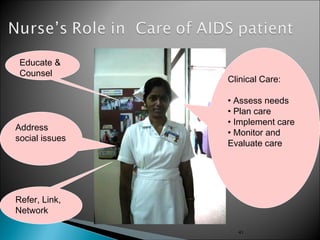
Educate & 
Counsel Clinical Care: 
41 
Address 
social issues 
• Assess needs 
• Plan care 
• Implement care 
• Monitor and 
Evaluate care 
Refer, Link, 
Network
Q 1. Who is causative organism of 
AIDS…?
Q 2.What is the incubation period of 
AIDS..?
Q 3. What is the normal CD4 Cell count...?
Q 4. What is the full form of ELISA…..?
Q 5.Which is confirmatory test for 
HIV/AIDS...?
Q 6. Which drugs we are use to treat 
AIDS..?
ppt on aids

ppt on aids

  • 1.
    BBYY-- MMrr.. AASSHHOOKKBBIISSHHNNOOII LLeeccttuurreerr ,,JJIINNRR
  • 3.
     WBC arethe most important part of the immune system 3  Neutrophils attack bacteria  B-lymphocytes make antibodies  T-lymphocytes ā—¦ Responsible for coordinating the immune system’s attack on viruses, fungi and some bacteria
  • 4.
    4 Important componentsof the immune system Lymphocytes T4-lymphocytes B lymphocytes CD4 type* CD8 type Antibodies HIV uses CD4 cells for replication
  • 5.
  • 6.
     Human: ā—¦Can live only in humans  Immunodeficienc y: ā—¦ Damages the immune system of people it infects  Virus: ā—¦ Retrovirus (RNA) 6 Transmembrane Glycoprotein – gp 41 Envelope Glycoprotein gp 120 Viral genome RNA Nucleoid Core protein p 24 Reverse Transcriptase
  • 7.
    Acquired (not bornwith) Immune (body’s defense system) Deficiency (not working properly) Syndrome (a group of signs and symptoms) 7 Transmitted from person to person It affects the body’s immune system, the part of the body which usually works to fight off germs such as bacteria and viruses Malfunctioning of the body’s immune system Someone with AIDS may experience a wide range of different diseases and OIs
  • 9.
    9  HIVis a virus and AIDS is a disease  HIV develops into AIDS  AIDS is deficiency in the body’s defense mechanism or immune system  AIDS is acquired, not hereditary
  • 10.
     The firstAIDS case in India was detected in 1986 at Chennai  According to the (WHO), there were approximately 35 millions people worldwide living with HIV/AIDS in 2013. Of these, 3.2 million were children (<15 years old).  4.4 Million people living with the HIV Positive in India (2013)  India has the 3rd largest no of people living with HIV at the end of 2013
  • 11.
     In India2,52000 death are reported on 1dec.2013  In M.P. 39114 peoples are living with HIV/AIDS reported on oct.2014  At the end of 2013 more then ā€œ7ā€ lakh people were on ARV therapy, Is the 2nd largest number of people on treatment in any single country
  • 13.
  • 14.
     HIV (HumanImmunodeficiency Virus)
  • 15.
    HIV 1. Attachment to host CD4 cell 2. Reverse transcriptase makes DNA from the virus’s RNA 3. Integration into host cell’s nucleus 4. Reproduction of viral components 5. Assembly of new HIV viruses 6. Release
  • 16.
    Viral replication (8-10years) CD4 cell death Further impairment of immune system Increased likelihood of opportunistic infections (OIs) AIDS
  • 17.
    Blood products Vaginalfluids Semen Breast milk
  • 18.
  • 19.
     Sharing Needles  Unsterilized blades & razor Through Sex:-(Unprotected Intercourse) Eg, Oral & Anal sex
  • 20.
     Hugging Contact with sweat, tears, urine or faeces  Bathing/Swimming in the same pool  Sharing cooking utensils, cups, toilet seats, bedding, telephones or towels  Eating food prepared by an infected person
  • 21.
    WHO Stage SomeTypical Diseases* CD4 Count I Asymptomatic No symptoms or signs of any illness Persistent Generalized Lymphadenopathy >500 II Minor Symptoms Dermatomal Herpes (Varicella) Zoster 500 to 350 III Moderate Symptoms Oral Candidiasis, Leukoplakia, Pulmonary Tuberculosis 350 to 200 IV AIDS-defining Illness Cytomegalovirus, Severe Chronic Herpes Ulcers, Toxoplasmosis. <200 *Staging of diseases is approximate and not the same for all individuals
  • 22.
    Weight Loss  Frequent Fever and sweating  Persistence skin rashes & flaky skin
  • 23.
     Severe &persistence Diarrhea  Vision loss  Nausea  Vomiting  Abdominal cramps
  • 24.
    24 11.. HHiissttoorryy 22.. SSoocciiaall HHiissttoorryy 66.. LLaabboorraattoorryy FFiinnddiinnggss 55.. PPhhyyssiiccaall EExxaammiinnaattiioonn Patient 33.. SSeexxuuaall HHiissttoorryy
  • 25.
     HIV AntibodyTests - HIV Rapid test - ELISA - Western Blot Test (Confirmatory Test)  HIV Antigen Tests - DNA PCR - P24 Antigen
  • 27.
     Note- (Provideinfants with 4-6 weeks of once-daily Nevirapine or twice-daily Zidovudine )  1. ART(Anti-retroviral Therapy) (Anti HIV drugs) 2. Palliative care 3. Complimentary therapy 4. Guidance/Counselling
  • 28.
     Although ARTdramatically improves the health and life expectancy for PLHIV -ART is NOT a cure for AIDS - HIV is NEVER entirely eliminated from the body  HIV can still be transmitted to others, even when the PLHIV is healthy and taking his/her medication regularly 28  ART is to be taken lifelong
  • 29.
    As HIV replication decreases immune response increases  ARVs reduce the ability of the HIV virus to replicate  In turn, this increases the body’s ability to fight disease
  • 30.
  • 31.
  • 32.
     Alters/reverses courseof existing OIs  Decreases hospitalizations  Increases survival  Restores hope  Improves quality of life  Reduces HIV transmission  Benefits both adults and children ARVs change HIV from a terminal (fatal) disease to a chronic disease
  • 33.
  • 34.
    End of life 34 Entry Well Continuum of care Death Palliative care Symptom Management Psychosocial Management Spiritual Management Pain Management
  • 35.
  • 36.
     Yoga Massage  Aromatherapy  Relaxation Techniques - Meditation -Visualization ( Imagery)  Laughter Therapy  Music Therapy  Hydrotherapy
  • 39.
    We can reducesexual transmission of HIV. We can prevent mothers from dying and babies from becoming infected with HIV. We can ensure that people living with HIV receive treatment. We can protect drug users from becoming infected with HIV.
  • 40.
    We can remove,policies, practices, stigma and discrimination that block effective responses to AIDS. We can stop violence against women and girls. We can empower young people to protect themselves from HIV. We can enhance social protection for people affected by HIV.
  • 41.
    Educate & CounselClinical Care: 41 Address social issues • Assess needs • Plan care • Implement care • Monitor and Evaluate care Refer, Link, Network
  • 43.
    Q 1. Whois causative organism of AIDS…?
  • 44.
    Q 2.What isthe incubation period of AIDS..?
  • 45.
    Q 3. Whatis the normal CD4 Cell count...?
  • 46.
    Q 4. Whatis the full form of ELISA…..?
  • 47.
    Q 5.Which isconfirmatory test for HIV/AIDS...?
  • 48.
    Q 6. Whichdrugs we are use to treat AIDS..?

Editor's Notes

  • #4Ā Trainer’s Notes : Discuss the basic components of the immune system in the human body using the points on the slide. The body protects itself from infections in two ways: Skin and mucous membrane: prevent infection from physically entering the body The Immune System: fights infection inside the body. The immune system protects the body by recognizing and destroying: Infectious agents such as bacteria, viruses, and parasites; Abnormal cells; Foreign objects – anything from small objects like thorns, to transplanted organs.
  • #5Ā Trainer’s Notes : T-lymphocytes are processed and stored in the thymus. The most important of T lymphocytes are CD4 type and CD8 type. B-lymphocytes are produced in the bone marrow. The HIV is especially attracted to the CD4 type of lymphocytes. It enters the CD4 lymphocyte and multiplies in them thereby destroying the CD4 cells. Gradual loss of these CD4 cells results in the loss of immunity in these patients. Ask participants to think about how they can give patients simple explanations about the immune system as part of ongoing patient education.
  • #6Ā Trainer’s Notes : Ask participants ā€œAre HIV and AIDS the same thing?ā€ If they say no, ask them ā€œHow are they different?ā€ Wait for their answers and then project the next series of slides.
  • #7Ā Trainer’s Notes : HIV, like all viruses, must enter other cells if it is to replicate and survive. HIV is a ā€œretrovirusā€. The genetic material of retroviruses are carried in the form of RNA rather than DNA. Retroviruses usually contain an enzyme, reverse transcriptase, that helps in converting RNA to DNA during the replication process. Unlike most viruses, HIV cannot be destroyed by the body. After becoming infected, a person has HIV infection for the rest of his/her life. Ā  HIV cannot stay alive outside the human body unless under laboratory conditions.
  • #8Ā Trainer’s Notes : Someone may be infected with HIV for many years before their immune system is damaged sufficiently (CD4&amp;lt;200) to cause opportunistic infections and hence AIDS.
  • #16Ā Trainer’s Notes : Review slide and explain the six stages of the HIV life cycle. HIV uses the CD4 cell like a factory to reproduce more of itself: HIV attaches to the CD4 cell &amp; releases RNA &amp; enzymes on entry The enzyme ā€˜Reverse Transcriptase’ makes a DNA copy of the viral RNA New viral DNA is then integrated using the enzyme ā€˜Integrase’ into the CD4 cell nucleus New viral components are then produced, using the cell’s machinery These are assembled together using the enzyme ā€˜Protease’ The new viruses are released. The host CD4 cell eventually gets destroyed by this process. The normal CD4 count ranges between 500-1500 cells/mm3 Reinforce with video clip
  • #17Ā Trainer’s Notes : As CD4 cells get destroyed, the immune system is weakened. The body’s capacity to fight infections is reduced.Ā  Person becomes susceptible to many infections including OIs (caused by organisms that naturally reside in the body (e.g. PCP) or that are in the environment (e.g. TB). Presence of major OIs indicate AIDS .
  • #21Ā Trainer’s Notes: Brainstorm with participants why HIV cannot be transmitted as mentioned in the slide. Ask participants what other myths they have heard about routes of transmission. Clarify any doubts before moving on. HIV is NOT transmitted by: -Kissing and hugging – contact with intact skin is not harmful -Contact with sweat, tears, urine or faeces – as long as none of these contain blood, they pose no risk for transmission of HIV -Insect bites – HIV cannot be transmitted by insects. -Swimming, sharing utensils, toilet seats, etc. – HIV cannot exist outside the human body, so there is no risk of transmission through these methods -Eating food prepared by an infected person – will not lead to transmission of HIV. This is just a common myth and increases stigma towards HIV +ve people Ask participants what biological factors increase the risk of HIV transmission. After eliciting their responses, screen the next slide.
  • #22Ā Trainer’s Notes : Remind participants of the section on clinical staging covered in Unit 3. This table depicts HIV disease progression with some typical OIs and the relationship with CD4 count. HIV disease progresses with a decrease in CD4 count.
  • #25Ā Trainer’s Notes: The &amp;quot;whole&amp;quot; patient has to be considered in order to get a complete and accurate picture of the situation. Each portion of the assessment – how the patient perceives his/her condition, medical and social histories, the lab results - impacts the final conclusions and will determine the appropriate interventions.
  • #26Ā Trainer’s Notes : Inform the participants that the commonly used HIV tests in India are: 1. Antibody based Tests . 2. Antigen based Tests HIV antibody tests -HIV rapid tests ELISA Western Blot (Confirmatory Test) 3 tests are done before declaring whether a person is HIV positive or negative. In case of indeterminate results or if the person is in the window period the person is advised to return for HIV testing again and is counseled to stay HIV negative .
  • #30Ā Trainer’s Notes : HIV replicates inside CD4 cells, it destroys those CD4 cells and gradually weakens the immune system. ARVs protect the immune system from destruction by reducing the ability of HIV to replicate. With the immune system restored and protected, the body is then able to fight infections.
  • #32Ā Trainer’s Notes : This is a picture of Jyothi from Jyothi’ s Hope video before ART and after starting her on ART.
  • #33Ā Trainer’s Notes : There are many benefits to ART : It helps to stabilize the immune system, reversing the progressive destruction of immune function and increasing the CD4 cell count. Preventing OIs which crop up when there is a severe damage to the immune system and very low CD4 cell count, because the immune system is stronger, OIs are not able to attack. If the infections are already present, their course may be shortened or made less severe with antiretroviral therapy. Antiretroviral therapy has been associated with major reductions in mother-to-child transmission in the developed world and by lowering the amount of virus in the blood, it is expected that other forms of HIV transmission may be reduced as well. Antiretroviral therapy has been shown to benefit both adults and children. The availability of therapy may be an incentive for voluntary HIV counselling and testing, which increases identification of HIV-infected individuals, allowing them to access healthcare and prevent further transmission. The free ART Program of Government of India was launched on 1st April, 2004.
  • #35Ā Trainer’s Notes : Palliative care is most successful when initiated early in the disease progression, since it takes time to develop the necessary supportive relationships between the patient and the interdisciplinary team. It can be initiated any time during the continuum of care. The focus is to reduce symptoms, pain, as well as emotional and spiritual distress so that ultimately the patient could have a comfortable and peaceful death.
  • #42Ā Trainer’s Notes: These are just a few examples of a nurse’s role in care of a person with HIV - participants will have different and/or more responsibilities according to their particular practice sites.