HIV PATHOPHYSIOLOGY: ALL
YOU NEED TO KNOW
Dr. Vishnu R Nair, Pharm-D, RPh,
Dip. (Nutrition),
Assistant Professor (Dept. of
Pharmacy Practice),
NIMS Institute of Pharmacy.
HIV: THE SILENT KILLER
DEFINITIONS:
 HIV (Human Immunodeficiency Virus): Virus, that
attacks cells which help in fighting infections 
reduces immunity of the affected person
 Refer: https://www.hiv.gov/hiv-
basics/overview/about-hiv-and-aids/what-are-hiv-
and-aids
 AIDS (Acquired Immunodeficiency Syndrome): Late
stage of HIV infection, that occurs when the body’s
immune system is badly damaged due to HIV.
EPIDEMIOLOGICAL STATISTICS:
 38 million people are living with HIV worldwide
 African region  remains worst affected (1 out of
every 25 people have HIV)
 Refer: https://www.who.int/gho/hiv/en/
 In India:
a.2.1 million people living with HIV
b.Third largest HIV epidemic in the world
c.Prevalence age of disease: 15-49 years
d.50% of HIV cases in India concentrated in
Maharashtra, Tamil Nadu & Andhra Pradesh
(mostly contracted heterosexually)
e.8% of HIV cases in India  concentrated in
North-East (Manipur) [among intravenous drug
abusers].
f.Refer: https://www.avert.org/professionals/hiv-
around-world/asia-pacific/india
ETIOLOGIC AGENT:
STRUCTURE OF HIV VIRUS.
 AIDS  caused by a HIV virus
 RNA virus in nature (retrovirus)
ROUTES OF TRANSMISSION:
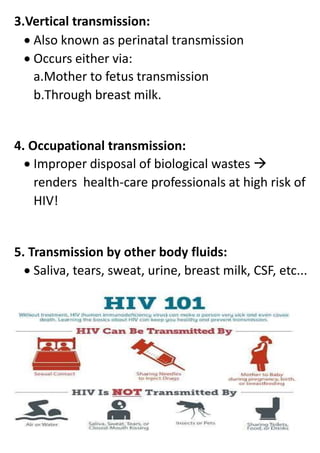
1.Sexual transmission:
 Constitutes 75% of all HIV transmissions
 Other STDs (gonorrhea, chlamydial infections) 
help in HIV spreading
 Transmission from male-to-male & male-to- female
 more potent than female-to-male.
2.Transmission via blood & blood products:
 Occurs due to:
a.Intravenous drug abusers (sharing needles,
syringes)
b.Haemophiliac patients  receive large
amounts of blood from multiple donors  high
risk!
c.Blood transfusions (if blood/ blood product is
infected with HIV)
3.Vertical transmission:
 Also known as perinatal transmission
 Occurs either via:
a.Mother to fetus transmission
b.Through breast milk.
4. Occupational transmission:
 Improper disposal of biological wastes 
renders health-care professionals at high risk of
HIV!
5. Transmission by other body fluids:
 Saliva, tears, sweat, urine, breast milk, CSF, etc...
PATHOGENESIS:
 Major principle: Depletion of CD4+ T-cells
(Helper T-cells)  results in profound
immunosuppression!!
 Explained via the following steps:
A.Selective tropism for CD4+ molecule
receptor
B.Internalisation
C.Uncoating & viral DNA formation
D.Viral integration
E.Viral replication
F.Latent period & immune attack
G.CD4+ T-cell destruction
H.Viral dissemination
I.Impact of HIV infection on other immune
cells.
1. Selective tropism for CD4+ molecule receptor:
 HIV  enters into body  uses its gp120
envelope to bind to CD4+ T-cell
 Tropism means affinity
 In other words,  HIV  has affinity for
CD4+ T-cell  binds to it.
2. Internalization:
 HIV  binds to CD4+ T-cell receptor surface
 For entering into cell membrane  HIV uses
CCR (Chemokine coreceptor)
3. Uncoating & viral DNA formation:
Once virus enters into T-cell cytoplasm
Viral RNA gets converted into DNA, using
enzyme reverse transcriptase
ss-DNA formed
ss-DNA  forms ds-DNA using enzyme DNA
polymerase
This viral DNA  undergoes frequent mutations
Thus, HIV is incurable (less response to anti-
retroviral therapy)!!
4. Viral integration:
Viral DNA in cytoplasm
Enters into nucleus of host T-cell, using
enzyme integrase
Viral particle at this stage  provirus (stage of
virus, where it enters into T-cell DNA, and
becomes part of host cell DNA).
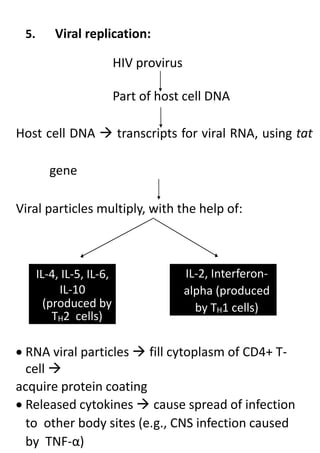
5. Viral replication:
HIV provirus
Part of host cell DNA
Host cell DNA  transcripts for viral RNA, using tat
gene
Viral particles multiply, with the help of:
 RNA viral particles  fill cytoplasm of CD4+ T-
cell 
acquire protein coating
 Released cytokines  cause spread of infection
to other body sites (e.g., CNS infection caused
by TNF-α)
IL-4, IL-5, IL-6,
IL-10
(produced by
TH2 cells)
IL-2, Interferon-
alpha (produced
by TH1 cells)
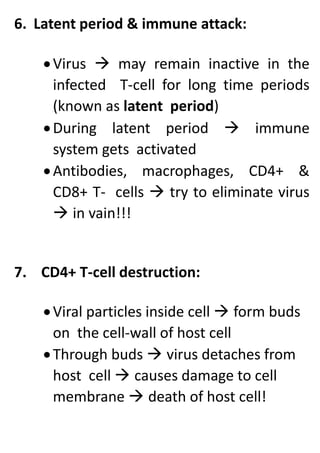
6. Latent period & immune attack:
Virus  may remain inactive in the
infected T-cell for long time periods
(known as latent period)
During latent period  immune
system gets activated
Antibodies, macrophages, CD4+ &
CD8+ T- cells  try to eliminate virus
 in vain!!!
7. CD4+ T-cell destruction:
Viral particles inside cell  form buds
on the cell-wall of host cell
Through buds  virus detaches from
host cell  causes damage to cell
membrane  death of host cell!
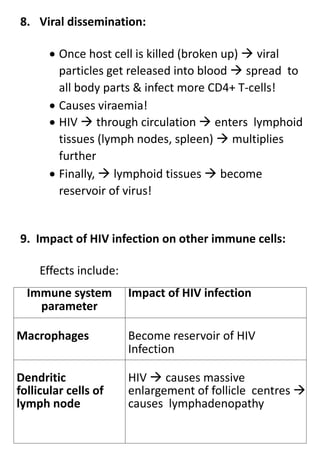
8. Viral dissemination:
 Once host cell is killed (broken up)  viral
particles get released into blood  spread to
all body parts & infect more CD4+ T-cells!
 Causes viraemia!
 HIV  through circulation  enters lymphoid
tissues (lymph nodes, spleen)  multiplies
further
 Finally,  lymphoid tissues  become
reservoir of virus!
9. Impact of HIV infection on other immune cells:
Effects include:
Immune system
parameter
Impact of HIV infection
Macrophages Become reservoir of HIV
Infection
Dendritic
follicular cells of
lymph node
HIV  causes massive
enlargement of follicle centres 
causes lymphadenopathy
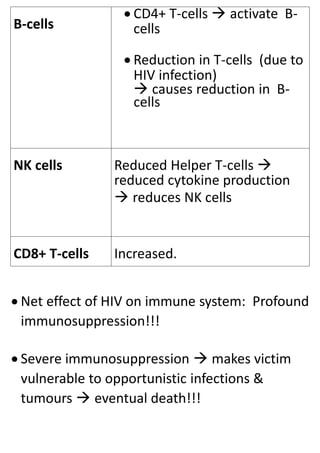
B-cells
 CD4+ T-cells  activate B-
cells
 Reduction in T-cells (due to
HIV infection)
 causes reduction in B-
cells
NK cells Reduced Helper T-cells 
reduced cytokine production
 reduces NK cells
CD8+ T-cells Increased.
 Net effect of HIV on immune system: Profound
immunosuppression!!!
 Severe immunosuppression  makes victim
vulnerable to opportunistic infections &
tumours  eventual death!!!
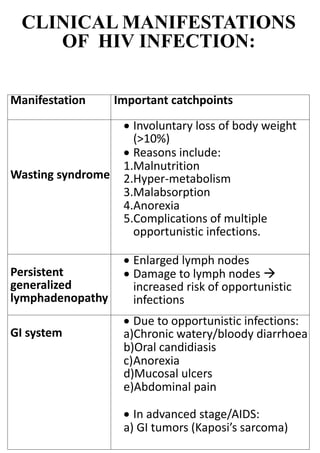
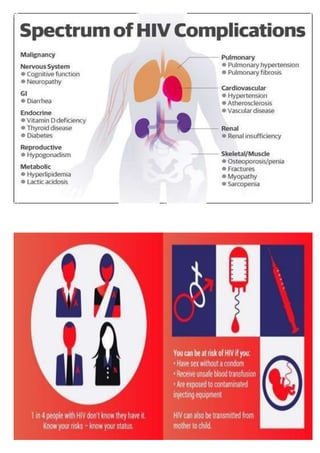
CLINICAL MANIFESTATIONS
OF HIV INFECTION:
Manifestation Important catchpoints
Wasting syndrome
 Involuntary loss of body weight
(>10%)
 Reasons include:
1.Malnutrition
2.Hyper-metabolism
3.Malabsorption
4.Anorexia
5.Complications of multiple
opportunistic infections.
Persistent
generalized
lymphadenopathy
 Enlarged lymph nodes
 Damage to lymph nodes 
increased risk of opportunistic
infections
GI system
 Due to opportunistic infections:
a)Chronic watery/bloody diarrhoea
b)Oral candidiasis
c)Anorexia
d)Mucosal ulcers
e)Abdominal pain
 In advanced stage/AIDS:
a) GI tumors (Kaposi’s sarcoma)
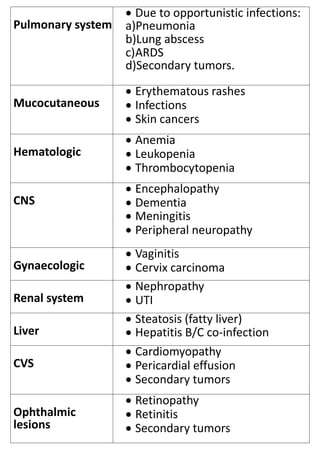
Pulmonary system
 Due to opportunistic infections:
a)Pneumonia
b)Lung abscess
c)ARDS
d)Secondary tumors.
Mucocutaneous
 Erythematous rashes
 Infections
 Skin cancers
Hematologic
 Anemia
 Leukopenia
 Thrombocytopenia
CNS
 Encephalopathy
 Dementia
 Meningitis
 Peripheral neuropathy
Gynaecologic
 Vaginitis
 Cervix carcinoma
Renal system
 Nephropathy
 UTI
Liver
 Steatosis (fatty liver)
 Hepatitis B/C co-infection
CVS
 Cardiomyopathy
 Pericardial effusion
 Secondary tumors
Ophthalmic
lesions
 Retinopathy
 Retinitis
 Secondary tumors
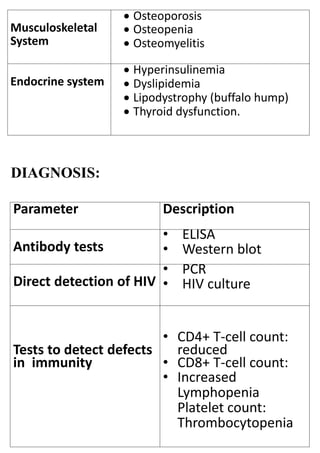
Musculoskeletal
System
 Osteoporosis
 Osteopenia
 Osteomyelitis
Endocrine system
 Hyperinsulinemia
 Dyslipidemia
 Lipodystrophy (buffalo hump)
 Thyroid dysfunction.
DIAGNOSIS:
Parameter Description
Antibody tests
• ELISA
• Western blot
Direct detection of HIV
• PCR
• HIV culture
Tests to detect defects
in immunity
• CD4+ T-cell count:
reduced
• CD8+ T-cell count:
• Increased
Lymphopenia
Platelet count:
Thrombocytopenia
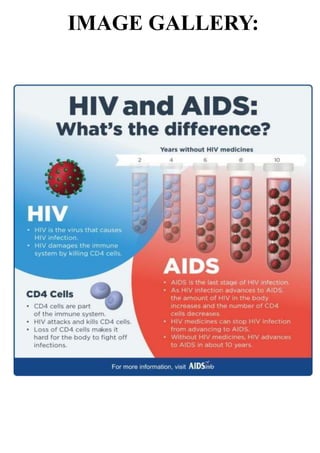
IMAGE GALLERY:
For further reference  check on the
following links:
1.https://www.youtube.com/watch?v=5g1ijp
BI6Dk
2.https://www.youtube.com/watch?v=Qm2
wV- wCCOI
3.https://www.youtube.com/watch?v=8sipX8
6JfUw
THANK YOU!!!

HIV Pathophysiology, by Dr. Vishnu

  • 1.
    HIV PATHOPHYSIOLOGY: ALL YOUNEED TO KNOW Dr. Vishnu R Nair, Pharm-D, RPh, Dip. (Nutrition), Assistant Professor (Dept. of Pharmacy Practice), NIMS Institute of Pharmacy. HIV: THE SILENT KILLER
  • 2.
    DEFINITIONS:  HIV (HumanImmunodeficiency Virus): Virus, that attacks cells which help in fighting infections  reduces immunity of the affected person  Refer: https://www.hiv.gov/hiv- basics/overview/about-hiv-and-aids/what-are-hiv- and-aids  AIDS (Acquired Immunodeficiency Syndrome): Late stage of HIV infection, that occurs when the body’s immune system is badly damaged due to HIV. EPIDEMIOLOGICAL STATISTICS:  38 million people are living with HIV worldwide  African region  remains worst affected (1 out of every 25 people have HIV)  Refer: https://www.who.int/gho/hiv/en/  In India: a.2.1 million people living with HIV b.Third largest HIV epidemic in the world c.Prevalence age of disease: 15-49 years
  • 3.
    d.50% of HIVcases in India concentrated in Maharashtra, Tamil Nadu & Andhra Pradesh (mostly contracted heterosexually) e.8% of HIV cases in India  concentrated in North-East (Manipur) [among intravenous drug abusers]. f.Refer: https://www.avert.org/professionals/hiv- around-world/asia-pacific/india ETIOLOGIC AGENT: STRUCTURE OF HIV VIRUS.
  • 4.
     AIDS caused by a HIV virus  RNA virus in nature (retrovirus) ROUTES OF TRANSMISSION: 1.Sexual transmission:  Constitutes 75% of all HIV transmissions  Other STDs (gonorrhea, chlamydial infections)  help in HIV spreading  Transmission from male-to-male & male-to- female  more potent than female-to-male. 2.Transmission via blood & blood products:  Occurs due to: a.Intravenous drug abusers (sharing needles, syringes) b.Haemophiliac patients  receive large amounts of blood from multiple donors  high risk! c.Blood transfusions (if blood/ blood product is infected with HIV)
  • 5.
    3.Vertical transmission:  Alsoknown as perinatal transmission  Occurs either via: a.Mother to fetus transmission b.Through breast milk. 4. Occupational transmission:  Improper disposal of biological wastes  renders health-care professionals at high risk of HIV! 5. Transmission by other body fluids:  Saliva, tears, sweat, urine, breast milk, CSF, etc...
  • 6.
    PATHOGENESIS:  Major principle:Depletion of CD4+ T-cells (Helper T-cells)  results in profound immunosuppression!!  Explained via the following steps: A.Selective tropism for CD4+ molecule receptor B.Internalisation C.Uncoating & viral DNA formation D.Viral integration E.Viral replication F.Latent period & immune attack G.CD4+ T-cell destruction H.Viral dissemination I.Impact of HIV infection on other immune cells.
  • 7.
    1. Selective tropismfor CD4+ molecule receptor:  HIV  enters into body  uses its gp120 envelope to bind to CD4+ T-cell  Tropism means affinity  In other words,  HIV  has affinity for CD4+ T-cell  binds to it. 2. Internalization:  HIV  binds to CD4+ T-cell receptor surface  For entering into cell membrane  HIV uses CCR (Chemokine coreceptor) 3. Uncoating & viral DNA formation: Once virus enters into T-cell cytoplasm Viral RNA gets converted into DNA, using enzyme reverse transcriptase
  • 8.
    ss-DNA formed ss-DNA forms ds-DNA using enzyme DNA polymerase This viral DNA  undergoes frequent mutations Thus, HIV is incurable (less response to anti- retroviral therapy)!! 4. Viral integration: Viral DNA in cytoplasm Enters into nucleus of host T-cell, using enzyme integrase Viral particle at this stage  provirus (stage of virus, where it enters into T-cell DNA, and becomes part of host cell DNA).
  • 9.
    5. Viral replication: HIVprovirus Part of host cell DNA Host cell DNA  transcripts for viral RNA, using tat gene Viral particles multiply, with the help of:  RNA viral particles  fill cytoplasm of CD4+ T- cell  acquire protein coating  Released cytokines  cause spread of infection to other body sites (e.g., CNS infection caused by TNF-α) IL-4, IL-5, IL-6, IL-10 (produced by TH2 cells) IL-2, Interferon- alpha (produced by TH1 cells)
  • 10.
    6. Latent period& immune attack: Virus  may remain inactive in the infected T-cell for long time periods (known as latent period) During latent period  immune system gets activated Antibodies, macrophages, CD4+ & CD8+ T- cells  try to eliminate virus  in vain!!! 7. CD4+ T-cell destruction: Viral particles inside cell  form buds on the cell-wall of host cell Through buds  virus detaches from host cell  causes damage to cell membrane  death of host cell!
  • 11.
    8. Viral dissemination: Once host cell is killed (broken up)  viral particles get released into blood  spread to all body parts & infect more CD4+ T-cells!  Causes viraemia!  HIV  through circulation  enters lymphoid tissues (lymph nodes, spleen)  multiplies further  Finally,  lymphoid tissues  become reservoir of virus! 9. Impact of HIV infection on other immune cells: Effects include: Immune system parameter Impact of HIV infection Macrophages Become reservoir of HIV Infection Dendritic follicular cells of lymph node HIV  causes massive enlargement of follicle centres  causes lymphadenopathy
  • 12.
    B-cells  CD4+ T-cells activate B- cells  Reduction in T-cells (due to HIV infection)  causes reduction in B- cells NK cells Reduced Helper T-cells  reduced cytokine production  reduces NK cells CD8+ T-cells Increased.  Net effect of HIV on immune system: Profound immunosuppression!!!  Severe immunosuppression  makes victim vulnerable to opportunistic infections & tumours  eventual death!!!
  • 13.
    CLINICAL MANIFESTATIONS OF HIVINFECTION: Manifestation Important catchpoints Wasting syndrome  Involuntary loss of body weight (>10%)  Reasons include: 1.Malnutrition 2.Hyper-metabolism 3.Malabsorption 4.Anorexia 5.Complications of multiple opportunistic infections. Persistent generalized lymphadenopathy  Enlarged lymph nodes  Damage to lymph nodes  increased risk of opportunistic infections GI system  Due to opportunistic infections: a)Chronic watery/bloody diarrhoea b)Oral candidiasis c)Anorexia d)Mucosal ulcers e)Abdominal pain  In advanced stage/AIDS: a) GI tumors (Kaposi’s sarcoma)
  • 14.
    Pulmonary system  Dueto opportunistic infections: a)Pneumonia b)Lung abscess c)ARDS d)Secondary tumors. Mucocutaneous  Erythematous rashes  Infections  Skin cancers Hematologic  Anemia  Leukopenia  Thrombocytopenia CNS  Encephalopathy  Dementia  Meningitis  Peripheral neuropathy Gynaecologic  Vaginitis  Cervix carcinoma Renal system  Nephropathy  UTI Liver  Steatosis (fatty liver)  Hepatitis B/C co-infection CVS  Cardiomyopathy  Pericardial effusion  Secondary tumors Ophthalmic lesions  Retinopathy  Retinitis  Secondary tumors
  • 15.
    Musculoskeletal System  Osteoporosis  Osteopenia Osteomyelitis Endocrine system  Hyperinsulinemia  Dyslipidemia  Lipodystrophy (buffalo hump)  Thyroid dysfunction. DIAGNOSIS: Parameter Description Antibody tests • ELISA • Western blot Direct detection of HIV • PCR • HIV culture Tests to detect defects in immunity • CD4+ T-cell count: reduced • CD8+ T-cell count: • Increased Lymphopenia Platelet count: Thrombocytopenia
  • 16.
  • 18.
    For further reference check on the following links: 1.https://www.youtube.com/watch?v=5g1ijp BI6Dk 2.https://www.youtube.com/watch?v=Qm2 wV- wCCOI 3.https://www.youtube.com/watch?v=8sipX8 6JfUw THANK YOU!!!