HIV AIDS
Daisy Dharmaraj M.D.
Dpt of Community Medicine
ACS Medical College, Chennai
Introduction
• AIDS Acquired Immuno deficiency syndrome is
a fatal illness caused by the Human Immuno
deficiency virus (HIV).
• The immune system of the body is broken down,
and the body is made vulnerable to life
threatening infections, neurological disorder s or
unusual malignancies
• Infection is for life by a retro virus
• Modern pandemic affecting the whole world
• Recognised as an emerging disease in
early 80s
• Global pandemic. Tens of millions infected
in less than 20 years
• Number infected, number of deaths
continues to grow. Eastern Europe and
central Asia
• Children : 1.5 million in 2001 to 2.5 in 2011
• Estimated prevalence was 0.8% in 2011
• Pre dominant route of infection:
unprotected heterosexual
• Others are unprotected penetrative sex
bet men; Inj drug use; unsafe blood
transfusions and injections
• Time lag bet infection and the onset of full
disease 9 -11 years
• Greatest mortality impact bet 20 – 40 yrs
of age.
• Women die earlier
• Interaction with other diseases is a public
health concern
Global attempts
• Initiative 3 by 5 : 3 million to receive ART
by 2005 achieved in 2007
• Treatment 2.0 initiative by WHO UNAIDS
in 2010
• Global health sector strategy on HIV AIDS
for 2011- 2015
Global health sector strategy on HIV AIDS
for 2011- 2015
a)optimise HIV prevention diagnosis,
treatment and care outcomes
b) leverage broader health outcomes
through HIV responses
c) build strong and sustainable health
systems
d) address inequalities and advance human
rights
AIDS epidemic has been halted and begun
to reverse the spread of HIV
Now the worry is – how soon will there be
• Zero discrimination
• Zero new infection and
• Zero AIDS related deaths through
universal access to effective HIV
prevention, treatment care and support
• Resurgence of Tb. Co-infection
• Women represent 50% of PLHIV
• Age 15-24 comprise of 40% of PLHIV
• Combination ART in 1996, reduced
mortality
• 2010- WHO initiated earlier treatment. i.e.
if CD4 is < 350 cells/mm3
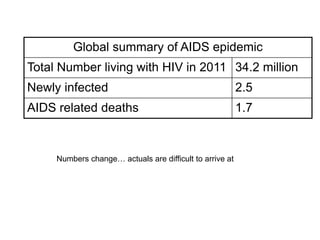
Global summary of AIDS epidemic
Total Number living with HIV in 2011 34.2 million
Newly infected 2.5
AIDS related deaths 1.7
Numbers change… actuals are difficult to arrive at
Types of HIV epidemics-
WHO and UNAIDS
Low level – largely confined to individuals
with high risk behaviour
Not >5% prevalence in sub population
Concentrated- rapid spread into sub
population, but not well established in
general population > 5% in at least 1
defined sub population but is below 1% in
pregnant women in urban areas
Generalized
HIV firmly established in the general
population..HIV prevalence is consistently
over 1% in pregnant women
Main aim: reduce the incidence 2.5
milllion in 2007
Sub saharan Africa has world’s 68% of HIV
+ adults and >90% of infected children
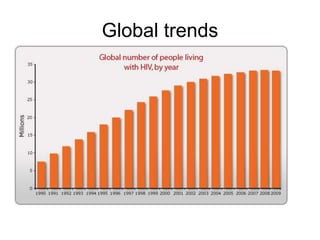
Global trends
Pondichery
Gujarat
Karnataka
Goa
Lakshwadeep
Dadra Nagar Haveli
Maharashtra
Madhya Pradesh
Tamil Nadu
Andhra Pradesh
Punjab
Rajasthan
Daman & Diu
J & K
Haryana
Uttar Pradesh
Himachal Pradesh
Delhi
Chandigarh
Bihar
West Bengal
Orissa
Andaman & Nicobar
Mizoram
Meghalaya
Assam
Sikkim
Manipur
Tripura
Arunachal Pradesh
Nagaland
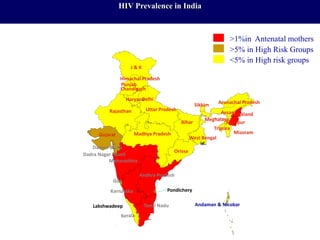
>1%in Antenatal mothers
>5% in High Risk Groups
<5% in High risk groups
HIV Prevalence in India
India
• Heterogenicity- not a single epidemic but a
number of distinct epidemics in some
places within the same state
• Highest risk behaviour group….prevalence
of >5% Bridge population….General
population
• Time lag of 2-3 years between the shifts
Patterns of HIV epidemic at
national level-%
ANC STD IDU MSM FSW Migrant Truckers
0.48 2.46 9.16 7.3 4.94 2.35 1.62
Classification of states by HIV
prevalence in adult population
Group 1
High prevalence
states
>5% in high risk
group and
>1% in ANC
Maharshtra,
Tamil nadu,
Karnataka, AP,
Manipur,
Nagaland
Group 2
Moderate
prevalence
states
>5% in high risk
group and
<1% in ANC
Gujarat,
Goa,
Pondicherri
Group 3
Low prevalence
states
<5% in high risk
group and
<1% in ANC
others
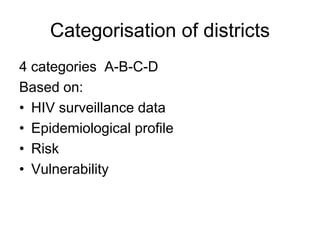
Categorisation of districts
4 categories A-B-C-D
Based on:
• HIV surveillance data
• Epidemiological profile
• Risk
• Vulnerability
ANC/PTCT
prevalence
during last 3
years
HRG
>1% in any site A
< 1% >5% in any HRG group B
<1% in ANC <5% in all STD clinic attendees
or any HRG with known hot
spots
C
<1% in ANC <5% in all STD clinic attendees
or any HRG with known hot
spots or poor data with no
known hot spots
D
Epidemiological features- Agent
Lymphadenopathy asociated virus LAV; Human T cell lymphotroic virus III HTLV
III May 1986_ Human Immuno deficiency virus
Replicates in actively dividing T4 lymphocytes can be latent
Destroy human T4 helper cells.Spreads throughout the body but concentration
most in semen, vaginal fluids and CSF
Type 1
Type II
• Reservoir : cases and carriers
• Source of infection: semen, blood and
CSF
HOST Factors
• Age: 20-49 yrs
• Sex; Men / women
• High risk groups: Male homosexuals,
multiple partners, IVDU, transfusion
recipients, haemophiliacs, Clients of STI
Mode of transmission
• Sexual hetero / homo. If STI exists 8 to 10
times higher transmission Window period
• Blood and Blood products >95%. Also
tattooing etc
• Maternal 30% Prevention of parent to child
transmission PMTCT
The agent – HIV- a retro virus
• A retrovirus is an RNA virus that is replicated in
a host cell via the enzyme reverse transcriptase
to produce DNA from its RNA genome.
• The DNA is then incorporated into the host's
genome by an integrase enzyme.
• The virus thereafter replicates as part of the host
cell's DNA.
• Rapidly mutates
• Depletes T 4 helper cells rapidly
Epidemiological features- Agent
Lymphadenopathy asociated virus LAV; Human T cell
lymphotroic virus III HTLV III
May 1986_ Human Immuno deficiency virus
Replicates in actively dividing T4 lymphocytes.
Can be latent
Destroys human T4 helper cells. CD4
Spreads throughout the body but concentration most
in semen, vaginal fluids and CSF
Type 1 / Type II
• Reservoir : cases and carriers
• Source of infection: semen, blood and
CSF
HOST Factors
Age: 20-49 yrs
Sex; Men / women
High risk groups:
Male homosexuals, multiple partners,
IVDU, transfusion recipients,
haemophiliacs, Clients of STI
Mode of transmission
• Sexual : hetero / homosexual. If STI exists
8 to 10 times higher transmission -
Window period
• Blood and Blood products: >95%. Also
tattooing etc
• Maternal/ vertical : 30% Prevention of
parent to child transmission PMTCT
Clinical manifestations
1. Initial infection and development of
antibodies
2. Asymptomatic carrier stage
3. AIDS related complex
4. AIDS
Diagnosis of AIDS :
Clinical: For AIDS surveillance- WHO definition
At least 2 major and 1 minor
Major signs
• Wt loss>10% of
body wt
• Chronic diarrhoea>1
mth
• Prolonged fever > 1
mth
Minor signs
• Persistent cough > 1 mth
• Generalised pruritic dermatitis
• h/o herpes zoster
• Oro pharyngeal candidiasis
• Chronic progressive or
disseminated herpes simplex
inf
• Generalised lymphadenopathy
**Kaposi’s sarcoma / cryptococcus meningitis alone – sufficient
for diagnosis
For :Children
Clinical: For AIDS surveillance- WHO definition
At least 2 major and 1 minor
Major signs
• Wt loss or
abnormally slow
growth
• Chronic diarrhoea>1
mth
• Prolonged fever > 1
mth
Minor signs
• Generalised lymphadenopathy
• Generalised rash
• Recurrent commpn infections-
ear, pharynx
• Oro pharyngeal candidiasis
• Persistent cough
• Confirmed infection in the
mother
**Kaposi’s sarcoma / cryptococcus meningitis alone – sufficient
for diagnosis
• Clinical manifestations – reliable indicator
of underlying HIV infection
• Overuse of HIV testing is avoided- testing
is for confirmation
• Counselling is necessary Pre and post
test
• Many HIV related illnesses can be treated
• Some drugs cause severe reaction and
are avoided- thiacetazone
Remember….
Expanded WHO case definition for
AIDS surveillance
A Positive Elisa Test for HIV PLUS one or more of the
following
• >10% body wt loss, cachexia, +diarrhoea/ fever without
a known cause
• Cryptococcal meningitis
• Pulm or extra pulm TB
• Kaposi Sarcoma
• Neurological impairment without a known cause
• Oesophagial candidiasis
• Invasive cervical cancer
WHO for Clinical Staging system
for HIV infection and HIV related disease
• Clinical condition
• Performance score
Whichever is higher determines the
stage 1 -4
Clinical staging is important as criterion to
start ART
WHO clinical staging in adults/adolescents
Stage 1 Asymptomatic. Persistent generalised
lymphadenopathy
Stage Wt loss<10%, recurrent URI, Herpes zoster, ang
cheilitis, recurrent oral ulcers,papular pruritic
eruptions, seborrhiec dermatitis, fungal nail
infections
Stage Unexplained wt loss >10%, chronic diarrhoea >1
mth, persistent oral candidiasis, oral hairy
leukoplakia, Pulm TB, severe bact infections,
unexplained pneumonia
Stage HIV wasting syndrome,pneumocystitis
pneumonia, recurrent severe bact pneumonia,
oesophagial candidiasis,extrapulm Tb, kaposi’s
sarcoma, CMV retinitis, HIV encephalopathy, etc
Window period
• Antibody tests may give false negative (no
antibodies were detected despite the
presence of HIV) results during the window
period, an interval of three weeks to six
months between the time of HIV infection
and the production of measurable
antibodies to HIV seroconversion.
• During the window period, an infected
person can transmit HIV to others
although the blood test is negative for
HIV
1.Initial infection
• Fever sore throat rash – 70%
2.Asymptomatic carrier stage- no symptoms for
abt 5 yrs
3. AIDS related complex
• Unexplained diarrhoea
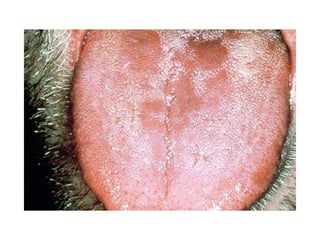
• Oral thrush
• Generalised lymphadenopathy
• Enlarged spleen
2 or more of these + < CD
4 + AIDS related complex
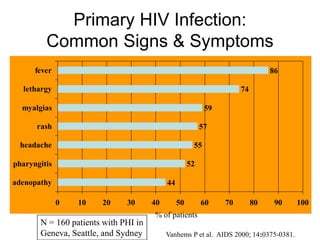
Primary HIV Infection:
Common Signs & Symptoms
44
52
55
57
59
74
86
0 10 20 30 40 50 60 70 80 90 100
adenopathy
pharyngitis
headache
rash
myalgias
lethargy
fever
N = 160 patients with PHI in
Geneva, Seattle, and Sydney Vanhems P et al. AIDS 2000; 14:0375-0381.
% of patients
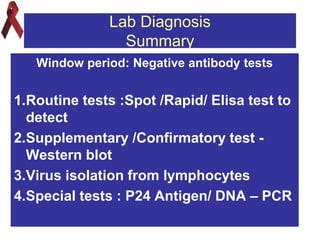
Lab Diagnosis
Summary
Window period: Negative antibody tests
1.Routine tests :Spot /Rapid/ Elisa test to
detect
2.Supplementary /Confirmatory test -
Western blot
3.Virus isolation from lymphocytes
4.Special tests : P24 Antigen/ DNA – PCR
The enzyme-linked immunosorbent
assay (ELISA), or enzyme
immunoassay (EIA), was the first
screening test commonly employed for
HIV. It has a high sensitivity.
First a sensitive test and second confirmatory test done
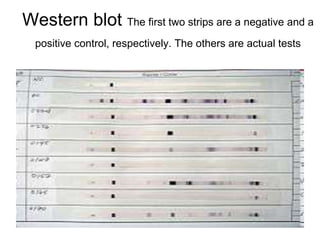
Western blot The first two strips are a negative and a
positive control, respectively. The others are actual tests
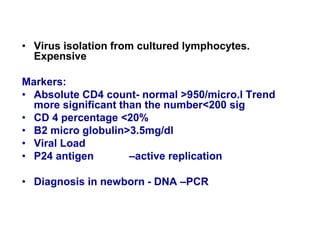
• Virus isolation from cultured lymphocytes.
Expensive
Markers:
• Absolute CD4 count- normal >950/micro.l Trend
more significant than the number<200 sig
• CD 4 percentage <20%
• B2 micro globulin>3.5mg/dl
• Viral Load
• P24 antigen –active replication
• Diagnosis in newborn - DNA –PCR
HIV
Infection
Long-term
Non-progressors
Rapid Progressors
Typical Progressors
<3 years
7-10 years
>10-15 yr
Normal, Stable CD4
90 %
<5 %
<10 %
Progression of HIV infection
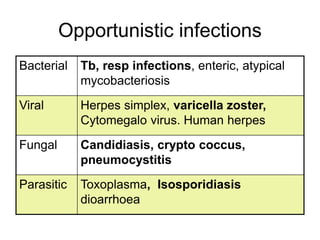
Opportunistic infections
Bacterial Tb, resp infections, enteric, atypical
mycobacteriosis
Viral Herpes simplex, varicella zoster,
Cytomegalo virus. Human herpes
Fungal Candidiasis, crypto coccus,
pneumocystitis
Parasitic Toxoplasma, Isosporidiasis
dioarrhoea
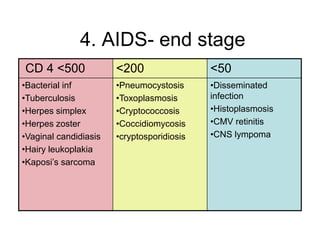
4. AIDS- end stage
CD 4 <500 <200 <50
•Bacterial inf
•Tuberculosis
•Herpes simplex
•Herpes zoster
•Vaginal candidiasis
•Hairy leukoplakia
•Kaposi’s sarcoma
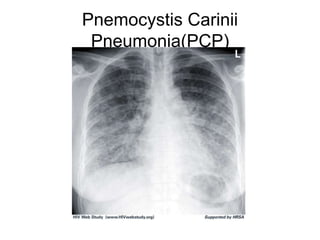
•Pneumocystosis
•Toxoplasmosis
•Cryptococcosis
•Coccidiomycosis
•cryptosporidiosis
•Disseminated
infection
•Histoplasmosis
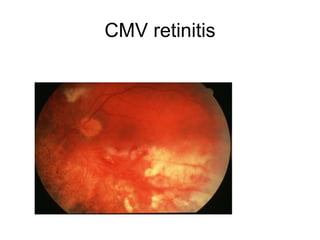
•CMV retinitis
•CNS lympoma
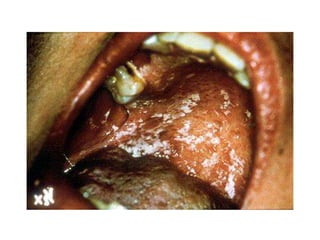
Angular cheilitis
Pnemocystis Carinii
Pneumonia(PCP)
Disseminated TB
Karposi’s sarcoma
Herpes zoster
CMV retinitis
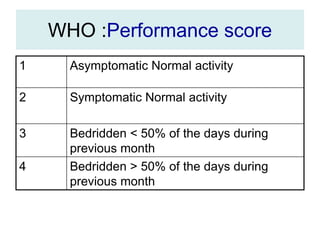
WHO :Performance score
1 Asymptomatic Normal activity
2 Symptomatic Normal activity
3 Bedridden < 50% of the days during
previous month
4 Bedridden > 50% of the days during
previous month
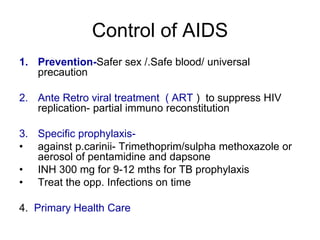
Control of AIDS
1. Prevention-Safer sex /.Safe blood/ universal
precaution
2. Ante Retro viral treatment ( ART ) to suppress HIV
replication- partial immuno reconstitution
3. Specific prophylaxis-
• against p.carinii- Trimethoprim/sulpha methoxazole or
aerosol of pentamidine and dapsone
• INH 300 mg for 9-12 mths for TB prophylaxis
• Treat the opp. Infections on time
4. Primary Health Care
Primary prevention
• Education
Information Education and Communication
Behaviour change communication –BCC
Needle sharing
PMTCT
Safer sex
Prevention of blood borne HIV
transmission
• Infected persons should not donate
biological products
• Screen all blood for HIV 1 & 2
• Heat treatment of factors VII and IX for
haemophiliacs
• Strict sterilisation practices
• Sterile needles/ disposables
• Avoid injections
Universal Precaution
against HIV AIDS
1. Assume that all patients in the hospital are HIV
infected.
2. Observe universal precautions at all times.
3. Never bend or recap needles.
4. Dispose off hospital waste appropriately.
5. Prepare disinfectants fresh & in correct
concentrations.
6. Attend to blood spills promptly and properly.
7. Disinfect ,clean &sterilize critical instruments.
8. PEP –In case of accidental sharp injury ,seek
expert’s help immediately!
Antiretroviral treatment
• Nucleoside reverse transcriptase inhibitors
NRTIs- abacavir, Lamivudine, stavudine, zidovidine
• Nucletside reverse transcriptase inhibitors
NtRTIs - tenofir
• Non-nucleoside reverse transcriptase
inhibitors NNRTIs- efavirenz,nevirapine
• Protease inhibitors PIs- ATV, FPV
• Integrase strand transfer inhibitors INSTIs
Occupational Post exposure prophylaxis- PEP
Initiate within the first few hours. Not later than 72 hrs
• first aid care; counselling;
• risk assessment;
• 28day provision of ARV- start<72 hrs-2 NRTI drugs.
Add PI if drug resistance is suspected.
• support and follow up
• If HIV test is neg, repeat at 3 and 6 mths
• Training
• Evaluate working conditions and procedures and make
changes if needed
Monitoring the efficacy of ART
1. Clinical improvement- gain in body
weight, decrease in infections and
malignancies
2. Increase in total lymphocyte count
3. Improvement in biological markers of
HIV. CD4, T-lymphocytes, plasma HIV
RNA levels
Specific prophylaxis
• Primary prophylaxis against P carinii
pneumonia- Trimethoprim/ sulpha
methoxazole, areosolized pentamidine
and dapsome
• M.avium complex- Ribafutin. Ensure no M
Tb
• Tb- INH 300mg for 9-12 mths
• Treat Kaposi’s sarcoma, CMV retinits ,
oesoph.candidiasis
Prevention of Mother to Child
transmission of HIV (PMTCT)
ARV after first trimester
• Zidovudine 300 mg twice a day.
• ZDV 300 mg three hourly during delivery
Or 200 mg NVP single dose during labour(
reduces risk of transmission from 35% to
12%)
Prevent Premature Rupture Of Membranes
PMTCT Contd..
• Elective LSCS done as early as 36 -38
wks
• Vaginal disinfection with chlorhexidine
• Avoid episiotomy/ suture early if done
• Cut umbilical cord without milking it and
after the pulsation stops
Care of the newborn
• Suck the throat first
• Wipe the baby’s body thoroughly with
warm clean towel
• Single dose of NVP 2 mg/kg syrup orally
within 72 hrs
• or ZDV 4 mgper kg for 6 weeks.
Care During breastfeeding
• Ensure proper nutrition during ANC
• Prevent sore nipple
• Should breast feed -Exclusive bf only upto 3
mths / 6 mths abruptly substitute with other milk
• Do not mixfeed
• Surrogate feeding from uninfected mother
• Risk of transmission 10-15%
Other options – infant formula
WHO recommendations for ART (2010)
• If CD4 is < 350 cells/mm3 start on ART. For those with severe
clinical disease. Start regardless of CD4 counts
• First line NNRTI + 2 NRTI one of which should be Zidovudine
or Tenofovir
• Second line retinovir boosted PI +2NRTI one of which should
be AZT or TDF
• Lab monitoring for pre ART and ART management. HIVRNA-
viral load recommended to confirm suspected failure
• HIV / TB coinfection- irrespective of CD4 counts start ART as
soon as possible after starting anti TB drugs.
• HIV/HBV coinfection: first and second line should have TDF ,
FTC or 3 TC
WHO launched AIDS control in 1987
India: National AIDS control Program
• NACP Phase 1-1992
• NACP Phase II -1999
• National aids control policy 2002
• NACP Phase III -2007-2012
• NACP Phase IV-2014
National AIDS control program IV
national strategy
• Establishment of surveillance centres
tocover whole country
• Identify High risk groups and their screening
• Issuing specific guidelines for managemen
of cases and follow up Guidelines for blood
banks, blood product manufacturers, blood
donors dialysis units
• IEC and research
• Control of STD
• Condoms program
Package of services
• Care and support
• Lab services for CD4 and others
• ART first and second line through ART centres,
centres of excellence, and ART plus centres
• Paedeatric ART
• Early infant diagnosis
• Care and support centres
• HIv/TB coordination
• Treatment of OI
• Drop in centres for PLHIV networks
Prevention programs
• Targeted intervention for HR
groups and bridge populations
• Needle exchange. Opioid
substitution for IVDU
• Prevention intervention for
migrant population at source,
transit and destination
• Link worker scheme for HRG
and vulnerable population in
rural areas
• STI prevention RTI prevention
• Blood safety
• HIV counseling and
testing
• PPTCT
• Condom promotion
• BCC,IEC
• Social mobilization
• Mainstreaming HIV
AIDS
• Work place
intervention
Integrate prevention
into Primary Health Care
Uniting the world
against AIDS
THANK YOU

HIV AIDS for paramedical workers

  • 1.
    HIV AIDS Daisy DharmarajM.D. Dpt of Community Medicine ACS Medical College, Chennai
  • 2.
    Introduction • AIDS AcquiredImmuno deficiency syndrome is a fatal illness caused by the Human Immuno deficiency virus (HIV). • The immune system of the body is broken down, and the body is made vulnerable to life threatening infections, neurological disorder s or unusual malignancies • Infection is for life by a retro virus • Modern pandemic affecting the whole world
  • 3.
    • Recognised asan emerging disease in early 80s • Global pandemic. Tens of millions infected in less than 20 years • Number infected, number of deaths continues to grow. Eastern Europe and central Asia
  • 4.
    • Children :1.5 million in 2001 to 2.5 in 2011 • Estimated prevalence was 0.8% in 2011 • Pre dominant route of infection: unprotected heterosexual • Others are unprotected penetrative sex bet men; Inj drug use; unsafe blood transfusions and injections
  • 5.
    • Time lagbet infection and the onset of full disease 9 -11 years • Greatest mortality impact bet 20 – 40 yrs of age. • Women die earlier • Interaction with other diseases is a public health concern
  • 6.
    Global attempts • Initiative3 by 5 : 3 million to receive ART by 2005 achieved in 2007 • Treatment 2.0 initiative by WHO UNAIDS in 2010 • Global health sector strategy on HIV AIDS for 2011- 2015
  • 7.
    Global health sectorstrategy on HIV AIDS for 2011- 2015 a)optimise HIV prevention diagnosis, treatment and care outcomes b) leverage broader health outcomes through HIV responses c) build strong and sustainable health systems d) address inequalities and advance human rights
  • 8.
    AIDS epidemic hasbeen halted and begun to reverse the spread of HIV Now the worry is – how soon will there be • Zero discrimination • Zero new infection and • Zero AIDS related deaths through universal access to effective HIV prevention, treatment care and support
  • 9.
    • Resurgence ofTb. Co-infection • Women represent 50% of PLHIV • Age 15-24 comprise of 40% of PLHIV • Combination ART in 1996, reduced mortality • 2010- WHO initiated earlier treatment. i.e. if CD4 is < 350 cells/mm3
  • 10.
    Global summary ofAIDS epidemic Total Number living with HIV in 2011 34.2 million Newly infected 2.5 AIDS related deaths 1.7 Numbers change… actuals are difficult to arrive at
  • 11.
    Types of HIVepidemics- WHO and UNAIDS Low level – largely confined to individuals with high risk behaviour Not >5% prevalence in sub population Concentrated- rapid spread into sub population, but not well established in general population > 5% in at least 1 defined sub population but is below 1% in pregnant women in urban areas
  • 12.
    Generalized HIV firmly establishedin the general population..HIV prevalence is consistently over 1% in pregnant women Main aim: reduce the incidence 2.5 milllion in 2007 Sub saharan Africa has world’s 68% of HIV + adults and >90% of infected children
  • 13.
  • 14.
    Pondichery Gujarat Karnataka Goa Lakshwadeep Dadra Nagar Haveli Maharashtra MadhyaPradesh Tamil Nadu Andhra Pradesh Punjab Rajasthan Daman & Diu J & K Haryana Uttar Pradesh Himachal Pradesh Delhi Chandigarh Bihar West Bengal Orissa Andaman & Nicobar Mizoram Meghalaya Assam Sikkim Manipur Tripura Arunachal Pradesh Nagaland >1%in Antenatal mothers >5% in High Risk Groups <5% in High risk groups HIV Prevalence in India
  • 15.
    India • Heterogenicity- nota single epidemic but a number of distinct epidemics in some places within the same state • Highest risk behaviour group….prevalence of >5% Bridge population….General population • Time lag of 2-3 years between the shifts
  • 16.
    Patterns of HIVepidemic at national level-% ANC STD IDU MSM FSW Migrant Truckers 0.48 2.46 9.16 7.3 4.94 2.35 1.62
  • 17.
    Classification of statesby HIV prevalence in adult population Group 1 High prevalence states >5% in high risk group and >1% in ANC Maharshtra, Tamil nadu, Karnataka, AP, Manipur, Nagaland Group 2 Moderate prevalence states >5% in high risk group and <1% in ANC Gujarat, Goa, Pondicherri Group 3 Low prevalence states <5% in high risk group and <1% in ANC others
  • 18.
    Categorisation of districts 4categories A-B-C-D Based on: • HIV surveillance data • Epidemiological profile • Risk • Vulnerability
  • 19.
    ANC/PTCT prevalence during last 3 years HRG >1%in any site A < 1% >5% in any HRG group B <1% in ANC <5% in all STD clinic attendees or any HRG with known hot spots C <1% in ANC <5% in all STD clinic attendees or any HRG with known hot spots or poor data with no known hot spots D
  • 20.
    Epidemiological features- Agent Lymphadenopathyasociated virus LAV; Human T cell lymphotroic virus III HTLV III May 1986_ Human Immuno deficiency virus Replicates in actively dividing T4 lymphocytes can be latent Destroy human T4 helper cells.Spreads throughout the body but concentration most in semen, vaginal fluids and CSF Type 1 Type II
  • 21.
    • Reservoir :cases and carriers • Source of infection: semen, blood and CSF HOST Factors • Age: 20-49 yrs • Sex; Men / women • High risk groups: Male homosexuals, multiple partners, IVDU, transfusion recipients, haemophiliacs, Clients of STI
  • 22.
    Mode of transmission •Sexual hetero / homo. If STI exists 8 to 10 times higher transmission Window period • Blood and Blood products >95%. Also tattooing etc • Maternal 30% Prevention of parent to child transmission PMTCT
  • 23.
    The agent –HIV- a retro virus • A retrovirus is an RNA virus that is replicated in a host cell via the enzyme reverse transcriptase to produce DNA from its RNA genome. • The DNA is then incorporated into the host's genome by an integrase enzyme. • The virus thereafter replicates as part of the host cell's DNA. • Rapidly mutates • Depletes T 4 helper cells rapidly
  • 24.
    Epidemiological features- Agent Lymphadenopathyasociated virus LAV; Human T cell lymphotroic virus III HTLV III May 1986_ Human Immuno deficiency virus Replicates in actively dividing T4 lymphocytes. Can be latent Destroys human T4 helper cells. CD4 Spreads throughout the body but concentration most in semen, vaginal fluids and CSF Type 1 / Type II
  • 25.
    • Reservoir :cases and carriers • Source of infection: semen, blood and CSF HOST Factors Age: 20-49 yrs Sex; Men / women High risk groups: Male homosexuals, multiple partners, IVDU, transfusion recipients, haemophiliacs, Clients of STI
  • 26.
    Mode of transmission •Sexual : hetero / homosexual. If STI exists 8 to 10 times higher transmission - Window period • Blood and Blood products: >95%. Also tattooing etc • Maternal/ vertical : 30% Prevention of parent to child transmission PMTCT
  • 27.
    Clinical manifestations 1. Initialinfection and development of antibodies 2. Asymptomatic carrier stage 3. AIDS related complex 4. AIDS
  • 28.
    Diagnosis of AIDS: Clinical: For AIDS surveillance- WHO definition At least 2 major and 1 minor Major signs • Wt loss>10% of body wt • Chronic diarrhoea>1 mth • Prolonged fever > 1 mth Minor signs • Persistent cough > 1 mth • Generalised pruritic dermatitis • h/o herpes zoster • Oro pharyngeal candidiasis • Chronic progressive or disseminated herpes simplex inf • Generalised lymphadenopathy **Kaposi’s sarcoma / cryptococcus meningitis alone – sufficient for diagnosis
  • 29.
    For :Children Clinical: ForAIDS surveillance- WHO definition At least 2 major and 1 minor Major signs • Wt loss or abnormally slow growth • Chronic diarrhoea>1 mth • Prolonged fever > 1 mth Minor signs • Generalised lymphadenopathy • Generalised rash • Recurrent commpn infections- ear, pharynx • Oro pharyngeal candidiasis • Persistent cough • Confirmed infection in the mother **Kaposi’s sarcoma / cryptococcus meningitis alone – sufficient for diagnosis
  • 30.
    • Clinical manifestations– reliable indicator of underlying HIV infection • Overuse of HIV testing is avoided- testing is for confirmation • Counselling is necessary Pre and post test • Many HIV related illnesses can be treated • Some drugs cause severe reaction and are avoided- thiacetazone Remember….
  • 31.
    Expanded WHO casedefinition for AIDS surveillance A Positive Elisa Test for HIV PLUS one or more of the following • >10% body wt loss, cachexia, +diarrhoea/ fever without a known cause • Cryptococcal meningitis • Pulm or extra pulm TB • Kaposi Sarcoma • Neurological impairment without a known cause • Oesophagial candidiasis • Invasive cervical cancer
  • 32.
    WHO for ClinicalStaging system for HIV infection and HIV related disease • Clinical condition • Performance score Whichever is higher determines the stage 1 -4 Clinical staging is important as criterion to start ART
  • 33.
    WHO clinical stagingin adults/adolescents Stage 1 Asymptomatic. Persistent generalised lymphadenopathy Stage Wt loss<10%, recurrent URI, Herpes zoster, ang cheilitis, recurrent oral ulcers,papular pruritic eruptions, seborrhiec dermatitis, fungal nail infections Stage Unexplained wt loss >10%, chronic diarrhoea >1 mth, persistent oral candidiasis, oral hairy leukoplakia, Pulm TB, severe bact infections, unexplained pneumonia Stage HIV wasting syndrome,pneumocystitis pneumonia, recurrent severe bact pneumonia, oesophagial candidiasis,extrapulm Tb, kaposi’s sarcoma, CMV retinitis, HIV encephalopathy, etc
  • 34.
    Window period • Antibodytests may give false negative (no antibodies were detected despite the presence of HIV) results during the window period, an interval of three weeks to six months between the time of HIV infection and the production of measurable antibodies to HIV seroconversion. • During the window period, an infected person can transmit HIV to others although the blood test is negative for HIV
  • 35.
    1.Initial infection • Feversore throat rash – 70% 2.Asymptomatic carrier stage- no symptoms for abt 5 yrs 3. AIDS related complex • Unexplained diarrhoea • Oral thrush • Generalised lymphadenopathy • Enlarged spleen 2 or more of these + < CD 4 + AIDS related complex
  • 36.
    Primary HIV Infection: CommonSigns & Symptoms 44 52 55 57 59 74 86 0 10 20 30 40 50 60 70 80 90 100 adenopathy pharyngitis headache rash myalgias lethargy fever N = 160 patients with PHI in Geneva, Seattle, and Sydney Vanhems P et al. AIDS 2000; 14:0375-0381. % of patients
  • 37.
    Lab Diagnosis Summary Window period:Negative antibody tests 1.Routine tests :Spot /Rapid/ Elisa test to detect 2.Supplementary /Confirmatory test - Western blot 3.Virus isolation from lymphocytes 4.Special tests : P24 Antigen/ DNA – PCR
  • 38.
    The enzyme-linked immunosorbent assay(ELISA), or enzyme immunoassay (EIA), was the first screening test commonly employed for HIV. It has a high sensitivity. First a sensitive test and second confirmatory test done
  • 39.
    Western blot Thefirst two strips are a negative and a positive control, respectively. The others are actual tests
  • 40.
    • Virus isolationfrom cultured lymphocytes. Expensive Markers: • Absolute CD4 count- normal >950/micro.l Trend more significant than the number<200 sig • CD 4 percentage <20% • B2 micro globulin>3.5mg/dl • Viral Load • P24 antigen –active replication • Diagnosis in newborn - DNA –PCR
  • 41.
    HIV Infection Long-term Non-progressors Rapid Progressors Typical Progressors <3years 7-10 years >10-15 yr Normal, Stable CD4 90 % <5 % <10 % Progression of HIV infection
  • 42.
    Opportunistic infections Bacterial Tb,resp infections, enteric, atypical mycobacteriosis Viral Herpes simplex, varicella zoster, Cytomegalo virus. Human herpes Fungal Candidiasis, crypto coccus, pneumocystitis Parasitic Toxoplasma, Isosporidiasis dioarrhoea
  • 43.
    4. AIDS- endstage CD 4 <500 <200 <50 •Bacterial inf •Tuberculosis •Herpes simplex •Herpes zoster •Vaginal candidiasis •Hairy leukoplakia •Kaposi’s sarcoma •Pneumocystosis •Toxoplasmosis •Cryptococcosis •Coccidiomycosis •cryptosporidiosis •Disseminated infection •Histoplasmosis •CMV retinitis •CNS lympoma
  • 47.
  • 48.
  • 50.
  • 51.
  • 52.
  • 53.
    WHO :Performance score 1Asymptomatic Normal activity 2 Symptomatic Normal activity 3 Bedridden < 50% of the days during previous month 4 Bedridden > 50% of the days during previous month
  • 54.
    Control of AIDS 1.Prevention-Safer sex /.Safe blood/ universal precaution 2. Ante Retro viral treatment ( ART ) to suppress HIV replication- partial immuno reconstitution 3. Specific prophylaxis- • against p.carinii- Trimethoprim/sulpha methoxazole or aerosol of pentamidine and dapsone • INH 300 mg for 9-12 mths for TB prophylaxis • Treat the opp. Infections on time 4. Primary Health Care
  • 55.
    Primary prevention • Education InformationEducation and Communication Behaviour change communication –BCC Needle sharing PMTCT Safer sex
  • 56.
    Prevention of bloodborne HIV transmission • Infected persons should not donate biological products • Screen all blood for HIV 1 & 2 • Heat treatment of factors VII and IX for haemophiliacs • Strict sterilisation practices • Sterile needles/ disposables • Avoid injections
  • 57.
    Universal Precaution against HIVAIDS 1. Assume that all patients in the hospital are HIV infected. 2. Observe universal precautions at all times. 3. Never bend or recap needles. 4. Dispose off hospital waste appropriately. 5. Prepare disinfectants fresh & in correct concentrations. 6. Attend to blood spills promptly and properly. 7. Disinfect ,clean &sterilize critical instruments. 8. PEP –In case of accidental sharp injury ,seek expert’s help immediately!
  • 58.
    Antiretroviral treatment • Nucleosidereverse transcriptase inhibitors NRTIs- abacavir, Lamivudine, stavudine, zidovidine • Nucletside reverse transcriptase inhibitors NtRTIs - tenofir • Non-nucleoside reverse transcriptase inhibitors NNRTIs- efavirenz,nevirapine • Protease inhibitors PIs- ATV, FPV • Integrase strand transfer inhibitors INSTIs
  • 59.
    Occupational Post exposureprophylaxis- PEP Initiate within the first few hours. Not later than 72 hrs • first aid care; counselling; • risk assessment; • 28day provision of ARV- start<72 hrs-2 NRTI drugs. Add PI if drug resistance is suspected. • support and follow up • If HIV test is neg, repeat at 3 and 6 mths • Training • Evaluate working conditions and procedures and make changes if needed
  • 60.
    Monitoring the efficacyof ART 1. Clinical improvement- gain in body weight, decrease in infections and malignancies 2. Increase in total lymphocyte count 3. Improvement in biological markers of HIV. CD4, T-lymphocytes, plasma HIV RNA levels
  • 61.
    Specific prophylaxis • Primaryprophylaxis against P carinii pneumonia- Trimethoprim/ sulpha methoxazole, areosolized pentamidine and dapsome • M.avium complex- Ribafutin. Ensure no M Tb • Tb- INH 300mg for 9-12 mths • Treat Kaposi’s sarcoma, CMV retinits , oesoph.candidiasis
  • 62.
    Prevention of Motherto Child transmission of HIV (PMTCT) ARV after first trimester • Zidovudine 300 mg twice a day. • ZDV 300 mg three hourly during delivery Or 200 mg NVP single dose during labour( reduces risk of transmission from 35% to 12%) Prevent Premature Rupture Of Membranes
  • 63.
    PMTCT Contd.. • ElectiveLSCS done as early as 36 -38 wks • Vaginal disinfection with chlorhexidine • Avoid episiotomy/ suture early if done • Cut umbilical cord without milking it and after the pulsation stops
  • 64.
    Care of thenewborn • Suck the throat first • Wipe the baby’s body thoroughly with warm clean towel • Single dose of NVP 2 mg/kg syrup orally within 72 hrs • or ZDV 4 mgper kg for 6 weeks.
  • 65.
    Care During breastfeeding •Ensure proper nutrition during ANC • Prevent sore nipple • Should breast feed -Exclusive bf only upto 3 mths / 6 mths abruptly substitute with other milk • Do not mixfeed • Surrogate feeding from uninfected mother • Risk of transmission 10-15% Other options – infant formula
  • 66.
    WHO recommendations forART (2010) • If CD4 is < 350 cells/mm3 start on ART. For those with severe clinical disease. Start regardless of CD4 counts • First line NNRTI + 2 NRTI one of which should be Zidovudine or Tenofovir • Second line retinovir boosted PI +2NRTI one of which should be AZT or TDF • Lab monitoring for pre ART and ART management. HIVRNA- viral load recommended to confirm suspected failure • HIV / TB coinfection- irrespective of CD4 counts start ART as soon as possible after starting anti TB drugs. • HIV/HBV coinfection: first and second line should have TDF , FTC or 3 TC
  • 67.
    WHO launched AIDScontrol in 1987 India: National AIDS control Program • NACP Phase 1-1992 • NACP Phase II -1999 • National aids control policy 2002 • NACP Phase III -2007-2012 • NACP Phase IV-2014
  • 68.
    National AIDS controlprogram IV national strategy • Establishment of surveillance centres tocover whole country • Identify High risk groups and their screening • Issuing specific guidelines for managemen of cases and follow up Guidelines for blood banks, blood product manufacturers, blood donors dialysis units • IEC and research • Control of STD • Condoms program
  • 69.
    Package of services •Care and support • Lab services for CD4 and others • ART first and second line through ART centres, centres of excellence, and ART plus centres • Paedeatric ART • Early infant diagnosis • Care and support centres • HIv/TB coordination • Treatment of OI • Drop in centres for PLHIV networks
  • 70.
    Prevention programs • Targetedintervention for HR groups and bridge populations • Needle exchange. Opioid substitution for IVDU • Prevention intervention for migrant population at source, transit and destination • Link worker scheme for HRG and vulnerable population in rural areas • STI prevention RTI prevention • Blood safety • HIV counseling and testing • PPTCT • Condom promotion • BCC,IEC • Social mobilization • Mainstreaming HIV AIDS • Work place intervention
  • 71.
  • 72.