HIV/AIDS
Mrs. Namita Batra Guin
Associate Professor
Dept. of Community Health Nursing
• FATAL DISEASE
• Caused by retrovirus- Human immuno-
deficiency virus. Attacks the immune system.
• Modern day pandemic.
• 2.7 million people infected with HIV in 2007,
• 33 million people living with HIV, including
millions who have developed AIDS.
HIV infection
• HIV breaks down the body’s immune system,
leaving victim vulnerable to life threatening
opportunistic infections.
• Implies the entire course of HIV infection,
from asymptomatic infection to early
symptoms to AIDS
AIDS
• Acquired immuno-deficiency syndrome.
• Most severe form of continuum of illness
associated with HIV infection.
• If untreated, it causes slow degeneration of
the immune system with the development of
opportunistic infections and malignancies.
• AIDS refers to the last stage of HIV infection
EPIDEMIOLOGICAL DETERMINANTS
• AGENT: retrovirus. Has unique ability
to destroy human T4 helper cells.
Virus spreads throughout the body,
can cross blood brain barrier and can
destroy brain cells.
• Can be kiiled by heat and can be
inactivated by ether, acetone and
ethanol.
EPIDEMIOLOGICAL DETERMINANTS
• Reservoir of infection: cases and
carriers. Once infected, virus remains
in body life long. Symptomless carrier
can infect other people for years.
• Sources of infection: greatest conc. in
blood, semen and CSF. Lower conc. in
tears, saliva, breast milk, urine and
cervical and vaginal secretions. Also
isolated from : bone marrow, lymph
nodes and skin etc.
EPIDEMIOLOGICAL DETERMINANTS
• HOST:
– AGE- sexually active persons aged 20-49 years
– SEX- equal in both the sexes.
– HIGH RISK GROUP- male homosexuals, bisexuals,
heterosexual partners (including prostitutes), I.V.
drug abusers, transfusion recipients of blood
and blood products, hemophiliacs and clients of
STD.
– IMMUNOLOGY- immune system disorders are
associated with HIV infection/AIDS
MODES OF TRANSMISSION
• Sexual transmission
• Blood contact
• Maternal-fetal transmission
• INCUBATION PERIOD: uncertain
(few months to 6 or more years)
STAGES OF HIV INFECTION
• Primary HIV infection:
– Acute HIV infection
– Approximately 50-90% of persons experience a brief flu
like symptoms about 2-4weeks following exposure to HIV.
– During this, there is sudden decrease in CD4 cells and
increase in viral load for a brief period before returning to
baseline.
– Typical Symptoms include:
• Fever
• Adenopathy
• Pharyngitis
• Rash
STAGES OF HIV INFECTION
• HIV asymptomatic:
– Infected person have antibodies but no overt signs
of disease except persistent generalized
lymphadenopathy.
– Viral level reaches a set point
– On an average 8-10years pass before major HIV
related complication develops.
– Apparently good health because level of CD4
remain high enough.
STAGES OF HIV INFECTION
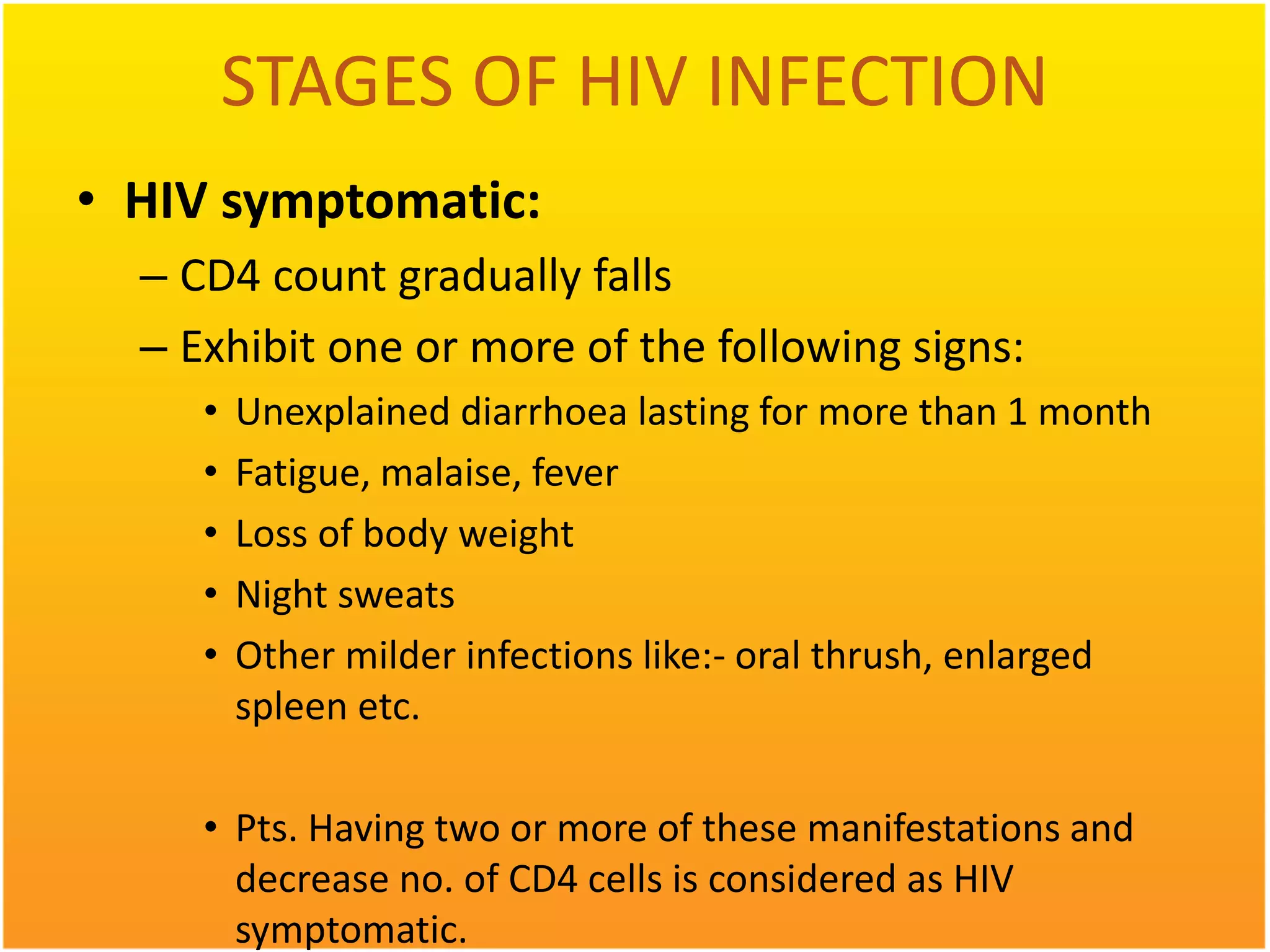
• HIV symptomatic:
– CD4 count gradually falls
– Exhibit one or more of the following signs:
• Unexplained diarrhoea lasting for more than 1 month
• Fatigue, malaise, fever
• Loss of body weight
• Night sweats
• Other milder infections like:- oral thrush, enlarged
spleen etc.
• Pts. Having two or more of these manifestations and
decrease no. of CD4 cells is considered as HIV
symptomatic.
STAGES OF HIV INFECTION
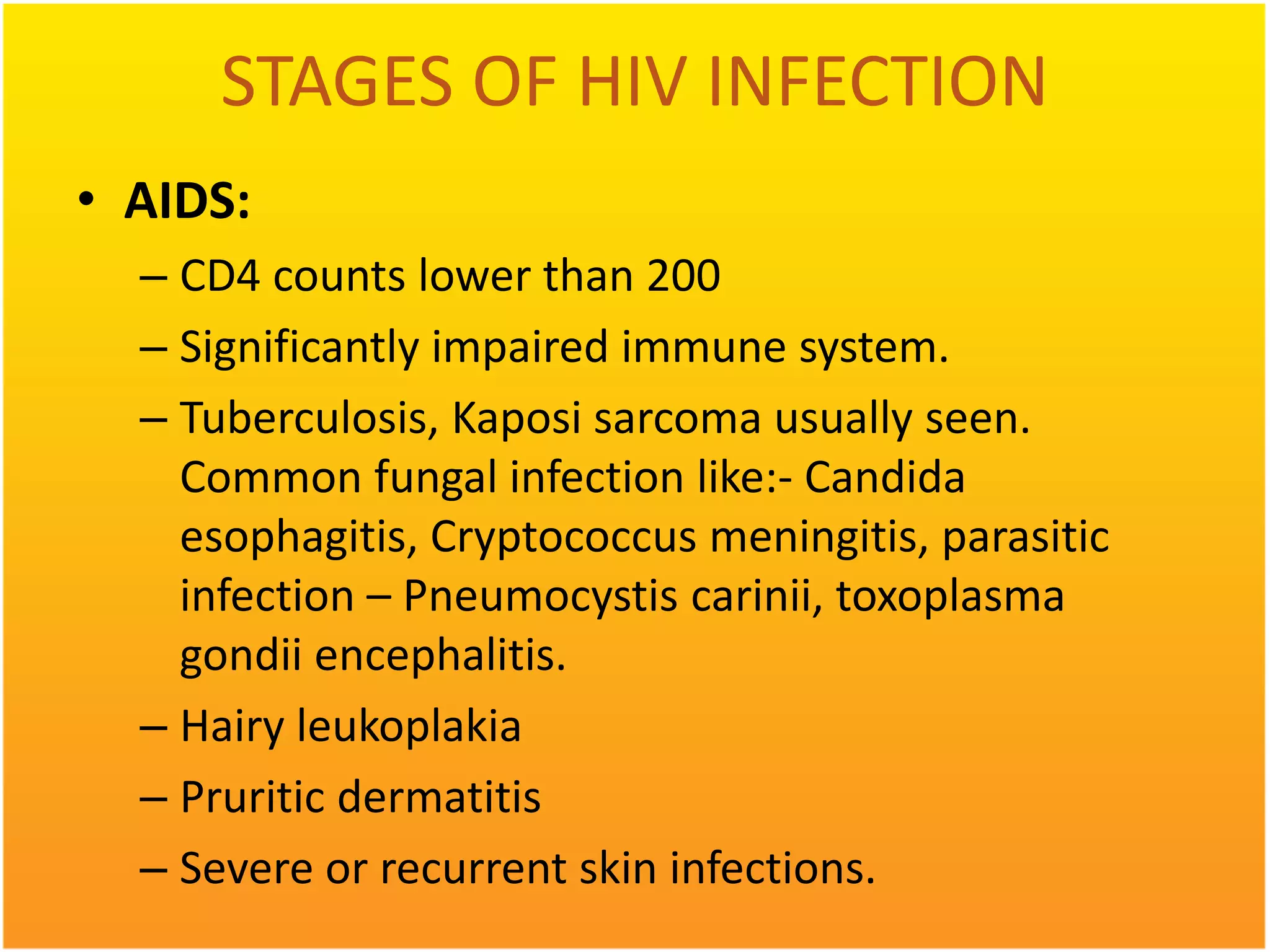
• AIDS:
– CD4 counts lower than 200
– Significantly impaired immune system.
– Tuberculosis, Kaposi sarcoma usually seen.
Common fungal infection like:- Candida
esophagitis, Cryptococcus meningitis, parasitic
infection – Pneumocystis carinii, toxoplasma
gondii encephalitis.
– Hairy leukoplakia
– Pruritic dermatitis
– Severe or recurrent skin infections.
ORAL CANDIDIASIS
ESOPHAGEAL CANDIDIASIS
LEUKOPLAKIA
KAPOSI SARCOMA
DIAGNOSIS
• Cinical
– Major signs- weight loss, chronic
diarrhoea, prolonged fever for more
than 1 month.
– Minor signs- persistent cough for
more than 1 month, generalized
pruritic dermatitis, H/o herpes
zoster,oropharyngeal cadidiasis,
chronic progressive or disseminated
herpes simplex infection, generalized
lymphadenopathy.
DIAGNOSIS
• Laboratory:
– ELISA- enzyme linked
immunosorbent assay- for detecting
antibody to HIV.
– Western Blot- used to confirm the
positive result on ELISA.
– CBC- Anemia, neutropenia and
thrombocytopenia.
– CD4 lymphocyte percentage.
TREATMENT
• HAART: Highly Active Anti-Retroviral Therapy.
• Consist of medications of four different
classifications as they prevent replication at
four different points.
• Drugs- Nucleoside/nucleotide reverse
transcriptase inhibitors (NRTI),Non
nucleoside reverse transcriptase inhibitors
(NNRTI),Protease inhibitors (PI) and Entry
inhibitors
TREATMENT
• Goals of treatment-
– Prolong life and improve quality of life.
– Reduce viral load as low as possible for as long as
possible.
– Increase the CD4 count to allow immune
reconstitution.
– Maintain options for future treatment by
preventing the development of treatment
resistant virus .
– Avoid drug toxicity.
TREATMENT
• Therapy usually consists of:
– 2 NRTI combined with either NNRTI or boosted
Protease inhibitor.
– Ritonavir usually used as booster.
– Two NRTI used are- zidovudine, lamivudine
combined with NNRTI- efavirenz
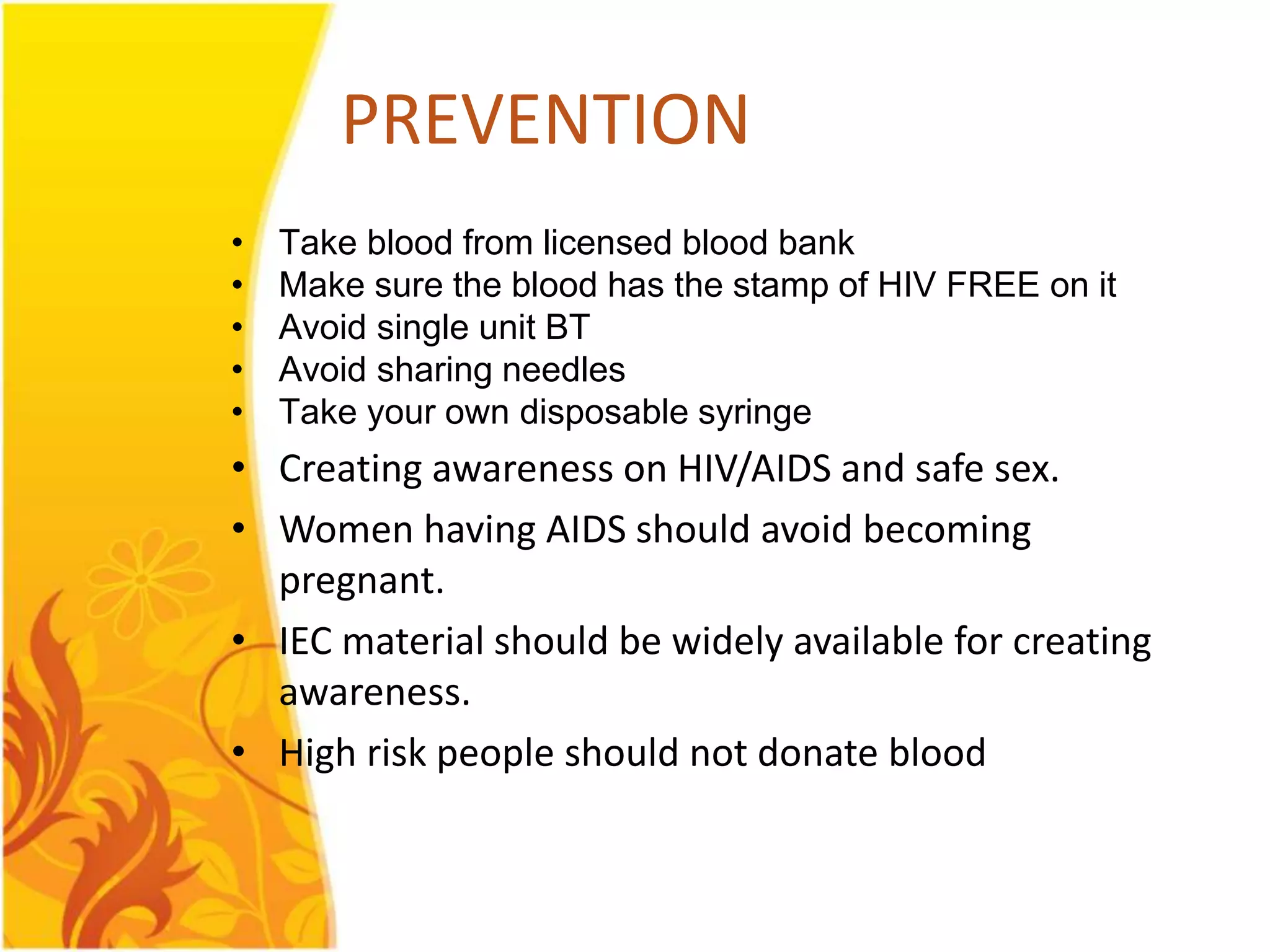
PREVENTION
• Take blood from licensed blood bank
• Make sure the blood has the stamp of HIV FREE on it
• Avoid single unit BT
• Avoid sharing needles
• Take your own disposable syringe
• Creating awareness on HIV/AIDS and safe sex.
• Women having AIDS should avoid becoming
pregnant.
• IEC material should be widely available for creating
awareness.
• High risk people should not donate blood
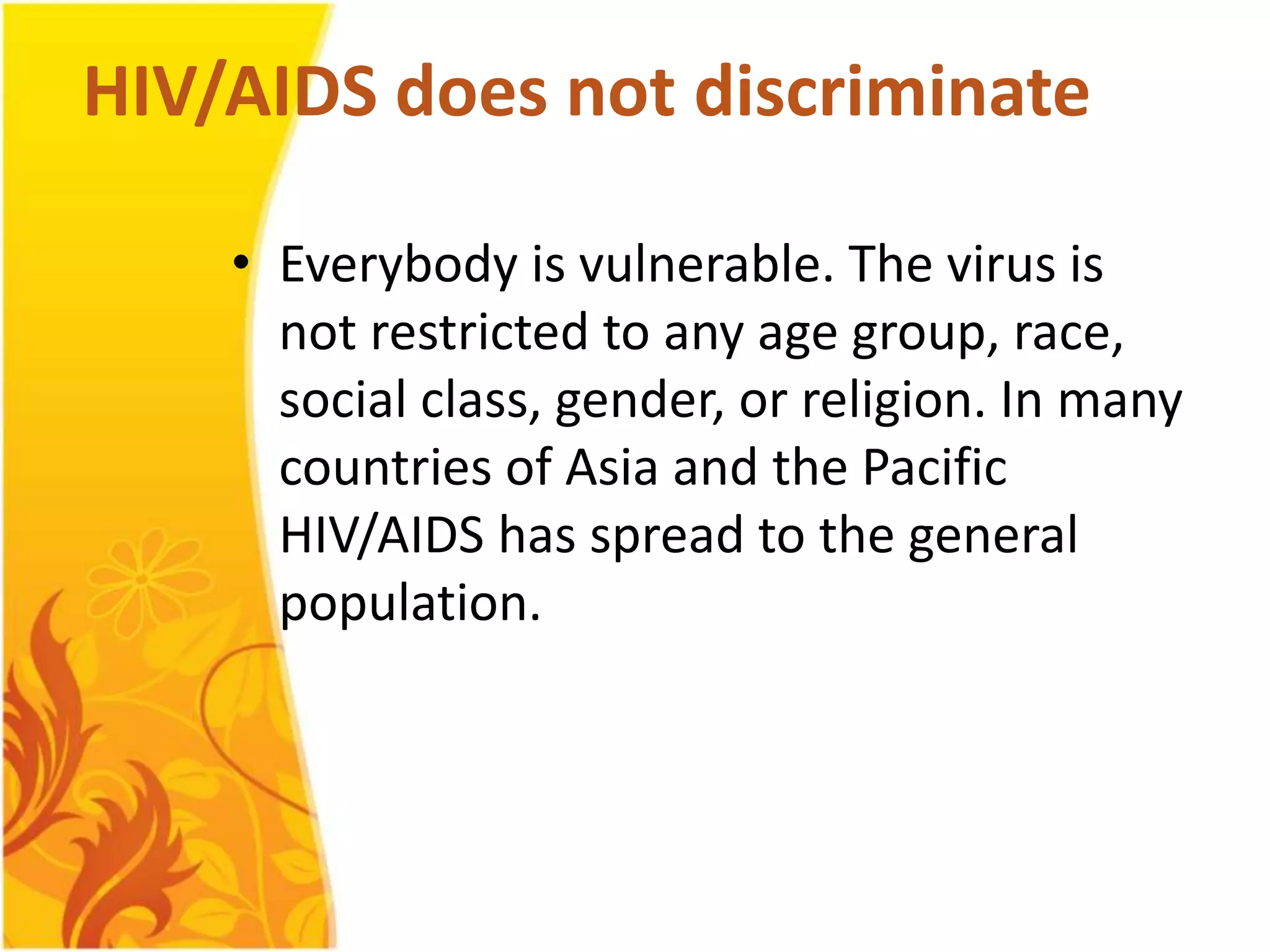
HIV/AIDS does not discriminate
• Everybody is vulnerable. The virus is
not restricted to any age group, race,
social class, gender, or religion. In many
countries of Asia and the Pacific
HIV/AIDS has spread to the general
population.
No country is immune to the
epidemic
• The HIV/AIDS epidemic can spread very
quickly
• Low HIV prevalence rates in the general
population of a country can conceal
serious epidemics in smaller, high-risk
groups or in certain areas
• The epidemic can quickly cross over
from high-risk groups to the general
population
Awareness is the only way
• There are no cures or vaccines for HIV/AIDS.
Currently awareness/education is the only
way to prevent infection.
• Preventive education also means preventing
stigma, denial, and discrimination.
• HIV/ADS is associated with sex, disease, and
death, and with behaviours that may be
illegal, forbidden or taboo, such as pre- and
extramarital sex, sex work, sex between men,
and injecting drug use. Awareness will reduce
the HIV vulnerability.

Hiv aids- epidemiology

  • 1.
    HIV/AIDS Mrs. Namita BatraGuin Associate Professor Dept. of Community Health Nursing
  • 2.
    • FATAL DISEASE •Caused by retrovirus- Human immuno- deficiency virus. Attacks the immune system. • Modern day pandemic. • 2.7 million people infected with HIV in 2007, • 33 million people living with HIV, including millions who have developed AIDS.
  • 3.
    HIV infection • HIVbreaks down the body’s immune system, leaving victim vulnerable to life threatening opportunistic infections. • Implies the entire course of HIV infection, from asymptomatic infection to early symptoms to AIDS
  • 4.
    AIDS • Acquired immuno-deficiencysyndrome. • Most severe form of continuum of illness associated with HIV infection. • If untreated, it causes slow degeneration of the immune system with the development of opportunistic infections and malignancies. • AIDS refers to the last stage of HIV infection
  • 5.
    EPIDEMIOLOGICAL DETERMINANTS • AGENT:retrovirus. Has unique ability to destroy human T4 helper cells. Virus spreads throughout the body, can cross blood brain barrier and can destroy brain cells. • Can be kiiled by heat and can be inactivated by ether, acetone and ethanol.
  • 6.
    EPIDEMIOLOGICAL DETERMINANTS • Reservoirof infection: cases and carriers. Once infected, virus remains in body life long. Symptomless carrier can infect other people for years. • Sources of infection: greatest conc. in blood, semen and CSF. Lower conc. in tears, saliva, breast milk, urine and cervical and vaginal secretions. Also isolated from : bone marrow, lymph nodes and skin etc.
  • 7.
    EPIDEMIOLOGICAL DETERMINANTS • HOST: –AGE- sexually active persons aged 20-49 years – SEX- equal in both the sexes. – HIGH RISK GROUP- male homosexuals, bisexuals, heterosexual partners (including prostitutes), I.V. drug abusers, transfusion recipients of blood and blood products, hemophiliacs and clients of STD. – IMMUNOLOGY- immune system disorders are associated with HIV infection/AIDS
  • 8.
    MODES OF TRANSMISSION •Sexual transmission • Blood contact • Maternal-fetal transmission • INCUBATION PERIOD: uncertain (few months to 6 or more years)
  • 9.
    STAGES OF HIVINFECTION • Primary HIV infection: – Acute HIV infection – Approximately 50-90% of persons experience a brief flu like symptoms about 2-4weeks following exposure to HIV. – During this, there is sudden decrease in CD4 cells and increase in viral load for a brief period before returning to baseline. – Typical Symptoms include: • Fever • Adenopathy • Pharyngitis • Rash
  • 11.
    STAGES OF HIVINFECTION • HIV asymptomatic: – Infected person have antibodies but no overt signs of disease except persistent generalized lymphadenopathy. – Viral level reaches a set point – On an average 8-10years pass before major HIV related complication develops. – Apparently good health because level of CD4 remain high enough.
  • 12.
    STAGES OF HIVINFECTION • HIV symptomatic: – CD4 count gradually falls – Exhibit one or more of the following signs: • Unexplained diarrhoea lasting for more than 1 month • Fatigue, malaise, fever • Loss of body weight • Night sweats • Other milder infections like:- oral thrush, enlarged spleen etc. • Pts. Having two or more of these manifestations and decrease no. of CD4 cells is considered as HIV symptomatic.
  • 13.
    STAGES OF HIVINFECTION • AIDS: – CD4 counts lower than 200 – Significantly impaired immune system. – Tuberculosis, Kaposi sarcoma usually seen. Common fungal infection like:- Candida esophagitis, Cryptococcus meningitis, parasitic infection – Pneumocystis carinii, toxoplasma gondii encephalitis. – Hairy leukoplakia – Pruritic dermatitis – Severe or recurrent skin infections.
  • 14.
  • 15.
  • 16.
  • 17.
  • 18.
    DIAGNOSIS • Cinical – Majorsigns- weight loss, chronic diarrhoea, prolonged fever for more than 1 month. – Minor signs- persistent cough for more than 1 month, generalized pruritic dermatitis, H/o herpes zoster,oropharyngeal cadidiasis, chronic progressive or disseminated herpes simplex infection, generalized lymphadenopathy.
  • 19.
    DIAGNOSIS • Laboratory: – ELISA-enzyme linked immunosorbent assay- for detecting antibody to HIV. – Western Blot- used to confirm the positive result on ELISA. – CBC- Anemia, neutropenia and thrombocytopenia. – CD4 lymphocyte percentage.
  • 20.
    TREATMENT • HAART: HighlyActive Anti-Retroviral Therapy. • Consist of medications of four different classifications as they prevent replication at four different points. • Drugs- Nucleoside/nucleotide reverse transcriptase inhibitors (NRTI),Non nucleoside reverse transcriptase inhibitors (NNRTI),Protease inhibitors (PI) and Entry inhibitors
  • 21.
    TREATMENT • Goals oftreatment- – Prolong life and improve quality of life. – Reduce viral load as low as possible for as long as possible. – Increase the CD4 count to allow immune reconstitution. – Maintain options for future treatment by preventing the development of treatment resistant virus . – Avoid drug toxicity.
  • 22.
    TREATMENT • Therapy usuallyconsists of: – 2 NRTI combined with either NNRTI or boosted Protease inhibitor. – Ritonavir usually used as booster. – Two NRTI used are- zidovudine, lamivudine combined with NNRTI- efavirenz
  • 23.
    PREVENTION • Take bloodfrom licensed blood bank • Make sure the blood has the stamp of HIV FREE on it • Avoid single unit BT • Avoid sharing needles • Take your own disposable syringe • Creating awareness on HIV/AIDS and safe sex. • Women having AIDS should avoid becoming pregnant. • IEC material should be widely available for creating awareness. • High risk people should not donate blood
  • 24.
    HIV/AIDS does notdiscriminate • Everybody is vulnerable. The virus is not restricted to any age group, race, social class, gender, or religion. In many countries of Asia and the Pacific HIV/AIDS has spread to the general population.
  • 25.
    No country isimmune to the epidemic • The HIV/AIDS epidemic can spread very quickly • Low HIV prevalence rates in the general population of a country can conceal serious epidemics in smaller, high-risk groups or in certain areas • The epidemic can quickly cross over from high-risk groups to the general population
  • 26.
    Awareness is theonly way • There are no cures or vaccines for HIV/AIDS. Currently awareness/education is the only way to prevent infection. • Preventive education also means preventing stigma, denial, and discrimination. • HIV/ADS is associated with sex, disease, and death, and with behaviours that may be illegal, forbidden or taboo, such as pre- and extramarital sex, sex work, sex between men, and injecting drug use. Awareness will reduce the HIV vulnerability.