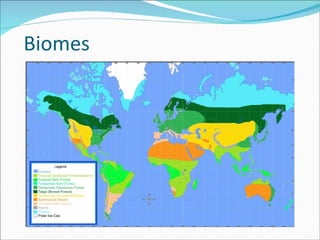
What are the characteristics you look at to determine a biome? How do ecosystems change as you travel north from the equator?
Biomes
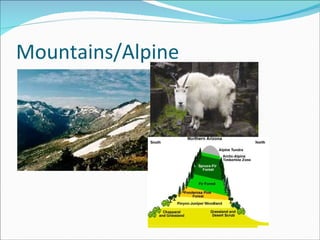
Mountains/Alpine
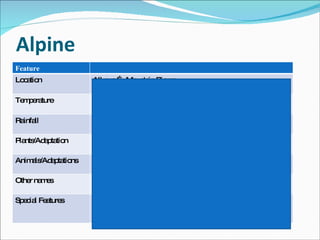
Alpine Feature Location All over….Mountain Biome Can be in middle of desert Temperature Cold Colderer as you go up the mountain Rainfall Average/ 30cm Plants/Adaptation Cold shallow soil, Conifers  mosses and lichens  Animals/Adaptations Cold Rocky terrain, Fur and hooves, Mountain goat Other names Mountain, Alpine Tundra Special Features Can be in the middle of the desert and still get snow. The bottom of the mountain is warm and colder as you go up. Biome changes as you go up the mountain.
Tundra
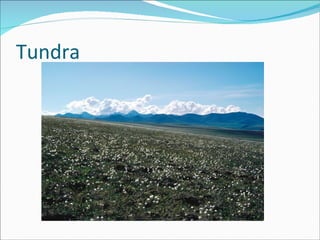
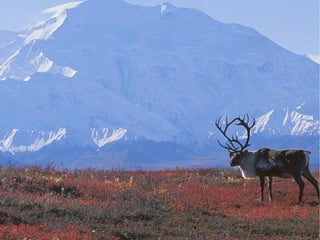
Tundra
Tundra How much rain? 25 cm or less.  A little higher than a pencil.  Temperature? HOT Constant Where in the world? Tropical Along Equators.  Temperate forests are more north.  Other Features.  Very diverse
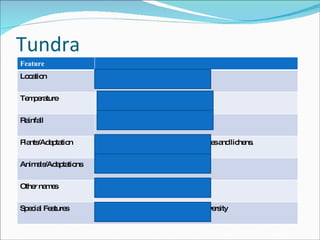
Tundra Feature Location Far north : Near the poles Temperature Almost always cold Rainfall Very dry, almost a desert , 15 cm Plants/Adaptation Shallow roots, grow very short.  Mosses and lichens.  Animals/Adaptations Hibernate/Migrate, Mammals, insects Other names Arctic Special Features Short season for growing, LOW biodiversity
Boreal Forests (Taiga)‏
Boreal Forests (Taiga)‏ How much rain? 25 cm or less.  A little higher than a pencil.  Temperature? HOT Constant Where in the world? Tropical Along Equators.  Temperate forests are more north.  Other Features.  Very diverse
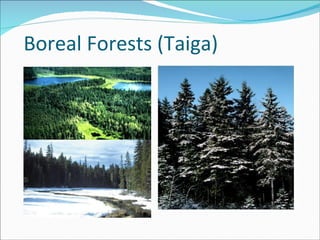
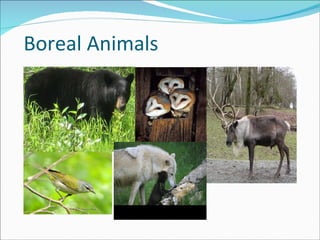
Boreal Boreal Forest Biomes also known as TAIGA far north mostly cold,  Canada and Alaska.  Coniferous Trees   Have needles Do not shed leaves Reproduce with cones.  Spruce and Pine Trees.  Animals Depend on trees for food and habitat.  mammals adapted to cold carnivores such as wolves to eat large herbivores such as elk
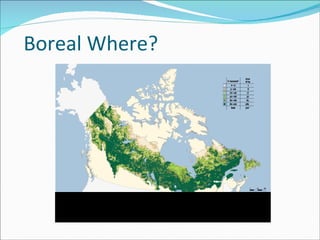
Boreal Where?
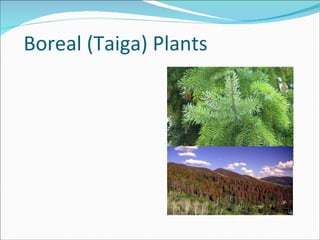
Boreal (Taiga) Plants
Boreal Animals
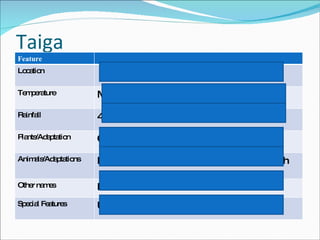
Taiga Feature Location North,Canada and russia. Under tundra Temperature Mostly Cold Rainfall 40-100 cm/ Mostly Snow Plants/Adaptation Conifers/Pines… Needles and waxy coating Animals/Adaptations Mammals and birds, Fur and feathers for warmth Other names Boreal/ Coniferous Forest Special Features Usually covered in snow most of year
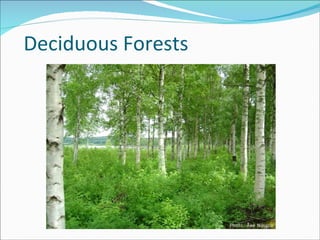
Deciduous Forests
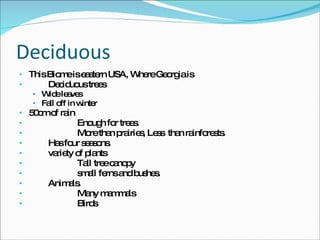
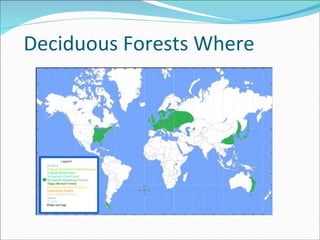
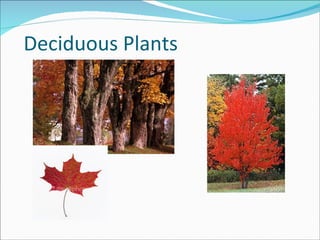
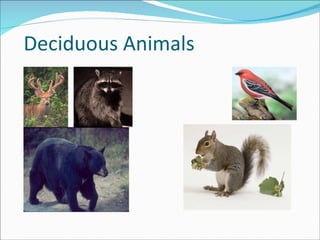
Deciduous This Biome is eastern USA, Where Georgia is Deciduous trees Wide leaves Fall off in winter 50cm of rain Enough for trees.  More than prairies, Less  than rainforests.  Has four seasons.  variety of plants Tall tree canopy small ferns and bushes.  Animals.  Many mammals Birds
Deciduous Forests How much rain? 25 cm or less.  A little higher than a pencil.  Temperature? HOT Constant Where in the world? Tropical Along Equators.  Temperate forests are more north.  Other Features.  Very diverse
Deciduous Forests Where
Deciduous Plants
Deciduous Animals
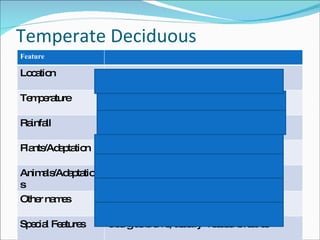
Temperate Deciduous Feature Location Eastern U.S Europe/ South of taiga Temperature Average (temperate)  4 seasons Rainfall Medium  75-125 cm Plants/Adaptation Leaves fall off. Tall trees thick bushes Animals/Adaptations Hibernate store food.  Other names Special Features Georgias biome, usually 4 seasons leaves
 
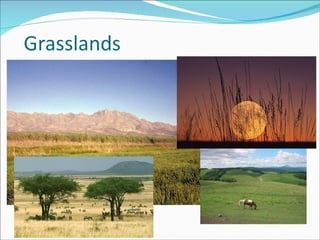
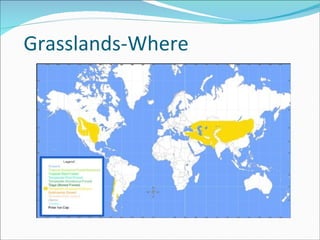
Grassland Lots of grass Dry but more rain than desert Not enough rain for trees.  Big Herbivores Large Herds Carnivores Lion King
Grasslands How much rain? 25 cm or less.  A little higher than a pencil.  Temperature? HOT Constant Where in the world? Tropical Along Equators.  Temperate forests are more north.  Other Features.  Very diverse
Grasslands-Where
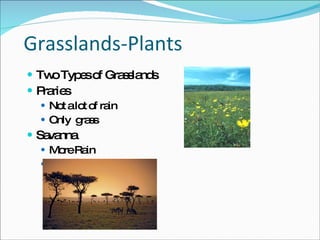
Grasslands-Plants Two Types of Grasslands Praries Not a lot of rain Only  grass Savanna  More Rain More trees
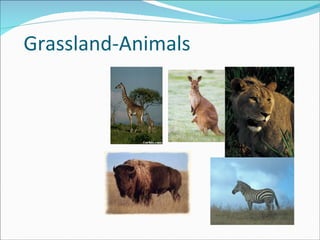
Grassland-Animals
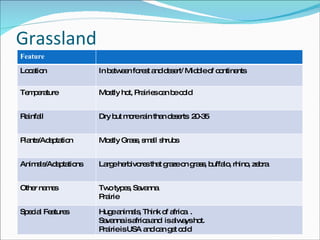
Grassland Feature Location In between forest and desert/ Middle of continents Temperature Mostly hot, Prairies can be cold Rainfall Dry but more rain than deserts  20-35 Plants/Adaptation Mostly Grass, small shrubs Animals/Adaptations Large herbivores that graze on grass, buffalo, rhino, zebra Other names Two types, Savanna  Prairie Special Features Huge animals, Think of africa  . Savanna is africa and  is always hot.  Prairie is USA and can get cold
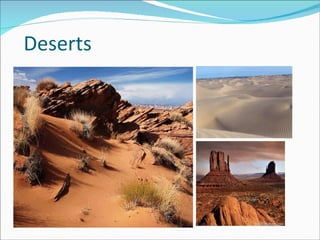
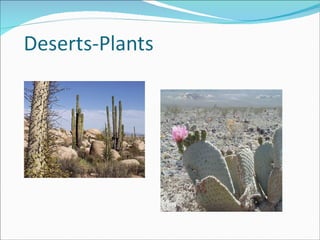
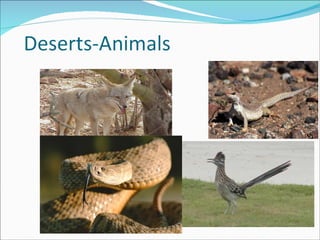
Deserts
Desert Less than 25cm  pop can Very hot Big Temperature swings Organisms Adapt to stay cool
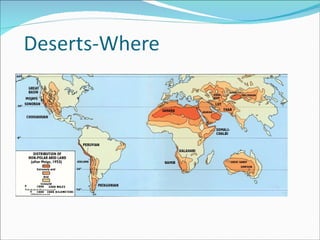
How much rain? 25 cm or less.  A little higher than a pencil.  Temperature? HOT Drastic changes in temperature Hot days cold nights Where in the world? Middle of continents.  30 degrees from the equator.  Other Features.


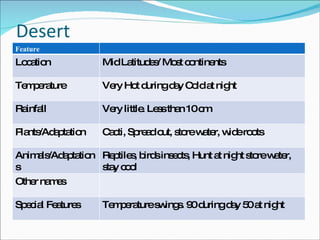
Desert Feature Location Mid Latitudes/ Most continents Temperature Very Hot during day Cold at night Rainfall Very little. Less than 10 cm Plants/Adaptation Cacti, Spread out, store water, wide roots Animals/Adaptations Reptiles, birds insects, Hunt at night store water, stay cool  Other names Special Features Temperature swings. 90 during day 50 at night
 
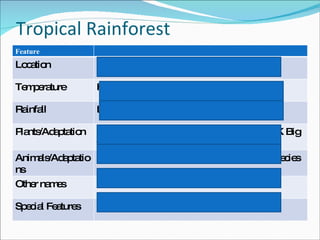
Tropical Rainforest Feature Location Equator Temperature Hot all year  80-90 degrees Rainfall Lots, 300cm Plants/Adaptation Grow quickly. and on top of each other, THICK Big trees, vines, ferns,  shrubs Animals/Adaptations All sorts of animals. 1400 birds, 150 million species Other names Special Features Most Biodiversity
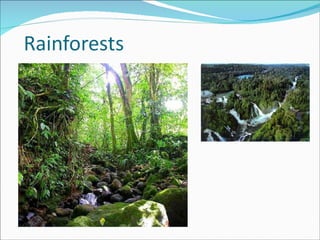
Rainforest Hot and Humid Lot of plants and animals Thick dense vegetation Dark Floor Canopy and Understory
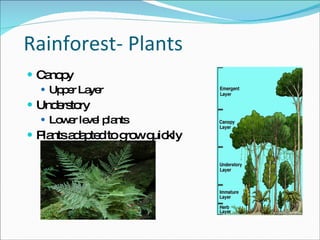
Rainforest- Plants Canopy Upper Layer Understory Lower level plants Plants adapted to grow quickly
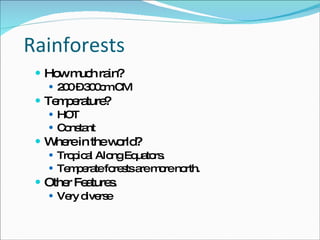
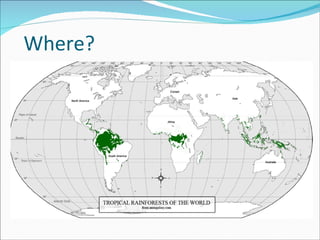
Rainforests How much rain? 200 – 300cm CM  Temperature? HOT Constant Where in the world? Tropical Along Equators.  Temperate forests are more north.  Other Features.  Very diverse
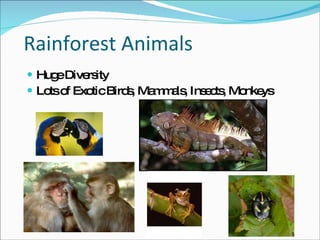
Rainforest Animals Huge Diversity Lots of Exotic Birds, Mammals, Insects, Monkeys
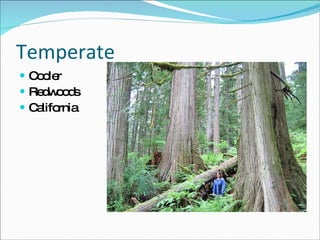
Temperate Cooler Redwoods California
Where?
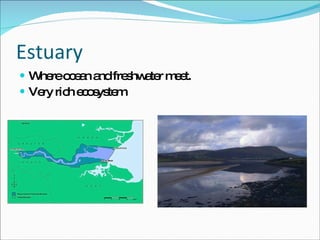
Estuary Where ocean and freshwater meet.  Very rich ecosystem
Freshwater
Marine
Many carnivores such as wolves to eat large herbivores such as elk Mountains and Ice Do not fall into major biomes.  Mountains have several mini-biomes.  The climate is different at the base of moment than at top.  Different plants and animals live at different parts of mountain.  Some parts of earth are covered in ice.  Arctic  and Antarctica.  Animals  such as penguins and seals.
 

Ppt Ecology Biomes

  • 1.
    What are thecharacteristics you look at to determine a biome? How do ecosystems change as you travel north from the equator?
  • 2.
  • 3.
  • 4.
    Alpine Feature LocationAll over….Mountain Biome Can be in middle of desert Temperature Cold Colderer as you go up the mountain Rainfall Average/ 30cm Plants/Adaptation Cold shallow soil, Conifers mosses and lichens Animals/Adaptations Cold Rocky terrain, Fur and hooves, Mountain goat Other names Mountain, Alpine Tundra Special Features Can be in the middle of the desert and still get snow. The bottom of the mountain is warm and colder as you go up. Biome changes as you go up the mountain.
  • 5.
  • 6.
  • 7.
    Tundra How muchrain? 25 cm or less. A little higher than a pencil. Temperature? HOT Constant Where in the world? Tropical Along Equators. Temperate forests are more north. Other Features. Very diverse
  • 8.
    Tundra Feature LocationFar north : Near the poles Temperature Almost always cold Rainfall Very dry, almost a desert , 15 cm Plants/Adaptation Shallow roots, grow very short. Mosses and lichens. Animals/Adaptations Hibernate/Migrate, Mammals, insects Other names Arctic Special Features Short season for growing, LOW biodiversity
  • 9.
  • 10.
    Boreal Forests (Taiga)‏How much rain? 25 cm or less. A little higher than a pencil. Temperature? HOT Constant Where in the world? Tropical Along Equators. Temperate forests are more north. Other Features. Very diverse
  • 11.
    Boreal Boreal ForestBiomes also known as TAIGA far north mostly cold, Canada and Alaska. Coniferous Trees Have needles Do not shed leaves Reproduce with cones. Spruce and Pine Trees. Animals Depend on trees for food and habitat. mammals adapted to cold carnivores such as wolves to eat large herbivores such as elk
  • 12.
  • 13.
  • 14.
  • 15.
    Taiga Feature LocationNorth,Canada and russia. Under tundra Temperature Mostly Cold Rainfall 40-100 cm/ Mostly Snow Plants/Adaptation Conifers/Pines… Needles and waxy coating Animals/Adaptations Mammals and birds, Fur and feathers for warmth Other names Boreal/ Coniferous Forest Special Features Usually covered in snow most of year
  • 16.
  • 17.
    Deciduous This Biomeis eastern USA, Where Georgia is Deciduous trees Wide leaves Fall off in winter 50cm of rain Enough for trees. More than prairies, Less than rainforests. Has four seasons. variety of plants Tall tree canopy small ferns and bushes. Animals. Many mammals Birds
  • 18.
    Deciduous Forests Howmuch rain? 25 cm or less. A little higher than a pencil. Temperature? HOT Constant Where in the world? Tropical Along Equators. Temperate forests are more north. Other Features. Very diverse
  • 19.
  • 20.
  • 21.
  • 22.
    Temperate Deciduous FeatureLocation Eastern U.S Europe/ South of taiga Temperature Average (temperate) 4 seasons Rainfall Medium 75-125 cm Plants/Adaptation Leaves fall off. Tall trees thick bushes Animals/Adaptations Hibernate store food. Other names Special Features Georgias biome, usually 4 seasons leaves
  • 23.
  • 24.
    Grassland Lots ofgrass Dry but more rain than desert Not enough rain for trees. Big Herbivores Large Herds Carnivores Lion King
  • 25.
    Grasslands How muchrain? 25 cm or less. A little higher than a pencil. Temperature? HOT Constant Where in the world? Tropical Along Equators. Temperate forests are more north. Other Features. Very diverse
  • 26.
  • 27.
    Grasslands-Plants Two Typesof Grasslands Praries Not a lot of rain Only grass Savanna More Rain More trees
  • 28.
  • 29.
    Grassland Feature LocationIn between forest and desert/ Middle of continents Temperature Mostly hot, Prairies can be cold Rainfall Dry but more rain than deserts 20-35 Plants/Adaptation Mostly Grass, small shrubs Animals/Adaptations Large herbivores that graze on grass, buffalo, rhino, zebra Other names Two types, Savanna Prairie Special Features Huge animals, Think of africa . Savanna is africa and is always hot. Prairie is USA and can get cold
  • 30.
  • 31.
    Desert Less than25cm pop can Very hot Big Temperature swings Organisms Adapt to stay cool
  • 32.
    How much rain?25 cm or less. A little higher than a pencil. Temperature? HOT Drastic changes in temperature Hot days cold nights Where in the world? Middle of continents. 30 degrees from the equator. Other Features.
  • 33.
  • 34.
  • 35.
  • 36.
    Desert Feature LocationMid Latitudes/ Most continents Temperature Very Hot during day Cold at night Rainfall Very little. Less than 10 cm Plants/Adaptation Cacti, Spread out, store water, wide roots Animals/Adaptations Reptiles, birds insects, Hunt at night store water, stay cool Other names Special Features Temperature swings. 90 during day 50 at night
  • 37.
  • 38.
    Tropical Rainforest FeatureLocation Equator Temperature Hot all year 80-90 degrees Rainfall Lots, 300cm Plants/Adaptation Grow quickly. and on top of each other, THICK Big trees, vines, ferns, shrubs Animals/Adaptations All sorts of animals. 1400 birds, 150 million species Other names Special Features Most Biodiversity
  • 39.
    Rainforest Hot andHumid Lot of plants and animals Thick dense vegetation Dark Floor Canopy and Understory
  • 40.
    Rainforest- Plants CanopyUpper Layer Understory Lower level plants Plants adapted to grow quickly
  • 41.
    Rainforests How muchrain? 200 – 300cm CM Temperature? HOT Constant Where in the world? Tropical Along Equators. Temperate forests are more north. Other Features. Very diverse
  • 42.
    Rainforest Animals HugeDiversity Lots of Exotic Birds, Mammals, Insects, Monkeys
  • 43.
  • 44.
  • 45.
    Estuary Where oceanand freshwater meet. Very rich ecosystem
  • 46.
  • 47.
  • 48.
    Many carnivores suchas wolves to eat large herbivores such as elk Mountains and Ice Do not fall into major biomes. Mountains have several mini-biomes. The climate is different at the base of moment than at top. Different plants and animals live at different parts of mountain. Some parts of earth are covered in ice. Arctic and Antarctica. Animals such as penguins and seals.
  • 49.