TUNDRA
Coldest of all biomes

“
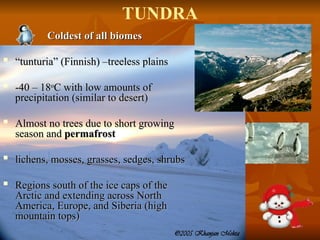
“tunturia” (Finnish) –treeless plains
tunturia” (Finnish) –treeless plains

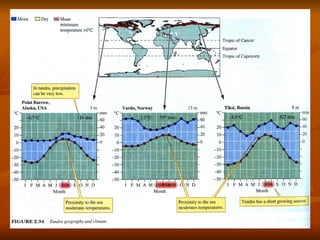
-40 – 18
-40 – 18o
o
C with low amounts of
precipitation (similar to desert)

Almost no trees due to short growing
season and
season and permafrost
permafrost

lichens, mosses, grasses, sedges, shrubs

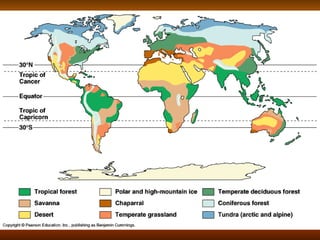
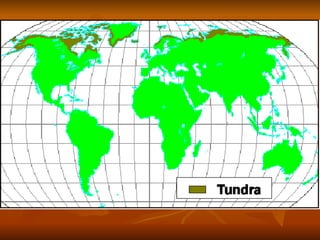
Regions south of the ice caps of the
Arctic and extending across North
America, Europe, and Siberia (high
mountain tops)
mountain tops)
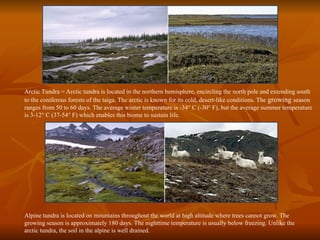
Arctic Tundra = Arctic tundra is located in the northern hemisphere, encircling the north pole and extending south
to the coniferous forests of the taiga. The arctic is known for its cold, desert-like conditions. The growing season
ranges from 50 to 60 days. The average winter temperature is -34° C (-30° F), but the average summer temperature
is 3-12° C (37-54° F) which enables this biome to sustain life.
Alpine tundra is located on mountains throughout the world at high altitude where trees cannot grow. The
growing season is approximately 180 days. The nighttime temperature is usually below freezing. Unlike the
arctic tundra, the soil in the alpine is well drained.
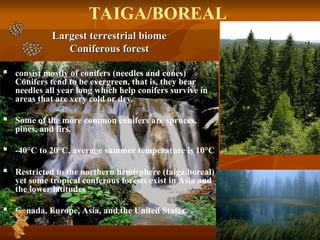
Largest terrestrial biome
Coniferous forest
Coniferous forest
 consist mostly of conifers (needles and cones)
Conifers tend to be evergreen, that is, they bear
needles all year long which help conifers survive in
areas that are very cold or dry.
 Some of the more common conifers are spruces,
pines, and firs.
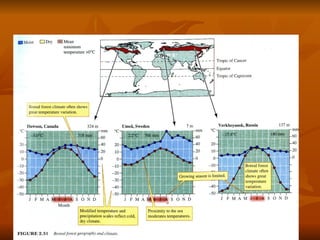
 -40°C to 20°C, average summer temperature is 10°C
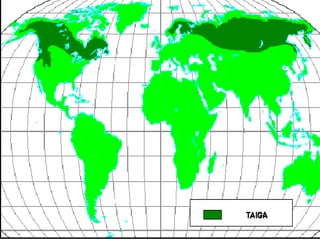
 Restricted to the northern hemisphere (taiga/boreal)
yet some tropical conferous forests exist in Asia and
the lower latitudes
 Canada, Europe, Asia, and the United States
TAIGA/BOREAL
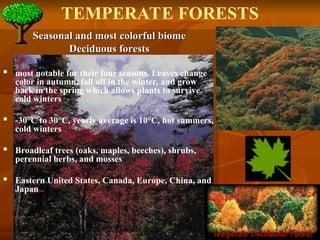
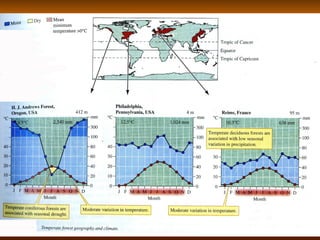
Seasonal and most colorful biome
Deciduous forests
Deciduous forests
 most notable for their four seasons. Leaves change
color in autumn, fall off in the winter, and grow
back in the spring which allows plants to survive
cold winters
 -30°C to 30°C, yearly average is 10°C, hot summers,
cold winters
 Broadleaf trees (oaks, maples, beeches), shrubs,
perennial herbs, and mosses
 Eastern United States, Canada, Europe, China, and
Japan
TEMPERATE FORESTS
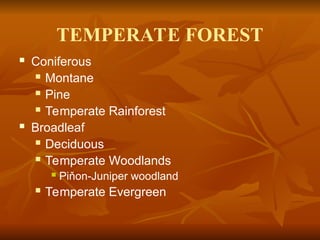
TEMPERATE FOREST
 Coniferous
 Montane
 Pine
 Temperate Rainforest
 Broadleaf
 Deciduous
 Temperate Woodlands
 Piňon-Juniper woodland
 Temperate Evergreen
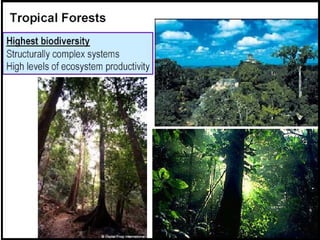
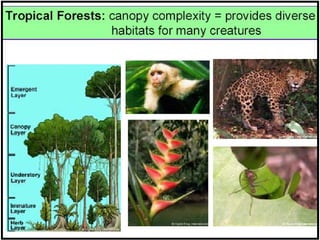
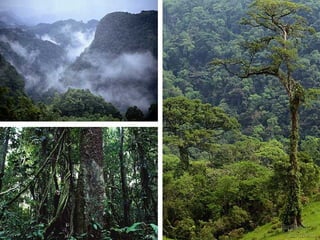
Most diverse and humid among all biomes!
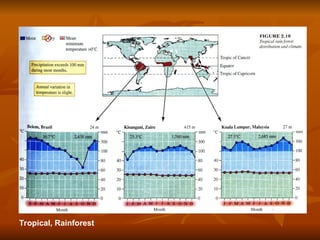
Wet the whole year round
 20°C to 25°C, must remain warm and frost-free

2,000 to 10,000 millimeters of rain per year

Between the Tropic of Cancer and the Tropic of
Capricorn
Capricorn

known for its dense canopies of vegetation that
form different layers
TROPICAL RAINFOREST
Tropical, Rainforest
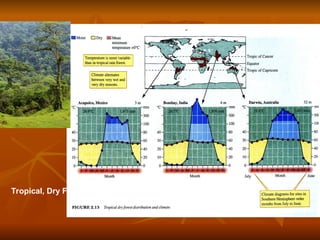
Tropical, Dry Forest
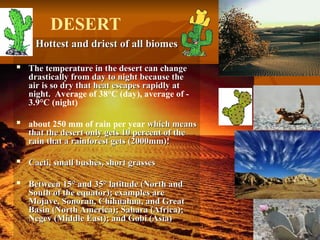
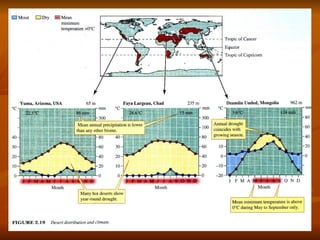
Hottest and driest of all biomes

The temperature in the desert can change
drastically from day to night because the
air is so dry that heat escapes rapidly at
night.
night. Average of 38°C (day), average of -
3.9°C (night)
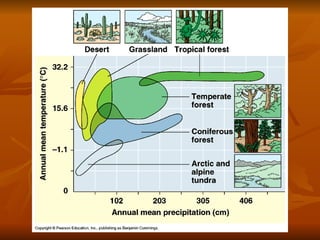
 about 250 mm of rain per year which means
which means
that the desert only gets 10 percent of the
rain that a rainforest gets (2000mm)!

Cacti, small bushes, short grasses

Between 15° and 35° latitude (North and
South of the equator); examples are
Mojave, Sonoran, Chihuahua, and Great
Basin (North America); Sahara (Africa);
Negev (Middle East); and Gobi (Asia)
DESERT
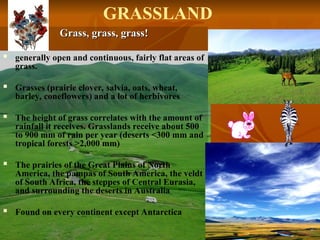
Grass, grass, grass!
 generally open and continuous, fairly flat areas of
grass.
 Grasses (prairie clover, salvia, oats, wheat,
barley, coneflowers) and a lot of herbivores
 The height of grass correlates with the amount of
rainfall it receives. Grasslands receive about 500
to 900 mm of rain per year (deserts <300 mm and
tropical forests >2,000 mm)
 The prairies of the Great Plains of North
America, the pampas of South America, the veldt
of South Africa, the steppes of Central Eurasia,
and surrounding the deserts in Australia
 Found on every continent except Antarctica
GRASSLAND
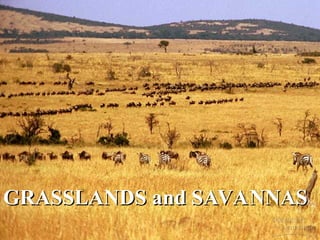
GRASSLANDS and SAVANNAS
GRASSLANDS
 Domestic
 North American Grasslands
 Tallgrass prairie
 Mixed-grass prairie
 Shortgrass prairie
 Desert grassland
 Annual grassland
 Eurasian Steppes
 South American Pampas
 South African Veld
 Australian Grasslands
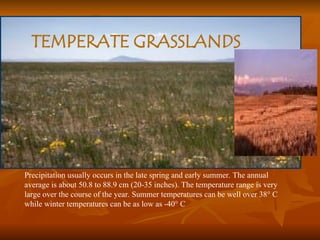
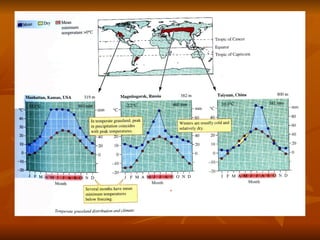
TEMPERATE GRASSLANDS
Precipitation usually occurs in the late spring and early summer. The annual
average is about 50.8 to 88.9 cm (20-35 inches). The temperature range is very
large over the course of the year. Summer temperatures can be well over 38° C
while winter temperatures can be as low as -40° C
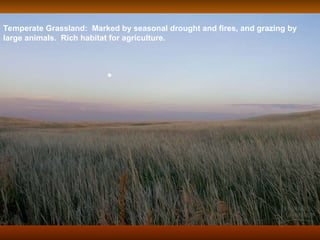
Temperate Grassland: Marked by seasonal drought and fires, and grazing by
large animals. Rich habitat for agriculture.
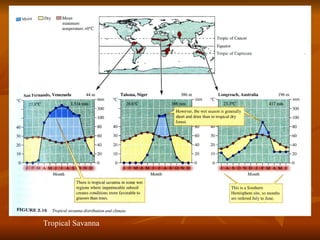
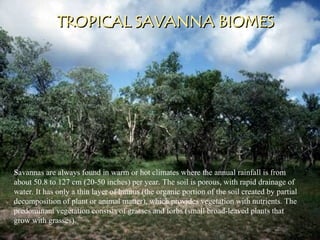
TROPICAL SAVANNA BIOMES
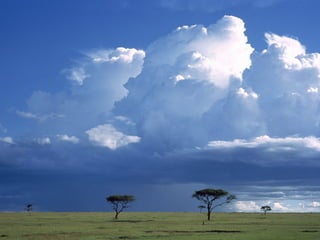
Savannas are always found in warm or hot climates where the annual rainfall is from
about 50.8 to 127 cm (20-50 inches) per year. The soil is porous, with rapid drainage of
water. It has only a thin layer of humus (the organic portion of the soil created by partial
decomposition of plant or animal matter), which provides vegetation with nutrients. The
predominant vegetation consists of grasses and forbs (small broad-leaved plants that
grow with grasses).
Tropical Savanna
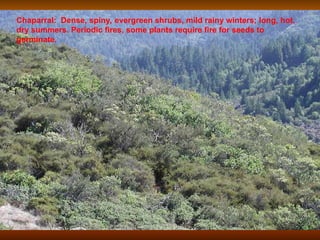
Chaparral: Dense, spiny, evergreen shrubs, mild rainy winters; long, hot,
dry summers. Periodic fires, some plants require fire for seeds to
germinate.
Thank you for Listening

Ecodiversityreviewer.copy.biodiversity...

  • 11.
    TUNDRA Coldest of allbiomes Coldest of all biomes  “ “tunturia” (Finnish) –treeless plains tunturia” (Finnish) –treeless plains  -40 – 18 -40 – 18o o C with low amounts of C with low amounts of precipitation (similar to desert) precipitation (similar to desert)  Almost no trees due to short growing Almost no trees due to short growing season and season and permafrost permafrost  lichens, mosses, grasses, sedges, shrubs lichens, mosses, grasses, sedges, shrubs  Regions south of the ice caps of the Regions south of the ice caps of the Arctic and extending across North Arctic and extending across North America, Europe, and Siberia (high America, Europe, and Siberia (high mountain tops) mountain tops)
  • 13.
    Arctic Tundra =Arctic tundra is located in the northern hemisphere, encircling the north pole and extending south to the coniferous forests of the taiga. The arctic is known for its cold, desert-like conditions. The growing season ranges from 50 to 60 days. The average winter temperature is -34° C (-30° F), but the average summer temperature is 3-12° C (37-54° F) which enables this biome to sustain life. Alpine tundra is located on mountains throughout the world at high altitude where trees cannot grow. The growing season is approximately 180 days. The nighttime temperature is usually below freezing. Unlike the arctic tundra, the soil in the alpine is well drained.
  • 15.
    Largest terrestrial biome Largestterrestrial biome Coniferous forest Coniferous forest  consist mostly of conifers (needles and cones) Conifers tend to be evergreen, that is, they bear needles all year long which help conifers survive in areas that are very cold or dry.  Some of the more common conifers are spruces, pines, and firs.  -40°C to 20°C, average summer temperature is 10°C  Restricted to the northern hemisphere (taiga/boreal) yet some tropical conferous forests exist in Asia and the lower latitudes  Canada, Europe, Asia, and the United States TAIGA/BOREAL
  • 19.
    Seasonal and mostcolorful biome Seasonal and most colorful biome Deciduous forests Deciduous forests  most notable for their four seasons. Leaves change color in autumn, fall off in the winter, and grow back in the spring which allows plants to survive cold winters  -30°C to 30°C, yearly average is 10°C, hot summers, cold winters  Broadleaf trees (oaks, maples, beeches), shrubs, perennial herbs, and mosses  Eastern United States, Canada, Europe, China, and Japan TEMPERATE FORESTS
  • 20.
    TEMPERATE FOREST  Coniferous Montane  Pine  Temperate Rainforest  Broadleaf  Deciduous  Temperate Woodlands  Piňon-Juniper woodland  Temperate Evergreen
  • 24.
    Most diverse andhumid among all biomes! Most diverse and humid among all biomes! Wet the whole year round Wet the whole year round  20°C to 25°C, must remain warm and frost-free  2,000 to 10,000 millimeters of rain per year 2,000 to 10,000 millimeters of rain per year  Between the Tropic of Cancer and the Tropic of Between the Tropic of Cancer and the Tropic of Capricorn Capricorn  known for its dense canopies of vegetation that known for its dense canopies of vegetation that form different layers form different layers TROPICAL RAINFOREST
  • 25.
  • 26.
  • 28.
    Hottest and driestof all biomes Hottest and driest of all biomes  The temperature in the desert can change The temperature in the desert can change drastically from day to night because the drastically from day to night because the air is so dry that heat escapes rapidly at air is so dry that heat escapes rapidly at night. night. Average of 38°C (day), average of - 3.9°C (night)  about 250 mm of rain per year which means which means that the desert only gets 10 percent of the that the desert only gets 10 percent of the rain that a rainforest gets (2000mm)! rain that a rainforest gets (2000mm)!  Cacti, small bushes, short grasses Cacti, small bushes, short grasses  Between 15° and 35° latitude (North and Between 15° and 35° latitude (North and South of the equator); examples are South of the equator); examples are Mojave, Sonoran, Chihuahua, and Great Mojave, Sonoran, Chihuahua, and Great Basin (North America); Sahara (Africa); Basin (North America); Sahara (Africa); Negev (Middle East); and Gobi (Asia) Negev (Middle East); and Gobi (Asia) DESERT
  • 30.
    Grass, grass, grass! Grass,grass, grass!  generally open and continuous, fairly flat areas of grass.  Grasses (prairie clover, salvia, oats, wheat, barley, coneflowers) and a lot of herbivores  The height of grass correlates with the amount of rainfall it receives. Grasslands receive about 500 to 900 mm of rain per year (deserts <300 mm and tropical forests >2,000 mm)  The prairies of the Great Plains of North America, the pampas of South America, the veldt of South Africa, the steppes of Central Eurasia, and surrounding the deserts in Australia  Found on every continent except Antarctica GRASSLAND
  • 33.
  • 34.
    GRASSLANDS  Domestic  NorthAmerican Grasslands  Tallgrass prairie  Mixed-grass prairie  Shortgrass prairie  Desert grassland  Annual grassland  Eurasian Steppes  South American Pampas  South African Veld  Australian Grasslands
  • 35.
    TEMPERATE GRASSLANDS Precipitation usuallyoccurs in the late spring and early summer. The annual average is about 50.8 to 88.9 cm (20-35 inches). The temperature range is very large over the course of the year. Summer temperatures can be well over 38° C while winter temperatures can be as low as -40° C
  • 36.
    Temperate Grassland: Markedby seasonal drought and fires, and grazing by large animals. Rich habitat for agriculture.
  • 38.
    TROPICAL SAVANNA BIOMES TROPICALSAVANNA BIOMES Savannas are always found in warm or hot climates where the annual rainfall is from about 50.8 to 127 cm (20-50 inches) per year. The soil is porous, with rapid drainage of water. It has only a thin layer of humus (the organic portion of the soil created by partial decomposition of plant or animal matter), which provides vegetation with nutrients. The predominant vegetation consists of grasses and forbs (small broad-leaved plants that grow with grasses).
  • 39.
  • 40.
    Chaparral: Dense, spiny,evergreen shrubs, mild rainy winters; long, hot, dry summers. Periodic fires, some plants require fire for seeds to germinate.
  • 41.
    Thank you forListening