Chapter 19 Lesson 1 – p682-689
LAND BIOMES
Vocabulary
 Biome – a geographic area on Earth that contains
ecosystems with similar biotic and abiotic features
 Desert – biomes that receive very little rain
 Grassland – biomes are areas where grasses are the
dominate plants
 Temperate – Regions of Earth between the tropics
and the polar circles
 Taiga – forest biomes consisting mostly of cone-
bearing evergreen trees
 Tundra – biome that is cold, dry, and treeless
Land Ecosystems and Biomes
 The living or once-living parts of an environment
are the biotic parts
 The nonliving parts that the living pasts need to
survive are the abiotic parts
 An ecosystem includes an environments:
 Biotic factors
 Abiotic factors
 *Cultural factors
Land Ecosystems
 Earth’s continents have many different
ecosystems, from deserts to rainforests.
 Scientists have classified similar ecosystems in
large geographic areas called biomes
 Biomes are geographic areas on Earth that
contain ecosystems with similar biotic and abiotic
factors.
 Earth has 7 major land biomes with similar climates
and organisms
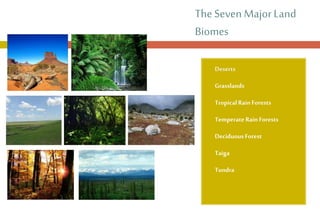
The Seven MajorLand
Biomes
• Deserts
• Grasslands
• Tropical RainForests
• Temperate RainForests
• DeciduousForest
• Taiga
• Tundra
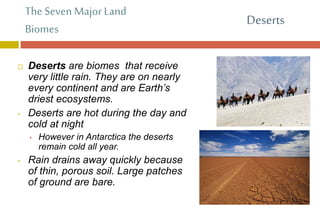
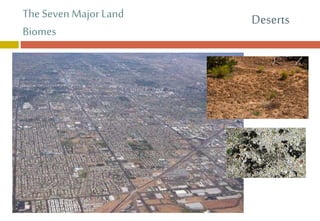
 Deserts are biomes that receive
very little rain. They are on nearly
every continent and are Earth’s
driest ecosystems.
• Deserts are hot during the day and
cold at night
• However in Antarctica the deserts
remain cold all year.
• Rain drains away quickly because
of thin, porous soil. Large patches
of ground are bare.
The Seven Major Land
Biomes
Deserts
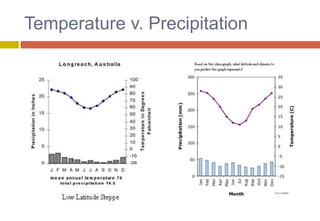
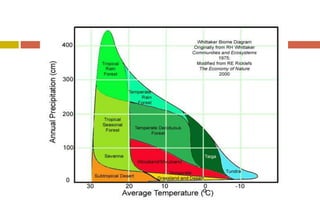
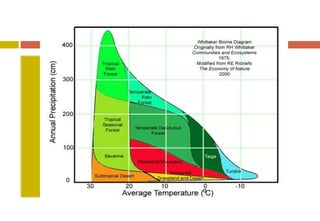
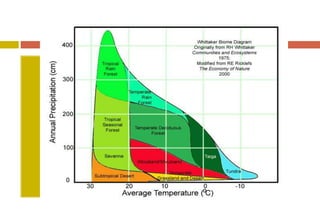
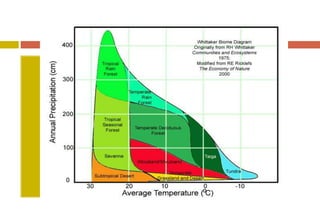
Temperature v. Precipitation
The Seven MajorLand
Biomes
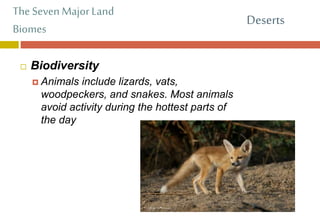
 Biodiversity
 Animals include lizards, vats,
woodpeckers, and snakes. Most animals
avoid activity during the hottest parts of
the day
Deserts
The Seven Major Land
Biomes
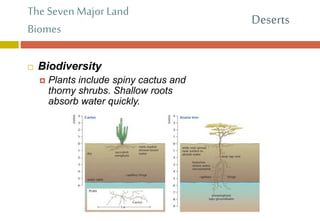
 Biodiversity
 Plants include spiny cactus and
thorny shrubs. Shallow roots
absorb water quickly.
Deserts
The Seven Major Land
Biomes
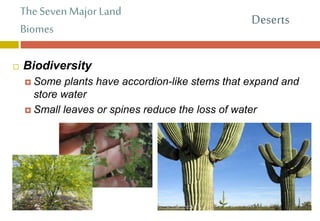
 Biodiversity
 Some plants have accordion-like stems that expand and
store water
 Small leaves or spines reduce the loss of water
Deserts
The Seven MajorLand
Biomes
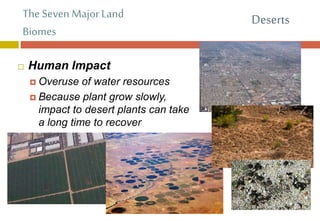
 Human Impact
 Overuse of water resources
 Because plant grow slowly,
impact to desert plants can take
a long time to recover
Deserts
The Seven MajorLand
Biomes
 Human Impact
 Overuse of water resources
 Because plant grow slowly,
impact to desert plants can take
a long time to recover
Deserts
The Seven MajorLand
Biomes
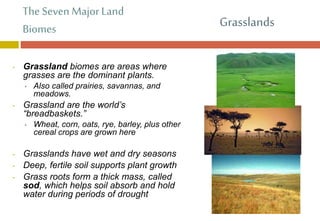
• Grassland biomes are areas where
grasses are the dominant plants.
• Also called prairies, savannas, and
meadows.
• Grassland are the world’s
“breadbaskets.”
• Wheat, corn, oats, rye, barley, plus other
cereal crops are grown here
• Grasslands have wet and dry seasons
• Deep, fertile soil supports plant growth
• Grass roots form a thick mass, called
sod, which helps soil absorb and hold
water during periods of drought
Grasslands
The Seven Major Land
Biomes
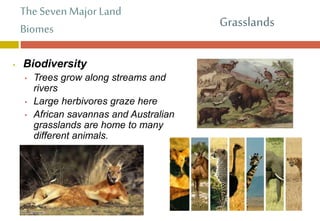
• Biodiversity
• Trees grow along streams and
rivers
• Large herbivores graze here
• African savannas and Australian
grasslands are home to many
different animals.
Grasslands
The Seven MajorLand
Biomes
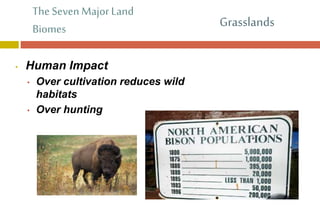
• Human Impact
• Over cultivation reduces wild
habitats
• Over hunting
Grasslands
The Seven Major Land
Biomes
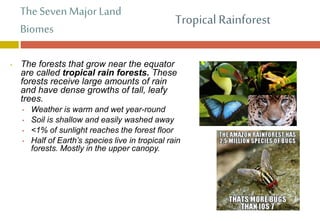
• The forests that grow near the equator
are called tropical rain forests. These
forests receive large amounts of rain
and have dense growths of tall, leafy
trees.
• Weather is warm and wet year-round
• Soil is shallow and easily washed away
• <1% of sunlight reaches the forest floor
• Half of Earth’s species live in tropical rain
forests. Mostly in the upper canopy.
Tropical Rainforest
The Seven Major Land
Biomes
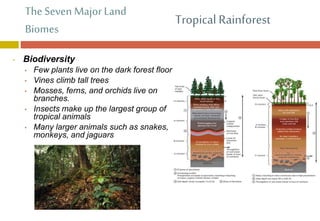
• Biodiversity
• Few plants live on the dark forest floor
• Vines climb tall trees
• Mosses, ferns, and orchids live on
branches.
• Insects make up the largest group of
tropical animals
• Many larger animals such as snakes,
monkeys, and jaguars
Tropical Rainforest
The Seven Major Land
Biomes
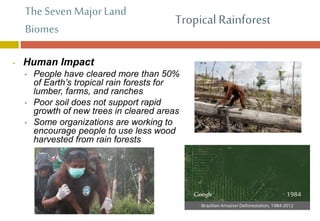
• Human Impact
• People have cleared more than 50%
of Earth’s tropical rain forests for
lumber, farms, and ranches
• Poor soil does not support rapid
growth of new trees in cleared areas
• Some organizations are working to
encourage people to use less wood
harvested from rain forests
Tropical Rainforest
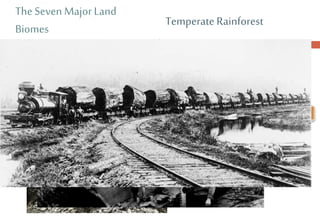
The Seven Major Land
Biomes
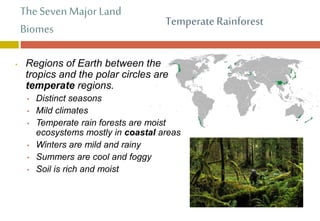
• Regions of Earth between the
tropics and the polar circles are
temperate regions.
• Distinct seasons
• Mild climates
• Temperate rain forests are moist
ecosystems mostly in coastal areas
• Winters are mild and rainy
• Summers are cool and foggy
• Soil is rich and moist
Temperate Rainforest
The Seven MajorLand
Biomes
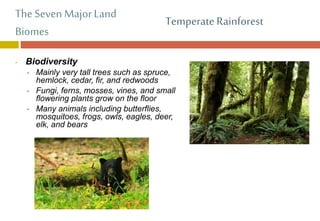
• Biodiversity
• Mainly very tall trees such as spruce,
hemlock, cedar, fir, and redwoods
• Fungi, ferns, mosses, vines, and small
flowering plants grow on the floor
• Many animals including butterflies,
mosquitoes, frogs, owls, eagles, deer,
elk, and bears
Temperate Rainforest
The Seven MajorLand
Biomes
• Human Impact
• Over logging
• Rich soil allows cut forests to
grow back quickly
• Tree farms help provide lumber
without destroying habitats
Temperate Rainforest
The Seven Major Land
Biomes
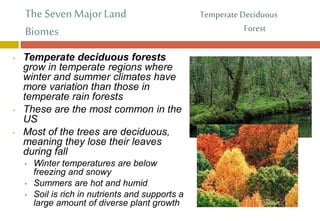
• Temperate deciduous forests
grow in temperate regions where
winter and summer climates have
more variation than those in
temperate rain forests
• These are the most common in the
US
• Most of the trees are deciduous,
meaning they lose their leaves
during fall
• Winter temperatures are below
freezing and snowy
• Summers are hot and humid
• Soil is rich in nutrients and supports a
large amount of diverse plant growth
Temperate Deciduous
Forest
The Seven MajorLand
Biomes
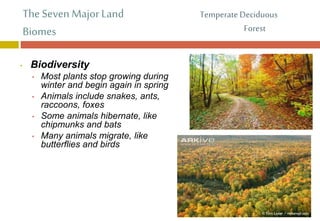
• Biodiversity
• Most plants stop growing during
winter and begin again in spring
• Animals include snakes, ants,
raccoons, foxes
• Some animals hibernate, like
chipmunks and bats
• Many animals migrate, like
butterflies and birds
Temperate Deciduous
Forest
The Seven Major Land
Biomes
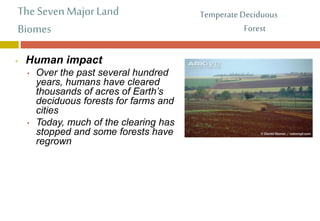
• Human impact
• Over the past several hundred
years, humans have cleared
thousands of acres of Earth’s
deciduous forests for farms and
cities
• Today, much of the clearing has
stopped and some forests have
regrown
Temperate Deciduous
Forest
The Seven Major Land
Biomes
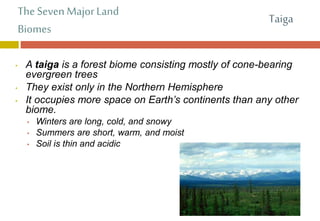
• A taiga is a forest biome consisting mostly of cone-bearing
evergreen trees
• They exist only in the Northern Hemisphere
• It occupies more space on Earth’s continents than any other
biome.
• Winters are long, cold, and snowy
• Summers are short, warm, and moist
• Soil is thin and acidic
Taiga
The Seven Major Land
Biomes
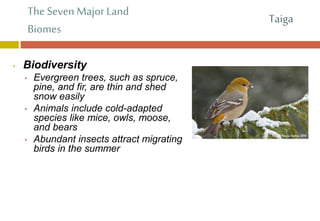
• Biodiversity
• Evergreen trees, such as spruce,
pine, and fir, are thin and shed
snow easily
• Animals include cold-adapted
species like mice, owls, moose,
and bears
• Abundant insects attract migrating
birds in the summer
Taiga
The Seven Major Land
Biomes
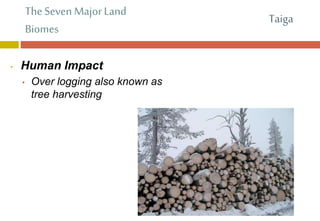
• Human Impact
• Over logging also known as
tree harvesting
Taiga
The Seven Major Land
Biomes
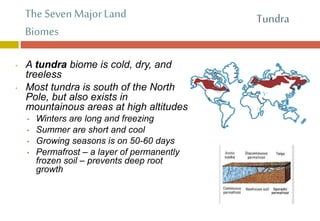
• A tundra biome is cold, dry, and
treeless
• Most tundra is south of the North
Pole, but also exists in
mountainous areas at high altitudes
• Winters are long and freezing
• Summer are short and cool
• Growing seasons is on 50-60 days
• Permafrost – a layer of permanently
frozen soil – prevents deep root
growth
Tundra
The Seven Major Land
Biomes
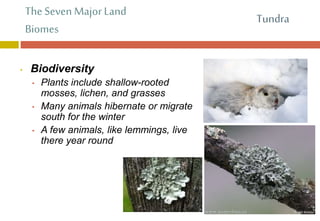
• Biodiversity
• Plants include shallow-rooted
mosses, lichen, and grasses
• Many animals hibernate or migrate
south for the winter
• A few animals, like lemmings, live
there year round
Tundra
The Seven Major Land
Biomes
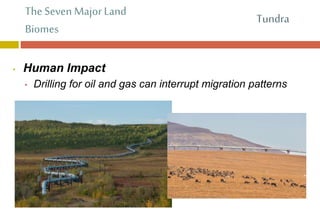
• Human Impact
• Drilling for oil and gas can interrupt migration patterns
Tundra

Chapter 19.1: Land Biomes

  • 1.
    Chapter 19 Lesson1 – p682-689 LAND BIOMES
  • 2.
    Vocabulary  Biome –a geographic area on Earth that contains ecosystems with similar biotic and abiotic features  Desert – biomes that receive very little rain  Grassland – biomes are areas where grasses are the dominate plants  Temperate – Regions of Earth between the tropics and the polar circles  Taiga – forest biomes consisting mostly of cone- bearing evergreen trees  Tundra – biome that is cold, dry, and treeless
  • 3.
    Land Ecosystems andBiomes  The living or once-living parts of an environment are the biotic parts  The nonliving parts that the living pasts need to survive are the abiotic parts  An ecosystem includes an environments:  Biotic factors  Abiotic factors  *Cultural factors
  • 4.
    Land Ecosystems  Earth’scontinents have many different ecosystems, from deserts to rainforests.  Scientists have classified similar ecosystems in large geographic areas called biomes  Biomes are geographic areas on Earth that contain ecosystems with similar biotic and abiotic factors.  Earth has 7 major land biomes with similar climates and organisms
  • 5.
    The Seven MajorLand Biomes •Deserts • Grasslands • Tropical RainForests • Temperate RainForests • DeciduousForest • Taiga • Tundra
  • 6.
     Deserts arebiomes that receive very little rain. They are on nearly every continent and are Earth’s driest ecosystems. • Deserts are hot during the day and cold at night • However in Antarctica the deserts remain cold all year. • Rain drains away quickly because of thin, porous soil. Large patches of ground are bare. The Seven Major Land Biomes Deserts
  • 7.
  • 8.
    The Seven MajorLand Biomes Biodiversity  Animals include lizards, vats, woodpeckers, and snakes. Most animals avoid activity during the hottest parts of the day Deserts
  • 9.
    The Seven MajorLand Biomes  Biodiversity  Plants include spiny cactus and thorny shrubs. Shallow roots absorb water quickly. Deserts
  • 10.
    The Seven MajorLand Biomes  Biodiversity  Some plants have accordion-like stems that expand and store water  Small leaves or spines reduce the loss of water Deserts
  • 11.
    The Seven MajorLand Biomes Human Impact  Overuse of water resources  Because plant grow slowly, impact to desert plants can take a long time to recover Deserts
  • 12.
    The Seven MajorLand Biomes Human Impact  Overuse of water resources  Because plant grow slowly, impact to desert plants can take a long time to recover Deserts
  • 14.
    The Seven MajorLand Biomes •Grassland biomes are areas where grasses are the dominant plants. • Also called prairies, savannas, and meadows. • Grassland are the world’s “breadbaskets.” • Wheat, corn, oats, rye, barley, plus other cereal crops are grown here • Grasslands have wet and dry seasons • Deep, fertile soil supports plant growth • Grass roots form a thick mass, called sod, which helps soil absorb and hold water during periods of drought Grasslands
  • 15.
    The Seven MajorLand Biomes • Biodiversity • Trees grow along streams and rivers • Large herbivores graze here • African savannas and Australian grasslands are home to many different animals. Grasslands
  • 16.
    The Seven MajorLand Biomes •Human Impact • Over cultivation reduces wild habitats • Over hunting Grasslands
  • 18.
    The Seven MajorLand Biomes • The forests that grow near the equator are called tropical rain forests. These forests receive large amounts of rain and have dense growths of tall, leafy trees. • Weather is warm and wet year-round • Soil is shallow and easily washed away • <1% of sunlight reaches the forest floor • Half of Earth’s species live in tropical rain forests. Mostly in the upper canopy. Tropical Rainforest
  • 19.
    The Seven MajorLand Biomes • Biodiversity • Few plants live on the dark forest floor • Vines climb tall trees • Mosses, ferns, and orchids live on branches. • Insects make up the largest group of tropical animals • Many larger animals such as snakes, monkeys, and jaguars Tropical Rainforest
  • 20.
    The Seven MajorLand Biomes • Human Impact • People have cleared more than 50% of Earth’s tropical rain forests for lumber, farms, and ranches • Poor soil does not support rapid growth of new trees in cleared areas • Some organizations are working to encourage people to use less wood harvested from rain forests Tropical Rainforest
  • 22.
    The Seven MajorLand Biomes • Regions of Earth between the tropics and the polar circles are temperate regions. • Distinct seasons • Mild climates • Temperate rain forests are moist ecosystems mostly in coastal areas • Winters are mild and rainy • Summers are cool and foggy • Soil is rich and moist Temperate Rainforest
  • 23.
    The Seven MajorLand Biomes •Biodiversity • Mainly very tall trees such as spruce, hemlock, cedar, fir, and redwoods • Fungi, ferns, mosses, vines, and small flowering plants grow on the floor • Many animals including butterflies, mosquitoes, frogs, owls, eagles, deer, elk, and bears Temperate Rainforest
  • 24.
    The Seven MajorLand Biomes •Human Impact • Over logging • Rich soil allows cut forests to grow back quickly • Tree farms help provide lumber without destroying habitats Temperate Rainforest
  • 26.
    The Seven MajorLand Biomes • Temperate deciduous forests grow in temperate regions where winter and summer climates have more variation than those in temperate rain forests • These are the most common in the US • Most of the trees are deciduous, meaning they lose their leaves during fall • Winter temperatures are below freezing and snowy • Summers are hot and humid • Soil is rich in nutrients and supports a large amount of diverse plant growth Temperate Deciduous Forest
  • 27.
    The Seven MajorLand Biomes •Biodiversity • Most plants stop growing during winter and begin again in spring • Animals include snakes, ants, raccoons, foxes • Some animals hibernate, like chipmunks and bats • Many animals migrate, like butterflies and birds Temperate Deciduous Forest
  • 28.
    The Seven MajorLand Biomes • Human impact • Over the past several hundred years, humans have cleared thousands of acres of Earth’s deciduous forests for farms and cities • Today, much of the clearing has stopped and some forests have regrown Temperate Deciduous Forest
  • 29.
    The Seven MajorLand Biomes • A taiga is a forest biome consisting mostly of cone-bearing evergreen trees • They exist only in the Northern Hemisphere • It occupies more space on Earth’s continents than any other biome. • Winters are long, cold, and snowy • Summers are short, warm, and moist • Soil is thin and acidic Taiga
  • 30.
    The Seven MajorLand Biomes • Biodiversity • Evergreen trees, such as spruce, pine, and fir, are thin and shed snow easily • Animals include cold-adapted species like mice, owls, moose, and bears • Abundant insects attract migrating birds in the summer Taiga
  • 31.
    The Seven MajorLand Biomes • Human Impact • Over logging also known as tree harvesting Taiga
  • 32.
    The Seven MajorLand Biomes • A tundra biome is cold, dry, and treeless • Most tundra is south of the North Pole, but also exists in mountainous areas at high altitudes • Winters are long and freezing • Summer are short and cool • Growing seasons is on 50-60 days • Permafrost – a layer of permanently frozen soil – prevents deep root growth Tundra
  • 33.
    The Seven MajorLand Biomes • Biodiversity • Plants include shallow-rooted mosses, lichen, and grasses • Many animals hibernate or migrate south for the winter • A few animals, like lemmings, live there year round Tundra
  • 34.
    The Seven MajorLand Biomes • Human Impact • Drilling for oil and gas can interrupt migration patterns Tundra