BestBottomLines,LLCBestBottomLines,LLCBestBottomLines,LLC
Release Powerful,
Underutilized Tax-Saving
Strategies for Commercial and
Investment Real properties
Understanding The Latest IRS Updates
Relative to Cost Segregation Studies
This document and/or electronic file contains information that (a) is or
may be LEGALLY PRIVILEGED, CONFIDENTIAL, PROPRIETARY IN
NATURE, OR OTHERWISE PROTECTED BY LAW FROM
DISCLOSURE, and (b) is intended only for the use
of Best Bottom Lines, LLC. You must have written authorization from Best
Bottom Lines, LLC to use, copy or distribute any part of this document as
it’s strictly prohibited.
BestBottomLines,LLCBestBottomLines,LLCBestBottomLines,LLC
Goal of Cost Segregation Studies
Goal = to identify all construction-related costs that can be
depreciated over 5, 7 and 15 years and reclassified from 39,
31.5 and 27.5 years
Traditional depreciation for Real Property is 39 years for
commercial property and 27.5 years for residential rental
property
Personal property is depreciated much quicker and can be
depreciated over 5, 7, 10, and 15 years
Reducing tax lives results in accelerated depreciation
deductions, a reduced tax liability, and increased cash flow
Would you Rather Get Your Money Back Today or in 39 Years?Would you Rather Get Your Money Back Today or in 39 Years?
“You must pay taxes. But stop
leaving a tip.”
BestBottomLines,LLCBestBottomLines,LLCBestBottomLines,LLC
Major Benefits to The
Property Owners?
Generates Cash Flow and Minimizes Taxes
Look back study for catch-up of depreciation could generate
refund
Free up money for investments which allows for compounded
growth
Benefit to clients includes ability to expense versus
capitalization of real property when conducting demolition or
when remodeling is involved.
Reduces real estate property taxes
Increase Cash Flow for Maximum Bank Financing
Section 179 Benefits
Reduced Insurance premiums
BestBottomLines,LLCBestBottomLines,LLCBestBottomLines,LLC
So What Is The Big Deal?
The depreciation for a property with a Cost
Segregation Study allows for significant increase in
deductions within the first five years.
For every $100,000 of cost shifting from 39-year
property to 5-year property, the net present value
of the tax benefit is approximately $16,000*
For $100,000 of cost shifted from 39-year property
to 15-year property, the net present value of the
tax benefit is approximately$10,600*
* Benefits assume a tax rate of 35% and a 5% return on investment
BestBottomLines,LLCBestBottomLines,LLCBestBottomLines,LLC
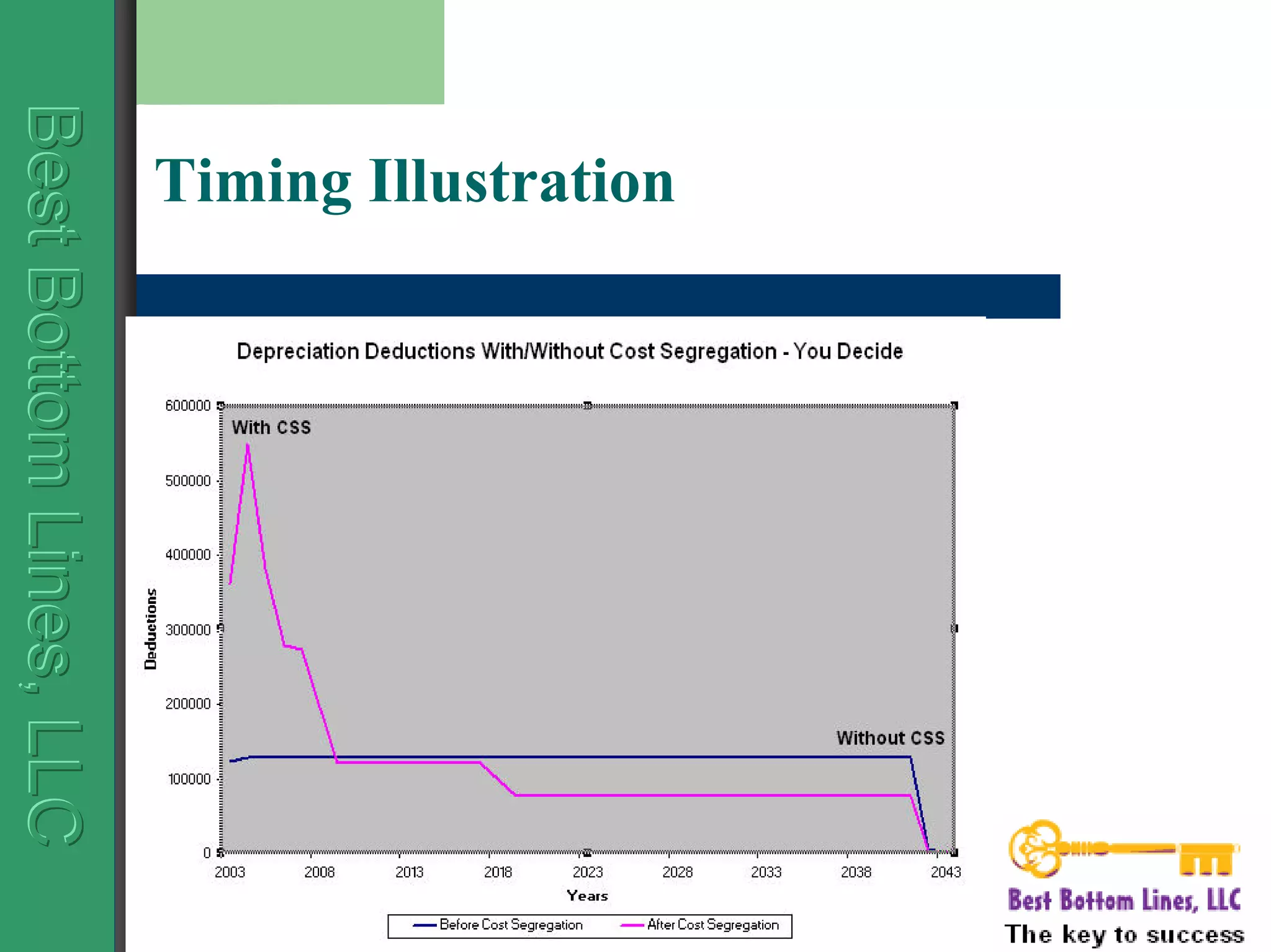
Timing Illustration
BestBottomLines,LLCBestBottomLines,LLCBestBottomLines,LLC
CSS Brief History
CS has been around since the 1960’s – it was called Component
Depreciation
There have been over 200 court cases and IRS rulings supporting
the benefits of CS
Initial cases were related to Investment Tax Credit (ITC) and
whether items related to a structure could qualify for a credit.
Congress enacted ACRS 1981 with new shorter lives
40 year life reduced to 15, 18 & 19 years
Simultaneously disallowed component depreciation
MACRS enacted in 1986 reiterated disallowance of component
depreciation
BestBottomLines,LLCBestBottomLines,LLCBestBottomLines,LLC
Hospital Corporation of America
Landmark Decision - 109 TC 21(1997)
Court reinstated and expanded a form of
component depreciation
Certain costs related to specific ordinary
use equipment (building support systems
that would otherwise be viewed as
structural) qualify to be depreciated over
life of underlying asset.
IRS acquiesced to Tax Court Ruling - 1999
BestBottomLines,LLCBestBottomLines,LLCBestBottomLines,LLC
CSS Brief History
In 1999, the IRS released Legal Memorandum 19921045 in which the IRS agreed not
to contest the (HCA) reclassification of building costs into different asset categories
that result in shorter depreciation lives
– This legal memorandum directs agents to verify that an engineering or
architectural study has been done to identify portions of the building's
system not related to the operation and maintenance of the building
– Without these detailed studies, IRS agents are advised NOT to accept the
reclassifications
– is a “facts and circumstances” assessment
– Use of Cost Segregation Study (CSS) must be specifically applied by the
taxpayer
– Allocations based on “logical and objective” measures
– Not based on non-contemporaneous data, or assumptions without
supporting records
– CSS must be “closely scrutinized” by the field
BestBottomLines,LLCBestBottomLines,LLCBestBottomLines,LLC
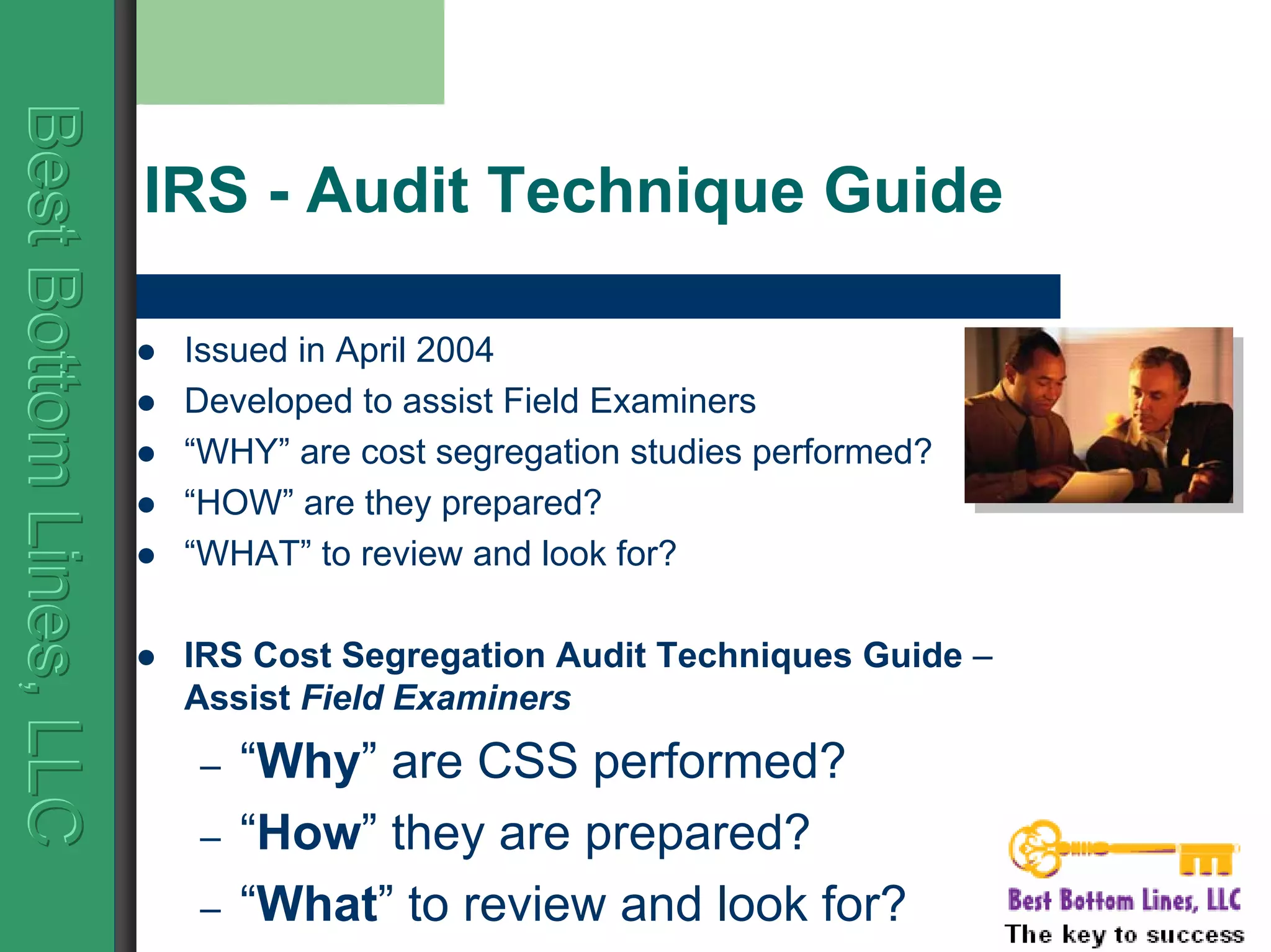
IRS - Audit Technique Guide
Issued in April 2004
Developed to assist Field Examiners
“WHY” are cost segregation studies performed?
“HOW” are they prepared?
“WHAT” to review and look for?
IRS Cost Segregation Audit Techniques Guide –
Assist Field Examiners
– “Why” are CSS performed?
– “How” they are prepared?
– “What” to review and look for?
BestBottomLines,LLCBestBottomLines,LLCBestBottomLines,LLC
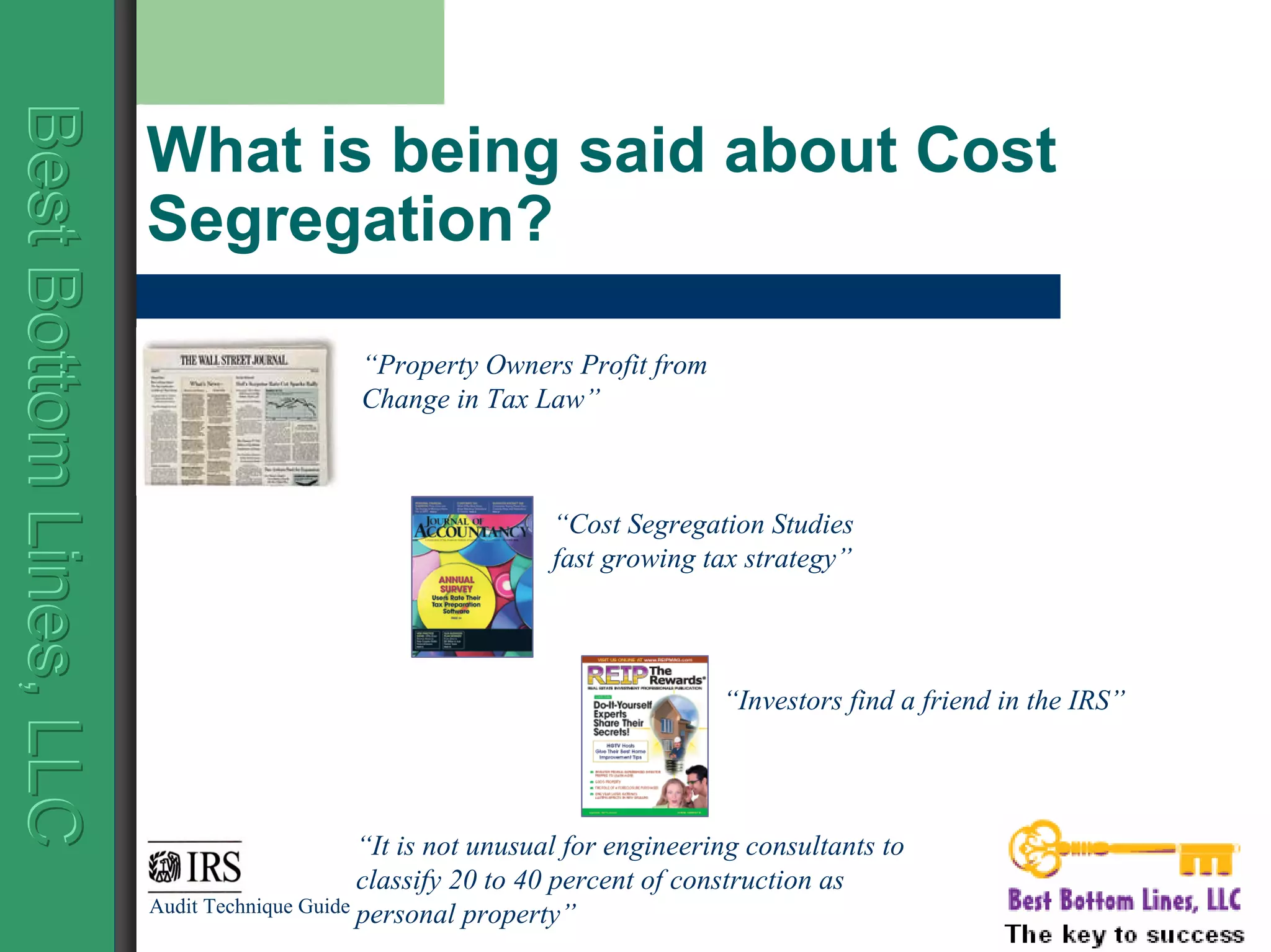
What is being said about Cost
Segregation?
“It is not unusual for engineering consultants to
classify 20 to 40 percent of construction as
personal property”Audit Technique Guide
“Investors find a friend in the IRS”
“Cost Segregation Studies
fast growing tax strategy”
“Property Owners Profit from
Change in Tax Law”
BestBottomLines,LLCBestBottomLines,LLCBestBottomLines,LLC
Qualifying Property
Any building placed in service since January 1st,
1987
Existing buildings undergoing renovation,
remodeling, restoration, or expansion
Major leasehold improvements to any building
made after January 1st, 1987
Inheritance of commercial and investment real
properties
Preconstruction planning to recommend possible
modification to the building designs to increase
shorter-life asset classification
BestBottomLines,LLCBestBottomLines,LLCBestBottomLines,LLC
Cost Segregation for an Existing Building
“Catch Up” – Look Back
If a cost segregation study is conducted on an existing
building,
– The unclaimed depreciation on personal property
components that were previously classified as real
property can be deducted as a Code Sec. 481 (a)
adjustment in the year of change
– The automatic change of accounting rules of Rev.
Proc. 2002-9, apply
If a cost segregation study is performed on a building
that was placed in service in a tax year that ended before
December 30, 2003,
– The IRS will allow a tax payer to file amended returns to
claim the benefits
– Interest is payable by the IRS on the refund
BestBottomLines,LLCBestBottomLines,LLCBestBottomLines,LLC
Cost Segregation Studies Includes
New and Previously Acquired Properties
The optimal time to perform a study is the year the property is placed in service
Current IRS procedures allow a taxpayer to recover any missed depreciation on properties
placed in service as far back as 1987 without having to amend prior years tax returns
Cost Segregation is not limited to new construction. In fact, most studies are performed on
acquired properties where land and building is purchased for one negotiated price in a previous
year
OR
MACRS - GDS
39 - Year Property
27.5 – Year Property
15 - Year Property
7 - Year Property
5 - Year Property
3 – Year Property
NEW CONSTRUCTION
Indirect Costs
+
General Contractor
Costs
+
Direct Costs outside
General Contract
ACQUIRED PROPERTY
Purchase Price
Land Cost
Building and Site
Implementation Cost
BestBottomLines,LLCBestBottomLines,LLCBestBottomLines,LLC
Benefit of Cost Segregation – Cash Flow –
Would You Take the Cash Savings Today?
CSS Illustration No. 1CSS Illustration No. 1
A taxpayer purchases (or constructs) a strip mall for $4
million (land excluded)
Without a Cost Segregation Study, the taxpayer would
have depreciated $4,000,000 as a 39-year asset over 40
years (straight-line, HY convention)
BestBottomLines,LLCBestBottomLines,LLCBestBottomLines,LLC
Benefit of Cost Segregation – Cash Flow –
Would You Take the Cash Savings Today?
By segregating assets and applying proper class lives, significant
portion of the building can be depreciated faster
Typically, about 35% of total cost can be reclassified from real
property to personal property for this type of building
CSS Illustration No. 1- (continued)CSS Illustration No. 1- (continued)
Asset Original Original Allocation Allocation
Class Asset Life Allocation Allocation After CSS After CSS
Personal Property 5 yr. 200% db -$ 0.0% 1,000,000$ 25.0%
Personal Property 7 yr. 200% db -$ 0.0% -$ 0.0%
Land Improvements 15 yr. 150% db -$ 0.0% 400,000$ 10.0%
Real Property in yrs. 39 4,000,000$ 100.0% 2,600,000$ 65.0%
4,000,000$ 100.0% 4,000,000$ 100.0%
4,000,000$ 100.0% 4,000,000$ 100.0%Total Cost
Real & Personal Property
BestBottomLines,LLCBestBottomLines,LLCBestBottomLines,LLC
Benefit of Cost Segregation – Cash Flow –
Would You Take the Cash Savings Today?
Cash savings of $320,282 can be achieved over the fist 5 years w/ CSS
Although cash savings / tax savings over the tax life of the building does not exist, net
present value of the earlier tax savings or deferred taxes due to accelerated
depreciation results in net present value of $200,000!
CSSIllustrationContinuedCSSIllustrationContinued
Asset Year Year
Depreciation
Expense
Without CSS
Depreciation
Expense With
CSS
Change in
Depreciation
Tax Savings
from Change in
Depreciation
(35% Tax Rate)
NPV of
Deferred
Taxes
(5% Disc. Rate)
Cumulative
NPV
1 2006 98,291$ 283,889$ 185,598$ 64,959$ 64,959$ 64,959$
2 2007 102,564$ 424,667$ 322,103$ 112,736$ 107,368$ 172,327$
3 2008 102,564$ 292,867$ 190,303$ 66,606$ 60,414$ 232,740$
4 2009 102,564$ 212,647$ 110,083$ 38,529$ 33,283$ 266,023$
5 2010 102,564$ 209,569$ 107,005$ 37,452$ 30,812$ 296,835$
5-year Total 2010 508,547$ 1,423,638$ 915,091$ 320,282$ 296,835$
6 2011 102,564$ 149,198$ 46,634$ 16,322$ 12,789$ 309,623$
7 2012 102,564$ 90,286$ (12,278)$ (4,297)$ (3,207)$ 306,417$
8 2013 102,564$ 90,286$ (12,278)$ (4,297)$ (3,054)$ 303,363$
9 2014 102,564$ 90,286$ (12,278)$ (4,297)$ (2,909)$ 300,454$
10 2015 102,564$ 90,286$ (12,278)$ (4,297)$ (2,770)$ 297,684$
10-year Total 2015 1,021,368$ 1,933,981$ 912,614$ 319,415$ 297,684$
40 2045 4,274$ 2,778$ (1,496)$ (524)$ (78)$ 200,039$
Over 40 Years 4,000,000$ 4,000,000$ -$ -$ 200,039$
Cost Segregation Estimate Benefit Calculation
BestBottomLines,LLCBestBottomLines,LLCBestBottomLines,LLC
Again, What is the Big Deal?
The depreciation for a property
with a Cost Segregation Study
allows for significant increase in
deductions within the first five
years.
For every $100,000 of cost shifting
from 39-year property to 5-year
property, the net present value of
the tax benefit is approximately
$16,000* (NPV = $16.00
per $100 invested)
For $100,000 of cost shifted from
39-year property to 15-year
property, the net present value of
the tax benefit is
approximately$10,600*
(NPV = $10.60 per $100 invested)
* Benefits assume a tax rate of
35% and a 5% return on
investment
FASTER CASH FLOW!
BestBottomLines,LLCBestBottomLines,LLCBestBottomLines,LLC
First element of a quality Cost Segregation Study according to the IRS Audit Techniques Guide is:
Provider who marries the science of engineering with the principles of tax and accounting to arrive at financial
solutions that results in increased cash flow, minimized tax payments and increased ROI. A firm that meticulously
follow the IRS guidelines and go beyond the standards and basic requirements outlined by the IRS
“Prepared by an individual with expertise and experience.”
Select CPAs and engineers familiar with engineering, construction, architectural and estimating processes
and techniques are essential for a quality CSS process.
Select CPAs and engineers with appropriate tax background and knowledge of over 200 court cases, many
revenue ruling and revenue procedures dealing with cost segregation area are essential for a quality CSS.
Additional Considerations
I think Audit should be first
I would also add preconstruction
Must understand abandonment issues
Knowledgeable on issues involved with §1031 & §1033 exchanges and how they interact with Cost
Segregation
Must have expertise in Form 3115 Change in Accounting Method filing procedures
Understanding how Cost Segregation can affect estate taxes, passive loss situations, IRS §179
deductions, Net Operating Loss situations, §168(k),
partnership §754 step-up elections and other tax situations
Experience in lease review and identification of
“qualified leasehold property”
Does the CSS include time for audit support
Why are the CPA and Engineer
Important in the CSS Process?
BestBottomLines,LLCBestBottomLines,LLCBestBottomLines,LLC
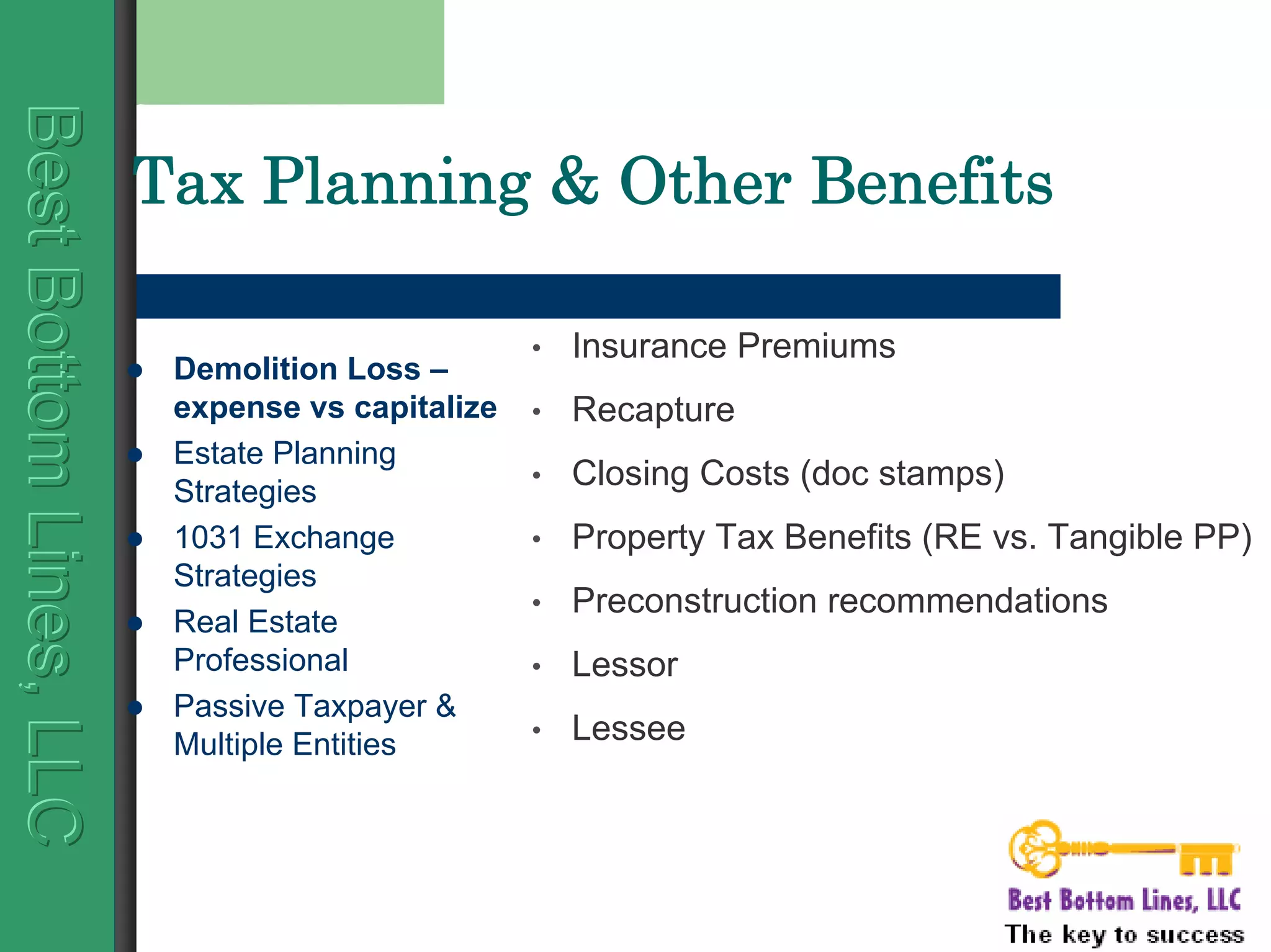
Tax Planning & Other Benefits
Demolition Loss –
expense vs capitalize
Estate Planning
Strategies
1031 Exchange
Strategies
Real Estate
Professional
Passive Taxpayer &
Multiple Entities
• Insurance Premiums
• Recapture
• Closing Costs (doc stamps)
• Property Tax Benefits (RE vs. Tangible PP)
• Preconstruction recommendations
• Lessor
• Lessee
BestBottomLines,LLCBestBottomLines,LLCBestBottomLines,LLC
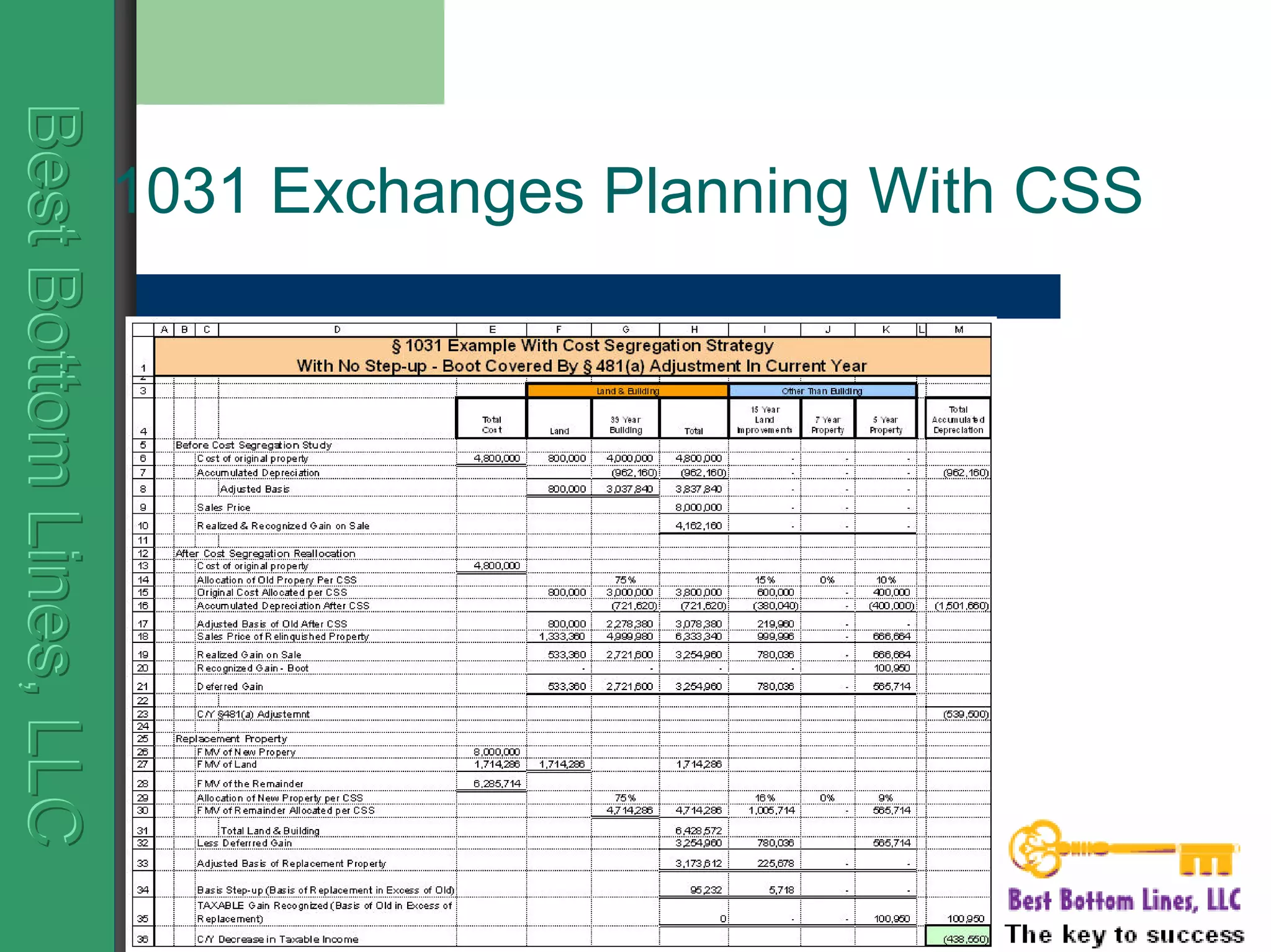
1031 Exchanges Planning With CSS
BestBottomLines,LLCBestBottomLines,LLCBestBottomLines,LLC
Why do I need an Engineering
Expertise for a CSS?
Cost segregation study (CSS) is an IRS-sanction technique allowing businesses
to accelerate depreciation on their facilities
Although the IRS does not prescribe one specific methodology, the IRS’ Cost
Segregation Audit Technique Guide does not enumerate several and elevates
the Detailed Engineering Approach From Actual Cost Records as “the most
methodical and accurate approach”
– This approach consists of carefully examining all contemporaneous
construction and accounting records
– Estimates or “take-offs” are used to supplement the actual cost detail when
the existing detail is not sufficient for the purposes of the study
– A professional firm comprised of accountants, engineers, and architects
with prior cost segregation experience, is required to perform this kind of
cost segregation study
Methodology without the engineering expertise will not withstand IRS scrutiny in
accordance with the IRS Audit Technique Guidelines
Without the contractor/engineering expertise coupled with the tax law guidance,
there will likely be valuable tax benefits left on the table
Determining 1245 property value on existing
properties must be properly documented and
appraised and indicated according to the IRS
Audit Technique Guidelines
3 Words: Mechanical, Electrical, Plumbing3 Words: Mechanical, Electrical, Plumbing
BestBottomLines,LLCBestBottomLines,LLCBestBottomLines,LLC
Detailed Engineering Approach
Identify the specific project/assets that will be analyzed
Obtain a complete listing of all project costs and substantiate the
total project costs
Inspect the facility to determine the nature of the project and its
intended use
Photograph specific property items for reference.
Review “as-built” prints, specifications, contracts, bid documents,
contractor invoices and other construction documentation.
Identify and assign specific project items to property classes
Prepare quantitative take-offs for all materials and payment
records to compute actual unit costs
Audit Technique Guide
“It is the most methodical
and accurate approach.”
BestBottomLines,LLCBestBottomLines,LLCBestBottomLines,LLC
Qualifying Property
Airports
Apartment buildings
Assisted Living Facilities
Automobile dealerships
Automotive service centers
Banks
Casinos
Cinemas
Day care centers
Department stores
Distribution centers
Fitness centers
Funeral homes
Gas stations
Golf resorts
Grocery stores Hospitals
Hotels
Industrial facilities
Laboratories
Manufacturing facilities
Marinas
Medical facilities
Mixed-use facilities
Nursing homes
Office buildings
Research facilities
Retail centers
Resorts
Restaurants
Service stations
Shopping centers
Sports facilities
Storage facilities
Warehouses
Property TypesProperty Types
BestBottomLines,LLCBestBottomLines,LLCBestBottomLines,LLC
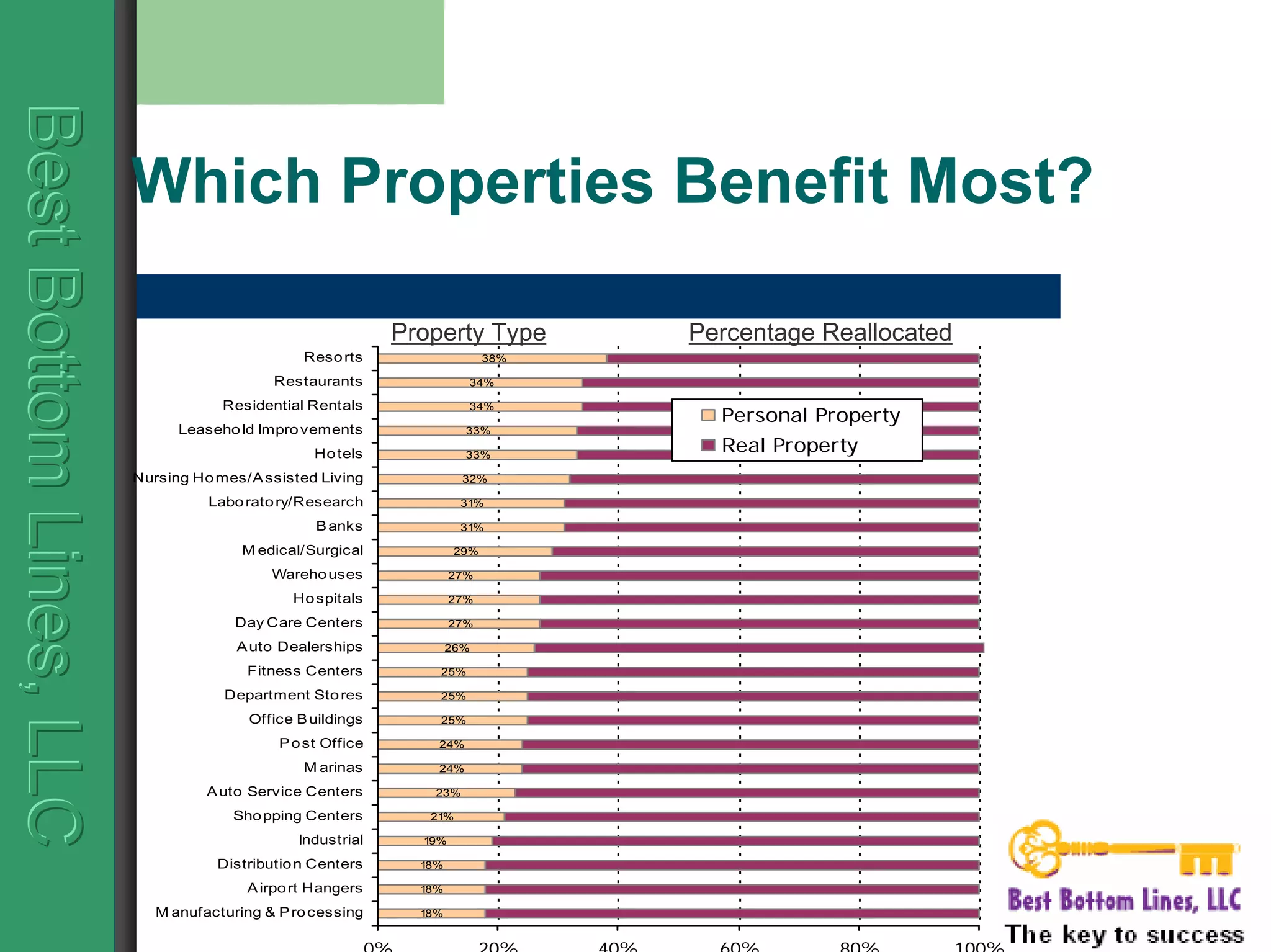
Which Properties Benefit Most?
18%
18%
18%
19%
21%
23%
24%
24%
25%
25%
25%
26%
27%
27%
27%
29%
31%
31%
32%
33%
33%
34%
34%
38%
0% 20% 40% 60% 80% 100%
M anufacturing & Processing
Airport Hangers
Distribution Centers
Industrial
Shopping Centers
Auto Service Centers
M arinas
Post Office
Office Buildings
Department Stores
Fitness Centers
Auto Dealerships
Day Care Centers
Hospitals
Warehouses
M edical/Surgical
Banks
Laboratory/Research
Nursing Homes/Assisted Living
Hotels
Leasehold Improvements
Residential Rentals
Restaurants
Resorts
Personal Property
Real Property
Property Type Percentage Reallocated
BestBottomLines,LLCBestBottomLines,LLCBestBottomLines,LLC
Cost Segregation Recent Results
Project: Hotel
Cost: $7,123,456
5 Year Tax Savings: $812,145
Project: High-End Office
Building
Cost: $5,234,125
5 Year Tax Savings: $625,678
Project: Apartment Complex – 12 Complexes
Cost: $18,100,000
5 Year Tax Savings: $1,585,222
BestBottomLines,LLCBestBottomLines,LLCBestBottomLines,LLC
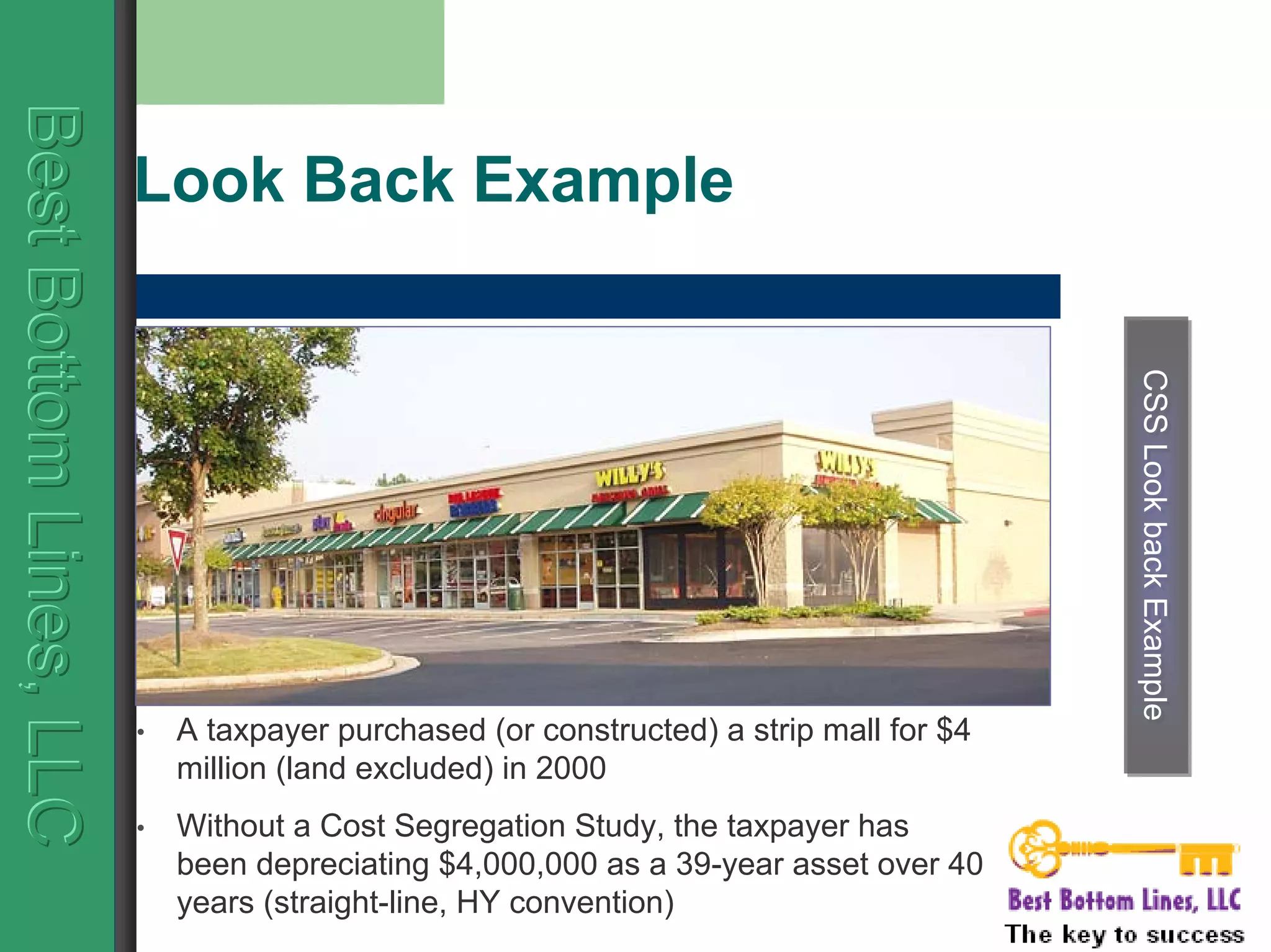
Look Back Example
CSSLookbackExampleCSSLookbackExample
• A taxpayer purchased (or constructed) a strip mall for $4
million (land excluded) in 2000
• Without a Cost Segregation Study, the taxpayer has
been depreciating $4,000,000 as a 39-year asset over 40
years (straight-line, HY convention)
BestBottomLines,LLCBestBottomLines,LLCBestBottomLines,LLC
Look Back Example – continued
• What could you do with the new found money of $336,604 that was
trapped in the walls of your investment?
Make additional investment
Reduce mortgage debt
Address maintenance items
CSSLookBackExample
(continued)
CSSLookBackExample
(continued)
Asset Year Year
Depreciation
Expense
Without CSS
Depreciation
Expense With
CSS
Change in
Depreciation
Overpaid Taxes
(35% Tax Rate)
1 2000 98,291$ 283,889$ 185,598$ 64,959$
2 2001 102,564$ 424,667$ 322,103$ 112,736$
3 2002 102,564$ 292,867$ 190,303$ 66,606$
4 2003 102,564$ 212,647$ 110,083$ 38,529$
5 2004 102,564$ 209,569$ 107,005$ 37,452$
6 2005 102,564$ 149,198$ 46,634$ 16,322$
6-year Total 611,111$ 1,572,836$ 961,725$ 336,604$
Cost Segregation Estimate Benefit Calculation
IRS Owes The Property Owner $336,604!IRS Owes The Property Owner $336,604!
BestBottomLines,LLCBestBottomLines,LLCBestBottomLines,LLC
Examples of Pre-Construction
Benefits
Pre-Construction Planning: In the design phase, CORE can help
make the building more tax efficient by identifying business
components from the structural components
Example: Law Firm uses hinges for $1MM decorative lobby
shelving versus attaching shelving with a permanent adhesive
– Total property is able to be moved from
39-year depreciation to 5-year
depreciation for a tremendous savings
Example: Hospital installs $1.8MM floating floor system versus
permanent attached flooring
– Structurally as sound, cash savings from
more attractive depreciation schedule
substantial
BestBottomLines,LLCBestBottomLines,LLCBestBottomLines,LLC
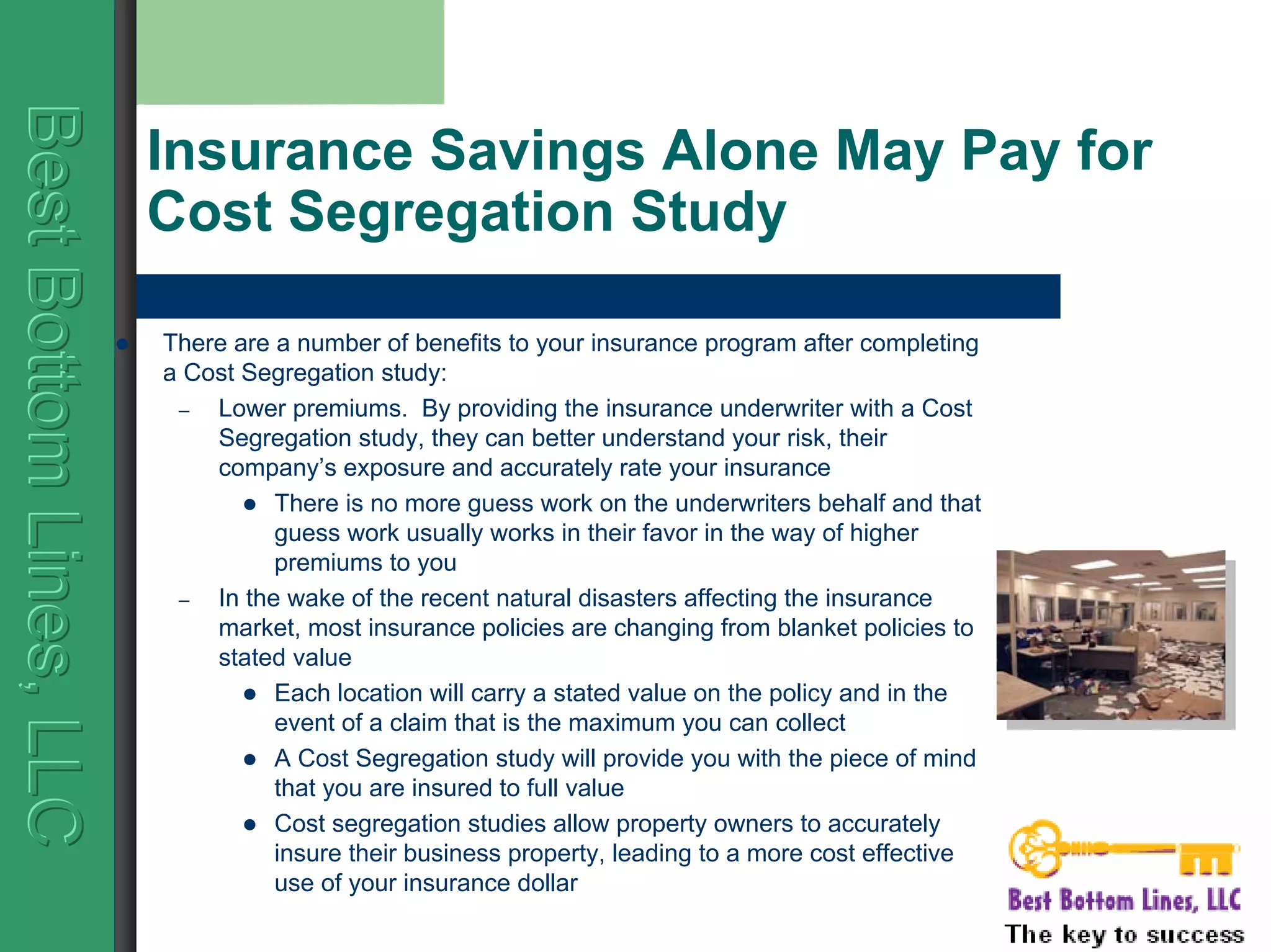
Insurance Savings Alone May Pay for
Cost Segregation Study
There are a number of benefits to your insurance program after completing
a Cost Segregation study:
– Lower premiums. By providing the insurance underwriter with a Cost
Segregation study, they can better understand your risk, their
company’s exposure and accurately rate your insurance
There is no more guess work on the underwriters behalf and that
guess work usually works in their favor in the way of higher
premiums to you
– In the wake of the recent natural disasters affecting the insurance
market, most insurance policies are changing from blanket policies to
stated value
Each location will carry a stated value on the policy and in the
event of a claim that is the maximum you can collect
A Cost Segregation study will provide you with the piece of mind
that you are insured to full value
Cost segregation studies allow property owners to accurately
insure their business property, leading to a more cost effective
use of your insurance dollar
BestBottomLines,LLCBestBottomLines,LLCBestBottomLines,LLC
Additional Benefits from CSS
Demolition/Rehabilitation
Ability to identify components of a building
prior to demolition and/or rehabilitation which
can be reclassified as personal property
versus real property
Allows the owner to write off these items
versus capitalizing the assets which generate
a substantial tax savings
For example, if a property owner has a $5-
million property that they are going to
demolish:
– The total cost would typically get
applied to the land with the property
owner having no ability to depreciate or
recoup the $5-million investment
– A cost segregation study, prior to the
demolition, identifies $1,500,000 of
personal property
– The property owner will now be able to
write off the $1,500,000 as abandoned
personal property
BestBottomLines,LLCBestBottomLines,LLCBestBottomLines,LLC
Real Estate Investment Trusts
(REITs) Benefit
Increase non-cash expense to reduce income and thus minimize
dividend distribution, allowing increased cash flow for additional
acquisitions
REIT dividends have 3 components:
– Ordinary Dividends
– Long-Term Capital Gains Dividends
– Return of Capital Dividends
Due to the favorable tax treatment of Return of Capital Dividends
(taxed at the long-term capital gains rate of 15% or 25% and tax
payment is deferred until the sale of the share), investors typically
prefer dividends with the greatest percentage of Return of Capital
Cost Segregation increases the Return of Capital component; thereby,
increasing the Taxable Equivalent Yield
DIVIDEND GROWTH IS INCREASED
– A significant source of dividend growth is acquisitions
REIT must pay out a minimum of 90% of taxable income as
dividends, and many REITs pay out over 100% of taxable
income.
BestBottomLines,LLCBestBottomLines,LLCBestBottomLines,LLC
Cost Segregation Asset Class
Lives for Restaurants
The crux of cost segregation is determining whether an asset is I.R.C.
– §1245 property (shorter cost recovery period property, 5 or 7 years) –
e.g., depreciable personal property, such as equipment – or
– §1250 property (longer cost recovery period property, 39, 31.5 or 15
years) – e.g., buildings and building components, which generally are
not §1245 property
The Director for the Retailers, Food, Pharmaceuticals and Healthcare
Industry chartered a working group to address the most efficient way to
approach cost segregation issues specific to the restaurant industry
– The group produced a special section related to the required cost
segregation study for such purposes
BestBottomLines,LLCBestBottomLines,LLCBestBottomLines,LLC
Cost Segregation and 1031 Exchanges
- Best of Both Worlds -
Most valuable tax deferral strategies for real estate are:
– Cost Segregation (Accelerated depreciation of real estate)
– 1031 Exchanges (Deferral on the disposition of appreciated property)
How To Best Utilize Both Strategies
– Real Estate Investors and their advisors must understand issues in
utilizing both strategies
Real vs. Personal Property
– Real and personal property under section 1031 is determined by state
law
– In contrast, the definition of real and personal property for cost
segregation studies is determined under federal law
– Property such as wall coverings, carpeting, special purpose wiring or
other installations affixed to the building can be considered real
property under state law and like kind for section 1031 purposes, but
be considered personal property in cost segregation studies
– Real estate owners can benefit from both the gain deferral under
section 1031 for real estate exchanges and the enhanced cost
recovery deductions of cost segregation study
BestBottomLines,LLCBestBottomLines,LLCBestBottomLines,LLC
IRS Determination/Tests -
Structure or Personal?
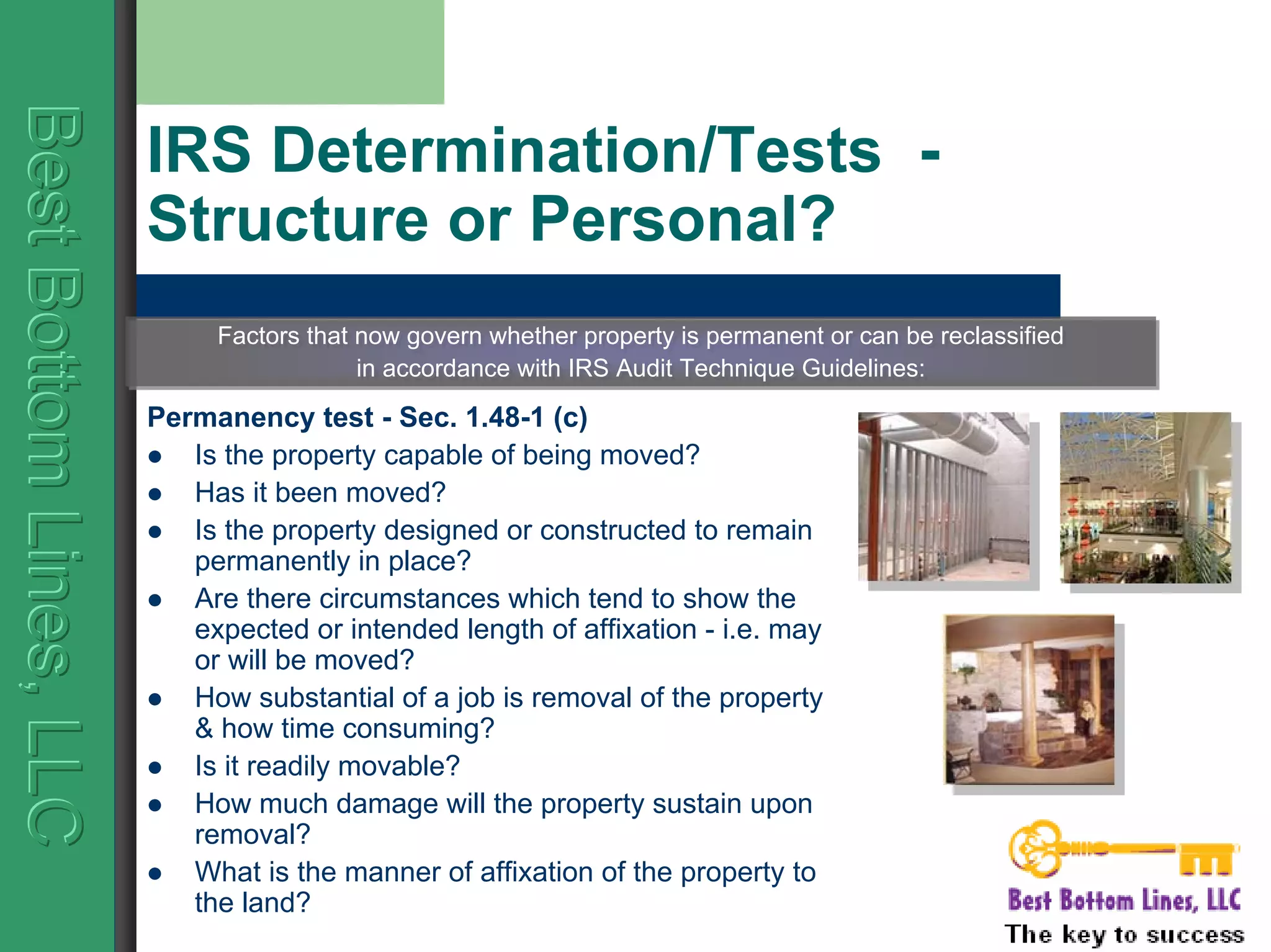
Permanency test - Sec. 1.48-1 (c)
Is the property capable of being moved?
Has it been moved?
Is the property designed or constructed to remain
permanently in place?
Are there circumstances which tend to show the
expected or intended length of affixation - i.e. may
or will be moved?
How substantial of a job is removal of the property
& how time consuming?
Is it readily movable?
How much damage will the property sustain upon
removal?
What is the manner of affixation of the property to
the land?
Factors that now govern whether property is permanent or can be reclassified
in accordance with IRS Audit Technique Guidelines:
Factors that now govern whether property is permanent or can be reclassified
in accordance with IRS Audit Technique Guidelines:
BestBottomLines,LLCBestBottomLines,LLCBestBottomLines,LLC
IRS Determination/Tests -
Structure or Personal?
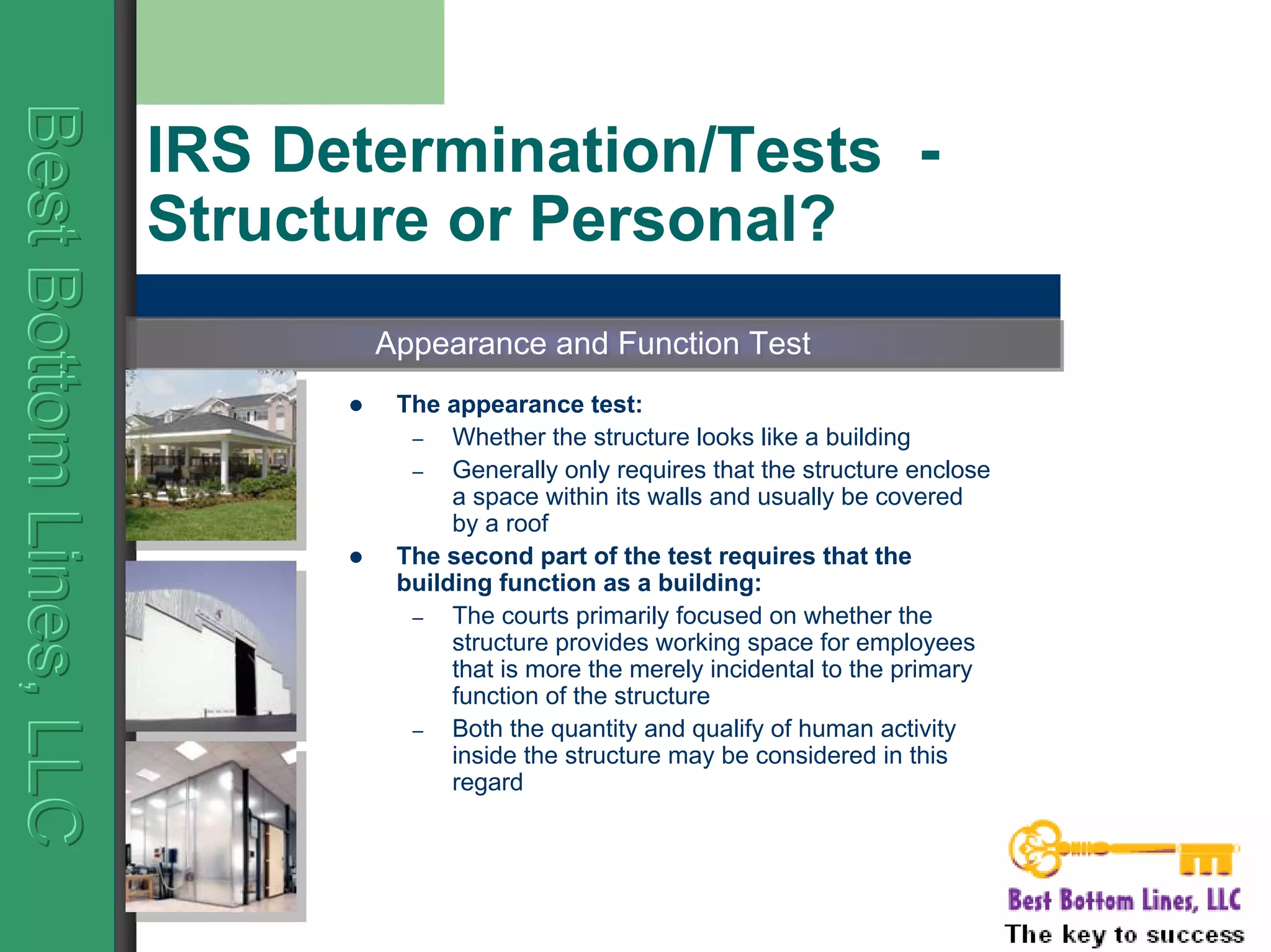
The appearance test:
– Whether the structure looks like a building
– Generally only requires that the structure enclose
a space within its walls and usually be covered
by a roof
The second part of the test requires that the
building function as a building:
– The courts primarily focused on whether the
structure provides working space for employees
that is more the merely incidental to the primary
function of the structure
– Both the quantity and qualify of human activity
inside the structure may be considered in this
regard
Appearance and Function TestAppearance and Function Test
BestBottomLines,LLCBestBottomLines,LLCBestBottomLines,LLC
Items To Be Reclassified in a Cost
Segregation Study
Site Improvements
(landscaping/parking)
Light Fixtures
Branch wiring
Special Plumbing
Flooring
Millwork
Millwork Window Coverings
Partition Walls
Cabinetry
Furnishings
Shelving
Wall Coverings
BestBottomLines,LLCBestBottomLines,LLCBestBottomLines,LLC
Qualified Property
Property to include:
– Accordion-style room
dividers
– Decorative lattice millwork
used to separate areas
These items are not permanent structures
therefore do not affect the operation nor
maintenance of the building
1245 property
PartitionsPartitions
BestBottomLines,LLCBestBottomLines,LLCBestBottomLines,LLC
UNIQUE ASSETS TO IDENTIFY
BestBottomLines,LLCBestBottomLines,LLCBestBottomLines,LLC
Qualified Property
Property to include:
– Main panels
– Motor control centers
– Transformers
– Main distribution panel switchgear
– Related wiring and conduit
The courts conclude that the portion of the cost of
the primary and secondary electrical distribution
systems which is equal to the percentage of the
electrical load carried to those systems allocable
to the property equipment, as stipulated
constitutes the 1245 qualification class property
and is depreciable over an accelerated life
Primary and Secondary Electrical Distribution SystemsPrimary and Secondary Electrical Distribution Systems
BestBottomLines,LLCBestBottomLines,LLCBestBottomLines,LLC
Qualified Property
Property to include:
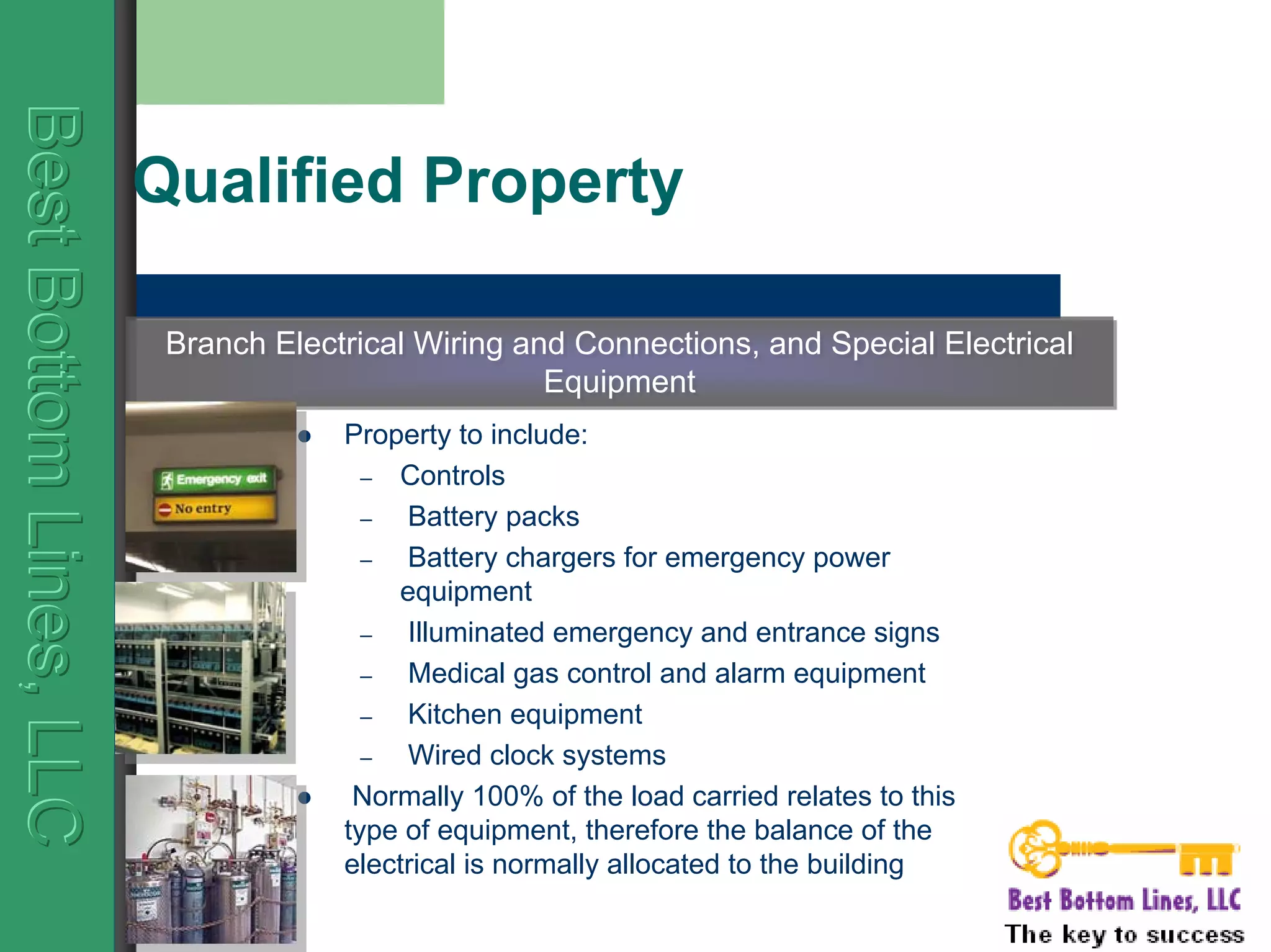
– Controls
– Battery packs
– Battery chargers for emergency power
equipment
– Illuminated emergency and entrance signs
– Medical gas control and alarm equipment
– Kitchen equipment
– Wired clock systems
Normally 100% of the load carried relates to this
type of equipment, therefore the balance of the
electrical is normally allocated to the building
Branch Electrical Wiring and Connections, and Special Electrical
Equipment
Branch Electrical Wiring and Connections, and Special Electrical
Equipment
BestBottomLines,LLCBestBottomLines,LLCBestBottomLines,LLC
Qualified Property
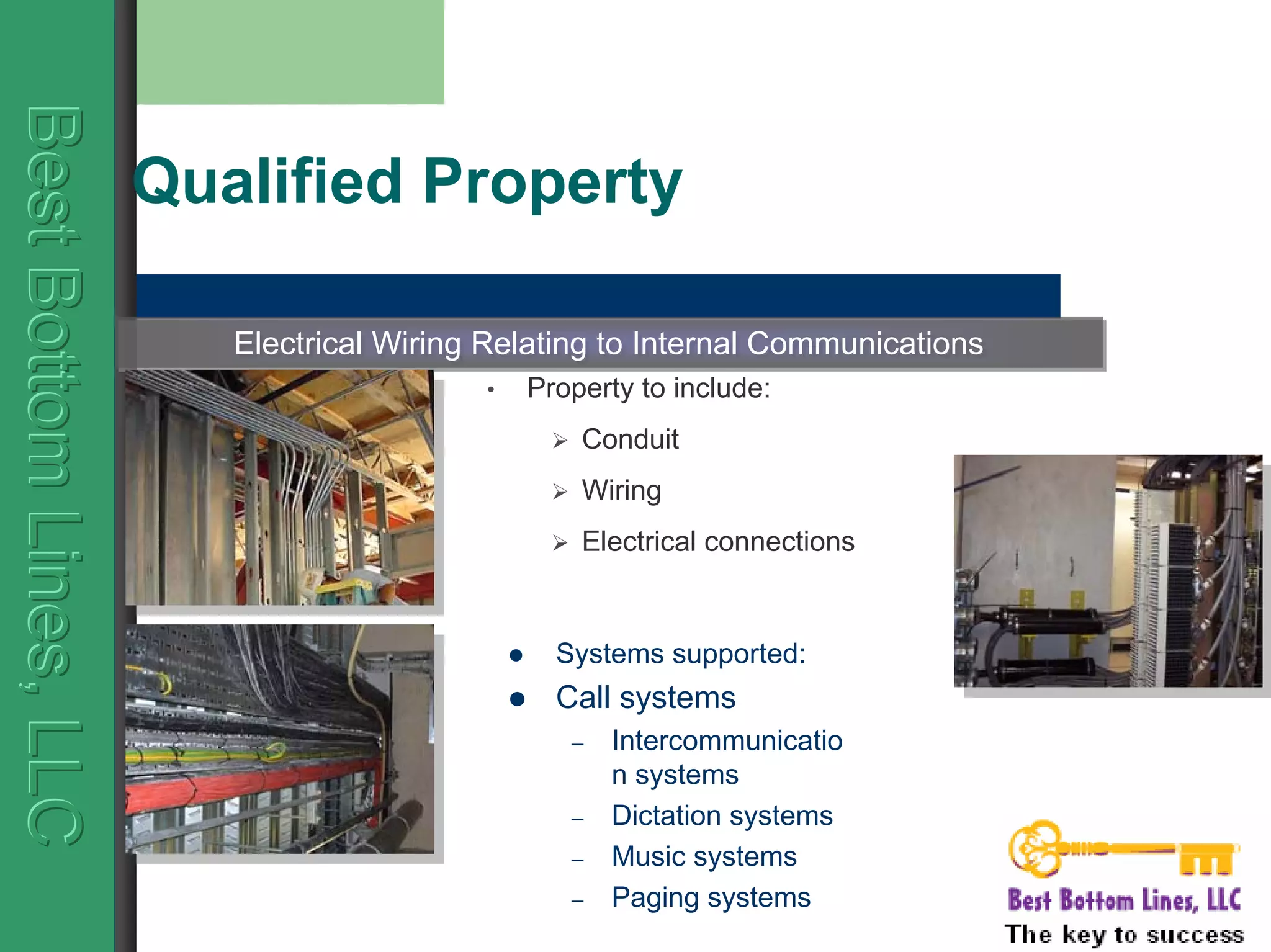
Systems supported:
Call systems
– Intercommunicatio
n systems
– Dictation systems
– Music systems
– Paging systems
Electrical Wiring Relating to Internal CommunicationsElectrical Wiring Relating to Internal Communications
• Property to include:
Conduit
Wiring
Electrical connections
BestBottomLines,LLCBestBottomLines,LLCBestBottomLines,LLC
Qualified Property
Property to include:
Branch electrical wiring
Conduit, floor boxes
Junction boxes
Outlet receptacles
All other equipment in
connection with its
operation
Wiring and Related Property Items Relating to Television EquipmentWiring and Related Property Items Relating to Television Equipment
BestBottomLines,LLCBestBottomLines,LLCBestBottomLines,LLC
Qualified Property
Property to include:
Items relating to operation of
grease trap systems
Trench drains
Grease waste piping
Waste excavation
Waste fill
Trap itself
All connections (hose and reel
connections)
Water piping used for
operation of kitchen equipment
Kitchen PlumbingKitchen Plumbing
BestBottomLines,LLCBestBottomLines,LLCBestBottomLines,LLC
Qualified Property
Property to include:
– Air intake fans & related
duct work
– Dishwasher condensate
return units
These items ventilate air,
remove humidity and steam,
replace air expelled
Test:
– Do the items relate to the
buildings operation or
maintenance?
– NO! Therefore are
considered Section 1245
property
Kitchen Hoods and Exhaust SystemsKitchen Hoods and Exhaust Systems
BestBottomLines,LLCBestBottomLines,LLCBestBottomLines,LLC
Sample Report –
Engineering Calculations Per IRS Guidelines
Total S.F. Unit Cost
Unit of
Measure Qty Subtotal
Functional
OBS.
Total Unit
Cost
Location
Factor Unit Cost Adj. Totals Reference Numbers
Sales Floor 880
Special Finishes
Vinyl Baseboard-4" high, .080" thick 1.78$ l.f. 108 192.24 100.00% 192.24 100% 192.24 09-651-200-1150
Carpet-42 oz. Nylon 43.00$ s.y. 98 4,214.00 100.00% 4,214.00 100% 4,214.00 09-673-800-1100
Total-Special Finishes 4,406.24
Finishes
1/2" gypsum wallboard- taped & finished 0.65$ s.f. 972 631.80 100.00% 631.80 100% 631.80 09-250-700-0150
Paint 0.73$ s.f. 972 709.56 100.00% 709.56 100% 709.56 09-910-920-1240
Total-Finishes 1,341.36
Furnishings -
Window coverings-Vertical 3" PVC 9.55$ s.f. 180 1,719.00 100.00% 1,719.00 100% 1,719.00 12-483-100-1500
Total-Furnishings 1,719.00
7,466.60
Total S.F. Unit Cost
Unit of
Measure Qty Subtotal
Functional
OBS.
Total Unit
Cost
Location
Factor Unit Cost Adj. Totals Reference Numbers
Office #1 195
Special Doors & Windows
Interior Window Glass-3/8" thick, tinted 6.90$ s.f. 36 248.40 100.00% 248.40 100% 248.40 08-810-850-0600
Total-Special Doors & Windows 248.40
Doors & Windows
Hollow core door-3' W x 6'-8" H 102.00$ ea. 1 102.00 100.00% 102.00 100% 102.00 08-210-900-2380
Door trim-pine, 4-9/16" deep 8.35$ l.f. 15 125.25 100.00% 125.25 100% 125.25 08-210-960-3020
Total-Doors & Windows 227.25
Special Finishes
Vinyl Baseboard-4" high, .080" thick 1.78$ l.f. 53 94.34 100.00% 94.34 100% 94.34 09-651-200-1150
Carpet-42 oz. Nylon 43.00$ s.y. 22 946.00 100.00% 946.00 100% 946.00 09-673-800-1100
Carpet Padding-sponge, rubber 6.05$ s.y. 22 133.10 100.00% 133.10 100% 133.10 09-673-600-9000
Total-Special Finishes 1,173.44
Finishes 0.00%
1/2" gypsum wallboard- taped & finished 0.65$ s.f. 488 317.20 100.00% 317.20 100% 317.20 09-250-700-0150
Paint 0.73$ s.f. 488 356.24 100.00% 356.24 100% 356.24 09-910-920-1240
Total-Finishes 673.44
2,322.53
Office
BestBottomLines,LLCBestBottomLines,LLCBestBottomLines,LLC
Sample Report –
Depreciation Analysis
Per IRS Guidelines
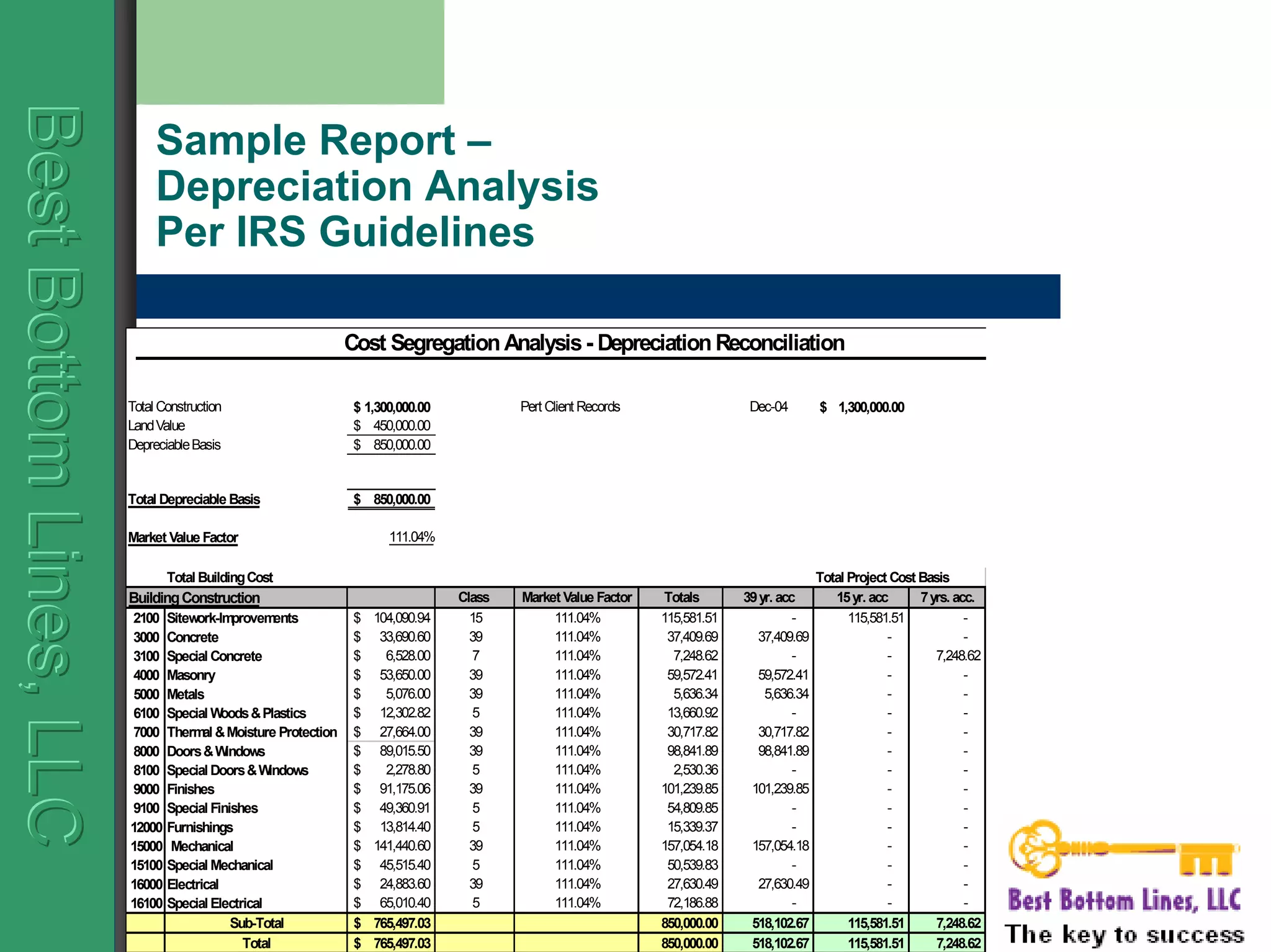
Total Construction 1,300,000.00$ Pert Client Records Dec-04 1,300,000.00$
LandValue 450,000.00$
DepreciableBasis 850,000.00$
Total Depreciable Basis 850,000.00$
Market Value Factor 111.04%
Total BuildingCost Total Project Cost Basis
BuildingConstruction Class Market Value Factor Totals 39yr. acc 15yr. acc 7yrs. acc.
2100 Sitework-Improvements 104,090.94$ 15 111.04% 115,581.51 - 115,581.51 -
3000 Concrete 33,690.60$ 39 111.04% 37,409.69 37,409.69 - -
3100 Special Concrete 6,528.00$ 7 111.04% 7,248.62 - - 7,248.62
4000 Masonry 53,650.00$ 39 111.04% 59,572.41 59,572.41 - -
5000 Metals 5,076.00$ 39 111.04% 5,636.34 5,636.34 - -
6100 Special Woods&Plastics 12,302.82$ 5 111.04% 13,660.92 - - -
7000 Thermal &Moisture Protection 27,664.00$ 39 111.04% 30,717.82 30,717.82 - -
8000 Doors&Windows 89,015.50$ 39 111.04% 98,841.89 98,841.89 - -
8100 Special Doors&Windows 2,278.80$ 5 111.04% 2,530.36 - - -
9000 Finishes 91,175.06$ 39 111.04% 101,239.85 101,239.85 - -
9100 Special Finishes 49,360.91$ 5 111.04% 54,809.85 - - -
12000 Furnishings 13,814.40$ 5 111.04% 15,339.37 - - -
15000 Mechanical 141,440.60$ 39 111.04% 157,054.18 157,054.18 - -
15100 Special Mechanical 45,515.40$ 5 111.04% 50,539.83 - - -
16000 Electrical 24,883.60$ 39 111.04% 27,630.49 27,630.49 - -
16100 Special Electrical 65,010.40$ 5 111.04% 72,186.88 - - -
Sub-Total 765,497.03$ 850,000.00 518,102.67 115,581.51 7,248.62
Total 765,497.03$ 850,000.00 518,102.67 115,581.51 7,248.62
Cost SegregationAnalysis- DepreciationReconciliation
BestBottomLines,LLCBestBottomLines,LLCBestBottomLines,LLC
Sample Report – Depreciation Schedule
Per IRS Guidelines
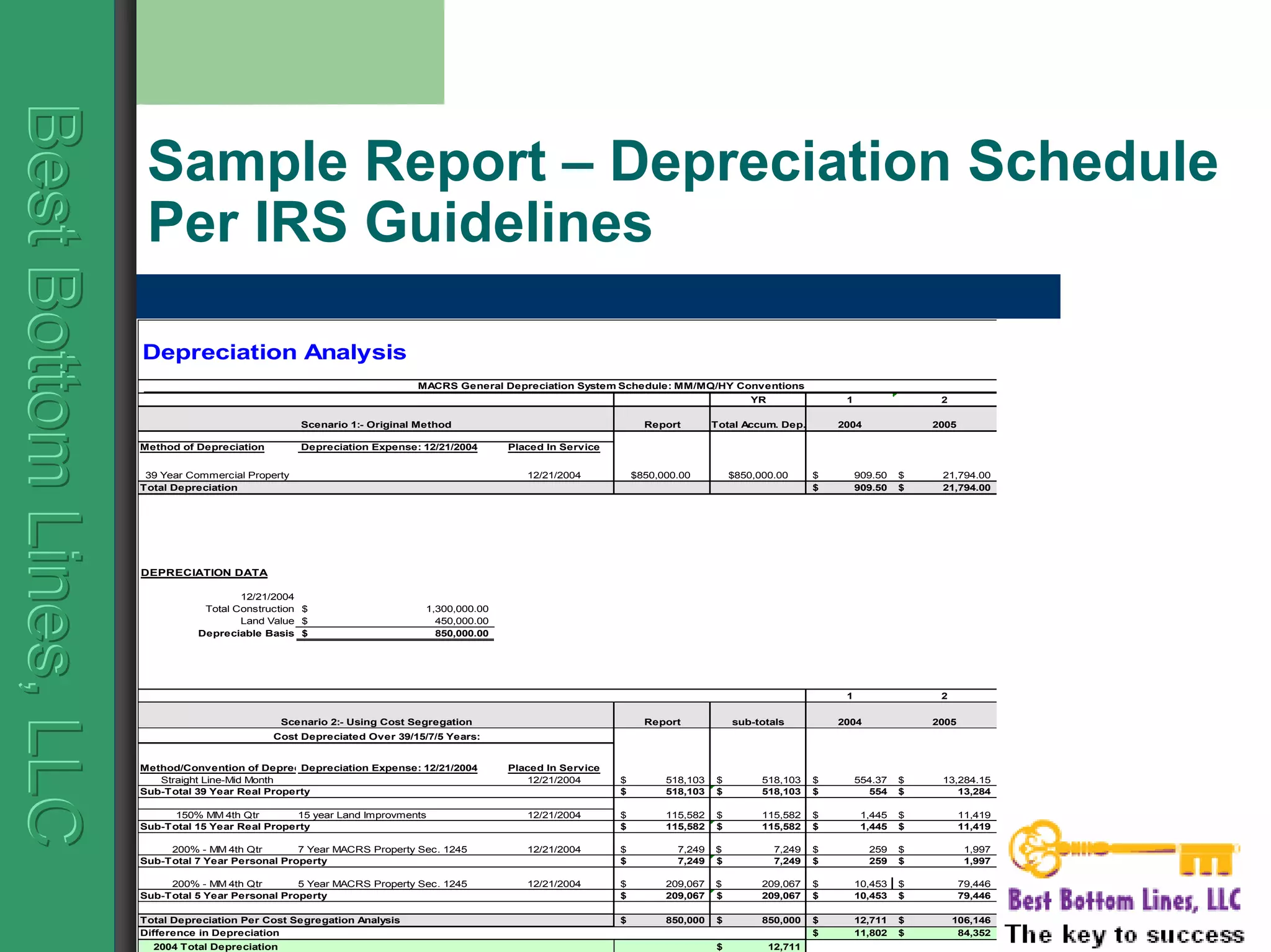
Depreciation Analysis
YR 1 2
Report Total Accum. Dep. 2004 2005
Method of Depreciation Depreciation Expense: 12/21/2004 Placed In Service
39 Year Commercial Property 12/21/2004 $850,000.00 $850,000.00 909.50$ 21,794.00$
Total Depreciation 909.50$ 21,794.00$
DEPRECIATION DATA
12/21/2004
Total Construction 1,300,000.00$
Land Value 450,000.00$
Depreciable Basis 850,000.00$
1 2
Report sub-totals 2004 2005
Method/Convention of DeprecDepreciation Expense: 12/21/2004 Placed In Service
Straight Line-Mid Month 12/21/2004 518,103$ 518,103$ 554.37$ 13,284.15$
Sub-Total 39 Year Real Property 518,103$ 518,103$ 554$ 13,284$
150% MM 4th Qtr 15 year Land Improvments 12/21/2004 115,582$ 115,582$ 1,445$ 11,419$
Sub-Total 15 Year Real Property 115,582$ 115,582$ 1,445$ 11,419$
200% - MM 4th Qtr 7 Year MACRS Property Sec. 1245 12/21/2004 7,249$ 7,249$ 259$ 1,997$
Sub-Total 7 Year Personal Property 7,249$ 7,249$ 259$ 1,997$
200% - MM 4th Qtr 5 Year MACRS Property Sec. 1245 12/21/2004 209,067$ 209,067$ 10,453$ 79,446$
Sub-Total 5 Year Personal Property 209,067$ 209,067$ 10,453$ 79,446$
Total Depreciation Per Cost Segregation Analysis 850,000$ 850,000$ 12,711$ 106,146$
Difference in Depreciation 11,802$ 84,352$
2004 Total Depreciation 12,711$
Cost Depreciated Over 39/15/7/5 Years:
MACRS General Depreciation System Schedule: MM/MQ/HY Conventions
Scenario 2:- Using Cost Segregation
Scenario 1:- Original Method
BestBottomLines,LLCBestBottomLines,LLCBestBottomLines,LLC
Sample Report –
Tax References Per IRS Guidelines
Tax References
•2004 U.S. Master Depreciation Guide, CCH Inc: …***
Revenue Rulings:
• Rev. Rul. 69-558, 1969-2 CB 4 Definition of section 38 Property
• Rev. Rul. 75-78., 1975-1 CB 8 Factory air handling and safety
• Rev. Rul. 75-137, 1975-1 CB 74 Dredging and excavation costs
• Rev. Rul. 75-77, 1975-1 CB 7 Factory air conditioning and heating units
• Rev. Rul. 81-240, 1981-2 CB 11 Individual room refrigeration units; warehouse
• Rev. Rul. 80-93, 1980-1 CB 50 Land preparation costs; Electric and gas distribution systems
Regulations:…**
• 1.48-1
• 1.48-(a)(1)
• 1.48-(e)(1)
• 1.48-(e)(2)
• 1.48-(c)
Revenue Procedure 88-35
LSMB Field Directive
Court Cases:
• Hospital Corp of America, et. Al. v. Commr, 109TC No.2 ***
• Morrison v. Commr, T.C. Memeo 1986-129***
• Whiteco Indus., Inc. v. Commr, 65 T.C. 664,672-673(1975)***
• Central Citrus Co. v. Commr, 58 T.C. at 374***
• Scott Paper Co. v. Commr, supra,***
• Fed. Sav. And Loan Association v. United States, 313 F. Supp 294-96 ***
* Denotes, in text
** Denotes, referenced in text
*** Denotes, reference material
BestBottomLines,LLCBestBottomLines,LLCBestBottomLines,LLC
The Cost Segregation Study
Process Continued…
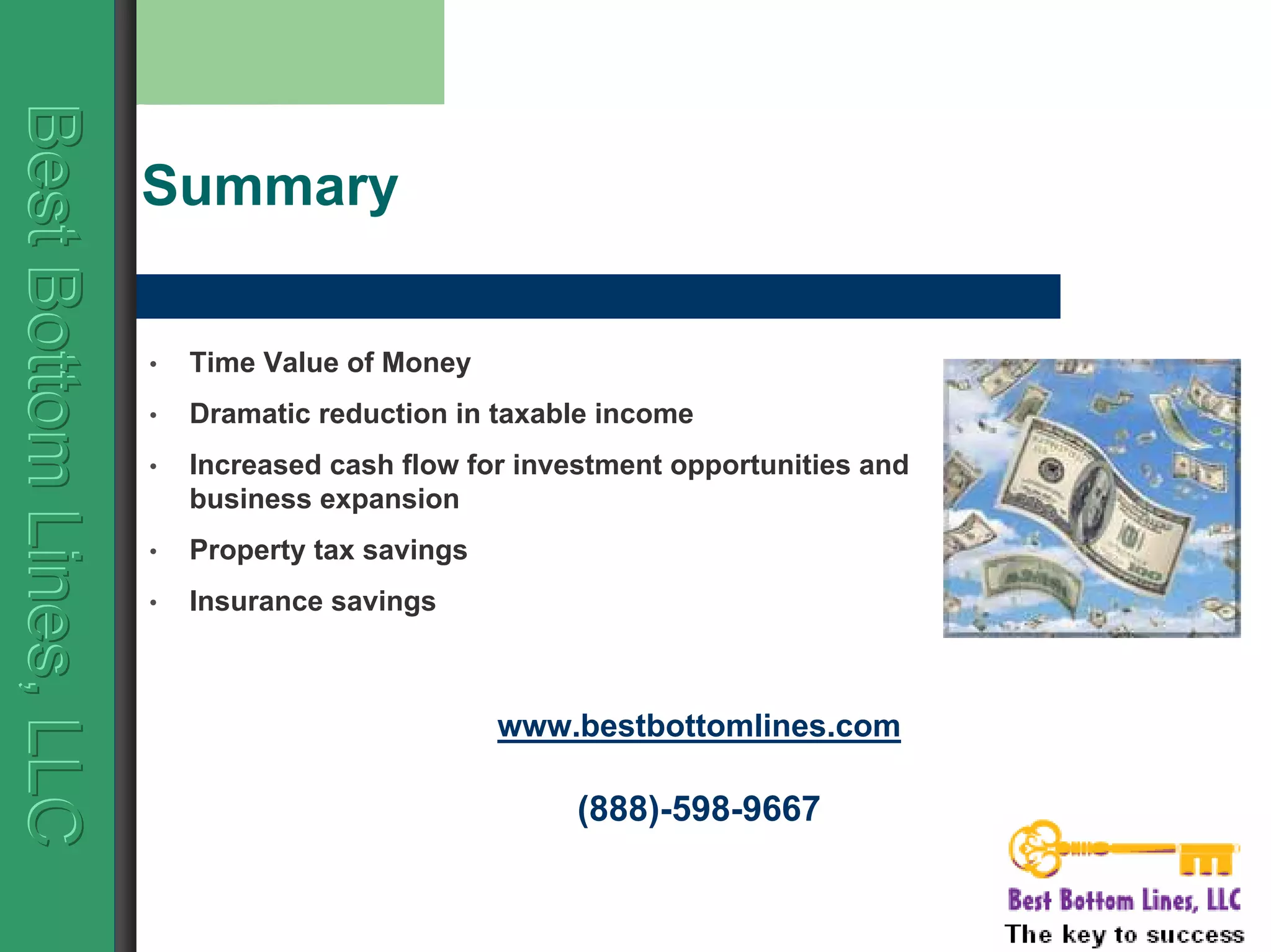
Landscaping
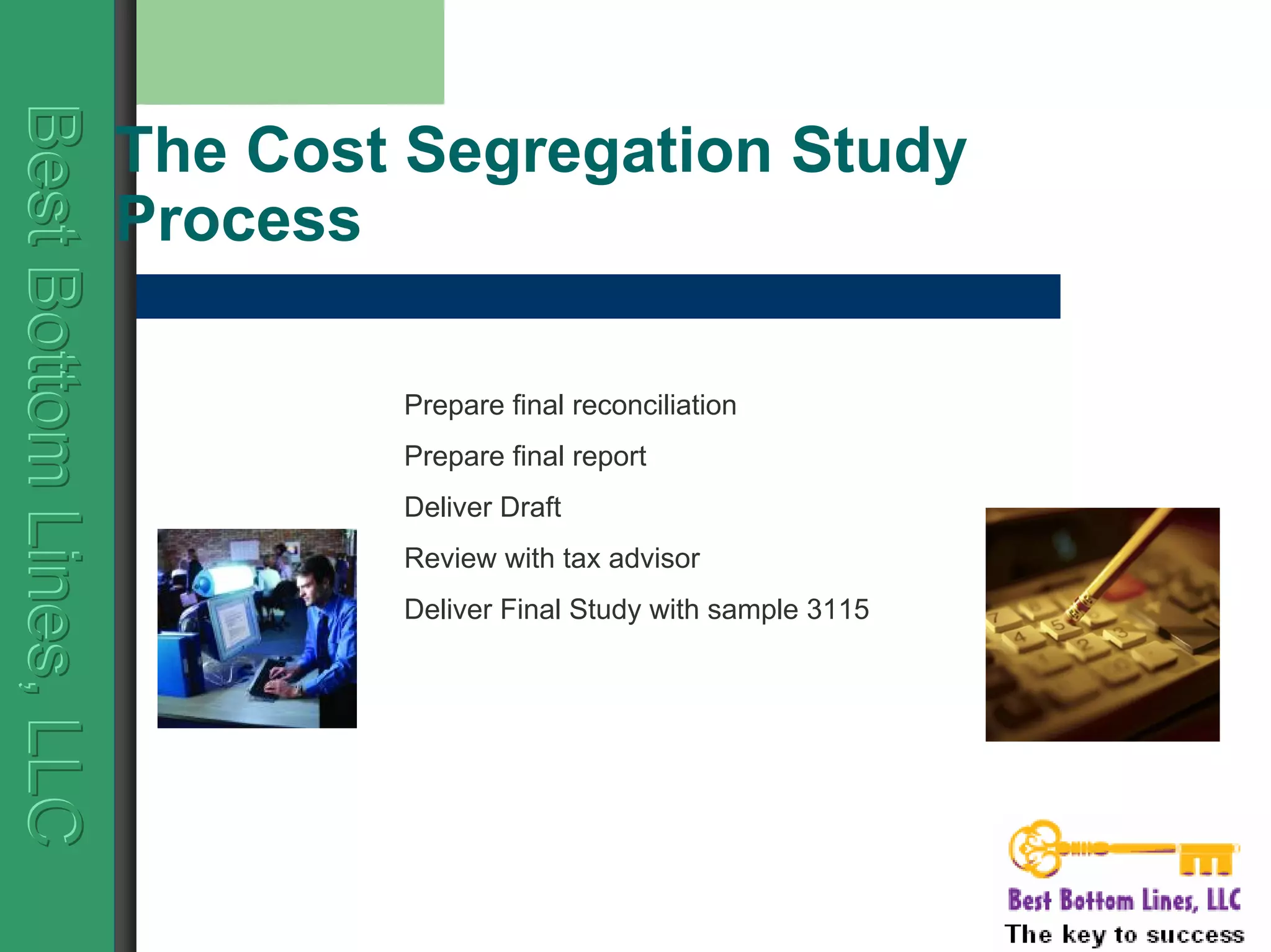
Site Work
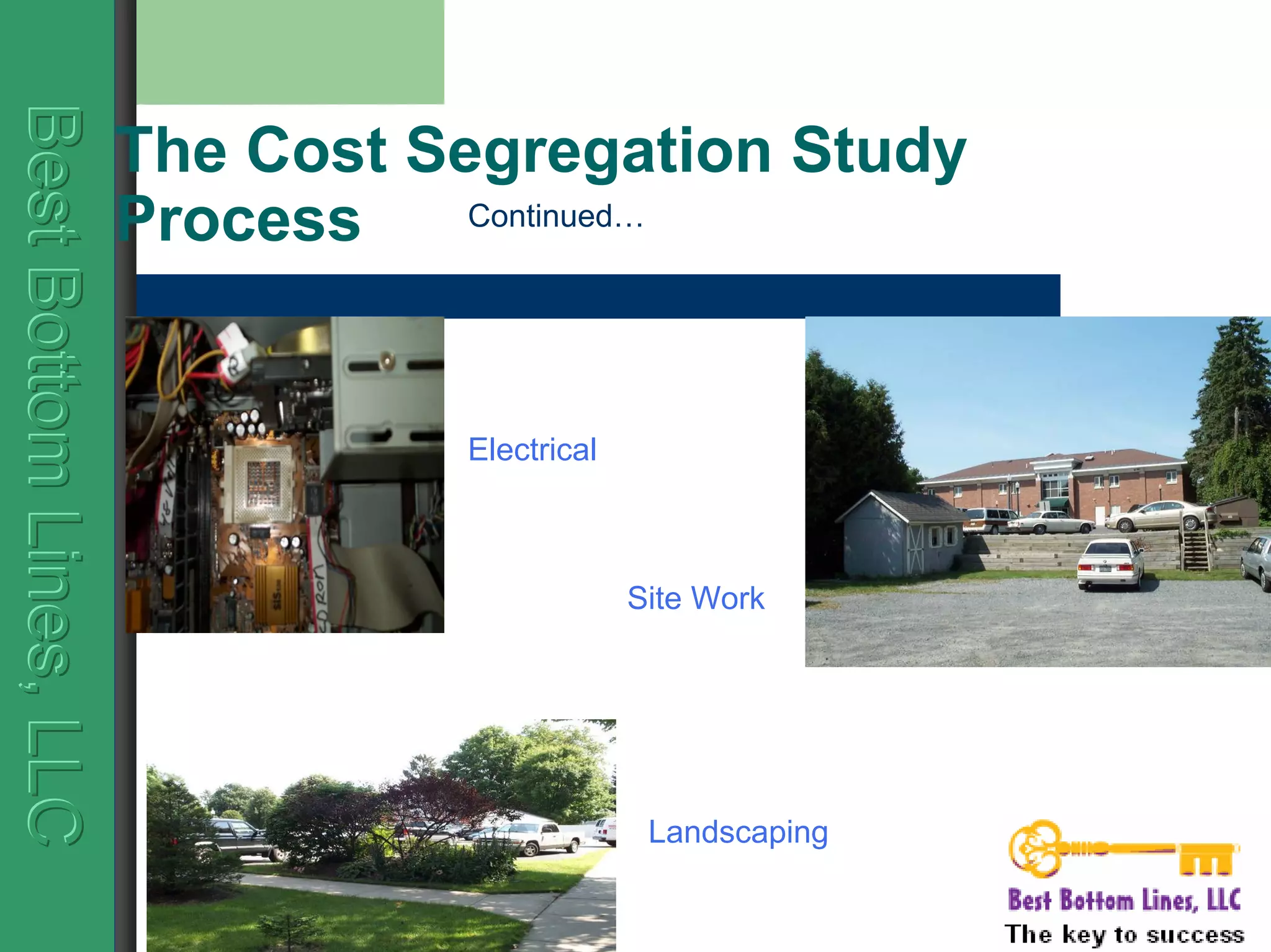
Electrical
BestBottomLines,LLCBestBottomLines,LLCBestBottomLines,LLC
The Cost Segregation Study
Process
Prepare final reconciliation
Prepare final report
Deliver Draft
Review with tax advisor
Deliver Final Study with sample 3115
BestBottomLines,LLCBestBottomLines,LLCBestBottomLines,LLC
Summary
• Time Value of Money
• Dramatic reduction in taxable income
• Increased cash flow for investment opportunities and
business expansion
• Property tax savings
• Insurance savings
www.bestbottomlines.com
(888)-598-9667
BestBottomLines,LLCBestBottomLines,LLCBestBottomLines,LLC
I.R.C § 1031: Key Points
A 1031 Exchange rolls the gain from
the sale of an Old Property into a
New Property - Without having to pay
tax
There is no limit to the number of
times you can do a 1031 Exchange
– Hold Property 1 year + 1 day
BestBottomLines,LLCBestBottomLines,LLCBestBottomLines,LLC
Property Use and Title
Property given up and property
received must be held for productive
business use or investment
– Real Property
– Personal Property
Property given up and property
received must be held by the same
taxpayer (i.e. Same Tax ID #)
BestBottomLines,LLCBestBottomLines,LLCBestBottomLines,LLC
Timeline Rules
45 Day Identification Period
– The Exchangor must identify the potential replacement
property by midnight of the 45th day from the date of the sale
180 Day Exchange Period
– The Exchangor must acquire the replacement property by
midnight of the 180th day, or the date the taxpayer must file
its tax return (including extensions) for the year of the
transfer of the relinquished property, whichever is earlier
BestBottomLines,LLCBestBottomLines,LLCBestBottomLines,LLC
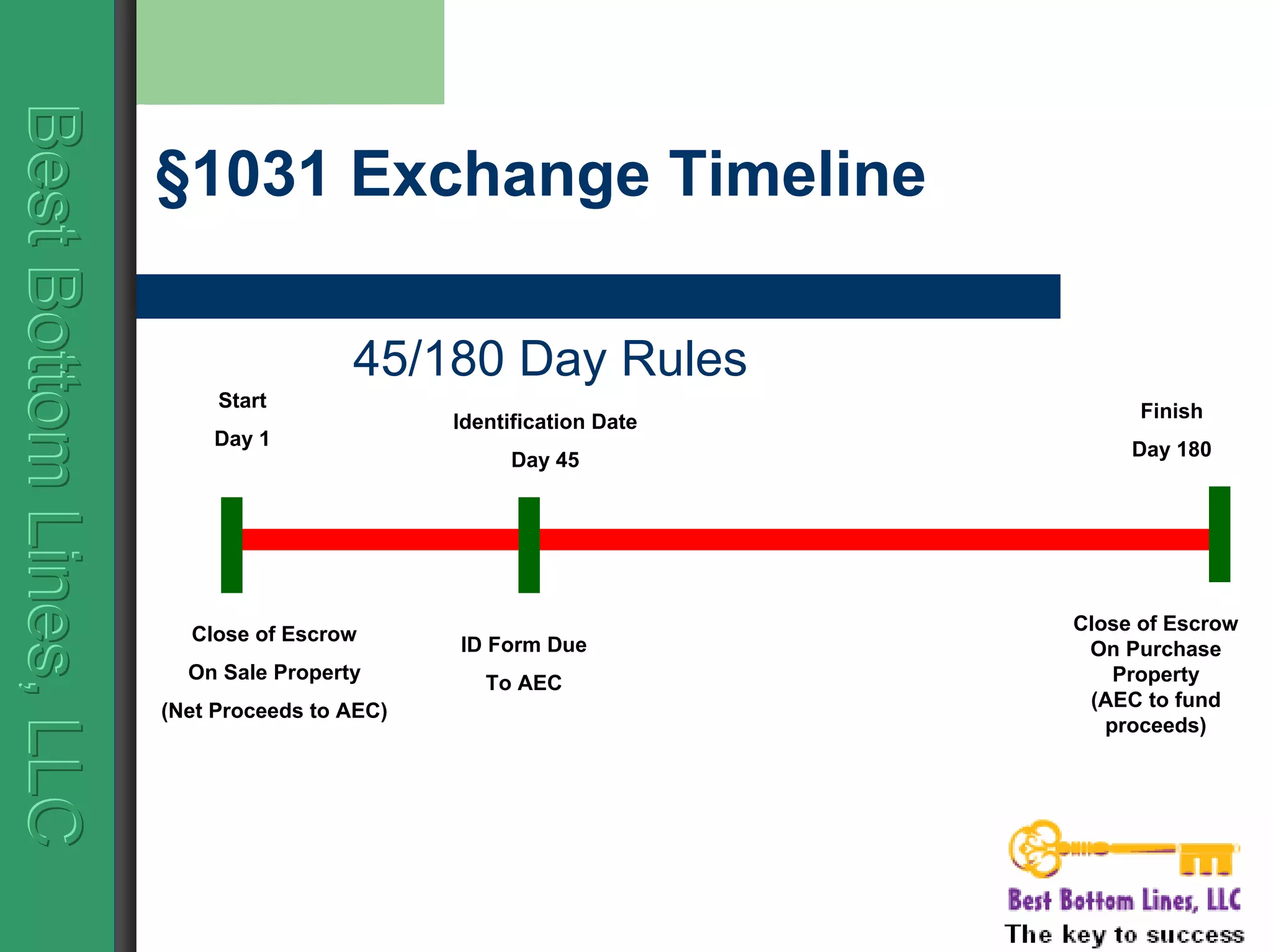
§1031 Exchange Timeline
45/180 Day Rules
Start
Day 1
Identification Date
Day 45
Finish
Day 180
Close of Escrow
On Sale Property
(Net Proceeds to AEC)
ID Form Due
To AEC
Close of Escrow
On Purchase
Property
(AEC to fund
proceeds)
BestBottomLines,LLCBestBottomLines,LLCBestBottomLines,LLC
Replacement Identification Rules
3 Property Rule – Three properties of any value
OR
200 Percent Rule – Any number of properties as
long as their combined fair market value does
not exceed 200 percent of the value of the sold
property
OR
95 Percent Rule – Any number of Replacement
Properties, of any value, but only if the
Exchangor buys at least 95% of the aggregate
fair market value of all identified Replacement
Properties
BestBottomLines,LLCBestBottomLines,LLCBestBottomLines,LLC
Reinvestment Requirement
Equal or Up
– Purchase price of NEW Property must be
equal to or greater than the net selling price of
OLD Property
Reinvest All The Cash
– You must reinvest all of the cash. Any cash
you touch will be taxable
BestBottomLines,LLCBestBottomLines,LLCBestBottomLines,LLC
Constructive Receipt
What is Constructive Receipt?
Main Reason Taxpayers ‘flunk’ §1031
– Funds credited to taxpayer account or made available for
use
– Funds credited to a “Disqualified Person” on behalf of
taxpayer are treated as credited to taxpayer
Safe Harbor from Constructive Receipt – Qualified Intermediary
BestBottomLines,LLCBestBottomLines,LLCBestBottomLines,LLC
Functions of QI
Prepare Documentation
Act as Trustee
– Funds – Deferred Exchanges
– Property – Reverse Exchanges
Consulting
BestBottomLines,LLCBestBottomLines,LLCBestBottomLines,LLC
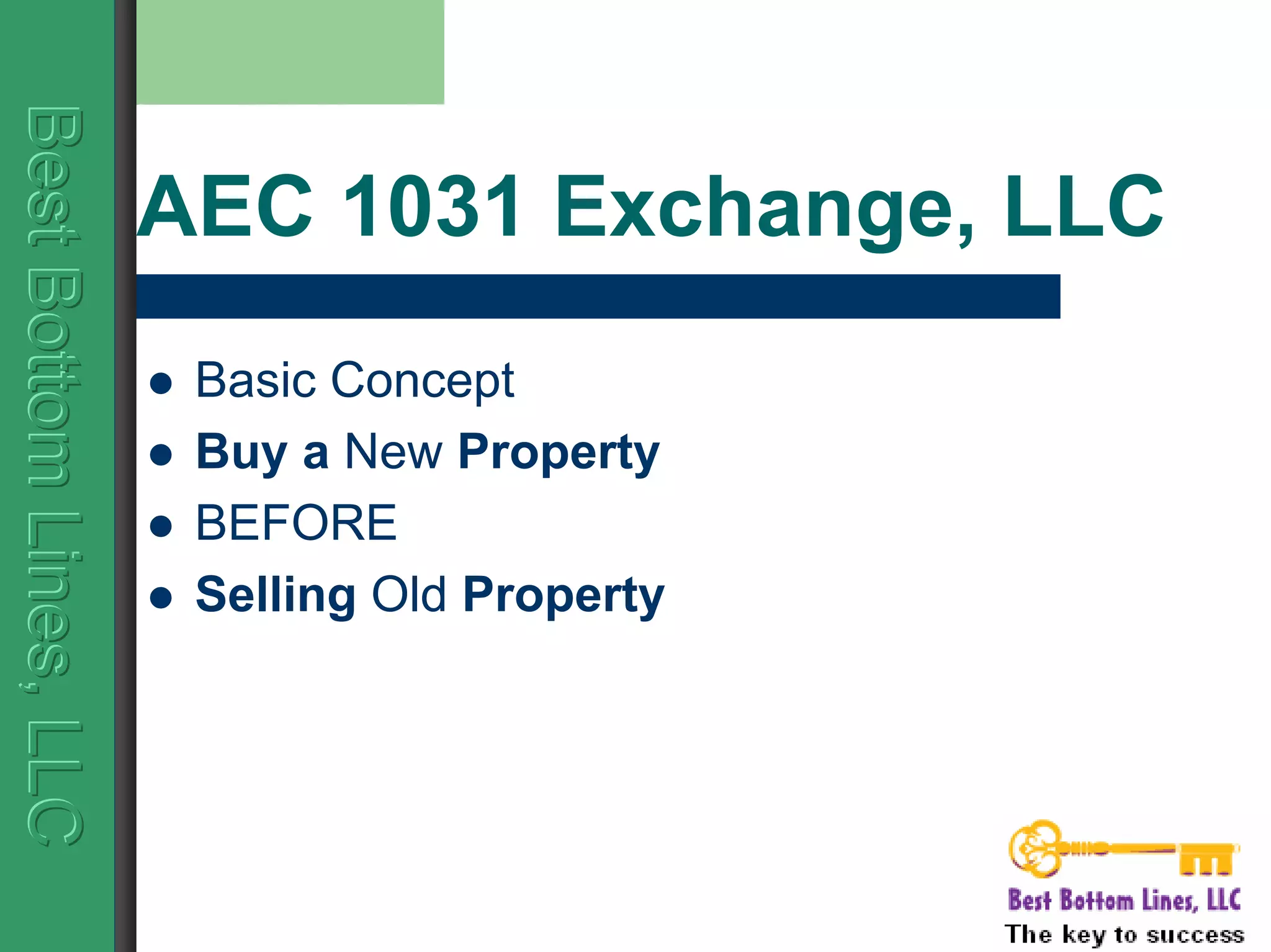
AEC 1031 Exchange, LLC
Reverse Exchange
BestBottomLines,LLCBestBottomLines,LLCBestBottomLines,LLC
Basic Concept
Buy a New Property
BEFORE
Selling Old Property
AEC 1031 Exchange, LLC
BestBottomLines,LLCBestBottomLines,LLCBestBottomLines,LLC
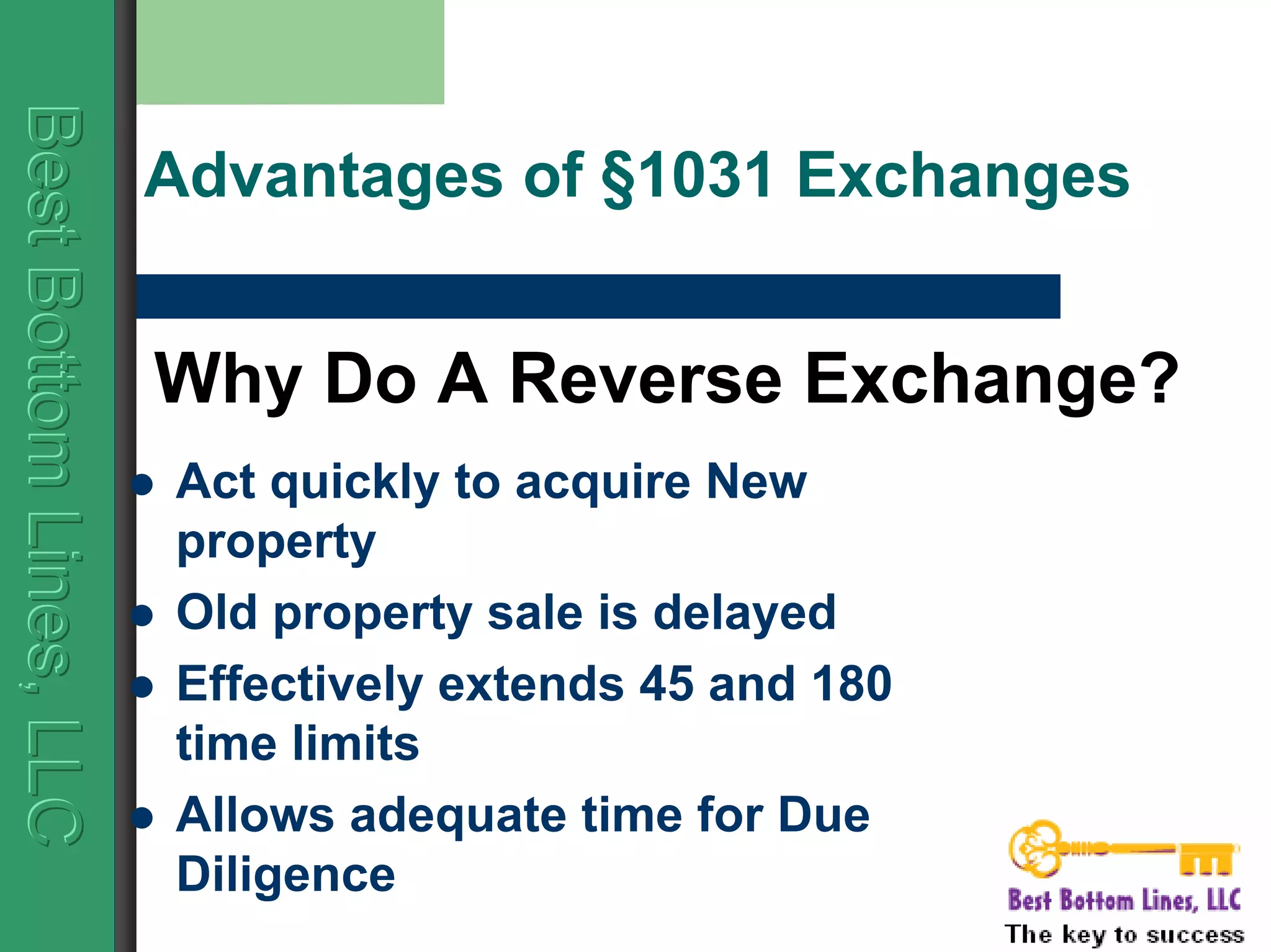
Advantages of §1031 Exchanges
Act quickly to acquire New
property
Old property sale is delayed
Effectively extends 45 and 180
time limits
Allows adequate time for Due
Diligence
Why Do A Reverse Exchange?
BestBottomLines,LLCBestBottomLines,LLCBestBottomLines,LLC
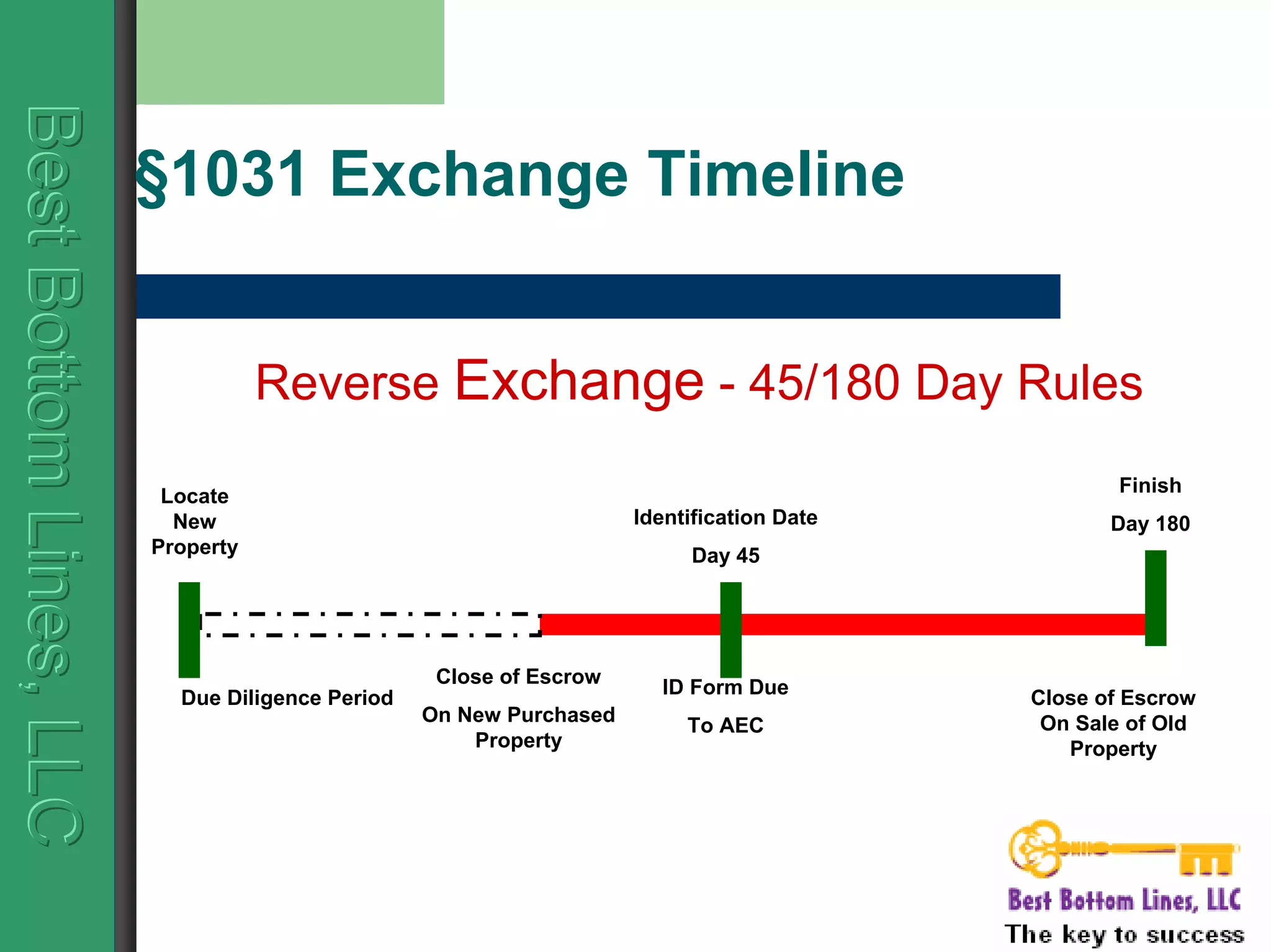
§1031 Exchange Timeline
Reverse Exchange - 45/180 Day Rules
Identification Date
Day 45
Finish
Day 180
Close of Escrow
On New Purchased
Property
ID Form Due
To AEC
Close of Escrow
On Sale of Old
Property
Locate
New
Property
Due Diligence Period
BestBottomLines,LLCBestBottomLines,LLCBestBottomLines,LLC
AEC 1031 Exchange, LLC
Key Point
Taxpayer cannot receive
and own both OLD and
NEW property at the same
time
BestBottomLines,LLCBestBottomLines,LLCBestBottomLines,LLC
AEC 1031 Exchange, LLC
Two Reverse Methods
1. Give up OLD property to
‘EAT’ before receiving NEW
property
2. NEW property is received by
‘EAT’ and held in trust for
taxpayer until OLD property
is sold
BestBottomLines,LLCBestBottomLines,LLCBestBottomLines,LLC
AEC 1031 Exchange, LLC
Business started as Alaska
Exchange Corporation (AEC)
Over 20 years experience
1000’s of Exchanges – all 50 states
Interest paid on trust funds
Specialize in providing exchange
strategies and guidance

Cost Segregation Study

  • 1.
    BestBottomLines,LLCBestBottomLines,LLCBestBottomLines,LLC Release Powerful, Underutilized Tax-Saving Strategiesfor Commercial and Investment Real properties Understanding The Latest IRS Updates Relative to Cost Segregation Studies This document and/or electronic file contains information that (a) is or may be LEGALLY PRIVILEGED, CONFIDENTIAL, PROPRIETARY IN NATURE, OR OTHERWISE PROTECTED BY LAW FROM DISCLOSURE, and (b) is intended only for the use of Best Bottom Lines, LLC. You must have written authorization from Best Bottom Lines, LLC to use, copy or distribute any part of this document as it’s strictly prohibited.
  • 2.
    BestBottomLines,LLCBestBottomLines,LLCBestBottomLines,LLC Goal of CostSegregation Studies Goal = to identify all construction-related costs that can be depreciated over 5, 7 and 15 years and reclassified from 39, 31.5 and 27.5 years Traditional depreciation for Real Property is 39 years for commercial property and 27.5 years for residential rental property Personal property is depreciated much quicker and can be depreciated over 5, 7, 10, and 15 years Reducing tax lives results in accelerated depreciation deductions, a reduced tax liability, and increased cash flow Would you Rather Get Your Money Back Today or in 39 Years?Would you Rather Get Your Money Back Today or in 39 Years? “You must pay taxes. But stop leaving a tip.”
  • 3.
    BestBottomLines,LLCBestBottomLines,LLCBestBottomLines,LLC Major Benefits toThe Property Owners? Generates Cash Flow and Minimizes Taxes Look back study for catch-up of depreciation could generate refund Free up money for investments which allows for compounded growth Benefit to clients includes ability to expense versus capitalization of real property when conducting demolition or when remodeling is involved. Reduces real estate property taxes Increase Cash Flow for Maximum Bank Financing Section 179 Benefits Reduced Insurance premiums
  • 4.
    BestBottomLines,LLCBestBottomLines,LLCBestBottomLines,LLC So What IsThe Big Deal? The depreciation for a property with a Cost Segregation Study allows for significant increase in deductions within the first five years. For every $100,000 of cost shifting from 39-year property to 5-year property, the net present value of the tax benefit is approximately $16,000* For $100,000 of cost shifted from 39-year property to 15-year property, the net present value of the tax benefit is approximately$10,600* * Benefits assume a tax rate of 35% and a 5% return on investment
  • 5.
  • 6.
    BestBottomLines,LLCBestBottomLines,LLCBestBottomLines,LLC CSS Brief History CShas been around since the 1960’s – it was called Component Depreciation There have been over 200 court cases and IRS rulings supporting the benefits of CS Initial cases were related to Investment Tax Credit (ITC) and whether items related to a structure could qualify for a credit. Congress enacted ACRS 1981 with new shorter lives 40 year life reduced to 15, 18 & 19 years Simultaneously disallowed component depreciation MACRS enacted in 1986 reiterated disallowance of component depreciation
  • 7.
    BestBottomLines,LLCBestBottomLines,LLCBestBottomLines,LLC Hospital Corporation ofAmerica Landmark Decision - 109 TC 21(1997) Court reinstated and expanded a form of component depreciation Certain costs related to specific ordinary use equipment (building support systems that would otherwise be viewed as structural) qualify to be depreciated over life of underlying asset. IRS acquiesced to Tax Court Ruling - 1999
  • 8.
    BestBottomLines,LLCBestBottomLines,LLCBestBottomLines,LLC CSS Brief History In1999, the IRS released Legal Memorandum 19921045 in which the IRS agreed not to contest the (HCA) reclassification of building costs into different asset categories that result in shorter depreciation lives – This legal memorandum directs agents to verify that an engineering or architectural study has been done to identify portions of the building's system not related to the operation and maintenance of the building – Without these detailed studies, IRS agents are advised NOT to accept the reclassifications – is a “facts and circumstances” assessment – Use of Cost Segregation Study (CSS) must be specifically applied by the taxpayer – Allocations based on “logical and objective” measures – Not based on non-contemporaneous data, or assumptions without supporting records – CSS must be “closely scrutinized” by the field
  • 9.
    BestBottomLines,LLCBestBottomLines,LLCBestBottomLines,LLC IRS - AuditTechnique Guide Issued in April 2004 Developed to assist Field Examiners “WHY” are cost segregation studies performed? “HOW” are they prepared? “WHAT” to review and look for? IRS Cost Segregation Audit Techniques Guide – Assist Field Examiners – “Why” are CSS performed? – “How” they are prepared? – “What” to review and look for?
  • 10.
    BestBottomLines,LLCBestBottomLines,LLCBestBottomLines,LLC What is beingsaid about Cost Segregation? “It is not unusual for engineering consultants to classify 20 to 40 percent of construction as personal property”Audit Technique Guide “Investors find a friend in the IRS” “Cost Segregation Studies fast growing tax strategy” “Property Owners Profit from Change in Tax Law”
  • 11.
    BestBottomLines,LLCBestBottomLines,LLCBestBottomLines,LLC Qualifying Property Any buildingplaced in service since January 1st, 1987 Existing buildings undergoing renovation, remodeling, restoration, or expansion Major leasehold improvements to any building made after January 1st, 1987 Inheritance of commercial and investment real properties Preconstruction planning to recommend possible modification to the building designs to increase shorter-life asset classification
  • 12.
    BestBottomLines,LLCBestBottomLines,LLCBestBottomLines,LLC Cost Segregation foran Existing Building “Catch Up” – Look Back If a cost segregation study is conducted on an existing building, – The unclaimed depreciation on personal property components that were previously classified as real property can be deducted as a Code Sec. 481 (a) adjustment in the year of change – The automatic change of accounting rules of Rev. Proc. 2002-9, apply If a cost segregation study is performed on a building that was placed in service in a tax year that ended before December 30, 2003, – The IRS will allow a tax payer to file amended returns to claim the benefits – Interest is payable by the IRS on the refund
  • 13.
    BestBottomLines,LLCBestBottomLines,LLCBestBottomLines,LLC Cost Segregation StudiesIncludes New and Previously Acquired Properties The optimal time to perform a study is the year the property is placed in service Current IRS procedures allow a taxpayer to recover any missed depreciation on properties placed in service as far back as 1987 without having to amend prior years tax returns Cost Segregation is not limited to new construction. In fact, most studies are performed on acquired properties where land and building is purchased for one negotiated price in a previous year OR MACRS - GDS 39 - Year Property 27.5 – Year Property 15 - Year Property 7 - Year Property 5 - Year Property 3 – Year Property NEW CONSTRUCTION Indirect Costs + General Contractor Costs + Direct Costs outside General Contract ACQUIRED PROPERTY Purchase Price Land Cost Building and Site Implementation Cost
  • 14.
    BestBottomLines,LLCBestBottomLines,LLCBestBottomLines,LLC Benefit of CostSegregation – Cash Flow – Would You Take the Cash Savings Today? CSS Illustration No. 1CSS Illustration No. 1 A taxpayer purchases (or constructs) a strip mall for $4 million (land excluded) Without a Cost Segregation Study, the taxpayer would have depreciated $4,000,000 as a 39-year asset over 40 years (straight-line, HY convention)
  • 15.
    BestBottomLines,LLCBestBottomLines,LLCBestBottomLines,LLC Benefit of CostSegregation – Cash Flow – Would You Take the Cash Savings Today? By segregating assets and applying proper class lives, significant portion of the building can be depreciated faster Typically, about 35% of total cost can be reclassified from real property to personal property for this type of building CSS Illustration No. 1- (continued)CSS Illustration No. 1- (continued) Asset Original Original Allocation Allocation Class Asset Life Allocation Allocation After CSS After CSS Personal Property 5 yr. 200% db -$ 0.0% 1,000,000$ 25.0% Personal Property 7 yr. 200% db -$ 0.0% -$ 0.0% Land Improvements 15 yr. 150% db -$ 0.0% 400,000$ 10.0% Real Property in yrs. 39 4,000,000$ 100.0% 2,600,000$ 65.0% 4,000,000$ 100.0% 4,000,000$ 100.0% 4,000,000$ 100.0% 4,000,000$ 100.0%Total Cost Real & Personal Property
  • 16.
    BestBottomLines,LLCBestBottomLines,LLCBestBottomLines,LLC Benefit of CostSegregation – Cash Flow – Would You Take the Cash Savings Today? Cash savings of $320,282 can be achieved over the fist 5 years w/ CSS Although cash savings / tax savings over the tax life of the building does not exist, net present value of the earlier tax savings or deferred taxes due to accelerated depreciation results in net present value of $200,000! CSSIllustrationContinuedCSSIllustrationContinued Asset Year Year Depreciation Expense Without CSS Depreciation Expense With CSS Change in Depreciation Tax Savings from Change in Depreciation (35% Tax Rate) NPV of Deferred Taxes (5% Disc. Rate) Cumulative NPV 1 2006 98,291$ 283,889$ 185,598$ 64,959$ 64,959$ 64,959$ 2 2007 102,564$ 424,667$ 322,103$ 112,736$ 107,368$ 172,327$ 3 2008 102,564$ 292,867$ 190,303$ 66,606$ 60,414$ 232,740$ 4 2009 102,564$ 212,647$ 110,083$ 38,529$ 33,283$ 266,023$ 5 2010 102,564$ 209,569$ 107,005$ 37,452$ 30,812$ 296,835$ 5-year Total 2010 508,547$ 1,423,638$ 915,091$ 320,282$ 296,835$ 6 2011 102,564$ 149,198$ 46,634$ 16,322$ 12,789$ 309,623$ 7 2012 102,564$ 90,286$ (12,278)$ (4,297)$ (3,207)$ 306,417$ 8 2013 102,564$ 90,286$ (12,278)$ (4,297)$ (3,054)$ 303,363$ 9 2014 102,564$ 90,286$ (12,278)$ (4,297)$ (2,909)$ 300,454$ 10 2015 102,564$ 90,286$ (12,278)$ (4,297)$ (2,770)$ 297,684$ 10-year Total 2015 1,021,368$ 1,933,981$ 912,614$ 319,415$ 297,684$ 40 2045 4,274$ 2,778$ (1,496)$ (524)$ (78)$ 200,039$ Over 40 Years 4,000,000$ 4,000,000$ -$ -$ 200,039$ Cost Segregation Estimate Benefit Calculation
  • 17.
    BestBottomLines,LLCBestBottomLines,LLCBestBottomLines,LLC Again, What isthe Big Deal? The depreciation for a property with a Cost Segregation Study allows for significant increase in deductions within the first five years. For every $100,000 of cost shifting from 39-year property to 5-year property, the net present value of the tax benefit is approximately $16,000* (NPV = $16.00 per $100 invested) For $100,000 of cost shifted from 39-year property to 15-year property, the net present value of the tax benefit is approximately$10,600* (NPV = $10.60 per $100 invested) * Benefits assume a tax rate of 35% and a 5% return on investment FASTER CASH FLOW!
  • 18.
    BestBottomLines,LLCBestBottomLines,LLCBestBottomLines,LLC First element ofa quality Cost Segregation Study according to the IRS Audit Techniques Guide is: Provider who marries the science of engineering with the principles of tax and accounting to arrive at financial solutions that results in increased cash flow, minimized tax payments and increased ROI. A firm that meticulously follow the IRS guidelines and go beyond the standards and basic requirements outlined by the IRS “Prepared by an individual with expertise and experience.” Select CPAs and engineers familiar with engineering, construction, architectural and estimating processes and techniques are essential for a quality CSS process. Select CPAs and engineers with appropriate tax background and knowledge of over 200 court cases, many revenue ruling and revenue procedures dealing with cost segregation area are essential for a quality CSS. Additional Considerations I think Audit should be first I would also add preconstruction Must understand abandonment issues Knowledgeable on issues involved with §1031 & §1033 exchanges and how they interact with Cost Segregation Must have expertise in Form 3115 Change in Accounting Method filing procedures Understanding how Cost Segregation can affect estate taxes, passive loss situations, IRS §179 deductions, Net Operating Loss situations, §168(k), partnership §754 step-up elections and other tax situations Experience in lease review and identification of “qualified leasehold property” Does the CSS include time for audit support Why are the CPA and Engineer Important in the CSS Process?
  • 19.
    BestBottomLines,LLCBestBottomLines,LLCBestBottomLines,LLC Tax Planning &Other Benefits Demolition Loss – expense vs capitalize Estate Planning Strategies 1031 Exchange Strategies Real Estate Professional Passive Taxpayer & Multiple Entities • Insurance Premiums • Recapture • Closing Costs (doc stamps) • Property Tax Benefits (RE vs. Tangible PP) • Preconstruction recommendations • Lessor • Lessee
  • 20.
  • 21.
    BestBottomLines,LLCBestBottomLines,LLCBestBottomLines,LLC Why do Ineed an Engineering Expertise for a CSS? Cost segregation study (CSS) is an IRS-sanction technique allowing businesses to accelerate depreciation on their facilities Although the IRS does not prescribe one specific methodology, the IRS’ Cost Segregation Audit Technique Guide does not enumerate several and elevates the Detailed Engineering Approach From Actual Cost Records as “the most methodical and accurate approach” – This approach consists of carefully examining all contemporaneous construction and accounting records – Estimates or “take-offs” are used to supplement the actual cost detail when the existing detail is not sufficient for the purposes of the study – A professional firm comprised of accountants, engineers, and architects with prior cost segregation experience, is required to perform this kind of cost segregation study Methodology without the engineering expertise will not withstand IRS scrutiny in accordance with the IRS Audit Technique Guidelines Without the contractor/engineering expertise coupled with the tax law guidance, there will likely be valuable tax benefits left on the table Determining 1245 property value on existing properties must be properly documented and appraised and indicated according to the IRS Audit Technique Guidelines 3 Words: Mechanical, Electrical, Plumbing3 Words: Mechanical, Electrical, Plumbing
  • 22.
    BestBottomLines,LLCBestBottomLines,LLCBestBottomLines,LLC Detailed Engineering Approach Identifythe specific project/assets that will be analyzed Obtain a complete listing of all project costs and substantiate the total project costs Inspect the facility to determine the nature of the project and its intended use Photograph specific property items for reference. Review “as-built” prints, specifications, contracts, bid documents, contractor invoices and other construction documentation. Identify and assign specific project items to property classes Prepare quantitative take-offs for all materials and payment records to compute actual unit costs Audit Technique Guide “It is the most methodical and accurate approach.”
  • 23.
    BestBottomLines,LLCBestBottomLines,LLCBestBottomLines,LLC Qualifying Property Airports Apartment buildings AssistedLiving Facilities Automobile dealerships Automotive service centers Banks Casinos Cinemas Day care centers Department stores Distribution centers Fitness centers Funeral homes Gas stations Golf resorts Grocery stores Hospitals Hotels Industrial facilities Laboratories Manufacturing facilities Marinas Medical facilities Mixed-use facilities Nursing homes Office buildings Research facilities Retail centers Resorts Restaurants Service stations Shopping centers Sports facilities Storage facilities Warehouses Property TypesProperty Types
  • 24.
    BestBottomLines,LLCBestBottomLines,LLCBestBottomLines,LLC Which Properties BenefitMost? 18% 18% 18% 19% 21% 23% 24% 24% 25% 25% 25% 26% 27% 27% 27% 29% 31% 31% 32% 33% 33% 34% 34% 38% 0% 20% 40% 60% 80% 100% M anufacturing & Processing Airport Hangers Distribution Centers Industrial Shopping Centers Auto Service Centers M arinas Post Office Office Buildings Department Stores Fitness Centers Auto Dealerships Day Care Centers Hospitals Warehouses M edical/Surgical Banks Laboratory/Research Nursing Homes/Assisted Living Hotels Leasehold Improvements Residential Rentals Restaurants Resorts Personal Property Real Property Property Type Percentage Reallocated
  • 25.
    BestBottomLines,LLCBestBottomLines,LLCBestBottomLines,LLC Cost Segregation RecentResults Project: Hotel Cost: $7,123,456 5 Year Tax Savings: $812,145 Project: High-End Office Building Cost: $5,234,125 5 Year Tax Savings: $625,678 Project: Apartment Complex – 12 Complexes Cost: $18,100,000 5 Year Tax Savings: $1,585,222
  • 26.
    BestBottomLines,LLCBestBottomLines,LLCBestBottomLines,LLC Look Back Example CSSLookbackExampleCSSLookbackExample •A taxpayer purchased (or constructed) a strip mall for $4 million (land excluded) in 2000 • Without a Cost Segregation Study, the taxpayer has been depreciating $4,000,000 as a 39-year asset over 40 years (straight-line, HY convention)
  • 27.
    BestBottomLines,LLCBestBottomLines,LLCBestBottomLines,LLC Look Back Example– continued • What could you do with the new found money of $336,604 that was trapped in the walls of your investment? Make additional investment Reduce mortgage debt Address maintenance items CSSLookBackExample (continued) CSSLookBackExample (continued) Asset Year Year Depreciation Expense Without CSS Depreciation Expense With CSS Change in Depreciation Overpaid Taxes (35% Tax Rate) 1 2000 98,291$ 283,889$ 185,598$ 64,959$ 2 2001 102,564$ 424,667$ 322,103$ 112,736$ 3 2002 102,564$ 292,867$ 190,303$ 66,606$ 4 2003 102,564$ 212,647$ 110,083$ 38,529$ 5 2004 102,564$ 209,569$ 107,005$ 37,452$ 6 2005 102,564$ 149,198$ 46,634$ 16,322$ 6-year Total 611,111$ 1,572,836$ 961,725$ 336,604$ Cost Segregation Estimate Benefit Calculation IRS Owes The Property Owner $336,604!IRS Owes The Property Owner $336,604!
  • 28.
    BestBottomLines,LLCBestBottomLines,LLCBestBottomLines,LLC Examples of Pre-Construction Benefits Pre-ConstructionPlanning: In the design phase, CORE can help make the building more tax efficient by identifying business components from the structural components Example: Law Firm uses hinges for $1MM decorative lobby shelving versus attaching shelving with a permanent adhesive – Total property is able to be moved from 39-year depreciation to 5-year depreciation for a tremendous savings Example: Hospital installs $1.8MM floating floor system versus permanent attached flooring – Structurally as sound, cash savings from more attractive depreciation schedule substantial
  • 29.
    BestBottomLines,LLCBestBottomLines,LLCBestBottomLines,LLC Insurance Savings AloneMay Pay for Cost Segregation Study There are a number of benefits to your insurance program after completing a Cost Segregation study: – Lower premiums. By providing the insurance underwriter with a Cost Segregation study, they can better understand your risk, their company’s exposure and accurately rate your insurance There is no more guess work on the underwriters behalf and that guess work usually works in their favor in the way of higher premiums to you – In the wake of the recent natural disasters affecting the insurance market, most insurance policies are changing from blanket policies to stated value Each location will carry a stated value on the policy and in the event of a claim that is the maximum you can collect A Cost Segregation study will provide you with the piece of mind that you are insured to full value Cost segregation studies allow property owners to accurately insure their business property, leading to a more cost effective use of your insurance dollar
  • 30.
    BestBottomLines,LLCBestBottomLines,LLCBestBottomLines,LLC Additional Benefits fromCSS Demolition/Rehabilitation Ability to identify components of a building prior to demolition and/or rehabilitation which can be reclassified as personal property versus real property Allows the owner to write off these items versus capitalizing the assets which generate a substantial tax savings For example, if a property owner has a $5- million property that they are going to demolish: – The total cost would typically get applied to the land with the property owner having no ability to depreciate or recoup the $5-million investment – A cost segregation study, prior to the demolition, identifies $1,500,000 of personal property – The property owner will now be able to write off the $1,500,000 as abandoned personal property
  • 31.
    BestBottomLines,LLCBestBottomLines,LLCBestBottomLines,LLC Real Estate InvestmentTrusts (REITs) Benefit Increase non-cash expense to reduce income and thus minimize dividend distribution, allowing increased cash flow for additional acquisitions REIT dividends have 3 components: – Ordinary Dividends – Long-Term Capital Gains Dividends – Return of Capital Dividends Due to the favorable tax treatment of Return of Capital Dividends (taxed at the long-term capital gains rate of 15% or 25% and tax payment is deferred until the sale of the share), investors typically prefer dividends with the greatest percentage of Return of Capital Cost Segregation increases the Return of Capital component; thereby, increasing the Taxable Equivalent Yield DIVIDEND GROWTH IS INCREASED – A significant source of dividend growth is acquisitions REIT must pay out a minimum of 90% of taxable income as dividends, and many REITs pay out over 100% of taxable income.
  • 32.
    BestBottomLines,LLCBestBottomLines,LLCBestBottomLines,LLC Cost Segregation AssetClass Lives for Restaurants The crux of cost segregation is determining whether an asset is I.R.C. – §1245 property (shorter cost recovery period property, 5 or 7 years) – e.g., depreciable personal property, such as equipment – or – §1250 property (longer cost recovery period property, 39, 31.5 or 15 years) – e.g., buildings and building components, which generally are not §1245 property The Director for the Retailers, Food, Pharmaceuticals and Healthcare Industry chartered a working group to address the most efficient way to approach cost segregation issues specific to the restaurant industry – The group produced a special section related to the required cost segregation study for such purposes
  • 33.
    BestBottomLines,LLCBestBottomLines,LLCBestBottomLines,LLC Cost Segregation and1031 Exchanges - Best of Both Worlds - Most valuable tax deferral strategies for real estate are: – Cost Segregation (Accelerated depreciation of real estate) – 1031 Exchanges (Deferral on the disposition of appreciated property) How To Best Utilize Both Strategies – Real Estate Investors and their advisors must understand issues in utilizing both strategies Real vs. Personal Property – Real and personal property under section 1031 is determined by state law – In contrast, the definition of real and personal property for cost segregation studies is determined under federal law – Property such as wall coverings, carpeting, special purpose wiring or other installations affixed to the building can be considered real property under state law and like kind for section 1031 purposes, but be considered personal property in cost segregation studies – Real estate owners can benefit from both the gain deferral under section 1031 for real estate exchanges and the enhanced cost recovery deductions of cost segregation study
  • 34.
    BestBottomLines,LLCBestBottomLines,LLCBestBottomLines,LLC IRS Determination/Tests - Structureor Personal? Permanency test - Sec. 1.48-1 (c) Is the property capable of being moved? Has it been moved? Is the property designed or constructed to remain permanently in place? Are there circumstances which tend to show the expected or intended length of affixation - i.e. may or will be moved? How substantial of a job is removal of the property & how time consuming? Is it readily movable? How much damage will the property sustain upon removal? What is the manner of affixation of the property to the land? Factors that now govern whether property is permanent or can be reclassified in accordance with IRS Audit Technique Guidelines: Factors that now govern whether property is permanent or can be reclassified in accordance with IRS Audit Technique Guidelines:
  • 35.
    BestBottomLines,LLCBestBottomLines,LLCBestBottomLines,LLC IRS Determination/Tests - Structureor Personal? The appearance test: – Whether the structure looks like a building – Generally only requires that the structure enclose a space within its walls and usually be covered by a roof The second part of the test requires that the building function as a building: – The courts primarily focused on whether the structure provides working space for employees that is more the merely incidental to the primary function of the structure – Both the quantity and qualify of human activity inside the structure may be considered in this regard Appearance and Function TestAppearance and Function Test
  • 36.
    BestBottomLines,LLCBestBottomLines,LLCBestBottomLines,LLC Items To BeReclassified in a Cost Segregation Study Site Improvements (landscaping/parking) Light Fixtures Branch wiring Special Plumbing Flooring Millwork Millwork Window Coverings Partition Walls Cabinetry Furnishings Shelving Wall Coverings
  • 37.
    BestBottomLines,LLCBestBottomLines,LLCBestBottomLines,LLC Qualified Property Property toinclude: – Accordion-style room dividers – Decorative lattice millwork used to separate areas These items are not permanent structures therefore do not affect the operation nor maintenance of the building 1245 property PartitionsPartitions
  • 38.
  • 39.
    BestBottomLines,LLCBestBottomLines,LLCBestBottomLines,LLC Qualified Property Property toinclude: – Main panels – Motor control centers – Transformers – Main distribution panel switchgear – Related wiring and conduit The courts conclude that the portion of the cost of the primary and secondary electrical distribution systems which is equal to the percentage of the electrical load carried to those systems allocable to the property equipment, as stipulated constitutes the 1245 qualification class property and is depreciable over an accelerated life Primary and Secondary Electrical Distribution SystemsPrimary and Secondary Electrical Distribution Systems
  • 40.
    BestBottomLines,LLCBestBottomLines,LLCBestBottomLines,LLC Qualified Property Property toinclude: – Controls – Battery packs – Battery chargers for emergency power equipment – Illuminated emergency and entrance signs – Medical gas control and alarm equipment – Kitchen equipment – Wired clock systems Normally 100% of the load carried relates to this type of equipment, therefore the balance of the electrical is normally allocated to the building Branch Electrical Wiring and Connections, and Special Electrical Equipment Branch Electrical Wiring and Connections, and Special Electrical Equipment
  • 41.
    BestBottomLines,LLCBestBottomLines,LLCBestBottomLines,LLC Qualified Property Systems supported: Callsystems – Intercommunicatio n systems – Dictation systems – Music systems – Paging systems Electrical Wiring Relating to Internal CommunicationsElectrical Wiring Relating to Internal Communications • Property to include: Conduit Wiring Electrical connections
  • 42.
    BestBottomLines,LLCBestBottomLines,LLCBestBottomLines,LLC Qualified Property Property toinclude: Branch electrical wiring Conduit, floor boxes Junction boxes Outlet receptacles All other equipment in connection with its operation Wiring and Related Property Items Relating to Television EquipmentWiring and Related Property Items Relating to Television Equipment
  • 43.
    BestBottomLines,LLCBestBottomLines,LLCBestBottomLines,LLC Qualified Property Property toinclude: Items relating to operation of grease trap systems Trench drains Grease waste piping Waste excavation Waste fill Trap itself All connections (hose and reel connections) Water piping used for operation of kitchen equipment Kitchen PlumbingKitchen Plumbing
  • 44.
    BestBottomLines,LLCBestBottomLines,LLCBestBottomLines,LLC Qualified Property Property toinclude: – Air intake fans & related duct work – Dishwasher condensate return units These items ventilate air, remove humidity and steam, replace air expelled Test: – Do the items relate to the buildings operation or maintenance? – NO! Therefore are considered Section 1245 property Kitchen Hoods and Exhaust SystemsKitchen Hoods and Exhaust Systems
  • 45.
    BestBottomLines,LLCBestBottomLines,LLCBestBottomLines,LLC Sample Report – EngineeringCalculations Per IRS Guidelines Total S.F. Unit Cost Unit of Measure Qty Subtotal Functional OBS. Total Unit Cost Location Factor Unit Cost Adj. Totals Reference Numbers Sales Floor 880 Special Finishes Vinyl Baseboard-4" high, .080" thick 1.78$ l.f. 108 192.24 100.00% 192.24 100% 192.24 09-651-200-1150 Carpet-42 oz. Nylon 43.00$ s.y. 98 4,214.00 100.00% 4,214.00 100% 4,214.00 09-673-800-1100 Total-Special Finishes 4,406.24 Finishes 1/2" gypsum wallboard- taped & finished 0.65$ s.f. 972 631.80 100.00% 631.80 100% 631.80 09-250-700-0150 Paint 0.73$ s.f. 972 709.56 100.00% 709.56 100% 709.56 09-910-920-1240 Total-Finishes 1,341.36 Furnishings - Window coverings-Vertical 3" PVC 9.55$ s.f. 180 1,719.00 100.00% 1,719.00 100% 1,719.00 12-483-100-1500 Total-Furnishings 1,719.00 7,466.60 Total S.F. Unit Cost Unit of Measure Qty Subtotal Functional OBS. Total Unit Cost Location Factor Unit Cost Adj. Totals Reference Numbers Office #1 195 Special Doors & Windows Interior Window Glass-3/8" thick, tinted 6.90$ s.f. 36 248.40 100.00% 248.40 100% 248.40 08-810-850-0600 Total-Special Doors & Windows 248.40 Doors & Windows Hollow core door-3' W x 6'-8" H 102.00$ ea. 1 102.00 100.00% 102.00 100% 102.00 08-210-900-2380 Door trim-pine, 4-9/16" deep 8.35$ l.f. 15 125.25 100.00% 125.25 100% 125.25 08-210-960-3020 Total-Doors & Windows 227.25 Special Finishes Vinyl Baseboard-4" high, .080" thick 1.78$ l.f. 53 94.34 100.00% 94.34 100% 94.34 09-651-200-1150 Carpet-42 oz. Nylon 43.00$ s.y. 22 946.00 100.00% 946.00 100% 946.00 09-673-800-1100 Carpet Padding-sponge, rubber 6.05$ s.y. 22 133.10 100.00% 133.10 100% 133.10 09-673-600-9000 Total-Special Finishes 1,173.44 Finishes 0.00% 1/2" gypsum wallboard- taped & finished 0.65$ s.f. 488 317.20 100.00% 317.20 100% 317.20 09-250-700-0150 Paint 0.73$ s.f. 488 356.24 100.00% 356.24 100% 356.24 09-910-920-1240 Total-Finishes 673.44 2,322.53 Office
  • 46.
    BestBottomLines,LLCBestBottomLines,LLCBestBottomLines,LLC Sample Report – DepreciationAnalysis Per IRS Guidelines Total Construction 1,300,000.00$ Pert Client Records Dec-04 1,300,000.00$ LandValue 450,000.00$ DepreciableBasis 850,000.00$ Total Depreciable Basis 850,000.00$ Market Value Factor 111.04% Total BuildingCost Total Project Cost Basis BuildingConstruction Class Market Value Factor Totals 39yr. acc 15yr. acc 7yrs. acc. 2100 Sitework-Improvements 104,090.94$ 15 111.04% 115,581.51 - 115,581.51 - 3000 Concrete 33,690.60$ 39 111.04% 37,409.69 37,409.69 - - 3100 Special Concrete 6,528.00$ 7 111.04% 7,248.62 - - 7,248.62 4000 Masonry 53,650.00$ 39 111.04% 59,572.41 59,572.41 - - 5000 Metals 5,076.00$ 39 111.04% 5,636.34 5,636.34 - - 6100 Special Woods&Plastics 12,302.82$ 5 111.04% 13,660.92 - - - 7000 Thermal &Moisture Protection 27,664.00$ 39 111.04% 30,717.82 30,717.82 - - 8000 Doors&Windows 89,015.50$ 39 111.04% 98,841.89 98,841.89 - - 8100 Special Doors&Windows 2,278.80$ 5 111.04% 2,530.36 - - - 9000 Finishes 91,175.06$ 39 111.04% 101,239.85 101,239.85 - - 9100 Special Finishes 49,360.91$ 5 111.04% 54,809.85 - - - 12000 Furnishings 13,814.40$ 5 111.04% 15,339.37 - - - 15000 Mechanical 141,440.60$ 39 111.04% 157,054.18 157,054.18 - - 15100 Special Mechanical 45,515.40$ 5 111.04% 50,539.83 - - - 16000 Electrical 24,883.60$ 39 111.04% 27,630.49 27,630.49 - - 16100 Special Electrical 65,010.40$ 5 111.04% 72,186.88 - - - Sub-Total 765,497.03$ 850,000.00 518,102.67 115,581.51 7,248.62 Total 765,497.03$ 850,000.00 518,102.67 115,581.51 7,248.62 Cost SegregationAnalysis- DepreciationReconciliation
  • 47.
    BestBottomLines,LLCBestBottomLines,LLCBestBottomLines,LLC Sample Report –Depreciation Schedule Per IRS Guidelines Depreciation Analysis YR 1 2 Report Total Accum. Dep. 2004 2005 Method of Depreciation Depreciation Expense: 12/21/2004 Placed In Service 39 Year Commercial Property 12/21/2004 $850,000.00 $850,000.00 909.50$ 21,794.00$ Total Depreciation 909.50$ 21,794.00$ DEPRECIATION DATA 12/21/2004 Total Construction 1,300,000.00$ Land Value 450,000.00$ Depreciable Basis 850,000.00$ 1 2 Report sub-totals 2004 2005 Method/Convention of DeprecDepreciation Expense: 12/21/2004 Placed In Service Straight Line-Mid Month 12/21/2004 518,103$ 518,103$ 554.37$ 13,284.15$ Sub-Total 39 Year Real Property 518,103$ 518,103$ 554$ 13,284$ 150% MM 4th Qtr 15 year Land Improvments 12/21/2004 115,582$ 115,582$ 1,445$ 11,419$ Sub-Total 15 Year Real Property 115,582$ 115,582$ 1,445$ 11,419$ 200% - MM 4th Qtr 7 Year MACRS Property Sec. 1245 12/21/2004 7,249$ 7,249$ 259$ 1,997$ Sub-Total 7 Year Personal Property 7,249$ 7,249$ 259$ 1,997$ 200% - MM 4th Qtr 5 Year MACRS Property Sec. 1245 12/21/2004 209,067$ 209,067$ 10,453$ 79,446$ Sub-Total 5 Year Personal Property 209,067$ 209,067$ 10,453$ 79,446$ Total Depreciation Per Cost Segregation Analysis 850,000$ 850,000$ 12,711$ 106,146$ Difference in Depreciation 11,802$ 84,352$ 2004 Total Depreciation 12,711$ Cost Depreciated Over 39/15/7/5 Years: MACRS General Depreciation System Schedule: MM/MQ/HY Conventions Scenario 2:- Using Cost Segregation Scenario 1:- Original Method
  • 48.
    BestBottomLines,LLCBestBottomLines,LLCBestBottomLines,LLC Sample Report – TaxReferences Per IRS Guidelines Tax References •2004 U.S. Master Depreciation Guide, CCH Inc: …*** Revenue Rulings: • Rev. Rul. 69-558, 1969-2 CB 4 Definition of section 38 Property • Rev. Rul. 75-78., 1975-1 CB 8 Factory air handling and safety • Rev. Rul. 75-137, 1975-1 CB 74 Dredging and excavation costs • Rev. Rul. 75-77, 1975-1 CB 7 Factory air conditioning and heating units • Rev. Rul. 81-240, 1981-2 CB 11 Individual room refrigeration units; warehouse • Rev. Rul. 80-93, 1980-1 CB 50 Land preparation costs; Electric and gas distribution systems Regulations:…** • 1.48-1 • 1.48-(a)(1) • 1.48-(e)(1) • 1.48-(e)(2) • 1.48-(c) Revenue Procedure 88-35 LSMB Field Directive Court Cases: • Hospital Corp of America, et. Al. v. Commr, 109TC No.2 *** • Morrison v. Commr, T.C. Memeo 1986-129*** • Whiteco Indus., Inc. v. Commr, 65 T.C. 664,672-673(1975)*** • Central Citrus Co. v. Commr, 58 T.C. at 374*** • Scott Paper Co. v. Commr, supra,*** • Fed. Sav. And Loan Association v. United States, 313 F. Supp 294-96 *** * Denotes, in text ** Denotes, referenced in text *** Denotes, reference material
  • 49.
    BestBottomLines,LLCBestBottomLines,LLCBestBottomLines,LLC The Cost SegregationStudy Process Continued… Landscaping Site Work Electrical
  • 50.
    BestBottomLines,LLCBestBottomLines,LLCBestBottomLines,LLC The Cost SegregationStudy Process Prepare final reconciliation Prepare final report Deliver Draft Review with tax advisor Deliver Final Study with sample 3115
  • 51.
    BestBottomLines,LLCBestBottomLines,LLCBestBottomLines,LLC Summary • Time Valueof Money • Dramatic reduction in taxable income • Increased cash flow for investment opportunities and business expansion • Property tax savings • Insurance savings www.bestbottomlines.com (888)-598-9667
  • 52.
    BestBottomLines,LLCBestBottomLines,LLCBestBottomLines,LLC I.R.C § 1031:Key Points A 1031 Exchange rolls the gain from the sale of an Old Property into a New Property - Without having to pay tax There is no limit to the number of times you can do a 1031 Exchange – Hold Property 1 year + 1 day
  • 53.
    BestBottomLines,LLCBestBottomLines,LLCBestBottomLines,LLC Property Use andTitle Property given up and property received must be held for productive business use or investment – Real Property – Personal Property Property given up and property received must be held by the same taxpayer (i.e. Same Tax ID #)
  • 54.
    BestBottomLines,LLCBestBottomLines,LLCBestBottomLines,LLC Timeline Rules 45 DayIdentification Period – The Exchangor must identify the potential replacement property by midnight of the 45th day from the date of the sale 180 Day Exchange Period – The Exchangor must acquire the replacement property by midnight of the 180th day, or the date the taxpayer must file its tax return (including extensions) for the year of the transfer of the relinquished property, whichever is earlier
  • 55.
    BestBottomLines,LLCBestBottomLines,LLCBestBottomLines,LLC §1031 Exchange Timeline 45/180Day Rules Start Day 1 Identification Date Day 45 Finish Day 180 Close of Escrow On Sale Property (Net Proceeds to AEC) ID Form Due To AEC Close of Escrow On Purchase Property (AEC to fund proceeds)
  • 56.
    BestBottomLines,LLCBestBottomLines,LLCBestBottomLines,LLC Replacement Identification Rules 3Property Rule – Three properties of any value OR 200 Percent Rule – Any number of properties as long as their combined fair market value does not exceed 200 percent of the value of the sold property OR 95 Percent Rule – Any number of Replacement Properties, of any value, but only if the Exchangor buys at least 95% of the aggregate fair market value of all identified Replacement Properties
  • 57.
    BestBottomLines,LLCBestBottomLines,LLCBestBottomLines,LLC Reinvestment Requirement Equal orUp – Purchase price of NEW Property must be equal to or greater than the net selling price of OLD Property Reinvest All The Cash – You must reinvest all of the cash. Any cash you touch will be taxable
  • 58.
    BestBottomLines,LLCBestBottomLines,LLCBestBottomLines,LLC Constructive Receipt What isConstructive Receipt? Main Reason Taxpayers ‘flunk’ §1031 – Funds credited to taxpayer account or made available for use – Funds credited to a “Disqualified Person” on behalf of taxpayer are treated as credited to taxpayer Safe Harbor from Constructive Receipt – Qualified Intermediary
  • 59.
    BestBottomLines,LLCBestBottomLines,LLCBestBottomLines,LLC Functions of QI PrepareDocumentation Act as Trustee – Funds – Deferred Exchanges – Property – Reverse Exchanges Consulting
  • 60.
  • 61.
    BestBottomLines,LLCBestBottomLines,LLCBestBottomLines,LLC Basic Concept Buy aNew Property BEFORE Selling Old Property AEC 1031 Exchange, LLC
  • 62.
    BestBottomLines,LLCBestBottomLines,LLCBestBottomLines,LLC Advantages of §1031Exchanges Act quickly to acquire New property Old property sale is delayed Effectively extends 45 and 180 time limits Allows adequate time for Due Diligence Why Do A Reverse Exchange?
  • 63.
    BestBottomLines,LLCBestBottomLines,LLCBestBottomLines,LLC §1031 Exchange Timeline ReverseExchange - 45/180 Day Rules Identification Date Day 45 Finish Day 180 Close of Escrow On New Purchased Property ID Form Due To AEC Close of Escrow On Sale of Old Property Locate New Property Due Diligence Period
  • 64.
    BestBottomLines,LLCBestBottomLines,LLCBestBottomLines,LLC AEC 1031 Exchange,LLC Key Point Taxpayer cannot receive and own both OLD and NEW property at the same time
  • 65.
    BestBottomLines,LLCBestBottomLines,LLCBestBottomLines,LLC AEC 1031 Exchange,LLC Two Reverse Methods 1. Give up OLD property to ‘EAT’ before receiving NEW property 2. NEW property is received by ‘EAT’ and held in trust for taxpayer until OLD property is sold
  • 66.
    BestBottomLines,LLCBestBottomLines,LLCBestBottomLines,LLC AEC 1031 Exchange,LLC Business started as Alaska Exchange Corporation (AEC) Over 20 years experience 1000’s of Exchanges – all 50 states Interest paid on trust funds Specialize in providing exchange strategies and guidance